
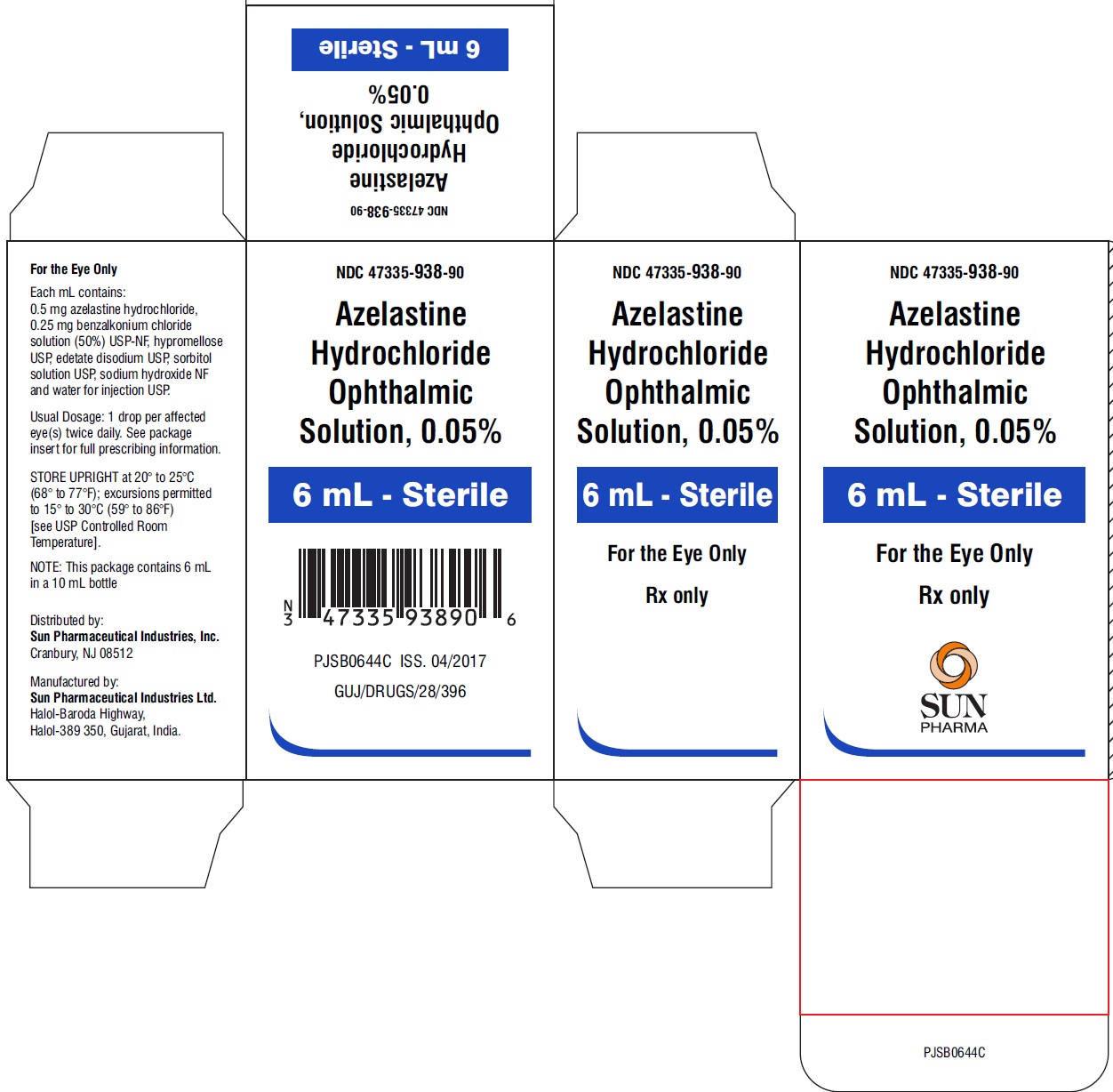
Azelastine Hydrochloride .5 mg/mL Solution/ Drops — NDC 47335-938-90 (Billing 47335-0938-90)
This is a package of Azelastine Hydrochloride .5 mg/mL Solution/ Drops from Sun Pharmaceutical Industries, Inc., marketed since May 2010 and currently FDA-listed; retail pharmacies pay about $0.9081 per mL (NADAC). It is this product's only package size.
NDC database record
One package, one record: these facts belong to NDC 47335-938-90 alone.
- Record
- FDA NDC Directory package listing · Human prescription drug
- Code segments
- 47335 labeler · 938 product · 90 package
- Package marketed since
- May 31, 2010
- Sample package
- No — commercial package
- Listing certified through
- Dec 31, 2026
- Barcode (UPC)
- 0347335938906
- Medicaid fills, this package
- 4,170 prescriptions in the last four reported quarters
- FDA record last changed
- Jul 24, 2026
Other active recalls for Azelastine Hydrochloride (different manufacturers) — 1 · tap to view
Identity & classification
Regulatory identifiers FDA, NLM and CMS codes for this package
Drug-database identifiers Medi-Span GPI and First Databank GCN / HICL / AHFS classification
- GSN (GCN sequence number): 040646
- GCN: 94615
- GPI-14 (Medi-Span): 86802006102020
- HICL (First Databank): 007607
- AHFS class code: 04:08.00.00
- RxCUI (RxNorm): 860805
Where does this data come from?
- FDA openFDA NDC Directory · synced Oct 1, 2026
- FDA label on DailyMed · label index refreshed Oct 6, 2026
- RxNorm (NLM RxNav) · catalog refreshed Oct 1, 2026
- Medi-Span GPI (licensed)
- First Databank (licensed) · refreshed Oct 1, 2026
RxNorm drug class
This medicine belongs to the Histamine-1 Receptor Antagonist class.
Where does this data come from?
- RxClass (NLM) · catalog refreshed Oct 1, 2026
Clinical
Azelastine ophthlamic is used to relieve the itching of allergic pink eye. Azelastine is in a class of medications called antihistamines. It works by blocking histamine, a substance in the body that causes allergic symptoms.
Read the full MedlinePlus article ↗Patient education
Supplement & herbal interactions
Where does this data come from?
- MedlinePlus (NLM) · refreshed Oct 1, 2026
- FDA label on DailyMed · label index refreshed Oct 6, 2026
Ask a licensed pharmacist directly — free, answered by our team.
Pricing
A drug doesn't have one price. Each row is a different public payment system, and none is what you'd pay at the counter — that depends on your insurance. The ⓘ on each row explains what it measures.
| Price system | Per mL | Per package |
|---|---|---|
| Retail pharmacies payNADAC · weekly | $0.908 | $5.45 / 6 ml |
| Medicaid paysCMS SDUD · 12 mo | $2.62 | $15.70 / 6 ml |
| Medicare drug plans payPart D · Q2 2026 | $1.79 | $10.72 / 6 ml |
Where does this data come from?
- CMS NADAC weekly file · file of Feb 18, 2026
- CMS ASP pricing files · refreshed Sep 20, 2026
- CMS Medicaid State Drug Utilization Data · through Q1 2026
- CMS Part D plan pricing files · refreshed Sep 24, 2026
- VA National Acquisition Center price file
Packaging — all sizes for this product
| Package NDC | Description | Marketing start | Marketing end | Status |
|---|---|---|---|---|
| 47335-0938-90 You're viewing this Main listing | 1 BOTTLE, PLASTIC in 1 BOX / 6 mL in 1 BOTTLE, PLASTIC | 2010-05-31 | — | Active |
Therapeutic equivalents
| Product | Labeler | Pack | NADAC/unit | TE | Status | Price vs. this |
|---|---|---|---|---|---|---|
| Azelastine Hydrochloride .5 mg/mLthis 47335-0938-90 | Sun | 1 bottle | $0.908 | — | FDA listed | — |
| Azelastine Hydrochloride .5 mg/mL 60505-0578-04 | Apotex | 1 bottle | $1.012 | AT | Availability likely | +11% |
| Azelastine Hydrochloride .5 mg/mL 61314-0308-02 | Sandoz | 1 bottle | $1.012 | AT | Availability likely | +11% |
| Azelastine Hydrochloride Ophthalmic Solution 0.05% .5 mg/mL 62332-0506-06 | Alembic | 1 bottle | $1.012 | AT | Availability likely | +11% |
| Azelastine Hydrochloride .5 mg/mL 70069-0091-01 | Somerset | 1 bottle | $1.012 | AT | Availability likely | +11% |
| Azelastine Hydrochloride .5 mg/mL 72266-0141-01 | Fosun | 1 bottle | $1.012 | AT | Availability likely | +11% |
| Azelastine Hydrochloride .5 mg/mL 46708-0506-06 | Alembic | 1 bottle | — | AT | FDA listed | — |
| Azelastine Hydrochloride .5 mg/mL 68083-0287-01 | Gland | 1 bottle | — | AT | FDA listed | — |
Where does this data come from?
- FDA openFDA NDC Directory · synced Oct 1, 2026
- FDA Orange Book · refreshed Oct 3, 2026
- CMS NADAC weekly file · file of Feb 18, 2026
Availability & generic status
This product is an FDA-approved generic. Other versions of the same drug are listed under Therapeutic equivalents, least expensive first.
Where does this data come from?
- FDA Orange Book · refreshed Oct 3, 2026
Inactive Ingredients / Excipients
Inactive ingredients, also called excipients, are components of the drug product other than the active ingredient. They may include fillers, dyes, coatings, preservatives, flavors, or other formulation ingredients.
💡 Tap an ingredient (hover on desktop) to see what it is and why it’s used.
-
UNII F5UM2KM3W7
Benzalkonium chloride is a chemical compound that works as a preservative and antimicrobial agent in medications. It prevents bacterial and fungal growth in liquid formulations to keep the product safe during storage and use.
-
UNII 7FLD91C86K
Edetate disodium is a chemical compound that binds and removes certain metal ions. In medicines, it acts as a preservative and stabilizer by preventing metals like calcium from interfering with the product's shelf life and consistency.
-
UNII 3NXW29V3WO
Hypromellose is a plant-based thickener made from cellulose. It's used in medicines as a binder to hold ingredients together, a coating for tablets, and a thickener for liquids.
-
UNII 55X04QC32I
A strong alkaline chemical used to adjust and maintain the pH balance of liquid medicines. It helps keep the medicine stable and ensures it stays effective during storage.
-
UNII 506T60A25R
Sorbitol is a natural sugar alcohol derived from glucose. It serves as a sweetener, humectant, and bulking agent in medications to improve taste and help maintain moisture in the product.
-
UNII 059QF0KO0R
Water is a liquid solvent that dissolves and mixes ingredients together in liquid medicines, syrups, and injections. It helps distribute the active drug evenly throughout the product.
6 inactive ingredients listed in the exact product block matched to this NDC.
Where does this data come from?
ingredient classCode="IACT" elements from the exact product block matched by this NDC. Label-section narrative from DailyMed / the openFDA label index is shown separately when available.- FDA label on DailyMed · label index refreshed Oct 6, 2026
- FDA openFDA NDC Directory · synced Oct 1, 2026
Inactive ingredient FAQ
Are inactive ingredients the same for every manufacturer?
Why might an inactive ingredient be missing?
Can inactive ingredients matter?
Manufacturer & labeler
More NDCs from Sun Pharmaceutical Industries, Inc. labeler code 47335
- Temozolomide 180 mg Capsule NDC 47335-930-21
- vecuronium bromide 1 mg/mL Injection, Powder, Lyophilized, For Solution NDC 47335-931-44
- ketorolac tromethamine 15 mg/mL Injection NDC 47335-933-45
- ketorolac tromethamine 30 mg/mL Injection NDC 47335-934-45
- ketorolac tromethamine 60 mg/2mL Injection NDC 47335-935-45
- leuprolide acetate Kit NDC 47335-936-40
- Docetaxel 160 mg/8mL Injection, Solution NDC 47335-939-40
- Lacosamide 150 mg Tablet, Film Coated NDC 47335-943-18
- Bupropion Hydrochloride 150 mg Tablet, Extended Release NDC 47335-954-13
- Alfuzosin Hydrochloride 10 mg Tablet, Extended Release NDC 47335-956-08
- Lacosamide 200 mg Tablet, Film Coated NDC 47335-980-18
- Glatiramer Acetate 20 mg/mL Injection, Solution NDC 47335-990-02
Where does this data come from?
- FDA openFDA NDC Directory · synced Oct 1, 2026
- Drugs@FDA
Full prescribing information FDA SPL
🎯 Indications and Usage ▾
INDICATIONS AND USAGE Azelastine hydrochloride ophthalmic solution is indicated for the treatment of itching of the eye associated with allergic conjunctivitis.
⏱️ Dosage and Administration ▾
DOSAGE AND ADMINISTRATION The recommended dose is one drop instilled into each affected eye twice a day.
⛔ Contraindications ▾
CONTRAINDICATIONS Azelastine hydrochloride ophthalmic solution is contraindicated in persons with known or suspected hypersensitivity to any of its components.
⚠️ Warnings ▾
WARNINGS Azelastine hydrochloride ophthalmic solution is for ocular use only and not for injection or oral use.
🤒 Adverse Reactions ▾
ADVERSE REACTIONS In controlled multiple-dose studies where patients were treated for up to 56 days, the most frequently reported adverse reactions were transient eye burning/stinging (approximately 30%), headaches (approximately 15%) and bitter taste (approximately 10%). The occurrence of these events was generally mild. The following events were reported in 1 to 10% of patients: asthma, conjunctivitis, dyspnea, eye pain, fatigue, influenza-like symptoms, pharyngitis, pruritus, rhinitis and temporary blurring.
Some of these events were similar to the underlying disease being studied.
🤰 Pregnancy ▾
Pregnancy Teratogenic Effects: Pregnancy Category C. Azelastine hydrochloride has been shown to be embryotoxic, fetotoxic, and teratogenic (external and skeletal abnormalities) in mice at an oral dose of 68.6 mg/kg/day (57,000 times the recommended ocular human use level). At an oral dose of 30 mg/kg/day (25,000 times the recommended ocular human use level), delayed ossification (undeveloped metacarpus) and the incidence of 14 th rib were increased in rats.
At 68.6 mg/kg/day (57,000 times the maximum recommended ocular human use level) azelastine hydrochloride caused resorption and fetotoxic effects in rats. The relevance to humans of these skeletal findings noted at only high drug exposure levels is unknown. There are no adequate and well-controlled studies in pregnant women.
Azelastine hydrochloride ophthalmic solution should be used during pregnancy only if the potential benefit justifies the potential risk to the fetus.
🧒 Pediatric Use ▾
Pediatric Use Safety and effectiveness in pediatric patients below the age of 3 have not been established.
🧓 Geriatric Use ▾
Geriatric Use No overall differences in safety or effectiveness have been observed between elderly and younger adult patients.
🧬 Clinical Pharmacology ▾
CLINICAL PHARMACOLOGY Azelastine hydrochloride is a relatively selective histamine H 1 antagonist and an inhibitor of the release of histamine and other mediators from cells (e.g., mast cells) involved in the allergic response. Based on in-vitro studies using human cell lines, inhibition of other mediators involved in allergic reactions (e.g., leukotrienes and PAF) has been demonstrated with azelastine hydrochloride. Decreased chemotaxis and activation of eosinophils has also been demonstrated.
Pharmacokinetics and Metabolism Absorption of azelastine following ocular administration was relatively low. A study in symptomatic patients receiving one drop of azelastine hydrochloride ophthalmic solution in each eye two to four times a day (0.06 to 0.12 mg azelastine hydrochloride) demonstrated plasma concentrations of azelastine hydrochloride to generally be between 0.02 and 0.25 ng/mL after 56 days of treatment. Three of nineteen patients had quantifiable amounts of N-desmethylazelastine that ranged from 0.25 to 0.87 ng/mL at Day 56.
Based on intravenous and oral administration, the elimination half-life, steady-state volume of distribution and plasma clearance were 22 hours,
14.5 L/kg and
0.5L/h/kg, respectively. Approximately 75% of an oral dose of radiolabeled azelastine hydrochloride was excreted in the feces with less than 10% as unchanged azelastine. Azelastine hydrochloride is oxidatively metabolized to the principal metabolite, N-desmethylazelastine, by the cytochrome P450 enzyme system.
In-vitro studies in human plasma indicate that the plasma protein binding of azelastine and N-desmethylazelastine are approximately 88% and 97%, respectively. Clinical Trials In a conjunctival antigen challenge study, azelastine hydrochloride ophthalmic solution was more effective than its vehicle in preventing itching associated with allergic conjunctivitis. Azelastine hydrochloride ophthalmic solution had a rapid (within 3 minutes) onset of effect and a duration of effect of approximately 8 hours for the prevention of itching.
In environmental studies, adult and pediatric, patients with seasonal allergic conjunctivitis were treated with azelastine hydrochloride ophthalmic solution for two to eight weeks. In these studies, azelastine hydrochloride ophthalmic solution was more effective than its vehicle in relieving itching associated with allergic conjunctivitis.
📦 How Supplied / Storage and Handling ▾
HOW SUPPLIED Azelastine hydrochloride ophthalmic solution, 0.05% is supplied as follows: 6 mL (NDC# 47335-938-90) solution in a translucent 10 mL HDPE container with a LDPE dropper tip, and a white HDPE screw cap. Storage STORE UPRIGHT at 20° to 25°C (68° to 77°F); excursions permitted to 15° to 30°C (59° to 86°F) [see USP Controlled Room Temperature].
📋 Description ▾
DESCRIPTION Azelastine hydrochloride ophthalmic solution, 0.05% is a sterile ophthalmic solution containing azelastine hydrochloride, a relatively selective H 1 -receptor antagonist for topical administration to the eyes. Azelastine hydrochloride is a white crystalline powder with a molecular weight of 418.37. Azelastine hydrochloride is sparingly soluble in water, methanol and propylene glycol, and slightly soluble in ethanol, octanol and glycerine.
Azelastine hydrochloride is a racemic mixture with a melting point of 225°C. The chemical name for azelastine hydrochloride is (±)-1-(2H)-phthalazinone,4-[(4-chlorophenyl) methyl]-2-(hexahydro-1-methyl-1H-azepin-4-yl)-, monohydrochloride and is represented by the following chemical structure: Empirical chemical structure: C 22 H 24 CIN 3 O•HCl Each mL of azelastine hydrochloride ophthalmic solution, 0.05% contains: Active: 0.5 mg azelastine hydrochloride, equivalent to 0.457 mg of azelastine base; Preservative: 0.25 mg benzalkonium chloride solution (50%) USP-NF; Inactives: disodium edetate dihydrate, hypromellose, sorbitol solution, sodium hydroxide and water for injection.
It has a pH of approximately 5 to 6.5 and an osmolality of approximately 271 to 312 mOsmol/L. chemical structure
💬 Information for Patients ▾
Information for Patients To prevent contaminating the dropper tip and solution, care should be taken not to touch any surface, the eyelids or surrounding areas with the dropper tip of the bottle. Keep bottle tightly closed when not in use. This product is sterile when packaged.
Patients should be advised not to wear a contact lens if their eye is red. Azelastine hydrochloride ophthalmic solution should not be used to treat contact lens related irritation. The preservative in azelastine hydrochloride ophthalmic solution, benzalkonium chloride, may be absorbed by soft contact lenses.
Patients who wear soft contact lenses and whose eyes are not red , should be instructed to wait at least ten minutes after instilling azelastine hydrochloride ophthalmic solution before they insert their contact lenses.
⚠️ Precautions ▾
PRECAUTIONS Information for Patients To prevent contaminating the dropper tip and solution, care should be taken not to touch any surface, the eyelids or surrounding areas with the dropper tip of the bottle. Keep bottle tightly closed when not in use. This product is sterile when packaged.
Patients should be advised not to wear a contact lens if their eye is red. Azelastine hydrochloride ophthalmic solution should not be used to treat contact lens related irritation. The preservative in azelastine hydrochloride ophthalmic solution, benzalkonium chloride, may be absorbed by soft contact lenses.
Patients who wear soft contact lenses and whose eyes are not red , should be instructed to wait at least ten minutes after instilling azelastine hydrochloride ophthalmic solution before they insert their contact lenses. Carcinogenesis, Mutagenesis, Impairment of Fertility Azelastine hydrochloride administered orally for 24 months was not carcinogenic in rats and mice at doses up to 30 mg/kg/day and 25 mg/kg/day, respectively. Based on a 30 µ L drop size, these doses were approximately 25,000 and 21,000 times higher than the maximum recommended ocular human use level of 0.001 mg/kg/day for a 50 kg adult.
Azelastine hydrochloride showed no genotoxic effects in the Ames test, DNA repair test, mouse lymphoma forward mutation assay, mouse micronucleus test, or chromosomal aberration test in rat bone marrow. Reproduction and fertility studies in rats showed no effects on male or female fertility at oral doses of up to 25,000 times the maximum recommended ocular human use level. At 68.6 mg/kg/day (57,000 times the maximum recommended ocular human use level), the duration of the estrous cycle was prolonged and copulatory activity and the number of pregnancies were decreased.
The numbers of corpora lutea and implantations were decreased; however, the implantation ratio was not affected. Pregnancy Teratogenic Effects: Pregnancy Category C. Azelastine hydrochloride has been shown to be embryotoxic, fetotoxic, and teratogenic (external and skeletal abnormalities) in mice at an oral dose of 68.6 mg/kg/day (57,000 times the recommended ocular human use level).
At an oral dose of 30 mg/kg/day (25,000 times the recommended ocular human use level), delayed ossification (undeveloped metacarpus) and the incidence of 14 th rib were increased in rats. At 68.6 mg/kg/day (57,000 times the maximum recommended ocular human use level) azelastine hydrochloride caused resorption and fetotoxic effects in rats. The relevance to humans of these skeletal findings noted at only high drug exposure levels is unknown.
There are no adequate and well-controlled studies in pregnant women. Azelastine hydrochloride ophthalmic solution should be used during pregnancy only if the potential benefit justifies the potential risk to the fetus. Nursing Mothers It is not known whether azelastine hydrochloride is excreted in human milk.
Because many drugs are excreted in human milk, caution should be exercised when azelastine hydrochloride ophthalmic solution is administered to a nursing woman. Pediatric Use Safety and effectiveness in pediatric patients below the age of 3 have not been established. Geriatric Use No overall differences in safety or effectiveness have been observed between elderly and younger adult patients.
🍼 Nursing Mothers ▾
Nursing Mothers It is not known whether azelastine hydrochloride is excreted in human milk. Because many drugs are excreted in human milk, caution should be exercised when azelastine hydrochloride ophthalmic solution is administered to a nursing woman.
📄 Carcinogenesis, Mutagenesis, Impairment of Fertility ▾
Carcinogenesis, Mutagenesis, Impairment of Fertility Azelastine hydrochloride administered orally for 24 months was not carcinogenic in rats and mice at doses up to 30 mg/kg/day and 25 mg/kg/day, respectively. Based on a 30 µ L drop size, these doses were approximately 25,000 and 21,000 times higher than the maximum recommended ocular human use level of 0.001 mg/kg/day for a 50 kg adult. Azelastine hydrochloride showed no genotoxic effects in the Ames test, DNA repair test, mouse lymphoma forward mutation assay, mouse micronucleus test, or chromosomal aberration test in rat bone marrow.
Reproduction and fertility studies in rats showed no effects on male or female fertility at oral doses of up to 25,000 times the maximum recommended ocular human use level. At 68.6 mg/kg/day (57,000 times the maximum recommended ocular human use level), the duration of the estrous cycle was prolonged and copulatory activity and the number of pregnancies were decreased. The numbers of corpora lutea and implantations were decreased; however, the implantation ratio was not affected.
📄 Package Label / Principal Display Panel ▾
PACKAGE LABEL.PRINCIPAL DISPLAY PANEL - LABEL NDC 47335-938-90 Azelastine Hydrochloride Ophthalmic Solution, 0.05% 6 mL - Sterile For the Eye Only Rx only azelastine-label
PACKAGE LABEL.PRINCIPAL DISPLAY PANEL - CARTON NDC 47335-938-90 Azelastine Hydrochloride Ophthalmic Solution, 0.05% 6 mL - Sterile For the Eye Only Rx only SUN PHARMA spl-azelastine-carton