
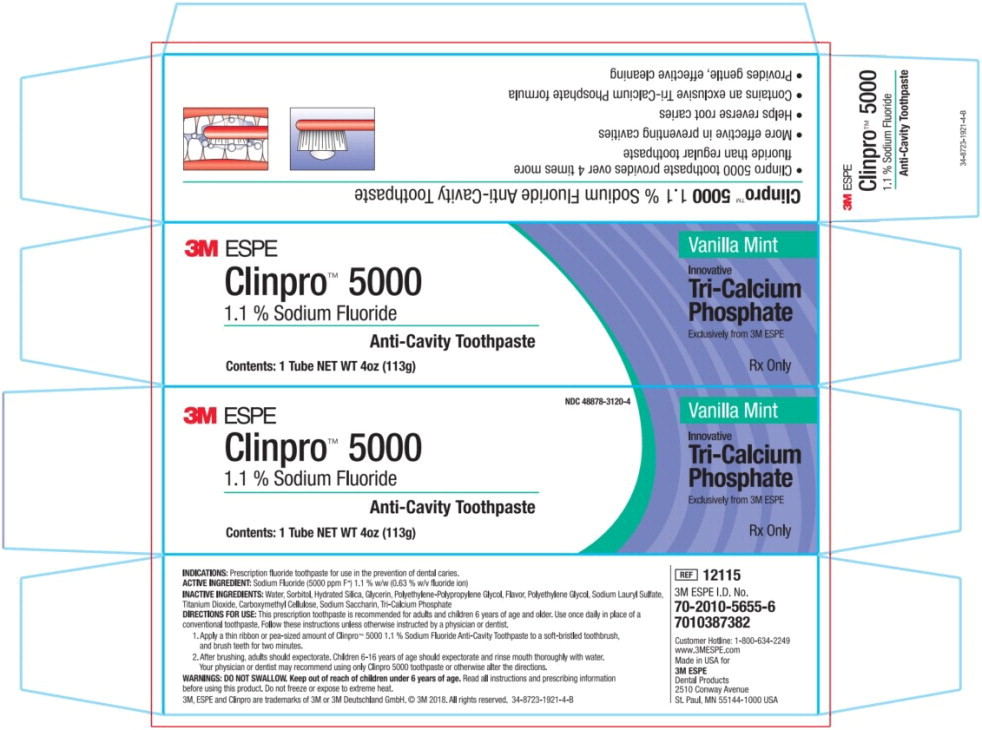
Clinpro 5000 sodium fluoride 5 mg/g Paste, Dentifrice
🆔 Identity & classification
Where does this data come from?
🏷️ RxNorm drug class
This medicine belongs to the Caries prophylactic agents class.
Where does this data come from?
🏭 Manufacturer & labeler
Where does this data come from?
🩺 Clinical
Fluoride is used to prevent tooth decay. It is taken up by teeth and helps to strengthen teeth, resist acid, and block the cavity-forming action of bacteria. Fluoride usually is prescribed for children and adults whose homes have water that is not fluoridated (already has fluoride added). This medication is sometimes prescribed for other uses; ask your doctor or pharmacist for more information.
Read the full MedlinePlus article ↗Clinpro 5000 is a prescription toothpaste containing sodium fluoride at a concentration of 5 mg per gram. Sodium fluoride is a form of fluoride commonly used in dental products to help strengthen tooth enamel and reduce the risk of tooth decay. This paste is applied topically in the mouth as part of a dental care routine. This product is marketed without an FDA-approved application.
Patient education
Supplement & herbal interactions
Where does this data come from?
Ask a licensed pharmacist directly — free, answered by our team.
💊 What it looks like
Where does this data come from?
🧪 Inactive Ingredients / Excipients
Inactive ingredients, also called excipients, are components of the drug product other than the active ingredient. They may include fillers, dyes, coatings, preservatives, flavors, or other formulation ingredients.
💡 Tap an ingredient (hover on desktop) to see what it is and why it’s used.
-
UNII K679OBS311
Carboxymethylcellulose sodium is a plant-derived thickening agent made from cellulose. In medicines, it acts as a binder to hold ingredients together, a disintegrant to help the tablet break apart, or a thickener in liquids.
-
UNII PDC6A3C0OX
Glycerin is a clear, thick liquid derived from plant oils or fats. It acts as a humectant to retain moisture, a sweetener, and a solvent in medications.
-
UNII 3WJQ0SDW1A
Polyethylene glycol is a synthetic liquid or solid polymer used in medicines as a solvent, lubricant, and humectant. It helps dissolve active ingredients, reduces friction during manufacturing, and retains moisture in the final product.
-
UNII SB8ZUX40TY
Saccharin sodium is an artificial sweetener made from saccharin salt. It's added to medicines to improve taste, especially in liquid formulations for children or bitter drugs.
-
UNII ETJ7Z6XBU4
Silicon dioxide is a naturally occurring mineral used as a glidant and anti-caking agent. It helps powder ingredients flow smoothly and prevents clumping during manufacturing and storage.
-
UNII 368GB5141J
A detergent and foaming agent derived from coconut or palm oil. In medications, it helps break down and mix oil and water-based ingredients, aids in tablet disintegration, and improves how the drug dissolves and spreads in the mouth or digestive system.
-
UNII 506T60A25R
Sorbitol is a natural sugar alcohol derived from glucose. It serves as a sweetener, humectant, and bulking agent in medications to improve taste and help maintain moisture in the product.
-
UNII 15FIX9V2JP
Titanium dioxide is a bright white mineral powder commonly used as a colorant and opacifying agent. It makes pills and tablets white or lighter in color and helps make coatings non-transparent.
-
UNII K4C08XP666
A mineral salt made from calcium and phosphate. It acts as a filler to add bulk and texture to tablets and powders, and also helps stabilize and bind ingredients together.
-
UNII 059QF0KO0R
Water is a liquid solvent that dissolves and mixes ingredients together in liquid medicines, syrups, and injections. It helps distribute the active drug evenly throughout the product.
10 inactive ingredients listed in the exact product block matched to this NDC.
Where does this data come from?
ingredient classCode="IACT" elements from the exact product block matched by this NDC. Label-section narrative from DailyMed / the openFDA label index is shown separately when available.Inactive ingredient FAQ
Are inactive ingredients the same for every manufacturer?
Why might an inactive ingredient be missing?
Can inactive ingredients matter?
💲 Pricing
A drug doesn't have one price. Each row is a different public payment system, and none is what you'd pay at the counter — that depends on your insurance. The ⓘ on each row explains what it measures.
| Price system | Per g | Per package |
|---|---|---|
| Retail pharmacies payNADAC · weekly | Not in the retail survey — common for institutional, discontinued, or low-volume packs. | |
| Medicaid paysCMS SDUD · 12 mo | No recent Medicaid claims on file for this NDC — rare and low-volume NDCs are suppressed in the public data. | |
| Medicare drug plans payPart D · quarterly | No Part D plan price is available for this NDC in our data. | |
Where does this data come from?
🔁 Therapeutic equivalents
| Product | Labeler | Pack | NADAC/unit | TE | Status | Price vs. this |
|---|---|---|---|---|---|---|
| Denta 5000 Plus 1.1 g/100g 16571-0814-50 | Rising | 51 g | $0.065 | — | Availability likely | — |
| Sodium Fluoride 5000 Plus 5 mg/g 69367-0309-51 | Westminster | 1 tube | $0.065 | — | Availability likely | — |
| SF 5000 Plus 5 mg/g 60258-0150-01 | Cypress | 1 tube | $0.093 | — | FDA listed | — |
| Sodium Fluoride 5000 ppm Fruit 6 mg/mL 11527-0730-44 | Sheffield | 1 tube | $0.097 | — | Availability likely | — |
| Sodium Fluoride 5000 ppm Spearmint 6 mg/mL 11527-0750-43 | Sheffield | 1 tube | $0.097 | — | Availability likely | — |
| Sodium Fluoride 5000 ppm Dry Mouth 6.1 mg/mL 11527-0755-34 | Sheffield | 1 tube | $0.097 | — | Availability likely | — |
| Sodium Fluoride 5000 PPM 6 mg/mL 69367-0311-01 | Westminster | 100 ml | $0.097 | — | Availability likely | — |
| Sodium Fluoride 5000 PPM 6 mg/mL 69367-0312-01 | Westminster | 100 ml | $0.097 | — | Availability likely | — |
| DentaGel 1.1 g/100g 16571-0815-60 | Rising | 56 g | $0.110 | — | Availability likely | — |
| PreviDent 5000 Dry Mouth 6.1 mg/mL 00126-0016-61 | Colgate | 100 ml | — | — | FDA listed | — |
| PreviDent 5000 Booster Plus Fruitastic 6 mg/mL 00126-0072-92 | Colgate | 100 ml | — | — | FDA listed | — |
| PreviDent 5000 Booster Plus Spearmint 6 mg/mL 00126-0074-92 | Colgate | 100 ml | — | — | FDA listed | — |
| PreviDent Fresh Mint 5 mg/g 00126-0088-02 | Colgate | 1 tube | — | — | FDA listed | — |
| PreviDent 5000 Plus Fruitastic 11 mg/g 00126-0286-66 | Colgate | 1 tube | — | — | FDA listed | — |
| PreviDent 5000 Plus Spearmint 11 mg/g 00126-0287-66 | Colgate | 1 tube | — | — | FDA listed | — |
| PreviDent Very Berry 5 mg/g 00126-0288-02 | Colgate | 1 tube | — | — | FDA listed | — |
| PreviDent OrthoDefense 6 mg/mL 00126-0289-92 | Colgate | 100 ml | — | — | FDA listed | — |
| PreviDent 5000 Kids 6 mg/mL 00126-0311-92 | Colgate | 100 ml | — | — | FDA listed | — |
| Acclean Anti-Cavity 1.1 g/100g 00404-0173-04 | Henry | 1 tube | — | — | FDA listed | — |
| Sodium Flouride 5 mg/mL 42291-0741-51 | AvKARE | 1 tube | — | — | FDA listed | — |
| Clinpro 5000 5 mg/gthis 48878-3120-04 | Solventum | 1 tube | — | — | FDA listed | — |
| Clinpro 5000 5 mg/g 48878-3130-04 | Solventum | 1 tube | — | — | FDA listed | — |
| Clinpro 5000 5 mg/g 48878-3140-04 | Solventum | 1 tube | — | — | FDA listed | — |
| Just Right 5000 1.1 g/100g 57511-0001-01 | Elevate | 97 g | — | — | FDA listed | — |
| Just Right 5000 1.1 g/100g 57511-0002-01 | Elevate | 97 g | — | — | FDA listed | — |
| Just Right 5000 1.1 g/100g 57511-0003-01 | Elevate | 97 g | — | — | FDA listed | — |
| Allday 5000 1.1 g/100g 57511-0005-01 | Elevate | 2 tubes | — | — | FDA listed | — |
| FluoriMax 5000 1.1 g/100g 57511-0504-01 | Elevate | 96 g | — | — | FDA listed | — |
| PRO Gel 5000 Mint 5000 ug/g 61578-0215-01 | DENTAL | 68 g | — | — | FDA listed | — |
| PRO Gel 5000 Citrus 5000 ug/g 61578-0216-01 | DENTAL | 68 g | — | — | FDA listed | — |
| Neutramaxx 5000 Plus Turbo 1.1 g/112g 63783-0500-04 | Massco | 112 g | — | — | FDA listed | — |
| Neutramaxx 5000 Tcp 1.1 g/112g 63783-0501-04 | Massco | 112 g | — | — | FDA listed | — |
| Neutra Maxx 5000 1.428 g/120g 63783-0504-06 | Massco | 120 g | — | — | FDA listed | — |
| Prosys .11 g/100g 66975-0782-01 | Benco | 113 g | — | — | FDA listed | — |
| Super Mint Prescription 1.1 g/100g 83729-0102-10 | SuperMouth, | 1 tube | — | — | FDA listed | — |
| Super Chocolate Prescription 1.1 g/100g 83729-0103-10 | SuperMouth, | 1 tube | — | — | FDA listed | — |
Where does this data come from?
⏳ Availability & generic status
We did not find an FDA-approved generic match for this exact strength, form and route.
Where does this data come from?
📊 Medicare Part D spend CMS · PART D · 2026 (Q1)
📦 Packaging — all sizes for this product
| Package NDC | Description | Marketing start | Status |
|---|---|---|---|
| 48878-3120-04 You're viewing this | 1 TUBE in 1 BOX (48878-3120-4) / 113 g in 1 TUBE | 2009-01-01 | Active |
🧭 About this NDC listing & data coverage
Listed without an FDA application
This product's marketing category indicates it is marketed without an approved FDA application (no NDA, ANDA, or BLA on file). Having an NDC does not by itself establish FDA approval — the NDC Directory is a listing system, not an approval decision. Approval-linked data such as Orange Book therapeutic-equivalence ratings therefore does not apply.
What data is (and isn’t) available for this NDC — tap to expand
| NDC identity (package / product / labeler codes) | ✓ Available |
| Labeler | ✓ Available |
| Product & package description | ✓ Available |
| Marketing category & status | ✓ Available |
| Active ingredient / dosage form / route | ✓ Available |
| FDA label (SPL via DailyMed) | ✓ Available |
| Package photos | ✓ Available |
| Inactive ingredients (structured) | ✓ Available |
| NADAC pharmacy acquisition price (CMS) | — Not published for this NDC CMS publishes NADAC only for NDCs reported in its retail-pharmacy survey. |
| Orange Book / therapeutic-equivalence data | — Not published for this NDC Applies only to products approved under an NDA/ANDA; many listings are out of scope. |
| HCPCS J-code billing crosswalk | — Not published for this NDC Most self-administered / retail products have no J-code — that is normal. |
| Medicaid utilization (CMS SDUD) | — Not published for this NDC CMS reports utilization only for NDCs with Medicaid claims above its privacy threshold. |
Questions about this listing
Is this NDC FDA-approved?
Why is there no price listed?
Is the NDC printed on the package the same as the 11-digit billing NDC?
What do the three segments of this NDC mean?
Is this package still being marketed?
Who lists this product with the FDA?
Do I need a prescription for this product?
Where does this data come from?
📄 Full prescribing information FDA SPL
🎯 Indications and Usage ▾
1 INDICATIONS AND USAGE Clinpro 5000 Anti-Cavity Toothpaste is indicated for use as part of a professional program for the prevention and control of dental caries. Clinpro 5000 Anti-Cavity Toothpaste is indicated for use as part of a professional program for the prevention and control of dental caries. ( 1 )
⏱️ Dosage and Administration ▾
2 DOSAGE AND ADMINISTRATION • Use once daily in place of conventional toothpaste unless instructed otherwise by a physician or dentist. • Apply a thin ribbon or pea-sized amount of Clinpro 5000 Anti-Cavity Toothpaste using a soft-bristled toothbrush and brush teeth for at least two minutes. • After brushing adults should expectorate. Children 6 to 16 years of age should expectorate and rinse mouth thoroughly with water. • Follow these instructions or use as directed by a dental professional. Use once daily in place of conventional toothpaste unless instructed otherwise by a physician or dentist.
( 2 ) Apply a thin ribbon or pea-sized amount of Clinpro 5000 Anti-Cavity Toothpaste using a soft-bristled toothbrush and brush teeth for at least two minutes. ( 2 ) After brushing adults should expectorate. Children 6 to 16 years of age should expectorate and rinse mouth thoroughly with water.
( 2 )
💊 Dosage Forms and Strengths ▾
3 DOSAGE FORMS AND STRENGTHS White toothpaste containing 1.1% sodium fluoride White toothpaste containing 1.1% sodium fluoride ( 3 )
⛔ Contraindications ▾
4 CONTRAINDICATIONS Do not use in children under 6 years of age unless recommended by a dentist or physician. Do not use in children under 6 years of age unless recommended by a dentist or physician. ( 4 )
⚠️ Warnings and Cautions ▾
5 WARNINGS AND PRECAUTIONS • DO NOT SWALLOW. If more than a pea-sized amount of Clinpro 5000 Anti-Cavity Toothpaste is swallowed, contact a medical or dental professional or a poison control center. • Keep out of reach of children under 6 years of age. • Repeated ingestion of high levels of fluoride may cause dental fluorosis. For this reason, use in children with developing dentition requires special supervision to prevent swallowing.
Prescribing dentists and physicians should consider risk of fluorosis when prescribing for use in children less than 6 years of age. Do not swallow. ( 5 ) Keep out of reach of children under 6 years of age.
( 5 ) Repeated ingestion of high levels of fluoride may cause dental fluorosis. ( 5 )
🤒 Adverse Reactions ▾
6 ADVERSE REACTIONS Allergic reactions and other idiosyncrasies have been rarely reported. Allergic reactions and other idiosyncrasies have been rarely reported. ( 6 ) To report SUSPECTED ADVERSE REACTIONS, contact 3M ESPE Dental Products Division at 1-800-634-2249 or www.3MESPE.com , or FDA at 1-800-FDA-1088 or www.fda.gov/medwatch
👥 Use in Specific Populations ▾
8 USE IN SPECIFIC POPULATIONS
8.1Pregnancy Fluoride crosses the placenta in women and has been measured in cord blood, amniotic fluid, and serum of newborn children, but without a consistent correlation to maternal serum fluoride levels. 1,2 There are no data to indicate an increased susceptibility to fluorosis during pregnancy. Developmental studies were conducted by the National Toxicology Program, with sodium fluoride administered in the drinking water to pregnant rats and rabbits.
No developmental toxicity was observed, even at doses that caused maternal toxicity. The No Adverse Effect Levels were about 29 mg/kg-day and 27 mg/kg-day for rabbits and rats, respectively. 3 There is no conclusive evidence of fluoride developmental effects in humans.
1,2 The Institute of Medicine established a fluoride Upper Limit of 10 mg/day for pregnant women. 2 Prescribing physicians and dentists should consider total fluoride exposure (dental care plus food, water and other sources) when prescribing the product for use in pregnant women or women who may become pregnant.
8.3Nursing Mothers An extremely small proportion of fluoride in drinking water is transferred to breast milk. The Institute of Medicine established a fluoride Upper Limit of 10 mg/day for nursing women. 2 Prescribing physicians and dentists should consider total fluoride exposure (dental care plus food, water and other sources) when prescribing the product for use in women who are nursing.
8.4Pediatric Use The primary adverse effects of fluoride are fluorosis of dental enamel and of the skeleton; these effects occur at exposures below those associated with other adverse health effects. The population most at risk for dental fluorosis is children during the period of tooth formation, i.e. from birth to 8 years of age. For this population, the Institute of Medicine established Fluoride Upper Limits of intake based on the risk of dental fluorosis.
In populations with permanent dentition, skeletal fluorosis is the greatest risk from excessive fluoride. For this population the Institute of Medicine (IOM) established Fluoride Upper Limits based on the risk of skeletal fluorosis. 2 Population IOM Fluoride Upper Limit Infants 0-6 months old 0.7 mg/day Infants 7-12 months old 0.9 mg/day Children 1-3 years old 1.3 mg/day Children 4-8 years old 2.2 mg/day Children > 8 years old 10 mg/day Prescribing physicians and dentists should consider total fluoride exposure (dental care plus food, water and other sources) when prescribing the product for use in children.
8.5Geriatric Use No studies of Clinpro 5000 Anti-Cavity Toothpaste have been conducted to determine whether subjects aged 65 and over respond differently from younger subjects.
🤰 Pregnancy ▾
8.1Pregnancy Fluoride crosses the placenta in women and has been measured in cord blood, amniotic fluid, and serum of newborn children, but without a consistent correlation to maternal serum fluoride levels. 1,2 There are no data to indicate an increased susceptibility to fluorosis during pregnancy. Developmental studies were conducted by the National Toxicology Program, with sodium fluoride administered in the drinking water to pregnant rats and rabbits.
No developmental toxicity was observed, even at doses that caused maternal toxicity. The No Adverse Effect Levels were about 29 mg/kg-day and 27 mg/kg-day for rabbits and rats, respectively. 3 There is no conclusive evidence of fluoride developmental effects in humans.
1,2 The Institute of Medicine established a fluoride Upper Limit of 10 mg/day for pregnant women. 2 Prescribing physicians and dentists should consider total fluoride exposure (dental care plus food, water and other sources) when prescribing the product for use in pregnant women or women who may become pregnant.
🧒 Pediatric Use ▾
8.4Pediatric Use The primary adverse effects of fluoride are fluorosis of dental enamel and of the skeleton; these effects occur at exposures below those associated with other adverse health effects. The population most at risk for dental fluorosis is children during the period of tooth formation, i.e. from birth to 8 years of age. For this population, the Institute of Medicine established Fluoride Upper Limits of intake based on the risk of dental fluorosis.
In populations with permanent dentition, skeletal fluorosis is the greatest risk from excessive fluoride. For this population the Institute of Medicine (IOM) established Fluoride Upper Limits based on the risk of skeletal fluorosis. 2 Population IOM Fluoride Upper Limit Infants 0-6 months old 0.7 mg/day Infants 7-12 months old 0.9 mg/day Children 1-3 years old 1.3 mg/day Children 4-8 years old 2.2 mg/day Children > 8 years old 10 mg/day Prescribing physicians and dentists should consider total fluoride exposure (dental care plus food, water and other sources) when prescribing the product for use in children.
🧓 Geriatric Use ▾
8.5Geriatric Use No studies of Clinpro 5000 Anti-Cavity Toothpaste have been conducted to determine whether subjects aged 65 and over respond differently from younger subjects.
🆘 Overdosage ▾
10 OVERDOSAGE Ingestion of large amounts of fluoride may result in abdominal pain, stomach upset, nausea, vomiting, and diarrhea. These symptoms may occur at overdosages of 5 mg/kg of body weight. Fluoride doses of 16 mg/kg have been fatal.
Treatment Recommendations for Overdose of Clinpro 5000 Anti-Cavity Toothpaste 4 Ingested fluoride dose Amount for 10 kg (22 pound) child* Recommended action to take Less than 5 mg/kg This equals less than ½ ounce (or less than 3 teaspoons). Do not induce vomiting. Give 1-2 glasses of milk and observe for symptoms of stomach upset.
If symptoms persist more than a few hours, seek medical attention or contact a poison control center. 5 mg/kg or more This equals about ½ ounce (about 1 tablespoon) or more. Do not induce vomiting.
Give 1-2 glasses of milk and seek medical attention or contact a poison control center. 15 mg/kg This equals 1 ounce or ¼ of the tube. Seek immediate medical attention.
Do not induce vomiting. Give 1-2 glasses of milk. *The amount to reach the fluoride dose will be proportionately larger with older children and adults. A thin ribbon or pea-sized amount of Clinpro 5000 Anti-Cavity Toothpaste weighs approximately 0.3 g and contains approximately 1.5 mg of fluoride ion.
A 4 oz. tube contains 564 mg of fluoride ion.
🧬 Clinical Pharmacology ▾
12 CLINICAL PHARMACOLOGY Clinpro 5000 1.1% Sodium Fluoride Anti-Cavity Toothpaste aids in the prevention of tooth decay. Fluoride delivered from Clinpro 5000 inhibits the demineralization of sound teeth and enhances the remineralization (i.e., repair) of demineralized teeth. During tooth brushing, fluoride is taken up by teeth and dental plaque.
Fluoride is taken up with calcium and phosphate by demineralized teeth resulting in an improved tooth structure than contains more fluoride and less carbonate than naturally occurring tooth structure and is more resistant to acid challenge. Additionally, calcium fluoride is formed on the crystal structure of teeth. As the pH of the mouth drops, fluoride is released from calcium fluoride and aids in the remineralization of teeth.
Fluoride taken up into plaque alters the activity of cariogenic bacteria. Fluoride inhibits the process by which cariogenic bacteria metabolize carbohydrates resulting in less acid and adhesive polysaccharide production by the bacteria.
📦 How Supplied / Storage and Handling ▾
16 HOW SUPPLIED/STORAGE AND HANDLING Clinpro 5000 Anti-Cavity Toothpaste is supplied as a white dentifrice paste in a 4 oz. (113 gm) plastic tube (NDC 48878-3120-4, Vanilla Mint Flavor; NDC 48878-3130-4 Spearmint Flavor; NDC 48878-3140-4 Bubble Gum Flavor). Storage This product is designed to be stored and used at room temperature.
Do not freeze or expose to extreme heat. See outer package for expiration date. Manufactured for: 3M ESPE Dental Products 2510 Conway Avenue St.
Paul, MN 55144-1000 USA Revision date: 01/11/2012 Rx Only 3M, ESPE, and Clinpro are trademarks of 3M or 3M Deutschland GmbH. © 3M 2016. All rights reserved.
📦 Storage and Handling ▾
Storage This product is designed to be stored and used at room temperature. Do not freeze or expose to extreme heat. See outer package for expiration date. Manufactured for: 3M ESPE Dental Products 2510 Conway Avenue St. Paul, MN 55144-1000 USA Revision date: 01/11/2012 Rx Only 3M, ESPE, and Clinpro are trademarks of 3M or 3M Deutschland GmbH. © 3M 2016. All rights reserved.
📋 Description ▾
11 DESCRIPTION Clinpro 5000 1.1% Sodium Fluoride Anti-Cavity Toothpaste is a self-applied fluoride dentifrice for the prevention of dental caries. Each gram contains 5 mg of fluoride ion in a neutral pH base, consisting of water, sorbitol, hydrated silica, glycerin, polyethylene-polypropylene glycol, flavor, polyethylene glycol, sodium lauryl sulfate, titanium dioxide, carboxymethyl cellulose, sodium saccharin and tri-calcium phosphate.