
Naproxen 500 mg Tablet, 100-count — NDC 49483-618-01 (Billing 49483-0618-01)
This is a package of 100 tablets of Naproxen 500 mg Tablet from TIME CAP LABORATORIES, marketed since Jul 2016 and currently FDA-listed; retail pharmacies pay about $0.0565 per tablet (NADAC).
Other active recalls for Naproxen (different manufacturers) — 1 · tap to view
Identity & classification
Regulatory identifiers FDA, NLM and CMS codes for this package
Drug-database identifiers Medi-Span GPI and First Databank GCN / HICL / AHFS classification
- GSN (GCN sequence number): 008362
- GCN: 35793
- GPI-14 (Medi-Span): 66100060000315
- HICL (First Databank): 003727
- AHFS class code: 28:08.04.04
- RxCUI (RxNorm): 198012
Where does this data come from?
- FDA openFDA NDC Directory · synced Oct 1, 2026
- FDA label on DailyMed · label index refreshed Oct 1, 2026
- RxNorm (NLM RxNav) · catalog refreshed Oct 1, 2026
- Medi-Span GPI (licensed)
- First Databank (licensed) · refreshed Oct 1, 2026
RxNorm drug class
This medicine belongs to the Nonsteroidal Anti-inflammatory Drug class.
Where does this data come from?
- RxClass (NLM) · catalog refreshed Oct 1, 2026
Clinical
Prescription naproxen is used to relieve pain, tenderness, swelling, and stiffness caused by osteoarthritis (arthritis caused by a breakdown of the lining of the joints), rheumatoid arthritis (arthritis caused by swelling of the lining of the joints), juvenile arthritis (a form of joint disease in children), and ankylosing spondylitis (arthritis that mainly affects the spine). Prescription naproxen tablets, extended-release tablets, and suspension are also used to relieve shoulder pain caused by bursitis (inflammation of a fluid-filled sac in the shoulder joint), tendinitis (inflammation of th...
Read the full MedlinePlus article ↗- It relieves pain, inflammation and fever. Prescription versions treat arthritis, tendonitis, bursitis, acute gout and painful periods. Over-the-counter versions handle minor aches...
- Take it by mouth with a full glass of water. Over-the-counter products are taken every 8 to 12 hours while symptoms last, and you should use the smallest dose that works. For presc...
- Headache, indigestion, heartburn, nausea and swelling are common. Call your doctor if you have black stools, vomit blood, a rash, yellow skin or eyes, or chest pain.
- Usually not. Combining naproxen with other NSAIDs or aspirin raises bleeding risk with little added benefit. Naproxen can also interfere with low-dose aspirin taken for your heart,...
Patient education
Supplement & herbal interactions
Some supplements/herbs that may interact with Naproxen — tap one for details:
Naproxen may be associated with lower levels of 1 nutrient — worth a chat with your pharmacist, not a cause for alarm.
Where does this data come from?
- MedlinePlus (NLM) · refreshed Oct 1, 2026
- FDA label on DailyMed · label index refreshed Oct 1, 2026
Ask a licensed pharmacist directly — free, answered by our team.
Pricing
A drug doesn't have one price. Each row is a different public payment system, and none is what you'd pay at the counter — that depends on your insurance. The ⓘ on each row explains what it measures.
| Price system | Per ea | Per package |
|---|---|---|
| Retail pharmacies payNADAC · weekly | $0.057 | $5.65 / 100 tablets |
| Medicaid paysCMS SDUD · 12 mo | $0.2442 | $24.42 / 100 tablets |
| Medicare drug plans payPart D · Q2 2026 | $0.1110 | $11.10 / 100 tablets |
Where does this data come from?
- CMS NADAC weekly file · file of Sep 30, 2026
- CMS ASP pricing files · refreshed Sep 20, 2026
- CMS Medicaid State Drug Utilization Data · through Q4 2025
- CMS Part D plan pricing files · refreshed Sep 24, 2026
- VA National Acquisition Center price file
Packaging — all sizes for this product
| Package NDC | Description | Per unit | Per pack | Marketing start | Marketing end | Status |
|---|---|---|---|---|---|---|
| 49483-0618-01 You're viewing this | 100 TABLET in 1 BOTTLE, PLASTIC | $0.0565 / ea | $5.65 | 2016-07-06 | — | Active |
| 49483-0618-50 49483-618-50 Main listing | 500 TABLET in 1 BOTTLE, PLASTIC | $0.0565 / ea | $28.27 | 2016-07-06 | — | Active |
You're viewing the smallest of 2 pack sizes for this product.
This pack has the lowest per-ea cost of the 2 priced pack sizes ($0.0565 NADAC).
This pack accounts for about 44% of this product's recent Medicaid fills; most go to the 500 tablets pack. See all packs ↓
Pack size FAQ
What quantity is in this package?
How does this package differ from NDC 49483-0618-50?
What NDC number is used to bill for this package of Naproxen 500 mg Tablet?
Prices are the latest CMS NADAC pharmacy acquisition cost per NDC; per-pack figures are per-unit × pack quantity, shown only when the pack is denominated in the same measure NADAC prices.
Therapeutic equivalents
| Product | Labeler | Pack | NADAC/unit | TE | Status | Price vs. this |
|---|---|---|---|---|---|---|
| Naproxen 500 mgthis 49483-0618-01 | TIME | 100 tablets | $0.057 | AB | Availability likely | — |
| Naproxen 500 mg 50228-0436-01 | ScieGen | 100 tablets | $0.057 | AB | Availability likely | — |
| Naproxen 500 mg 60687-0491-01 | American | 100 tablets | $0.057 | AB | Availability likely | — |
| Naproxen 500 mg 65162-0190-10 | Amneal | 100 tablets | $0.057 | AB | Availability likely | — |
| Naproxen 500 mg 65862-0522-01 | Aurobindo | 100 tablets | $0.057 | — | Availability likely | — |
| Naproxen 500 mg 68462-0190-01 | Glenmark | 100 tablets | $0.057 | AB | Availability likely | — |
| Naproxen 500 mg 70010-0139-01 | Granules | 100 tablets | $0.057 | AB | Availability likely | — |
| Naproxen 500 mg 76282-0342-01 | Exelan | 100 tablets | $0.057 | — | Availability likely | — |
| Naproxen 500 mg 42494-0454-10 | Cameron | 100 tablets | $1.841 | AB | Availability likely | +3157% |
| Naproxen 500 mg 00615-8094-39 | NCS | 30 tablets | — | AB | FDA listed | — |
| Naproxen 500 mg 25000-0140-03 | MARKSANS | 30 tablets | — | AB | FDA listed | — |
| Naproxen 500 mg 42708-0043-20 | QPharma, | 20 tablets | — | AB | FDA listed | — |
| Naproxen 500 mg 42708-0140-20 | QPharma | 20 tablets | — | AB | FDA listed | — |
| Naproxen 500 mg 43063-0920-04 | PD-Rx | 4 tablets | — | AB | FDA listed | — |
| Naproxen 500 mg 43353-0211-53 | Aphena | 60 tablets | — | — | FDA listed | — |
| Naproxen 500 mg 50090-0481-00 | A-S | 15 tablets | — | AB | FDA listed | — |
| Naproxen 500 mg 50090-0482-01 | A-S | 90 tablets | — | AB | FDA listed | — |
| Naproxen 500 mg 50090-0483-00 | A-S | 20 tablets | — | AB | FDA listed | — |
| Naproxen 500 mg 50090-5645-00 | A-S | 15 tablets | — | AB | FDA listed | — |
| Naproxen 500 mg 50090-5646-01 | A-S | 90 tablets | — | AB | FDA listed | — |
| Naproxen 500 mg 50090-5649-00 | A-S | 20 tablets | — | AB | FDA listed | — |
| Naproxen 500 mg 50090-6666-00 | A-S | 15 tablets | — | AB | FDA listed | — |
| Naproxen 500 mg 50090-6667-01 | A-S | 90 tablets | — | AB | FDA listed | — |
| Naproxen 500 mg 50090-6762-00 | A-S | 20 tablets | — | AB | FDA listed | — |
| Naproxen 500 mg 50090-6980-00 | A-S | 90 tablets | — | AB | FDA listed | — |
| Naproxen 500 mg 50090-7198-00 | A-S | 90 tablets | — | AB | FDA listed | — |
| Naproxen 500 mg 50090-7676-00 | A-S | 90 tablets | — | AB | FDA listed | — |
| Naproxen 500 mg 51655-0363-26 | Northwind | 90 tablets | — | AB | FDA listed | — |
| Naproxen 500 mg 51655-0457-20 | Northwind | 20 tablets | — | AB | FDA listed | — |
| Naproxen 500 mg 51655-0621-20 | Northwind | 20 tablets | — | AB | FDA listed | — |
| Naproxen 500 mg 51655-0743-20 | Northwind | 20 tablets | — | AB | FDA listed | — |
| Naproxen 500 mg 53746-0190-01 | Amneal | 100 tablets | — | AB | FDA listed | — |
| Naproxen 500 mg 55700-0888-20 | Quality | 20 tablets | — | AB | Discontinued | — |
| Naproxen 500 mg 60760-0564-14 | St. | 14 tablets | — | AB | FDA listed | — |
| Naproxen 500 mg 62207-0747-43 | Granules | 100 tablets | — | AB | FDA listed | — |
| Naproxen 500 mg 63187-0028-10 | Proficient | 10 tablets | — | AB | FDA listed | — |
| Naproxen 500 mg 63187-0455-20 | Proficient | 20 tablets | — | AB | FDA listed | — |
| Naproxen 500 mg 63629-5863-01 | Bryant | 60 tablets | — | AB | FDA listed | — |
| Naproxen 500 mg 63629-8514-01 | Bryant | 500 tablets | — | AB | FDA listed | — |
| Naproxen 500 mg 63629-8515-01 | Bryant | 100 tablets | — | AB | FDA listed | — |
| Naproxen 500 mg 66267-0153-10 | NuCare | 10 tablets | — | AB | FDA listed | — |
| Naproxen 500 mg 66267-0807-04 | NuCare | 4 tablets | — | AB | FDA listed | — |
| Naproxen 500 mg 67046-0501-03 | Coupler | 30 tablets | — | AB | FDA listed | — |
| Naproxen 500 mg 67046-1553-03 | Coupler | 30 tablets | — | AB | FDA listed | — |
| Naproxen 500 mg 67296-2235-05 | Redpharm | 30 tablets | — | AB | FDA listed | — |
| Naproxen 500 mg 68071-2396-04 | NuCare | 4 tablets | — | AB | FDA listed | — |
| Naproxen 500 mg 68071-4006-01 | NuCare | 10 tablets | — | AB | FDA listed | — |
| Naproxen 500 mg 68071-4381-02 | NuCare | 20 tablets | — | AB | FDA listed | — |
| Naproxen 500 mg 68788-7090-01 | Preferred | 100 tablets | — | AB | FDA listed | — |
| Naproxen 500 mg 68788-8602-01 | Preferred | 100 tablets | — | AB | FDA listed | — |
| Naproxen 500 mg 68788-8797-01 | Preferred | 100 tablets | — | AB | FDA listed | — |
| naproxen 500 mg 69097-0855-07 | Cipla | 100 tablets | — | — | FDA listed | — |
| Naproxen 500 mg 70518-3822-00 | REMEDYREPACK | 30 tablets | — | AB | FDA listed | — |
| Naproxen 500 mg 70518-4439-00 | REMEDYREPACK | 12 tablets | — | AB | FDA listed | — |
| Naproxen 500 mg 71205-0597-10 | Proficient | 10 tablets | — | AB | FDA listed | — |
| Naproxen 500 mg 71335-0345-00 | Bryant | 28 tablets | — | AB | FDA listed | — |
| Naproxen 500 mg 71335-2485-00 | Bryant | 28 tablets | — | AB | FDA listed | — |
| Naproxen 500 mg 71335-2777-00 | Bryant | 28 tablets | — | AB | FDA listed | — |
| Naproxen 500 mg 71610-0436-53 | Aphena | 60 tablets | — | AB | FDA listed | — |
| Naproxen 500 mg 71610-0489-53 | Aphena | 60 tablets | — | AB | FDA listed | — |
| Naproxen 500 mg 71610-0597-53 | Aphena | 60 tablets | — | AB | FDA listed | — |
| Naproxen 500 mg 72189-0136-14 | DIRECT | 14 tablets | — | AB | FDA listed | — |
| Naproxen 500 mg 72789-0321-04 | PD-Rx | 4 tablets | — | AB | FDA listed | — |
| Naproxen 500 mg 72789-0541-14 | PD-Rx | 14 tablets | — | AB | FDA listed | — |
| Naproxen 500 mg 76420-0042-01 | Asclemed | 1 tablet | — | AB | FDA listed | — |
| Naproxen 500 mg 76420-0264-01 | Asclemed | 1 tablet | — | AB | FDA listed | — |
| Naproxen 500 mg 77771-0436-01 | Radha | 100 tablets | — | AB | FDA listed | — |
| Naproxen 500 mg 80425-0049-01 | Advanced | 60 tablets | — | AB | FDA listed | — |
| Naproxen 500 mg 80425-0050-01 | Advanced | 60 tablets | — | AB | FDA listed | — |
| Naproxen 500 mg 80425-0051-01 | Advanced | 60 tablets | — | AB | FDA listed | — |
| Naproxen 500 mg 80425-0378-01 | Advanced | 30 tablets | — | AB | FDA listed | — |
| Naproxen 500 mg 82461-0711-60 | Medcore | 60 tablets | — | AB | FDA listed | — |
| Naproxen 500 mg 83209-0190-14 | Boswell | 14 tablets | — | AB | FDA listed | — |
| Naproxen 500 mg 85509-1436-03 | PHOENIX | 30 tablets | — | AB | FDA listed | — |
| Naproxen 500 mg 85766-0107-00 | Sportpharm | 1000 tablets | — | AB | FDA listed | — |
| Naproxen 500 mg 72162-2276-01 | Bryant | 100 tablets | — | AB | FDA listed | — |
| Naproxen 500 mg 87441-0060-01 | Unit | 30 tablets | — | AB | Discontinued | — |
| Naproxen 500 mg 85534-0024-00 | HAWAII | 30 tablets | — | AB | FDA listed | — |
| Naproxen 500 mg 70518-1516-00 | REMEDYREPACK | 30 tablets | — | AB | Discontinued | — |
| Naproxen 500 mg 67046-0784-03 | Coupler | 30 tablets | — | AB | FDA listed | — |
| Naproxen 500 mg 70518-4750-00 | REMEDYREPACK | 30 tablets | — | AB | FDA listed | — |
Where does this data come from?
- FDA openFDA NDC Directory · synced Oct 1, 2026
- FDA Orange Book · refreshed Sep 3, 2026
- CMS NADAC weekly file · file of Sep 30, 2026
Availability & generic status
This product is an FDA-approved generic. Other versions of the same drug are listed under Therapeutic equivalents, least expensive first.
Where does this data come from?
- FDA Orange Book · refreshed Sep 3, 2026
What it looks like
Where does this data come from?
- FDA label on DailyMed · label index refreshed Oct 1, 2026
Inactive Ingredients / Excipients
Inactive ingredients, also called excipients, are components of the drug product other than the active ingredient. They may include fillers, dyes, coatings, preservatives, flavors, or other formulation ingredients.
💡 Tap an ingredient (hover on desktop) to see what it is and why it’s used.
-
UNII M28OL1HH48
Croscarmellose sodium is a plant-based substance derived from cellulose. It acts as a disintegrant, helping tablets and capsules break down quickly in the digestive system so the medicine can be absorbed.
-
UNII 70097M6I30
Magnesium stearate is a salt made from magnesium and stearic acid, a fatty substance. It's used in tablets and capsules as a lubricant and glidant to help ingredients flow smoothly during manufacturing and prevent sticking.
-
UNII FZ989GH94E
Povidone is a synthetic polymer made from a plastic-like material. It acts as a binder to hold tablet ingredients together and as a disintegrant to help the tablet break apart in your stomach so the medicine can be absorbed.
3 inactive ingredients listed in the exact product block matched to this NDC.
Where does this data come from?
ingredient classCode="IACT" elements from the exact product block matched by this NDC. Label-section narrative from DailyMed / the openFDA label index is shown separately when available.- FDA label on DailyMed · label index refreshed Oct 1, 2026
- FDA openFDA NDC Directory · synced Oct 1, 2026
Inactive ingredient FAQ
Are inactive ingredients the same for every manufacturer?
Why might an inactive ingredient be missing?
Can inactive ingredients matter?
Manufacturer & labeler
Where does this data come from?
- FDA openFDA NDC Directory · synced Oct 1, 2026
- Drugs@FDA
Full prescribing information FDA SPL
🎯 Indications and Usage ▾
CAREFULLY CONSIDER THE POTENTIAL BENEFITS AND RISKS OF NAPROXEN AND OTHER TREATMENT OPTIONS BEFORE DECIDING TO USE NAPROXEN TABLETS. USE THE LOWEST EFFECTIVE DOSE FOR THE SHORTEST DURATION CONSISTENT WITH INDIVIDUAL PATIENT TREATMENT GOALS (SEE WARNINGS: GASTROINTESTINAL BLEEDING, ULCERATION, AND PERFORATION). NAPROXEN TABLETS ARE INDICATED: FOR THE RELIEF OF THE SIGNS AND SYMPTOMS OF RHEUMATOID ARTHRITIS.
FOR THE RELIEF OF THE SIGNS AND SYMPTOMS OF OSTEOARTHRITIS FOR THE RELIEF OF THE SIGNS AND SYMPTOMS OF ANKYLOSING SPONDYLITIS FOR THE RELIEF OF THE SIGNS AND SYMPTOMS OF JUVENILE ARTHRITIS NAPROXEN TABLETS ARE ALSO INDICATED: FOR RELIEF OF THE SIGNS AND SYMPTOMS OF TENDONITIS FOR RELIEF OF THE SIGNS AND SYMPTOMS OF BURSITIS FOR RELIEF OF THE SIGNS AND SYMPTOMS OF ACUTE GOUT FOR THE MANAGEMENT OF PAIN FOR THE MANAGEMENT OF PRIMARY DYSMENORRHEA
⏱️ Dosage and Administration ▾
CAREFULLY CONSIDER THE POTENTIAL BENEFITS AND RISKS OF NAPROXEN AND OTHER TREATMENT OPTIONS BEFORE DECIDING TO USE NAPROXEN TABLETS. USE THE LOWEST EFFECTIVE DOSE FOR THE SHORTEST DURATION CONSISTENT WITH INDIVIDUAL PATIENT TREATMENT GOALS (SEE WARNINGS; GASTROINTESTINAL BLEEDING, ULCERATION, AND PERFORATION). AFTER OBSERVING THE RESPONSE TO INITIAL THERAPY WITH NAPROXEN TABLETS, THE DOSE AND FREQUENCY SHOULD BE ADJUSTED TO SUIT AN INDIVIDUAL PATIENT'S NEEDS.
DIFFERENT DOSE STRENGTHS AND FORMULATIONS (I.E., TABLETS, SUSPENSION) OF THE DRUG ARE NOT NECESSARILY BIOEQUIVALENT. THIS DIFFERENCE SHOULD BE TAKEN INTO CONSIDERATION WHEN CHANGING FORMULATION. ALTHOUGH NAPROXEN TABLETS, NAPROXEN SUSPENSION, NAPROXEN DELAYED-RELEASED TABLETS, AND NAPROXEN SODIUM TABLETS ALL CIRCULATE IN THE PLASMA AS NAPROXEN, THEY HAVE PHARMACOKINETIC DIFFERENCES THAT MAY AFFECT ONSET OF ACTION.
ONSET OF PAIN RELIEF CAN BEGIN WITHIN 1 HOUR IN PATIENTS TAKING NAPROXEN. THE RECOMMENDED STRATEGY FOR INITIATING THERAPY IS TO CHOOSE A FORMULATION AND A STARTING DOSE LIKELY TO BE EFFECTIVE FOR THE PATIENT AND THEN ADJUST THE DOSAGE BASED ON OBSERVATION OF BENEFIT AND/OR ADVERSE EVENTS. A LOWER DOSE SHOULD BE CONSIDERED IN PATIENTS WITH RENAL OR HEPATIC IMPAIRMENT OR IN ELDERLY PATIENTS (SEE WARNINGS; HEPATOTOXICITY, AND RENAL TOXICITY AND HYPERKALEMIA, AND PRECAUTIONS; GERIATRIC USE).
GERIATRIC PATIENTS STUDIES INDICATE THAT ALTHOUGH TOTAL PLASMA CONCENTRATION OF NAPROXEN IS UNCHANGED, THE UNBOUND PLASMA FRACTION OF NAPROXEN IS INCREASED IN THE ELDERLY. CAUTION IS ADVISED WHEN HIGH DOSES ARE REQUIRED AND SOME ADJUSTMENT OF DOSAGE MAY BE REQUIRED IN ELDERLY PATIENTS. AS WITH OTHER DRUGS USED IN THE ELDERLY, IT IS PRUDENT TO USE THE LOWEST EFFECTIVE DOSE.
PATIENTS WITH MODERATE TO SEVERE RENAL IMPAIRMENT NAPROXEN-CONTAINING PRODUCTS ARE NOT RECOMMENDED FOR USE IN PATIENTS WITH MODERATE TO SEVERE AND SEVERE RENAL IMPAIRMENT (CREATININE CLEARANCE < 30 ML/MIN) (SEE WARNINGS: RENAL EFFECTS). RHEUMATOID ARTHRITIS, OSTEOARTHRITIS AND ANKYLOSING SPONDYLITIS THE RECOMMENDED DOSE IS 250 MG, 375 MG, OR 500 MG TWICE DAILY. DURING LONG-TERM ADMINISTRATION, THE DOSE OF NAPROXEN MAY BE ADJUSTED UP OR DOWN DEPENDING ON THE CLINICAL RESPONSE OF THE PATIENT.
A LOWER DAILY DOSE MAY SUFFICE FOR LONG-TERM ADMINISTRATION. THE MORNING AND EVENING DOSES DO NOT HAVE TO BE EQUAL IN SIZE AND THE ADMINISTRATION OF THE DRUG MORE FREQUENTLY THAN TWICE DAILY IS NOT NECESSARY. IN PATIENTS WHO TOLERATE LOWER DOSES WELL, THE DOSE MAY BE INCREASED TO NAPROXEN 1500 MG/DAY FOR LIMITED PERIODS OF UP TO 6 MONTHS WHEN A HIGHER LEVEL OF ANTI-INFLAMMATORY/ANALGESIC ACTIVITY IS REQUIRED.
WHEN TREATING SUCH PATIENTS WITH NAPROXEN 1500 MG/DAY, THE PHYSICIAN SHOULD OBSERVE SUFFICIENT INCREASED CLINICAL BENEFITS TO OFFSET THE POTENTIAL INCREASED RISK. THE MORNING AND EVENING DOSES DO NOT HAVE TO BE EQUAL IN SIZE AND ADMINISTRATION OF THE DRUG MORE FREQUENTLY THAN TWICE DAILY DOES NOT GENERALLY MAKE A DIFFERENCE IN RESPONSE (SEE CLINICAL PHARMACOLOGY). JUVENILE ARTHRITIS NAPROXEN TABLETS MAY NOT ALLOW FOR THE FLEXIBLE DOSE TITRATION NEEDED IN PEDIATRIC PATIENTS WITH JUVENILE ARTHRITIS.
A LIQUID FORMULATION MAY BE MORE APPROPRIATE. IN PEDIATRIC PATIENTS, DOSES OF 5 MG/KG/DAY PRODUCED PLASMA LEVELS OF NAPROXEN SIMILAR TO THOSE SEEN IN ADULTS TAKING 500 MG OF NAPROXEN (SEE CLINICAL PHARMACOLOGY). THE RECOMMENDED TOTAL DAILY DOSE OF NAPROXEN IS APPROXIMATELY 10 MG/KG GIVEN IN 2 DIVIDED DOSES.
ONE-HALF OF THE 250 MG TABLET WILL BE NEEDED FOR DOSING LOWER-WEIGHT CHILDREN. DOSING WITH NAPROXEN TABLETS IS NOT APPROPRIATE FOR CHILDREN WEIGHING LESS THAN 25 KILOGRAMS. THE RECOMMENDED TOTAL DAILY DOSE OF NAPROXEN IS APPROXIMATELY 10 MG/KG GIVEN IN 2 DIVIDED DOSES (I.E., 5 MG/KG GIVEN TWICE A DAY).
NAPROXEN TABLETS ARE NOT WELL SUITED TO THIS DOSAGE SO USE OF NAPROXEN ORAL SUSPENSION IS RECOMMENDED FOR THIS INDICATION. MANAGEMENT OF PAIN, PRIMARY DYSMENORRHEA, AND ACUTE TENDONITIS AND BURSITIS BECAUSE THE SODIUM SALT O… [Excerpted — this section continues on DailyMed.]
⚠️ Warnings ▾
CARDIOVAS CULAR THROMBOTIC EVENTS CLINICAL TRIALS OF SEVERAL COX-2 SELECTIVE AND NON-SELECTIVE NSAIDS OF UP TO THREE YEARS DURATION HAVE SHOWN AN INCREASED RISK OF SERIOUS CARDIOVASCULAR (CV) THROMBOTIC EVENTS, MYOCARDIAL INFARCTION, AND STROKE, WHICH CAN BE FATAL. BASED ON AVAILABLE DATA, IT IS UNCLEAR THAT THE RISK FOR CV THROMBOTIC EVENTS IS SIMILAR FOR ALL NSAIDS. THE RELATIVE INCREASE IN SERIOUS CV THROMBOTIC EVENTS OVER BASELINE CONFERRED BY NSAID USE APPEARS TO BE SIMILAR IN THOSE WITH AND WITHOUT KNOWN CV DISEASE OR RISK FACTORS FOR CV DISEASE.
HOWEVER, PATIENTS WITH KNOWN CV DISEASE OR RISK FACTORS HAD A HIGHER ABSOLUTE INCIDENCE OF EXCESS SERIOUS CV THROMBOTIC EVENTS, DUE TO THEIR INCREASED BASELINE RATE. SOMEOBSERVATIONAL STUDIES FOUND THAT THIS INCREASED RISK OF SERIOUS CV THROMBOTIC EVENTS BEGAN AS EARLY AS THE FIRST WEEKS OF TREATMENT. THE INCREASE IN CV THROMBOTIC RISK HAS BEEN OBSERVED MOST CONSISTENTLY AT HIGHER DOSES.
TO MINIMIZE THE POTENTIAL RISK FOR AN ADVERSE CV EVENT IN NSAID-TREATED PATIENTS, USE THE LOWEST EFFECTIVE DOSE FOR THE SHORTEST DURATION POSSIBLE. PHYSICIANS AND PATIENTS SHOULD REMAIN ALERT FOR THE DEVELOPMENT OF SUCH EVENTS, THROUGHOUT THE ENTIRE TREATMENT COURSE, EVEN IN THE ABSENCE OF PREVIOUS CV SYMPTOMS. PATIENTS SHOULD BE INFORMED ABOUT THE SYMPTOMS OF SERIOUS CV EVENTS AND THE STEPS TO TAKE IF THEY OCCUR.
THERE IS NO CONSISTENT EVIDENCE THAT CONCURRENT USE OF ASPIRIN MITIGATES THE INCREASED RISK OF SERIOUS CV THROMBOTIC EVENTS ASSOCIATED WITH NSAID USE. THE CONCURRENT USE OF ASPIRIN AND AN NSAID, SUCH AS NAPROXEN, INCREASES THE RISK OF SERIOUS GASTROINTESTINAL (GI) EVENTS (SEE WARNINGS; GASTROINTESTINAL BLEEDING, ULCERATION, AND PERFORATION). STATUS POST CORONARY ARTERY BYPASS GRAFT (CABG) SURGERY TWO LARGE, CONTROLLED, CLINICAL TRIALS OF A COX-2 SELECTIVE NSAID FOR THE TREATMENT OF PAIN IN THE FIRST 10-14 DAYS FOLLOWING CABG SURGERY FOUND AN INCREASED INCIDENCE OF MYOCARDIAL INFARCTION AND STROKE.
NSAIDS ARE CONTRAINDICATED IN THE SETTING OF CABG (SEE CONTRAINDICATIONS). POST-MI PATIENTS OBSERVATIONAL STUDIES CONDUCTED IN THE DANISH NATIONAL REGISTRY HAVE DEMONSTRATED THAT PATIENTS TREATED WITH NSAIDS IN THE POST-MI PERIOD WERE AT INCREASED RISK OF REINFARCTION, CV-RELATED DEATH, AND ALL CAUSE MORTALITY BEGINNING IN THE FIRST WEEK OF TREATMENT. IN THIS SAME COHORT, THE INCIDENCE OF DEATH IN THE FIRST YEAR POST-MI WAS 20 PER 100 PERSON YEARS IN NSAID-TREATED PATIENTS COMPARED TO 12 PER 100 PERSON YEARS IN NON-NSAID EXPOSED PATIENTS.
ALTHOUGH THE ABSOLUTE RATE OF DEATH DECLINED SOMEWHAT AFTER THE FIRST YEAR POST-MI, THE INCREASED RELATIVE RISK OF DEATH IN NSAID USERS PERSISTED OVER AT LEAST THE NEXT FOUR YEARS OF FOLLOW-UP. AVOID THE USE OF NAPROXEN IN PATIENTS WITH A RECENT MI UNLESS THE BENEFITS ARE EXPECTED TO OUTWEIGH THE RISK OF RECURRENT CV THROMBOTIC EVENTS. IF NAPROXEN IS USED IN PATIENTS WITH A RECENT MI, MONITOR PATIENTS FOR SIGNS OF CARDIAC ISCHEMIA.
GASTROINTESTINAL BLEEDING, ULCERATION, AND PERFORATION NSAIDS, INCLUDING NAPROXEN CAUSE SERIOUS GASTROINTESTINAL (GI) ADVERSE EVENTS INCLUDING INFLAMMATION, BLEEDING, ULCERATION, AND PERFORATION OF THE ESOPHAGUS, STOMACH, SMALL INTESTINE, OR LARGE INTESTINE, WHICH CAN BE FATAL. THESE SERIOUS ADVERSE EVENTS CAN OCCUR AT ANY TIME, WITH OR WITHOUT WARNING SYMPTOMS, IN PATIENTS TREATED WITH NSAIDS. ONLY ONE IN FIVE PATIENTS WHO DEVELOP A SERIOUS UPPER GI ADVERSE EVENT ON NSAID THERAPY IS SYMPTOMATIC.
UPPER GI ULCERS, GROSS BLEEDING, OR PERFORATION CAUSED BY NSAIDS OCCURRED IN APPROXIMATELY 1% OF PATIENTS TREATED FOR 3-6 MONTHS, AND IN ABOUT 2%- 4% OF PATIENTS TREATED FOR ONE YEAR. HOWEVER, EVEN SHORT-TERM NSAID THERAPY IS NOT WITHOUT RISK. RISK FACTORS FOR GI BLEEDING, ULCERATION, AND PERFORATION PATIENTS WITH A PRIOR HISTORY OF PEPTIC ULCER DISEASE AND/OR GI BLEEDING WHO USED NSAIDS HAD A GREATER THAN 10-FOLD INCREASED RISK FOR DEVELOPING A GI BLEED COMPARED TO PATIENTS WITHOUT THESE RISK FACTORS.
OTHER FACTORS THAT INCREASE THE RISK… [Excerpted — this section continues on DailyMed.]
📦 How Supplied / Storage and Handling ▾
NAPROXEN TABLETS 250 MG : WHITE TO OFF-WHITE, ROUND SHAPED TABLET WITH “138” DEBOSSED ON ONE SIDE AND SCORED ON OTHER SIDE. PACKAGED IN LIGHT-RESISTANT BOTTLES OF 100 AND 500. 100'S (BOTTLE): NDC 49483-619-01 500’S (BOTTLE): NDC 49483-619-50 375 MG : WHITE TO OFF-WHITE, OVAL SHAPED TABLET WITH “139” DEBOSSED ON ONE SIDE AND PLAIN ON OTHER SIDE.
PACKAGED IN LIGHT-RESISTANT BOTTLES OF 100 AND 1000. 100'S (BOTTLE): NDC 49483-617-01 500’S (BOTTLE): NDC 49483-617-50 500 MG : WHITE TO OFF-WHITE, CAPSULE-SHAPED TABLETS WITH “140” DEBOSSED ON ONE SIDE AND SCORED ON OTHER SIDE. PACKAGED IN LIGHT-RESISTANT BOTTLES OF 100 AND 500.
100'S (BOTTLE): NDC 49483-618-01 500’S (BOTTLE): NDC 49483-618-50 STORE AT 20°-25°C (68°-77°F) EXCURSIONS PERMITTED TO 15°-30°C (59°-86°F) IN WELL-CLOSED CONTAINERS [SEE USP CONTROLLED ROOM TEMPERATURE]. DISPENSE IN LIGHT-RESISTANT CONTAINERS. RX ONLY
💬 Medication Guide ▾
MED GUIDE FOR NAPROXEN TABLETS USP 250 MG 375 MG 500 MG Medication Guide for Non-Steroidal Anti-Inflammatory Drugs (NSAIDs) Medication Guide for Nonsteroidal Anti-Inflammatory Drugs (NSAIDs) What is the most important information I should know about medicines called Non-Steroidal Anti-Inflammatory Drugs (NSAIDs)? NSAIDs can cause serious side effects, including: Increased risk of a heart attack or stroke that can lead to death. This risk may happen early in treatment and may increase: o with increasing doses of NSAIDs o with longer use of NSAIDs Do not take NSAIDs right before or after a heart surgery called a “coronary artery bypass graft (CABG).” Avoid taking NSAIDs after a recent heart attack, unless your healthcare provider tells you to.
You may have an increased risk of another heart attack if you take NSAIDs after a recent heart attack. Increased risk of bleeding, ulcers, and tears (perforation) of the esophagus (tube leading from the mouth to the stomach), stomach and intestines: o any time during use o without warning symptoms o that may cause death The risk of getting an ulcer or bleeding increases with: o past history of stomach ulcers, or stomach or intestinal bleeding with use of NSAIDs o taking medicines called “corticosteroids”, “anticoagulants”, “SSRIs”, or “SNRIs” o increasing doses of NSAIDs o older age o longer use of NSAIDs o poor health o smoking o advanced liver disease o drinking alcohol o bleeding problems NSAIDs should only be used: o exactly as prescribed o at the lowest dose possible for your treatment o for the shortest time needed What are NSAIDs?
NSAIDs are used to treat pain and redness, swelling, and heat (inflammation) from medical conditions such as different types of arthritis, menstrual cramps, and other types of short-term pain. Who should not take NSAIDs? Do not take NSAIDs: • if you have had an asthma attack, hives, or other allergic reaction with aspirin or any other NSAIDs. • right before or after heart bypass surgery.
Before taking NSAIDs, tell your healthcare provider about all of your medical conditions, including if you: • have liver or kidney problems • have high blood pressure • have asthma • are pregnant or plan to become pregnant. Talk to your healthcare provider if you are considering taking NSAIDs during pregnancy. You should not take NSAIDs after 29 weeks of pregnancy. • are breastfeeding or plan to breastfeed.
Tell your healthcare provider about all of the medicines you take, including prescription or over-the-counter medicines, vitamins or herbal supplements. NSAIDs and some other medicines can interact with each other and cause serious side effects. Do not start taking any new medicine without talking to your healthcare provider first.
What are the possible side effects of NSAIDs? NSAIDs can cause serious side effects, including: See “What is the most important information I should know about medicines called Nonsteroidal Anti-inflammatory Drugs (NSAIDs)"? • new or worse high blood pressure • heart failure • liver problems including liver failure • kidney problems including kidney failure • low red blood cells (anemia) • life-threatening skin reactions • life-threatening allergic reactions • Other side effects of NSAIDs include: stomach pain, constipation, diarrhea, gas, heartburn, nausea, vomiting, and dizziness.
Get emergency help right away if you have any of the following symptoms: shortness of breath or trouble breathing chest pain weakness in one part or side of your body slurred speech swelling of the face or throat Stop taking your NSAID and call your healthcare provider right away if you get any of the following symptoms: nausea more tired or weaker than usual diarrhea itching your skin or eyes look yellow indigestion or stomach pain flu-like symptoms vomit blood there is blood in your bowel movement or it is black and sticky like tar unusual weight gain skin rash or blisters with fever swelling of the arms and legs, hands and feet If you take too much of your NSAI… [Excerpted — this section continues on DailyMed.]
📄 Package Label / Principal Display Panel ▾
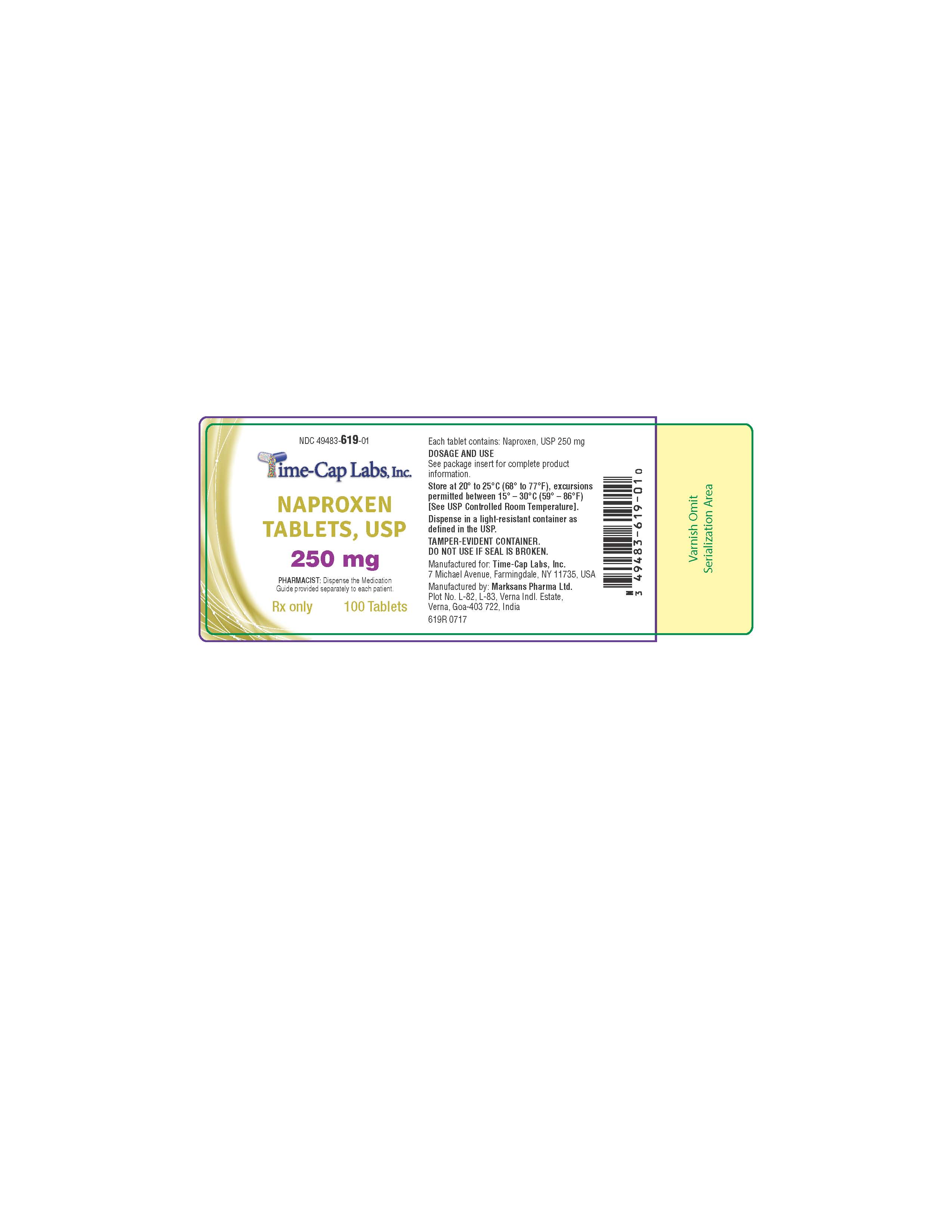
619R - NAPROXEN 250 MG 100 COUNT 250 MG 100 COUNT
617R NAPROXEN 375 MG 100 COUNT 375MG 100 COUNT
618R NAPROXEN 500 MG 100 COUNT 500 MG 100 COUNT