
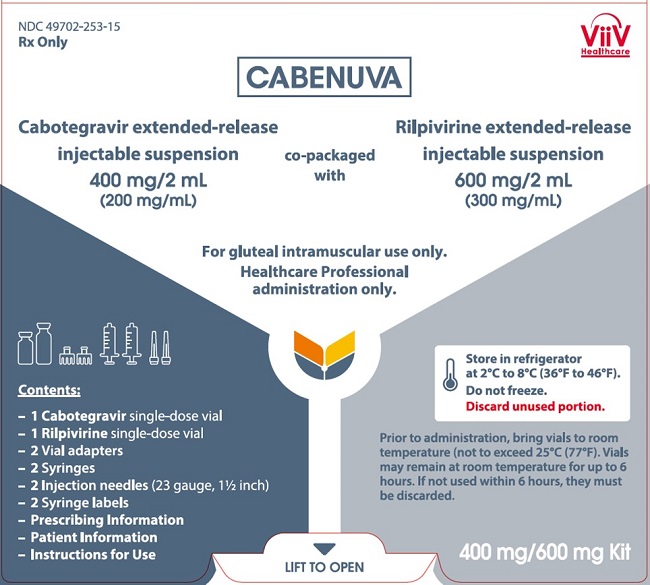
Cabenuva cabotegravir and rilpivirine Kit — NDC 49702-253-15 (Billing 49702-0253-15)
This is a package of Cabenuva cabotegravir and rilpivirine Kit from ViiV Healthcare Company, marketed since Jan 2021 and currently FDA-listed. It is this product's only package size.
NDC database record
One package, one record: these facts belong to NDC 49702-253-15 alone.
- Record
- FDA NDC Directory package listing · Human prescription drug
- Code segments
- 49702 labeler · 253 product · 15 package
- Package marketed since
- Jan 21, 2021
- Sample package
- No — commercial package
- Listing certified through
- Dec 31, 2026
- Barcode (UPC-A, from the NDC)
- 3 4970225315 5
- Medicaid fills, this package
- 3,045 prescriptions in the last four reported quarters
- FDA record last changed
- Jul 24, 2026
Identity & classification
Regulatory identifiers FDA, NLM and CMS codes for this package
Drug-database identifiers Medi-Span GPI and First Databank GCN / HICL / AHFS classification
- GSN (GCN sequence number): 081857
- GCN: 49090
- GPI-14 (Medi-Span): 1210990225G120
- HICL (First Databank): 046258
- AHFS class code: 08:18.08.12
- RxCUI (RxNorm): 2475415
Where does this data come from?
- FDA openFDA NDC Directory · synced Oct 8, 2026
- FDA label on DailyMed · label index refreshed Oct 6, 2026
- RxNorm (NLM RxNav) · catalog refreshed Oct 1, 2026
- Medi-Span GPI (licensed)
- First Databank (licensed) · refreshed Oct 8, 2026
RxNorm drug class
This medicine belongs to the Human Immunodeficiency Virus 1 Non-Nucleoside Analog Reverse Transcriptase Inhibitor class.
Where does this data come from?
- RxClass (NLM) · catalog refreshed Oct 1, 2026
Clinical
Patient education
Supplement & herbal interactions
Where does this data come from?
- MedlinePlus (NLM) · refreshed Oct 1, 2026
- FDA label on DailyMed · label index refreshed Oct 6, 2026
Ask a licensed pharmacist directly — free, answered by our team.
Pricing
A drug doesn't have one price. Each row is a different public payment system, and none is what you'd pay at the counter — that depends on your insurance. The ⓘ on each row explains what it measures.
| Price system | Per each | Per package |
|---|---|---|
| Retail pharmacies payNADAC · weekly | Not in the retail survey — common for institutional, discontinued, or low-volume packs. | |
| Medicaid paysCMS SDUD · 12 mo | $1,109.25 | — |
| Medicare drug plans payPart D · quarterly | No Part D plan price is available for this NDC in our data. | |
| Medicare Part B allowsASP · J0741 | $24.667 / J0741 unit | — |
Where does this data come from?
- CMS NADAC weekly file
- CMS ASP pricing files · refreshed Sep 20, 2026
- CMS Medicaid State Drug Utilization Data · through Q1 2026
- CMS Part D plan pricing files · refreshed Sep 24, 2026
- VA National Acquisition Center price file
Billing & reimbursement
Where does this data come from?
- CMS ASP NDC-HCPCS crosswalk · refreshed Sep 22, 2026
- DMEPDAC NDC-HCPCS crosswalk
- openFDA NSDE billing units · refreshed Oct 7, 2026
Packaging — all sizes for this product
| Package NDC | Description | Marketing start | Marketing end | Status |
|---|---|---|---|---|
| 49702-0253-15 You're viewing this Main listing | 1 KIT in 1 CARTON * 2 mL in 1 VIAL * 2 mL in 1 VIAL | 2021-01-21 | — | Active |
Therapeutic equivalents
| Product | Labeler | Pack | NADAC/unit | TE | Status | Price vs. this |
|---|---|---|---|---|---|---|
| Cabenuva 49702-0266-63 | ViiV | 1 kit | — | — | FDA listed | — |
| Cabenuvathis 49702-0253-15 | ViiV | 1 kit | — | — | FDA listed | — |
| Cabenuva 49702-0240-15 | ViiV | 1 kit | — | — | FDA listed | — |
Where does this data come from?
- FDA openFDA NDC Directory · synced Oct 8, 2026
- FDA Orange Book · refreshed Oct 3, 2026
- CMS NADAC weekly file
Availability & generic status
We did not find an FDA-approved generic match for this exact strength, form and route. Patent/protection dates below may affect future generic timing.
Why the date isn’t exact: Generic timing can change because patents may be challenged, settled, licensed, added, removed, or worked around with a narrower label — and FDA approval does not always mean a pharmacy can get the generic today.
🛈 What do these terms mean?
- Patent
- Legal protection listed in the Orange Book that may delay generic approval or launch. Issued by the U.S. Patent & Trademark Office.
- Substance patent
- Covers the active drug molecule itself — the hardest to design around. A generic generally can’t launch until it expires.
- Formulation (product) patent
- Covers a specific formulation or dosage form. A generic can sometimes work around it with a different formulation.
- Method-of-use patent
- A patent covering one specific approved use of the drug — not necessarily the whole molecule. A generic can sometimes launch with a “skinny label” that carves out the protected use and keeps the others.
- Skinny label
- A generic label that omits a still-patented use when the FDA allows it — letting a generic reach the market for the unprotected uses.
- Exclusivity
- FDA-granted marketing protection, separate from patents — e.g. 5-yr new chemical entity, 7-yr orphan drug, or a +6-month pediatric extension.
- Paragraph IV
- A generic applicant’s formal challenge to a listed patent. It can potentially lead to earlier generic entry, but often involves litigation or a settlement.
- RLD / RS
- Reference Listed Drug — the brand product the FDA uses as the reference for generic applications. Reference Standard — the product the FDA expects generics to compare against in bioequivalence testing.
- TE / AB rating
- FDA therapeutic-equivalence rating. An AB rating generally means the FDA considers a generic therapeutically equivalent to — and substitutable for — the brand.
- LOE (loss of exclusivity)
- The latest patent or exclusivity currently listed — the loss-of-exclusivity / latest-listed-protection date shown on this page. Paragraph-IV challenges and settlements can move the real date earlier; FDA approval and a manufacturer’s decision to market can move it later.
Built from the FDA Orange Book. The bars above are scaled to each protection’s expiry; the red LOE marker is the last one to lapse.
| Patent | Type | Use code | Expires |
|---|---|---|---|
| US 12178815 ↗ | Method of use | U-3348 | Jul 18, 2038 |
| US 12178815 ↗ | Method of use | U-3348 | Jul 18, 2038 |
| US 12138264 ↗ | Method of use | U-3348 | Sep 15, 2031 |
| US 12138264 ↗ | Method of use | U-3348 | Sep 15, 2031 |
| US RE50189 ↗ | Method of use | U-3348 | Nov 27, 2031 |
| US RE50189 ↗ | Method of use | U-3348 | Nov 27, 2031 |
| US 11224597 ↗ | Method of use | U-3348 | Sep 15, 2031 |
| US 11224597 ↗ | Method of use | U-3348 | Sep 15, 2031 |
| US 8410103 ↗ | Drug substance | U-3348 | Feb 4, 2031 |
| US 8410103 ↗ | Drug substance | U-3348 | Feb 4, 2031 |
| US 11389447 ↗ | Method of use | U-3405 | Jun 30, 2027 |
| US 11389447 ↗ | Method of use | U-3405 | Jun 30, 2027 |
| US 12636286 ↗ | Method of use | U-3348 | Oct 1, 2040 |
| US 12636286 ↗ | Method of use | U-3348 | Oct 1, 2040 |
| US 12636285 ↗ | Method of use | U-3348 | Oct 1, 2040 |
| US 12636285 ↗ | Method of use | U-3348 | Oct 1, 2040 |
| US 10927129 ↗ | Drug substance | — | Apr 28, 2026 |
| US 11389448 ↗ | Drug product | — | Apr 13, 2032 |
| US 10927129 ↗ | Drug substance | — | Apr 28, 2026 |
| US 11389448 ↗ | Drug product | — | Apr 13, 2032 |
| Code | What it grants | Expires |
|---|---|---|
| NCE | New Chemical Entity (5-year) | Jan 21, 2026 |
| NCE | New Chemical Entity (5-year) | Jan 21, 2026 |
Is there a generic version of CABENUVA ER 400 MG-600 MG SUSP?
The FDA approved a generic — why can’t I get it at my pharmacy yet?
Why do different websites show different generic release dates?
What does “FDA listed” mean?
What does a patent or protection date mean here?
What does “current Orange Book estimate” mean?
Can a generic come out before the last patent expires?
Can a generic come out after the listed dates?
What is the difference between patents and exclusivity?
Why are there multiple patent dates?
Where does this data come from?
- FDA Orange Book · refreshed Oct 3, 2026
What it looks like
Where does this data come from?
- FDA label on DailyMed · label index refreshed Oct 6, 2026
Inactive Ingredients / Excipients
Inactive ingredients, also called excipients, are components of the drug product other than the active ingredient. They may include fillers, dyes, coatings, preservatives, flavors, or other formulation ingredients.
Where does this data come from?
IACT rows and label-wide narrative are kept separate; availability and product-level specificity depend on the submitted label.- FDA label on DailyMed · label index refreshed Oct 6, 2026
- FDA openFDA NDC Directory · synced Oct 8, 2026
Inactive ingredient FAQ
Are inactive ingredients the same for every manufacturer?
Why might an inactive ingredient be missing?
Can inactive ingredients matter?
Manufacturer & labeler
More NDCs from ViiV Healthcare Company labeler code 49702
- Triumeq abacavir sulfate, dolutegravir sodium, lamivudine 600 mg; 50 mg; 300 mg Tablet, Film Coated NDC 49702-231-13
- Cabenuva cabotegravir and rilpivirine Kit NDC 49702-240-15
- Juluca dolutegravir sodium and rilpivirine hydrochloride 50 mg; 25 mg Tablet, Film Coated NDC 49702-242-13
- Dovato dolutegravir sodium and lamivudine 50 mg; 300 mg Tablet, Film Coated NDC 49702-246-13
- Vocabria cabotegravir sodium 30 mg Tablet, Film Coated NDC 49702-248-13
- Rukobia fostemsavir tromethamine 600 mg Tablet, Film Coated, Extended Release NDC 49702-250-18
- Tivicay PD dolutegravir sodium 5 mg Tablet, For Suspension NDC 49702-255-37
- Triumeq PD abacavir sulfate, dolutegravir sodium, lamivudine Kit NDC 49702-258-37
- SELZENTRY maraviroc Kit NDC 49702-260-55
- Apretude Cabotegravir Kit NDC 49702-264-23
- Cabenuva cabotegravir and rilpivirine Kit NDC 49702-266-63
- Apretude Cabotegravir Kit NDC 49702-280-63
Where does this data come from?
- FDA openFDA NDC Directory · synced Oct 8, 2026
- Drugs@FDA
Full prescribing information FDA SPL
🎯 Indications and Usage ▾
1 INDICATIONS AND USAGE CABENUVA is indicated as a complete regimen for the treatment of HIV-1 infection in adults and adolescents 12 years of age and older and weighing at least 35 kg to replace the current antiretroviral regimen in those who are virologically suppressed (HIV-1 RNA <50 copies/mL) on a stable antiretroviral regimen with no history of treatment failure and with no known or suspected resistance to either cabotegravir or rilpivirine [see Microbiology ( 12.4 ), Clinical Studies ( 14.1 )] . CABENUVA, a 2-drug co-packaged product of cabotegravir, an HIV-1 integrase strand transfer inhibitor (INSTI), and rilpivirine, an HIV-1 non‑nucleoside reverse transcriptase inhibitor (NNRTI), is indicated as a complete regimen for the treatment of HIV-1 infection in adults and adolescents 12 years of age and older and weighing at least 35 kg to replace the current antiretroviral regimen in those who are virologically suppressed (HIV‑1 RNA <50 copies/mL) on a stable antiretroviral regimen with no history of treatment failure and with no known or suspected resistance to either cabotegravir or rilpivirine.
( 1 )
⏱️ Dosage and Administration ▾
2 DOSAGE AND ADMINISTRATION • Refer to full prescribing information for detailed information on dosage and administration recommendations. ( 2 ) • Prior to initiating treatment with CABENUVA, oral lead-in dosing may be considered to assess the tolerability of cabotegravir and rilpivirine with the recommended dosage used for approximately 1 month. ( 2.3 ) • For gluteal intramuscular injection only.
( 2.4 , 2.5 , 2.9 ) • Recommended Monthly Dosing Schedule: Initiate injections of CABENUVA (600 mg of cabotegravir and 900 mg of rilpivirine) on the last day of current antiretroviral therapy or oral lead-in and continue with injections of CABENUVA (400 mg of cabotegravir and 600 mg of rilpivirine) every month thereafter. ( 2.4 ) • Recommended Every-2-Month Dosing Schedule: Initiate injections of CABENUVA (600 mg of cabotegravir and 900 mg of rilpivirine) on the last day of current antiretroviral therapy or oral lead-in for 2 consecutive months and continue with injections of CABENUVA every 2 months thereafter.
( 2.5 )
2.1Dosage and Administration Overview • CABENUVA contains cabotegravir extended-release injectable suspension in a single-dose vial and rilpivirine extended-release injectable suspension in a single-dose vial [see Dosage Forms and Strengths ( 3 )] . • CABENUVA must be administered by a healthcare provider by gluteal intramuscular injection [see Dosage and Administration ( 2.9 )] . • CABENUVA may be initiated with oral cabotegravir and oral rilpivirine prior to the intramuscular injections or the patient may proceed directly to injection of CABENUVA without an oral lead-in [see Dosage and Administration ( 2.3 )] . • CABENUVA can be injected monthly or every 2 months [see Dosage and Administration ( 2.4 , 2.5 )] .
Healthcare providers should discuss these 2 dosing options with the patient prior to starting CABENUVA and decide which injection dosing frequency would be the most appropriate option for the patient [see Adverse Reactions ( 6.1 ), Microbiology ( 12.4 ), Clinical Studies ( 14.1 )] .
2.2Adherence to CABENUVA Prior to starting CABENUVA, healthcare providers should carefully select patients who agree to the required monthly or every‑2-month injection dosing schedule and counsel patients about the importance of adherence to scheduled dosing visits to help maintain viral suppression and reduce the risk of viral rebound and potential development of resistance with missed doses [see Dosage and Administration ( 2.1 ), Warnings and Precautions ( 5.6 ), Microbiology ( 12.4 )] .
2.3Optional Oral Lead-In Dosing to Assess Tolerability of CABENUVA in Adults and Adolescents 12 Years of Age and Older and Weighing at Least 35 kg The healthcare provider and patient may decide to use an oral lead-in with oral cabotegravir and oral rilpivirine prior to the initiation of CABENUVA to assess the tolerability of cabotegravir and rilpivirine, or the healthcare provider and patient may proceed directly to injection of CABENUVA without the use of an oral lead-in. If oral lead-in is used, the recommended oral lead-in daily dose is one 30-mg tablet of VOCABRIA (cabotegravir) and one 25-mg tablet of EDURANT (rilpivirine) taken with a meal for approximately 1 month (at least 28 days), followed by intramuscular initiation injections of CABENUVA.
See Tables 1 and 2 for recommended oral lead-in and monthly or every-2-month intramuscular injection dosing schedule for CABENUVA [see Dosage and Administration ( 2.4 , 2.5 )] .
2.4Recommended Monthly Gluteal Intramuscular Injection Dosing with CABENUVA in Adults and Adolescents 12 Years of Age and Older and Weighing at Least 35 kg Initiation Injections (CABENUVA 600-mg/900-mg Kit) Initiate injections on the last day of current antiretroviral therapy or oral lead-in, if used [see Dosage and Administration ( 2.3 )] . The recommended initiation injection doses of CABENUVA are a single 600-mg (3-mL) intramuscular injection of cabotegravir and a single 900-mg (3-mL) intramuscular injection of rilpivir… [Excerpted — this section continues on DailyMed.]
💊 Dosage Forms and Strengths ▾
3 DOSAGE FORMS AND STRENGTHS Injection: • Kit of single-dose vials of 400 mg/2 mL (200 mg/mL) of cabotegravir extended-release injectable suspension and 600 mg/2 mL (300 mg/mL) of rilpivirine extended-release injectable suspension. ( 3 ) • Kit of single-dose vials of 600 mg/3 mL (200 mg/mL) of cabotegravir extended-release injectable suspension and 900 mg/3 mL (300 mg/mL) of rilpivirine extended-release injectable suspension. ( 3 ) Injection: • Kit of single-dose vials of 400 mg/2 mL (200 mg/mL) of cabotegravir extended-release injectable suspension and 600 mg/2 mL (300 mg/mL) of rilpivirine extended-release injectable suspension.
( 3 ) • Kit of single-dose vials of 600 mg/3 mL (200 mg/mL) of cabotegravir extended-release injectable suspension and 900 mg/3 mL (300 mg/mL) of rilpivirine extended-release injectable suspension. ( 3 )
⛔ Contraindications ▾
4 CONTRAINDICATIONS CABENUVA is contraindicated in patients: • with previous hypersensitivity reaction to cabotegravir or rilpivirine [see Warnings and Precautions ( 5.1 )] . • receiving the following coadministered drugs for which significant decreases in cabotegravir and/or rilpivirine plasma concentrations may occur due to uridine diphosphate glucuronosyltransferase (UGT)1A1 and/or cytochrome P450 (CYP)3A enzyme induction, which may result in loss of virologic response [see Drug Interactions ( 7 ), Clinical Pharmacology ( 12.3 )] : o Anticonvulsants: Carbamazepine, oxcarbazepine, phenobarbital, phenytoin o Antimycobacterials: Rifabutin, rifampin, rifapentine o Glucocorticoid (systemic): Dexamethasone (more than a single-dose treatment) o Herbal product: St John’s wort ( Hypericum perforatum ) • Previous hypersensitivity reaction to cabotegravir or rilpivirine.
( 4 ) • Coadministration with drugs where significant decreases in cabotegravir and/or rilpivirine plasma concentrations may occur, which may result in loss of virologic response. ( 4 )
⚠️ Warnings and Cautions ▾
5 WARNINGS AND PRECAUTIONS • Serious or severe hypersensitivity reactions have been reported with cabotegravir- and rilpivirine-containing regimens. Reactions associated with cabotegravir include Stevens-Johnson syndrome (SJS)/toxic epidermal necrolysis (TEN). Reactions associated with rilpivirine-containing regimens include cases of drug reaction with eosinophilia and systemic symptoms (DRESS).
Discontinue CABENUVA immediately if signs or symptoms of hypersensitivity reactions develop. ( 5.1 ) • Serious post-injection reactions with rilpivirine were reported. Monitor and treat as clinically indicated.
( 5.2 ) • Hepatotoxicity has been reported in patients receiving cabotegravir or rilpivirine. Monitoring of liver chemistries is recommended. Discontinue CABENUVA if hepatotoxicity is suspected.
( 5.3 ) • Depressive disorders have been reported with CABENUVA. Prompt evaluation is recommended for depressive symptoms. ( 5.4 ) • Residual concentrations of cabotegravir and rilpivirine may remain in the systemic circulation of patients up to 12 months or longer.
It is essential to initiate an alternative, fully suppressive antiretroviral regimen no later than 1 month after the final injections of CABENUVA when dosed monthly and no later than 2 months after the final injections when dosed every 2 months. If virologic failure is suspected, prescribe an alternative regimen as soon as possible. ( 5.6 )
5.1Hypersensitivity Reactions Serious or severe hypersensitivity reactions have been reported with cabotegravir- and rilpivirine-containing regimens. Reactions associated with cabotegravir include Stevens-Johnson syndrome (SJS)/toxic epidermal necrolysis (TEN) [see Adverse Reactions ( 6.2 )] . Reactions associated with rilpivirine-containing regimens include cases of drug reaction with eosinophilia and systemic symptoms (DRESS) [see Adverse Reactions ( 6.1 , 6.2 )] .
While some skin reactions were accompanied by constitutional symptoms such as fever, other skin reactions were associated with organ dysfunctions, including elevations in hepatic serum biochemistries. Administration of cabotegravir and rilpivirine oral lead-in dosing was used in clinical studies to help identify patients who may be at risk of a hypersensitivity reaction [see Dosage and Administration ( 2.3 ), Contraindications ( 4 )] . Remain vigilant and discontinue CABENUVA if a hypersensitivity reaction is suspected [see Contraindications ( 4 ), Adverse Reactions ( 6 )] .
Discontinue CABENUVA immediately if signs or symptoms of hypersensitivity reactions develop (including, but not limited to, severe rash, or rash accompanied by fever, general malaise, fatigue, muscle or joint aches, blisters, mucosal involvement [oral blisters or lesions], conjunctivitis, facial edema, hepatitis, eosinophilia, angioedema, difficulty breathing). Clinical status, including liver transaminases, should be monitored and appropriate therapy initiated. For information regarding the long-acting properties of CABENUVA, [see Warnings and Precautions ( 5.6 )] .
Administer oral lead-in dosing prior to administration of CABENUVA to help identify patients who may be at risk of a hypersensitivity reaction [see Dosage and Administration ( 2.3 ), Contraindications ( 4 )] .
5.2Post-Injection Reactions In clinical trials, serious post-injection reactions were reported within minutes after the injection of rilpivirine. These events included symptoms such as dyspnea, bronchospasm, agitation, abdominal cramping, rash/urticaria, dizziness, flushing, sweating, oral numbness, changes in blood pressure, and pain (e.g., back and chest). These events were reported in <1% of participants and began to resolve within minutes after the injection, with some patients receiving supportive care.
These events may have been associated with accidental intravenous administration during the intramuscular injection procedure [see Adverse Reactions ( 6.1 )] . Carefully follow the Instructions for Use when preparing and administer… [Excerpted — this section continues on DailyMed.]
🤒 Adverse Reactions ▾
6 ADVERSE REACTIONS The following adverse reactions are described below and in other sections of the labeling: • Hypersensitivity reactions [see Warnings and Precautions ( 5.1 )] • Post-injection reactions [see Warnings and Precautions ( 5.2 )] • Hepatotoxicity [see Warnings and Precautions ( 5.3 )] • Depressive disorders [see Warnings and Precautions ( 5.4 )] The most common adverse reactions (Grades 1 to 4) observed in ≥2% of participants receiving CABENUVA were injection site reactions, pyrexia, fatigue, headache, musculoskeletal pain, nausea, sleep disorders, dizziness, and rash.
( 6.1 ) To report SUSPECTED ADVERSE REACTIONS, contact ViiV Healthcare at 1-877-844-8872 or FDA at 1-800-FDA-1088 or www.fda.gov/medwatch .
6.1Clinical Trials Experience Because clinical trials are conducted under widely varying conditions, adverse reaction rates observed in the clinical trials of a drug cannot be directly compared with rates in the clinical trials of another drug and may not reflect rates observed in practice. Clinical Trials Experience in Adults The safety assessment of CABENUVA is based on the analysis of pooled 48-week data from 1,182 virologically suppressed participants with HIV-1 infection in 2 international, multicenter, open-label pivotal trials, FLAIR and ATLAS, and 1,045 virologically suppressed participants from the ATLAS-2M trial [see Clinical Studies ( 14.1 )] .
Additional safety information from other ongoing or earlier clinical trials in the cabotegravir and rilpivirine program have been considered in assessing the overall safety profile of CABENUVA. Adverse reactions were reported following exposure to CABENUVA extended-release injectable suspensions (median time exposure at the time of analysis: 54 weeks in FLAIR and ATLAS, and 64 weeks in ATLAS-2M) and data from VOCABRIA (cabotegravir) tablets and EDURANT (rilpivirine) tablets administered in combination as oral lead-in therapy (median time exposure: 5.3 weeks in FLAIR and ATLAS, and 5.6 weeks in ATLAS-2M).
Adverse reactions included those attributable to both the oral and injectable formulations of cabotegravir and rilpivirine administered as a combination regimen. Refer to the prescribing information for EDURANT (rilpivirine) for other adverse reactions associated with oral rilpivirine. The most common adverse reactions regardless of severity reported in ≥2% of adult participants from FLAIR and ATLAS at Week 48 are presented in Table 5 .
Selected laboratory abnormalities are included in Table 7 . At Week 96, the overall safety profile for FLAIR was consistent with that observed at Week 48, with no new safety findings identified. In the extension phase of the FLAIR study at Week 124, the overall safety profile was consistent with that observed at Week 48 and when injection therapy with CABENUVA was initiated directly without the oral lead-in phase.
Overall, 4% of participants in the group receiving CABENUVA and 2% of participants in the control group in FLAIR and ATLAS discontinued due to adverse events. Non-injection-site-related adverse events leading to discontinuation and occurring in more than 1 participant were headache, diarrhea, hepatitis A, and acute hepatitis B (all with an incidence <1%). In ATLAS-2M, 2% of participants in both treatment groups discontinued due to adverse events.
Non-injection-site–related adverse events leading to discontinuation and occurring in more than 1 participant in ATLAS-2M were fatigue, pyrexia, headache, presyncope, acute hepatitis B, hyperhidrosis, and abnormal dreams that occurred with an incidence of ≤1% in either treatment group. Table 5. Adverse Reactions a (Grades 1 to 4) Reported in at Least 2% of Participants with HIV-1 Infection in FLAIR and ATLAS Trials (Week 48 Pooled Analyses) a Adverse reactions defined as “treatment-related” as assessed by the investigator. b See Injection-Associated Adverse Reactions for additional information. c Pyrexia: includes pyrexia, feeling hot, chills, influenza-like illness, body t… [Excerpted — this section continues on DailyMed.]
🔄 Drug Interactions ▾
7 DRUG INTERACTIONS • Refer to the full prescribing information for important drug interactions with CABENUVA. ( 4 , 5.5 , 7 ) • Because CABENUVA is a complete regimen, coadministration with other antiretroviral medications for the treatment of HIV-1 infection is not recommended. ( 7.1 ) • Drugs that induce uridine diphosphate glucuronosyltransferase (UGT)1A1 or cytochrome P450 (CYP)3A4 may decrease the plasma concentrations of the components of CABENUVA.
( 4 , 7.3 , 7.4 ) • CABENUVA should be used with caution in combination with drugs with a known risk of Torsade de Pointes. ( 7.3 , 7.4 )
7.1Concomitant Use with Other Antiretroviral Medicines Because CABENUVA is a complete regimen, coadministration with other antiretroviral medications for the treatment of HIV-1 infection is not recommended [see Indications and Usage ( 1 )] .
7.2Use of Other Antiretroviral Drugs after Discontinuation of CABENUVA Residual concentrations of cabotegravir and rilpivirine may remain in the systemic circulation of patients for prolonged periods (up to 12 months or longer). These residual concentrations are not expected to affect the exposures of antiretroviral drugs that are initiated after discontinuation of CABENUVA [see Warnings and Precautions ( 5.6 ), Drug Interactions ( 7.4 ), Clinical Pharmacology ( 12.3 )] .
7.3Potential for Other Drugs to Affect CABENUVA Refer to the prescribing information for VOCABRIA (cabotegravir) and EDURANT (rilpivirine) for additional drug interaction information related to oral cabotegravir and oral rilpivirine, respectively. Cabotegravir Cabotegravir is primarily metabolized by UGT1A1 with some contribution from UGT1A9. Drugs that are strong inducers of UGT1A1 or UGT1A9 are expected to decrease cabotegravir plasma concentrations and may result in loss of virologic response; therefore, coadministration of CABENUVA with these drugs is contraindicated [see Contraindications ( 4 )] .
Rilpivirine Rilpivirine is primarily metabolized by CYP3A. Coadministration of CABENUVA and drugs that induce CYP3A may result in decreased plasma concentrations of rilpivirine and loss of virologic response and possible resistance to rilpivirine or to the class of NNRTIs [see Contraindications ( 4 ), Drug Interactions ( 7.4 )]. Coadministration of CABENUVA and drugs that inhibit CYP3A may result in increased plasma concentrations of rilpivirine [see Drug Interactions ( 7.4 ), Clinical Pharmacology ( 12.3 )] .
QT-Prolonging Drugs: At mean steady-state C max values 4.4- and 11.6-fold higher than those with the recommended 600‑mg dose of rilpivirine extended-release injectable suspension, rilpivirine may prolong the QTc interval [see Clinical Pharmacology ( 12.2 )] . CABENUVA should be used with caution in combination with drugs with a known risk of Torsade de Pointes [see Warnings and Precautions ( 5.5 ), Drug Interactions ( 7.4 )] .
7.4Established and Other Potentially Significant Drug Interactions Refer to the prescribing information for VOCABRIA (cabotegravir) and EDURANT (rilpivirine) for additional drug interaction information related to oral cabotegravir and oral rilpivirine, respectively. Information regarding potential drug interactions with cabotegravir and rilpivirine is provided in Table 8 . These recommendations are based on either drug interaction trials following oral administration of cabotegravir or rilpivirine or predicted interactions due to the expected magnitude of the interaction and potential for loss of virologic response [see Contraindications ( 4 ), Warnings and Precautions ( 5.5 ), Clinical Pharmacology ( 12.3 )] .
Table 8 includes potentially significant interactions but is not all inclusive. Table 8. Drug Interactions with CABENUVA ↑ = Increase, ↓ = Decrease, ↔ = No change. a See Clinical Pharmacology ( 12.3 ) for magnitude of interaction.
Concomitant Drug Class: Drug Name Effect on Concentration Clinical Comment Anticonvulsants: Carbamazepine Oxcarbazepine Phenobarbital Phenytoin ↓Cabotegravir ↓Rilpivirine… [Excerpted — this section continues on DailyMed.]
👥 Use in Specific Populations ▾
8 USE IN SPECIFIC POPULATIONS • Pregnancy: After oral use of rilpivirine, exposures were generally lower during pregnancy compared with the postpartum period. ( 8.1 )
8.1Pregnancy Pregnancy Exposure Registry There is a pregnancy exposure registry that monitors pregnancy outcomes in individuals exposed to CABENUVA during pregnancy. Healthcare providers are encouraged to register patients by calling the Antiretroviral Pregnancy Registry (APR) at 1-800-258-4263. Risk Summary There are insufficient human data on the use of CABENUVA during pregnancy to adequately assess a drug-associated risk of birth defects and miscarriage.
Discuss the benefit-risk of using CABENUVA with individuals of childbearing potential or during pregnancy. Cabotegravir and rilpivirine are detected in systemic circulation for up to 12 months or longer after discontinuing injections of CABENUVA; therefore, consideration should be given to the potential for fetal exposure during pregnancy [see Warnings and Precautions ( 5.6 ), Drug Interactions ( 7.2 )] . Cabotegravir use in pregnant individuals has not been evaluated.
Available data from the APR show no difference in the overall risk of birth defects for rilpivirine compared with the background rate for major birth defects of 2.7% in a United States (U.S.) reference population of the Metropolitan Atlanta Congenital Defects Program (MACDP) (see Data ). The rate of miscarriage is not reported in the APR. The background risk for major birth defects and miscarriage for the indicated population is unknown.
The background rate for major birth defects in a U.S. reference population of the MACDP is 2.7%. The estimated background rate of miscarriage in clinically recognized pregnancies in the U.S. general population is 15% to 20%. The APR uses the MACDP as the U.S. reference population for birth defects in the general population.
The MACDP evaluates mothers and infants from a limited geographic area and does not include outcomes for births that occurred at <20 weeks’ gestation. In animal reproduction studies with oral cabotegravir, a delay in the onset of parturition and increased stillbirths and neonatal deaths were observed in a rat pre- and postnatal development study at >28 times the exposure at the recommended human dose (RHD). No evidence of adverse developmental outcomes was observed with oral cabotegravir in rats or rabbits (>28 times or similar to the exposure at the RHD, respectively) given during organogenesis (see Data ).
No adverse developmental outcomes were observed when rilpivirine was administered orally at exposures 15 (rats) and 70 (rabbits) times the exposure in humans at the RHD (see Data ). Clinical Considerations Lower exposures with oral rilpivirine were observed during pregnancy. Viral load should be monitored closely if the patient remains on CABENUVA during pregnancy.
Cabotegravir and rilpivirine are detected in systemic circulation for up to 12 months or longer after discontinuing injections of CABENUVA; therefore, consideration should be given to the potential for fetal exposure during pregnancy [see Warnings and Precautions ( 5.6 ), Drug Interactions ( 7.2 )] . Data Human Data: Rilpivirine: Based on prospective reports to the APR of over 580 exposures to oral rilpivirine-containing regimens during the first trimester of pregnancy and over 200 during second/third trimester of pregnancy, the prevalence of birth defects in live births was 1.5% (95% CI: 0.7% to 2.9%) and 1.5% (95% CI: 0.3% to 4.2%) following first and second/third trimester exposures, respectively, compared with the background birth defect rate of 2.7% in the U.S. reference population of the MACDP.
In a clinical trial, total oral rilpivirine exposures were generally lower during pregnancy compared with the postpartum period. Refer to the prescribing information for EDURANT (rilpivirine) for additional information on rilpivirine. Animal Data: Cabotegravir: Cabotegravir was administered orally to pregnant rats at 0, 0.5, 5, or… [Excerpted — this section continues on DailyMed.]
🤰 Pregnancy ▾
8.1Pregnancy Pregnancy Exposure Registry There is a pregnancy exposure registry that monitors pregnancy outcomes in individuals exposed to CABENUVA during pregnancy. Healthcare providers are encouraged to register patients by calling the Antiretroviral Pregnancy Registry (APR) at 1-800-258-4263. Risk Summary There are insufficient human data on the use of CABENUVA during pregnancy to adequately assess a drug-associated risk of birth defects and miscarriage.
Discuss the benefit-risk of using CABENUVA with individuals of childbearing potential or during pregnancy. Cabotegravir and rilpivirine are detected in systemic circulation for up to 12 months or longer after discontinuing injections of CABENUVA; therefore, consideration should be given to the potential for fetal exposure during pregnancy [see Warnings and Precautions ( 5.6 ), Drug Interactions ( 7.2 )] . Cabotegravir use in pregnant individuals has not been evaluated.
Available data from the APR show no difference in the overall risk of birth defects for rilpivirine compared with the background rate for major birth defects of 2.7% in a United States (U.S.) reference population of the Metropolitan Atlanta Congenital Defects Program (MACDP) (see Data ). The rate of miscarriage is not reported in the APR. The background risk for major birth defects and miscarriage for the indicated population is unknown.
The background rate for major birth defects in a U.S. reference population of the MACDP is 2.7%. The estimated background rate of miscarriage in clinically recognized pregnancies in the U.S. general population is 15% to 20%. The APR uses the MACDP as the U.S. reference population for birth defects in the general population.
The MACDP evaluates mothers and infants from a limited geographic area and does not include outcomes for births that occurred at <20 weeks’ gestation. In animal reproduction studies with oral cabotegravir, a delay in the onset of parturition and increased stillbirths and neonatal deaths were observed in a rat pre- and postnatal development study at >28 times the exposure at the recommended human dose (RHD). No evidence of adverse developmental outcomes was observed with oral cabotegravir in rats or rabbits (>28 times or similar to the exposure at the RHD, respectively) given during organogenesis (see Data ).
No adverse developmental outcomes were observed when rilpivirine was administered orally at exposures 15 (rats) and 70 (rabbits) times the exposure in humans at the RHD (see Data ). Clinical Considerations Lower exposures with oral rilpivirine were observed during pregnancy. Viral load should be monitored closely if the patient remains on CABENUVA during pregnancy.
Cabotegravir and rilpivirine are detected in systemic circulation for up to 12 months or longer after discontinuing injections of CABENUVA; therefore, consideration should be given to the potential for fetal exposure during pregnancy [see Warnings and Precautions ( 5.6 ), Drug Interactions ( 7.2 )] . Data Human Data: Rilpivirine: Based on prospective reports to the APR of over 580 exposures to oral rilpivirine-containing regimens during the first trimester of pregnancy and over 200 during second/third trimester of pregnancy, the prevalence of birth defects in live births was 1.5% (95% CI: 0.7% to 2.9%) and 1.5% (95% CI: 0.3% to 4.2%) following first and second/third trimester exposures, respectively, compared with the background birth defect rate of 2.7% in the U.S. reference population of the MACDP.
In a clinical trial, total oral rilpivirine exposures were generally lower during pregnancy compared with the postpartum period. Refer to the prescribing information for EDURANT (rilpivirine) for additional information on rilpivirine. Animal Data: Cabotegravir: Cabotegravir was administered orally to pregnant rats at 0, 0.5, 5, or 1,000 mg/kg/day from 15 days before cohabitation, during cohabitation, and from Gestation Days 0 to 17.
There were no effects on fetal viability when fetuses were del… [Excerpted — this section continues on DailyMed.]
🧒 Pediatric Use ▾
8.4Pediatric Use The safety and effectiveness of CABENUVA have been established in adolescents aged 12 to younger than 18 years and weighing at least 35 kg, which is supported by the following: • Trials in adults [see Clinical Studies ( 14.1 )] • MOCHA (NCT03497676) trial in adolescents, in which virologically suppressed adolescents with HIV-1 (aged 12 to younger than 18 years and weighing at least 35 kg) received either cabotegravir or rilpivirine in addition to their background antiretroviral regimen (cohort 1), or cabotegravir plus rilpivirine as a complete regimen (cohort 2) [see Adverse Reactions ( 6.1 ), Clinical Pharmacology ( 12.3 ), Clinical Studies ( 14.2 )] .
The safety and efficacy in adolescents (aged 12 to younger than 18 years and weighing at least 35 kg) were similar to that in adults and there was no clinically significant change in exposure for the components of CABENUVA [see Adverse Reactions ( 6.1 )] . The efficacy of CABENUVA in adolescents is extrapolated from adults with support from pharmacokinetic analyses showing similar drug exposure and additional supportive efficacy data from the MOCHA study [see Clinical Pharmacology ( 12.3 ), Clinical Studies ( 14.2 )] .
The safety, efficacy, and pharmacokinetics of CABENUVA have not been established in pediatric patients younger than 12 years of age or weighing <35 kg.
🧓 Geriatric Use ▾
8.5Geriatric Use Clinical trials of CABENUVA did not include sufficient numbers of participants aged 65 years and older to determine whether they respond differently from younger participants. In general, caution should be exercised in administration of CABENUVA in elderly patients, reflecting greater frequency of decreased hepatic, renal, or cardiac function and of concomitant disease or other drug therapy [see Clinical Pharmacology ( 12.3 )] .
🆘 Overdosage ▾
10 OVERDOSAGE There is no known specific treatment for overdose with cabotegravir or rilpivirine. If overdose occurs, monitor the patient and apply standard supportive treatment as required, including monitoring of vital signs and ECG (QT interval) as well as observation of the clinical status of the patient. As both cabotegravir and rilpivirine are highly bound to plasma proteins, it is unlikely that either would be significantly removed by dialysis.
Consider the prolonged exposure to cabotegravir and rilpivirine (components of CABENUVA) following an injection when assessing treatment needs and recovery [see Warnings and Precautions ( 5.6 )] .
🧬 Clinical Pharmacology ▾
12 CLINICAL PHARMACOLOGY
12.1Mechanism of Action CABENUVA contains 2 long-acting HIV-1 antiretroviral drugs, cabotegravir and rilpivirine [see Microbiology ( 12.4 )] .
12.2Pharmacodynamics Cardiac Electrophysiology At a dose of cabotegravir 150 mg orally every 12 hours (10 times the recommended total daily oral lead-in dosage of CABENUVA), the QT interval is not prolonged to any clinically relevant extent. Administration of 3 doses of cabotegravir 150 mg orally every 12 hours resulted in a geometric mean C max approximately 2.8-, 5.4-, and 5.6-fold above the geometric mean steady-state C max associated with the recommended 30‑mg dose of oral cabotegravir, the recommended 400‑mg dose given monthly, and the recommended 600-mg dose given every 2 months of cabotegravir extended-release injectable suspension, respectively.
At the recommended dose of rilpivirine 25 mg orally once daily, the QT interval is not prolonged to any clinically relevant extent. The rilpivirine 25-mg once-daily mean steady-state C max was 247 ng/mL, which is 1.7-fold higher than the mean steady-state C max observed with the recommended 600-mg dose of rilpivirine extended-release injectable suspension given monthly and 1.6-fold higher than the mean steady-state C max observed with the recommended 900-mg dose of rilpivirine extended-release injectable suspension given every 2 months.
When rilpivirine 75-mg and 300-mg once-daily oral doses (3 and 12 times, respectively, the recommended oral lead-in dosage) were studied in healthy adults, the maximum mean time-matched (95% upper confidence bound) differences in QTcF interval were 10.7 (15.3) and 23.3 (28.4) msec, respectively, after baseline and placebo adjustment. Steady-state administration of rilpivirine 75 mg once daily and 300 mg once daily resulted in a mean steady-state C max approximately 4.4- and 11.6-fold, respectively, higher than the mean steady-state C max observed with the recommended 600-mg dose of rilpivirine extended-release injectable suspension given monthly and approximately 4.1- and 10.7-fold, respectively, higher than the mean steady-state C max observed with the recommended 900-mg dose of rilpivirine extended-release injectable suspension given every 2 months.
The corresponding C max ratios are 2.6 and 6.7 when compared with the recommended oral rilpivirine dosage [see Warnings and Precautions ( 5.5 )] .
12.3Pharmacokinetics Absorption, Distribution, and Elimination The pharmacokinetic properties of the components of CABENUVA are provided in Table 9 . The multiple-dose pharmacokinetic parameters are provided in Table 10 . For the pharmacokinetic properties of oral cabotegravir and oral rilpivirine, refer to the full prescribing information for VOCABRIA (cabotegravir) and EDURANT (rilpivirine), respectively.
Table 9. Pharmacokinetic Properties of the Components of CABENUVA CSF = Cerebrospinal Fluid, BLQ = Below Limit of Quantification. a When taken orally with a high-fat meal versus fasted, the AUC (0-inf) (geometric mean ratio [90% CI] of cabotegravir and rilpivirine are 1.14 [1.02, 1.28] and 1.72 [1.36, 2.16]), respectively. b The clinical relevance of CSF-to-plasma concentration ratios is unknown. Concentrations were measured at steady-state 1 week after intramuscular administration of cabotegravir and rilpivirine extended-release injectable suspensions given monthly or every 2 months. c Elimination half-life driven by slow absorption rate from the intramuscular injection site. d Dosing in mass balance studies: single-dose oral administration of [ 14 C] cabotegravir; single-dose oral administration of [ 14 C] rilpivirine.
Cabotegravir Rilpivirine Absorption a T max (days), median 7 3 to 4 Distribution % Bound to human plasma proteins >99.8
99.7Blood-to-plasma ratio 0.52
0.7CSF-to-plasma concentration ratio (median [range]) b 0.003 0.01 (0.002 to 0.004) (BLQ to 0.02) Elimination t 1/2 (weeks), mean c 5.6 to 11.5 13 to 28 Metabolism Metabolic pathways UGT1A1 CYP3A UGT1A9 (minor) Excre… [Excerpted — this section continues on DailyMed.]
🧬 Mechanism of Action ▾
12.1Mechanism of Action CABENUVA contains 2 long-acting HIV-1 antiretroviral drugs, cabotegravir and rilpivirine [see Microbiology ( 12.4 )] .
📦 How Supplied / Storage and Handling ▾
16 HOW SUPPLIED/STORAGE AND HANDLING How Supplied CABENUVA is supplied in 2 dosing kits. Each kit contains 1 vial of cabotegravir extended‑release injectable suspension and 1 vial of rilpivirine extended-release injectable suspension, co‑packaged as follows: CABENUVA 400-mg/600-mg Kit (NDC 49702-253-15) containing: • One single-dose vial of cabotegravir extended-release injectable suspension containing 400 mg/2 mL (200 mg/mL) of cabotegravir. • One single-dose vial of rilpivirine extended-release injectable suspension containing 600 mg/2 mL (300 mg/mL) of rilpivirine CABENUVA 600-mg/900-mg Kit (NDC 49702-240-15) containing: • One single-dose vial of cabotegravir extended-release injectable suspension containing 600 mg/3 mL (200 mg/mL) of cabotegravir. • One single-dose vial of rilpivirine extended-release injectable suspension containing 900 mg/3 mL (300 mg/mL) of rilpivirine.
Each dosing kit also contains 2 syringes, 2 syringe labels, 2 vial adapters, and 2 needles for intramuscular injection (23-gauge, 1½ inch). The vial stoppers are not made with natural rubber latex. Storage and Handling Store CABENUVA in the refrigerator at 2°C to 8°C (36°F to 46°F) in the original carton until ready to use.
Do not freeze. Do not mix with any other product or diluent. Prior to administration, vials should be brought to room temperature (not to exceed 25°C [77°F]).
Vials may remain in the carton at room temperature for up to 6 hours; do not put back into the refrigerator. If not used within 6 hours, they must be discarded. Once the suspensions have been drawn into the respective syringes, the injections should be administered as soon as possible, but may remain in the syringes for up to 2 hours.
The filled syringes should not be placed in the refrigerator. If the medicines remain in the syringes for more than 2 hours, the filled syringes and needles must be discarded [see Dosage and Administration ( 2.9 )] .
📋 Description ▾
11 DESCRIPTION CABENUVA contains cabotegravir extended-release injectable suspension, an HIV INSTI, co-packaged with rilpivirine extended-release injectable suspension, an HIV NNRTI. Cabotegravir The chemical name for cabotegravir is ( 3S,11aR )-N-[(2,4-difluorophenyl)methyl]-6-hydroxy-3-methyl-5,7-dioxo-2,3,5,7,11,11a-hexahydro[1,3]oxazolo[3,2-a]pyrido[1,2-d]pyrazine-8-carboxamide. The empirical formula is C 19 H 17 F 2 N 3 O 5 and the molecular weight is 405.35 g/mol.
It has the following structural formula: Cabotegravir extended-release injectable suspension is a white to light pink free-flowing suspension for intramuscular injection in a sterile single-dose vial. Each vial contains 2 mL or 3 mL of the following: cabotegravir 200 mg/mL and the inactive ingredients mannitol (35 mg/mL), polyethylene glycol (PEG) 3350 (20 mg/mL), polysorbate 20 (20 mg/mL), and Water for Injection. The vial stoppers are not made with natural rubber latex.
Rilpivirine The chemical name for rilpivirine is 4-[[4-[[4-[(E)-2-cyanoethenyl]-2,6-dimethylphenyl]amino]-2-pyrimidinyl]amino]benzonitrile. Its molecular formula is C 22 H 18 N 6 and its molecular weight is 366.42. Rilpivirine has the following structural formula: Rilpivirine extended-release injectable suspension is a white to off-white suspension for intramuscular injection.
Each sterile single-dose vial contains 2 mL or 3 mL of the following: rilpivirine 300 mg/mL and the following inactive ingredients: citric acid monohydrate (1 mg/mL), dextrose to ensure isotonicity, monobasic sodium phosphate (1.74 mg/mL), poloxamer 338 (50 mg/mL), sodium hydroxide to adjust pH, and Water for Injection. The vial stoppers are not made with natural rubber latex. Cabotegravir chemical structure Rilpivirine chemical structure
💬 Information for Patients ▾
17 PATIENT COUNSELING INFORMATION Advise the patient to read the FDA-approved patient labeling (Patient Information). Hypersensitivity Reactions Advise patients to immediately contact their healthcare provider if they develop a rash. Instruct patients to immediately stop taking CABENUVA and seek medical attention if they develop a rash associated with any of the following symptoms, as it may be a sign of a more serious reaction such as Stevens-Johnson syndrome (SJS)/toxic epidermal necrolysis (TEN) or drug reaction with eosinophilia and systemic symptoms (DRESS): fever; generally ill feeling; extreme tiredness; muscle or joint aches; blisters; oral blisters or lesions; eye inflammation; facial swelling; swelling of the eyes, lips, tongue, or mouth; difficulty breathing; and/or signs and symptoms of liver problems (e.g., yellowing of the skin or whites of the eyes; dark or tea-colored urine; pale-colored stools or bowel movements; nausea; vomiting; loss of appetite; or pain, aching, or sensitivity on the right side below the ribs).
Advise patients that if hypersensitivity occurs, they will be closely monitored, laboratory tests will be ordered, and appropriate therapy will be initiated [see Warnings and Precautions ( 5.1 )] . Adverse Reactions Following Injections Advise patients that injection site reactions have been reported in the majority of patients receiving CABENUVA. These local reactions typically consist of one or more of the following: pain, erythema, tenderness, pruritus, and local swelling.
Systemic reactions have also been reported, such as fever, musculoskeletal pain, and sciatica pain [see Adverse Reactions ( 6.1 )] . Serious post-injection reactions were reported within minutes after the injection of rilpivirine, including dyspnea, bronchospasm, agitation, abdominal cramping, rash/urticaria, dizziness, flushing, sweating, oral numbness, changes in blood pressure, and back pain (e.g., back and chest). These events began to resolve within minutes after the injection.
Advise patients that they will be observed briefly (approximately 10 minutes) after the injection. If they experience a post-injection reaction, they will be monitored and appropriate treatment administered [see Warnings and Precautions ( 5.2 )] . Hepatotoxicity Inform patients that hepatotoxicity has been reported with cabotegravir and rilpivirine, components of CABENUVA [see Warnings and Precautions ( 5.3 ), Adverse Reactions ( 6.1 )] .
Inform patients that monitoring for liver transaminases is recommended. Depressive Disorders Inform patients that depressive disorders (including depressed mood, depression, major depression, mood altered, mood swings, unusual mood, negative thoughts, suicidal ideation, suicide attempt) have been reported with at least one of the components of CABENUVA. Advise patients to seek prompt medical evaluation if they experience depressive symptoms [see Warnings and Precautions ( 5.4 ), Adverse Reactions ( 6.1 )] .
Drug Interactions Inform patients that CABENUVA may interact with other drugs; therefore, advise patients to report to their healthcare provider the use of any other prescription or nonprescription medication or herbal products, including St. John’s wort. CABENUVA is an extended-release injectable that may be systemically present for 12 months or longer.
These residual concentrations are not expected to affect the exposures of antiretroviral drugs that are initiated after discontinuation of CABENUVA [see Contraindications ( 4 ), Drug Interactions ( 7 )] . Adherence to CABENUVA Counsel patients about the importance of continued medication adherence and scheduled visits to help maintain viral suppression and to reduce risk of loss of virologic response and development of resistance [see Dosage and Administration ( 2.1 ), Warnings and Precautions ( 5.6 )] . Two Options for Dosing Frequency Advise the patient that CABENUVA can be injected monthly or every 2 months after oral lead‑in with cabotegravir and rilpivirine… [Excerpted — this section continues on DailyMed.]
🧬 Pharmacokinetics ▾
12.3Pharmacokinetics Absorption, Distribution, and Elimination The pharmacokinetic properties of the components of CABENUVA are provided in Table 9 . The multiple-dose pharmacokinetic parameters are provided in Table 10 . For the pharmacokinetic properties of oral cabotegravir and oral rilpivirine, refer to the full prescribing information for VOCABRIA (cabotegravir) and EDURANT (rilpivirine), respectively.
Table 9. Pharmacokinetic Properties of the Components of CABENUVA CSF = Cerebrospinal Fluid, BLQ = Below Limit of Quantification. a When taken orally with a high-fat meal versus fasted, the AUC (0-inf) (geometric mean ratio [90% CI] of cabotegravir and rilpivirine are 1.14 [1.02, 1.28] and 1.72 [1.36, 2.16]), respectively. b The clinical relevance of CSF-to-plasma concentration ratios is unknown. Concentrations were measured at steady-state 1 week after intramuscular administration of cabotegravir and rilpivirine extended-release injectable suspensions given monthly or every 2 months. c Elimination half-life driven by slow absorption rate from the intramuscular injection site. d Dosing in mass balance studies: single-dose oral administration of [ 14 C] cabotegravir; single-dose oral administration of [ 14 C] rilpivirine.
Cabotegravir Rilpivirine Absorption a T max (days), median 7 3 to 4 Distribution % Bound to human plasma proteins >99.8
99.7Blood-to-plasma ratio 0.52
0.7CSF-to-plasma concentration ratio (median [range]) b 0.003 0.01 (0.002 to 0.004) (BLQ to 0.02) Elimination t 1/2 (weeks), mean c 5.6 to 11.5 13 to 28 Metabolism Metabolic pathways UGT1A1 CYP3A UGT1A9 (minor) Excretion Major route of elimination Metabolism Metabolism % of dose excreted as total 14 C (unchanged drug) in urine d 27 (0) 6 (<1) % of dose excreted as total 14 C (unchanged drug) in feces d 59 (47) 85 (26) Table 10. Pharmacokinetic Parameters following Once-Daily Oral Cabotegravir and Rilpivirine and following Initiation and Monthly and Every-2-Month Continuation Intramuscular Injections of the Components of CABENUVA in Adults IM = Intramuscular. a Pharmacokinetic parameter values were based on individual post-hoc estimates from separate cabotegravir and rilpivirine population pharmacokinetic models (cabotegravir: pooled FLAIR and ATLAS for the oral, initial, and monthly injection dosing schedule and ATLAS-2M [participants with no prior exposure to cabotegravir plus rilpivirine] for the every-2-month injection dosing schedule; rilpivirine: pooled FLAIR, ATLAS, and ATLAS-2M [participants with no prior exposure], except for initial injection (direct to injection) [see footnote e] and for oral rilpivirine [see footnote g] ). b tau is dosing interval: 24 hours for oral cabotegravir and rilpivirine, 1 month for cabotegravir and rilpivirine extended-release injectable suspensions given monthly, 2 months for cabotegravir and rilpivirine extended-release injectable suspensions given every 2 months. c Oral lead-in pharmacokinetic parameter values represent steady-state. d Initial injection C max values primarily reflect oral dosing because the initial injection was administered on the same day as the last oral dose; however, AUC (0-tau) and the C tau values reflect the initial injections for cabotegravir and rilpivirine. e Pharmacokinetic parameters for initial injection (direct to injection) based on observed data from FLAIR Extension Phase (n = 110), AUC not calculated based on observed data, C max = 1 week following initial injection, C tau = 1 month following initial injection. f Monthly and every-2-month injection pharmacokinetic parameter values represent Week 48 data. g Oral rilpivirine: AUC (0-tau) based on population pharmacokinetic estimates of rilpivirine 25 mg once daily from pooled Phase 3 trials with EDURANT (rilpivirine); C tau based on observed data from FLAIR, ATLAS, and ATLAS-2M; C max based on observed data for rilpivirine 25 mg once daily from a pharmacokinetic substudy in pooled Phase 3 trials with EDURANT (rilpivirine).
Drug Dosing… [Excerpted — this section continues on DailyMed.]
🧬 Pharmacodynamics ▾
12.2Pharmacodynamics Cardiac Electrophysiology At a dose of cabotegravir 150 mg orally every 12 hours (10 times the recommended total daily oral lead-in dosage of CABENUVA), the QT interval is not prolonged to any clinically relevant extent. Administration of 3 doses of cabotegravir 150 mg orally every 12 hours resulted in a geometric mean C max approximately 2.8-, 5.4-, and 5.6-fold above the geometric mean steady-state C max associated with the recommended 30‑mg dose of oral cabotegravir, the recommended 400‑mg dose given monthly, and the recommended 600-mg dose given every 2 months of cabotegravir extended-release injectable suspension, respectively.
At the recommended dose of rilpivirine 25 mg orally once daily, the QT interval is not prolonged to any clinically relevant extent. The rilpivirine 25-mg once-daily mean steady-state C max was 247 ng/mL, which is 1.7-fold higher than the mean steady-state C max observed with the recommended 600-mg dose of rilpivirine extended-release injectable suspension given monthly and 1.6-fold higher than the mean steady-state C max observed with the recommended 900-mg dose of rilpivirine extended-release injectable suspension given every 2 months.
When rilpivirine 75-mg and 300-mg once-daily oral doses (3 and 12 times, respectively, the recommended oral lead-in dosage) were studied in healthy adults, the maximum mean time-matched (95% upper confidence bound) differences in QTcF interval were 10.7 (15.3) and 23.3 (28.4) msec, respectively, after baseline and placebo adjustment. Steady-state administration of rilpivirine 75 mg once daily and 300 mg once daily resulted in a mean steady-state C max approximately 4.4- and 11.6-fold, respectively, higher than the mean steady-state C max observed with the recommended 600-mg dose of rilpivirine extended-release injectable suspension given monthly and approximately 4.1- and 10.7-fold, respectively, higher than the mean steady-state C max observed with the recommended 900-mg dose of rilpivirine extended-release injectable suspension given every 2 months.
The corresponding C max ratios are 2.6 and 6.7 when compared with the recommended oral rilpivirine dosage [see Warnings and Precautions ( 5.5 )] .
🔬 Clinical Studies ▾
14 CLINICAL STUDIES
14.1Clinical Trials in Adults Monthly Dosing Trials The efficacy of CABENUVA has been evaluated in 2 Phase 3 randomized, multicenter, active-controlled, parallel-arm, open-label, non-inferiority trials: • Trial 201584 (FLAIR [NCT02938520]), (n = 629): antiretroviral treatment (ART)‑naive participants with HIV-1 received a dolutegravir INSTI-containing regimen for 20 weeks (either dolutegravir/abacavir/lamivudine or dolutegravir plus 2 other NRTIs if participants were HLA‑B*5701 positive). Participants who were virologically suppressed (HIV-1 RNA <50 copies/mL, n = 566) were then randomized (1:1) to receive either a cabotegravir plus rilpivirine regimen or remain on the current antiretroviral regimen.
Participants randomized to receive cabotegravir plus rilpivirine initiated treatment with daily oral lead-in dosing with one 30-mg VOCABRIA (cabotegravir) tablet plus one 25-mg EDURANT (rilpivirine) tablet for at least 4 weeks followed by monthly injections with CABENUVA for an additional 44 weeks [see Dosage and Administration ( 2.2 , 2.3 )] . • Trial 201585 (ATLAS [NCT02951052]), (n = 616): ART-experienced, virologically-suppressed (for at least 6 months; median prior treatment duration was 4.3 years) participants (HIV-1 RNA <50 copies/mL) with HIV-1 were randomized and received either a cabotegravir plus rilpivirine regimen or remained on their current antiretroviral regimen.
Participants randomized to receive cabotegravir plus rilpivirine initiated treatment with daily oral lead-in dosing with one 30-mg VOCABRIA (cabotegravir) tablet plus one 25-mg EDURANT (rilpivirine) tablet for at least 4 weeks followed by monthly injections with CABENUVA for an additional 44 weeks [see Dosage and Administration ( 2.2 , 2.3 )] . The primary analysis was conducted after all participants completed their Week 48 visit or discontinued the trial prematurely. At baseline, in FLAIR and ATLAS the median age was 34 years and 40 years, 22% and 32% were female, and 24% and 31% were non-White, respectively.
In both studies, 7% had CD4+ cell count <350 cells/mm 3 ; these characteristics were similar between treatment arms. In ATLAS, participants received an NNRTI (50%), integrase inhibitor (33%), or protease inhibitor (17%) as their baseline third-agent class prior to randomization; this was similar between treatment arms. Participants with hepatitis B co-infection were excluded from the trial.
The primary endpoint of FLAIR and ATLAS was the proportion of participants with plasma HIV-1 RNA ≥50 copies/mL at Week 48. The primary endpoint and other Week 48 outcomes, including outcomes by key baseline factors, for FLAIR and ATLAS are shown in Tables 17 and 18 . Table 17.
Virologic Outcomes of Randomized Treatment in FLAIR and ATLAS Trials at Week 48 CAB = Cabotegravir, RPV = Rilpivirine, CAR = Current Antiretroviral Regimen, n = Number of participants in each treatment group, CI = Confidence Interval. a Includes participants who discontinued for lack of efficacy and discontinued while not suppressed. Virologic Outcomes FLAIR Monthly Dosing ATLAS Monthly Dosing CAB plus RPV (n = 283) CAR (n = 283) CAB plus RPV (n = 308) CAR (n = 308) HIV-1 RNA ≥50 copies/mL a 2% 2% 2% 1% Treatment difference -0.4% 0.7% (95% CI: -2.8%, 2.1%) (95% CI: -1.2%, 2.5%) HIV-1 RNA <50 copies/mL 94% 93% 93% 95% No virologic data at Week 48 window 4% 4% 6% 4% Discontinued due to adverse event or death 3% <1% 4% 2% Discontinued for other reasons 1% 4% 2% 2% Missing data during window but on study 0 0 0 0 Adjusted for study and randomization stratification factors, treatment difference of HIV-1 RNA ≥50 copies/mL for the pooled data was 0.2% with 95% CI (-1.4%, 1.7%).
Table 18. Proportion of Participants in FLAIR and ATLAS Trials with Plasma HIV-1 RNA ≥50 copies/mL at Week 48 for Key Baseline Factors CAB = Cabotegravir, RPV = Rilpivirine, CAR = Current Antiretroviral Regimen. Baseline Factors FLAIR Monthly Dosing ATLAS Monthly Dosing CAB plus RPV (N = 283) n/N (%) CAR… [Excerpted — this section continues on DailyMed.]
🧪 Nonclinical Toxicology ▾
13 NONCLINICAL TOXICOLOGY
13.1Carcinogenesis, Mutagenesis, Impairment of Fertility Carcinogenesis Two-year carcinogenicity studies in mice and rats were conducted with cabotegravir. In mice, no drug-related increases in tumor incidence were observed at cabotegravir exposures (AUC) up to approximately 8 times (males) and 7 times (females) higher than those in humans at the RHD. In rats, no drug-related increases in tumor incidence were observed at cabotegravir exposures up to approximately 26 times higher than those in humans at the RHD.
Two-year carcinogenicity studies in mice and rats were conducted with rilpivirine. In mice, rilpivirine was positive for hepatocellular neoplasms in both males and females. The observed hepatocellular findings in mice may be rodent-specific.
At the lowest tested dose in the mouse carcinogenicity study, the systemic exposure to rilpivirine was 21 times that observed in humans at the RHD. In rats, no drug-related neoplasms were observed at exposures 3 times those observed in humans at the RHD. Mutagenesis Cabotegravir and rilpivirine were not genotoxic in the bacterial reverse mutation assay, mouse lymphoma assay, or in the in vivo rodent micronucleus assay.
Impairment of Fertility In rats, no effects on fertility were observed at cabotegravir exposures (AUC) >20 times (male) and 28 times (female) the exposure in humans at the RHD. Similarly, no effects on fertility were observed in rats at rilpivirine exposures (AUC) >36 times (male) and 40 times (female) the exposure in humans at the RHD.
📄 Carcinogenesis, Mutagenesis, Impairment of Fertility ▾
13.1Carcinogenesis, Mutagenesis, Impairment of Fertility Carcinogenesis Two-year carcinogenicity studies in mice and rats were conducted with cabotegravir. In mice, no drug-related increases in tumor incidence were observed at cabotegravir exposures (AUC) up to approximately 8 times (males) and 7 times (females) higher than those in humans at the RHD. In rats, no drug-related increases in tumor incidence were observed at cabotegravir exposures up to approximately 26 times higher than those in humans at the RHD.
Two-year carcinogenicity studies in mice and rats were conducted with rilpivirine. In mice, rilpivirine was positive for hepatocellular neoplasms in both males and females. The observed hepatocellular findings in mice may be rodent-specific.
At the lowest tested dose in the mouse carcinogenicity study, the systemic exposure to rilpivirine was 21 times that observed in humans at the RHD. In rats, no drug-related neoplasms were observed at exposures 3 times those observed in humans at the RHD. Mutagenesis Cabotegravir and rilpivirine were not genotoxic in the bacterial reverse mutation assay, mouse lymphoma assay, or in the in vivo rodent micronucleus assay.
Impairment of Fertility In rats, no effects on fertility were observed at cabotegravir exposures (AUC) >20 times (male) and 28 times (female) the exposure in humans at the RHD. Similarly, no effects on fertility were observed in rats at rilpivirine exposures (AUC) >36 times (male) and 40 times (female) the exposure in humans at the RHD.
📄 Patient Package Insert ▾
PATIENT INFORMATION CABENUVA [KAB-en-ew-vah] (cabotegravir extended-release injectable suspension; rilpivirine extended-release injectable suspension) co-packaged for intramuscular use What is CABENUVA? CABENUVA is a prescription medicine that is used without other human immunodeficiency virus-1 (HIV-1) medicines to treat HIV-1 infection in people 12 years of age and older who weigh at least 77 pounds (35 kg) to replace their current HIV-1 medicines when their healthcare provider determines that they meet certain requirements.
HIV-1 is the virus that causes acquired immune deficiency syndrome (AIDS). CABENUVA contains 2 different medicines: • cabotegravir • rilpivirine It is not known if CABENUVA is safe and effective in children younger than 12 years of age or weighing less than 77 pounds (35 kg). Do not receive CABENUVA if you: • have ever had an allergic reaction to cabotegravir or rilpivirine. • are taking any of the following medicines: • carbamazepine • oxcarbazepine • phenobarbital • phenytoin • rifabutin • rifampin • rifapentine • dexamethasone (more than a single-dose treatment) • St John’s wort (Hypericum perforatum) Before you receive CABENUVA, tell your healthcare provider about all your medical conditions, including if you: • have ever had a skin rash or an allergic reaction to medicines that contain cabotegravir or rilpivirine. • have or have had liver problems, including hepatitis B or C infection. • have or ever had kidney problems. • have ever had mental health problems. • are pregnant or plan to become pregnant.
It is not known if CABENUVA will harm your unborn baby. CABENUVA can remain in your body for up to 12 months or longer after the last injection. Tell your healthcare provider if you become pregnant during or after treatment with CABENUVA.
Pregnancy Registry. There is a pregnancy registry for those who take CABENUVA during pregnancy. The purpose of this registry is to collect information about the health of you and your baby.
Talk to your healthcare provider about how you can take part in this registry. • are breastfeeding or plan to breastfeed. CABENUVA may pass into your breast milk. Talk to your healthcare provider about the following risks to your baby from breastfeeding during or after treatment with CABENUVA: o the HIV-1 virus may pass to your baby if your baby does not have HIV-1 infection. o the HIV-1 virus may become harder to treat if your baby has HIV-1 infection. o your baby may get side effects from CABENUVA.
Tell your healthcare provider about all the medicines you take, including prescription and over-the-counter medicines, vitamins, and herbal supplements. Some medicines interact with CABENUVA. Keep a list of your medicines and show it to your healthcare provider and pharmacist when you get a new medicine.
You can ask your healthcare provider or pharmacist for a list of medicines that interact with CABENUVA. Do not start taking a new medicine without telling your healthcare provider. Your healthcare provider can tell you if it is safe to take CABENUVA with other medicines.
How will I receive CABENUVA? • Your healthcare provider will inject CABENUVA into the muscle of each side of your buttocks or on the same side of your buttocks at least 2 cm apart. • You will receive CABENUVA as 2 injections (cabotegravir and rilpivirine), either one time every month or one time every 2 months. • Before receiving your first injection doses of CABENUVA, your healthcare provider may have you take 1 VOCABRIA (cabotegravir) tablet and 1 EDURANT (rilpivirine) tablet 1 time a day for 1 month (at least 28 days).
This will allow your healthcare provider to assess how well you tolerate these medicines. • CABENUVA is a long-acting medicine and may stay in your system for 12 months or longer after your last injection. • Stay under the care of a healthcare provider during treatment with CABENUVA. It is important that you attend your planned appointments to receive your injection doses of CABENUVA. • If you miss o… [Excerpted — this section continues on DailyMed.]
📖 Instructions for Use ▾
Overview: A complete dose of CABENUVA requires two injections: 400 mg (2 mL) of cabotegravir and 600 mg (2 mL) of rilpivirine. Cabotegravir and rilpivirine are suspensions that do not need further dilution or reconstitution. The preparation steps for both medicines are the same.
Carefully follow these instructions when preparing the suspension for injection to avoid leakage. Cabotegravir and rilpivirine are for gluteal intramuscular use only. Each injection must be administered to separate gluteal intramuscular sites (on opposite sides or at least 2 cm apart).
Note: The ventrogluteal site is recommended. The administration order is not important. Storage information Store in refrigerator at 2°C to 8°C (36°F to 46°F).
Do not freeze. Prior to administration: • Before preparing the injections, the vials may sit in the carton at room temperature (maximum temperature of 25°C [77°F]) for up to 6 hours; do not put back into the refrigerator. If not used within 6 hours, the medicines must be discarded. • Once the medicines have been drawn into the syringes, they can remain in the syringes for up to 2 hours before injection.
The filled syringes should not be placed in the refrigerator. If the medicines remain in the syringes for more than 2 hours, the filled syringes and needles must be discarded. • It is recommended to label each syringe with the time that the medicine has been drawn into the syringe if the medicine is not administered immediately. Your pack contains: • 1 vial of Cabotegravir • 1 vial of Rilpivirine • 2 vial adapters • 2 syringes • 2 syringe labels • 2 injection needles (23 gauge, 1½ inch) Consider the patient’s build and use medical judgment to select an appropriate injection needle length.
You will also need: • Non-sterile gloves • 4 alcohol wipes • 4 gauze pads • A suitable sharps container Preparation: 1. Inspect both vials. Figure A • Check that the expiration date has not passed.
See Figure A. • Inspect the vials immediately. If you can see foreign matter, do not use the product. Note: The Cabotegravir vial has a brown tint to the glass.
Do not use if the expiration date has passed. 2. Wait 15 minutes.
Figure B • Wait at least 15 minutes before you are ready to give the injection to allow the medicine to come to room temperature. See Figure B. 3.
Shake the vial vigorously. Figure C • Hold the vial firmly, and vigorously shake for a full 10 seconds. See Figure C.
Note: Vial preparation order is not important. 4. Inspect suspension.
Figure D • Invert the vial and confirm the suspension is uniform. It should look uniform. See Figure D. • If the suspension is not uniform, shake the vial again. • It is also normal to see small air bubbles.
5. Remove the vial cap. Figure E • Remove the cap from the vial.
See Figure E. • Wipe the rubber stopper with an alcohol wipe. Do not allow anything to touch the rubber stopper after wiping it. 6.
Peel open the vial adapter. Figure F • Peel off the paper backing from the vial adapter packaging. See Figure F.
Note: Do not remove the adapter from its packaging for the next step. The adapter will not fall out when its packaging is turned upside down. 7.
Place vial on flat surface and attach the vial adapter. Figure G • Ensure the vial is upright and on a flat surface. • Press the vial adapter straight down onto the vial, as shown. • The vial adapter should click securely into place. See Figure G.
8. Lift off the packaging. Figure H • Lift off the vial adapter packaging, as shown.
See Figure H. 9. Prepare the syringe.
Figure I • Remove the syringe from its packaging. • Draw 1 mL of air into the syringe. This will make it easier to draw up the medicine later. See Figure I.
10. Attach the syringe. Figure J • Hold the vial adapter and vial firmly, as shown. • Screw the syringe firmly onto the vial adapter.
See Figure J. 11. Press the plunger.
Figure K • Press the plunger all the way down to push the air into the vial. See Figure K. 12.
Slowly draw up the dose. Figure L • Invert the syring… [Excerpted — this section continues on DailyMed.]
📄 Recent Major Changes ▾
Warnings and Precautions, Hypersensitivity Reactions ( 5.1 ) 4/2025
📄 Package Label / Principal Display Panel ▾
PRINCIPAL DISPLAY PANEL NDC 49702-253-15 CABENUVA Cabotegravir extended-release injectable suspension 400 mg/2 mL (200 mg/mL) co-packaged with Rilpivirine extended-release injectable suspension 600 mg/2 mL (300 mg/mL) Rx Only ViiV Healthcare For gluteal intramuscular use only. Healthcare Professional administration only. Contents: • 1 Cabotegravir single-dose vial • 1 Rilpivirine single-dose vial • 2 Vial adapters • 2 Syringes • 2 Injection needles (23 gauge, 1 ½ inch) • 2 Syringe labels • Prescribing Information • Patient Information • Instructions for Use Store in refrigerator at 2°C to 8°C (36°F to 46°F).
Do not freeze. Discard unused portion. Prior to administration, bring vials to room temperature (not to exceed 25°C (77°F).
Vials may remain at room temperature for up to 6 hours. If not used within 6 hours, they must be discarded. Ensure vial adapter is used correctly.
400 mg/600 mg Kit Cabotegravir – Made in Singapore and Belgium Rilpivirine – Made in Belgium and Ireland ©2025 ViiV Healthcare group of companies or its licensor. Rev. 9/25 620000000101118 Cabenua 400 mg-600mg carton
PRINCIPAL DISPLAY PANEL NDC 49702-240-15 CABENUVA Cabotegravir extended-release injectable suspension 600 mg/3 mL (200 mg/mL) co-packaged with Rilpivirine extended-release injectable suspension 900 mg/3 mL (300 mg/mL) Rx Only ViiV Healthcare For gluteal intramuscular use only. Healthcare Professional administration only. Contents: • 1 Cabotegravir single-dose vial • 1 Rilpivirine single-dose vial • 2 Vial adapters • 2 Syringes • 2 Injection needles (23 gauge, 1 ½ inch) • 2 Syringe labels • Prescribing Information • Patient Information • Instructions for Use Store in refrigerator at 2°C to 8°C (36°F to 46°F).
Do not freeze. Discard unused portion. Prior to administration, bring vials to room temperature (not to exceed 25°C (77°F).
Vials may remain at room temperature for up to 6 hours. If not used within 6 hours, they must be discarded. Ensure vial adapter is used correctly.
600 mg/900 mg Kit Cabotegravir – Made in Singapore and Belgium Rilpivirine – Made in Belgium and Ireland ©2025 ViiV Healthcare group of companies or its licensor. Rev. 9/25 620000000101176 Cabenua 600 mg-900mg carton
PRINCIPAL DISPLAY PANEL NDC 49702-266-63 CABENUVA Cabotegravir extended-release injectable suspension 600 mg/3 mL (200 mg/mL) co-packaged with Rilpivirine extended-release injectable suspension 900 mg/3 mL (300 mg/mL) Rx Only Sample-Not for Sale ViiV Healthcare For gluteal intramuscular use only. Healthcare Professional administration only. Contents: • 1 Cabotegravir single-dose vial • 1 Rilpivirine single-dose vial • 2 Vial adapters • 2 Syringes • 2 Injection needles (23 gauge, 1 ½ inch) • 2 Syringe labels • Prescribing Information • Patient Information • Instructions for Use Store in refrigerator at 2°C to 8°C (36°F to 46°F).
Do not freeze. Discard unused portion. Prior to administration, bring vials to room temperature (not to exceed 25°C (77°F).
Vials may remain at room temperature for up to 6 hours. If not used within 6 hours, they must be discarded. Ensure vial adapter is used correctly.
600 mg/900 mg Kit Cabotegravir – Made in Singapore and Belgium Rilpivirine – Made in Belgium and Ireland ©2025 ViiV Healthcare group of companies or its licensor. Rev. 9/25 62000000010112 Cabenua 600 mg-900mg sample carton
Medicaid utilization & spend
Medicare Part D spend CMS · PART D · 2026 (Q1)
About this NDC listing & data coverage
Kit / multi-component package
This NDC identifies a kit — a package containing more than one component. Structured data (pricing, ingredients, equivalents) is often reported per component rather than for the kit NDC itself, which can make this page look thinner than the components' own pages.
What data is (and isn’t) available for this NDC — tap to expand
| NDC identity (package / product / labeler codes) | ✓ Available |
| Labeler | ✓ Available |
| Product & package description | ✓ Available |
| Marketing category & status | ✓ Available |
| Active ingredient / dosage form / route | ✓ Available |
| FDA label (SPL via DailyMed) | ✓ Available |
| Package photos | ✓ Available |
| Inactive ingredients (structured) | — Not published for this NDC The labeler did not submit a structured excipient list, or no SPL is available. |
| NADAC pharmacy acquisition price (CMS) | — Not published for this NDC CMS publishes NADAC only for NDCs reported in its retail-pharmacy survey. |
| Orange Book / therapeutic-equivalence data | ✓ Available |
| HCPCS J-code billing crosswalk | ✓ Available |
| Medicaid utilization (CMS SDUD) | ✓ Available |