
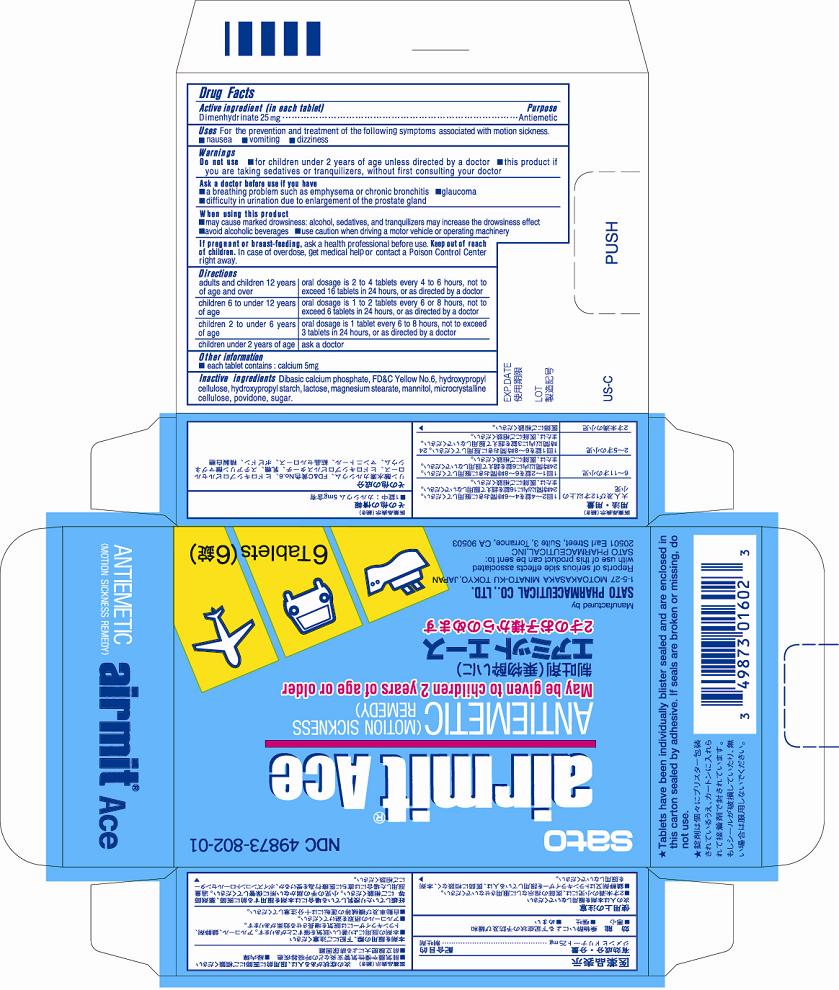
Airmit Ace dimenhydrinate 25 mg Tablet, 6-count
🆔 Identity & classification
Where does this data come from?
🏷️ RxNorm drug class
This medicine belongs to the Aminoalkyl ethers class.
Where does this data come from?
🏭 Manufacturer & labeler
Where does this data come from?
🩺 Clinical
Dimenhydrinate is used to prevent and treatmotion sickness. Dimenhydrinate is in a class of medications called antihistamines. It works by preventing problems with body balance.
Read the full MedlinePlus article ↗- Dimenhydrinate works by calming your inner ear when it gets overstimulated during travel — that's the root cause of the nausea, vomiting, and dizziness you feel. It's proven effect...
- What exactly does dimenhydrinate do — and will it stop my motion sickness?
- Drowsiness is the most common side effect — it's very real and something to plan for. Avoid driving or operating machinery until you know how dimenhydrinate affects you. Alcohol, s...
- It can be used in children as young as 2 years old — but only with a doctor's guidance for children under 2, and never in newborns. In young children especially, antihistamine over...
Patient education
Supplement & herbal interactions
Some supplements/herbs that may interact with Dimenhydrinate — tap one for details:
Where does this data come from?
Ask a licensed pharmacist directly — free, answered by our team.
💊 What it looks like
Where does this data come from?
🧪 Inactive Ingredients / Excipients
Inactive ingredients, also called excipients, are components of the drug product other than the active ingredient. They may include fillers, dyes, coatings, preservatives, flavors, or other formulation ingredients.
💡 Tap an ingredient (hover on desktop) to see what it is and why it’s used.
-
UNII L11K75P92J
A mineral salt made from calcium and phosphate. It acts as a filler and binder in tablets to add bulk and help hold the medicine together in solid form.
-
UNII OP1R32D61U
Microcrystalline cellulose is a purified form of cellulose, a natural fiber from plant sources. It acts as a binder and filler in tablets and capsules, helping hold ingredients together and give the medicine its shape and size.
-
UNII H77VEI93A8
A synthetic yellow dye used to color medications. It helps identify the drug and make it visually distinctive, with no effect on how the medicine works.
-
UNII RFW2ET671P
Hydroxypropyl cellulose is a plant-derived thickening agent made from cellulose. It acts as a binder to hold tablet ingredients together and as a film-former to coat tablets or control how fast the medicine releases.
-
UNII 9M44R3409A
A modified corn starch where some starch molecules have hydroxypropyl groups attached. It's used as a binder and disintegrant to help hold tablet ingredients together and allow the tablet to break apart properly when swallowed.
-
UNII J2B2A4N98G
Lactose is a natural sugar derived from milk. In medications, it serves as a filler and binder to add bulk and help hold tablet or capsule ingredients together during manufacturing.
-
UNII 70097M6I30
Magnesium stearate is a salt made from magnesium and stearic acid, a fatty substance. It's used in tablets and capsules as a lubricant and glidant to help ingredients flow smoothly during manufacturing and prevent sticking.
-
UNII 3OWL53L36A
A natural sugar alcohol derived from seaweed or synthesized in the lab. It's used as a filler to add bulk, a sweetener in sugar-free formulas, and a disintegrant to help tablets break apart in the stomach.
-
UNII FZ989GH94E
Povidone is a synthetic polymer made from a plastic-like material. It acts as a binder to hold tablet ingredients together and as a disintegrant to help the tablet break apart in your stomach so the medicine can be absorbed.
-
UNII C151H8M554
A natural sugar derived from sugar cane or sugar beets. It's used as a sweetener, filler, and binder to improve taste, add bulk, and help hold tablet or capsule ingredients together.
10 inactive ingredients listed in the exact product block matched to this NDC.
Label-section wording can be broader than the structured product block and may mention additional formulation ingredients.
Where does this data come from?
ingredient classCode="IACT" elements from the exact product block matched by this NDC. Label-section narrative from DailyMed / the openFDA label index is shown separately when available.Inactive ingredient FAQ
Are inactive ingredients the same for every manufacturer?
Why might an inactive ingredient be missing?
Can inactive ingredients matter?
💲 Pricing
A drug doesn't have one price. Each row is a different public payment system, and none is what you'd pay at the counter — that depends on your insurance. The ⓘ on each row explains what it measures.
| Price system | Per each | Per package |
|---|---|---|
| Retail pharmacies payNADAC · weekly | Not in the retail survey — common for institutional, discontinued, or low-volume packs. | |
| Medicaid paysCMS SDUD · 12 mo | No recent Medicaid claims on file for this NDC — rare and low-volume NDCs are suppressed in the public data. | |
| Medicare drug plans payPart D · quarterly | No Part D plan price is available for this NDC in our data. | |
Where does this data come from?
🔁 Therapeutic equivalents
| Product | Labeler | Pack | NADAC/unit | TE | Status | Price vs. this |
|---|---|---|---|---|---|---|
| Airmit Ace 25 mgthis 49873-0802-01 | Sato | 6 tablets | — | — | FDA listed | — |
Where does this data come from?
⏳ Availability & generic status
We did not find an FDA-approved generic match for this exact strength, form and route.
Where does this data come from?
📊 Medicare Part D spend CMS · PART D · 2025 (Q1-Q4)
📦 Packaging — all sizes for this product
| Package NDC | Description | Marketing start | Status |
|---|---|---|---|
| 49873-0802-01 You're viewing this | 1 BLISTER PACK in 1 CARTON (49873-802-01) / 6 TABLET in 1 BLISTER PACK | 2005-03-11 | Active |
🧭 About this NDC listing & data coverage
What data is (and isn’t) available for this NDC — tap to expand
| NDC identity (package / product / labeler codes) | ✓ Available |
| Labeler | ✓ Available |
| Product & package description | ✓ Available |
| Marketing category & status | ✓ Available |
| Active ingredient / dosage form / route | ✓ Available |
| FDA label (SPL via DailyMed) | ✓ Available |
| Package photos | ✓ Available |
| Inactive ingredients (structured) | ✓ Available |
| NADAC pharmacy acquisition price (CMS) | — Not published for this NDC CMS publishes NADAC only for NDCs reported in its retail-pharmacy survey. |
| Orange Book / therapeutic-equivalence data | — Not published for this NDC Applies only to products approved under an NDA/ANDA; many listings are out of scope. |
| HCPCS J-code billing crosswalk | — Not published for this NDC Most self-administered / retail products have no J-code — that is normal. |
| Medicaid utilization (CMS SDUD) | — Not published for this NDC CMS reports utilization only for NDCs with Medicaid claims above its privacy threshold. |
Questions about this listing
Is this NDC FDA-approved?
Why is there no price listed?
Is the NDC printed on the package the same as the 11-digit billing NDC?
What do the three segments of this NDC mean?
Is this package still being marketed?
Who lists this product with the FDA?
Do I need a prescription for this product?
Where does this data come from?
📄 FDA label — Drug Facts FDA SPL
🎯 Indications and Usage ▾
Uses For the prevention and treatment of the following symptoms associated with motion sickness ■nausea ■vomiting ■dizziness
⏱️ Dosage and Administration ▾
Directions adults and children 12 years of age and over - oral dosage is 2 to 4 tablets every 4 to 6 hours, not to exceed 16 tablets in 24 hours, or as directed by a doctor children 6 to under 12 years of age - oral dosage is 1 to 2 tablets every 6 to 8 hours, not to exceed 6 tablets in 24 hours, or as directed by a doctor children 2 to under 6 years of age - oral dosage is 1 tablet every 6 to 8 hours, not to exceed 3 tablets in 24 hours, or as directed by a doctor children under 2 years of age - ask a doctor
⚠️ Warnings ▾
Warnings Do not use ■for children under 2 years of age unless directed by a doctor ■this product if you are taking sedatives or tranquilizers, without first consulting your doctor Ask a doctor before use if you have ■a breathing problem such as emphysema or chronic bronchitis ■glaucoma ■difficulty in urination due to enlargement of the prostate gland When using this product ■may cause marked drowsiness: alcohol, sedatives, and tranquilizers may increase the drowsiness effect ■avoid alcoholic beverages ■use caution when driving a motor vehicle or operating machinery If pregnant or breast-feeding , ask a health professional before use.
Keep our of reach of children . In case of over dose, get medical help or contact a Poison Control Center right away.
🧪 Active Ingredient ▾
Active ingredient (in each tablet) Dimenhydrinate 25 mg
🧪 Inactive Ingredients ▾
Inactive ingredients Dibasic calcium phosphate, FD and C Yellow No. 6, hydroxypropyl cellulose, hydroxypropyl starch, lactose, magnesium stearate, mannitol, microcrystalline cellulose, povidone, sugar.
🎯 Purpose ▾
Purpose Antiemetic