
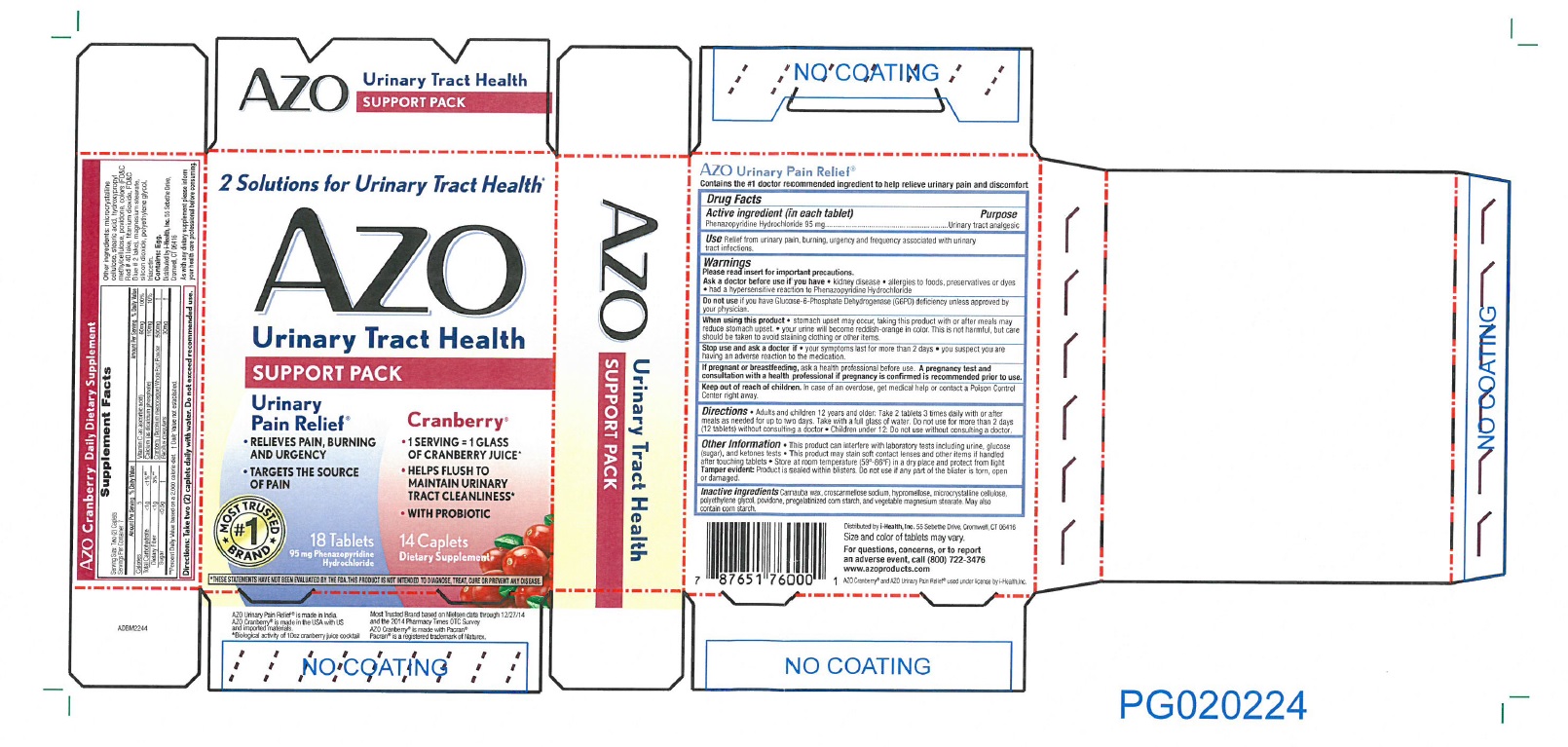
AZO Urinary Pain Relief 95 mg Tablet, 30-count — NDC 49973-301-31 (Billing 49973-0301-31)
This is a package of 30 tablets of AZO Urinary Pain Relief 95 mg Tablet from i-Health, Inc., marketed since May 2012 and currently FDA-listed. It is this product's only package size.
NDC database record
One package, one record: these facts belong to NDC 49973-301-31 alone.
- Record
- FDA NDC Directory package listing · Human OTC drug
- Code segments
- 49973 labeler · 301 product · 31 package
- Package marketed since
- May 24, 2012
- Sample package
- No — commercial package
- Listing certified through
- Dec 31, 2027
- Billing quantity
- 30 EA per package
- Barcode (UPC-A, from the NDC)
- 3 4997330131 9
- FDA record last changed
- Jul 24, 2026
Identity & classification
Regulatory identifiers FDA, NLM and CMS codes for this package
- RxCUI (RxNorm): 1094126
Where does this data come from?
- FDA openFDA NDC Directory · synced Oct 1, 2026
- FDA label on DailyMed · label index refreshed Oct 6, 2026
- RxNorm (NLM RxNav) · catalog refreshed Oct 1, 2026
- Medi-Span GPI (licensed)
- First Databank (licensed) · refreshed Oct 1, 2026
RxNorm drug class
This medicine belongs to the Other urologicals class.
Where does this data come from?
- RxClass (NLM) · catalog refreshed Oct 1, 2026
Clinical
Phenazopyridine relieves urinary tract pain, burning, irritation, and discomfort, as well as urgent and frequent urination caused by urinary tract infections, surgery, injury, or examination procedures. However, phenazopyridine is not an antibiotic; it does not cure infections.
Read the full MedlinePlus article ↗- It only helps with the pain — it doesn't kill the bacteria causing the infection. Think of it as taking the edge off while your antibiotic does the real work. If you have a UTI, yo...
- Does phenazopyridine actually treat my UTI, or does it just help with the pain?
- That's completely expected with phenazopyridine — it's one of the most common things people notice. The drug itself has an orange-red dye, and it passes into your urine, which is w...
- Why is my urine turning orange or red? Should I be worried?
Patient education
Supplement & herbal interactions
Where does this data come from?
- MedlinePlus (NLM) · refreshed Oct 1, 2026
- FDA label on DailyMed · label index refreshed Oct 6, 2026
Ask a licensed pharmacist directly — free, answered by our team.
Pricing
A drug doesn't have one price. Each row is a different public payment system, and none is what you'd pay at the counter — that depends on your insurance. The ⓘ on each row explains what it measures.
| Price system | Per each | Per package |
|---|---|---|
| Retail pharmacies payNADAC · weekly | Not in the retail survey — common for institutional, discontinued, or low-volume packs. | |
| Medicaid paysCMS SDUD · 12 mo | No recent Medicaid claims on file for this NDC — rare and low-volume NDCs are suppressed in the public data. | |
| Medicare drug plans payPart D · quarterly | No Part D plan price is available for this NDC in our data. | |
Where does this data come from?
- CMS NADAC weekly file
- CMS ASP pricing files · refreshed Sep 20, 2026
- CMS Medicaid State Drug Utilization Data · refreshed Oct 6, 2026
- CMS Part D plan pricing files · refreshed Sep 24, 2026
- VA National Acquisition Center price file
Packaging — all sizes for this product
| Package NDC | Description | Marketing start | Marketing end | Status |
|---|---|---|---|---|
| 49973-0301-31 You're viewing this Main listing | 15 BLISTER PACK in 1 BOX / 2 TABLET in 1 BLISTER PACK | 2012-05-24 | — | Active |
Therapeutic equivalents
| Product | Labeler | Pack | NADAC/unit | TE | Status | Price vs. this |
|---|---|---|---|---|---|---|
| Quality Choice Urinary Pain Relief 95 mg 63868-0117-30 | Chain | 30 tablets | $0.118 | — | FDA listed | — |
| HealthMart Urinary Pain Relief 95 mg 62011-0325-01 | Strategic | 30 tablets | $0.120 | — | FDA listed | — |
| Rugby Phenazopyridine HCl Urinary Tract Analgesic 95 mg 00536-1411-07 | Rugby | 30 tablets | $0.132 | — | Availability likely | — |
| Good Neighbor Pharmacy Urinary Pain Relief 95 mg 46122-0337-65 | AmerisourceBergen | 30 tablets | $0.132 | — | Availability likely | — |
| Uro-Pain 95 mg 57237-0331-03 | Rising | 30 tablets | $0.132 | — | Availability likely | — |
| Leader Urinary Pain Relief 95 mg 70000-0243-01 | Cardinal | 30 tablets | $0.132 | — | Availability likely | — |
| Foster and Thrive Neighbor Pharmacy Urinary Pain Relief 95 mg 70677-1229-01 | Strategic | 30 tablets | $0.132 | — | Availability likely | — |
| Sunmark Urinary Pain Relief 95 mg 49348-0076-44 | Strategic | 30 tablets | $0.132 | — | Availability likely | — |
| Walgreens Urinary Pain Relief 95 mg 00363-7775-30 | Walgreens | 30 tablets | — | — | FDA listed | — |
| CVS Health Urinary Pain Relief 95 mg 10956-0001-30 | Reese | 30 tablets | — | — | FDA listed | — |
| Preferred Urinary Pain Relief 95 mg 10956-0551-30 | Reese | 30 tablets | — | — | FDA listed | — |
| Rite Aid Urinary Pain Relief 95 mg 11822-8855-06 | Rite | 30 tablets | — | — | FDA listed | — |
| Kroger Urinary Pain Relief 95 mg 30142-0564-30 | THE | 30 tablets | — | — | FDA listed | — |
| TopCare Urinary Pain Relief 95 mg 36800-0040-30 | TOPCO | 30 tablets | — | — | FDA listed | — |
| Skopko Urinary Pain Relief 95 mg 37012-0098-01 | Skopko | 32 tablets | — | — | FDA listed | — |
| Azo 95 mgthis 49973-0301-31 | i-Health, | 30 tablets | — | — | FDA listed | — |
| Phenazopyridine Hydrochloride 95 mg 68071-2273-03 | NuCare | 30 tablets | — | — | FDA listed | — |
| Good Neighbor Pharmacy Urinary Pain Relief 95 mg 71205-0584-30 | Proficient | 30 tablets | — | — | FDA listed | — |
| Quality Choice Urinary Pain Relief 95 mg 83324-0201-30 | Chain | 30 tablets | — | — | FDA listed | — |
Where does this data come from?
- FDA openFDA NDC Directory · synced Oct 1, 2026
- FDA Orange Book · refreshed Oct 3, 2026
- CMS NADAC weekly file
Availability & generic status
We did not find an FDA-approved generic match for this exact strength, form and route.
Where does this data come from?
- FDA Orange Book · refreshed Oct 3, 2026
What it looks like
Where does this data come from?
- FDA label on DailyMed · label index refreshed Oct 6, 2026
Inactive Ingredients / Excipients
Inactive ingredients, also called excipients, are components of the drug product other than the active ingredient. They may include fillers, dyes, coatings, preservatives, flavors, or other formulation ingredients.
🧪 Avoiding an ingredient? See Phenazopyridine inactive ingredients by manufacturer: every current product's list side by side, so you can ask your pharmacy for the version that does not list it.
💡 Tap an ingredient (hover on desktop) to see what it is and why it’s used.
-
UNII R12CBM0EIZ
A natural wax derived from a Brazilian palm tree, used as a coating and polish on tablets and capsules. It creates a smooth, shiny finish that protects the medicine and improves appearance.
-
UNII OP1R32D61U
Microcrystalline cellulose is a purified form of cellulose, a natural fiber from plant sources. It acts as a binder and filler in tablets and capsules, helping hold ingredients together and give the medicine its shape and size.
-
UNII M28OL1HH48
Croscarmellose sodium is a plant-based substance derived from cellulose. It acts as a disintegrant, helping tablets and capsules break down quickly in the digestive system so the medicine can be absorbed.
-
UNII 3NXW29V3WO
Hypromellose is a plant-based thickener made from cellulose. It's used in medicines as a binder to hold ingredients together, a coating for tablets, and a thickener for liquids.
-
UNII 70097M6I30
Magnesium stearate is a salt made from magnesium and stearic acid, a fatty substance. It's used in tablets and capsules as a lubricant and glidant to help ingredients flow smoothly during manufacturing and prevent sticking.
-
UNII 3WJQ0SDW1A
Polyethylene glycol is a synthetic liquid or solid polymer used in medicines as a solvent, lubricant, and humectant. It helps dissolve active ingredients, reduces friction during manufacturing, and retains moisture in the final product.
-
UNII FZ989GH94E
Povidone is a synthetic polymer made from a plastic-like material. It acts as a binder to hold tablet ingredients together and as a disintegrant to help the tablet break apart in your stomach so the medicine can be absorbed.
-
UNII O8232NY3SJ
A plant-based carbohydrate derived from corn kernels. It acts as a filler to add bulk, a binder to hold ingredients together, and a disintegrant to help the tablet break apart in your stomach for absorption.
8 inactive ingredients listed in the exact product block matched to this NDC.
Label-section wording can be broader than the structured product block and may mention additional formulation ingredients.
Where does this data come from?
ingredient classCode="IACT" elements from the exact product block matched by this NDC. Label-section narrative from DailyMed / the openFDA label index is shown separately when available.- FDA label on DailyMed · label index refreshed Oct 6, 2026
- FDA openFDA NDC Directory · synced Oct 1, 2026
Inactive ingredient FAQ
Are inactive ingredients the same for every manufacturer?
Why might an inactive ingredient be missing?
Can inactive ingredients matter?
Manufacturer & labeler
More NDCs from i-Health, Inc. labeler code 49973
- Azo Urinary Tract Defense Antibacterial Protection Methenamine, Sodium salicylate 162 mg; 162.5 mg Tablet NDC 49973-011-18
- AZO Urinary Pain Relief Maximum Strength Phenazopyridine Hydrochloride 99.5 mg Tablet NDC 49973-247-06
- AZO Yeast Plus Candida Albicans, Wood Creosote, Sodium Chloride, and Sulfur 30 [hp_X]/1; 30 [hp_X]/1; 12 [hp_X]/1; 12 [hp_X]/1 Tablet NDC 49973-667-20
Where does this data come from?
- FDA openFDA NDC Directory · synced Oct 1, 2026
- Drugs@FDA
FDA label — Drug Facts FDA SPL
🎯 Indications and Usage ▾
Use Relief from urinary pain, burning, urgency and frequency associated with urinary tract infections.
⏱️ Dosage and Administration ▾
Directions Adults and children 12 years or older: Take 2 tablets 3 times daily with or after meals as needed for up to two days. Take with a full glass of water. Do not use for more than 2 days (12 tablets) without consulting a doctor. Children under 12: Do not use without consulting a doctor.
⚠️ Warnings ▾
Warnings Please read insert for important precautions. Ask a doctor before use if you have kidney disease allergies to foods, preservatives or dyes had a hypersensitive reaction to Phenazopyridine Hydrochloride. Caution: Do not use this product if you have Glucose-6-Phosphate Dehydrogenase (G6PD) deficiency unless approved by your physician.
When using this product stomach upset may occur, taking this product with or after meals may reduce stomach upset. your urine will become reddish-orange in color. This is not harmful, but care should be taken to avoid staining clothing or other items. Stop use and ask doctor your symptoms last for more than 2 days you suspect you are having an adverse reaction to the medication.
🧪 Active Ingredient ▾
Drug Facts Active ingredient (in each tablet) Phenazopyridine Hydrochloride 95 mg
🧪 Inactive Ingredients ▾
Inactive ingredients microcrystalline cellulose, pregelatinized corn starch, hypromellose, povidine, croscarmellose sodium, polyethylene glycol, carnauba wax and vegetable magnesium stearate. May also contain corn starch.
🎯 Purpose ▾
Purpose Urinary analgesic
📄 Do Not Use ▾
Caution: Do not use this product if you have Glucose-6-Phosphate Dehydrogenase (G6PD) deficiency unless approved by your physician.
📄 When Using This Product ▾
When using this product stomach upset may occur, taking this product with or after meals may reduce stomach upset. your urine will become reddish-orange in color. This is not harmful, but care should be taken to avoid staining clothing or other items.
📄 Stop Use and Ask a Doctor If ▾
Stop use and ask doctor your symptoms last for more than 2 days you suspect you are having an adverse reaction to the medication.
📄 Keep Out of Reach of Children ▾
Keep out of reach of children. In case of an overdose, get medical help or contact a Poison Control Center right away.
📄 Questions or Comments ▾
Distributed by i-Health, Inc. 25 Bacon Road, Enfield, CT 06082 Made in India. Most Trusted Brand based on Nielsen data through 3/23/2013. For questions, concerns, or to report an adverse event, call (800) 722-3476 www.azoproducts.com
📄 Package Label / Principal Display Panel ▾
AZO Urinary Pain Relief Relieves pain, burning & urgency Targets the source of pain #1 Most Trusted Brand Tablets 95 mg Phenazopyridine Hydrochloride AZO UPR Label Combined AZO UPR 95
Reported adverse events (FAERS)
Top reported reactions
Reporter sex
Serious outcomes
Where does this data come from?
About this NDC listing & data coverage
Listed without an FDA application
This product's marketing category indicates it is marketed without an approved FDA application (no NDA, ANDA, or BLA on file). Having an NDC does not by itself establish FDA approval — the NDC Directory is a listing system, not an approval decision. Approval-linked data such as Orange Book therapeutic-equivalence ratings therefore does not apply.
What data is (and isn’t) available for this NDC — tap to expand
| NDC identity (package / product / labeler codes) | ✓ Available |
| Labeler | ✓ Available |
| Product & package description | ✓ Available |
| Marketing category & status | ✓ Available |
| Active ingredient / dosage form / route | ✓ Available |
| FDA label (SPL via DailyMed) | ✓ Available |
| Package photos | ✓ Available |
| Inactive ingredients (structured) | ✓ Available |
| NADAC pharmacy acquisition price (CMS) | — Not published for this NDC CMS publishes NADAC only for NDCs reported in its retail-pharmacy survey. |
| Orange Book / therapeutic-equivalence data | — Not published for this NDC Applies only to products approved under an NDA/ANDA; many listings are out of scope. |
| HCPCS J-code billing crosswalk | — Not published for this NDC Most self-administered / retail products have no J-code — that is normal. |
| Medicaid utilization (CMS SDUD) | — Not published for this NDC CMS reports utilization only for NDCs with Medicaid claims above its privacy threshold. |