
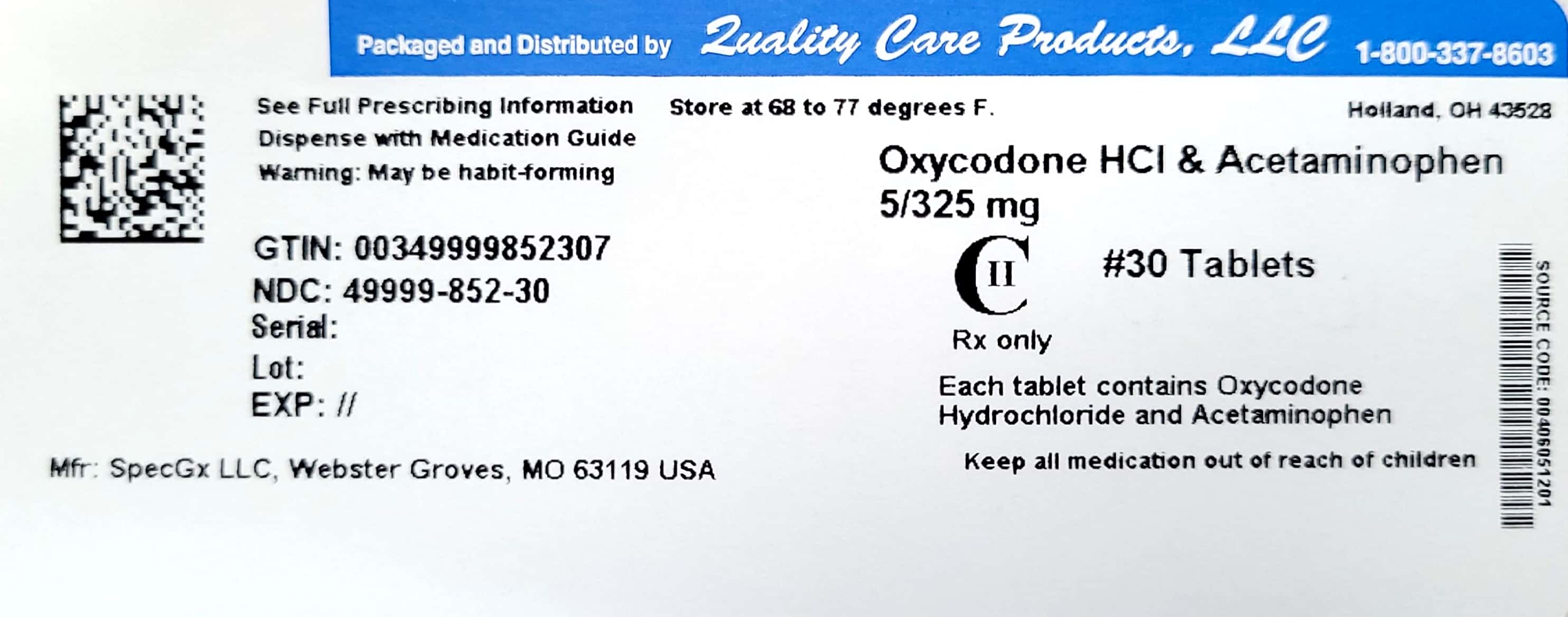
Oxycodone and Acetaminophen 5 mg; 325 mg Tablet, 14-count
🆔 Identity & classification
Where does this data come from?
🏷️ RxNorm drug class
This medicine belongs to the Anilides class.
Where does this data come from?
🏭 Manufacturer & labeler
Where does this data come from?
🩺 Clinical
Acetaminophen is used to relieve mild to moderate pain and to reduce fever. Acetaminophen is in a class of medications called analgesics (pain relievers) and antipyretics (fever reducers). It works by changing the way the body senses pain and by cooling the body.
Read the full MedlinePlus article ↗Patient education
Supplement & herbal interactions
Where does this data come from?
Ask a licensed pharmacist directly — free, answered by our team.
💊 What it looks like
Where does this data come from?
🧪 Inactive Ingredients / Excipients
Inactive ingredients, also called excipients, are components of the drug product other than the active ingredient. They may include fillers, dyes, coatings, preservatives, flavors, or other formulation ingredients.
💡 Tap an ingredient (hover on desktop) to see what it is and why it’s used.
-
UNII OP1R32D61U
Microcrystalline cellulose is a purified form of cellulose, a natural fiber from plant sources. It acts as a binder and filler in tablets and capsules, helping hold ingredients together and give the medicine its shape and size.
-
UNII 2S7830E561
Crospovidone is a synthetic polymer derived from povidone. It acts as a disintegrant, helping the tablet or capsule break apart quickly in the stomach so the active ingredient can be absorbed.
-
UNII FZ989GH94E
Povidone is a synthetic polymer made from a plastic-like material. It acts as a binder to hold tablet ingredients together and as a disintegrant to help the tablet break apart in your stomach so the medicine can be absorbed.
-
UNII ETJ7Z6XBU4
Silicon dioxide is a naturally occurring mineral used as a glidant and anti-caking agent. It helps powder ingredients flow smoothly and prevents clumping during manufacturing and storage.
-
UNII O8232NY3SJ
A plant-based carbohydrate derived from corn kernels. It acts as a filler to add bulk, a binder to hold ingredients together, and a disintegrant to help the tablet break apart in your stomach for absorption.
-
UNII 4ELV7Z65AP
Stearic acid is a fatty acid derived from plant or animal sources. It acts as a binder and lubricant in tablets and capsules, helping them hold together and flow smoothly during manufacturing.
6 inactive ingredients listed in the exact product block matched to this NDC.
Where does this data come from?
ingredient classCode="IACT" elements from the exact product block matched by this NDC. Label-section narrative from DailyMed / the openFDA label index is shown separately when available.Inactive ingredient FAQ
Are inactive ingredients the same for every manufacturer?
Why might an inactive ingredient be missing?
Can inactive ingredients matter?
💲 Pricing
A drug doesn't have one price. Each row is a different public payment system, and none is what you'd pay at the counter — that depends on your insurance. The ⓘ on each row explains what it measures.
| Price system | Per each | Per package |
|---|---|---|
| Retail pharmacies payNADAC · weekly | Not in the retail survey — common for institutional, discontinued, or low-volume packs. | |
| Medicaid paysCMS SDUD · 12 mo | No recent Medicaid claims on file for this NDC — rare and low-volume NDCs are suppressed in the public data. | |
| Medicare drug plans payPart D · Q2 2026 | $0.2090 | $2.93 / 14 tablets |
Where does this data come from?
🔁 Therapeutic equivalents
| Product | Labeler | Pack | NADAC/unit | TE | Status | Price vs. this |
|---|---|---|---|---|---|---|
| Oxycodone and Acetaminophen 5 mg/1; 325 mg 31722-0192-01 | Camber | 100 tablets | $0.086 | AA | FDA listed | — |
| Oxycodone and Acetaminophen 5 mg/1; 325 mg 42806-0114-01 | Epic | 100 tablets | $0.088 | AA | FDA listed | — |
| Oxycodone And Acetaminophen 5 mg/1; 325 mg 00406-0512-01 | SpecGx | 100 tablets | $0.117 | AA | Availability likely | — |
| Oxycodone And Acetaminophen 5 mg/1; 325 mg 00904-7093-61 | Major | 100 tablets | $0.117 | AA | Availability likely | — |
| Oxycodone and Acetaminophen 5 mg/1; 325 mg 10702-0185-01 | KVK-Tech, | 100 tablets | $0.117 | AA | Availability likely | — |
| Oxycodone and Acetaminophen 5 mg/1; 325 mg 13107-0044-01 | Aurolife | 100 tablets | $0.117 | AA | Availability likely | — |
| Oxycodone And Acetaminophen 5 mg/1; 325 mg 31722-0949-01 | Camber | 100 tablets | $0.117 | AA | Availability likely | — |
| Oxycodone and Acetaminophen 5 mg/1; 325 mg 42858-0102-01 | Rhodes | 100 tablets | $0.117 | AA | Availability likely | — |
| Oxycodone and Acetaminophen 5 mg/1; 325 mg 47781-0196-01 | Alvogen, | 100 tablets | $0.117 | AA | Availability likely | — |
| Oxycodone and Acetaminophen 5 mg/1; 325 mg 50268-0644-15 | AvPAK | 50 tablets | $0.117 | AA | Availability likely | — |
| Oxycodone and Acetaminophen 5 mg/1; 325 mg 53746-0203-01 | Amneal | 100 tablets | $0.117 | AA | Availability likely | — |
| Oxycodone and Acetaminophen 5 mg/1; 325 mg 60687-0642-01 | American | 100 tablets | $0.117 | AA | Availability likely | — |
| Endocet 5 mg/1; 325 mg 60951-0602-70 | Par | 100 tablets | $0.117 | AA | Availability likely | — |
| Oxycodone Hydrochloride and Acetaminophen 5 mg/1; 325 mg 64850-0621-01 | Elite | 100 tablets | $0.117 | AA | Availability likely | — |
| Oxycodone and Acetaminophen 5 mg/1; 325 mg 70010-0668-01 | Granules | 100 tablets | $0.117 | AA | Availability likely | — |
| Oxycodone And Acetaminophen 5 mg/1; 325 mg 71930-0045-12 | Eywa | 100 tablets | $0.117 | AA | Availability likely | — |
| Percocet 5 mg/1; 325 mg 63481-0623-70 | SpecGx | 100 tablets | $29.317 | AA | Availability likely | — |
| Oxycodone and Acetaminophen 5 mg/1; 325 mgthis 49999-0852-14 | Quality | 14 tablets | — | AA | FDA listed | — |
| Oxycodone and Acetaminophen 5 mg/1; 325 mg 60760-0897-30 | St. | 30 tablets | — | AA | FDA listed | — |
| Oxycodone Hydrochloride and Acetaminophen 5 mg/1; 325 mg 60760-0963-30 | St. | 30 tablets | — | AA | FDA listed | — |
| Oxycodone and Acetaminophen 5 mg/1; 325 mg 63187-0719-12 | Proficient | 12 tablets | — | AA | FDA listed | — |
| Oxycodone and Acetaminophen 5 mg/1; 325 mg 63187-0824-10 | Proficient | 10 tablets | — | AA | FDA listed | — |
| Oxycodone and Acetaminophen 5 mg/1; 325 mg 63187-0984-10 | Proficient | 10 tablets | — | AA | FDA listed | — |
| Endocet 325 mg/1; 5 mg 63629-2188-01 | Bryant | 100 tablets | — | AA | Discontinued | — |
| Endocet 325 mg/1; 5 mg 63629-2189-01 | Bryant | 500 tablets | — | AA | Discontinued | — |
| Oxycodone And Acetaminophen 5 mg/1; 325 mg 63629-8888-01 | Bryant | 30 tablets | — | AA | FDA listed | — |
| Endocet 5 mg/1; 325 mg 67296-0836-07 | Redpharm | 4 tablets | — | AA | FDA listed | — |
| Oxycodone and Acetaminophen 5 mg/1; 325 mg 67296-1937-00 | RedPharm | 4 tablets | — | AA | FDA listed | — |
| Oxycodone and Acetaminophen 5 mg/1; 325 mg 68071-3683-06 | NuCare | 6 tablets | — | AA | FDA listed | — |
| Oxycodone and Acetaminophen 5 mg/1; 325 mg 68071-5054-02 | NuCare | 12 tablets | — | AA | FDA listed | — |
| Oxycodone and Acetaminophen 5 mg/1; 325 mg 68071-5169-02 | NuCare | 20 tablets | — | AA | FDA listed | — |
| Oxycodone and Acetaminophen 5 mg/1; 325 mg 71205-0329-10 | Proficient | 10 tablets | — | AA | FDA listed | — |
| Oxycodone and Acetaminophen 5 mg/1; 325 mg 71335-0216-00 | Bryant | 25 tablets | — | AA | FDA listed | — |
| Oxycodone and Acetaminophen 5 mg/1; 325 mg 71335-1492-00 | Bryant | 25 tablets | — | AA | FDA listed | — |
| Oxycodone And Acetaminophen 5 mg/1; 325 mg 71335-2041-00 | Bryant | 25 tablets | — | AA | FDA listed | — |
| Oxycodone And Acetaminophen 5 mg/1; 325 mg 71335-9674-00 | Bryant | 25 tablets | — | AA | FDA listed | — |
| Oxycodone And Acetaminophen 5 mg/1; 325 mg 72865-0114-01 | XLCare | 100 tablets | — | AA | FDA listed | — |
| Oxycodone and Acetaminophen 5 mg/1; 325 mg 76420-0136-30 | Asclemed | 30 tablets | — | AA | FDA listed | — |
| Oxycodone And Acetaminophen 5 mg/1; 325 mg 76420-0321-01 | Asclemed | 100 tablets | — | AA | FDA listed | — |
| Oxycodone And Acetaminophen 5 mg/1; 325 mg 87063-0032-01 | Asclemed | 100 tablets | — | AA | FDA listed | — |
| Oxycodone and Acetaminophen 5 mg/1; 325 mg 43386-0491-01 | Lupin | 100 tablets | — | AA | FDA listed | — |
Where does this data come from?
⏳ Availability & generic status
This product is an FDA-approved generic. Other versions of the same drug are listed under Therapeutic equivalents, least expensive first.
Where does this data come from?
📦 Packaging — all sizes for this product
| Package NDC | Description | Marketing start | Status |
|---|---|---|---|
| 49999-0852-14 You're viewing this | 14 TABLET in 1 BOTTLE, PLASTIC (49999-852-14) | 2022-08-10 | Active |
| 49999-0852-30 | 30 TABLET in 1 BOTTLE, PLASTIC (49999-852-30) | 2022-08-03 | Active |
| 49999-0852-60 | 60 TABLET in 1 BOTTLE, PLASTIC (49999-852-60) | 2022-08-03 | Active |
| 49999-0852-90 | 90 TABLET in 1 BOTTLE, PLASTIC (49999-852-90) | 2022-08-03 | Active |
You're viewing the smallest of 4 pack sizes for this product.
Pack size FAQ
What quantity is in NDC 49999-0852-14?
What is the difference between NDC 49999-0852-14 and NDC 49999-0852-30?
What NDC number is used to bill for this package of Oxycodone and Acetaminophen 5 mg; 325 mg Tablet?
🧭 About this NDC listing & data coverage
What data is (and isn’t) available for this NDC — tap to expand
| NDC identity (package / product / labeler codes) | ✓ Available |
| Labeler | ✓ Available |
| Product & package description | ✓ Available |
| Marketing category & status | ✓ Available |
| Active ingredient / dosage form / route | ✓ Available |
| FDA label (SPL via DailyMed) | ✓ Available |
| Package photos | ✓ Available |
| Inactive ingredients (structured) | ✓ Available |
| NADAC pharmacy acquisition price (CMS) | — Not published for this NDC CMS publishes NADAC only for NDCs reported in its retail-pharmacy survey. |
| Orange Book / therapeutic-equivalence data | ✓ Available |
| HCPCS J-code billing crosswalk | — Not published for this NDC Most self-administered / retail products have no J-code — that is normal. |
| Medicaid utilization (CMS SDUD) | — Not published for this NDC CMS reports utilization only for NDCs with Medicaid claims above its privacy threshold. |
Questions about this listing
Why is there no price listed?
Is the NDC printed on the package the same as the 11-digit billing NDC?
What do the three segments of this NDC mean?
Is this package still being marketed?
Does this product come in other package sizes?
Who lists this product with the FDA?
Do I need a prescription for this product?
Where does this data come from?
📄 Full prescribing information FDA SPL
🎯 Indications and Usage ▾
INDICATIONS AND USAGE Oxycodone and acetaminophen tablets USP are indicated for the relief of moderate to moderately severe pain.
⏱️ Dosage and Administration ▾
DOSAGE AND ADMINISTRATION Dosage should be adjusted according to the severity of the pain and the response of the patient. It may occasionally be necessary to exceed the usual dosage recommended below in cases of more severe pain or in those patients who have become tolerant to the analgesic effect of opioids. If pain is constant, the opioid analgesic should be given at regular intervals on an around-the-clock schedule.
Oxycodone and acetaminophen tablets are given orally. The total daily dose of acetaminophen should not exceed 4 grams. Strength Usual Adult Dosage Maximal Daily Dose Oxycodone and acetaminophen tablets 5 mg/325 mg 1 tablet every 6 hours as needed for pain 12 Tablets Oxycodone and acetaminophen tablets 7.5 mg/325 mg 1 tablet every 6 hours as needed for pain 8 Tablets Oxycodone and acetaminophen tablets 7.5 mg/500 mg 1 tablet every 6 hours as needed for pain 8 Tablets Oxycodone and acetaminophen tablets 10 mg/325 mg 1 tablet every 6 hours as needed for pain 6 Tablets Cessation of Therapy In patients treated with oxycodone and acetaminophen tablets for more than a few weeks who no longer require therapy, doses should be tapered gradually to prevent signs and symptoms of withdrawal in the physically dependent patient.
⛔ Contraindications ▾
CONTRAINDICATIONS Oxycodone and acetaminophen tablets should not be administered to patients with known hypersensitivity to oxycodone, acetaminophen, or any other component of this product. Oxycodone is contraindicated in any situation where opioids are contraindicated including patients with significant respiratory depression (in unmonitored settings or the absence of resuscitative equipment) and patients with acute or severe bronchial asthma or hypercarbia. Oxycodone is contraindicated in the setting of suspected or known paralytic ileus.
⚠️ Warnings ▾
WARNINGS Misuse, Abuse and Diversion of Opioids Oxycodone is an opioid agonist of the morphine-type. Such drugs are sought by drug abusers and people with addiction disorders and are subject to criminal diversion. Oxycodone can be abused in a manner similar to other opioid agonists, legal or illicit.
This should be considered when prescribing or dispensing oxycodone and acetaminophen tablets in situations where the physician or pharmacist is concerned about an increased risk of misuse, abuse, or diversion. Concerns about misuse, addiction, and diversion should not prevent the proper management of pain. Healthcare professionals should contact their State Professional Licensing Board or State Controlled Substances Authority for information on how to prevent and detect abuse or diversion of this product.
Administration of oxycodone and acetaminophen tablets should be closely monitored for the following potentially serious adverse reactions and complications: Respiratory Depression Respiratory depression is a hazard with the use of oxycodone, one of the active ingredients in oxycodone and acetaminophen tablets, as with all opioid agonists. Elderly and debilitated patients are at particular risk for respiratory depression as are non-tolerant patients given large initial doses of oxycodone or when oxycodone is given in conjunction with other agents that depress respiration.
Oxycodone should be used with extreme caution in patients with acute asthma, chronic obstructive pulmonary disorder (COPD), cor pulmonale, or preexisting respiratory impairment. In such patients, even usual therapeutic doses of oxycodone may decrease respiratory drive to the point of apnea. In these patients alternative non-opioid analgesics should be considered, and opioids should be employed only under careful medical supervision at the lowest effective dose.
In case of respiratory depression, a reversal agent such as naloxone hydrochloride may be utilized ( see OVERDOSAGE ). Head Injury and Increased Intracranial Pressure The respiratory depressant effects of opioids include carbon dioxide retention and secondary elevation of cerebrospinal fluid pressure, and may be markedly exaggerated in the presence of head injury, other intracranial lesions or a preexisting increase in intracranial pressure. Oxycodone produces effects on pupillary response and consciousness which may obscure neurologic signs of worsening in patients with head injuries.
Hypotensive Effect Oxycodone may cause severe hypotension particularly in individuals whose ability to maintain blood pressure has been compromised by a depleted blood volume, or after concurrent administration with drugs which compromise vasomotor tone such as phenothiazines. Oxycodone, like all opioid analgesics of the morphine-type, should be administered with caution to patients in circulatory shock, since vasodilation produced by the drug may further reduce cardiac output and blood pressure. Oxycodone may produce orthostatic hypotension in ambulatory patients.
Hepatotoxicity Precaution should be taken in patients with liver disease. Hepatotoxicity and severe hepatic failure occurred in chronic alcoholics following therapeutic doses.
🤒 Adverse Reactions ▾
ADVERSE REACTIONS Serious adverse reactions that may be associated with oxycodone and acetaminophen tablet use include respiratory depression, apnea, respiratory arrest, circulatory depression, hypotension, and shock ( see OVERDOSAGE ). The most frequently observed non-serious adverse reactions include lightheadedness, dizziness, drowsiness or sedation, nausea, and vomiting. These effects seem to be more prominent in ambulatory than in nonambulatory patients, and some of these adverse reactions may be alleviated if the patient lies down.
Other adverse reactions include euphoria, dysphoria, constipation, and pruritus. Hypersensitivity reactions may include: Skin eruptions, urticarial, erythematous skin reactions. Hematologic reactions may include: Thrombocytopenia, neutropenia, pancytopenia, hemolytic anemia.
Rare cases of agranulocytosis have likewise been associated with acetaminophen use. In high doses, the most serious adverse effect is a dose-dependent, potentially fatal hepatic necrosis. Renal tubular necrosis and hypoglycemic coma also may occur.
Other adverse reactions obtained from postmarketing experiences with oxycodone and acetaminophen tablets are listed by organ system and in decreasing order of severity and/or frequency as follows: Body as a Whole Anaphylactoid reaction, allergic reaction, malaise, asthenia, fatigue, chest pain, fever, hypothermia, thirst, headache, increased sweating, accidental overdose, non-accidental overdose Cardiovascular Hypotension, hypertension, tachycardia, orthostatic hypotension, bradycardia, palpitations, dysrhythmias Central and Peripheral Nervous System Stupor, tremor, paraesthesia, hypoaesthesia, lethargy, seizures, anxiety, mental impairment, agitation, cerebral edema, confusion, dizziness Fluid and Electrolyte Dehydration, hyperkalemia, metabolic acidosis, respiratory alkalosis Gastrointestinal Dyspepsia, taste disturbances, abdominal pain, abdominal distention, sweating increased, diarrhea, dry mouth, flatulence, gastro-intestinal disorder, nausea, vomiting, pancreatitis, intestinal obstruction, ileus Hepatic Transient elevations of hepatic enzymes, increase in bilirubin, hepatitis, hepatic failure, jaundice, hepatotoxicity, hepatic disorder Hearing and Vestibular Hearing loss, tinnitus Hematologic Thrombocytopenia Hypersensitivity Acute anaphylaxis, angioedema, asthma, bronchospasm, laryngeal edema, urticaria, anaphylactoid reaction Metabolic and Nutritional Hypoglycemia, hyperglycemia, acidosis, alkalosis Musculoskeletal Myalgia, rhabdomyolysis Ocular Miosis, visual disturbances, red eye Psychiatric Drug dependence, drug abuse, insomnia, confusion, anxiety, agitation, depressed level of consciousness, nervousness, hallucination, somnolence, depression, suicide Respiratory System Bronchospasm, dyspnea, hyperpnea, pulmonary edema, tachypnea, aspiration, hypoventilation, laryngeal edema Skin and Appendages Erythema, urticaria, rash, flushing Urogenital Interstitial nephritis, papillary necrosis, proteinuria, renal insufficiency and failure, urinary retention
🆘 Overdosage ▾
Enter section text here
🧬 Clinical Pharmacology ▾
CLINICAL PHARMACOLOGY Central Nervous System Oxycodone is a semisynthetic pure opioid agonist whose principal therapeutic action is analgesia. Other pharmacological effects of oxycodone include anxiolysis, euphoria and feelings of relaxation. These effects are mediated by receptors (notably μ and κ) in the central nervous system for endogenous opioid-like compounds such as endorphins and enkephalins.
Oxycodone produces respiratory depression through direct activity at respiratory centers in the brain stem and depresses the cough reflex by direct effect on the center of the medulla. Acetaminophen is a non-opiate, non-salicylate analgesic and antipyretic. The site and mechanism for the analgesic effect of acetaminophen has not been determined.
The antipyretic effect of acetaminophen is accomplished through the inhibition of endogenous pyrogen action on the hypothalamic heat-regulating centers. Gastrointestinal Tract and Other Smooth Muscle Oxycodone reduces motility by increasing smooth muscle tone in the stomach and duodenum. In the small intestine, digestion of food is delayed by decreases in propulsive contractions.
Other opioid effects include contraction of biliary tract smooth muscle, spasm of the Sphincter of Oddi, increased ureteral and bladder sphincter tone, and a reduction in uterine tone. Cardiovascular System Oxycodone may produce a release of histamine and may be associated with orthostatic hypotension, and other symptoms, such as pruritus, flushing, red eyes, and sweating. Pharmacokinetics Absorption and Distribution – The mean absolute oral bioavailability of oxycodone in cancer patients was reported to be about 87%.
Oxycodone has been shown to be 45% bound to human plasma proteins in vitro. The volume of distribution after intravenous administration is 211.9 ± 186.6 L. Absorption of acetaminophen is rapid and almost complete from the GI tract after oral administration.
With overdosage, absorption is complete in 4 hours. Acetaminophen is relatively uniformly distributed throughout most body fluids. Binding of the drug to plasma proteins is variable; only 20% to 50% may be bound at the concentrations encountered during acute intoxication.
Metabolism and Elimination A high portion of oxycodone is N-dealkylated to noroxycodone during first-pass metabolism. Oxymorphone, is formed by the O-demethylation of oxycodone. The metabolism of oxycodone to oxymorphone is catalyzed by CYP2D6.
Free and conjugated noroxycodone, free and conjugated oxycodone, and oxymorphone are excreted in human urine following a single oral dose of oxycodone. Approximately 8% to 14% of the dose is excreted as free oxycodone over 24 hours after administration. Following a single, oral dose of oxycodone, the mean ± SD elimination half-life is 3.51 ± 1.43 hours.
Acetaminophen is metabolized in the liver via cytochrome P450 microsomal enzyme. About 80% to 85% of the acetaminophen in the body is conjugated principally with glucuronic acid and to a lesser extent with sulfuric acid and cysteine. After hepatic conjugation, 90% to 100% of the drug is recovered in the urine within the first day.
About 4% of acetaminophen is metabolized via cytochrome P450 oxidase to a toxic metabolite which is further detoxified by conjugation with glutathione, present in a fixed amount. It is believed that the toxic metabolite NAPQI (N acetyl-p-benzoquinoneimine, N-acetylimidoquinone) is responsible for liver necrosis. High doses of acetaminophen may deplete the glutathione stores so that inactivation of the toxic metabolite is decreased.
At high doses, the capacity of metabolic pathways for conjugation with glucuronic acid and sulfuric acid may be exceeded, resulting in increased metabolism of acetaminophen by alternate pathways.
📦 How Supplied / Storage and Handling ▾
HOW SUPPLIED Each oxycodone and acetaminophen tablet USP 5 mg/325 mg contains oxycodone hydrochloride 5 mg (equivalent to 4.4815 mg oxycodone) and acetaminophen 325 mg. It is available as a round, white scored tablet debossed with a 512 identification number. 49999-852-14 49999-852-30 49999-852-60 49999-852-90 Each oxycodone and acetaminophen tablet USP 7.5 mg/325 mg contains oxycodone hydrochloride 7.5 mg (equivalent to 6.7228 mg oxycodone) and acetaminophen 325 mg.
It is available as a white to off-white caplet shaped tablet debossed with “M522” on one side and “7.5/325” on the other side. Each oxycodone and acetaminophen tablet USP 7.5 mg/500 mg contains oxycodone hydrochloride 7.5 mg (equivalent to 6.7228 mg oxycodone) and acetaminophen 500 mg. It is available as a white to off-white oval shaped tablet debossed with “M582” on one side and the other side is plain.
Each oxycodone and acetaminophen tablet USP 10 mg/325 mg contains oxycodone hydrochloride 10 mg (equivalent to 8.9637 mg oxycodone) and acetaminophen 325 mg. It is available as a white to off-white caplet shaped tablet debossed with “M523” on one side and “10/325” on the other side. Store at 20° to 25°C (68° to 77°F) [see USP Controlled Room Temperature].
Dispense in a tight, light-resistant container as defined in the USP, with a child-resistant closure (as required). DEA Order Form Required. Mallinckrodt Inc., Hazelwood, MO 63042 USA.
Printed in U.S.A. COVIDIEN™ Mallinckrodt Rev 05/2009 PACKAGE LABEL - PRINCIPAL DISPLAY PANEL - 5 mg*/325 mg Bottle Multiple strengths. Do not dispense unless strength is stated.
NDC 0406-0512-05 500 TABLETS OXYCODONE AND ACETAMINOPHEN TABLETS USP CII 5 mg*/325 mg Each tablet contains: Oxycodone Hydrochloride USP. . . . . . . 5 mg* Acetaminophen USP . . . . . . . . . . . . . .325 mg Rx only Mallinckrodt
📋 Description ▾
DESCRIPTION Each tablet, for oral administration, contains oxycodone hydrochloride and acetaminophen in the following strengths: Oxycodone Hydrochloride USP ..........................................................................5 mg* Acetaminophen USP ........................................................................................325 mg *5 mg oxycodone HCl is equivalent to 4.4815 mg of oxycodone. Oxycodone Hydrochloride USP .......................................................................7.5 mg* Acetaminophen USP ........................................................................................325 mg *7.5 mg oxycodone HCl is equivalent to 6.7228 mg of oxycodone.
Oxycodone Hydrochloride USP .......................................................................7.5 mg* Acetaminophen USP ........................................................................................500 mg *7.5 mg oxycodone HCl is equivalent to 6.7228 mg of oxycodone. Oxycodone Hydrochloride USP .........................................................................10 mg* Acetaminophen USP .........................................................................................325 mg *10 mg oxycodone HCl is equivalent to 8.9637 mg of oxycodone.All strengths of oxycodone and acetaminophen tablets USP also contain the following inactive ingredients: crospovidone, microcrystalline cellulose, povidone, pregelatinized starch, silicon dioxide and stearic acid.
Oxycodone, 4,5α-epoxy-14-hydroxy-3-methoxy-17-methylmorphinan-6-one hydrochloride, is a semisynthetic opioid analgesic which occurs as a white, odorless, crystalline powder having a saline, bitter taste. It is derived from the opium alkaloid thebaine. Oxycodone hydrochloride may be represented by the following structural formula: Acetaminophen, 4'-hydroxyacetanilide, is a non-opiate, non-salicylate analgesic and antipyretic which occurs as a white, odorless, crystalline powder, possessing a slightly bitter taste.
It may be represented by the following structural formula: