
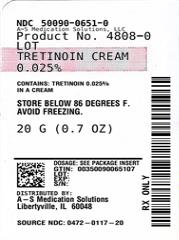
Tretinoin .25 mg/g Cream
🆔 Identity & classification
Where does this data come from?
🏷️ RxNorm drug class
This medicine belongs to the Retinoid class.
Where does this data come from?
🏭 Manufacturer & labeler
Where does this data come from?
🩺 Clinical
Tretinoin is used to treat acne. Tretinoin is also used to reduce fine wrinkles. Tretinoin is in a class of medications called retinoids. It works by increasing production of new skin cells and unclogging pores.
Read the full MedlinePlus article ↗- Honestly, it won't erase wrinkles — and the label is pretty direct about that. What it's approved to do is help reduce the appearance of fine wrinkles as part of a full routine tha...
- Will tretinoin actually get rid of my wrinkles?
- Redness, peeling, and irritation in the first couple of weeks are very common and usually mean your skin is adjusting — not that something is wrong. If it's tolerable, try hanging...
- My skin is really red and peeling after the first week — should I stop?
Patient education
Supplement & herbal interactions
Some supplements/herbs that may interact with Tretinoin — tap one for details:
Tretinoin may be associated with lower levels of 1 nutrient — worth a chat with your pharmacist, not a cause for alarm.
Where does this data come from?
Ask a licensed pharmacist directly — free, answered by our team.
🧪 Inactive Ingredients / Excipients
Inactive ingredients, also called excipients, are components of the drug product other than the active ingredient. They may include fillers, dyes, coatings, preservatives, flavors, or other formulation ingredients.
💡 Tap an ingredient (hover on desktop) to see what it is and why it’s used.
-
UNII 1P9D0Z171K
BHT is a synthetic antioxidant that prevents fats and oils in medicines from breaking down and becoming rancid. It helps keep the product stable and effective during storage.
-
UNII 0RE8K4LNJS
Isopropyl myristate is an oily liquid made from coconut or palm oil. It's used in medicines as an emollient and penetration enhancer to help the medicine absorb through skin or improve spreadability in topical products.
-
UNII 13A4J4NH9I
A synthetic emulsifier derived from stearic acid and polyethylene glycol. It helps mix oil and water-based ingredients together in liquid medicines and creams to create a smooth, uniform product.
-
UNII 1BK9DDD24E
A synthetic polymer made from propylene glycol and a crosslinking agent. It acts as a film-former and binder in medicines, helping create coatings on tablets or holding ingredients together in solid dosage forms.
-
UNII 6DC9Q167V3
Propylene glycol is a clear liquid derived from petroleum or vegetable sources. It acts as a solvent, humectant, and preservative in medicines, helping dissolve active ingredients and maintain product stability.
-
UNII X045WJ989B
Sorbic acid is a preservative derived from berries that prevents mold, yeast, and bacterial growth in medicines. It keeps the product stable and safe during storage.
-
UNII 4ELV7Z65AP
Stearic acid is a fatty acid derived from plant or animal sources. It acts as a binder and lubricant in tablets and capsules, helping them hold together and flow smoothly during manufacturing.
-
UNII 2KR89I4H1Y
Stearyl alcohol is a waxy, fatty substance derived from natural oils or made synthetically. It acts as an emulsifier and thickener in medicines, helping mix ingredients together and give the product the right texture.
-
UNII 059QF0KO0R
Water is a liquid solvent that dissolves and mixes ingredients together in liquid medicines, syrups, and injections. It helps distribute the active drug evenly throughout the product.
-
UNII TTV12P4NEE
Xanthan gum is a thickening and stabilizing ingredient made from fermented corn or other sugars. It's added to medicines to improve texture, prevent separation of liquids and solids, and help the product stay consistent.
10 inactive ingredients listed in the exact product block matched to this NDC.
Where does this data come from?
ingredient classCode="IACT" elements from the exact product block matched by this NDC. Label-section narrative from DailyMed / the openFDA label index is shown separately when available.Inactive ingredient FAQ
Are inactive ingredients the same for every manufacturer?
Why might an inactive ingredient be missing?
Can inactive ingredients matter?
💲 Pricing
A drug doesn't have one price. Each row is a different public payment system, and none is what you'd pay at the counter — that depends on your insurance. The ⓘ on each row explains what it measures.
| Price system | Per g | Per package |
|---|---|---|
| Retail pharmacies payNADAC · weekly | Not in the retail survey — common for institutional, discontinued, or low-volume packs. | |
| Medicaid paysCMS SDUD · 12 mo | No recent Medicaid claims on file for this NDC — rare and low-volume NDCs are suppressed in the public data. | |
| Medicare drug plans payPart D · Q2 2026 | $1.79 | $35.81 / 20 g |
Where does this data come from?
🔁 Therapeutic equivalents
| Product | Labeler | Pack | NADAC/unit | TE | Status | Price vs. this |
|---|---|---|---|---|---|---|
| Tretinoin .25 mg/g 21922-0079-06 | Encube | 1 tube | $0.468 | AB | Availability likely | — |
| Tretinoin .25 mg/g 00378-8082-20 | Mylan | 1 tube | $0.554 | AB | Availability likely | — |
| Tretinoin .25 mg/g 00472-0117-20 | Actavis | 1 tube | $0.554 | AB | Availability likely | — |
| Tretinoin .25 mg/g 00574-2225-20 | Padagis | 1 tube | $0.554 | AB | Availability likely | — |
| Tretinoin .25 mg/g 16714-0270-01 | NORTHSTAR | 1 tube | $0.554 | AB | Availability likely | — |
| Tretinoin .25 mg/g 51672-1407-00 | Sun | 1 tube | $0.554 | AB | Availability likely | — |
| Tretinoin .25 mg/g 62332-0809-20 | Alembic | 1 tube | $0.554 | AB | Availability likely | — |
| Retin-A .25 mg/g 00187-5160-20 | Bausch | 1 tube | $0.721 | AB | FDA listed | — |
| Retin-A .25 mg/g 00187-5170-15 | Bausch | 1 tube | $0.960 | AB | FDA listed | — |
| Tretinoin .25 mg/g 00378-8086-15 | Mylan | 1 tube | $3.779 | AB | Availability likely | — |
| Tretinoin .25 mg/g 59651-0713-14 | Aurobindo | 1 tube | $3.779 | AB | Availability likely | — |
| Tretinoin .25 mg/g 00574-2325-15 | Padagis | 1 tube | $3.779 | AB | Availability likely | — |
| Tretinoin .25 mg/g 21922-0057-04 | Encube | 1 tube | $3.779 | AB | Availability likely | — |
| Tretinoin .25 mg/g 46708-0809-20 | Alembic | 1 tube | — | AB | FDA listed | — |
| Tretinoin .25 mg/gthis 50090-0651-00 | A-S | 1 tube | — | AB | FDA listed | — |
| Tretinoin .25 mg/g 50090-3128-00 | A-S | 1 tube | — | AB | FDA listed | — |
| Tretinoin .25 mg/g 50090-7171-00 | A-S | 1 tube | — | AB | FDA listed | — |
| Tretinoin Cream .25 mg/g 62032-0414-20 | Obagi | 1 tube | — | AB | FDA listed | — |
| Tretinoin .25 mg/g 68071-3825-02 | NuCare | 1 tube | — | AB | FDA listed | — |
| Tretinoin .25 mg/g 68071-3888-02 | NuCare | 1 tube | — | AB | FDA listed | — |
| Tretinoin .25 mg/g 68071-3945-02 | NuCare | 1 tube | — | AB | FDA listed | — |
| Tretinoin .25 mg/g 68788-4069-02 | Preferred | 1 tube | — | AB | FDA listed | — |
| Tretinoin .25 mg/g 68788-8857-02 | Preferred | 1 tube | — | AB | FDA listed | — |
| Tretinoin .25 mg/g 72162-2135-02 | Bryant | 1 tube | — | AB | FDA listed | — |
| Tretinoin .25 mg/g 71335-2898-01 | Bryant | 1 tube | — | AB | FDA listed | — |
| Tretinoin .25 mg/g 67296-2287-04 | Redpharm | 1 tube | — | AB | FDA listed | — |
Where does this data come from?
⏳ Availability & generic status
FDA-approved generic versions are listed, and recent pricing/market data suggests they may be available — see Therapeutic equivalents.
Where does this data come from?
📊 Medicare Part D spend CMS · PART D · 2026 (Q1)
🔬 Reported adverse events (FAERS)
Top reported reactions
Age at onset
Reporter sex
Serious outcomes
Where does this data come from?
📦 Packaging — all sizes for this product
| Package NDC | Description | Marketing start | Status |
|---|---|---|---|
| 50090-0651-00 You're viewing this | 1 TUBE in 1 CARTON (50090-0651-0) / 20 g in 1 TUBE | 2014-11-28 | Active |
🧭 About this NDC listing & data coverage
What data is (and isn’t) available for this NDC — tap to expand
| NDC identity (package / product / labeler codes) | ✓ Available |
| Labeler | ✓ Available |
| Product & package description | ✓ Available |
| Marketing category & status | ✓ Available |
| Active ingredient / dosage form / route | ✓ Available |
| FDA label (SPL via DailyMed) | ✓ Available |
| Package photos | ✓ Available |
| Inactive ingredients (structured) | ✓ Available |
| NADAC pharmacy acquisition price (CMS) | — Not published for this NDC CMS publishes NADAC only for NDCs reported in its retail-pharmacy survey. |
| Orange Book / therapeutic-equivalence data | ✓ Available |
| HCPCS J-code billing crosswalk | — Not published for this NDC Most self-administered / retail products have no J-code — that is normal. |
| Medicaid utilization (CMS SDUD) | — Not published for this NDC CMS reports utilization only for NDCs with Medicaid claims above its privacy threshold. |
Questions about this listing
Why is there no price listed?
Is the NDC printed on the package the same as the 11-digit billing NDC?
What do the three segments of this NDC mean?
Is this package still being marketed?
Who lists this product with the FDA?
Do I need a prescription for this product?
Where does this data come from?
📄 Full prescribing information FDA SPL
🎯 Indications and Usage ▾
INDICATIONS AND USAGE Tretinoin Cream, USP is indicated for topical application in the treatment of acne vulgaris. The safety and efficacy of this product in the treatment of other disorders have not been established.
⏱️ Dosage and Administration ▾
DOSAGE AND ADMINISTRATION Tretinoin Cream should be applied once a day, in the evening, to the skin where acne lesions appear, using enough to cover the entire affected area lightly. Application may cause a transient feeling of warmth or slight stinging. In cases where it has been necessary to temporarily discontinue therapy or reduce the frequency of application, therapy may be resumed or frequency of application increased when the patients become able to tolerate the treatment.
Alterations of dose frequency should be closely monitored by careful observation of the clinical therapeutic response and skin tolerance. Efficacy has not been established for less than once-daily dosing frequencies. During the early weeks of therapy, an apparent increase in number and exacerbation of inflammatory acne lesions may occur.
This is due, in part, to the action of the medication on deep, previously unseen lesions and should not be considered a reason to discontinue therapy. Therapeutic results should be noticed after two to three weeks but more than six weeks of therapy may be required before definite beneficial effects are seen. Patients treated with tretinoin cream may use cosmetics, but the areas to be treated should be cleansed thoroughly before the medication is applied (see PRECAUTIONS section).
⛔ Contraindications ▾
CONTRAINDICATIONS The product should not be used if there is hypersensitivity to any of the ingredients.
🤒 Adverse Reactions ▾
ADVERSE REACTIONS The skin of certain sensitive individuals may become excessively red, edematous, blistered, or crusted. If these effects occur, the medication should either be discontinued until the integrity of the skin is restored, or the medication dosing frequency should be adjusted temporarily to a level the patient can tolerate. However, efficacy has not been established for lower dosing frequencies.
True contact allergy to topical tretinoin is rarely encountered. Temporary hyper- or hypopigmentation has been reported with repeated application of tretinoin cream. Some individuals have been reported to have heightened susceptibility to sunlight while under treatment with tretinoin cream.
Adverse effects of tretinoin cream have been reversible upon discontinuation of therapy (see DOSAGE AND ADMINISTRATION section).
🔄 Drug Interactions ▾
Drug Interactions Concomitant topical medication, medicated or abrasive soaps and cleansers, soaps and cosmetics that have a strong drying effect, and products with high concentrations of alcohol, astringents, spices or lime should be used with caution because of possible interaction with tretinoin. Particular caution should be exercised in using preparations containing sulfur, resorcinol, or salicylic acid with tretinoin cream. It also is advisable to “rest” a patient’s skin until the effects of such preparations subside before use of tretinoin cream is begun.
🤰 Pregnancy ▾
Pregnancy: Teratogenic Effects Oral tretinoin has been shown to be teratogenic in rats, mice, rabbits, hamsters, and subhuman primates. It was teratogenic and fetotoxic in rats when given orally in doses 1000 times the average recommended human topical clinical dose. However, variations in teratogenic doses among various strains of rats have been reported.
In the cynomolgus monkey, which metabolically is closer to humans for tretinoin than other species examined, fetal malformations were reported at oral doses of 10 mg/kg/day or greater, but none were observed at 5 mg/kg/day (1000 times the average recommended human topical clinical dose), although increased skeletal variations were observed at all doses. Dose-related increased embryolethality and abortion were reported. Similar results have also been reported in pigtail macaques.
Topical tretinoin in animal teratogenicity tests has generated equivocal results. There is evidence for teratogenicity (shortened or kinked tail) of topical tretinoin in Wistar rats at doses greater than 1 mg/kg/day (200 times the recommended human topical clinical dose). Anomalies (humerus: short 13%, bent 6%; os parietal incompletely ossified 14%) have also been reported in rats when 10 mg/kg/day was dermally applied.
Topical tretinoin (Tretinoin Cream, 0.1%) has been shown to be teratogenic in rabbits when given in doses 91 times the topical human dose for cream (assuming a 50 kg adult applies 1.0 g of 0.1% cream topically). In this study, increased incidence of cleft palate and hydrocephaly was reported in the tretinoin-treated animals. There are other reports, in New Zealand White rabbits with doses of approximately 80 times the recommended human topical clinical dose, of an increased incidence of domed head and hydrocephaly, typical of retinoid-induced fetal malformations in this species.
When given subcutaneously to rabbits, tretinoin was teratogenic at 2 mg/kg/day but not at 1 mg/kg/day. These doses are approximately 400 and 200 times, respectively, the human topical dose of tretinoin cream, 0.025% (assuming a 50 kg adult applies 1.0 g of 0.025% cream topically). In contrast, several well-controlled animal studies have shown that dermally applied tretinoin was not teratogenic at doses of 100 and 200 times the recommended human topical clinical dose, in rats and rabbits, respectively.
With widespread use of any drug, a small number of birth defect reports associated temporally with the administration of the drug would be expected by chance alone. Thirty cases of temporally associated congenital malformations have been reported during two decades of clinical use of another formulation of topical tretinoin (Retin-A). Although no definite pattern of teratogenicity and no causal association have been established from these cases, five of the reports describe the rare birth defect category, holoprosencephaly (defects associated with incomplete midline development of the forebrain).
The significance of these spontaneous reports in terms of risk to the fetus is not known. Nonteratogenic Effects Dermal tretinoin has been shown to be fetotoxic in rabbits when administered in doses 100 times the recommended topical human clinical dose. Oral tretinoin has been shown to be fetotoxic in rats when administered in doses 500 times the recommended topical human clinical dose.
There are, however, no adequate and well-controlled studies in pregnant women. Tretinoin Cream, 0.025% should not be used during pregnancy.
🆘 Overdosage ▾
OVERDOSAGE If medication is applied excessively, no more rapid or better results will be obtained and marked redness, peeling, or discomfort may occur. Oral ingestion of the drug may lead to the same side effects as those associated with excessive oral intake of vitamin A.
🧬 Clinical Pharmacology ▾
CLINICAL PHARMACOLOGY Although the exact mode of action of tretinoin is unknown, current evidence suggests that topical tretinoin decreases cohesiveness of follicular epithelial cells with decreased microcomedo formation. Additionally, tretinoin stimulates mitotic activity and increased turnover of follicular epithelial cells causing extrusion of the comedones. Pharmacokinetics: In vitro and in vivo pharmacokinetic studies with tretinoin cream indicate that less than 0.3% of the topically applied dose is bioavailable.
Circulating plasma levels of both tretinoin and isotretinoin are only slightly elevated above those found in healthy normal controls.
📦 How Supplied / Storage and Handling ▾
HOW SUPPLIED Product: 50090-0651 NDC: 50090-0651-0 20 g in a TUBE / 1 in a CARTON
📋 Description ▾
DESCRIPTION Tretinoin Cream, USP a topical retinoid, contains tretinoin USP, 0.025% by weight in a hydrophilic cream vehicle of stearic acid, polyolprepolymer-2, isopropyl myristate, polyoxyl 40 stearate, propylene glycol, stearyl alcohol, xanthan gum, sorbic acid, butylated hydroxytoluene, and purified water. Chemically, tretinoin is all- trans- retinoic acid (C 20 H 28 0 2 ; molecular weight 300.44 vitamin A acid) and has the following structural formula: Description: C:\Documents and Settings\MBORTZ\Desktop\image.jpg
💬 Information for Patients ▾
Information for Patients See attached Patient Package Insert .