
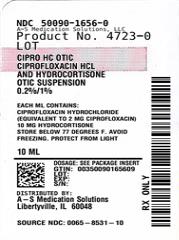
CIPRO ciprofloxacin hydrochloride and hydrocortisone 2; 10 mg/mL; mg/mL Suspension, 10 mL — NDC 50090-1656-0 (Billing 50090-1656-00)
This is a package of 10 mL of CIPRO ciprofloxacin hydrochloride and hydrocortisone 2; 10 mg/mL; mg/mL Suspension from A-S Medication Solutions, no longer marketed, no longer in the FDA NDC Directory. It is this product's only package size.
Identity & classification
Regulatory identifiers FDA, NLM and CMS codes for this package
Drug-database identifiers Medi-Span GPI and First Databank GCN / HICL / AHFS classification
- GSN (GCN sequence number): 039806
- GCN: 82031
- HICL (First Databank): 018392
- AHFS class code: 08:12.18.00
Where does this data come from?
- FDA openFDA NDC Directory · synced Oct 1, 2026
- FDA label on DailyMed · label index refreshed Oct 1, 2026
- RxNorm (NLM RxNav) · catalog refreshed Oct 1, 2026
- Medi-Span GPI (licensed)
- First Databank (licensed) · refreshed Oct 1, 2026
Clinical
Ciprofloxacin and hydrocortisone otic is used to treat outer ear infections in adults and children. Ciprofloxacin is in a class of medications called quinolone antibiotics. Hydrocortisone is in a class of medications called corticosteroids. The combination of ciprofloxacin and hydrocortisone works by killing the bacteria that cause infection and reducing swelling in the ear.
Read the full MedlinePlus article ↗- Yes, exactly. Ciprofloxacin / Hydrocortisone ear drops are specifically approved to treat acute otitis externa, which most people call swimmer's ear. It's an infection of the outer...
- What exactly is this ear drop treating — is it just swimmer's ear?
- First, shake the bottle well every time before you use it. Then warm the bottle in your hand for a minute or two — using cold drops can make you dizzy. Lie on your side with the in...
- How do I use the drops correctly so they actually work?
Patient education
Supplement & herbal interactions
Where does this data come from?
- MedlinePlus (NLM) · refreshed Oct 1, 2026
- FDA label on DailyMed · label index refreshed Oct 1, 2026
Ask a licensed pharmacist directly — free, answered by our team.
Pricing
A drug doesn't have one price. Each row is a different public payment system, and none is what you'd pay at the counter — that depends on your insurance. The ⓘ on each row explains what it measures.
| Price system | Per mL | Per package |
|---|---|---|
| Retail pharmacies payNADAC · weekly | Not in the retail survey — common for institutional, discontinued, or low-volume packs. | |
| Medicaid paysCMS SDUD · 12 mo | No recent Medicaid claims on file for this NDC — rare and low-volume NDCs are suppressed in the public data. | |
| Medicare drug plans payPart D · quarterly | No Part D plan price is available for this NDC in our data. | |
Where does this data come from?
- CMS NADAC weekly file
- CMS ASP pricing files · refreshed Sep 20, 2026
- CMS Medicaid State Drug Utilization Data · refreshed Oct 2, 2026
- CMS Part D plan pricing files · refreshed Sep 24, 2026
- VA National Acquisition Center price file
Packaging — all sizes for this product
| Package NDC | Description | Marketing start | Marketing end | Status |
|---|---|---|---|---|
| 50090-1656-00 You're viewing this Main listing | 10 mL in 1 BOTTLE, GLASS | 2015-01-22 | — | Inactivated by FDA |
Therapeutic equivalents
| Product | Labeler | Pack | NADAC/unit | TE | Status | Price vs. this |
|---|---|---|---|---|---|---|
| ciprofloxacin hydrochloride and hydrocortisone 2 mg/mL; 10 mg/mL 00713-0851-09 | Cosette | 1 bottle | $26.909 | AB | Availability likely | — |
| Cipro Hc 2 mg/mL; 10 mg/mL 66758-0087-70 | Sandoz | 1 bottle | $34.932 | AB | Availability likely | — |
| Cipro Hc 2 mg/mL; 10 mg/mL 50090-6043-00 | A-S | 10 ml | — | AB | FDA listed | — |
| Cipro Hc 2 mg/mL; 10 mg/mL 50090-7631-00 | A-S | 1 bottle | — | AB | FDA listed | — |
| Cipro Hc 2 mg/mL; 10 mg/mL 76420-0273-10 | Asclemed | 10 ml | — | AB | FDA listed | — |
| Cipro 2; 10 mg/mL; mg/mLthis 50090-1656-00 | A-S | 10 ml | — | AB | Discontinued | — |
Where does this data come from?
- FDA openFDA NDC Directory · synced Oct 1, 2026
- FDA Orange Book · refreshed Sep 3, 2026
- CMS NADAC weekly file
Availability & generic status
FDA-approved generic versions are listed, and recent pricing/market data suggests they may be available — see Therapeutic equivalents.
Where does this data come from?
- FDA Orange Book · refreshed Sep 3, 2026
Inactive Ingredients / Excipients
Inactive ingredients, also called excipients, are components of the drug product other than the active ingredient. They may include fillers, dyes, coatings, preservatives, flavors, or other formulation ingredients.
💡 Tap an ingredient (hover on desktop) to see what it is and why it’s used.
-
UNII Q40Q9N063P
Acetic acid is a weak organic acid commonly used in medicines as a buffer and pH adjuster. It helps maintain the proper acidity level to ensure the drug remains stable and effective in its formulation.
-
UNII LKG8494WBH
Benzyl alcohol is a clear liquid used as a preservative and solvent in medicines. It helps prevent bacterial and fungal growth and dissolves other ingredients to create uniform liquid formulations.
-
UNII QTT17582CB
A strong acid used to adjust and maintain the proper pH level in liquid medicines, ensuring stability and preventing breakdown of active ingredients.
-
UNII 1DI56QDM62
A natural fatty substance from soybeans that helps mix oil and water-based ingredients together. It acts as an emulsifier and lubricant in medicines to improve texture and help the product break down properly in your body.
-
UNII 7T1F30V5YH
A synthetic emulsifier derived from sorbitol and oleic acid. It helps mix oil and water-based ingredients together and keeps them from separating in liquid formulations.
-
UNII 532B59J990
Polyvinyl alcohol is a synthetic polymer made from plant-derived materials. It's used as a binder to hold ingredients together, a film-former in coatings, and a thickener in liquid formulations.
-
UNII 4550K0SC9B
Sodium acetate is a salt derived from acetic acid. It acts as a buffer to help maintain the medicine's pH stability and may serve as a preservative or solubilizer in liquid formulations.
-
UNII 451W47IQ8X
Sodium chloride is common table salt. It's used in medicines as a buffer to maintain proper pH, as a filler to add bulk, or to adjust the osmotic balance in liquid formulations.
-
UNII 55X04QC32I
A strong alkaline chemical used to adjust and maintain the pH balance of liquid medicines. It helps keep the medicine stable and ensures it stays effective during storage.
-
UNII 059QF0KO0R
Water is a liquid solvent that dissolves and mixes ingredients together in liquid medicines, syrups, and injections. It helps distribute the active drug evenly throughout the product.
10 inactive ingredients listed in the exact product block matched to this NDC.
Where does this data come from?
ingredient classCode="IACT" elements from the exact product block matched by this NDC. Label-section narrative from DailyMed / the openFDA label index is shown separately when available.- FDA label on DailyMed · label index refreshed Oct 1, 2026
- FDA openFDA NDC Directory · synced Oct 1, 2026
Inactive ingredient FAQ
Are inactive ingredients the same for every manufacturer?
Why might an inactive ingredient be missing?
Can inactive ingredients matter?
Manufacturer & labeler
Where does this data come from?
- FDA openFDA NDC Directory · synced Oct 1, 2026
- Drugs@FDA
Full prescribing information FDA SPL
🎯 Indications and Usage ▾
INDICATIONS AND USAGE CIPRO® HC OTIC is indicated for the treatment of acute otitis externa in adult and pediatric patients, one year and older, due to susceptible strains of Pseudomonas aeruginosa , Staphylococcus aureus , and Proteus mirabilis .
⏱️ Dosage and Administration ▾
DOSAGE AND ADMINISTRATION SHAKE WELL IMMEDIATELY BEFORE USING. For children (age 1 year and older) and adults, 3 drops of the suspension should be instilled into the affected ear twice daily for seven days. The suspension should be warmed by holding the bottle in the hand for 1-2 minutes to avoid the dizziness which may result from the instillation of a cold solution into the ear canal.
The patient should lie with the affected ear upward and then the drops should be instilled. This position should be maintained for 30-60 seconds to facilitate penetration of the drops into the ear. Repeat, if necessary, for the opposite ear.
Discard unused portion after therapy is completed.
⛔ Contraindications ▾
CONTRAINDICATIONS CIPRO® HC OTIC is contraindicated in persons with a history of hypersensitivity to hydrocortisone, ciprofloxacin or any member of the quinolone class of antimicrobial agents. This nonsterile product should not be used if the tympanic membrane is known or suspected to be perforated. Use of this product is contraindicated in viral infections of the external canal including varicella and herpes simplex infections.
⚠️ Warnings ▾
WARNINGS NOT FOR OPHTHALMIC USE. NOT FOR INJECTION. CIPRO® HC OTIC should be discontinued at the first appearance of a skin rash or any other sign of hypersensitivity.
Serious and occasionally fatal hypersensitivity (anaphylactic) reactions, some following the first dose, have been reported in patients receiving systemic quinolones. Serious acute hypersensitivity reactions may require immediate emergency treatment. The dropper cap contains natural rubber (latex) which may cause severe allergic reactions.
🤒 Adverse Reactions ▾
ADVERSE REACTIONS In Phase 3 clinical trials, a total of 564 patients were treated with CIPRO® HC OTIC. Adverse events with at least remote relationship to treatment included headache (1.2%) and pruritus (0.4%). The following treatment-related adverse events were each reported in a single patient: migraine, hypesthesia, paresthesia, fungal dermatitis, cough, rash, urticaria, and alopecia.
The following reactions have been identified during post-approval use of CIPRO® HC OTIC in clinical practice. Because they are reported voluntarily from a population of unknown size, estimates of frequency cannot be made. The reactions, which have been chosen for inclusion due to either their seriousness, frequency of reporting, possible causal connection to CIPRO® HC OTIC, or a combination of these factors, include: dizziness, ear canal erythema, ear congestion, hypoacusis and medication residue.
🤰 Pregnancy ▾
Pregnancy: Teratogenic Effects: Reproduction studies have been performed in rats and mice using oral doses of up to 100 mg/kg and IV doses up to 30 mg/kg and have revealed no evidence of harm to the fetus as a result of ciprofloxacin. In rabbits, ciprofloxacin (30 and 100 mg/kg orally) produced gastrointestinal disturbances resulting in maternal weight loss and an increased incidence of abortion, but no teratogenicity was observed at either dose. After intravenous administration of doses up to 20 mg/kg, no maternal toxicity was produced in the rabbit, and no embryotoxicity or teratogenicity was observed.
Corticosteroids are generally teratogenic in laboratory animals when administered systemically at relatively low dosage levels. The more potent corticosteroids have been shown to be teratogenic after dermal application in laboratory animals. Animal reproduction studies have not been conducted with CIPRO® HC OTIC.
No adequate and well controlled studies have been performed in pregnant women. Caution should be exercised when CIPRO® HC OTIC is used by a pregnant woman.
🧒 Pediatric Use ▾
Pediatric Use: The safety and efficacy of CIPRO® HC OTIC have been established in pediatric patients 2 years and older (131 patients) in adequate and well-controlled clinical trials. Efficacy has been extrapolated for patients, age 1 year and above based on studies in adults and older pediatric patients.
🧬 Clinical Pharmacology ▾
CLINICAL PHARMACOLOGY The plasma concentrations of ciprofloxacin were not measured following three drops of otic suspension administration because the systemic exposure to ciprofloxacin is expected to be below the limit of quantitation of the assay (0.05 μg/mL). Similarly, the predicted C max of hydrocortisone is within the range of endogenous hydrocortisone concentration (0-150 ng/mL), and therefore cannot be differentiated from the endogenous cortisol. Preclinical studies have shown that CIPRO® HC OTIC was not toxic to the guinea pig cochlea when administered intratympanically twice daily for 30 days and was only weakly irritating to rabbit skin upon repeated exposure.
Hydrocortisone has been added to aid in the resolution of the inflammatory response accompanying bacterial infection. Microbiology Ciprofloxacin has in vitro activity against a wide range of gram-positive and gram-negative microorganisms. The bactericidal action of ciprofloxacin results from interference with the enzyme, DNA gyrase, which is needed for the synthesis of bacterial DNA.
Cross-resistance has been observed between ciprofloxacin and other fluoroquinolones. There is generally no cross-resistance between ciprofloxacin and other classes of antibacterial agents such as beta-lactams or aminoglycosides. Ciprofloxacin has been shown to be active against most strains of the following microorganisms, both in vitro and in clinical infections of acute otitis externa as described in the INDICATIONS AND USAGE section: Aerobic gram-positive microorganism Staphylococcus aureus Aerobic gram-negative microorganisms Proteus mirabilis Pseudomonas aeruginosa
📦 How Supplied / Storage and Handling ▾
HOW SUPPLIED Product: 50090-1656 NDC: 50090-1656-0 10 mL in a BOTTLE, GLASS
📋 Description ▾
DESCRIPTION CIPRO® HC OTIC (ciprofloxacin hydrochloride and hydrocortisone otic suspension) contains the synthetic broad spectrum antibacterial agent, ciprofloxacin hydrochloride, combined with the anti-inflammatory corticosteroid, hydrocortisone, in a preserved, nonsterile suspension for otic use. Each mL of CIPRO® HC OTIC contains ciprofloxacin hydrochloride (equivalent to 2 mg ciprofloxacin), 10 mg hydrocortisone, and 9 mg benzyl alcohol as a preservative. The inactive ingredients are polyvinyl alcohol, sodium chloride, sodium acetate, glacial acetic acid, phospholipon 90H (modified lecithin), polysorbate, and purified water.
Sodium hydroxide or hydrochloric acid may be added for adjustment of pH. Ciprofloxacin, a fluoroquinolone, is available as the monohydrochloride monohydrate salt of 1-cyclopropyl-6-fluoro-1,4-dihydro-4-oxo-7-(1-piperazinyl)-3-quinolinecarboxylic acid. Its empirical formula is C 17 H 18 FN 3 O 3 •HCI•H 2 O and its chemical structure is as follows: Hydrocortisone, pregn-4-ene-3, 20-dione, 11, 17, 21-trihydroxy-(11(β)-, is an anti-inflammatory corticosteroid.
Its empirical formula is C 21 H 30 O 5 and its chemical structure is: chemical1 chemical2
💬 Information for Patients ▾
Information for Patients: If rash or allergic reaction occurs, discontinue use immediately and contact your physician. Do not use in the eyes. Avoid contaminating the dropper with material from the ear, fingers, or other sources. Protect from light. Shake well immediately before using. Discard unused portion after therapy is completed.
Medicare Part D spend CMS · PART D · 2026 (Q1)
Reported adverse events (FAERS)
Top reported reactions
Age at onset
Reporter sex
Serious outcomes
Where does this data come from?
About this NDC listing & data coverage
What data is (and isn’t) available for this NDC — tap to expand
| NDC identity (package / product / labeler codes) | ✓ Available |
| Labeler | ✓ Available |
| Product & package description | ✓ Available |
| Marketing category & status | ✓ Available |
| Active ingredient / dosage form / route | ✓ Available |
| FDA label (SPL via DailyMed) | ✓ Available |
| Package photos | ✓ Available |
| Inactive ingredients (structured) | ✓ Available |
| NADAC pharmacy acquisition price (CMS) | — Not published for this NDC CMS publishes NADAC only for NDCs reported in its retail-pharmacy survey. |
| Orange Book / therapeutic-equivalence data | ✓ Available |
| HCPCS J-code billing crosswalk | — Not published for this NDC Most self-administered / retail products have no J-code — that is normal. |
| Medicaid utilization (CMS SDUD) | — Not published for this NDC CMS reports utilization only for NDCs with Medicaid claims above its privacy threshold. |