
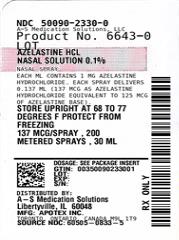
Azelastine Hydrochloride 137 ug Spray, Metered — NDC 50090-2330-0 (Billing 50090-2330-00)
This is a package of Azelastine Hydrochloride 137 ug Spray, Metered from A-S Medication Solutions, marketed since Mar 2010 and currently FDA-listed. It is this product's only package size.
NDC database record
One package, one record: these facts belong to NDC 50090-2330-0 alone.
- Record
- FDA NDC Directory package listing · Human prescription drug
- Code segments
- 50090 labeler · 2330 product · 0 package
- Package marketed since
- Mar 15, 2016
- Sample package
- No — commercial package
- Listing certified through
- Dec 31, 2026
- Barcode (UPC-A, from the NDC)
- 3 5009023300 1
- FDA record last changed
- Jul 24, 2026
Other active recalls for Azelastine Hydrochloride (different manufacturers) — 1 · tap to view
Identity & classification
Regulatory identifiers FDA, NLM and CMS codes for this package
Drug-database identifiers Medi-Span GPI and First Databank GCN / HICL / AHFS classification
- GSN (GCN sequence number): 029893
- GCN: 60544
- GPI-14 (Medi-Span): 42401015102020
- HICL (First Databank): 007607
- AHFS class code: 04:08.00.00
- RxCUI (RxNorm): 1797867
Where does this data come from?
- FDA openFDA NDC Directory · synced Oct 1, 2026
- FDA label on DailyMed · label index refreshed Oct 6, 2026
- RxNorm (NLM RxNav) · catalog refreshed Oct 1, 2026
- Medi-Span GPI (licensed)
- First Databank (licensed) · refreshed Oct 1, 2026
RxNorm drug class
This medicine belongs to the Histamine-1 Receptor Antagonist class.
Where does this data come from?
- RxClass (NLM) · catalog refreshed Oct 1, 2026
Clinical
Azelastine nasal spray is used to treat allergy symptoms: sneezing runny or itchy nose congestion Azelastine is in a class of medications called antihistamines. It works by blocking the action of histamine, a substance in the body that causes allergic symptoms.
Read the full MedlinePlus article ↗- It relieves symptoms of seasonal allergic rhinitis (hay fever) in adults and children 5 and older. It also treats vasomotor rhinitis, a non-allergic runny or stuffy nose, in people...
- Spray it only in your nose, never in your eyes or mouth. Prime a new bottle with 6 sprays until you see a fine mist, and reprime with 2 sprays if you haven't used it in 3 or more d...
- A bitter taste is the most common side effect. Tilting your head downward while you spray can help avoid it.
- Drowsiness can happen, so be careful driving or operating machinery until you know how it affects you. Avoid alcohol, sedatives and tranquilizers, since they can make drowsiness wo...
Patient education
Supplement & herbal interactions
Where does this data come from?
- MedlinePlus (NLM) · refreshed Oct 1, 2026
- FDA label on DailyMed · label index refreshed Oct 6, 2026
Ask a licensed pharmacist directly — free, answered by our team.
Pricing
A drug doesn't have one price. Each row is a different public payment system, and none is what you'd pay at the counter — that depends on your insurance. The ⓘ on each row explains what it measures.
| Price system | Per mL | Per package |
|---|---|---|
| Retail pharmacies payNADAC · weekly | Not in the retail survey — common for institutional, discontinued, or low-volume packs. | |
| Medicaid paysCMS SDUD · 12 mo | No recent Medicaid claims on file for this NDC — rare and low-volume NDCs are suppressed in the public data. | |
| Medicare drug plans payPart D · Q2 2026 | $0.4445 | — |
Where does this data come from?
- CMS NADAC weekly file
- CMS ASP pricing files · refreshed Sep 20, 2026
- CMS Medicaid State Drug Utilization Data · refreshed Oct 8, 2026
- CMS Part D plan pricing files · refreshed Sep 24, 2026
- VA National Acquisition Center price file
Packaging — all sizes for this product
| Package NDC | Description | Marketing start | Marketing end | Status |
|---|---|---|---|---|
| 50090-2330-00 You're viewing this Main listing | 1 BOTTLE, SPRAY in 1 CARTON / 200 SPRAY, METERED in 1 BOTTLE, SPRAY | 2016-03-15 | — | Active |
Therapeutic equivalents
| Product | Labeler | Pack | NADAC/unit | TE | Status | Price vs. this |
|---|---|---|---|---|---|---|
| Azelastine Hydrochloride 137 ug 59651-0214-30 | Aurobindo | 1 bottle | $0.273 | AB | Availability likely | — |
| Azelastine Hydrochloride 137 ug 60505-0833-05 | Apotex | 1 bottle | $0.273 | AB | Availability likely | — |
| Azelastine Hydrochloride 1 mg/mL 65162-0676-84 | Amneal | 1 bottle | $0.273 | AB | Availability likely | — |
| Azelastine 137 ug 67877-0477-50 | Ascend | 1 spray | $0.273 | AB | Availability likely | — |
| Azelastine Hydrochloride 137 ug 72603-0611-01 | NorthStar | 1 bottle | $0.273 | AB | Availability likely | — |
| Azelastine Hydrochloride 137 ug 47335-0779-91 | Sun | 1 bottle | $0.290 | — | FDA listed | — |
| Azelastine Hydrochloride 1 mg/mL 42291-0094-30 | AvKARE | 1 bottle | — | AB | FDA listed | — |
| Azelastine Hydrochloride 137 ugthis 50090-2330-00 | A-S | 1 bottle | — | AB | FDA listed | — |
| Azelastine Hydrochloride 137 ug 50090-7461-00 | A-S | 1 bottle | — | AB | FDA listed | — |
| Azelastine Hydrochloride 137 ug 68788-4056-02 | Preferred | 1 bottle | — | AB | FDA listed | — |
| Azelastine Hydrochloride 137 ug 68788-8514-02 | Preferred | 1 bottle | — | AB | FDA listed | — |
| Azelastine Hydrochloride 137 ug 71205-0449-30 | Proficient | 1 bottle | — | AB | FDA listed | — |
Where does this data come from?
- FDA openFDA NDC Directory · synced Oct 1, 2026
- FDA Orange Book · refreshed Oct 3, 2026
- CMS NADAC weekly file
Availability & generic status
This product is an FDA-approved generic. Other versions of the same drug are listed under Therapeutic equivalents, least expensive first.
Where does this data come from?
- FDA Orange Book · refreshed Oct 3, 2026
Inactive Ingredients / Excipients
Inactive ingredients, also called excipients, are components of the drug product other than the active ingredient. They may include fillers, dyes, coatings, preservatives, flavors, or other formulation ingredients.
🧪 Avoiding an ingredient? See Azelastine Nasal Spray inactive ingredients by manufacturer: every current product's list side by side, so you can ask your pharmacy for the version that does not list it.
💡 Tap an ingredient (hover on desktop) to see what it is and why it’s used.
-
UNII XF417D3PSL
Anhydrous citric acid is a sour, crystalline powder derived from citric acid with water removed. In medicines, it acts as a buffer to control pH, adds tartness to improve taste, and helps tablets disintegrate.
-
UNII F5UM2KM3W7
Benzalkonium chloride is a chemical compound that works as a preservative and antimicrobial agent in medications. It prevents bacterial and fungal growth in liquid formulations to keep the product safe during storage and use.
-
UNII 22ADO53M6F
A mineral salt derived from phosphoric acid, used as a buffer to maintain the pH balance of the medication and help stabilize the active ingredients.
-
UNII 7FLD91C86K
Edetate disodium is a chemical compound that binds and removes certain metal ions. In medicines, it acts as a preservative and stabilizer by preventing metals like calcium from interfering with the product's shelf life and consistency.
-
UNII 3NXW29V3WO
Hypromellose is a plant-based thickener made from cellulose. It's used in medicines as a binder to hold ingredients together, a coating for tablets, and a thickener for liquids.
-
UNII 451W47IQ8X
Sodium chloride is common table salt. It's used in medicines as a buffer to maintain proper pH, as a filler to add bulk, or to adjust the osmotic balance in liquid formulations.
-
UNII 059QF0KO0R
Water is a liquid solvent that dissolves and mixes ingredients together in liquid medicines, syrups, and injections. It helps distribute the active drug evenly throughout the product.
7 inactive ingredients listed in the exact product block matched to this NDC.
Where does this data come from?
ingredient classCode="IACT" elements from the exact product block matched by this NDC. Label-section narrative from DailyMed / the openFDA label index is shown separately when available.- FDA label on DailyMed · label index refreshed Oct 6, 2026
- FDA openFDA NDC Directory · synced Oct 1, 2026
Inactive ingredient FAQ
Are inactive ingredients the same for every manufacturer?
Why might an inactive ingredient be missing?
Can inactive ingredients matter?
Manufacturer & labeler
More NDCs from A-S Medication Solutions labeler code 50090
- Metoprolol Tartrate 100 mg Tablet, Film Coated NDC 50090-2260-0
- NovoLog Mix 70/30 insulin aspart 100 [iU]/mL Injection, Suspension NDC 50090-2272-0
- Venlafaxine Hydrochloride 37.5 mg Capsule, Extended Release NDC 50090-2281-0
- Mucinex Maximum Strength Guaifenesin 1200 mg Tablet, Extended Release NDC 50090-2301-0
- Dexamethasone Sodium Phosphate 4 mg/mL Injection, Solution NDC 50090-2313-2
- Estrace estradiol .1 mg/g Cream NDC 50090-2321-0
- Ondansetron 4 mg Tablet, Orally Disintegrating NDC 50090-2343-0
- REFRESH CLASSIC Polyvinyl Alcohol, Povidone 14 mg/mL; 6 mg/mL Solution/ Drops NDC 50090-2358-1
- KENALOG-40 TRIAMCINOLONE ACETONIDE 40 mg/mL Injection, Suspension NDC 50090-2360-0
- Tetracaine Hydrochloride 5 mg/mL Solution NDC 50090-2364-1
- Neomycin and Polymyxin B Sulfates and Hydrocortisone neomycin sulfate, polymyxin b sulfate 3.5 mg/mL; 10000 [USP'U]/mL; 10 mg/mL Suspension NDC 50090-2365-0
- Terazosin 10 mg Capsule NDC 50090-2371-0
Where does this data come from?
- FDA openFDA NDC Directory · synced Oct 1, 2026
- Drugs@FDA
Full prescribing information FDA SPL
🎯 Indications and Usage ▾
1 INDICATIONS AND USAGE Azelastine hydrochloride nasal spray is indicated for the treatment of the symptoms of seasonal allergic rhinitis in adults and pediatric patients 5 years and older, and for the treatment of the symptoms of vasomotor rhinitis in adults and adolescent patients 12 years and older. Azelastine hydrochloride nasal spray is an H1-receptor antagonist indicated for the treatment of the symptoms of seasonal allergic rhinitis in adults and pediatric patients 5 years and older and for the treatment of the symptoms of vasomotor rhinitis in adults and adolescent patients 12 years and older.
( 1 )
⏱️ Dosage and Administration ▾
2 DOSAGE AND ADMINISTRATION For intranasal use only ( 2.3 ) Seasonal allergic rhinitis: Pediatric patients 5 to 11 years of age: 1 spray per nostril twice daily ( 2.1 ) Adults and adolescents 12 years of age and older: 1 or 2 sprays per nostril twice daily ( 2.1 ) Vasomotor rhinitis: 2 sprays per nostril twice daily in adults and adolescents 12 years of age and older ( 2.2 ) Prime azelastine hydrochloride nasal spray before initial use and when it has not been used for 3 or more days ( 2.3 )
2.1Seasonal Allergic Rhinitis The recommended dosage of azelastine hydrochloride nasal spray in adults and adolescent patients 12 years and older with seasonal allergic rhinitis is one or two sprays per nostril twice daily. The recommended dosage of azelastine hydrochloride nasal spray in pediatric patients 5 years to 11 years of age is one spray per nostril twice daily.
2.2Vasomotor Rhinitis The recommended dosage of azelastine hydrochloride nasal spray in adults and adolescent patients 12 years and older with vasomotor rhinitis is two sprays per nostril twice daily.
2.3Important Administration Instructions Administer azelastine hydrochloride nasal spray by the intranasal route only. Priming Prime azelastine hydrochloride nasal spray before initial use by releasing 4 sprays or until a fine mist appears. When azelastine hydrochloride nasal spray has not been used for 3 or more days, reprime with 2 sprays or until a fine mist appears. Avoid spraying azelastine hydrochloride nasal spray into the eyes.
💊 Dosage Forms and Strengths ▾
3 DOSAGE FORMS AND STRENGTHS Azelastine hydrochloride nasal spray is a nasal spray solution. Each spray of azelastine hydrochloride nasal spray delivers a volume of 0.137 mL solution containing 137 mcg of azelastine hydrochloride. Azelastine hydrochloride nasal spray: 137 mcg of azelastine hydrochloride in each 0.137 mL spray. ( 3 )
⛔ Contraindications ▾
4 CONTRAINDICATIONS None. None ( 4 )
⚠️ Warnings and Cautions ▾
5 WARNINGS AND PRECAUTIONS Somnolence: Avoid engaging in hazardous occupations requiring complete mental alertness such as driving or operating machinery when taking azelastine hydrochloride nasal spray. ( 5.1 ) Alcohol and other central nervous system (CNS) depressants: Avoid concurrent use with azelastine hydrochloride nasal spray because further decreased alertness and impairment of CNS performance may occur. ( 5.1 )
5.1Somnolence in Activities Requiring Mental Alertness In clinical trials, the occurrence of somnolence has been reported in some patients taking azelastine hydrochloride nasal spray [see Adverse Reactions ( 6.1 )] . Patients should be cautioned against engaging in hazardous occupations requiring complete mental alertness and motor coordination such as operating machinery or driving a motor vehicle after administration of azelastine hydrochloride nasal spray. Concurrent use of azelastine hydrochloride nasal spray with alcohol or other central nervous system depressants should be avoided because additional reductions in alertness and additional impairment of central nervous system performance may occur [see Drug Interactions ( 7.1 )] .
🤒 Adverse Reactions ▾
6 ADVERSE REACTIONS Use of azelastine hydrochloride nasal spray has been associated with somnolence [see Warnings and Precautions ( 5.1 )]. The most common adverse reactions (≥2% incidence) are: bitter taste, headache, somnolence, dysesthesia, rhinitis, nasal burning, pharyngitis, epistaxis, sinusitis, paroxysmal sneezing, nausea, dry mouth, fatigue, dizziness, and weight increase. ( 6.1 ) To report SUSPECTED ADVERSE REACTIONS, contact Apotex CORP. at 1-800-706-5575 or FDA at 1-800-FDA-1088 or www.fda.gov/medwatch
6.1Clinical Trials Experience Because clinical trials are conducted under widely varying conditions, adverse reaction rates observed in clinical trials of a drug cannot be directly compared to rates in the clinical trials of another drug and may not reflect rates observed in practice. Seasonal Allergic Rhinitis Azelastine hydrochloride nasal spray Two Sprays Per Nostril Twice Daily Adverse experience information for azelastine hydrochloride nasal spray is derived from six placebo- and active- controlled, 2-day to 8-week clinical trials which included 391 patients, 12 years of age and older, with seasonal allergic rhinitis who received azelastine hydrochloride nasal spray at a dose of 2 sprays per nostril twice daily.
In placebo-controlled efficacy trials, the incidence of discontinuation due to adverse reactions in patients receiving azelastine hydrochloride nasal spray and vehicle placebo was 2.2% and 2.8%, respectively. Table 1 contains adverse reactions that were reported with frequencies ≥2% in the azelastine hydrochloride nasal spray 2 sprays per nostril twice daily treatment group and more frequently than placebo. Table 1: Adverse Reactions Reported in ≥2% Incidence in Placebo-Controlled Trials in Patients with Seasonal Allergic Rhinitis [n (%)] Azelastine hydrochloride Nasal Spray N = 391 Vehicle Placebo N = 353 Bitter Taste 77 (19.7%) 2 (0.6%) Headache 58 (14.8%) 45 (12.7%) Somnolence 45 (11.5%) 19 (5.4%) Nasal Burning 16 (4.1%) 6 (1.7%) Pharyngitis 15 (3.8%) 10 (2.8%) Paroxysmal Sneezing 12 (3.1%) 4 (1.1%) Dry Mouth 11 (2.8%) 6 (1.7%) Nausea 11 (2.8%) 4 (1.1%) Rhinitis 9 (2.3%) 5 (1.4%) Fatigue 9 (2.3%) 5 (1.4%) Dizziness 8 (2.0%) 5 (1.4%) Epistaxis 8 (2.0%) 5 (1.4%) Weight Increase 8 (2.0%) 0 (0.0%) Azelastine hydrochloride nasal spray One Spray Per Nostril Twice Daily Adverse experience information for azelastine hydrochloride nasal spray at a dose of one spray per nostril twice daily is derived from two placebo-controlled 2-week clinical studies which included 276 patients 12 years of age and older with seasonal allergic rhinitis.
The incidence of discontinuation due to adverse reactions in patients receiving azelastine hydrochloride nasal spray and vehicle placebo was 0.0% and 0.8%, respectively. Bitter taste was reported in 8.3% of patients compared to none in the placebo group. Somnolence was reported in 0.4% of patients compared to none in the placebo group.
A total of 176 patients 5 to 11 years of age were exposed to azelastine hydrochloride nasal spray at a dose of 1 spray each nostril twice daily in 3 placebo-controlled studies. In these studies, adverse reactions that occurred more frequently in patients treated with azelastine hydrochloride nasal spray than with placebo, and that were not represented in the adult adverse reactions table above include rhinitis/cold symptoms (17.0% vs. 9.5%), cough (11.4% vs.
8.3%), conjunctivitis (5.1% vs. 1.8%), and asthma (4.5% vs. 4.1%).
Adverse Reactions <2% in azelastine hydrochloride nasal spray One or Two Sprays Per Nostril Twice Daily The following reactions were observed infrequently (<2% and exceeding placebo incidence) in patients who received azelastine hydrochloride nasal spray dosed at 1 or 2 sprays per nostril twice daily in U.S. clinical trials. Cardiovascular Flushing, hypertension, tachycardia. Dermatological Contact dermatitis, eczema, hair and follicle infection, furunculosis, skin laceration.
Digestive Constipation, gastroenteritis, glossitis… [Excerpted — this section continues on DailyMed.]
🔄 Drug Interactions ▾
7 DRUG INTERACTIONS
7.1Central Nervous System Depressants Concurrent use of azelastine hydrochloride nasal spray with alcohol or other central nervous system depressants should be avoided because reductions in alertness and impairment of central nervous system performance may occur [see Warnings and Precautions ( 5.1 )].
👥 Use in Specific Populations ▾
8 USE IN SPECIFIC POPULATIONS
8.1Pregnancy Risk Summary Limited data from postmarketing experience over decades of use with azelastine hydrochloride nasal spray in pregnant women have not identified any drug associated risks of miscarriage, birth defects, or other adverse maternal or fetal outcomes. In animal reproduction studies, there was no evidence of fetal harm at oral doses approximately 5 times the clinical daily dose. Oral administration of azelastine hydrochloride to pregnant mice, rats, and rabbits, during the period of organogenesis, produced developmental toxicity that included structural abnormalities, decreased embryo-fetal survival, and decreased fetal body weights at doses 270 times and higher than the maximum recommended human daily intranasal dose (MRHDID) of 1.096 mg.
However, the relevance of these findings in animals to pregnant women was considered questionable based upon the high animal to human dose multiple. The estimated background risk of major birth defects and miscarriage for the indicated populations is unknown. All pregnancies have a background risk of birth defect, loss, or other adverse outcomes.
In the U.S. general population, the estimated background risk of major birth defects and miscarriage in clinically recognized pregnancies is 2-4% and 15-20%, respectively. Data Animal Data In an embryo-fetal development study in mice dosed during the period of organogenesis, azelastine hydrochloride caused embryo-fetal death, structural abnormalities (cleft palate; short or absent tail; fused, absent or branched ribs), delayed ossification, and decreased fetal weight at approximately 300 times the maximum recommended human daily intranasal dose (MRHDID) in adults (on a mg/m2 basis at a maternal oral dose of 68.6 mg/kg/day), which also caused maternal toxicity as evidenced by decreased maternal body weight.
Neither fetal nor maternal effects occurred in mice at approximately 15 times the MRHDID in adults (on a mg/m 2 basis at a maternal oral dose of 3 mg/kg/day). In an embryo-fetal development study in pregnant rats dosed during the period of organogenesis from gestation days 7 to 17, azelastine hydrochloride caused structural abnormalities (oligo-and brachydactylia), delayed ossification, and skeletal variations, in the absence of maternal toxicity, at approximately 270 times the MRHDID in adults (on a mg/m 2 basis at a maternal oral dose of 30 mg/kg/day).
Azelastine hydrochloride caused embryo-fetal death and decreased fetal weight and severe maternal toxicity at approximately 610 times the MRHDID (on a mg/m 2 basis at a maternal oral dose of 68.6 mg/kg/day). Neither fetal nor maternal effects occurred at approximately 20 times the MRHDID (on a mg/m 2 basis at a maternal oral dose of 2 mg/kg/day). In an embryo-fetal development study in pregnant rabbits dosed during the period of organogenesis from gestation days 6 to 18, azelastine hydrochloride caused abortion, delayed ossification and decreased fetal weight and severe maternal toxicity at approximately 530 times the MRHDID in adults (on a mg/m 2 basis at a maternal oral dose of 30 mg/kg/day).
Neither fetal nor maternal effects occurred at approximately 5 times the MRHDID (on a mg/m 2 basis at a maternal oral dose of 0.3 mg/kg/day). In a prenatal and postnatal development study in pregnant rats dosed from late in the gestation period and through the lactation period from gestation day 17 through lactation day 21, azelastine hydrochloride produced no adverse developmental effects on pups at maternal doses up to approximately 270 times the MRHDID (on mg/m2 basis at a maternal dose of 30 mg/kg/day).
8.2Lactation Risk Summary There are no data on the presence of azelastine hydrochloride in human milk, the effects on the breastfed infant, or the effects on milk production. Breastfed infants should be monitored for signs of milk rejection during azelastine hydrochloride use by lactating women (see Clinical Considerations). The developmental and health b… [Excerpted — this section continues on DailyMed.]
🆘 Overdosage ▾
10 OVERDOSAGE There have been no reported overdosages with azelastine hydrochloride nasal spray. Acute overdosage by adults with this dosage form is unlikely to result in clinically significant adverse reactions, other than increased somnolence, since one bottle of azelastine hydrochloride nasal spray contains 30 mg of azelastine hydrochloride. Clinical trials in adults with single doses of the oral formulation of azelastine hydrochloride (up to 16 mg) have not resulted in increased incidence of serious adverse reactions.
General supportive measures should be employed if overdosage occurs. There is no known antidote to azelastine hydrochloride nasal spray. Oral ingestion of antihistamines has the potential to cause serious adverse effects in young children.
Accordingly, azelastine hydrochloride nasal spray should be kept out of the reach of children.
🧬 Clinical Pharmacology ▾
12 CLINICAL PHARMACOLOGY
12.1Mechanism of Action Azelastine hydrochloride, a phthalazinone derivative, exhibits histamine H1-receptor antagonist activity in isolated tissues, animal models, and humans. Azelastine hydrochloride nasal spray is administered as a racemic mixture with no difference in pharmacologic activity noted between the enantiomers in in vitro studies. The major metabolite, desmethylazelastine, also possesses H1-receptor antagonist activity.
12.2Pharmacodynamics Cardiac Electrophysiology In a placebo-controlled study (95 subjects with allergic rhinitis), there was no evidence of an effect of azelastine hydrochloride nasal spray (2 sprays per nostril twice daily for 56 days) on cardiac repolarization as represented by the corrected QT interval (QTc) of the electrocardiogram. Following multiple dose oral administration of azelastine 4 mg or 8 mg twice daily, the mean change in QTc was 7.2 msec and 3.6 msec, respectively. Interaction studies investigating the cardiac repolarization effects of concomitantly administered oral azelastine hydrochloride and erythromycin or ketoconazole were conducted.
These drugs had no effect on QTc based on analysis of serial electrocardiograms. At a dose approximately 8 times the maximum recommended dose, azelastine hydrochloride does not prolong the QTc interval to any clinically relevant extent.
12.3Pharmacokinetics Absorption After intranasal administration, the systemic bioavailability of azelastine hydrochloride is approximately 40%. Maximum plasma concentrations (C max ) are achieved in 2-3 hours. Azelastine hydrochloride administered intranasally at doses above two sprays per nostril twice daily for 29 days resulted in greater than proportional increases in C max and area under the curve (AUC) for azelastine.
Distribution Based on intravenous and oral administration, the steady-state volume of distribution is
14.5L/kg. In vitro studies with human plasma indicate that the plasma protein binding of azelastine and its metabolite, desmethylazelastine, are approximately 88% and 97%, respectively. Metabolism Azelastine is oxidatively metabolized to the principal active metabolite, desmethylazelastine, by the cytochrome P450 enzyme system.
The specific P450 isoforms responsible for the biotransformation of azelastine have not been identified. After intranasal dosing of azelastine hydrochloride to steady-state, plasma concentrations of desmethylazelastine range from 20 to 50% of azelastine concentrations. Limited data indicate that the metabolite profile is similar when azelastine hydrochloride is administered via the intranasal or oral route.
Elimination Based on intravenous and oral administration, the elimination half-life and plasma clearance are 22 hours and
0.5L/h/kg, respectively. Approximately 75% of an oral dose of radiolabeled azelastine hydrochloride was excreted in the feces with less than 10% as unchanged azelastine. Special Populations Hepatic Impairment Following oral administration, pharmacokinetic parameters were not influenced by hepatic impairment.
Renal Impairment Based on oral, single-dose studies, renal insufficiency (creatinine clearance <50 mL/min) resulted in a 70 to 75% higher C max and AUC compared to normal subjects. Time to maximum concentration was unchanged. Age Following oral administration, pharmacokinetic parameters were not influenced by age.
Gender Following oral administration, pharmacokinetic parameters were not influenced by gender. Race The effect of race has not been evaluated. Drug-Drug Interactions Erythromycin No significant pharmacokinetic interaction was observed with the co-administration of orally administered azelastine (4 mg twice daily) with erythromycin (500 mg three times daily for 7 days).
In this study, co-administration of orally administered azelastine with erythromycin resulted in C max of 5.36 ± 2.6 ng/mL and AUC of 49.7 ± 24 ng•h/mL for azelastine, whereas, administration of azelastine alone resulted in C max of 5.57… [Excerpted — this section continues on DailyMed.]
📦 How Supplied / Storage and Handling ▾
16 HOW SUPPLIED/ STORAGE AND HANDLING Product: 50090-2330 NDC: 50090-2330-0 200 SPRAY, METERED in a BOTTLE, SPRAY / 1 in a CARTON
📋 Description ▾
11 DESCRIPTION Azelastine hydrochloride nasal solution 0.1% (nasal spray), 137 micrograms (mcg) per spray, is an antihistamine formulated as a metered-spray solution for intranasal administration . Azelastine hydrochloride occurs as a white, almost odorless, crystalline powder with a bitter taste . It has a molecular weight of 418.37 g/mol .
It is sparingly soluble in water, methanol, and propylene glycol and slightly soluble in ethanol, octanol, and glycerine . It has a melting point of about 225ºC and the pH of a saturated solution is between 5.0 and 5.4 . Its chemical name is (±)-1-(2H)-phthalazinone,4-[(4-chlorophenyl) methyl]-2-(hexahydro-1-methyl-1H-azepin-4-yl)-, monohydrochloride.
Its molecular formula is C 22 H 24 ClN 3 O•HCl with the following chemical structure: Azelastine hydrochloride nasal solution contains 0.1% azelastine hydrochloride in an aqueous solution at pH 6.8 ± 0.3. It also contains benzalkonium chloride (125 mcg/mL), citric acid, dibasic sodium phosphate, edetate disodium, hypromellose, purified water and sodium chloride. After priming [see Dosage and Administration ( 2.3 )] , each metered spray delivers a 0.137 mL mean volume containing 137 mcg of azelastine hydrochloride (equivalent to 125 mcg of azelastine base).
The bottle can deliver 200 metered sprays.
💬 Information for Patients ▾
17 PATIENT COUNSELING INFORMATION See FDA-approved patient labeling (Patient Information and Instructions for Use). Activities Requiring Mental Alertness Somnolence has been reported in some patients taking azelastine hydrochloride Nasal Spray. Caution patients against engaging in hazardous occupations requiring complete mental alertness and motor coordination such as driving or operating machinery after administration of azelastine hydrochloride nasal spray [ see Warnings and Precautions ( 5.1 ) ].
Concurrent Use of Alcohol and other Central Nervous System Depressants Instruct patients to avoid concurrent use of azelastine hydrochloride nasal spray with alcohol or other central nervous system depressants because additional reductions in alertness and additional impairment of central nervous system performance may occur [ see Warnings and Precautions ( 5.1 ) ]. Common Adverse Reactions Inform patients that the treatment with azelastine hydrochloride nasal spray may lead to adverse reactions, which include bitter taste, headache, somnolence, dysesthesia, rhinitis, nasal burning, pharyngitis, epistaxis, sinusitis, paroxysmal sneezing, nausea, dry mouth, fatigue, dizziness, and weight increase [ see Adverse Reactions ( 6.1 ) ].
Priming Instruct patients to prime the pump before initial use and when azelastine hydrochloride nasal spray has not been used for 3 or more days [ see Dosage and Administration ( 2.3 ) ]. Keep Spray Out of Eyes Instruct patients to avoid spraying azelastine hydrochloride nasal spray into their eyes. Keep Out of Children’s Reach Instruct patients to keep azelastine hydrochloride nasal spray out of the reach of children.
If a child accidentally ingests azelastine hydrochloride nasal spray, seek medical help or call a poison control center immediately. APOTEX INC. AZELASTINE HYDROCHLORIDE NASAL SPRAY 137 mcg Manufactured in Canada for Apotex Corp, Weston, FL 33326 Revised: November 2021
🔬 Clinical Studies ▾
14 CLINICAL STUDIES
14.1Seasonal Allergic Rhinitis Two Sprays Per Nostril Twice Daily The efficacy and safety of azelastine hydrochloride nasal spray were evaluated in three placebo-controlled clinical trials of azelastine hydrochloride nasal spray including 322 patients with seasonal allergic rhinitis who received two sprays per nostril twice a day for up to 4 weeks. These trials included 55 pediatric patients ages 12 to 16 years. Assessment of efficacy was based on the 12-hour reflective Total Symptom Complex (TSC) and Major Symptom Complex (MSC).
The MSC was calculated as the average of individual symptoms of nose blows, sneezes, runny nose/sniffles, itchy nose, and watery eyes as assessed by patients on a 0 to 5 categorical scale. Azelastine hydrochloride nasal spray two sprays per nostril twice daily demonstrated a greater decrease in the MSC than placebo (Table 3). Table 3: Mean Change from Baseline in Reflective MSC* in Adults and Adolescents ≥12 Years with Seasonal Allergic Rhinitis Treated with Azelastine hydrochloride Nasal Spray Two Sprays Per Nostril Twice Daily Versus Placebo Treatment N Baseline LS Mean (SD) Change from Baseline (SD) Treatment Difference P-value Trial 1: 12 Hour AM and PM Reflective MSC Azelastine hydrochloride Nasal Spray 63 11.48 (4.13) -3.05 (3.51) 1.98 <0.01 Placebo Nasal Spray 60 10.84 (4.53) -1.07 (3.52) Trial 2: 12 Hour AM and PM Reflective MSC Azelastine hydrochloride Nasal Spray 63 12.50 (4.5) -4.10 (3.46) 2.03 <0.01 Placebo Nasal Spray 63 12.18 (4.64) -2.07 (4.01) Trial 3: 12 Hour AM and PM Reflective MSC Azelastine hydrochloride Nasal Spray 66 12.04 (4.03) -3.31 (3.74) 1.35
0.04Placebo Nasal Spray 66 11.66 (3.96) -1.96 (3.57) *Major Symptom Comlex (MSC): Average of individual symptoms of nose blows, sneezes, runny nose/sniffles, itchy nose, and watery eyes as assessed by patients on a 0 to 5 categorical scale. In dose-ranging trials, administration of azelastine hydrochloride nasal spray two sprays per nostril twice daily resulted in a statistically significant decrease in symptoms compared to saline placebo within 3 hours after initial dosing and persisted over the 12-hour dosing interval.
One Spray Per Nostril Twice Daily The efficacy and safety of azelastine hydrochloride nasal spray were evaluated in two placebo-controlled clinical trials of azelastine hydrochloride nasal spray including 275 patients with seasonal allergic rhinitis who received one spray per nostril twice a day for up to 2 weeks. Assessment of efficacy was based on the 12-hour reflective Total Nasal Symptom Score [rTNSS]. rTNSS is calculated as the sum of the patients scoring of four individual nasal symptoms (runny nose, sneezing, itchy nose, and nasal congestion) as assessed by patients on a 0 to 3 categorical scale.
The primary efficacy endpoint was the change from Baseline to Day 14 in rTNSS. The mean change from baseline in rTNSS was greater in patients receiving azelastine hydrochloride nasal spray one spray per nostril twice daily than those receiving placebo (Table 4). Table 4: Mean Change from Baseline in Reflective TNSS* in Adults and Adolescents ≥12 years with Seasonal Allergic Rhinitis Treated with Azelastine hydrochloride Nasal Spray One Spray Per Nostril Twice Daily Versus Placebo Treatment N Baseline LS Mean (SD) Change from Baseline (SD) Treatment Difference P-value Trial 4: 12 Hour AM and PM Reflective TNSS Azelastine hydrochloride Nasal Spray 138 16.34 (4.22) -2.69 (4.79) 1.38
0.01Placebo Nasal Spray 141 17.21 (4.32) -1.31 (4.29) Trial 5: 12 Hour AM and PM Reflective TNSS Azelastine hydrochloride Nasal Spray 137 16.62 (4.20) -3.68 (4.16) 1.18
0.02Placebo Nasal Spray 136 16.84 (4.77) -2.50 (4.01) * Total Nasal Symptom Score (TNSS): Average of individual symptoms of runny nose, sneezing, itchy nose, and nasal congestion as assessed by patients on a 0 to 3 categorical scale. Two-week studies comparing the efficacy (and safety) of azelastine hydrochloride nasal spray two sprays per nostril twice… [Excerpted — this section continues on DailyMed.]
🧪 Nonclinical Toxicology ▾
13 NONCLINICAL TOXICOLOGY
13.1C a rcinogenesis, Mutagenesis, Impairment of Fertility Two-year carcinogenicity studies in Crl:CD(SD)BR rats and NMRI mice were conducted to assess the carcinogenic potential of azelastine hydrochloride. No evidence of tumorigenicity was observed in rats at doses up to 30 mg/kg day (approximately 270 and 240 times the MRHDID for adults and children, respectively, on a mg/m2 basis). No evidence for tumorigenicity was observed in mice at doses up to 25 mg/kg (approximately 110 and 100 times the MRHDID for adults and children, respectively, on a mg/m2 basis).
Azelastine hydrochloride showed no genotoxic effects in the Ames test, DNA repair test, mouse lymphoma forward mutation assay, mouse micronucleus test, or chromosomal aberration test in rat bone marrow. There were no effects on male or female fertility and reproductive performance in male and female rats at oral doses up to 30 mg/kg (approximately 270 times the MRHDID in adults on a mg/m 2 basis). At 68.6 mg/kg (approximately 610 times the MRHDID on a mg/m 2 basis), the duration of estrous cycles was prolonged and copulatory activity and the number of pregnancies were decreased.
The numbers of corpora lutea and implantations were decreased; however, pre-implantation loss was not increased.
13.1C a rcinogenesis, Mutagenesis, Impairment of Fertility Two-year carcinogenicity studies in Crl:CD(SD)BR rats and NMRI mice were conducted to assess the carcinogenic potential of azelastine hydrochloride. No evidence of tumorigenicity was observed in rats at doses up to 30 mg/kg day (approximately 270 and 240 times the MRHDID for adults and children, respectively, on a mg/m2 basis). No evidence for tumorigenicity was observed in mice at doses up to 25 mg/kg (approximately 110 and 100 times the MRHDID for adults and children, respectively, on a mg/m2 basis).
Azelastine hydrochloride showed no genotoxic effects in the Ames test, DNA repair test, mouse lymphoma forward mutation assay, mouse micronucleus test, or chromosomal aberration test in rat bone marrow. There were no effects on male or female fertility and reproductive performance in male and female rats at oral doses up to 30 mg/kg (approximately 270 times the MRHDID in adults on a mg/m 2 basis). At 68.6 mg/kg (approximately 610 times the MRHDID on a mg/m 2 basis), the duration of estrous cycles was prolonged and copulatory activity and the number of pregnancies were decreased.
The numbers of corpora lutea and implantations were decreased; however, pre-implantation loss was not increased.
📄 Patient Package Insert ▾
PATIENT INFORMATION Azelastine hydrochloride (a-ZEL-as-teen) Nasal Spray Important: For use in your nose only. What is azelastine hydrochloride nasal spray? Azelastine hydrochloride nasal spray is a prescription medicine used to treat symptoms of seasonal allergic rhinitis in people age 5 and older and vasomotor rhinitis in people age 12 and older.
Azelastine hydrochloride nasal spray may help to reduce your nasal symptoms including stuffy nose, runny nose, itching and sneezing. It is not known if azelastine hydrochloride nasal spray is safe and effective in children with seasonal allergic rhinitis under 5 years of age or in children with vasomotor rhinitis under 12 years of age. What should I tell my healthcare provider before using azelastine hydrochloride nasal spray?
Before using azelastine hydrochloride nasal spray, tell your healthcare provider if you are: allergic to any of the ingredients in azelastine hydrochloride nasal spray. See the end of this leaflet for a complete list of ingredients in azelastine hydrochloride Nasal Spray. pregnant, or plan to become pregnant. breastfeeding, or plan to breastfeed. It is not known if azelastine hydrochloride nasal spray passes into your breast milk.
You and your healthcare provider should decide if you will use azelastine hydrochloride nasal spray if you plan to breastfeed. Tell your healthcare provider about all the medicines you take, including prescription and over-the-counter medicines, vitamins, and herbal supplements. Azelastine hydrochloride nasal spray and other medicines may affect each other, causing side effects.
How should I use azelastine hydrochloride nasal spray? Read the Instructions for Use at the end of this leaflet for information about the right way to use azelastine hydrochloride nasal spray. Spray azelastine hydrochloride nasal spray in your nose only .
Do not spray it into your eyes or mouth. Use azelastine hydrochloride nasal spray exactly as your healthcare provider tells you to use it. Do not use more than your healthcare provider tells you.
Throw away your azelastine hydrochloride nasal spray bottle after using 200 sprays. Even though the bottle may not be completely empty, you may not get the correct dose of medicine. If you use too much or a child accidentally swallows azelastine hydrochloride nasal spray, call your healthcare provider or go to the nearest hospital emergency room right away.
What should I avoid while using azelastine hydrochloride nasal spray? Azelastine hydrochloride nasal spray can cause sleepiness: Do not drive, operate machinery, or do other dangerous activities until you know how azelastine hydrochloride nasal spray affects you. Do not drink alcohol or take other medicines that may cause you to feel sleepy while using azelastine hydrochloride nasal spray.
It may make your sleepiness worse. What are the possible side effects of azelastine hydrochloride nasal spray? The most common side effects of azelastine hydrochloride nasal spray include: unusual bitter taste headache sleepiness nose burning, pain or discomfort runny nose scratchy or sore throat nosebleeds inflammation or swelling of the sinuses sneezing nausea dry mouth fatigue dizziness weight increase Tell your healthcare provider if you have any side effect that bothers you or that does not go away.
These are not all of the possible side effects of azelastine hydrochloride nasal spray. For more information, ask your healthcare provider or pharmacist. Call your doctor for medical advice about side effects.
You may report side effects to FDA at 1 800-FDA-1088. How should I store azelastine hydrochloride nasal spray? Store upright at 20ºC to 25ºC (68ºF to 77ºF) Do not freeze azelastine hydrochloride nasal spray.
Do not use azelastine hydrochloride nasal spray after the expiration date "EXP" on the medicine label and box. Keep azelastine hydrochloride nasal spray and all medicines out of reach of children. General information about the safe and effective use of azelastine hyd… [Excerpted — this section continues on DailyMed.]
📄 Package Label / Principal Display Panel ▾
azelastine hydrochloride Label Image
About this NDC listing & data coverage
What data is (and isn’t) available for this NDC — tap to expand
| NDC identity (package / product / labeler codes) | ✓ Available |
| Labeler | ✓ Available |
| Product & package description | ✓ Available |
| Marketing category & status | ✓ Available |
| Active ingredient / dosage form / route | ✓ Available |
| FDA label (SPL via DailyMed) | ✓ Available |
| Package photos | ✓ Available |
| Inactive ingredients (structured) | ✓ Available |
| NADAC pharmacy acquisition price (CMS) | — Not published for this NDC CMS publishes NADAC only for NDCs reported in its retail-pharmacy survey. |
| Orange Book / therapeutic-equivalence data | ✓ Available |
| HCPCS J-code billing crosswalk | — Not published for this NDC Most self-administered / retail products have no J-code — that is normal. |
| Medicaid utilization (CMS SDUD) | — Not published for this NDC CMS reports utilization only for NDCs with Medicaid claims above its privacy threshold. |