
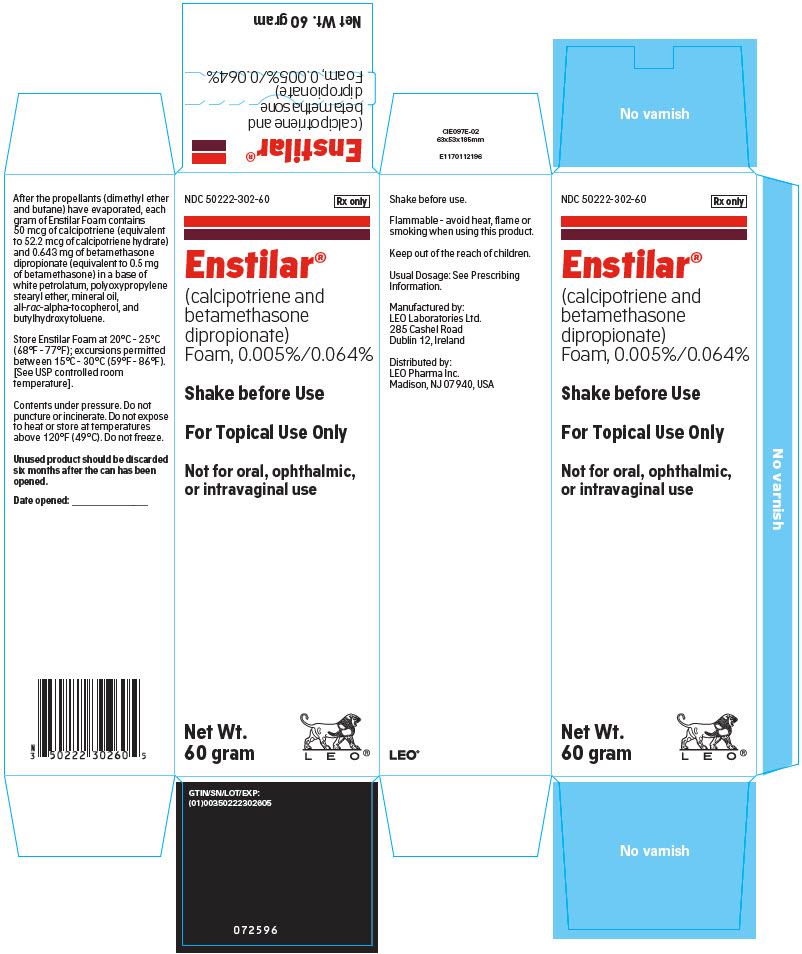
ENSTILAR calcipotriene and betamethasone dipropionate 50 ug/g; .5 mg/g Aerosol, Foam
🆔 Identity & classification
Where does this data come from?
🏷️ RxNorm drug class
This medicine belongs to the Corticosteroid class.
Where does this data come from?
🏭 Manufacturer & labeler
Where does this data come from?
🩺 Clinical
Betamethasone topical is used to treat the itching, redness, dryness, crusting, scaling, inflammation, and discomfort of various skin conditions, including psoriasis (a skin disease in which red, scaly patches form on some areas of the body) and eczema (a skin disease that causes the skin to be dry and itchy and to sometimes develop red, scaly rashes). Betamethasone is in a class of medications called corticosteroids. It works by activating natural substances in the skin to reduce swelling, redness, and itching.
Read the full MedlinePlus article ↗- It works on two fronts at once. The betamethasone part is a strong steroid that calms down the inflammation causing your redness and itch. The calcipotriene part is a form of vitam...
- What exactly is this medication supposed to do for my psoriasis?
- Apply it to the affected areas once daily, rub it in gently, and always wash your hands after. If you're using a suspension or solution for your scalp, shake the bottle first and d...
- How do I apply this correctly — is there anything I should know before I start?
Patient education
Supplement & herbal interactions
Where does this data come from?
Ask a licensed pharmacist directly — free, answered by our team.
🧪 Inactive Ingredients / Excipients
Inactive ingredients, also called excipients, are components of the drug product other than the active ingredient. They may include fillers, dyes, coatings, preservatives, flavors, or other formulation ingredients.
💡 Tap an ingredient (hover on desktop) to see what it is and why it’s used.
-
UNII 7QWA1RIO01
A synthetic form of vitamin E used as an antioxidant in medicines. It prevents oils and fats in the formulation from breaking down, helping the drug remain stable and effective during storage.
-
UNII 6LV4FOR43R
Butane is a colorless gas derived from petroleum. In medicines, it serves as a propellant in inhalers and aerosol sprays, helping deliver the active drug to the lungs or skin.
-
UNII 1P9D0Z171K
BHT is a synthetic antioxidant that prevents fats and oils in medicines from breaking down and becoming rancid. It helps keep the product stable and effective during storage.
-
UNII AM13FS69BX
Dimethyl ether is a gas that becomes liquid when pressurized. It's used in medicines as a propellant to help deliver the active ingredient from aerosol containers, similar to how spray cans work.
-
UNII T5L8T28FGP
Mineral oil is a clear, odorless liquid derived from crude oil. It acts as a lubricant and emollient in medications, helping pills slide smoothly during manufacturing and aiding moisture retention in topical products.
-
UNII 4T6H12BN9U
Petrolatum is a purified mineral oil-based jelly derived from petroleum. In medicines, it acts as an emollient, lubricant, and moisture barrier to soften skin, reduce friction, and help prevent water loss from formulations.
-
UNII S4G2J0Y0LG
PPG-11 stearyl ether is a synthetic compound made from propylene glycol and stearyl alcohol. It acts as an emulsifier and solubilizer in medicines, helping blend oil and water-based ingredients and improve how the drug dissolves or spreads.
7 inactive ingredients listed in the exact product block matched to this NDC.
Where does this data come from?
ingredient classCode="IACT" elements from the exact product block matched by this NDC. Label-section narrative from DailyMed / the openFDA label index is shown separately when available.Inactive ingredient FAQ
Are inactive ingredients the same for every manufacturer?
Why might an inactive ingredient be missing?
Can inactive ingredients matter?
💲 Pricing
A drug doesn't have one price. Each row is a different public payment system, and none is what you'd pay at the counter — that depends on your insurance. The ⓘ on each row explains what it measures.
| Price system | Per g | Per package |
|---|---|---|
| Retail pharmacies payNADAC · weekly | $21.837 | $1,310.21 / 60 g |
| Medicaid paysCMS SDUD · 12 mo | $21.86 | $1,311.56 / 60 g |
| Medicare drug plans payPart D · Q2 2026 | $21.56 | $1,293.76 / 60 g |
Where does this data come from?
🔁 Therapeutic equivalents
| Product | Labeler | Pack | NADAC/unit | TE | Status | Price vs. this |
|---|---|---|---|---|---|---|
| Enstilar 50 ug/g; .5 mg/gthis 50222-0302-60 | LEO | 1 can | $21.837 | — | Availability likely | — |
Where does this data come from?
⏳ Availability & generic status
The FDA lists approved generic versions of this medicine, but that does not always mean a pharmacy can get one today. Patent rules, launch agreements, supply and pricing can affect when generics actually arrive.
Why the date isn’t exact: Generic timing can change because patents may be challenged, settled, licensed, added, removed, or worked around with a narrower label — and FDA approval does not always mean a pharmacy can get the generic today.
🛈 What do these terms mean?
- Patent
- Legal protection listed in the Orange Book that may delay generic approval or launch. Issued by the U.S. Patent & Trademark Office.
- Substance patent
- Covers the active drug molecule itself — the hardest to design around. A generic generally can’t launch until it expires.
- Formulation (product) patent
- Covers a specific formulation or dosage form. A generic can sometimes work around it with a different formulation.
- Method-of-use patent
- A patent covering one specific approved use of the drug — not necessarily the whole molecule. A generic can sometimes launch with a “skinny label” that carves out the protected use and keeps the others.
- Skinny label
- A generic label that omits a still-patented use when the FDA allows it — letting a generic reach the market for the unprotected uses.
- Exclusivity
- FDA-granted marketing protection, separate from patents — e.g. 5-yr new chemical entity, 7-yr orphan drug, or a +6-month pediatric extension.
- Paragraph IV
- A generic applicant’s formal challenge to a listed patent. It can potentially lead to earlier generic entry, but often involves litigation or a settlement.
- RLD / RS
- Reference Listed Drug — the brand product the FDA uses as the reference for generic applications. Reference Standard — the product the FDA expects generics to compare against in bioequivalence testing.
- TE / AB rating
- FDA therapeutic-equivalence rating. An AB rating generally means the FDA considers a generic therapeutically equivalent to — and substitutable for — the brand.
- LOE (loss of exclusivity)
- The latest patent or exclusivity currently listed — the loss-of-exclusivity / latest-listed-protection date shown on this page. Paragraph-IV challenges and settlements can move the real date earlier; FDA approval and a manufacturer’s decision to market can move it later.
Built from the FDA Orange Book. The bars above are scaled to each protection’s expiry; the red LOE marker is the last one to lapse.
| Patent | Type | Use code | Expires |
|---|---|---|---|
| US 9119781 ↗ | Method of use | U-1761 | Jun 10, 2031 |
| US 9119781 ↗ | Method of use | U-2627 | Jun 10, 2031 |
| US 10688108 ↗ | Method of use | U-2627 | Jun 10, 2031 |
| US 10660908 ↗ | Method of use | U-2627 | Jun 10, 2031 |
| US 9566286 ↗ | Drug product | — | Jun 10, 2031 |
| US 10130640 ↗ | Drug product | — | Jun 10, 2031 |
| US 10617698 ↗ | Drug product | — | Jun 10, 2031 |
| US 10682364 ↗ | Drug product | — | Jun 10, 2031 |
| US 10716799 ↗ | Drug product | — | Jun 10, 2031 |
| US 9119781*PED ↗ | Drug product | — | Dec 10, 2031 |
| US 10130640*PED ↗ | Drug product | — | Dec 10, 2031 |
Is there a generic version of ENSTILAR 0.005%-0.064% FOAM?
The FDA approved a generic — why can’t I get it at my pharmacy yet?
Why do different websites show different generic release dates?
What does “FDA listed” mean?
What does a patent or protection date mean here?
What does “current Orange Book estimate” mean?
Can a generic come out before the last patent expires?
Can a generic come out after the listed dates?
What is the difference between patents and exclusivity?
Why are there multiple patent dates?
Where does this data come from?
🗺️ Medicaid utilization & spend
💊 Medicaid utilization by pack size
📊 Medicare Part D spend CMS · PART D · 2026 (Q1)
📦 Packaging — all sizes for this product
| Package NDC | Description | Per unit | Per pack | Marketing start | Status |
|---|---|---|---|---|---|
| 50222-0302-60 You're viewing this | 1 CAN in 1 CARTON (50222-302-60) / 60 g in 1 CAN | $21.84 / g | $1,310.21 | 2015-10-16 | Active |
| 50222-0302-66 | 2 CAN in 1 CARTON (50222-302-66) / 60 g in 1 CAN | — | — | 2015-10-16 | Active |
| 50222-0302-91 | 1 CAN in 1 CARTON (50222-302-91) / 60 g in 1 CAN | — | — | 2015-10-16 | Active |
In Medicaid, this is the most-dispensed pack of this product — about 96% of fills over the last four reported quarters. See all packs ↓
Pack size FAQ
What quantity is in NDC 50222-0302-60?
What NDC number is used to bill for this package of ENSTILAR calcipotriene and betamethasone dipropionate 50 ug/g; .5 mg/g Aerosol, Foam?
Prices are the latest CMS NADAC pharmacy acquisition cost per NDC; per-pack figures are per-unit × pack quantity, shown only when the pack is denominated in the same measure NADAC prices.
📄 Full prescribing information FDA SPL
🎯 Indications and Usage ▾
1 INDICATIONS AND USAGE Enstilar ® (calcipotriene and betamethasone dipropionate) Foam is indicated for the topical treatment of plaque psoriasis in patients 12 years and older. Enstilar Foam is a combination of calcipotriene, a vitamin D analog, and betamethasone dipropionate, a corticosteroid, indicated for the topical treatment of plaque psoriasis in patients 12 years and older. ( 1 )
⏱️ Dosage and Administration ▾
2 DOSAGE AND ADMINISTRATION Shake can prior to using Enstilar Foam. Apply Enstilar Foam to affected areas once daily for up to 4 weeks. The maximum dose should not exceed 60 grams every 4 days.
Rub in Enstilar Foam gently. Wash hands after applying the product. Discontinue Enstilar Foam when control is achieved.
Enstilar Foam should not be used: with occlusive dressings unless directed by a healthcare provider. on the face, groin, or axillae, or if skin atrophy is present at the treatment site. Enstilar Foam is not for oral, ophthalmic, or intravaginal use. Shake before use.
Apply Enstilar Foam to affected area(s) once daily for up to 4 weeks. Discontinue therapy when control is achieved. Do not use more than 60 grams every 4 days.
( 2 ) Do not use with occlusive dressings unless directed by a healthcare provider. ( 2 ) Avoid use on the face, groin, or axillae, or if skin atrophy is present at the treatment site. ( 2 ) Not for oral, ophthalmic, or intravaginal use.
( 2 )
💊 Dosage Forms and Strengths ▾
3 DOSAGE FORMS AND STRENGTHS Enstilar Foam: 0.005%/0.064% - each gram contains 50 mcg calcipotriene and 0.643 mg of betamethasone dipropionate in a white to off-white opalescent liquid in a pressurized aluminum spray can with a continuous valve and actuator. At administration the product is a white to off-white foam after evaporation of the propellants. Foam: 0.005%/0.064% - Each gram of Enstilar Foam contains 50 mcg of calcipotriene and 0.643 mg of betamethasone dipropionate.
( 3 )
⛔ Contraindications ▾
4 CONTRAINDICATIONS None. None. ( 4 )
⚠️ Warnings and Cautions ▾
5 WARNINGS AND PRECAUTIONS Flammability: The propellants in Enstilar Foam are flammable. Instruct the patient to avoid fire, flame, and smoking during and immediately following application. ( 5.1 ) Hypercalcemia and Hypercalciuria: Hypercalcemia and hypercalciuria have been observed with use of Enstilar Foam.
If hypercalcemia or hypercalciuria develop, discontinue treatment until parameters of calcium metabolism have normalized. ( 5.2 ) Effects on Endocrine System: Topical corticosteroids can produce reversible hypothalamic-pituitary-adrenal (HPA) axis suppression with the potential for glucocorticosteroid insufficiency during and after withdrawal of treatment. Risk factors include the use of high-potency topical corticosteroids, use over a large surface area or on areas under occlusion, prolonged use, altered skin barrier, liver failure, and use in pediatric patients.
Modify use should HPA axis suppression develop. ( 5.3 , 8.4 ) Ophthalmic Adverse Reactions: Topical corticosteroid products may increase the risk of cataracts and glaucoma. If visual symptoms occur, consider referral to an ophthalmologist.
( 5.5 )
5.1Flammability The propellants in Enstilar Foam are flammable. Instruct the patient to avoid fire, flame, and smoking during and immediately following application.
5.2Hypercalcemia and Hypercalciuria Hypercalcemia and hypercalciuria have been observed with use of Enstilar Foam. If hypercalcemia or hypercalciuria develop, discontinue treatment until parameters of calcium metabolism have normalized. The incidence of hypercalcemia and hypercalciuria following Enstilar Foam treatment of more than 56 weeks has not been evaluated [ s ee Clinical Pharmacology (12.2) ].
5.3Effects on Endocrine System Hypothalamic-Pituitary-Adrenal Axis Suppression Systemic absorption of topical corticosteroids can cause reversible hypothalamic-pituitary-adrenal (HPA) axis suppression with the potential for clinical glucocorticosteroid insufficiency. This may occur during treatment or upon withdrawal of treatment. Factors that predispose a patient to HPA axis suppression include the use of high-potency steroids, large treatment surface areas, prolonged use, use of occlusive dressings, altered skin barrier, liver failure, and young age.
Evaluation for HPA axis suppression may be done by using the adrenocorticotropic hormone (ACTH) stimulation test. If HPA axis suppression is documented, gradually withdraw Enstilar Foam, reduce the frequency of application, or substitute with a less potent corticosteroid. The following trials evaluated the effects of Enstilar Foam on HPA axis suppression [ see Clinical Pharmacology (12.2) ]: In a trial evaluating the effects of Enstilar Foam on the HPA axis, 35 adult subjects applied Enstilar Foam on the body and scalp.
Adrenal suppression was not observed in any subjects after 4 weeks of treatment. In another trial, 33 adolescent subjects age 12 to 17 years applied Enstilar Foam on the body and scalp. Adrenal suppression occurred in 3 (9%) of the subjects.
In a trial, 21 subjects aged 18 years and older with plaque psoriasis applied Enstilar Foam once daily for 4 weeks and then twice weekly on 2 non-consecutive days for 52 weeks, including once daily for 4 weeks if loss of response occurred. Adrenal suppression was observed in 2 (10%) of the subjects. Cushing's Syndrome and Hyperglycemia Systemic effects of topical corticosteroids may also include Cushing's syndrome, hyperglycemia, and glucosuria.
Additional Considerations for Endocrine Adverse Reactions Pediatric patients may be more susceptible to systemic toxicity due to their larger skin surface to body mass ratios [see Use in Specific Populations (8.4) ] . Use of more than one corticosteroid-containing product at the same time may increase the total systemic corticosteroid exposure.
5.4Allergic Contact Dermatitis Allergic contact dermatitis has been observed with topical calcipotriene and topical corticosteroids. Allergic contact dermatitis to a topica…
🤒 Adverse Reactions ▾
6 ADVERSE REACTIONS Adverse reactions reported in < 1% of subjects included application site irritation, application site pruritus, folliculitis, skin hypopigmentation, hypercalcemia, urticaria, and exacerbation of psoriasis. ( 6.1 ) To report SUSPECTED ADVERSE REACTIONS, contact LEO Pharma Inc. at 1-877-494-4536 or FDA at 1-800-FDA-1088 or www.fda.gov/medwatch.
6.1Clinical Trials Experience Because clinical trials are conducted under widely varying conditions, adverse reaction rates observed in the clinical trials of a drug cannot be directly compared to rates in the clinical trials of another drug and may not reflect the rates observed in practice. Clinical Trials Conducted in Subjects 18 years and older with Psoriasis The rates of adverse reactions described below were from three randomized, multicenter, vehicle and/or active-controlled clinical trials in adult subjects with plaque psoriasis [see Clinical Studies (14) ] .
Subjects applied study product once daily for 4 weeks, and the median weekly dose of Enstilar Foam was 25 grams. Adverse reactions reported in <1% of adult subjects treated with Enstilar Foam included: application site irritation, application site pruritus, folliculitis, skin hypopigmentation, hypercalcemia, urticaria, and exacerbation of psoriasis. Clinical Trials Conducted in Subjects 12 to 17 years with Psoriasis In one uncontrolled clinical trial, 106 subjects aged 12 to 17 years with plaque psoriasis of the scalp and body applied Enstilar Foam once daily for up to 4 weeks.
The median weekly dose was 40 grams. Adverse reactions reported in <1% of adolescent subjects treated were acne, erythema, application site pain, and skin reactions [see Use in Specific Populations (8.4) and Clinical Pharmacology (12.2) ].
6.2Postmarketing Experience Because adverse reactions are reported voluntarily from a population of uncertain size, it is not always possible to reliably estimate their frequency or establish a causal relationship to drug exposure. Postmarketing reports for local adverse reactions to Enstilar Foam included application site burning. Postmarketing reports for local adverse reactions to topical corticosteroids included atrophy, striae, telangiectasia, dryness, perioral dermatitis, secondary infection, and miliaria.
Ophthalmic adverse reactions of cataracts, glaucoma, and increased intraocular pressure have been reported with the use of topical corticosteroids, including topical betamethasone products.
👥 Use in Specific Populations ▾
8 USE IN SPECIFIC POPULATIONS
8.1Pregnancy Risk Summary Available data with Enstilar Foam are not sufficient to evaluate a drug-associated risk for major birth defects, miscarriages, or adverse maternal or fetal outcomes. Although there are no available data on use of the calcipotriene component in pregnant women, systemic exposure to calcipotriene after topical administration of Enstilar Foam is likely to be low [see Clinical Pharmacology (12.3) ]. Observational studies suggest an increased risk of having low birth weight infants with the maternal use of potent or super potent topical corticosteroids (see Data ).
Advise pregnant women that Enstilar ® Foam may increase the potential risk of having a low birth weight infant and to use Enstilar Foam on the smallest area of skin and for the shortest duration possible. In animal reproduction studies, oral administration of calcipotriene to pregnant rats during the period of organogenesis resulted in an increased incidence of minor skeletal abnormalities, including enlarged fontanelles and extra ribs (see Data ). Oral administration of calcipotriene to pregnant rabbits during the period of organogenesis had no apparent effects on embryo-fetal development.
Subcutaneous administration of betamethasone dipropionate to pregnant rats and rabbits during the period of organogenesis resulted in fetal toxicity, including fetal deaths, reduced fetal weight, and fetal malformations (cleft palate and crooked or short tail) (see Data ) . The available data do not allow the calculation of relevant comparisons between the systemic exposures of calcipotriene and betamethasone dipropionate observed in animal studies to the systemic exposures that would be expected in humans after topical use of Enstilar Foam.
The background risk of major birth defects and miscarriage in the indicated population is unknown. All pregnancies have a background risk of birth defect, loss, or other adverse outcomes. In the U.S. general population, the estimated background risk of major birth defects and miscarriage in clinically recognized pregnancies is 2% to 4% and 15% to 20%, respectively.
Data Human Data Available observational studies in pregnant women did not identify a drug-associated risk of major birth defects, preterm delivery, or fetal mortality with the use of topical corticosteroids of any potency. However, when the dispensed amount of potent or super potent topical corticosteroids exceeded 300 grams during the entire pregnancy, maternal use was associated with an increased risk of low birth weight in infants. Animal Data Embryo-fetal development studies with calcipotriene were performed by the oral route in rats and rabbits.
Pregnant rats received dosages of 0, 6, 18, or 54 mcg/kg/day (0, 36, 108, and 324 mcg/m 2 /day, respectively) on days 6-15 of gestation (the period of organogenesis). There were no apparent effects on maternal survival, behavior, or body weight gain, no effects on litter parameters, and no effects on the incidence of major malformations in fetuses. Fetuses from dams dosed at 54 mcg/kg/day exhibited a significantly increased incidence of minor skeletal abnormalities, including enlarged fontanelles and extra ribs.
Pregnant rabbits were dosed daily with calcipotriene at exposures of 0, 4, 12, or 36 mcg/kg/day (0, 48, 144, and 432 mcg/m 2 /day, respectively) on days 6-18 of gestation (the period of organogenesis). Mean maternal body weight gain was reduced in animals dosed at 12 or 36 mcg/kg/day. The incidence of fetal deaths was increased in the group dosed at 36 mcg/kg/day; reduced fetal weight was also observed in this group.
The incidence of major malformations among fetuses was not affected. An increase in the incidence of minor skeletal abnormalities, including incomplete ossification of sternebrae, pubic bones, and forelimb phalanges, was observed in the group dosed at 36 mcg/kg/day. Embryo-fetal development studies with betamethasone dipropionate were performed via subcutaneous inj…
🤰 Pregnancy ▾
8.1Pregnancy Risk Summary Available data with Enstilar Foam are not sufficient to evaluate a drug-associated risk for major birth defects, miscarriages, or adverse maternal or fetal outcomes. Although there are no available data on use of the calcipotriene component in pregnant women, systemic exposure to calcipotriene after topical administration of Enstilar Foam is likely to be low [see Clinical Pharmacology (12.3) ]. Observational studies suggest an increased risk of having low birth weight infants with the maternal use of potent or super potent topical corticosteroids (see Data ).
Advise pregnant women that Enstilar ® Foam may increase the potential risk of having a low birth weight infant and to use Enstilar Foam on the smallest area of skin and for the shortest duration possible. In animal reproduction studies, oral administration of calcipotriene to pregnant rats during the period of organogenesis resulted in an increased incidence of minor skeletal abnormalities, including enlarged fontanelles and extra ribs (see Data ). Oral administration of calcipotriene to pregnant rabbits during the period of organogenesis had no apparent effects on embryo-fetal development.
Subcutaneous administration of betamethasone dipropionate to pregnant rats and rabbits during the period of organogenesis resulted in fetal toxicity, including fetal deaths, reduced fetal weight, and fetal malformations (cleft palate and crooked or short tail) (see Data ) . The available data do not allow the calculation of relevant comparisons between the systemic exposures of calcipotriene and betamethasone dipropionate observed in animal studies to the systemic exposures that would be expected in humans after topical use of Enstilar Foam.
The background risk of major birth defects and miscarriage in the indicated population is unknown. All pregnancies have a background risk of birth defect, loss, or other adverse outcomes. In the U.S. general population, the estimated background risk of major birth defects and miscarriage in clinically recognized pregnancies is 2% to 4% and 15% to 20%, respectively.
Data Human Data Available observational studies in pregnant women did not identify a drug-associated risk of major birth defects, preterm delivery, or fetal mortality with the use of topical corticosteroids of any potency. However, when the dispensed amount of potent or super potent topical corticosteroids exceeded 300 grams during the entire pregnancy, maternal use was associated with an increased risk of low birth weight in infants. Animal Data Embryo-fetal development studies with calcipotriene were performed by the oral route in rats and rabbits.
Pregnant rats received dosages of 0, 6, 18, or 54 mcg/kg/day (0, 36, 108, and 324 mcg/m 2 /day, respectively) on days 6-15 of gestation (the period of organogenesis). There were no apparent effects on maternal survival, behavior, or body weight gain, no effects on litter parameters, and no effects on the incidence of major malformations in fetuses. Fetuses from dams dosed at 54 mcg/kg/day exhibited a significantly increased incidence of minor skeletal abnormalities, including enlarged fontanelles and extra ribs.
Pregnant rabbits were dosed daily with calcipotriene at exposures of 0, 4, 12, or 36 mcg/kg/day (0, 48, 144, and 432 mcg/m 2 /day, respectively) on days 6-18 of gestation (the period of organogenesis). Mean maternal body weight gain was reduced in animals dosed at 12 or 36 mcg/kg/day. The incidence of fetal deaths was increased in the group dosed at 36 mcg/kg/day; reduced fetal weight was also observed in this group.
The incidence of major malformations among fetuses was not affected. An increase in the incidence of minor skeletal abnormalities, including incomplete ossification of sternebrae, pubic bones, and forelimb phalanges, was observed in the group dosed at 36 mcg/kg/day. Embryo-fetal development studies with betamethasone dipropionate were performed via subcutaneous injection in mice and rabbits.
Pr…
🧒 Pediatric Use ▾
8.4Pediatric Use The safety and effectiveness of Enstilar Foam for the treatment of mild to severe plaque psoriasis have been established in pediatric patients age 12 to 17 years. The use of Enstilar Foam for this indication is supported by evidence from adequate and well-controlled trials in adults and from one uncontrolled trial in 106 adolescents age 12 to 17 years with psoriasis of the body and scalp. Calcium metabolism was evaluated in all pediatric subjects and no cases of hypercalcemia or clinically relevant changes in urinary calcium were reported.
Hypothalamic pituitary adrenal (HPA) axis suppression was evaluated in a subset of 33 pediatric subjects with moderate plaque psoriasis of the body and scalp (mean body surface area involvement of 16% and mean scalp area involvement of 56%). After 4 weeks of once daily treatment with a mean weekly dose of 47 grams, HPA axis suppression was observed in 3 of 33 subjects (9%) [see Warnings and Precautions (5.2) , Adverse Reactions (6.1) and Clinical Pharmacology (12.2) ]. Because of a higher ratio of skin surface area to body mass, children under the age of 12 years are at particular risk of systemic adverse effects when they are treated with topical corticosteroids.
Pediatric patients are, therefore, also at greater risk of HPA axis suppression and adrenal insufficiency with the use of topical corticosteroids including Enstilar Foam [see Warnings and Precautions (5.3) and Clinical Pharmacology (12.2) ]. Cushing's syndrome, linear growth retardation, delayed weight gain, and intracranial hypertension have been reported in pediatric patients treated with topical corticosteroids. Local adverse reactions including striae have been reported with use of topical corticosteroids in pediatric patients.
The safety and effectiveness of Enstilar Foam in pediatric patients less than 12 years of age have not been established.
🧓 Geriatric Use ▾
8.5Geriatric Use Of the total number of subjects in the controlled clinical studies of Enstilar Foam, 97 subjects were 65 years and over, and 21 were 75 and over. No overall differences in safety or effectiveness of Enstilar Foam were observed between these subjects and younger subjects, and other reported clinical experience has not identified differences in responses between the elderly and younger patients, but greater sensitivity of some older individuals cannot be ruled out.
🧬 Clinical Pharmacology ▾
12 CLINICAL PHARMACOLOGY
12.1Mechanism of Action Enstilar Foam combines the pharmacological effects of calcipotriene hydrate as a synthetic vitamin D3 analog and betamethasone dipropionate as a synthetic corticosteroid. However, while their pharmacologic and clinical effects are known, the exact mechanisms of their actions in the treatment of plaque psoriasis are unknown.
12.2Pharmacodynamics Hypothalamic-Pituitary-Adrenal (HPA) Axis Suppression: HPA axis suppression as indicated by a 30-minute post-stimulation cortisol level of ≤18 mcg/dL was evaluated in the following trials [see Warnings and Precautions (5.3) ] : Enstilar Foam was applied to adult subjects (N=35) with moderate to severe plaque psoriasis affecting a mean body surface area of 18% (range 12 to 28%) and mean scalp area of 50 % (range 30 to 100%). The mean ± SD weekly dose used was 62 ± 28 grams. HPA axis suppression was not observed in any subjects after 4 weeks of treatment.
Lack of adrenal suppression observed in this trial does not rule out the risk of HPA axis suppression. Enstilar Foam was applied to adolescent subjects (N=33) age 12 to 17 years with moderate plaque psoriasis affecting a mean body surface area of 16% (range from 10% to 21%) and mean scalp area of 56% (range from 25% to 90%). The mean ± SD weekly dose used was 47 ± 22 grams.
HPA axis suppression was observed in 3 (9%) of the subjects. Enstilar ® Foam was applied once daily for 4 weeks to adult subjects (N=21) with plaque psoriasis affecting a mean body surface area of 15% (range 10 to 30%), then twice weekly on 2 non-consecutive days for 52 weeks with 4 weeks and once daily treatment was resumed if loss of response occurred. The mean ± SD total dose used in the 52-week period was 1400 ± 905 grams (including total dose of 528 ± 650 grams used in the loss of response period).
HPA axis suppression was observed in 2 (10%) of the subjects at Week 56. Effects on Calcium Metabolism Effects of once daily application of Enstilar Foam for 4 weeks on calcium metabolism in adult subjects (N=564) with plaque psoriasis were examined in three randomized, multicenter, vehicle- and/or active-controlled clinical trials. Following once daily application of Enstilar Foam, elevated serum calcium levels outside the normal range were observed in 3 subjects.
Elevated urinary calcium levels outside the normal range were observed in 17 subjects. In a trial, calcium metabolism was evaluated in 106 adolescent subjects aged 12 to 17 years with plaque psoriasis of the scalp and body after once daily application of Enstilar Foam for 4 weeks. No cases of hypercalcemia and no clinically relevant changes in urinary calcium were reported.
In a trial, 272 subjects aged 18 years and older with plaque psoriasis applied Enstilar Foam once daily for 4 weeks and then twice weekly on 2 non-consecutive days for 52 weeks, including once daily for 4 weeks if loss of response occurred. No cases of hypercalcemia and no clinically relevant changes in urinary calcium were reported. Vasoconstrictor Assay Enstilar Foam is in the mid to potent range corticosteroid as demonstrated by studies in healthy subjects when compared with other topical corticosteroids.
However, similar blanching scores do not necessarily imply therapeutic equivalence.
12.3Pharmacokinetics Absorption The PK of Enstilar Foam was investigated in both adults (N = 35) and a subset of pediatric subjects with plaque psoriasis age 12 to 17 years (N=33) following once daily application of Enstilar Foam on the body and scalp for 4 weeks. Enstilar Foam was applied to adult subjects with moderate to severe plaque psoriasis affecting a mean body surface area of 18% and mean scalp area of 50%. Following application of a mean ± SD weekly dose of 62 ± 28 grams of Enstilar Foam, calcipotriene was quantifiable in 1 of 35 (3%) subjects and its main metabolite, MC1080, in 3 of 35 (9%) subjects.
For subjects with measurable concentrations, the maximal plasma concentrations (C max ) and…
🧬 Mechanism of Action ▾
12.1Mechanism of Action Enstilar Foam combines the pharmacological effects of calcipotriene hydrate as a synthetic vitamin D3 analog and betamethasone dipropionate as a synthetic corticosteroid. However, while their pharmacologic and clinical effects are known, the exact mechanisms of their actions in the treatment of plaque psoriasis are unknown.
📦 How Supplied / Storage and Handling ▾
16 HOW SUPPLIED/STORAGE AND HANDLING
16.1How Supplied Enstilar (calcipotriene and betamethasone dipropionate) Foam, 0.005%/0.064% is a white to off-white opalescent liquid in a pressurized aluminum spray can with a continuous valve and actuator. At administration, the product is a white to off-white foam after evaporation of the propellants. It is available as: 60 gram can (NDC 50222-302-60) 120 gram (2 cans of 60 gram) (NDC 50222-302-66)
16.2Storage Store Enstilar Foam at 20°C - 25°C (68°F - 77°F); excursions permitted between 15°C - 30°C (59°F - 86°F). [See USP controlled room temperature]. Contents under pressure. Do not puncture or incinerate. Do not expose to heat or store at temperatures above 120°F (49°C). Do not freeze. Unused product should be discarded six months after the can has been opened. Keep out of the reach of children.
16.3Handling Enstilar Foam is flammable; avoid heat, flame or smoking when using this product.
📦 Storage and Handling ▾
16.2Storage Store Enstilar Foam at 20°C - 25°C (68°F - 77°F); excursions permitted between 15°C - 30°C (59°F - 86°F). [See USP controlled room temperature]. Contents under pressure. Do not puncture or incinerate. Do not expose to heat or store at temperatures above 120°F (49°C). Do not freeze. Unused product should be discarded six months after the can has been opened. Keep out of the reach of children.
16.3Handling Enstilar Foam is flammable; avoid heat, flame or smoking when using this product.
📋 Description ▾
11 DESCRIPTION Enstilar Foam contains calcipotriene hydrate and betamethasone dipropionate. It is for topical use only. Calcipotriene Hydrate Calcipotriene hydrate is a synthetic vitamin D analog and has the chemical name 9,10-secochola-5,7,10(19),22-tetraene-1,3,24-triol,24-cyclo-propyl-,monohydrate, (1α,3β,5Z,7E,22E,24S) with the empirical formula C 27 H 40 O 3 ∙H 2 O), a molecular weight of 430.6, and the following structural formula (calcipotriene hydrate is a white to almost white, crystalline compound): Chemical Structure Betamethasone Dipropionate Betamethasone dipropionate is a synthetic corticosteroid and has the chemical name pregna-1,4-diene-3,20-dione-9-fluoro-11-hydroxy-16-methyl-17,21-bis(1-oxypropoxy)-(11β,16β), with the empirical formula C 28 H 37 FO 7 , a molecular weight of 504.6, and the following structural formula (betamethasone dipropionate is a white to almost white, crystalline powder): Chemical Structure Enstilar ® Foam Each gram of Enstilar Foam contains 50 mcg of calcipotriene (equivalent to 52.2 mcg of calcipotriene hydrate) and 0.643 mg of betamethasone dipropionate (equivalent to 0.5 mg of betamethasone) in a base of white petrolatum, polyoxypropylene stearyl ether, mineral oil, all- rac -alpha-tocopherol, and butylhydroxytoluene.
Enstilar Foam is a white to off-white opalescent liquid in a pressurized aluminum spray can with a continuous valve and actuator. The propellants used in Enstilar Foam are dimethyl ether and butane. At administration, the product is a white to off-white foam after evaporation of the propellants.
Enstilar Foam has the appearance of a non-expanding foam that gradually collapses after spraying.
💬 Information for Patients ▾
17 PATIENT COUNSELING INFORMATION See FDA-approved patient labeling ( Patient Information and Instructions for Use ). Flammability Instruct patients that Enstilar Foam is flammable; avoid heat, flame, or smoking when applying this medication. Administration Instructions Shake before use and spray the foam by holding the can in any orientation except horizontally.
Gently rub in Enstilar Foam to your affected areas. Do not use more than 60 grams every 4 days. Discontinue therapy when control is achieved unless directed otherwise by the healthcare provider.
Avoid use of Enstilar Foam on the face, underarms, groin or eyes. If this medicine gets on face or in mouth or eyes, wash area right away. Do not occlude the treatment area with a bandage or other covering unless directed by the healthcare provider.
Instruct the patients not to use other products containing calcipotriene or a corticosteroid with Enstilar Foam without first talking to the healthcare provider. Wash hands after application. Local Reactions and Skin Atrophy Advise patients that local reactions and skin atrophy are more likely to occur with occlusive use, prolonged use or use of higher potency corticosteroids.
Hypercalcemia and Hypercalciuria Advise patients that hypercalcemia and hypercalciuria have been observed with the use of Enstilar Foam [see Warnings and Precautions (5.2) ]. HPA Axis Suppression, Cushing's Syndrome, and Hyperglycemia Advise patients that Enstilar Foam can cause HPA axis suppression, Cushing's syndrome, and/or hyperglycemia [see Warnings and Precautions (5.3) ]. Ophthalmic Adverse Reactions Advise patients to avoid contact of Enstilar Foam with eyes and to report any visual symptoms [see Warnings and Precautions (5.5) ].
Pregnancy and Lactation Advise pregnant women that Enstilar Foam may increase the potential risk of having a low birth weight infant and to use Enstilar Foam on the smallest area of skin and for the shortest duration possible [see Use in Specific Populations (8.1) ]. Advise breastfeeding women not to apply Enstilar Foam directly to the nipple and areola to avoid direct infant exposure [see Use in Specific Populations (8.2) ] .