
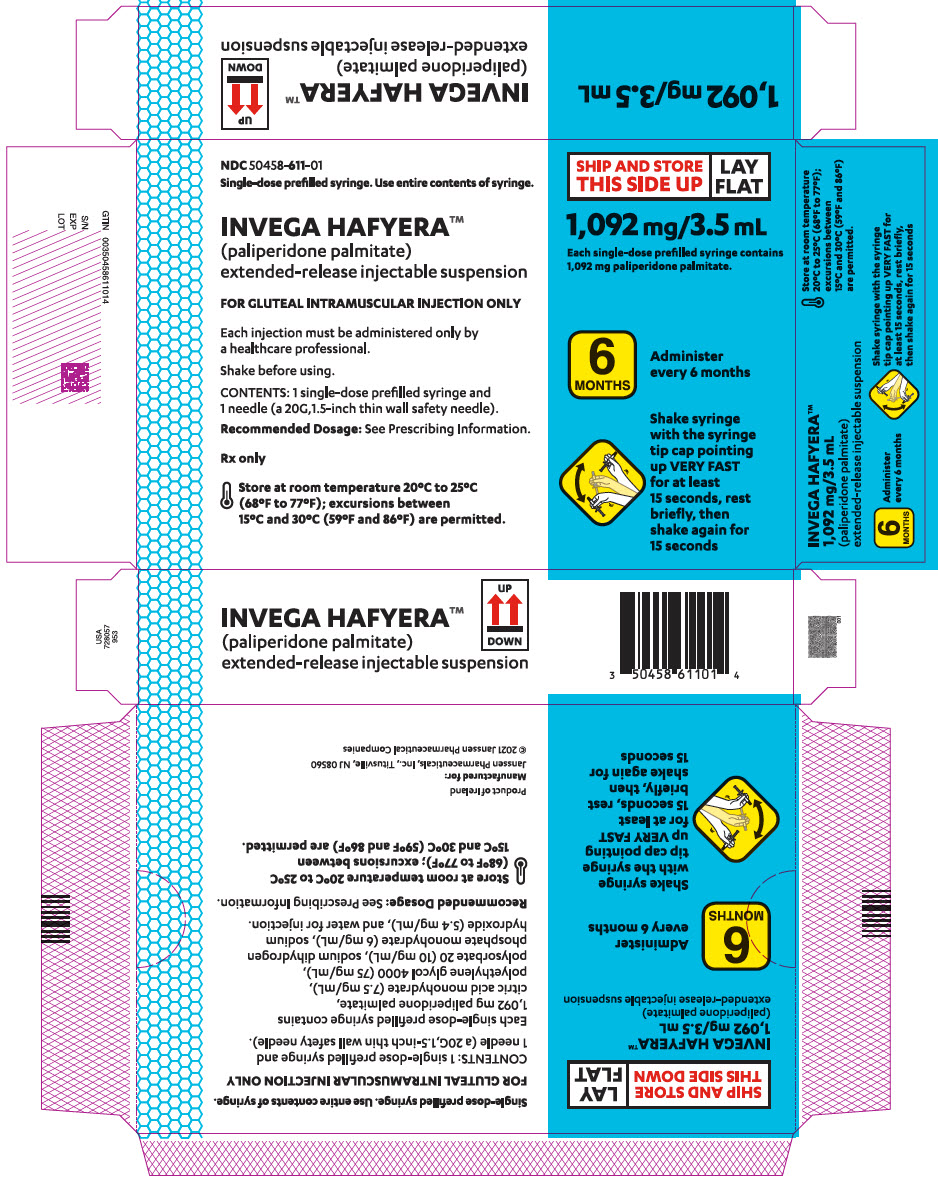
INVEGA HAFYERA paliperidone palmitate 1092 mg/3.5mL Injection, Suspension, Extended Release, 1 syringe
🆔 Identity & classification
Where does this data come from?
🏷️ RxNorm drug class
This medicine belongs to the Atypical Antipsychotic class.
Where does this data come from?
🏭 Manufacturer & labeler
Where does this data come from?
🩺 Clinical
Paliperidone extended-release injections are used to treat schizophrenia (a mental illness that affects how a person thinks, feels and behaves) and schizoaffective disorder (a mental illness that causes both a loss of contact with reality and mood problems such as depression or mania). Paliperidone extended-release injection is in a class of medications called atypical antipsychotics. It works by changing the activity of certain natural substances in the brain.
Read the full MedlinePlus article ↗- These long-acting injections are designed so you don't have to remember to take a pill every single day. Depending on which product your doctor prescribes, you'll only need a shot...
- Why am I getting a shot instead of taking a pill every day?
- The most common things people notice are soreness at the injection site, some drowsiness, dizziness, or a restless feeling (called akathisia — like you can't stop moving). These ar...
- What side effects should I actually expect, and which ones mean I should call someone right away?
Patient education
Supplement & herbal interactions
Some supplements/herbs that may interact with Paliperidone Palmitate — tap one for details:
Where does this data come from?
Ask a licensed pharmacist directly — free, answered by our team.
🧪 Inactive Ingredients / Excipients
Inactive ingredients, also called excipients, are components of the drug product other than the active ingredient. They may include fillers, dyes, coatings, preservatives, flavors, or other formulation ingredients.
💡 Tap an ingredient (hover on desktop) to see what it is and why it’s used.
-
UNII 2968PHW8QP
A weak organic acid derived from citrus fruits or made through fermentation. It works as a buffer to control pH, a preservative to extend shelf life, and a flavoring agent in medications.
-
UNII 4R4HFI6D95
Polyethylene glycol 4000 is a synthetic polymer derived from petroleum. It serves as a binder, filler, and lubricant in solid dosage forms, and helps control how quickly the medicine dissolves.
-
UNII 55X04QC32I
A strong alkaline chemical used to adjust and maintain the pH balance of liquid medicines. It helps keep the medicine stable and ensures it stays effective during storage.
-
UNII 593YOG76RN
A salt made from sodium and phosphate that helps regulate acidity and maintain proper pH balance in the medicine. It also acts as a buffer to keep the product stable.
-
UNII 059QF0KO0R
Water is a liquid solvent that dissolves and mixes ingredients together in liquid medicines, syrups, and injections. It helps distribute the active drug evenly throughout the product.
5 inactive ingredients listed in the exact product block matched to this NDC.
Where does this data come from?
ingredient classCode="IACT" elements from the exact product block matched by this NDC. Label-section narrative from DailyMed / the openFDA label index is shown separately when available.Inactive ingredient FAQ
Are inactive ingredients the same for every manufacturer?
Why might an inactive ingredient be missing?
Can inactive ingredients matter?
💲 Pricing
A drug doesn't have one price. Each row is a different public payment system, and none is what you'd pay at the counter — that depends on your insurance. The ⓘ on each row explains what it measures.
| Price system | Per mL | Per package |
|---|---|---|
| Retail pharmacies payNADAC · weekly | $4,018.060 | $14,063.21 / 3.5 ml |
| Medicaid paysCMS SDUD · 12 mo | $3,920.62 | $13,722.19 / 3.5 ml |
| Medicare drug plans payPart D · Q2 2026 | $4,052.57 | $14,183.98 / 3.5 ml |
| Medicare Part B allowsASP · J2427 | $13.262 / J2427 unit | — |
Where does this data come from?
🧾 Billing & reimbursement
Where does this data come from?
🔁 Therapeutic equivalents
| Product | Labeler | Pack | NADAC/unit | TE | Status | Price vs. this |
|---|---|---|---|---|---|---|
| Invega Hafyera 1092 mg/3.5mLthis 50458-0611-01 | Janssen | 1 syringe | $4,018.060 | — | Availability likely | — |
Where does this data come from?
⏳ Availability & generic status
We did not find an FDA-approved generic match for this exact strength, form and route. Patent/protection dates below may affect future generic timing.
Why the date isn’t exact: Generic timing can change because patents may be challenged, settled, licensed, added, removed, or worked around with a narrower label — and FDA approval does not always mean a pharmacy can get the generic today.
🛈 What do these terms mean?
- Patent
- Legal protection listed in the Orange Book that may delay generic approval or launch. Issued by the U.S. Patent & Trademark Office.
- Substance patent
- Covers the active drug molecule itself — the hardest to design around. A generic generally can’t launch until it expires.
- Formulation (product) patent
- Covers a specific formulation or dosage form. A generic can sometimes work around it with a different formulation.
- Method-of-use patent
- A patent covering one specific approved use of the drug — not necessarily the whole molecule. A generic can sometimes launch with a “skinny label” that carves out the protected use and keeps the others.
- Skinny label
- A generic label that omits a still-patented use when the FDA allows it — letting a generic reach the market for the unprotected uses.
- Exclusivity
- FDA-granted marketing protection, separate from patents — e.g. 5-yr new chemical entity, 7-yr orphan drug, or a +6-month pediatric extension.
- Paragraph IV
- A generic applicant’s formal challenge to a listed patent. It can potentially lead to earlier generic entry, but often involves litigation or a settlement.
- RLD / RS
- Reference Listed Drug — the brand product the FDA uses as the reference for generic applications. Reference Standard — the product the FDA expects generics to compare against in bioequivalence testing.
- TE / AB rating
- FDA therapeutic-equivalence rating. An AB rating generally means the FDA considers a generic therapeutically equivalent to — and substitutable for — the brand.
- LOE (loss of exclusivity)
- The latest patent or exclusivity currently listed — the loss-of-exclusivity / latest-listed-protection date shown on this page. Paragraph-IV challenges and settlements can move the real date earlier; FDA approval and a manufacturer’s decision to market can move it later.
Built from the FDA Orange Book. The bars above are scaled to each protection’s expiry; the red LOE marker is the last one to lapse.
| Patent | Type | Use code | Expires |
|---|---|---|---|
| US 10143693 ↗ | Method of use | U-2457 | Apr 5, 2036 |
| US 10143693 ↗ | Method of use | U-2458 | Apr 5, 2036 |
| US 10143693 ↗ | Method of use | U-2458 | Apr 5, 2036 |
| US 10143693 ↗ | Method of use | U-2457 | Apr 5, 2036 |
| US 10143693 ↗ | Method of use | U-2458 | Apr 5, 2036 |
| US 11324751 ↗ | Method of use | U-3359 | May 7, 2041 |
| US 11324751 ↗ | Method of use | U-3359 | May 7, 2041 |
| US 11304951 ↗ | Method of use | U-3349 | May 7, 2041 |
| US 11304951 ↗ | Method of use | U-3349 | May 7, 2041 |
| US 12208100 ↗ | Method of use | U-3359 | May 7, 2041 |
| US 12208100 ↗ | Method of use | U-4110 | May 7, 2041 |
| US 12208100 ↗ | Method of use | U-4110 | May 7, 2041 |
| US 12208100 ↗ | Method of use | U-3359 | May 7, 2041 |
| US 10143693 ↗ | Method of use | U-2457 | Apr 5, 2036 |
| US 10143693 ↗ | Method of use | U-2458 | Apr 5, 2036 |
| US 10143693 ↗ | Method of use | U-2457 | Apr 5, 2036 |
| US 11666697 ↗ | Method of use | U-3626 | Nov 24, 2041 |
| US 11666697 ↗ | Method of use | U-3626 | Nov 24, 2041 |
Is there a generic version of INVEGA HAFYERA 1,092 MG/3.5 ML?
The FDA approved a generic — why can’t I get it at my pharmacy yet?
Why do different websites show different generic release dates?
What does “FDA listed” mean?
What does a patent or protection date mean here?
What does “current Orange Book estimate” mean?
Can a generic come out before the last patent expires?
Can a generic come out after the listed dates?
What is the difference between patents and exclusivity?
Why are there multiple patent dates?
Where does this data come from?
🗺️ Medicaid utilization & spend
📊 Medicare Part D spend CMS · PART D · 2026 (Q1)
🔬 Reported adverse events (FAERS)
Top reported reactions
Age at onset
Reporter sex
Where does this data come from?
📦 Packaging — all sizes for this product
| Package NDC | Description | Marketing start | Status |
|---|---|---|---|
| 50458-0611-01 You're viewing this | 1 SYRINGE in 1 CARTON (50458-611-01) / 3.5 mL in 1 SYRINGE | 2021-08-30 | Active |
📄 Full prescribing information FDA SPL
🚨 Boxed Warning ▾
WARNING: INCREASED MORTALITY IN ELDERLY PATIENTS WITH DEMENTIA-RELATED PSYCHOSIS Elderly patients with dementia-related psychosis treated with antipsychotic drugs are at an increased risk of death. INVEGA HAFYERA is not approved for use in patients with dementia-related psychosis [see Warnings and Precautions (5.1) ] . WARNING: INCREASED MORTALITY IN ELDERLY PATIENTS WITH DEMENTIA-RELATED PSYCHOSIS See full prescribing information for complete boxed warning.
Elderly patients with dementia-related psychosis treated with antipsychotic drugs are at an increased risk of death. INVEGA HAFYERA is not approved for use in patients with dementia-related psychosis. ( 5.1 )
🎯 Indications and Usage ▾
1 INDICATIONS AND USAGE INVEGA HAFYERA, an every-six-month injection, is indicated for the treatment of schizophrenia in adults after they have been adequately treated with: A once-a-month paliperidone palmitate extended-release injectable suspension (e.g., INVEGA SUSTENNA) for at least four months, or An every-three-month paliperidone palmitate extended-release injectable suspension (e.g., INVEGA TRINZA) for at least one three-month cycle. INVEGA HAFYERA, an every-six-month injection, is an atypical antipsychotic indicated for the treatment of schizophrenia in adults after they have been adequately treated with: A once-a-month paliperidone palmitate extended-release injectable suspension (e.g., INVEGA SUSTENNA) for at least four months or An every-three-month paliperidone palmitate extended-release injectable suspension (e.g., INVEGA TRINZA) for at least one three-month cycle.
( 1 )
⏱️ Dosage and Administration ▾
2 DOSAGE AND ADMINISTRATION Administer INVEGA HAFYERA by gluteal injection once every 6 months by a healthcare professional. Do not administer by any other route. ( 2.1 ) See Full Prescribing Information for complete dosing information.
( 2.2 ) Initiate INVEGA HAFYERA when the next once-a-month or every three-month paliperidone palmitate extended-release injectable suspension dose is scheduled. Dose is based on the previous once-a-month or every-three-month product. ( 2.2 ): INVEGA HAFYERA Doses for Adults Adequately Treated with Once-a-month paliperidone palmitate extended-release injectable suspension (PP1M) Switching from the PP1M 39 mg, 78 mg and 117 mg doses was not studied.
If the Last Dose of PP1M is: Initiate INVEGA HAFYERA at the Following Dose: 156 mg 1,092 mg 234 mg 1,560 mg INVEGA HAFYERA Doses for Adults Adequately Treated with Every-three-month paliperidone palmitate injectable suspension (PP3M) Switching from the PP3M 273 mg and 410 mg doses was not studied. If the Last Dose of PP3M is: Initiate INVEGA HAFYERA at the Following Dose: 546 mg 1,092 mg 819 mg 1,560 mg Missed Doses: Refer to the Full Prescribing Information. ( 2.3 ) See Full Prescribing Information for important preparation and administration information.
( 2.5 ) Moderate to severe renal impairment (creatinine clearance <50 mL/min): INVEGA HAFYERA is not recommended. ( 2.4 ) Mild renal impairment (creatinine clearance ≥ 50 mL/min to < 80 mL/min): Adjust dosage and stabilize the patient using PP1M before transitioning to INVEGA HAFYERA, or from PP1M to PP3M before transitioning to INVEGA HAFYERA. See appropriate table above.
( 2.4 )
2.1Important Dosage and Administration Information INVEGA HAFYERA must be administered as a gluteal intramuscular injection by a healthcare professional once every 6 months. Do not administer by any other route [see Dosage and Administration (2.5) ] . Initiate INVEGA HAFYERA only after adequate treatment has been established with either: A once-a-month paliperidone palmitate extended-release injectable suspension (e.g., INVEGA SUSTENNA), referred to as PP1M, once monthly for at least four months; or An every-three-month paliperidone palmitate extended-release injectable suspension (e.g., INVEGA TRINZA), referred to as PP3M, once every three months for at least one three-month injection cycle.
See Prescribing Information of the PP1M and PP3M products for the recommended dosage of these products.
2.2Recommended Dosage for INVEGA HAFYERA Switching to INVEGA HAFYERA from a PP1M Product The recommended initial INVEGA HAFYERA dose is based on the previous PP1M dose (see Table 1 ). Initiate INVEGA HAFYERA when the next PP1M dose is scheduled. INVEGA HAFYERA may be administered up to 1 week before or 1 week after the next scheduled PP1M dose.
When switching from PP1M to INVEGA HAFYERA, the two injection cycles immediately preceding the switch should be the same dosage strength before starting INVEGA HAFYERA. Table 1. Initial INVEGA HAFYERA Dose for Adult Patients Switching from a PP1M PP1M: Once-a-month paliperidone palmitate extended-release injectable suspension Product Last Dose of PP1M There are no equivalent doses of INVEGA HAFYERA for 39 mg, 78 mg, or 117 mg doses of a PP1M product, which were not studied [see Clinical Studies (14)] .
Initial Dose of INVEGA HAFYERA 156 mg 1,092 mg 234 mg 1,560 mg Switching to INVEGA HAFYERA from a PP3M Product The recommended initial INVEGA HAFYERA dose is based on the previous PP3M dose (see Table 2 ). Initiate INVEGA HAFYERA when the next PP3M dose is scheduled. INVEGA HAFYERA may be administered up to 2 weeks before or 2 weeks after the next scheduled PP3M dose.
Table 2. Initial INVEGA HAFYERA Dose for Adult Patients Switching from a PP3M PP3M: Every-three-month paliperidone palmitate extended-release injectable suspension Product Last Dose of PP3M There are no equivalent doses of INVEGA HAFYERA for the 273 mg or 410 mg doses of a PP3M product, which were not studied [see Clinical Studi…
💊 Dosage Forms and Strengths ▾
3 DOSAGE FORMS AND STRENGTHS INVEGA HAFYERA is a white to off-white aqueous extended-release injectable suspension for gluteal intramuscular injection in dose strengths of 1,092 mg/3.5 mL and 1,560 mg/5 mL paliperidone palmitate in single-dose prefilled syringes. Extended-release injectable suspension: 1,092 mg/3.5 mL or 1,560 mg/5 mL single-dose prefilled syringes. ( 3 )
⛔ Contraindications ▾
4 CONTRAINDICATIONS INVEGA HAFYERA is contraindicated in patients with a known hypersensitivity to either paliperidone or risperidone, or to any of the excipients in the INVEGA HAFYERA formulation. Hypersensitivity reactions, including anaphylactic reactions and angioedema, have been reported in patients treated with risperidone and in patients treated with paliperidone. Paliperidone palmitate is converted to paliperidone, which is a metabolite of risperidone.
Known hypersensitivity to paliperidone, risperidone, or to any excipients in INVEGA HAFYERA. ( 4 )
⚠️ Warnings and Cautions ▾
5 WARNINGS AND PRECAUTIONS Cerebrovascular Adverse Reactions in Elderly Patients with Dementia-Related Psychosis : Increased incidence of cerebrovascular adverse reactions (e.g., stroke, transient ischemic attack, including fatalities). ( 5.2 ) Neuroleptic Malignant Syndrome : Manage with immediate discontinuation of drug and close monitoring. ( 5.3 ) QT Prolongation : Avoid use with drugs that also increase QT interval and in patients with risk factors for prolonged QT interval.
( 5.4 ) Tardive Dyskinesia : Discontinue treatment if clinically appropriate ( 5.5 ) Metabolic Changes : Monitor for hyperglycemia/diabetes mellitus, dyslipidemia, and weight gain. ( 5.6 ) Orthostatic Hypotension and Syncope : Use with caution in patients with known cardiovascular or cerebrovascular disease and patients predisposed to hypotension. ( 5.7 ) Leukopenia, Neutropenia, and Agranulocytosis : Perform complete blood counts (CBC) in patients with pre-existing low white blood cell count (WBC) or a history of leukopenia or neutropenia.
Consider discontinuing INVEGA HAFYERA if a clinically significant decline in WBC occurs in the absence of other causative factors. ( 5.9 ) Hyperprolactinemia : Prolactin elevations occur and persist during chronic administration. ( 5.10 ) Potential for Cognitive and Motor Impairment : Use caution when operating machinery.
( 5.11 ) Seizures : Use cautiously in patients with a history of seizures or with conditions that lower the seizure threshold. ( 5.12 )
5.1Increased Mortality in Elderly Patients with Dementia-Related Psychosis Elderly patients with dementia-related psychosis treated with antipsychotic drugs are at an increased risk of death. Analyses of 17 placebo-controlled trials (modal duration of 10 weeks), largely in patients taking atypical antipsychotic drugs, revealed a risk of death in drug-treated patients of between 1.6 to 1.7 times the risk of death in placebo-treated patients. Over the course of a typical 10-week controlled trial, the rate of death in drug-treated patients was about 4.5%, compared to a rate of about 2.6% in the placebo group.
Although the causes of death were varied, most of the deaths appeared to be either cardiovascular (e.g., heart failure, sudden death) or infectious (e.g., pneumonia) in nature. Observational studies suggest that, similar to atypical antipsychotic drugs, treatment with conventional antipsychotic drugs may increase mortality. The extent to which the findings of increased mortality in observational studies may be attributed to the antipsychotic drug as opposed to some characteristic(s) of the patients is not clear.
INVEGA HAFYERA is not approved for the treatment of patients with dementia-related psychosis [see Boxed Warning and Warnings and Precautions (5.2) ] .
5.2Cerebrovascular Adverse Reactions, Including Stroke, in Elderly Patients with Dementia-Related Psychosis In placebo-controlled trials with risperidone, aripiprazole, and olanzapine in elderly subjects with dementia, there was a higher incidence of cerebrovascular adverse reactions (cerebrovascular accidents and transient ischemic attacks) including fatalities compared to placebo-treated subjects. No studies have been conducted with oral paliperidone, the 1-month paliperidone palmitate extended-release injectable suspension, the 3-month paliperidone extended-release injectable suspension or INVEGA HAFYERA in elderly patients with dementia.
These medications are not approved for the treatment of patients with dementia-related psychosis [see Boxed Warning and Warnings and Precautions (5.1) ] .
5.3Neuroleptic Malignant Syndrome Neuroleptic Malignant Syndrome (NMS), a potentially fatal symptom complex, has been reported in association with antipsychotic drugs, including paliperidone. Clinical manifestations of NMS are hyperpyrexia, muscle rigidity, altered mental status, including delirium, and autonomic instability (irregular pulse or blood pressure, tachycardia, diaphoresis, and cardiac dysrhythmia). Ad…
🤒 Adverse Reactions ▾
6 ADVERSE REACTIONS The following are discussed in more detail in other sections of the labeling: Increased mortality in elderly patients with dementia-related psychosis [see Boxed Warning and Warnings and Precautions (5.1) ] Cerebrovascular adverse reactions, including stroke, in elderly patients with dementia-related psychosis [see Warnings and Precautions (5.2) ] Neuroleptic malignant syndrome [see Warnings and Precautions (5.3) ] QT prolongation [see Warnings and Precautions (5.4) ] Tardive dyskinesia [see Warnings and Precautions (5.5) ] Metabolic changes [see Warnings and Precautions (5.6) ] Orthostatic hypotension and syncope [see Warnings and Precautions (5.7) ] Falls [see Warnings and Precautions (5.8) ] Leukopenia, neutropenia, and agranulocytosis [see Warnings and Precautions (5.9) ] Hyperprolactinemia [see Warnings and Precautions (5.10) ] Potential for cognitive and motor impairment [see Warnings and Precautions (5.11) ] Seizures [see Warnings and Precautions (5.12) ] Dysphagia [see Warnings and Precautions (5.13) ] Priapism [see Warnings and Precautions (5.14) ] Disruption of body temperature regulation [see Warnings and Precautions (5.15) ] The most common adverse reactions were upper respiratory tract infection, injection site reaction, weight increased, headache, and parkinsonism.
( 6.1 ) To report SUSPECTED ADVERSE REACTIONS, contact Janssen Pharmaceuticals, Inc. at 1-800-526-7736 or FDA at 1-800-FDA-1088 or www.fda.gov/medwatch.
6.1Clinical Trials Experience Because clinical trials are conducted under widely varying conditions, adverse reaction rates observed in the clinical trials of a drug cannot be directly compared to rates in the clinical trials of another drug and may not reflect the rates observed in clinical practice. Patient Exposure The data described in this section is derived from the randomized double-blind active controlled non-inferiority study of INVEGA HAFYERA and 3-month paliperidone palmitate extended-release injectable suspension.
During the double-blind phase, 478 patients were randomized to receive 2 injection cycles of INVEGA HAFYERA over a 12-month duration. The mean (SD) duration of exposure was 329.8 (86.97) days in the INVEGA HAFYERA group and 336.4 (80.89) days in the PP3M group during the double-blind phase: Adverse Reactions in the Double-Blind, Active-Controlled Clinical Trial Commonly Observed Adverse Reactions : The most common adverse reactions (incidence at least 5% in the double-blind Phase) of the INVEGA HAFYERA clinical trial were, upper respiratory tract infection, injection site reaction, weight increased, headache and parkinsonism.
Discontinuation of Treatment Due to Adverse Reactions : In the double-blind phase of the INVEGA HAFYERA clinical trial 1.3% of subjects in the INVEGA HAFYERA group and 0.4% of subjects in the 3-month paliperidone palmitate extended-release injectable suspension group discontinued due to adverse reactions. Adverse Reactions Occurring at an Incidence of 2% or More in INVEGA HAFYERA-Treated Patients : Table 7 lists the adverse reactions reported in the INVEGA HAFYERA clinical trial. Table 7.
Incidences of Adverse Reactions 2% or More of INVEGA HAFYERA-Treated Patients for the Double-Blind Phase of the Randomized Double-blind Active Controlled Trial in Patients with Schizophrenia Double Blind System Organ Class PP3M PP3M – Every-three-month paliperidone palmitate extended-release injectable suspension (N=224) % INVEGA HAFYERA (N=478) % Adverse Reaction Gastrointestinal disorders Diarrhea The following terms were combined: Diarrhea includes: Diarrhea, Diarrhea infectious. Injection site reaction: includes Injection site reaction, Injection site discomfort, Injection site erythema, Injection site hemorrhage, Injection site induration, Injection site nodule, Injection site oedema, Injection site pain, Injection site swelling.
Weight increased includes: Weight increased, Body mass index increased, Obesity, Waist circumference increased. Upper resp…
🔄 Drug Interactions ▾
7 DRUG INTERACTIONS Strong CYP3A4/P-glycoprotein (P-gp) inducers : Avoid using strong CYP3A4 and/or P-gp inducers during a dosing interval for INVEGA HAFYERA. If administering a strong inducer is necessary, consider managing the patient using paliperidone extended-release tablets. ( 7.1 , 12.3 )
7.1Drugs Having Clinically Important Interactions with INVEGA HAFYERA Because paliperidone palmitate is hydrolyzed to paliperidone, results from studies with oral paliperidone should be taken into consideration when assessing drug-drug interaction potential. In addition, consider the 6-month dosing interval and the half-life of INVEGA HAFYERA [see Clinical Pharmacology (12.3) ] . Table 10 presents clinically significant drug interactions with INVEGA HAFYERA.
Table 10. Clinically Important Drug Interactions with INVEGA HAFYERA Centrally acting Drugs and Alcohol Clinical Rationale Given the primary CNS effects of paliperidone, concomitant use of centrally acting drugs and alcohol may modulate the CNS effects of INVEGA HAFYERA. Clinical Recommendation INVEGA HAFYERA should be used with caution with other centrally acting drugs and alcohol.
Drugs with Potential for Inducing Orthostatic Hypotension Clinical Rationale Because INVEGA HAFYERA has the potential for inducing orthostatic hypotension, an additive effect may occur when INVEGA HAFYERA is administered with other therapeutic agents that have this potential [see Warnings and Precautions (5.7) ] . Clinical Recommendation Monitor orthostatic vital signs in patients who are vulnerable to hypotension [see Warnings and Precautions (5.7) ] . Strong Inducers of CYP3A4 and P-gp Clinical Rationale The concomitant use of INVEGA HAFYERA and strong inducers of CYP3A4 and P-gp may decrease the exposure of paliperidone [see Clinical Pharmacology (12.3) ] .
Clinical Recommendation Avoid using CYP3A4 and/or P-gp inducers with INVEGA HAFYERA during the 6-month dosing interval, if possible. If administering a strong inducer is necessary, consider managing the patient using paliperidone extended-release tablets [see Dosage and Administration (2.1) ] . Examples carbamazepine, rifampin, or St.
John's Wort Levodopa and Other Dopamine Agonists Clinical Rationale Paliperidone may antagonize the effect of levodopa and other dopamine agonists. Clinical Recommendation Monitor and manage patient as clinically appropriate.
7.2Drugs Having No Clinically Important Interactions with INVEGA HAFYERA Based on pharmacokinetic studies with oral paliperidone, no dosage adjustment of INVEGA HAFYERA is required when administered concomitantly with valproate [see Clinical Pharmacology (12.3) ] . Additionally, no dosage adjustment is necessary for valproate when co-administered with INVEGA HAFYERA [see Clinical Pharmacology (12.3) ] . Pharmacokinetic interaction between lithium and INVEGA HAFYERA is unlikely.
Paliperidone is not expected to cause clinically important pharmacokinetic interactions with drugs that are metabolized by cytochrome P450 isozymes. In vitro studies indicate that CYP2D6 and CYP3A4 may be involved in paliperidone metabolism; however, there is no evidence in vivo that inhibitors of these enzymes significantly affect the metabolism of paliperidone. Paliperidone is not a substrate of CYP1A2, CYP2A6, CYP2C9, and CYP2C19; an interaction with inhibitors or inducers of these isozymes is unlikely [see Clinical Pharmacology (12.3) ].
👥 Use in Specific Populations ▾
8 USE IN SPECIFIC POPULATIONS Pregnancy: May cause extrapyramidal and/or withdrawal symptoms in neonates with third trimester exposure. ( 8.1 )
8.1Pregnancy Pregnancy Exposure Registry There is a pregnancy exposure registry that monitors pregnancy outcomes in women exposed to atypical antipsychotics, including INVEGA HAFYERA, during pregnancy. Healthcare providers are encouraged to register patients by contacting the National Pregnancy Registry for Atypical Antipsychotics at 1-866-961-2388 or online at http://womensmentalhealth.org/clinical-and-research-programs/pregnancyregistry/ . Risk Summary Neonates exposed to antipsychotic drugs during the third trimester of pregnancy are at risk for extrapyramidal and/or withdrawal symptoms following delivery (see Clinical Considerations ) .
Overall, available data from published epidemiologic studies of pregnant women exposed to paliperidone have not established a drug-associated risk for major birth defects, miscarriage, or adverse maternal or fetal outcomes (see Data ) . There are risks to the mother associated with untreated schizophrenia and with exposure to antipsychotics, including INVEGA HAFYERA during pregnancy (see Clinical Considerations ) . Paliperidone has been detected in plasma in adult subjects up to 18 months after a single-dose administration of 3-month paliperidone palmitate extended-release injectable suspension. [See Clinical Pharmacology (12.3) ] .
The clinical significance of INVEGA HAFYERA administered before pregnancy or anytime during pregnancy is not known. The estimated background risk of major birth defects and miscarriage for the indicated population is unknown. All pregnancies have a background risk of birth defects, loss, or other adverse outcomes.
In the U.S. general population, the estimated background risk of major birth defects and miscarriage in clinically recognized pregnancies is 2 to 4% and 15 to 20%, respectively. In animal reproduction studies, there were no treatment related effects on the offspring when pregnant rats were injected intramuscularly with paliperidone palmitate or when pregnant rats and rabbits were treated orally with paliperidone during the period of organogenesis. Additional reproduction toxicity studies were conducted with orally administered risperidone, which is extensively converted to paliperidone (see Animal Data ) .
Clinical Considerations Disease-associated maternal and/or embryo/fetal risk There is a risk to the mother from untreated schizophrenia, including increased risk of relapse, hospitalization, and suicide. Schizophrenia is associated with increased adverse perinatal outcomes, including preterm birth. It is not known if this is a direct result of the illness or other comorbid factors.
Fetal/Neonatal Adverse Reactions Extrapyramidal and/or withdrawal symptoms, including agitation, hypertonia, hypotonia, tremor, somnolence, respiratory distress, and feeding disorder have been reported in neonates who were exposed to antipsychotic drugs, including INVEGA HAFYERA, during the third trimester of pregnancy. These symptoms have varied in severity. Monitor neonates for extrapyramidal and/or withdrawal symptoms and manage symptoms appropriately.
Some neonates recovered within hours or days without specific treatment; others required prolonged hospitalization. Data Human Data Published data from observational studies, birth registries, and case reports on the use of atypical antipsychotics during pregnancy do not report a clear association with antipsychotics and major birth defects. A prospective observational study including 6 women treated with risperidone, the parent compound of paliperidone, demonstrated placental passage of risperidone and paliperidone.
A retrospective cohort study from a Medicaid database of 9258 women exposed to antipsychotics during pregnancy did not indicate an overall increased risk for major birth defects. There was a small increase in the risk of major birth defects (RR=1.26, 95% CI 1.02–1.56…
🤰 Pregnancy ▾
8.1Pregnancy Pregnancy Exposure Registry There is a pregnancy exposure registry that monitors pregnancy outcomes in women exposed to atypical antipsychotics, including INVEGA HAFYERA, during pregnancy. Healthcare providers are encouraged to register patients by contacting the National Pregnancy Registry for Atypical Antipsychotics at 1-866-961-2388 or online at http://womensmentalhealth.org/clinical-and-research-programs/pregnancyregistry/ . Risk Summary Neonates exposed to antipsychotic drugs during the third trimester of pregnancy are at risk for extrapyramidal and/or withdrawal symptoms following delivery (see Clinical Considerations ) .
Overall, available data from published epidemiologic studies of pregnant women exposed to paliperidone have not established a drug-associated risk for major birth defects, miscarriage, or adverse maternal or fetal outcomes (see Data ) . There are risks to the mother associated with untreated schizophrenia and with exposure to antipsychotics, including INVEGA HAFYERA during pregnancy (see Clinical Considerations ) . Paliperidone has been detected in plasma in adult subjects up to 18 months after a single-dose administration of 3-month paliperidone palmitate extended-release injectable suspension. [See Clinical Pharmacology (12.3) ] .
The clinical significance of INVEGA HAFYERA administered before pregnancy or anytime during pregnancy is not known. The estimated background risk of major birth defects and miscarriage for the indicated population is unknown. All pregnancies have a background risk of birth defects, loss, or other adverse outcomes.
In the U.S. general population, the estimated background risk of major birth defects and miscarriage in clinically recognized pregnancies is 2 to 4% and 15 to 20%, respectively. In animal reproduction studies, there were no treatment related effects on the offspring when pregnant rats were injected intramuscularly with paliperidone palmitate or when pregnant rats and rabbits were treated orally with paliperidone during the period of organogenesis. Additional reproduction toxicity studies were conducted with orally administered risperidone, which is extensively converted to paliperidone (see Animal Data ) .
Clinical Considerations Disease-associated maternal and/or embryo/fetal risk There is a risk to the mother from untreated schizophrenia, including increased risk of relapse, hospitalization, and suicide. Schizophrenia is associated with increased adverse perinatal outcomes, including preterm birth. It is not known if this is a direct result of the illness or other comorbid factors.
Fetal/Neonatal Adverse Reactions Extrapyramidal and/or withdrawal symptoms, including agitation, hypertonia, hypotonia, tremor, somnolence, respiratory distress, and feeding disorder have been reported in neonates who were exposed to antipsychotic drugs, including INVEGA HAFYERA, during the third trimester of pregnancy. These symptoms have varied in severity. Monitor neonates for extrapyramidal and/or withdrawal symptoms and manage symptoms appropriately.
Some neonates recovered within hours or days without specific treatment; others required prolonged hospitalization. Data Human Data Published data from observational studies, birth registries, and case reports on the use of atypical antipsychotics during pregnancy do not report a clear association with antipsychotics and major birth defects. A prospective observational study including 6 women treated with risperidone, the parent compound of paliperidone, demonstrated placental passage of risperidone and paliperidone.
A retrospective cohort study from a Medicaid database of 9258 women exposed to antipsychotics during pregnancy did not indicate an overall increased risk for major birth defects. There was a small increase in the risk of major birth defects (RR=1.26, 95% CI 1.02–1.56) and of cardiac malformations (RR=1.26, 95% CI 0.88–1.81) in a subgroup of 1566 women exposed to the parent compound of paliperidone, risperido…
🧒 Pediatric Use ▾
8.4Pediatric Use Safety and effectiveness of INVEGA HAFYERA in patients less than 18 years of age have not been established. Use of INVEGA HAFYERA is not recommended in pediatric patients because of the potential longer duration of an adverse event. In clinical trials of oral paliperidone, there were notably higher incidences of dystonia, hyperkinesia, tremor, and parkinsonism in the adolescent population as compared to the adult studies.
Juvenile Animal Studies No juvenile animal studies were conducted with the 6-month paliperidone palmitate extended-release injectable suspension. In a study in which juvenile rats were treated with oral paliperidone from days 24 to 73 of age, a reversible impairment of performance in a test of learning and memory was seen, in females only, with a no-effect dose of 0.63 mg/kg/day, which produced plasma levels (AUC) of paliperidone similar to those in adolescents dosed at 12 mg/day. No other consistent effects on neurobehavioral or reproductive development were seen up to the highest dose tested (2.5 mg/kg/day), which produced plasma levels of paliperidone 2–3 times those in adolescents.
Juvenile dogs were treated for 40 weeks with oral risperidone, which is extensively metabolized to paliperidone in animals and humans, at doses of 0.31, 1.25, or 5 mg/kg/day. Decreased bone length and density were seen with a no-effect dose of 0.31 mg/kg/day, which produced plasma levels (AUC) of risperidone plus paliperidone which were similar to those in children and adolescents receiving the MRHD of risperidone. In addition, a delay in sexual maturation was seen at all doses in both males and females.
The above effects showed little or no reversibility in females after a 12-week drug-free recovery period.
🧓 Geriatric Use ▾
8.5Geriatric Use The clinical study of INVEGA HAFYERA did not include sufficient numbers of subjects aged 65 and over to determine whether they respond differently from younger subjects. Other reported clinical experience has not identified differences in responses between the elderly and younger patients. This drug is substantially excreted by the kidney and clearance is decreased in patients with renal impairment [see Clinical Pharmacology (12.3) ] .
Because elderly patients are more likely to have decreased renal function, INVEGA HAFYERA is not recommended to be used in elderly patients with mild, moderate or severe renal impairment [see Use in Specific Populations (8.6) ] .
🆘 Overdosage ▾
10 OVERDOSAGE Human Experience No cases of overdose were reported in premarketing studies with paliperidone palmitate injection. While experience with paliperidone overdose is limited, among the few cases of overdose reported in premarketing trials with oral paliperidone, the highest estimated ingestion was 405 mg. Observed signs and symptoms included extrapyramidal symptoms and gait unsteadiness.
Other potential signs and symptoms include those resulting from an exaggeration of paliperidone's known pharmacological effects, i.e., drowsiness and sedation, tachycardia and hypotension, and QT prolongation. Torsades de pointes and ventricular fibrillation have been reported in a patient in the setting of overdose with oral paliperidone. Paliperidone is the major active metabolite of risperidone.
Refer to the OVERDOSAGE section of the risperidone prescribing information for overdose experience with risperidone. Management of Overdosage Contact a Certified Poison Control Center for the most up to date information on the management of paliperidone and INVEGA HAFYERA overdosage (1-800-222-1222 or www.poison.org). Provide supportive care, including close medical supervision and monitoring.
Treatment should consist of general measures employed in the management of overdosage with any drug. Consider the possibility of multiple drug overdosage. Ensure an adequate airway, oxygenation, and ventilation.
Monitor cardiac rhythm and vital signs. Use supportive and symptomatic measures. There is no specific antidote to paliperidone.
Consider the extended-release characteristics of INVEGA HAFYERA and the half-life of paliperidone when assessing treatment needs and recovery.
🧬 Clinical Pharmacology ▾
12 CLINICAL PHARMACOLOGY
12.1Mechanism of Action Paliperidone palmitate is hydrolyzed to paliperidone [see Clinical Pharmacology (12.3) ] . Paliperidone is the major active metabolite of risperidone. The mechanism of action of paliperidone is unclear. However, its efficacy in the treatment of schizophrenia could be mediated through a combination of central dopamine D 2 and serotonin 5HT 2A receptor antagonism.
12.2Pharmacodynamics In vitro , paliperidone acts as an antagonist at the central dopamine D 2 and serotonin 5HT 2A receptors with binding affinities (Ki values) of 1.6–2.8 nM and 0.8–1.2 nM, respectively. Paliperidone also acts as an antagonist at histamine H 1 and α 1 and α 2 adrenergic receptors with binding affinities of 32 nM, 4 nM, and 17 nM, respectively. Paliperidone has no appreciable affinity for cholinergic muscarinic or β 1 - and β 2 -adrenergic receptors.
The pharmacological activity of the (+)- and (-)- paliperidone enantiomers is qualitatively and quantitatively similar.
12.3Pharmacokinetics The pharmacokinetics for INVEGA HAFYERA presented below are based on gluteal administration only. INVEGA HAFYERA delivers paliperidone over a 6-month period, compared to the 1-month or 3-month products which are administered every month or every three months, respectively. INVEGA HAFYERA doses of 1,092 mg and 1,560 mg result in paliperidone total exposure ranges that are encompassed within the exposure range for corresponding doses of 1-month paliperidone palmitate injections (PP1M) (156 mg and 234 mg) or corresponding doses of 3-month paliperidone palmitate (PP3M) injections (546 mg and 819 mg, respectively) or to corresponding once daily doses of paliperidone extended-release tablets.
However, mean trough concentrations (C trough ) at the end of the dosing interval were approximately 20 – 25% lower for INVEGA HAFYERA as compared to corresponding doses of 3-month paliperidone palmitate. The mean peak concentration (C max ) was higher (1.4 to 1.5-fold) for INVEGA HAFYERA as compared to corresponding doses of 3-month paliperidone palmitate. Inter-subject variability in paliperidone PK parameters for INVEGA HAFYERA ranged from 42 to 48% for AUC 6months and ranged from 56 to 103% for C max .
Because of the difference in pharmacokinetic profiles among the four paliperidone products, caution should be exercised when making a direct comparison of their pharmacokinetic properties. Absorption Due to its extremely low water solubility, the 6-month formulation of paliperidone palmitate dissolves slowly after intramuscular injection before being hydrolyzed to paliperidone and absorbed into the systemic circulation. The release of the drug starts as early as day 1 and is predicted to last longer than 18 months.
Following gluteal injection(s) of INVEGA HAFYERA at doses of 1,092 or 1,560 mg plasma concentrations of paliperidone rise to reach maximum concentrations at a median T max of 29 to 32 days. The release profile and dosing regimen of INVEGA HAFYERA results in sustained concentrations over 6 months. The total and peak dose-normalized exposures of paliperidone following INVEGA HAFYERA administration were comparable between 1,092 mg and 1,560 mg dose levels.
The median steady-state peak:trough ratio for an INVEGA HAFYERA dose is 3.1 and 3.0 following gluteal administration of 1,092 and 1,560 mg respectively. Distribution Following administration of INVEGA HAFYERA, the apparent volume of distribution of paliperidone is 1,960 L. The plasma protein binding of racemic paliperidone is 74%.
Elimination Metabolism In a study with oral immediate-release 14 C-paliperidone, one week following administration of a single oral dose of 1 mg immediate-release 14 C-paliperidone, 59% of the dose was excreted unchanged into urine, indicating that paliperidone is not extensively metabolized in the liver. Approximately 80% of the administered radioactivity was recovered in urine and 11% in the feces. Four metabolic pathways have been identified…
🧬 Mechanism of Action ▾
12.1Mechanism of Action Paliperidone palmitate is hydrolyzed to paliperidone [see Clinical Pharmacology (12.3) ] . Paliperidone is the major active metabolite of risperidone. The mechanism of action of paliperidone is unclear. However, its efficacy in the treatment of schizophrenia could be mediated through a combination of central dopamine D 2 and serotonin 5HT 2A receptor antagonism.
📦 How Supplied / Storage and Handling ▾
16 HOW SUPPLIED/STORAGE AND HANDLING INVEGA HAFYERA ® is available as a white to off-white sterile aqueous extended-release suspension for gluteal intramuscular injection in dose strengths of 1,092 mg/3.5 mL and 1,560 mg/5 mL paliperidone palmitate. The kit contains a single-dose prefilled syringe and a 20G, 1½-inch safety needle. 1,092 mg paliperidone palmitate kit (NDC 50458-611-01) 1,560 mg paliperidone palmitate kit (NDC 50458-612-01) Storage and Handling Store at room temperature 20 °C to 25 °C (68 °F to 77 °F); excursions between 15 °C and 30 °C (59 °F and 86 °F) are permitted.
Do not mix with any other product or diluent. Ship and store in a horizontal position. See arrows on product carton for proper orientation.
📦 Storage and Handling ▾
Storage and Handling Store at room temperature 20 °C to 25 °C (68 °F to 77 °F); excursions between 15 °C and 30 °C (59 °F and 86 °F) are permitted. Do not mix with any other product or diluent. Ship and store in a horizontal position. See arrows on product carton for proper orientation.
📋 Description ▾
11 DESCRIPTION INVEGA HAFYERA ® contains a racemic mixture of (+)- and (-)- paliperidone palmitate. Paliperidone palmitate is an atypical antipsychotic belonging to the chemical class of benzisoxazole derivatives. The chemical name is (9 RS )-3-[2-[4-(6-Fluoro-1,2-benzisoxazol-3-yl)piperidin-1-yl]ethyl]-2-methyl-4-oxo-6,7,8,9-tetrahydro-4 H -pyrido[1,2- a ]pyrimadin-9-yl hexadecanoate.
Its molecular formula is C 39 H 57 FN 4 O 4 and its molecular weight is 664.89. The structural formula is: Paliperidone palmitate is very slightly soluble in ethanol and methanol, practically insoluble in polyethylene glycol 400 and propylene glycol, and slightly soluble in ethyl acetate. INVEGA HAFYERA is available as a white to off-white sterile aqueous extended-release suspension for intramuscular injection in dose strengths of 1,092 mg and 1,560 mg paliperidone palmitate.
The drug product hydrolyzes to the active moiety, paliperidone, resulting in dose strengths of 700 mg, and 1,000 mg of paliperidone, respectively. The inactive ingredients are polysorbate 20 (10 mg/mL), polyethylene glycol 4000 (75 mg/mL), citric acid monohydrate (7.5 mg/mL), sodium dihydrogen phosphate monohydrate (6 mg/mL), sodium hydroxide (5.4 mg/mL), and water for injection. INVEGA HAFYERA is provided in a single-dose prefilled syringe (cyclic-olefin-copolymer) prefilled with either 700 mg (3.5 mL), or 1,000 mg (5.0 mL) paliperidone (as 1,092 mg, or 1,560 mg paliperidone palmitate) suspension with a tip cap, plunger rod, backstop and a thin walled 20G, 1½-inch safety needle.
Chemical Structure
💬 Information for Patients ▾
17 PATIENT COUNSELING INFORMATION Advise the patient to read the FDA-approved patient labeling (Patient Information). Neuroleptic Malignant Syndrome (NMS) Counsel patients about a potentially fatal side effect referred to as Neuroleptic Malignant Syndrome (NMS) that has been reported in association with administration of antipsychotic drugs. Patients should contact their health care provider or report to the emergency room if they experience the following signs and symptoms of NMS, including hyperpyrexia, muscle rigidity, altered mental status, and evidence of autonomic instability (irregular pulse or blood pressure, tachycardia, diaphoresis, and cardiac dysrhythmia [see Warnings and Precautions (5.3) ] .
Tardive Dyskinesia Counsel patients on the signs and symptoms of tardive dyskinesia and to contact their health care provider if these abnormal movements occur [see Warnings and Precautions (5.5) ] . Metabolic Changes Educate patients about the risk of metabolic changes, how to recognize symptoms of hyperglycemia (high blood sugar) and diabetes mellitus (e.g., polydipsia, polyuria, polyphagia, and weakness), and the need for specific monitoring, including blood glucose, lipids, and weight [see Warnings and Precautions (5.6) ] .
Orthostatic Hypotension Educate patients about the risk of orthostatic hypotension, particularly at the time of initiating treatment, re-initiating treatment, or increasing the dose [see Warnings and Precautions (5.7) ] . Leukopenia/Neutropenia Advise patients with a pre-existing low WBC or a history of drug induced leukopenia/neutropenia they should have their CBC monitored while taking INVEGA HAFYERA [see Warnings and Precautions (5.9) ] . Hyperprolactinemia Counsel patients on signs and symptoms of hyperprolactinemia that may be associated with chronic use of INVEGA HAFYERA.
Advise them to seek medical attention if they experience any of the following: amenorrhea or galactorrhea in females, erectile dysfunction or gynecomastia in males. [See Warnings and Precautions (5.10) ]. Interference with Cognitive and Motor Performance As INVEGA HAFYERA has the potential to impair judgment, thinking, or motor skills, caution patients about operating hazardous machinery, including automobiles, until they are reasonably certain that INVEGA HAFYERA therapy does not affect them adversely [see Warnings and Precautions (5.11) ] .
Priapism Advise patients of the possibility of painful or prolonged penile erections (priapism). Instruct the patient to seek immediate medical attention in the event of priapism [see Warnings and Precautions (5.14) ] . Heat Exposure and Dehydration Counsel patients on the importance of avoiding overheating and dehydration [see Warnings and Precautions (5.15) ] .
Concomitant Medication Advise patients to inform their health care providers if they are taking, or plan to take any prescription or over-the-counter drugs, as there is a potential for interactions [see Drug Interactions (7) ] . Pregnancy Advise patients to notify their healthcare provider if they become pregnant or intend to become pregnant during treatment with INVEGA HAFYERA. Advise patients that INVEGA HAFYERA may cause extrapyramidal and/or withdrawal symptoms in a neonate.
Advise patients that there is a pregnancy registry that monitors pregnancy outcomes in women exposed to INVEGA HAFYERA during pregnancy [see Use in Specific Populations (8.1) ] . Lactation Advise breastfeeding women using INVEGA HAFYERA to monitor infants for somnolence, failure to thrive, jitteriness, and extrapyramidal symptoms (tremors and abnormal muscle movements) and to seek medical care if they notice these signs [see Use in Specific Populations (8.2) ] . Infertility Advise females of reproductive potential that INVEGA HAFYERA may impair fertility due to an increase in serum prolactin levels.
The effects on fertility are reversible [see Use in Specific Populations (8.3) ] .