
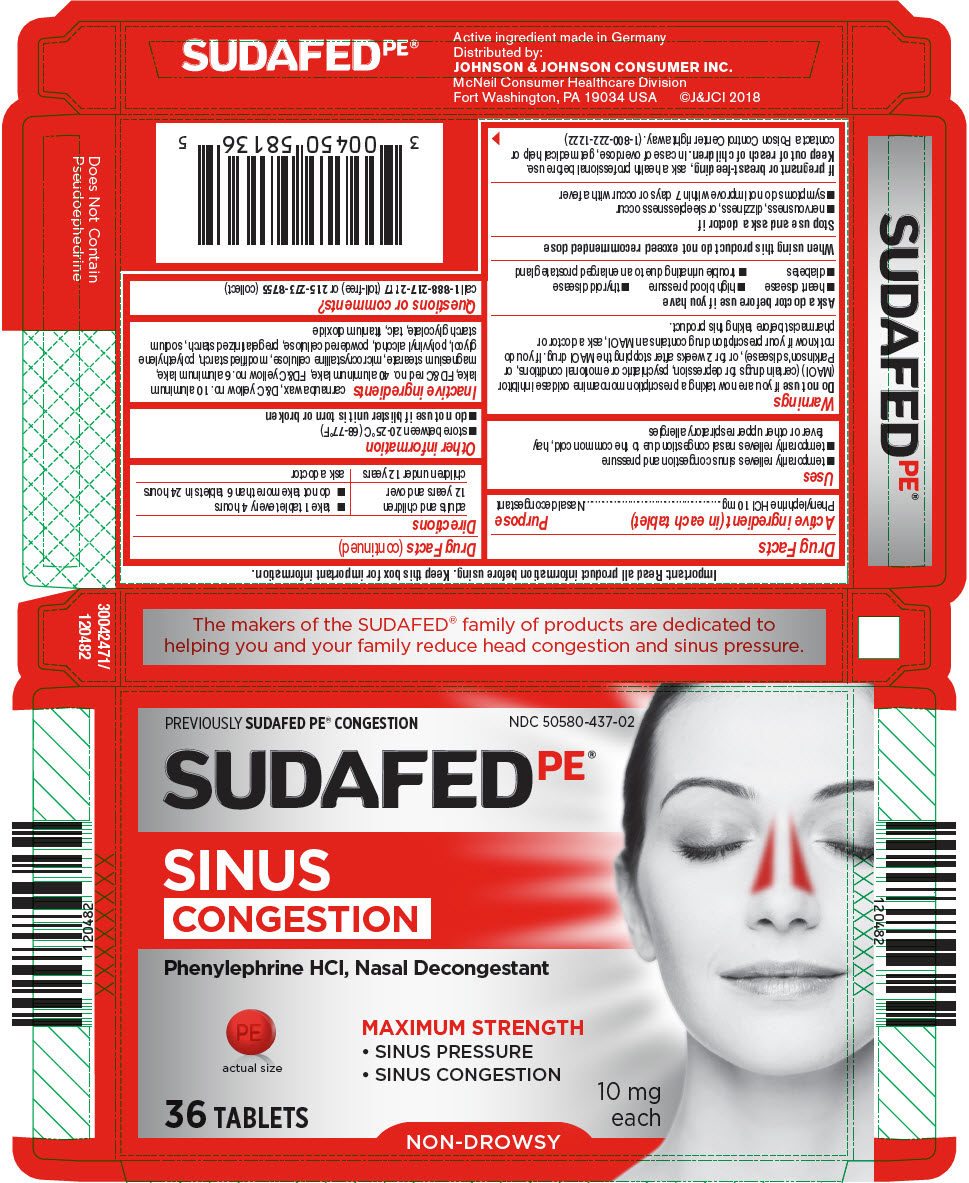
Sudafed PE Sinus Congestion Phenylephrine Hydrochloride 10 mg Tablet, Film Coated — NDC 50580-437-03 (Billing 50580-0437-03)
This is a package of Sudafed PE Sinus Congestion Phenylephrine Hydrochloride 10 mg Tablet, Film Coated from Kenvue Brands LLC, marketed since Jun 2019 and currently FDA-listed.
Identity & classification
Regulatory identifiers FDA, NLM and CMS codes for this package
Drug-database identifiers Medi-Span GPI and First Databank GCN / HICL / AHFS classification
- GSN (GCN sequence number): 058496
- GCN: 23944
- GPI-14 (Medi-Span): 42101040100310
- HICL (First Databank): 002087
- AHFS class code: 12:12.04.00
- RxCUI (RxNorm): 1049182
Where does this data come from?
- FDA openFDA NDC Directory · synced Oct 1, 2026
- FDA label on DailyMed · label index refreshed Oct 1, 2026
- RxNorm (NLM RxNav) · catalog refreshed Oct 1, 2026
- Medi-Span GPI (licensed)
- First Databank (licensed) · refreshed Oct 1, 2026
RxNorm drug class
This medicine belongs to the alpha-1 Adrenergic Agonist class.
Where does this data come from?
- RxClass (NLM) · catalog refreshed Oct 1, 2026
Clinical
Phenylephrine is used to relieve nasal discomfort caused by colds, allergies, and hay fever. It is also used to relieve sinus congestion and pressure. Phenylephrine will relieve symptoms but will not treat the cause of the symptoms or speed recovery. Phenylephrine is in a class of medications called nasal decongestants. It works by reducing swelling of the blood vessels in the nasal passages.
Read the full MedlinePlus article ↗- It depends on the product. The injection raises low blood pressure during anesthesia and, for some products, septic shock. Eye drops dilate the pupil, nasal products relieve conges...
- Be careful. Over-the-counter phenylephrine should not be used with a prescription MAOI or within 2 weeks of stopping one. If you aren't sure whether your medicine is an MAOI, ask m...
- With the injection, the most common are nausea, vomiting and headache. Call for help right away if you have chest pain, a very slow heartbeat, or pain or skin changes around the IV...
- Stop and talk to a doctor if you get nervousness, dizziness or sleeplessness. Also stop if symptoms last more than 7 days or come with a fever. Don't use more than the label recomm...
Patient education
Supplement & herbal interactions
Some supplements/herbs that may interact with Phenylephrine Hydrochloride — tap one for details:
Where does this data come from?
- MedlinePlus (NLM) · refreshed Oct 1, 2026
- FDA label on DailyMed · label index refreshed Oct 1, 2026
Ask a licensed pharmacist directly — free, answered by our team.
Pricing
A drug doesn't have one price. Each row is a different public payment system, and none is what you'd pay at the counter — that depends on your insurance. The ⓘ on each row explains what it measures.
| Price system | Per each | Per package |
|---|---|---|
| Retail pharmacies payNADAC · weekly | Not in the retail survey — common for institutional, discontinued, or low-volume packs. | |
| Medicaid paysCMS SDUD · 12 mo | No recent Medicaid claims on file for this NDC — rare and low-volume NDCs are suppressed in the public data. | |
| Medicare drug plans payPart D · quarterly | No Part D plan price is available for this NDC in our data. | |
Where does this data come from?
- CMS NADAC weekly file
- CMS ASP pricing files · refreshed Sep 20, 2026
- CMS Medicaid State Drug Utilization Data · refreshed Oct 3, 2026
- CMS Part D plan pricing files · refreshed Sep 24, 2026
- VA National Acquisition Center price file
Packaging — all sizes for this product
| Package NDC | Description | Marketing start | Marketing end | Status |
|---|---|---|---|---|
| 50580-0437-01 50580-437-01 Main listing | 1 BLISTER PACK in 1 CARTON / 18 TABLET, FILM COATED in 1 BLISTER PACK | 2019-06-17 | — | Active |
| 50580-0437-02 50580-437-02 | 2 BLISTER PACK in 1 CARTON / 18 TABLET, FILM COATED in 1 BLISTER PACK | 2019-06-17 | — | Active |
| 50580-0437-03 You're viewing this | 3 CARTON in 1 PACKAGE / 2 BLISTER PACK in 1 CARTON / 18 TABLET, FILM COATED in 1 BLISTER PACK | 2019-09-03 | — | Active |
Pack size FAQ
What quantity is in this package?
What NDC number is used to bill for this package of Sudafed PE Sinus Congestion Phenylephrine Hydrochloride 10 mg Tablet, Film Coated?
Therapeutic equivalents
| Product | Labeler | Pack | NADAC/unit | TE | Status | Price vs. this |
|---|---|---|---|---|---|---|
| Nasal Decongestant PE Maximum Strength 10 mg 70677-1152-01 | Strategic | 18 tablets | $0.050 | — | Availability likely | — |
| Nasal Decongestant PE 10 mg 00363-4531-07 | Walgreen | 18 tablets | — | — | FDA listed | — |
| PhysiciansCare Sinus Non-Drowsy 10 mg 00924-0133-01 | Acme | 1 tablet | — | — | FDA listed | — |
| Sinus Pressure and Congestion Relief PE Maximum Strength 10 mg 11822-4530-02 | Rite | 24 tablets | — | — | FDA listed | — |
| Nasal Decongestant PE 10 mg 21130-0453-07 | Better | 18 tablets | — | — | FDA listed | — |
| Sinus Decongestion PE 10 mg 30142-0534-07 | Kroger | 18 tablets | — | — | FDA listed | — |
| Sinus Congestion 10 mg 30142-0853-07 | Kroger | 18 tablets | — | — | FDA listed | — |
| PE Sinus Congestion 10 mg 36800-0704-07 | Topco | 18 tablets | — | — | FDA listed | — |
| Nasal Decongestant PE 10 mg 37808-0453-23 | H | 24 tablets | — | — | FDA listed | — |
| Nasal Decongestant PE 10 mg 37835-0651-01 | Bi-Mart | 100 tablets | — | — | FDA listed | — |
| Medi-First Sinus Decongestant 10 mg 47682-0809-13 | Unifirst | 1 tablet | — | — | FDA listed | — |
| Medi-First Plus Sinus Decongestant 10 mg 47682-0990-33 | Unifirst | 1 tablet | — | — | FDA listed | — |
| Unishield Sinus Decongestant 10 mg 49314-2083-03 | Unishield | 1 tablet | — | — | FDA listed | — |
| Pseudo Time Pe 10 mg 49483-0234-00 | TIME | 100000 tablets | — | — | FDA listed | — |
| Good Sense Nasal Decongestant PE 10 mg 50090-3659-00 | A-S | 36 tablets | — | — | FDA listed | — |
| Phenylephrine HCl Maximum Strength 10 mg 50090-5606-00 | A-S | 18 tablets | — | — | FDA listed | — |
| Nasal Decongestant Pe 10 mg 50090-7449-00 | A-S | 18 tablets | — | — | FDA listed | — |
| Sudafed PE Sinus Congestion 10 mgthis 50580-0437-03 | Kenvue | 18 tablets | — | — | FDA listed | — |
| Sinus Congestion 10 mg 50844-0493-08 | L.N.K. | 24 tablets | — | — | FDA listed | — |
| Suphedrine PE Sinus Congestion Non-Drowsy 10 mg 55301-0753-23 | ARMY | 24 tablets | — | — | FDA listed | — |
| SU PHEDRINE PE Non-Drowsy, Maximum Strength 10 mg 57243-0453-44 | Salado | 18 tablets | — | — | FDA listed | — |
| Su Phedrine Pe Sinus Congestion 10 mg 57243-0953-44 | Salado | 18 tablets | — | — | FDA listed | — |
| Phenylephrine Hydrochloride 10 mg 57631-0018-00 | InvaTech | 30000 tablets | — | — | FDA listed | — |
| Nasal Decongestant PE Non-Drowsy Maximum Strength 10 mg 63868-0144-19 | CHAIN | 18 tablets | — | — | FDA listed | — |
| Nasal Decongestant PE Maximum Strength 10 mg 67091-0207-18 | WinCo | 18 tablets | — | — | FDA listed | — |
| Nasal Decongestant PE Maximum Strength Non-Drowsy 10 mg 69168-0272-17 | Allegiant | 300 tablets | — | — | FDA listed | — |
| Redicare Nasal and Sinus Decongestant 10 mg 71105-0272-02 | Redicare | 100 tablets | — | — | FDA listed | — |
| Gencare-Nasal Decongestant PE 10 mg 72090-0025-01 | Pioneer | 300 tablets | — | — | FDA listed | — |
| Gencare-Nasal Decongestant PE 10 mg 72090-0039-01 | Pioneer | 300 tablets | — | — | FDA listed | — |
| Crane Safety Sinus Decongestant 10 mg 73408-0990-33 | Crane | 1 tablet | — | — | FDA listed | — |
| ValuMeds Nasal Decongestant Phenylephrine HCl 10 mg 82725-1111-01 | Cabinet | 300 tablets | — | — | FDA listed | — |
| Goodmeds Non-Drowsy Nasal Decongestant PE 10 mg 82725-4111-01 | Cabinet | 365 tablets | — | — | FDA listed | — |
| Sinus Congestion 10 mg 83324-0073-18 | Chain | 18 tablets | — | — | FDA listed | — |
| Phenylephrine Hydrochloride 10 mg 83586-0010-00 | HHH | 130000 tablets | — | — | FDA listed | — |
| Nasal Decongestant PE 10 mg 83586-0160-01 | HHH | 100 tablets | — | — | FDA listed | — |
| Nasal Decongestant PE 10 mg 84324-0010-01 | NUVICARE | 100 tablets | — | — | FDA listed | — |
| Nasal Decongestant PE Maximum Strength 10 mg 85766-0178-18 | Sportpharm | 18 tablets | — | — | FDA listed | — |
| Medi-First Plus Sinus Decongestant 10 mg 85766-0182-01 | Sportpharm | 1 tablet | — | — | FDA listed | — |
| GoodMeds Nasal Decongestant 10 mg 82725-4011-01 | Cabinet | 365 tablets | — | — | FDA listed | — |
| ValuMeds Nasal Decongestant PE Phenylephrine 10 mg 82725-1011-01 | Cabinet | 300 tablets | — | — | FDA listed | — |
| Nasal Decongestant PE 10 mg 80513-0789-01 | Advanced | 100 tablets | — | — | FDA listed | — |
Where does this data come from?
- FDA openFDA NDC Directory · synced Oct 1, 2026
- FDA Orange Book · refreshed Sep 3, 2026
- CMS NADAC weekly file
Availability & generic status
We did not find an FDA-approved generic match for this exact strength, form and route.
Where does this data come from?
- FDA Orange Book · refreshed Sep 3, 2026
What it looks like
Where does this data come from?
- FDA label on DailyMed · label index refreshed Oct 1, 2026
Inactive Ingredients / Excipients
Inactive ingredients, also called excipients, are components of the drug product other than the active ingredient. They may include fillers, dyes, coatings, preservatives, flavors, or other formulation ingredients.
💡 Tap an ingredient (hover on desktop) to see what it is and why it’s used.
-
UNII LMI26O6933
Alumina is a white powder form of aluminum oxide. It's used as a filler to add bulk to tablets and capsules, and sometimes as a thickening or anti-caking agent in powdered formulations.
-
UNII R12CBM0EIZ
A natural wax derived from a Brazilian palm tree, used as a coating and polish on tablets and capsules. It creates a smooth, shiny finish that protects the medicine and improves appearance.
-
UNII CQ3XH3DET6
D&C Yellow No. 10 Aluminum Lake is a yellow colorant made by combining a dye with aluminum salts. It's used in medicines to add color for product identification and visual appeal.
-
UNII WZB9127XOA
A synthetic red dye used to color medications and make them easier to identify. It serves as a colorant in tablets, capsules, and liquid formulations.
-
UNII H77VEI93A8
A synthetic yellow dye used to color medications. It helps identify the drug and make it visually distinctive, with no effect on how the medicine works.
-
UNII 70097M6I30
Magnesium stearate is a salt made from magnesium and stearic acid, a fatty substance. It's used in tablets and capsules as a lubricant and glidant to help ingredients flow smoothly during manufacturing and prevent sticking.
-
UNII OP1R32D61U
Microcrystalline cellulose is a purified form of cellulose, a natural fiber from plant sources. It acts as a binder and filler in tablets and capsules, helping hold ingredients together and give the medicine its shape and size.
-
UNII 3WJQ0SDW1A
Polyethylene glycol is a synthetic liquid or solid polymer used in medicines as a solvent, lubricant, and humectant. It helps dissolve active ingredients, reduces friction during manufacturing, and retains moisture in the final product.
-
UNII 532B59J990
Polyvinyl alcohol is a synthetic polymer made from plant-derived materials. It's used as a binder to hold ingredients together, a film-former in coatings, and a thickener in liquid formulations.
-
UNII SMD1X3XO9M
Powdered cellulose is a fine, plant-based powder made from purified wood fibers. In medicines, it acts as a filler to add bulk and volume, and helps tablets or capsules hold together during manufacturing and storage.
-
UNII H8AV0SQX4D
A modified starch derived from potato or corn starch. It absorbs water quickly and helps tablets or capsules break apart and dissolve in the stomach, acting as a disintegrant to ensure the medicine releases its active ingredients properly.
-
UNII 7SEV7J4R1U
A powder made from a naturally occurring mineral. In medicines, talc works as a glidant and anti-caking agent, helping tablets and capsules flow smoothly during manufacturing and preventing clumping.
-
UNII 15FIX9V2JP
Titanium dioxide is a bright white mineral powder commonly used as a colorant and opacifying agent. It makes pills and tablets white or lighter in color and helps make coatings non-transparent.
13 inactive ingredients listed in the exact product block matched to this NDC.
Label-section wording can be broader than the structured product block and may mention additional formulation ingredients.
Where does this data come from?
ingredient classCode="IACT" elements from the exact product block matched by this NDC. Label-section narrative from DailyMed / the openFDA label index is shown separately when available.- FDA label on DailyMed · label index refreshed Oct 1, 2026
- FDA openFDA NDC Directory · synced Oct 1, 2026
Inactive ingredient FAQ
Are inactive ingredients the same for every manufacturer?
Why might an inactive ingredient be missing?
Can inactive ingredients matter?
Manufacturer & labeler
Where does this data come from?
- FDA openFDA NDC Directory · synced Oct 1, 2026
- Drugs@FDA
FDA label — Drug Facts FDA SPL
🎯 Indications and Usage ▾
Uses temporarily relieves sinus congestion and pressure temporarily relieves nasal congestion due to the common cold, hay fever or other upper respiratory allergies
⏱️ Dosage and Administration ▾
Directions adults and children 12 years and over take 1 tablet every 4 hours do not take more than 6 tablets in 24 hours children under 12 years ask a doctor
⚠️ Warnings ▾
Warnings Do not use if you are now taking a prescription monoamine oxidase inhibitor (MAOI) (certain drugs for depression, psychiatric or emotional conditions, or Parkinson's disease), or for 2 weeks after stopping the MAOI drug. If you do not know if your prescription drug contains an MAOI, ask a doctor or pharmacist before taking this product. Ask a doctor before use if you have heart disease high blood pressure thyroid disease diabetes trouble urinating due to an enlarged prostate gland When using this product do not exceed recommended dose Stop use and ask a doctor if nervousness, dizziness, or sleeplessness occur symptoms do not improve within 7 days or occur with a fever If pregnant or breast-feeding, ask a health professional before use.
Keep out of reach of children. In case of overdose, get medical help or contact a Poison Control Center right away. (1-800-222-1222)
📦 Storage and Handling ▾
Other information store between 20-25°C (68-77°F) do not use if blister unit is torn or broken
🧪 Active Ingredient ▾
Active ingredient (in each tablet) Phenylephrine HCl 10 mg
🧪 Inactive Ingredients ▾
Inactive ingredients carnauba wax, D&C yellow no. 10 aluminum lake, FD&C red no. 40 aluminum lake, FD&C yellow no. 6 aluminum lake, magnesium stearate, microcrystalline cellulose, modified starch, polyethylene glycol, polyvinyl alcohol, powdered cellulose, pregelatinized starch, sodium starch glycolate, talc, titanium dioxide
🎯 Purpose ▾
Purpose Nasal decongestant
📄 Do Not Use ▾
Do not use if you are now taking a prescription monoamine oxidase inhibitor (MAOI) (certain drugs for depression, psychiatric or emotional conditions, or Parkinson's disease), or for 2 weeks after stopping the MAOI drug. If you do not know if your prescription drug contains an MAOI, ask a doctor or pharmacist before taking this product.
📄 Ask a Doctor Before Use If ▾
Ask a doctor before use if you have heart disease high blood pressure thyroid disease diabetes trouble urinating due to an enlarged prostate gland
📄 When Using This Product ▾
When using this product do not exceed recommended dose
📄 Stop Use and Ask a Doctor If ▾
Stop use and ask a doctor if nervousness, dizziness, or sleeplessness occur symptoms do not improve within 7 days or occur with a fever
🤰 If Pregnant or Breast-Feeding ▾
If pregnant or breast-feeding, ask a health professional before use.
📄 Keep Out of Reach of Children ▾
Keep out of reach of children. In case of overdose, get medical help or contact a Poison Control Center right away. (1-800-222-1222)
📄 Questions or Comments ▾
Questions or comments? call 1-888-217-2117 (toll-free) or 215-273-8755 (collect)
📄 Package Label / Principal Display Panel ▾
PRINCIPAL DISPLAY PANEL PREVIOUSLY SUDAFED PE ® CONGESTION NDC 50580-437-02 SUDAFED PE® SINUS CONGESTION Phenylephrine HCl, Nasal Decongestant actual size MAXIMUM STRENGTH SINUS PRESSURE SINUS CONGESTION 36 TABLETS NON-DROWSY 10 mg each Principal Display Panel
About this NDC listing & data coverage
What data is (and isn’t) available for this NDC — tap to expand
| NDC identity (package / product / labeler codes) | ✓ Available |
| Labeler | ✓ Available |
| Product & package description | ✓ Available |
| Marketing category & status | ✓ Available |
| Active ingredient / dosage form / route | ✓ Available |
| FDA label (SPL via DailyMed) | ✓ Available |
| Package photos | ✓ Available |
| Inactive ingredients (structured) | ✓ Available |
| NADAC pharmacy acquisition price (CMS) | — Not published for this NDC CMS publishes NADAC only for NDCs reported in its retail-pharmacy survey. |
| Orange Book / therapeutic-equivalence data | — Not published for this NDC Applies only to products approved under an NDA/ANDA; many listings are out of scope. |
| HCPCS J-code billing crosswalk | — Not published for this NDC Most self-administered / retail products have no J-code — that is normal. |
| Medicaid utilization (CMS SDUD) | — Not published for this NDC CMS reports utilization only for NDCs with Medicaid claims above its privacy threshold. |