
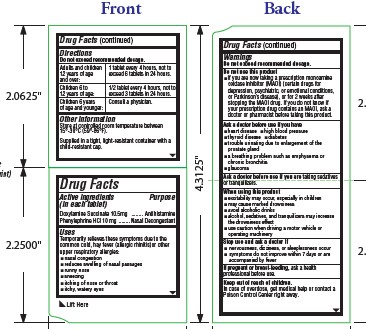
Poly Hist Forte Doxylamine Succinate and Phenylephrine Hydrochloride 10.5 mg; 10 mg Tablet, 12-count
🆔 Identity & classification
Where does this data come from?
🏷️ RxNorm drug class
This medicine belongs to the Antihistamine class.
Where does this data come from?
🏭 Manufacturer & labeler
Where does this data come from?
🩺 Clinical
Doxylamine is used to treat insomnia (difficulty falling asleep or staying asleep). Doxylamine is in a class of medications called antihistamines. It works by blocking the action of histamine, a substance in the body that causes allergic symptoms. Doxylamine is also used in combination with acetaminophen, dextromethorphan, decongestants and other medications to manage cold and flu symptoms. This monograph only includes information about the use of doxylamine alone. If you are taking the doxylamine combination products, read the information on the package label or ask your doctor or pharmacis...
Read the full MedlinePlus article ↗Poly Hist Forte is an over-the-counter oral tablet marketed under FDA's OTC monograph rules. It contains doxylamine succinate, a sedating antihistamine typically used to relieve allergy symptoms and sneezing, and phenylephrine hydrochloride, a decongestant commonly used to reduce nasal congestion. This combination is intended for people seeking temporary relief from cold and allergy symptoms.
Patient education
Supplement & herbal interactions
Where does this data come from?
Ask a licensed pharmacist directly — free, answered by our team.
💊 What it looks like
Where does this data come from?
🧪 Inactive Ingredients / Excipients
Inactive ingredients, also called excipients, are components of the drug product other than the active ingredient. They may include fillers, dyes, coatings, preservatives, flavors, or other formulation ingredients.
💡 Tap an ingredient (hover on desktop) to see what it is and why it’s used.
-
UNII OP1R32D61U
Microcrystalline cellulose is a purified form of cellulose, a natural fiber from plant sources. It acts as a binder and filler in tablets and capsules, helping hold ingredients together and give the medicine its shape and size.
-
UNII L06K8R7DQK
A synthetic blue dye approved by the FDA for use in medications and foods. It serves as a colorant to make pills and liquids visually distinct and easier to identify.
-
UNII 70097M6I30
Magnesium stearate is a salt made from magnesium and stearic acid, a fatty substance. It's used in tablets and capsules as a lubricant and glidant to help ingredients flow smoothly during manufacturing and prevent sticking.
-
UNII 5856J3G2A2
A starch-based powder made from potatoes and processed with sodium. It acts as a disintegrant, helping the tablet or capsule break apart quickly in the stomach so the medicine can be absorbed.
4 inactive ingredients listed in the exact product block matched to this NDC.
Label-section wording can be broader than the structured product block and may mention additional formulation ingredients.
Where does this data come from?
ingredient classCode="IACT" elements from the exact product block matched by this NDC. Label-section narrative from DailyMed / the openFDA label index is shown separately when available.Inactive ingredient FAQ
Are inactive ingredients the same for every manufacturer?
Why might an inactive ingredient be missing?
Can inactive ingredients matter?
💲 Pricing
A drug doesn't have one price. Each row is a different public payment system, and none is what you'd pay at the counter — that depends on your insurance. The ⓘ on each row explains what it measures.
| Price system | Per each | Per package |
|---|---|---|
| Retail pharmacies payNADAC · weekly | Not in the retail survey — common for institutional, discontinued, or low-volume packs. | |
| Medicaid paysCMS SDUD · 12 mo | No recent Medicaid claims on file for this NDC — rare and low-volume NDCs are suppressed in the public data. | |
| Medicare drug plans payPart D · quarterly | No Part D plan price is available for this NDC in our data. | |
Where does this data come from?
🔁 Therapeutic equivalents
| Product | Labeler | Pack | NADAC/unit | TE | Status | Price vs. this |
|---|---|---|---|---|---|---|
| Poly Hist Forte 10.5 mg/1; 10 mgthis 50991-0626-02 | Poly | 12 tablets | — | — | FDA listed | — |
Where does this data come from?
⏳ Availability & generic status
We did not find an FDA-approved generic match for this exact strength, form and route.
Where does this data come from?
💊 Medicaid utilization by pack size
🔬 Reported adverse events (FAERS)
Top reported reactions
Age at onset
Reporter sex
Serious outcomes
Where does this data come from?
📦 Packaging — all sizes for this product
| Package NDC | Description | Per unit | Per pack | Marketing start | Status |
|---|---|---|---|---|---|
| 50991-0626-01 | 100 TABLET in 1 BOTTLE (50991-626-01) | $0.6637 / ea | $66.37 | 2019-06-01 | Active |
| 50991-0626-02 You're viewing this | 12 BLISTER PACK in 1 CARTON (50991-626-02) / 1 TABLET in 1 BLISTER PACK | — | — | 2019-06-01 | Active |
This pack shows little to no recent Medicaid volume — the 100 tablets pack carries most fills. See all packs ↓
Pack size FAQ
What quantity is in NDC 50991-0626-02?
What is the difference between NDC 50991-0626-02 and NDC 50991-0626-01?
What NDC number is used to bill for this package of Poly Hist Forte Doxylamine Succinate and Phenylephrine Hydrochloride 10.5 mg; 10 mg Tablet?
Prices are the latest CMS NADAC pharmacy acquisition cost per NDC; per-pack figures are per-unit × pack quantity, shown only when the pack is denominated in the same measure NADAC prices.
🧭 About this NDC listing & data coverage
What data is (and isn’t) available for this NDC — tap to expand
| NDC identity (package / product / labeler codes) | ✓ Available |
| Labeler | ✓ Available |
| Product & package description | ✓ Available |
| Marketing category & status | ✓ Available |
| Active ingredient / dosage form / route | ✓ Available |
| FDA label (SPL via DailyMed) | ✓ Available |
| Package photos | ✓ Available |
| Inactive ingredients (structured) | ✓ Available |
| NADAC pharmacy acquisition price (CMS) | — Not published for this NDC CMS publishes NADAC only for NDCs reported in its retail-pharmacy survey. |
| Orange Book / therapeutic-equivalence data | — Not published for this NDC Applies only to products approved under an NDA/ANDA; many listings are out of scope. |
| HCPCS J-code billing crosswalk | — Not published for this NDC Most self-administered / retail products have no J-code — that is normal. |
| Medicaid utilization (CMS SDUD) | — Not published for this NDC CMS reports utilization only for NDCs with Medicaid claims above its privacy threshold. |
Questions about this listing
Is this NDC FDA-approved?
Why is there no price listed?
Is the NDC printed on the package the same as the 11-digit billing NDC?
What do the three segments of this NDC mean?
Is this package still being marketed?
Does this product come in other package sizes?
Who lists this product with the FDA?
Do I need a prescription for this product?
Where does this data come from?
📄 FDA label — Drug Facts FDA SPL
🎯 Indications and Usage ▾
Uses Temporarily relieves these symptoms due to the common cold, hay fever (allergic rhinitis)or other upper respiratory allergies: nasal congestion reduces swelling of nasal passages runny nose sneezing itching of nose or throat itchy, watery eyes
⏱️ Dosage and Administration ▾
Directions Do not exceed recommended dosage. Adults and children 12 years of age and over 1 tablet every 4 hours, not to exceed 6 tablets in 24 hours. Children 6 to 12 years of age: 1/2 tablet every 4 hours, not to exceed 3 tablets in 24 hours. Children 6 years of age and younger: Consult a physician.
⚠️ Warnings ▾
Warnings
🧪 Active Ingredient ▾
Active ingredients (in each tablet) Doxylamine Succinate 10.5mg
Active ingredients (in each tablet) Phenylephrine HCl 10 mg
🧪 Inactive Ingredients ▾
Inactive ingredients FD&C Blue # 2, magnesium stearate, microcrystalline cellulose, sodium starch glycolate.
🎯 Purpose ▾
Purpose Antihistamine
Purpose Nasal Decongestant