
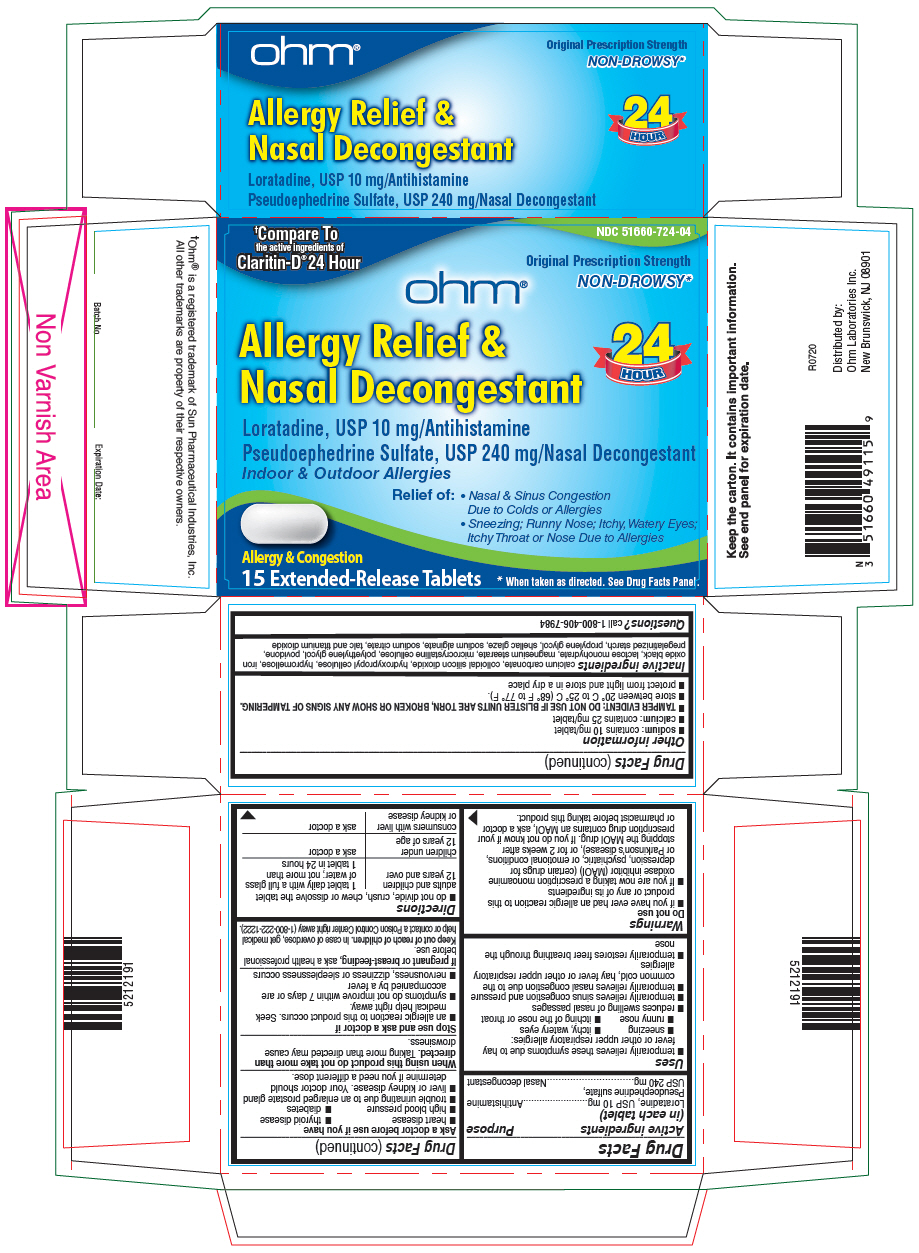
Loratadine and Pseudoephedrine 10 mg; 240 mg Tablet, Extended Release, 5-count
🆔 Identity & classification
Where does this data come from?
🏷️ RxNorm drug class
This medicine belongs to the Other antihistamines for systemic use class.
Where does this data come from?
🏭 Manufacturer & labeler
Where does this data come from?
🩺 Clinical
Loratadine is used to treat allergy symptoms: sneezing runny nose itching of the nose or throat red, itchy, or watery eyes Loratadine is in a class of medications called antihistamines. It works by blocking the action of histamine, a substance in the body that causes allergic symptoms.
Read the full MedlinePlus article ↗- Great question. The two ingredients each do something different. Loratadine is an antihistamine — it targets the sneezing, runny nose, itchy eyes, and throat itching that come with...
- What exactly does this medicine do, and why does it have two ingredients?
- You take it by mouth with a full glass of water — but it's really important that you swallow it whole. Do not crush, split, chew, or dissolve it. These are extended-release tablets...
- How do I take it, and does it matter if I crush or split the tablet?
Patient education
Supplement & herbal interactions
Where does this data come from?
Ask a licensed pharmacist directly — free, answered by our team.
💊 What it looks like
Where does this data come from?
🧪 Inactive Ingredients / Excipients
Inactive ingredients, also called excipients, are components of the drug product other than the active ingredient. They may include fillers, dyes, coatings, preservatives, flavors, or other formulation ingredients.
Where does this data come from?
IACT rows and label-wide narrative are kept separate; availability and product-level specificity depend on the submitted label.Inactive ingredient FAQ
Are inactive ingredients the same for every manufacturer?
Why might an inactive ingredient be missing?
Can inactive ingredients matter?
💲 Pricing
A drug doesn't have one price. Each row is a different public payment system, and none is what you'd pay at the counter — that depends on your insurance. The ⓘ on each row explains what it measures.
| Price system | Per each | Per package |
|---|---|---|
| Retail pharmacies payNADAC · weekly | Not in the retail survey — common for institutional, discontinued, or low-volume packs. | |
| Medicaid paysCMS SDUD · 12 mo | No recent Medicaid claims on file for this NDC — rare and low-volume NDCs are suppressed in the public data. | |
| Medicare drug plans payPart D · quarterly | No Part D plan price is available for this NDC in our data. | |
Where does this data come from?
🔁 Therapeutic equivalents
| Product | Labeler | Pack | NADAC/unit | TE | Status | Price vs. this |
|---|---|---|---|---|---|---|
| allergy d 10 mg/1; 240 mg 00113-9004-22 | L. | 1 tablet | $0.566 | — | Availability likely | — |
| Loratadine and Pseudoephedrine Sulfate 10 mg/1; 240 mg 00904-5833-15 | Major | 10 tablets | $0.566 | — | Availability likely | — |
| Loratadine and Pseudoephedrine Sulfate 10 mg/1; 240 mg 46122-0167-52 | Amerisource | 10 tablets | $0.566 | — | Availability likely | — |
| Loratadine and Pseudoephedrine 10 mg/1; 240 mg 46122-0383-22 | AMERISOURCE | 15 tablets | $0.566 | — | Availability likely | — |
| Leader Allergy Relief D-24 10 mg/1; 240 mg 70000-0162-01 | Cardinal | 10 tablets | $0.566 | — | Availability likely | — |
| Loratadine and Pseudoephedrine 10 mg/1; 240 mg 70677-1018-01 | STRATEGIC | 10 tablets | $0.566 | — | Availability likely | — |
| Loratadine and Pseudoephedrine Sulfate 10 mg/1; 240 mg 49348-0543-01 | STRATEGIC | 10 tablets | $0.574 | — | FDA listed | — |
| Loratadine and Pseudoephedrine Sulfate 10 mg/1; 240 mg 62011-0071-01 | Strategic | 10 tablets | $0.574 | — | FDA listed | — |
| Loratadine and Pseudoephedrine 10 mg/1; 240 mg 00363-0725-15 | Walgreen | 15 tablets | — | — | FDA listed | — |
| Allergy Relief D 10 mg/1; 240 mg 00363-2010-22 | Walgreen | 1 tablet | — | — | FDA listed | — |
| Claritin-D 24 Hour 10 mg/1; 240 mg 11523-0102-01 | Bayer | 10 tablets | — | — | FDA listed | — |
| Claritin-D 24 Hour 10 mg/1; 240 mg 11523-4332-01 | Bayer | 5 tablets | — | — | Discontinued | — |
| Loratadine and Pseudoephedrine 10 mg/1; 240 mg 11822-9990-00 | Rite | 10 tablets | — | — | FDA listed | — |
| Loratadine and Pseudoephedrine Sulfate 10 mg/1; 240 mg 21130-0724-15 | Safeway | 15 tablets | — | — | FDA listed | — |
| Loratadine and Pseudoephedrine Sulfate 10 mg/1; 240 mg 30142-0724-15 | The | 1 tablet | — | — | FDA listed | — |
| allergy congestion relief 10 mg/1; 240 mg 30142-0846-22 | Kroger | 1 tablet | — | — | FDA listed | — |
| topcare allergy and congestion relief 10 mg/1; 240 mg 36800-0706-22 | Topco | 1 tablet | — | — | FDA listed | — |
| Loratadine and Pseudoephedrine Sulfate 10 mg/1; 240 mg 37808-0427-69 | HEB | 10 tablets | — | — | FDA listed | — |
| Loratadine and Pseudoephedrine Sulfate 10 mg/1; 240 mg 37808-0724-69 | HEB | 10 tablets | — | — | FDA listed | — |
| Allergy Relief-D 240 mg/1; 10 mg 37808-0787-07 | HEB | 5 tablets | — | — | FDA listed | — |
| Loratadine and Pseudoephedrine Sulfate 10 mg/1; 240 mg 41250-0724-52 | Meijer | 15 tablets | — | — | FDA listed | — |
| Loratadine and Pseudoephedrine Sulfate 10 mg/1; 240 mg 49035-0488-15 | WAL-MART | 15 tablets | — | — | FDA listed | — |
| Loratadine and Pseudoephedrine 10 mg/1; 240 mg 51660-0491-15 | Ohm | 15 tablets | — | — | Discontinued | — |
| Loratadine and Pseudoephedrine 10 mg/1; 240 mgthis 51660-0724-56 | Ohm | 5 tablets | — | — | Discontinued | — |
| Loratadine and Pseudoephedrine Sulfate 10 mg/1; 240 mg 56062-0724-15 | Publix | 15 tablets | — | — | FDA listed | — |
| Allergy Relief-D 10 mg/1; 240 mg 59779-0726-15 | CVS | 5 tablets | — | — | FDA listed | — |
| Loratadine and Pseudoephedrine 10 mg/1; 240 mg 63187-0305-10 | Proficient | 10 tablets | — | — | FDA listed | — |
| kirkland signature allerclear d 24 hr 10 mg/1; 240 mg 63981-0138-22 | Costco | 1 tablet | — | — | FDA listed | — |
| KIRKLAND SIGNATURE ALLERCLEAR D 24 HR Extended Release 10 mg/1; 240 mg 63981-0724-15 | Kirkland-COSTCO | 15 tablets | — | — | FDA listed | — |
| Loratadine and Pseudoephedrine 10 mg/1; 240 mg 85766-0048-10 | Sportpharm | 10 tablets | — | — | FDA listed | — |
Where does this data come from?
⏳ Availability & generic status
This product is an FDA-approved generic. Other versions of the same drug are listed under Therapeutic equivalents, least expensive first.
Where does this data come from?
💊 Medicaid utilization by pack size
📦 Packaging — all sizes for this product
| Package NDC | Description | Per unit | Per pack | Marketing start | Status |
|---|---|---|---|---|---|
| 51660-0724-04 | 3 BLISTER PACK in 1 CARTON (51660-724-04) / 5 TABLET, EXTENDED RELEASE in 1 BLISTER PACK | $0.5656 / ea | $8.48 | 2004-11-17 | Active |
| 51660-0724-15 | 1 BLISTER PACK in 1 CARTON (51660-724-15) / 15 TABLET, EXTENDED RELEASE in 1 BLISTER PACK | $0.5656 / ea | $8.48 | 2004-11-17 | Active |
| 51660-0724-56 You're viewing this | 1 BLISTER PACK in 1 CARTON (51660-724-56) / 5 TABLET, EXTENDED RELEASE in 1 BLISTER PACK | — | — | 2004-11-17 | Discontinued by firm |
| 51660-0724-69 | 1 BLISTER PACK in 1 CARTON (51660-724-69) / 10 TABLET, EXTENDED RELEASE in 1 BLISTER PACK | $0.5656 / ea | $5.66 | 2004-11-17 | Active |
This pack shows little to no recent Medicaid volume — a different pack size carries most fills. See all packs ↓
Pack size FAQ
What quantity is in NDC 51660-0724-56?
What is the difference between NDC 51660-0724-56 and NDC 51660-0724-69?
What NDC number is used to bill for this package of Loratadine and Pseudoephedrine 10 mg; 240 mg Tablet, Extended Release?
Prices are the latest CMS NADAC pharmacy acquisition cost per NDC; per-pack figures are per-unit × pack quantity, shown only when the pack is denominated in the same measure NADAC prices.
🧭 About this NDC listing & data coverage
What data is (and isn’t) available for this NDC — tap to expand
| NDC identity (package / product / labeler codes) | ✓ Available |
| Labeler | ✓ Available |
| Product & package description | ✓ Available |
| Marketing category & status | ✓ Available |
| Active ingredient / dosage form / route | ✓ Available |
| FDA label (SPL via DailyMed) | ✓ Available |
| Package photos | ✓ Available |
| Inactive ingredients (structured) | — Not published for this NDC The labeler did not submit a structured excipient list, or no SPL is available. |
| NADAC pharmacy acquisition price (CMS) | — Not published for this NDC CMS publishes NADAC only for NDCs reported in its retail-pharmacy survey. |
| Orange Book / therapeutic-equivalence data | — Not published for this NDC Applies only to products approved under an NDA/ANDA; many listings are out of scope. |
| HCPCS J-code billing crosswalk | — Not published for this NDC Most self-administered / retail products have no J-code — that is normal. |
| Medicaid utilization (CMS SDUD) | — Not published for this NDC CMS reports utilization only for NDCs with Medicaid claims above its privacy threshold. |
Questions about this listing
Why is there no price listed?
What does the discontinued status mean for this NDC?
Is the NDC printed on the package the same as the 11-digit billing NDC?
What do the three segments of this NDC mean?
Does this product come in other package sizes?
Who lists this product with the FDA?
Do I need a prescription for this product?
Where does this data come from?
📄 FDA label — Drug Facts FDA SPL
🎯 Indications and Usage ▾
USES temporarily relieves these symptoms due to hay fever or other upper respiratory allergies: sneezing itchy, watery eyes runny nose itching of the nose or throat reduces swelling of nasal passages temporarily relieves sinus congestion and pressure temporarily relieves nasal congestion due to the common cold, hay fever or other upper respiratory allergies temporarily restores freer breathing through the nose
⏱️ Dosage and Administration ▾
DIRECTIONS do not divide, crush, chew or dissolve the tablet adults and children 12 years and over 1 tablet daily with a full glass of water; not more than 1 tablet in 24 hours children under 12 years of age ask a doctor consumers with liver or kidney disease ask a doctor
⚠️ Warnings ▾
WARNINGS Do not use if you have ever had an allergic reaction to this product or any of its ingredients if you are now taking a prescription monoamine oxidase inhibitor (MAOI) (certain drugs for depression, psychiatric, or emotional conditions, or Parkinson's disease), or for 2 weeks after stopping the MAOI drug. If you do not know if your prescription drug contains an MAOI, ask a doctor or pharmacist before taking this product. Ask a doctor before use if you have heart disease thyroid disease high blood pressure diabetes trouble urinating due to an enlarged prostate gland liver or kidney disease.
Your doctor should determine if you need a different dose. When using this product do not take more than directed. Taking more than directed may cause drowsiness.
Stop use and ask a doctor if an allergic reaction to this product occurs. Seek medical help right away. symptoms do not improve within 7 days or are accompanied by a fever. nervousness, dizziness or sleeplessness occurs If pregnant or breast-feeding Ask a health professional before use. Keep out of reach of children.
In case of overdose, get medical help or contact a Poison Control Center right away (1-800-222-1222).
🧪 Active Ingredient ▾
ACTIVE INGREDIENTS (IN EACH TABLET) Loratadine, USP 10 mg Pseudoephedrine sulfate, USP 240 mg
🧪 Inactive Ingredients ▾
INACTIVE INGREDIENTS Calcium carbonate, colloidal silicon dioxide, hydroxypropyl cellulose, hypromellose, iron oxide black, lactose monohydrate, magnesium stearate, microcrystalline cellulose, polyethylene glycol, povidone, pregelatinized starch, propylene glycol, shellac glaze, sodium alginate, sodium citrate, talc and titanium dioxide
🎯 Purpose ▾
PURPOSE Antihistamine Nasal decongestant