
Naftifine Hydrochloride 10 mg/g Cream — NDC 51672-1362-1 (Billing 51672-1362-01)
This is a package of Naftifine Hydrochloride 10 mg/g Cream from Sun Pharmaceutical Industries, Inc., marketed since Sep 2016 and currently FDA-listed.
Identity & classification
Regulatory identifiers FDA, NLM and CMS codes for this package
Drug-database identifiers Medi-Span GPI and First Databank GCN / HICL / AHFS classification
- GSN (GCN sequence number): 007374
- GCN: 47770
- GPI-14 (Medi-Span): 90150078003710
- HICL (First Databank): 003204
- AHFS class code: 84:04.08.04
- RxCUI (RxNorm): 896110
Where does this data come from?
- FDA openFDA NDC Directory · synced Oct 1, 2026
- FDA label on DailyMed · label index refreshed Oct 1, 2026
- RxNorm (NLM RxNav) · catalog refreshed Oct 1, 2026
- Medi-Span GPI (licensed)
- First Databank (licensed) · refreshed Oct 1, 2026
RxNorm drug class
This medicine belongs to the Allylamine Antifungal class.
Where does this data come from?
- RxClass (NLM) · catalog refreshed Oct 1, 2026
Clinical
Naftifine is used for skin infections such as athlete's foot, jock itch, and ringworm. This medication is sometimes prescribed for other uses; ask your doctor or pharmacist for more information.
Read the full MedlinePlus article ↗- The gel treats athlete's foot between the toes (interdigital tinea pedis). It works against the fungi that commonly cause this infection.
- Apply a thin layer once a day to the infected skin and a small margin of healthy skin around it. Keep going for 2 weeks. It is only for the skin, so keep it out of your eyes, mouth...
- Itching is the most common one. Some people notice redness, irritation or burning. Most reactions are mild.
- Stop and call your doctor if redness, irritation or sensitivity develops. Also call if you notice blisters, crusting or fluid draining from the skin.
Patient education
Supplement & herbal interactions
Where does this data come from?
- MedlinePlus (NLM) · refreshed Oct 1, 2026
- FDA label on DailyMed · label index refreshed Oct 1, 2026
Ask a licensed pharmacist directly — free, answered by our team.
Pricing
A drug doesn't have one price. Each row is a different public payment system, and none is what you'd pay at the counter — that depends on your insurance. The ⓘ on each row explains what it measures.
| Price system | Per g | Per package |
|---|---|---|
| Retail pharmacies payNADAC · weekly | Not in the retail survey — common for institutional, discontinued, or low-volume packs. | |
| Medicaid paysCMS SDUD · 12 mo | No recent Medicaid claims on file for this NDC — rare and low-volume NDCs are suppressed in the public data. | |
| Medicare drug plans payPart D · Q2 2026 | $3.52 | $52.79 / 15 g |
Where does this data come from?
- CMS NADAC weekly file
- CMS ASP pricing files · refreshed Sep 20, 2026
- CMS Medicaid State Drug Utilization Data · refreshed Oct 2, 2026
- CMS Part D plan pricing files · refreshed Sep 24, 2026
- VA National Acquisition Center price file
Packaging — all sizes for this product
| Package NDC | Description | Per unit | Per pack | Marketing start | Marketing end | Status |
|---|---|---|---|---|---|---|
| 51672-1362-01 You're viewing this | 1 TUBE in 1 CARTON / 15 g in 1 TUBE | — | — | 2016-09-08 | — | Active |
| 51672-1362-02 51672-1362-2 | 1 TUBE in 1 CARTON / 30 g in 1 TUBE | — | — | 2016-09-08 | — | Active |
| 51672-1362-03 51672-1362-3 Main listing | 1 TUBE in 1 CARTON / 60 g in 1 TUBE | $4.19 / g | $251.57 | 2016-09-08 | — | Active |
| 51672-1362-08 51672-1362-8 | 1 TUBE in 1 CARTON / 90 g in 1 TUBE | — | — | 2016-09-08 | — | Active |
This pack shows little to no recent Medicaid volume — a different pack size carries most fills. See all packs ↓
Pack size FAQ
What quantity is in this package?
What NDC number is used to bill for this package of Naftifine Hydrochloride 10 mg/g Cream?
Prices are the latest CMS NADAC pharmacy acquisition cost per NDC; per-pack figures are per-unit × pack quantity, shown only when the pack is denominated in the same measure NADAC prices.
Therapeutic equivalents
| Product | Labeler | Pack | NADAC/unit | TE | Status | Price vs. this |
|---|---|---|---|---|---|---|
| Naftifine Hydrochloride 10 mg/gthis 51672-1362-01 | Sun | 1 tube | — | — | FDA listed | — |
Where does this data come from?
- FDA openFDA NDC Directory · synced Oct 1, 2026
- FDA Orange Book · refreshed Sep 3, 2026
- CMS NADAC weekly file
Availability & generic status
This product is an FDA-approved generic. Other versions of the same drug are listed under Therapeutic equivalents, least expensive first.
Where does this data come from?
- FDA Orange Book · refreshed Sep 3, 2026
What it looks like
Where does this data come from?
- FDA label on DailyMed · label index refreshed Oct 1, 2026
Inactive Ingredients / Excipients
Inactive ingredients, also called excipients, are components of the drug product other than the active ingredient. They may include fillers, dyes, coatings, preservatives, flavors, or other formulation ingredients.
Where does this data come from?
IACT rows and label-wide narrative are kept separate; availability and product-level specificity depend on the submitted label.- FDA label on DailyMed · label index refreshed Oct 1, 2026
- FDA openFDA NDC Directory · synced Oct 1, 2026
Inactive ingredient FAQ
Are inactive ingredients the same for every manufacturer?
Why might an inactive ingredient be missing?
Can inactive ingredients matter?
Manufacturer & labeler
Where does this data come from?
- FDA openFDA NDC Directory · synced Oct 1, 2026
- Drugs@FDA
Full prescribing information FDA SPL
🎯 Indications and Usage ▾
INDICATIONS AND USAGE Naftifine Hydrochloride Cream USP, 1% is indicated for the topical treatment of tinea pedis, tinea cruris and tinea corporis caused by the organisms Trichophyton rubrum, Trichophyton mentagrophytes, and Epidermophyton floccosum .
⏱️ Dosage and Administration ▾
DOSAGE AND ADMINISTRATION A sufficient quantity of Naftifine Hydrochloride Cream USP, 1% should be gently massaged into the affected and surrounding skin areas once a day. The hands should be washed after application. If no clinical improvement is seen after four weeks of treatment with Naftifine Hydrochloride Cream USP, 1%, the patient should be re-evaluated.
⛔ Contraindications ▾
CONTRAINDICATIONS Naftifine Hydrochloride Cream USP, 1% is contraindicated in individuals who have shown hypersensitivity to any of its components.
⚠️ Warnings ▾
WARNINGS Naftifine Hydrochloride Cream USP, 1% is for topical use only and not for ophthalmic use.
🤒 Adverse Reactions ▾
ADVERSE REACTIONS During clinical trials with Naftifine Hydrochloride Cream USP, 1%, the incidence of adverse reactions was as follows: burning/stinging (6%), dryness (3%), erythema (2%), itching (2%), local irritation (2%).
🤰 Pregnancy ▾
Pregnancy Teratogenic Effects Reproduction studies have been performed in rats and rabbits (via oral administration) at doses 150 times or more than the topical human dose and have revealed no evidence of impaired fertility or harm to the fetus due to naftifine. There are, however, no adequate and well-controlled studies in pregnant women. Because animal reproduction studies are not always predictive of human response, this drug should be used during pregnancy only if clearly needed.
🧒 Pediatric Use ▾
Pediatric use Safety and effectiveness in pediatric patients have not been established.
🧬 Clinical Pharmacology ▾
CLINICAL PHARMACOLOGY Naftifine hydrochloride is a synthetic allylamine derivative. The following in vitro data are available, but their clinical significance is unknown. Naftifine hydrochloride has been shown to exhibit fungicidal activity in vitro against a broad spectrum of organisms, including Trichophyton rubrum, Trichophyton mentagrophytes, Trichophyton tonsurans, Epidermophyton floccosum, Microsporum canis, Microsporum audouini, and Microsporum gypseum; and fungistatic activity against Candida species, including Candida albicans .
Naftifine Hydrochloride Cream USP, 1% has only been shown to be clinically effective against the disease entities listed in the INDICATIONS AND USAGE section. Although the exact mechanism of action against fungi is not known, naftifine hydrochloride appears to interfere with sterol biosynthesis by inhibiting the enzyme squalene 2, 3-epoxidase. This inhibition of enzyme activity results in decreased amounts of sterols, especially ergosterol, and a corresponding accumulation of squalene in the cells.
Pharmacokinetics In vitro and in vivo bioavailability studies have demonstrated that naftifine penetrates the stratum corneum in sufficient concentration to inhibit the growth of dermatophytes. Following a single topical application of 1% naftifine cream to the skin of healthy subjects, systemic absorption of naftifine was approximately 6% of the applied dose. Naftifine and/or its metabolites are excreted via the urine and feces with a half-life of approximately two to three days.
📦 How Supplied / Storage and Handling ▾
HOW SUPPLIED Naftifine Hydrochloride Cream USP, 1% is supplied in the following sizes: 15 g - NDC 51672-1362-1 (tube) 30 g - NDC 51672-1362-2 (tube) 60 g - NDC 51672-1362-3 (tube) 90 g - NDC 51672-1362-8 (tube) Store at 20° to 25°C (68° to 77°F) [see USP Controlled Room Temperature].
📦 Storage and Handling ▾
Store at 20° to 25°C (68° to 77°F) [see USP Controlled Room Temperature].
📋 Description ▾
DESCRIPTION Naftifine Hydrochloride Cream USP, 1% contains the synthetic, broad-spectrum, antifungal agent naftifine hydrochloride. Naftifine Hydrochloride Cream USP, 1% is for topical use only. CHEMICAL NAME: (E)-N-Cinnamyl-N-methyl-1-naphthalenemethylamine hydrochloride.
Naftifine hydrochloride has an empirical formula of C 21 H 21 N∙HCl and a molecular weight of 323.86. Structural Formula naftifine hydrochloride Contains Active Ingredient Naftifine hydrochloride 1% Inactive Ingredients benzyl alcohol, cetyl alcohol, cetyl esters wax, isopropyl myristate, polysorbate 60, purified water, sodium hydroxide, sorbitan monostearate, and stearyl alcohol. Hydrochloric acid may be added to adjust pH.
Chemical Structure
💬 Information for Patients ▾
Information for patients The patient should be told to: Avoid the use of occlusive dressings or wrappings unless otherwise directed by the physician. Keep Naftifine Hydrochloride Cream USP, 1% away from the eyes, nose, mouth and other mucous membranes.
⚠️ Precautions ▾
PRECAUTIONS General Naftifine Hydrochloride Cream USP, 1% is for external use only. If irritation or sensitivity develops with the use of Naftifine Hydrochloride Cream USP, 1%, treatment should be discontinued and appropriate therapy instituted. Diagnosis of the disease should be confirmed either by direct microscopic examination of a mounting of infected tissue in a solution of potassium hydroxide or by culture on an appropriate medium.
Information for patients The patient should be told to: Avoid the use of occlusive dressings or wrappings unless otherwise directed by the physician. Keep Naftifine Hydrochloride Cream USP, 1% away from the eyes, nose, mouth and other mucous membranes. Carcinogenesis, mutagenesis, impairment of fertility In a 2-year dermal carcinogenicity study, naftifine hydrochloride cream was administered to Sprague-Dawley rats at topical doses of 1%, 2% and 3% (10 mg/kg/day, 20 mg/kg/day, and 30 mg/kg/day naftifine hydrochloride).
No drug-related tumors were noted in this study up to the highest dose evaluated in this study of 30 mg/kg/day [3.6 times the maximum recommended human dose (MRHD) based on mg/m 2 comparison]. Naftifine hydrochloride revealed no evidence of mutagenic or clastogenic potential based on the results of two in vitro genotoxicity tests (Ames assay and Chinese hamster ovary cell chromosome aberration assay) and one in vivo genotoxicity test (mouse bone marrow micronucleus assay). Oral administration of naftifine hydrochloride to rats, throughout mating, gestation, parturition and lactation, demonstrated no effects on growth, fertility or reproduction, at doses up to 100 mg/kg/day (12 times MRHD based on mg/m 2 comparison).
Pregnancy Teratogenic Effects Reproduction studies have been performed in rats and rabbits (via oral administration) at doses 150 times or more than the topical human dose and have revealed no evidence of impaired fertility or harm to the fetus due to naftifine. There are, however, no adequate and well-controlled studies in pregnant women. Because animal reproduction studies are not always predictive of human response, this drug should be used during pregnancy only if clearly needed.
Nursing mothers It is not known whether this drug is excreted in human milk. Because many drugs are excreted in human milk, caution should be exercised when Naftifine Hydrochloride Cream USP, 1% is administered to a nursing woman. Pediatric use Safety and effectiveness in pediatric patients have not been established.
🍼 Nursing Mothers ▾
Nursing mothers It is not known whether this drug is excreted in human milk. Because many drugs are excreted in human milk, caution should be exercised when Naftifine Hydrochloride Cream USP, 1% is administered to a nursing woman.
🧬 Pharmacokinetics ▾
Pharmacokinetics In vitro and in vivo bioavailability studies have demonstrated that naftifine penetrates the stratum corneum in sufficient concentration to inhibit the growth of dermatophytes. Following a single topical application of 1% naftifine cream to the skin of healthy subjects, systemic absorption of naftifine was approximately 6% of the applied dose. Naftifine and/or its metabolites are excreted via the urine and feces with a half-life of approximately two to three days.
📄 Carcinogenesis, Mutagenesis, Impairment of Fertility ▾
Carcinogenesis, mutagenesis, impairment of fertility In a 2-year dermal carcinogenicity study, naftifine hydrochloride cream was administered to Sprague-Dawley rats at topical doses of 1%, 2% and 3% (10 mg/kg/day, 20 mg/kg/day, and 30 mg/kg/day naftifine hydrochloride). No drug-related tumors were noted in this study up to the highest dose evaluated in this study of 30 mg/kg/day [3.6 times the maximum recommended human dose (MRHD) based on mg/m 2 comparison]. Naftifine hydrochloride revealed no evidence of mutagenic or clastogenic potential based on the results of two in vitro genotoxicity tests (Ames assay and Chinese hamster ovary cell chromosome aberration assay) and one in vivo genotoxicity test (mouse bone marrow micronucleus assay).
Oral administration of naftifine hydrochloride to rats, throughout mating, gestation, parturition and lactation, demonstrated no effects on growth, fertility or reproduction, at doses up to 100 mg/kg/day (12 times MRHD based on mg/m 2 comparison).
📄 Package Label / Principal Display Panel ▾
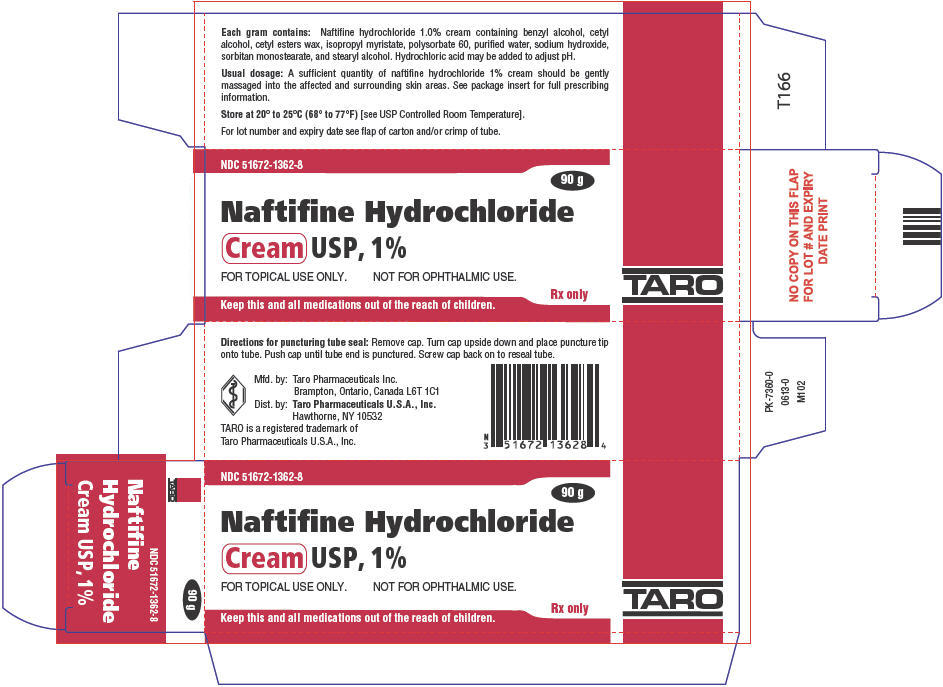
PRINCIPAL DISPLAY PANEL - 90 g Tube Carton NDC 51672-1362-8 90 g Naftifine Hydrochloride Cream USP, 1% FOR TOPICAL USE ONLY. NOT FOR OPHTHALMIC USE. Rx only TARO Keep this and all medications out of the reach of children. Principal Display Panel - 90 g Tube Carton
Medicaid utilization by pack size
Reported adverse events (FAERS)
Top reported reactions
Age at onset
Reporter sex
Serious outcomes
Where does this data come from?
About this NDC listing & data coverage
What data is (and isn’t) available for this NDC — tap to expand
| NDC identity (package / product / labeler codes) | ✓ Available |
| Labeler | ✓ Available |
| Product & package description | ✓ Available |
| Marketing category & status | ✓ Available |
| Active ingredient / dosage form / route | ✓ Available |
| FDA label (SPL via DailyMed) | ✓ Available |
| Package photos | ✓ Available |
| Inactive ingredients (structured) | — Not published for this NDC The labeler did not submit a structured excipient list, or no SPL is available. |
| NADAC pharmacy acquisition price (CMS) | — Not published for this NDC CMS publishes NADAC only for NDCs reported in its retail-pharmacy survey. |
| Orange Book / therapeutic-equivalence data | — Not published for this NDC Applies only to products approved under an NDA/ANDA; many listings are out of scope. |
| HCPCS J-code billing crosswalk | — Not published for this NDC Most self-administered / retail products have no J-code — that is normal. |
| Medicaid utilization (CMS SDUD) | — Not published for this NDC CMS reports utilization only for NDCs with Medicaid claims above its privacy threshold. |