
Naftifine Hydrochloride 20 mg/g Cream
🆔 Identity & classification
Where does this data come from?
🏷️ RxNorm drug class
This medicine belongs to the Allylamine Antifungal class.
Where does this data come from?
🏭 Manufacturer & labeler
Where does this data come from?
🩺 Clinical
Naftifine is used for skin infections such as athlete's foot, jock itch, and ringworm. This medication is sometimes prescribed for other uses; ask your doctor or pharmacist for more information.
Read the full MedlinePlus article ↗- Naftifine is an antifungal medicine applied to the skin to treat common fungal infections. The gel form (2%) is specifically approved for athlete's foot between the toes — that itc...
- What exactly is naftifine used to treat?
- Apply a thin layer once a day to the infected area plus a small border — about a half-inch — of the healthy skin around it. Treatment generally lasts 2 weeks. It's important to fin...
- How do I apply it, and how long do I need to use it?
Patient education
Supplement & herbal interactions
Where does this data come from?
Ask a licensed pharmacist directly — free, answered by our team.
💊 What it looks like
Where does this data come from?
🧪 Inactive Ingredients / Excipients
Inactive ingredients, also called excipients, are components of the drug product other than the active ingredient. They may include fillers, dyes, coatings, preservatives, flavors, or other formulation ingredients.
💡 Tap an ingredient (hover on desktop) to see what it is and why it’s used.
-
UNII LKG8494WBH
Benzyl alcohol is a clear liquid used as a preservative and solvent in medicines. It helps prevent bacterial and fungal growth and dissolves other ingredients to create uniform liquid formulations.
-
UNII 936JST6JCN
Cetyl alcohol is a waxy, fatty substance derived from plant or animal sources. It acts as an emulsifier and thickener in medicines, helping blend oil and water components and giving products a smooth, creamy texture.
-
UNII D072FFP9GU
Cetyl esters wax is a waxy substance made from natural or synthetic fatty acids. It's used as a binder, hardening agent, and coating material to give tablets and capsules their structure and texture.
-
UNII QTT17582CB
A strong acid used to adjust and maintain the proper pH level in liquid medicines, ensuring stability and preventing breakdown of active ingredients.
-
UNII 0RE8K4LNJS
Isopropyl myristate is an oily liquid made from coconut or palm oil. It's used in medicines as an emollient and penetration enhancer to help the medicine absorb through skin or improve spreadability in topical products.
-
UNII CAL22UVI4M
A synthetic emulsifier derived from sorbitol and fatty acids. It helps mix oil and water-based ingredients together and improves the texture and stability of the medicine.
-
UNII 55X04QC32I
A strong alkaline chemical used to adjust and maintain the pH balance of liquid medicines. It helps keep the medicine stable and ensures it stays effective during storage.
-
UNII NVZ4I0H58X
A waxy substance made from sorbitol and stearic acid. It acts as an emulsifier and stabilizer, helping keep oil and water mixed together and preventing separation in the medicine.
-
UNII 2KR89I4H1Y
Stearyl alcohol is a waxy, fatty substance derived from natural oils or made synthetically. It acts as an emulsifier and thickener in medicines, helping mix ingredients together and give the product the right texture.
-
UNII 059QF0KO0R
Water is a liquid solvent that dissolves and mixes ingredients together in liquid medicines, syrups, and injections. It helps distribute the active drug evenly throughout the product.
10 inactive ingredients listed in the exact product block matched to this NDC.
Where does this data come from?
ingredient classCode="IACT" elements from the exact product block matched by this NDC. Label-section narrative from DailyMed / the openFDA label index is shown separately when available.Inactive ingredient FAQ
Are inactive ingredients the same for every manufacturer?
Why might an inactive ingredient be missing?
Can inactive ingredients matter?
💲 Pricing
A drug doesn't have one price. Each row is a different public payment system, and none is what you'd pay at the counter — that depends on your insurance. The ⓘ on each row explains what it measures.
| Price system | Per g | Per package |
|---|---|---|
| Retail pharmacies payNADAC · weekly | Not in the retail survey — common for institutional, discontinued, or low-volume packs. | |
| Medicaid paysCMS SDUD · 12 mo | No recent Medicaid claims on file for this NDC — rare and low-volume NDCs are suppressed in the public data. | |
| Medicare drug plans payPart D · Q2 2026 | $3.53 | $106.03 / 30 g |
Where does this data come from?
🔁 Therapeutic equivalents
| Product | Labeler | Pack | NADAC/unit | TE | Status | Price vs. this |
|---|---|---|---|---|---|---|
| Naftifine Hydrochloride 20 mg/g 51672-1376-03 | Sun | 1 tube | $8.565 | AB | Availability likely | — |
| Naftifine Hydrochloride 20 mg/gthis 51672-1368-02 | Sun | 1 tube | — | AB | FDA listed | — |
Where does this data come from?
⏳ Availability & generic status
This product is an FDA-approved generic. Other versions of the same drug are listed under Therapeutic equivalents, least expensive first.
Where does this data come from?
💊 Medicaid utilization by pack size
📦 Packaging — all sizes for this product
| Package NDC | Description | Per unit | Per pack | Marketing start | Status |
|---|---|---|---|---|---|
| 51672-1368-02 You're viewing this | 1 TUBE in 1 CARTON (51672-1368-2) / 30 g in 1 TUBE | — | — | 2016-01-06 | Active |
| 51672-1368-03 | 1 TUBE in 1 CARTON (51672-1368-3) / 60 g in 1 TUBE | $2.26 / g | $135.40 | 2016-01-06 | Active |
| 51672-1368-06 | 1 TUBE in 1 CARTON (51672-1368-6) / 45 g in 1 TUBE | $1.89 / g | $84.99 | 2016-01-06 | Active |
This pack shows little to no recent Medicaid volume — a different pack size carries most fills. See all packs ↓
Pack size FAQ
What quantity is in NDC 51672-1368-02?
What NDC number is used to bill for this package of Naftifine Hydrochloride 20 mg/g Cream?
Prices are the latest CMS NADAC pharmacy acquisition cost per NDC; per-pack figures are per-unit × pack quantity, shown only when the pack is denominated in the same measure NADAC prices.
🧭 About this NDC listing & data coverage
What data is (and isn’t) available for this NDC — tap to expand
| NDC identity (package / product / labeler codes) | ✓ Available |
| Labeler | ✓ Available |
| Product & package description | ✓ Available |
| Marketing category & status | ✓ Available |
| Active ingredient / dosage form / route | ✓ Available |
| FDA label (SPL via DailyMed) | ✓ Available |
| Package photos | ✓ Available |
| Inactive ingredients (structured) | ✓ Available |
| NADAC pharmacy acquisition price (CMS) | — Not published for this NDC CMS publishes NADAC only for NDCs reported in its retail-pharmacy survey. |
| Orange Book / therapeutic-equivalence data | ✓ Available |
| HCPCS J-code billing crosswalk | — Not published for this NDC Most self-administered / retail products have no J-code — that is normal. |
| Medicaid utilization (CMS SDUD) | — Not published for this NDC CMS reports utilization only for NDCs with Medicaid claims above its privacy threshold. |
Questions about this listing
Why is there no price listed?
Is the NDC printed on the package the same as the 11-digit billing NDC?
What do the three segments of this NDC mean?
Is this package still being marketed?
Does this product come in other package sizes?
Who lists this product with the FDA?
Do I need a prescription for this product?
Where does this data come from?
📄 Full prescribing information FDA SPL
🎯 Indications and Usage ▾
1 INDICATIONS AND USAGE Naftifine Hydrochloride Cream is indicated for the treatment of interdigital tinea pedis, tinea cruris, and tinea corporis caused by the organism Trichophyton rubrum . Naftifine Hydrochloride Cream is an allylamine antifungal indicated for the treatment of interdigital tinea pedis, tinea cruris, and tinea corporis caused by the organism Trichophyton rubrum .
⏱️ Dosage and Administration ▾
2 DOSAGE AND ADMINISTRATION For topical use only. Naftifine Hydrochloride Cream is not for ophthalmic, oral, or intravaginal use. Apply a thin layer of Naftifine Hydrochloride Cream once-daily to the affected areas plus a ½ inch margin of healthy surrounding skin for 2 weeks.
For topical use only. Naftifine Hydrochloride Cream is not for ophthalmic, oral, or intravaginal use. ( 2 ) Apply a thin layer of Naftifine Hydrochloride Cream once-daily to the affected areas plus a ½ inch margin of healthy surrounding skin for 2 weeks.
( 2 )
💊 Dosage Forms and Strengths ▾
3 DOSAGE FORMS AND STRENGTHS Each gram of Naftifine Hydrochloride Cream contains 20 mg of naftifine hydrochloride (2%) in a white to off-white base. Cream: 2%
⛔ Contraindications ▾
4 CONTRAINDICATIONS None None
⚠️ Warnings and Cautions ▾
5 WARNINGS AND PRECAUTIONS Discontinue treatment if redness or irritation develops with Naftifine Hydrochloride Cream use. ( 5.1 )
5.1Local Adverse Reactions Discontinue treatment if irritation or sensitivity develops with the use of Naftifine Hydrochloride Cream. Direct patients to contact their physician if these conditions develop following use of Naftifine Hydrochloride Cream.
🤒 Adverse Reactions ▾
6 ADVERSE REACTIONS The most common adverse reaction (≥1%) is pruritus. ( 6.1 ) To report SUSPECTED ADVERSE REACTIONS, contact Sun Pharmaceutical Industries, Inc., at 1-866-923-4914 or FDA at 1-800-FDA-1088 or www.fda.gov/medwatch.
6.1Clinical Trials Experience Because clinical trials are conducted under widely varying conditions, adverse reaction rates observed in the clinical trials of a drug cannot be directly compared to rates in the clinical trials of another drug and may not reflect the rates observed in clinical practice. During clinical trials, 903 subjects were exposed to naftifine 1% and 2% cream formulations. A total of 564 subjects with interdigital tinea pedis, tinea cruris, or tinea corporis were treated with Naftifine Hydrochloride Cream.
In two randomized, vehicle-controlled trials (400 subjects were treated with Naftifine Hydrochloride Cream). The population was 12 to 88 years old, primarily male (79%), 48% Caucasian, 36% Black or African American, 40% Hispanic or Latino and had either predominantly interdigital tinea pedis or tinea cruris. Most subjects received doses once-daily, topically, for 2 weeks to cover the affected skin areas plus a ½ inch margin of surrounding healthy skin.
In the two vehicle-controlled trials, 17.5% of Naftifine Hydrochloride Cream treated subjects experienced an adverse reaction compared with 19.3% of vehicle subjects. The most common adverse reaction (≥1%) is pruritus. Most adverse reactions were mild in severity.
The incidence of adverse reactions in the Naftifine Hydrochloride Cream treated population was not significantly different than in the vehicle treated population. In a third randomized, vehicle-controlled trial, 116 pediatric subjects with tinea corporis were treated with Naftifine Hydrochloride Cream. The population was aged ≥2 to <18 years (mean age of 9 years), predominately male (61%), 47% White, 51% Black or African American, 92% Hispanic or Latino, and infected with tinea corporis.
Naftifine Hydrochloride Cream was topically applied once daily for 2 weeks to all affected body surface areas with tinea corporis plus a ½ inch margin of healthy skin surrounding the affected lesions. The incidence of adverse reactions in the Naftifine Hydrochloride Cream treated population was not significantly different than in the vehicle treated population. In two open-label pediatric pharmacokinetics and safety trials, 49 pediatric subjects 2 to <18 years of age with interdigital tinea pedis, tinea cruris, and tinea corporis received Naftifine Hydrochloride Cream.
The incidence of adverse reactions in the pediatric population was similar to that observed in the adult population.
6.2Postmarketing Experience The following adverse reactions have been identified during post-approval use of naftifine hydrochloride: redness/irritation, inflammation, maceration, swelling, burning, blisters, serous drainage, crusting, headache, dizziness, leukopenia, agranulocytosis. Because these reactions are reported voluntarily from a population of uncertain size, it is not always possible to reliably estimate their frequency or establish a causal relationship to drug exposure.
👥 Use in Specific Populations ▾
8 USE IN SPECIFIC POPULATIONS
8.1Pregnancy Risk Summary There are no available data with Naftifine Hydrochloride Cream in pregnant women to inform the drug-associated risk for major birth defects and miscarriage. In animal reproduction studies, no adverse effects on embryofetal development were seen at oral doses administered during the period of organogenesis up to 18 times the maximum recommended human dose (MRHD) in pregnant rats or subcutaneous doses administered during the period of organogenesis up to 2 times the MRHD in pregnant rats or 4 times the MRHD in pregnant rabbits [see Data ] .
The estimated background risk of major birth defects and miscarriage for the indicated population is unknown. All pregnancies have a background risk of birth defect, loss, or other adverse outcomes. In the U.S. general population, the estimated background risk of major birth defects and miscarriage in clinically recognized pregnancies is 2 to 4% and 15 to 20%, respectively.
Data Animal Data Systemic embryofetal development studies were conducted in rats and rabbits. For the comparison of animal to human doses based on body surface area comparison (mg/m 2 ), the MRHD is set at 8 g 2% cream per day (2.67 mg/kg/day for a 60 kg individual). Oral doses of 30 mg/kg/day, 100 mg/kg/day and 300 mg/kg/day naftifine hydrochloride were administered during the period of organogenesis to pregnant female rats.
No treatment-related effects on embryofetal development were noted at doses up to 300 mg/kg/day (18 times MRHD). Subcutaneous doses of 10 mg/kg/day and 30 mg/kg/day naftifine hydrochloride were administered during the period of organogenesis to pregnant female rats. No treatment-related effects on embryofetal development were noted at 30 mg/kg/day (2 times MRHD).
Subcutaneous doses of 3 mg/kg/day, 10 mg/kg/day and 30 mg/kg/day naftifine hydrochloride were administered during the period of organogenesis to pregnant female rabbits. No treatment-related effects on embryofetal development were noted at 30 mg/kg/day (4 times MRHD). A peri- and post-natal development study was conducted in rats.
Oral doses of 30 mg/kg/day, 100 mg/kg/day and 300 mg/kg/day naftifine hydrochloride were administered to female rats from gestational day 14 to lactation day 21. Reduced body weight gain of females during gestation and of the offspring during lactation was noted at 300 mg/kg/day (18 times MRHD). No developmental toxicity was noted at 100 mg/kg/day (6 times MRHD).
8.2Lactation Risk Summary There is no information available on the presence of Naftifine Hydrochloride Cream in human milk, the effects of the drug on the breastfed infant, or the effects of the drug on milk production. The lack of clinical data during lactation precludes a clear determination of the risk of Naftifine Hydrochloride Cream to an infant during lactation; therefore, the development and health benefits of breastfeeding should be considered along with the mother's clinical need for Naftifine Hydrochloride Cream and any potential adverse effects on the breastfed infant from Naftifine Hydrochloride Cream or from the underlying maternal condition.
8.4Pediatric Use The safety and effectiveness of Naftifine Hydrochloride Cream have been established in pediatric patients age 12 and above with interdigital tinea pedis and tinea cruris and age 2 and above with tinea corporis [see Clinical Studies (14) and Clinical Pharmacology (12.3) ] . Use of Naftifine Hydrochloride Cream in these age groups is supported by evidence from adequate and well controlled studies in adults and children, with additional safety and PK data from two open label trials conducted in 49 pediatric subjects exposed to Naftifine Hydrochloride Cream [see Clinical Studies (14) and Clinical Pharmacology (12.3) ] .
Safety and effectiveness of Naftifine Hydrochloride Cream in the treatment of tinea cruris and interdigital tinea pedis in pediatric patients less than 12 years of age have not been established. Safety and effectiveness…
🤰 Pregnancy ▾
8.1Pregnancy Risk Summary There are no available data with Naftifine Hydrochloride Cream in pregnant women to inform the drug-associated risk for major birth defects and miscarriage. In animal reproduction studies, no adverse effects on embryofetal development were seen at oral doses administered during the period of organogenesis up to 18 times the maximum recommended human dose (MRHD) in pregnant rats or subcutaneous doses administered during the period of organogenesis up to 2 times the MRHD in pregnant rats or 4 times the MRHD in pregnant rabbits [see Data ] .
The estimated background risk of major birth defects and miscarriage for the indicated population is unknown. All pregnancies have a background risk of birth defect, loss, or other adverse outcomes. In the U.S. general population, the estimated background risk of major birth defects and miscarriage in clinically recognized pregnancies is 2 to 4% and 15 to 20%, respectively.
Data Animal Data Systemic embryofetal development studies were conducted in rats and rabbits. For the comparison of animal to human doses based on body surface area comparison (mg/m 2 ), the MRHD is set at 8 g 2% cream per day (2.67 mg/kg/day for a 60 kg individual). Oral doses of 30 mg/kg/day, 100 mg/kg/day and 300 mg/kg/day naftifine hydrochloride were administered during the period of organogenesis to pregnant female rats.
No treatment-related effects on embryofetal development were noted at doses up to 300 mg/kg/day (18 times MRHD). Subcutaneous doses of 10 mg/kg/day and 30 mg/kg/day naftifine hydrochloride were administered during the period of organogenesis to pregnant female rats. No treatment-related effects on embryofetal development were noted at 30 mg/kg/day (2 times MRHD).
Subcutaneous doses of 3 mg/kg/day, 10 mg/kg/day and 30 mg/kg/day naftifine hydrochloride were administered during the period of organogenesis to pregnant female rabbits. No treatment-related effects on embryofetal development were noted at 30 mg/kg/day (4 times MRHD). A peri- and post-natal development study was conducted in rats.
Oral doses of 30 mg/kg/day, 100 mg/kg/day and 300 mg/kg/day naftifine hydrochloride were administered to female rats from gestational day 14 to lactation day 21. Reduced body weight gain of females during gestation and of the offspring during lactation was noted at 300 mg/kg/day (18 times MRHD). No developmental toxicity was noted at 100 mg/kg/day (6 times MRHD).
🧒 Pediatric Use ▾
8.4Pediatric Use The safety and effectiveness of Naftifine Hydrochloride Cream have been established in pediatric patients age 12 and above with interdigital tinea pedis and tinea cruris and age 2 and above with tinea corporis [see Clinical Studies (14) and Clinical Pharmacology (12.3) ] . Use of Naftifine Hydrochloride Cream in these age groups is supported by evidence from adequate and well controlled studies in adults and children, with additional safety and PK data from two open label trials conducted in 49 pediatric subjects exposed to Naftifine Hydrochloride Cream [see Clinical Studies (14) and Clinical Pharmacology (12.3) ] .
Safety and effectiveness of Naftifine Hydrochloride Cream in the treatment of tinea cruris and interdigital tinea pedis in pediatric patients less than 12 years of age have not been established. Safety and effectiveness of Naftifine Hydrochloride Cream in the treatment of tinea corporis in pediatric patients less than 2 years of age have not been established.
🧓 Geriatric Use ▾
8.5Geriatric Use Clinical studies of Naftifine Hydrochloride Cream did not include sufficient numbers of subjects aged 65 and over to determine whether they respond differently from younger subjects.
🧬 Clinical Pharmacology ▾
12 CLINICAL PHARMACOLOGY
12.1Mechanism of Action Naftifine Hydrochloride Cream is a topical antifungal drug [see Clinical Pharmacology (12.4) ]
12.2Pharmacodynamics The pharmacodynamics of Naftifine Hydrochloride Cream have not been established.
12.3Pharmacokinetics In vitro and in vivo bioavailability studies have demonstrated that naftifine penetrates the stratum corneum in sufficient concentration to inhibit the growth of dermatophytes. The pharmacokinetics of Naftifine Hydrochloride Cream was evaluated following once-daily topical application for 2 weeks to 21 adult subjects, both males and females, with both tinea pedis and tinea cruris. The median total amount of cream applied was 6.4 g (range 5.3 to 7.5 g) per day.
The results showed that the systemic exposure (i.e., maximum concentration (C max ) and area under the curve from time 0 to 24 hours (AUC 0-24 )) to naftifine increased over the 2 week treatment period in all the 21 subjects. Geometric mean (coefficient of variation or CV%) AUC 0-24 was 117 (41.2) ng*hr/mL on Day 1, and 204 (28.5) ng*hr/mL on Day 14. Geometric mean (CV%) C max was 7 ng/mL (55.6) on Day 1 and 11 ng/mL (29.3) on Day 14.
Median time to C max (T max ) was 8 hours (range: 4 to 24 hours) on Day 1 and 6 hours (range: 0 to 16 hours) on Day 14. Accumulation after 14 days of topical application was less than two fold. Trough concentrations generally increased throughout the 14 day study period.
Naftifine continued to be detected in plasma in 13/21 (62%) subjects on Day 28, the mean (standard deviation or SD) plasma concentrations were 1.6 ± 0.5 ng/mL (range below limit of quantitation (BLQ) to 3 ng/mL). In the same pharmacokinetic trial conducted in patients with tinea pedis and tinea cruris, median fraction of the dose excreted in urine during the treatment period was 0.0016% on Day 1 versus 0.0020% on Day 14. In a second trial that enrolled 22 subjects, the pharmacokinetics of Naftifine Hydrochloride Cream was evaluated in 20 pediatric subjects 13 to <18 years of age with both tinea pedis and tinea cruris.
Subjects were treated with a median dose of 8.1 g (range 6.6 to 10.1 g) applied to the affected areas once daily for 2 weeks. The results showed that the systemic exposure increased over the treatment period. Geometric mean (CV%) AUC 0-24 was 138 (50.2) ng*hr/mL on Day 1, and 192 (74.9) ng*hr/mL on Day 14.
Geometric mean (CV%) C max was 9.21 ng/mL (48.4) on Day 1 and 12.7 ng/mL (67.2) on Day 14. Median fraction of the dose excreted in urine during the treatment period was 0.0030% on Day 1 and 0.0033% on Day 14. A third trial evaluated the pharmacokinetics of Naftifine Hydrochloride Cream in 27 pediatric subjects 2 to < 12 years of age with at least moderate tinea corporis.
Subjects were divided into younger (ages 2 to < 6 years, 17 subjects) and older (6 to <12 years, 10 subjects) groups. Median doses of 1.3 g (range 1 to 3.1 g) and 2.3 g (range 2.2 to 4.2 g) were applied once-daily for 2 weeks in the younger and older groups, respectively, to the affected area plus a ½ inch margin. Plasma and urine pharmacokinetic assessments were conducted on Day 1 in the older group only and on Day 14 in both groups.
All subjects showed measurable levels of naftifine in plasma after topical application of Naftifine Hydrochloride Cream. Following a single dose on Day 1 in subjects 6 to < 12 years of age, the geometric mean (CV%) values of C max and AUC 0-24 were 3.60 (76.6) ng/mL and 49.8 (64.4) ng*h/mL, respectively. On Day 14 in this group, the C max and AUC 0-24 were 3.31 (51.2) ng/mL and 52.4 (49.2) ng*h/mL, respectively.
In subjects 2 to < 6 years of age on Day 14, the C max and AUC 0-24 were 3.98 (186) ng/mL and 54.8 (150) ng*h/mL, respectively. In the older group of subjects 6 to 12 years of age, the systemic exposures (both C max and AUC 0-24 ) on Days 1 and 14 were comparable. The median fraction of the dose excreted into urine over 24 hours following drug applications on Day 1 and Day 14 was 0.0029%…
🧬 Mechanism of Action ▾
12.1Mechanism of Action Naftifine Hydrochloride Cream is a topical antifungal drug [see Clinical Pharmacology (12.4) ]
📦 How Supplied / Storage and Handling ▾
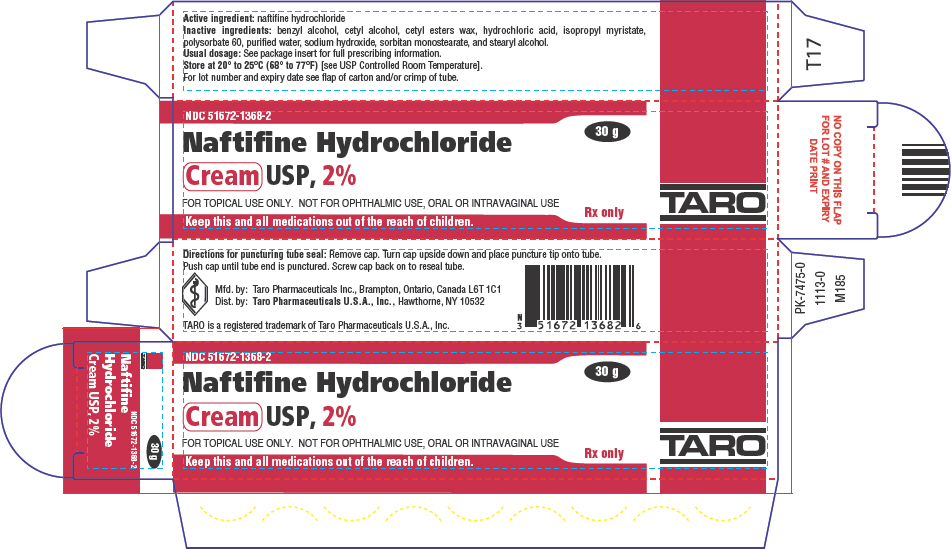
16 HOW SUPPLIED/STORAGE AND HANDLING How Supplied Naftifine Hydrochloride Cream USP, 2% is a white to off-white cream supplied in tubes in the following sizes: 30 g – NDC 51672-1368-2 45 g – NDC 51672-1368-6 60 g – NDC 51672-1368-3 Storage: Store Naftifine Hydrochloride Cream USP, 2% at 20° to 25°C (68 ° to 77°F) [see USP Controlled Room Temperature].
📦 Storage and Handling ▾
Storage: Store Naftifine Hydrochloride Cream USP, 2% at 20° to 25°C (68 ° to 77°F) [see USP Controlled Room Temperature].
📋 Description ▾
11 DESCRIPTION Naftifine Hydrochloride Cream is a white to off-white cream for topical use only. Each gram of Naftifine Hydrochloride Cream contains 20 mg of naftifine hydrochloride (2%), a synthetic allylamine antifungal compound. Chemically, naftifine HCl is (E)-N-Cinnamyl-N-methyl-1-napthalenemethylamine hydrochloride.
The molecular formula is C 21 H 21 N∙HCl with a molecular weight of 323.86. The structural formula of naftifine hydrochloride is: Naftifine Hydrochloride Cream contains the following inactive ingredients: benzyl alcohol, cetyl alcohol, cetyl esters wax, hydrochloric acid, isopropyl myristate, polysorbate 60, purified water, sodium hydroxide, sorbitan monostearate, and stearyl alcohol. Chemical Structure
💬 Information for Patients ▾
17 PATIENT COUNSELING INFORMATION Inform patients that Naftifine Hydrochloride Cream is for topical use only. Naftifine Hydrochloride Cream is not intended for oral, intravaginal or ophthalmic use. If irritation or sensitivity develops with the use of Naftifine Hydrochloride Cream treatment should be discontinued and appropriate therapy instituted.
Patients should be directed to contact their physician if these conditions develop following use of Naftifine Hydrochloride Cream.