
Adapalene 3 mg/g Gel — NDC 51672-1377-6 (Billing 51672-1377-06)
This is a package of Adapalene 3 mg/g Gel from Sun Pharmaceutical Industries, Inc., marketed since Jun 2016 and currently FDA-listed; retail pharmacies pay about $0.5038 per g (NADAC). It is the main listing for this product, which comes in 2 package sizes.
Identity & classification
Regulatory identifiers FDA, NLM and CMS codes for this package
Drug-database identifiers Medi-Span GPI and First Databank GCN / HICL / AHFS classification
- GSN (GCN sequence number): 062811
- GCN: 98582
- GPI-14 (Medi-Span): 90050003004030
- HICL (First Databank): 011233
- AHFS class code: 84:28.00.00
- RxCUI (RxNorm): 722111
Where does this data come from?
- FDA openFDA NDC Directory · synced Oct 1, 2026
- FDA label on DailyMed · label index refreshed Oct 1, 2026
- RxNorm (NLM RxNav) · catalog refreshed Oct 1, 2026
- Medi-Span GPI (licensed)
- First Databank (licensed) · refreshed Oct 1, 2026
RxNorm drug class
This medicine belongs to the Retinoid class.
Where does this data come from?
- RxClass (NLM) · catalog refreshed Oct 1, 2026
Clinical
Adapalene is used to treat acne in adults and children 12 years of and older. Adapalene is in a class of medications called retinoid-like compounds. It works by stopping pimples from forming under the surface of the skin.
Read the full MedlinePlus article ↗- It treats acne vulgaris, the common type of acne. Some products are labeled for ages 12 and up. Ask a doctor before using it in younger children.
- Use it once a day, usually in the evening, on clean, dry skin. Apply a thin layer to the whole affected area and keep it away from your eyes, lips and inside of your mouth or nose....
- Give it about 8 to 12 weeks. Acne can seem to flare in the early weeks, which is not a reason to stop. If you see no improvement after 12 weeks, talk to your prescriber.
- Redness, dryness, peeling and some burning or stinging are the most common, especially in the first month. They are usually mild to moderate and often ease. A moisturizer can help....
Patient education
Supplement & herbal interactions
Where does this data come from?
- MedlinePlus (NLM) · refreshed Oct 1, 2026
- FDA label on DailyMed · label index refreshed Oct 1, 2026
Ask a licensed pharmacist directly — free, answered by our team.
Pricing
A drug doesn't have one price. Each row is a different public payment system, and none is what you'd pay at the counter — that depends on your insurance. The ⓘ on each row explains what it measures.
| Price system | Per g | Per package |
|---|---|---|
| Retail pharmacies payNADAC · weekly | $0.504 | $22.67 / 45 g |
| Medicaid paysCMS SDUD · 12 mo | $0.7844 | $35.30 / 45 g |
| Medicare drug plans payPart D · Q2 2026 | $0.9380 | $42.21 / 45 g |
Where does this data come from?
- CMS NADAC weekly file · file of Sep 30, 2026
- CMS ASP pricing files · refreshed Sep 20, 2026
- CMS Medicaid State Drug Utilization Data · through Q1 2026
- CMS Part D plan pricing files · refreshed Sep 24, 2026
- VA National Acquisition Center price file
Packaging — all sizes for this product
| Package NDC | Description | Per unit | Per pack | Marketing start | Marketing end | Status |
|---|---|---|---|---|---|---|
| 51672-1377-06 You're viewing this Main listing | 1 TUBE in 1 CARTON / 45 g in 1 TUBE | $0.5038 / g | $22.67 | 2016-06-23 | — | Active |
| 51672-1377-09 51672-1377-9 | 1 BOTTLE, PUMP in 1 CARTON / 45 g in 1 BOTTLE, PUMP | $0.7822 / g | $35.20 | 2016-06-23 | — | Discontinued by firm |
This pack has the lowest per-g cost of the 2 priced pack sizes ($0.5038 NADAC).
In Medicaid, this is the most-dispensed pack of this product — about 100% of fills over the last four reported quarters. See all packs ↓
Pack size FAQ
What quantity is in this package?
What NDC number is used to bill for this package of Adapalene 3 mg/g Gel?
Prices are the latest CMS NADAC pharmacy acquisition cost per NDC; per-pack figures are per-unit × pack quantity, shown only when the pack is denominated in the same measure NADAC prices.
Therapeutic equivalents
| Product | Labeler | Pack | NADAC/unit | TE | Status | Price vs. this |
|---|---|---|---|---|---|---|
| adapalene 3 mg/g 00472-0126-45 | Actavis | 1 tube | $0.504 | AB | Availability likely | — |
| Adapalene Gel USP, 0.3% 3 mg/g 21922-0051-06 | Encube | 1 tube | $0.504 | AB | Availability likely | — |
| Adapalene 3 mg/gthis 51672-1377-06 | Sun | 1 tube | $0.504 | AB | Availability likely | — |
| Adapalene 3 mg/g 68308-0666-25 | Mayne | 1 tube | $0.504 | AB | Availability likely | — |
| Differin 3 mg/g 00299-5918-02 | Galderma | 2 g | — | AB | Discontinued | — |
| Adapalene 3 mg/g 46708-0549-15 | Alembic | 1 tube | — | AB | FDA listed | — |
| Adapalene 3 mg/g 62332-0549-15 | Alembic | 1 tube | — | AB | FDA listed | — |
| Adapalene Gel USP, 0.3% 3 mg/g 72162-2295-02 | Bryant | 1 tube | — | AB | FDA listed | — |
Where does this data come from?
- FDA openFDA NDC Directory · synced Oct 1, 2026
- FDA Orange Book · refreshed Sep 3, 2026
- CMS NADAC weekly file · file of Sep 30, 2026
Availability & generic status
This product is an FDA-approved generic. Other versions of the same drug are listed under Therapeutic equivalents, least expensive first.
Where does this data come from?
- FDA Orange Book · refreshed Sep 3, 2026
What it looks like
Where does this data come from?
- FDA label on DailyMed · label index refreshed Oct 1, 2026
Inactive Ingredients / Excipients
Inactive ingredients, also called excipients, are components of the drug product other than the active ingredient. They may include fillers, dyes, coatings, preservatives, flavors, or other formulation ingredients.
💡 Tap an ingredient (hover on desktop) to see what it is and why it’s used.
-
UNII 4Q93RCW27E
A synthetic polymer made from acrylic acid that's crosslinked for stability. It acts as a thickener and gelling agent in creams and gels, helping the medicine spread evenly and maintain its texture.
-
UNII 7FLD91C86K
Edetate disodium is a chemical compound that binds and removes certain metal ions. In medicines, it acts as a preservative and stabilizer by preventing metals like calcium from interfering with the product's shelf life and consistency.
-
UNII A2I8C7HI9T
Methylparaben is a preservative derived from benzoic acid that prevents growth of bacteria, fungi, and mold in medicines. It extends the product's shelf life and maintains safety during storage.
-
UNII JX0HIX6OAG
Poloxamer 182 is a synthetic polymer made from ethylene oxide and propylene oxide. It acts as a solubilizer and emulsifier, helping mix water and oil-based ingredients together in liquid medications.
-
UNII 6DC9Q167V3
Propylene glycol is a clear liquid derived from petroleum or vegetable sources. It acts as a solvent, humectant, and preservative in medicines, helping dissolve active ingredients and maintain product stability.
-
UNII 55X04QC32I
A strong alkaline chemical used to adjust and maintain the pH balance of liquid medicines. It helps keep the medicine stable and ensures it stays effective during storage.
-
UNII 059QF0KO0R
Water is a liquid solvent that dissolves and mixes ingredients together in liquid medicines, syrups, and injections. It helps distribute the active drug evenly throughout the product.
7 inactive ingredients listed in the exact product block matched to this NDC.
Where does this data come from?
ingredient classCode="IACT" elements from the exact product block matched by this NDC. Label-section narrative from DailyMed / the openFDA label index is shown separately when available.- FDA label on DailyMed · label index refreshed Oct 1, 2026
- FDA openFDA NDC Directory · synced Oct 1, 2026
Inactive ingredient FAQ
Are inactive ingredients the same for every manufacturer?
Why might an inactive ingredient be missing?
Can inactive ingredients matter?
Manufacturer & labeler
Where does this data come from?
- FDA openFDA NDC Directory · synced Oct 1, 2026
- Drugs@FDA
Full prescribing information FDA SPL
🎯 Indications and Usage ▾
1 INDICATIONS AND USAGE Adapalene Gel, 0.3% is indicated for the topical treatment of acne vulgaris in patients 12 years of age and older. Adapalene Gel, 0.3%, is a retinoid, indicated for the topical treatment of acne vulgaris in patients 12 years of age and older. ( 1 )
⏱️ Dosage and Administration ▾
2 DOSAGE AND ADMINISTRATION Wash affected areas gently with a non-medicated soap. Apply a thin film of Adapalene Gel, 0.3% to the entire face and any other affected areas of the skin once daily in the evening. Avoid application to the areas of skin around eyes, lips, and mucous membranes.
A mild transitory sensation of warmth or slight stinging may occur shortly after the application of Adapalene Gel, 0.3%. Instruct patients to minimize sun exposure and to use moisturizers for relief of dry skin or irritation. If therapeutic results are not noticed after 12 weeks of treatment, therapy should be re-evaluated.
For topical use only. Not for ophthalmic, oral or intravaginal use. Wash affected areas gently with a non-medicated soap.
( 2 ) Apply a thin film of Adapalene Gel, 0.3% to the entire face and other affected areas of the skin once daily in the evening. ( 2 ) For topical use only. Not for ophthalmic, oral or intravaginal use.
( 2 )
💊 Dosage Forms and Strengths ▾
3 DOSAGE FORMS AND STRENGTHS Each gram of Adapalene Gel, 0.3% contains 3 mg adapalene in an off-white aqueous gel. Gel, 0.3% ( 3 )
⛔ Contraindications ▾
4 CONTRAINDICATIONS Adapalene Gel, 0.3% is contraindicated in patients who have known hypersensitivity to adapalene or any excipient of Adapalene Gel, 0.3% [see WARNINGS AND PRECAUTIONS (5.1) ] . Contraindicated in patients who have known hypersensitivity to adapalene or any excipient of Adapalene Gel, 0.3%. ( 4 )
⚠️ Warnings and Cautions ▾
5 WARNINGS AND PRECAUTIONS Allergic/Hypersensitivity Reactions: Allergy/ hypersensitivity reactions include anaphylaxis, angioedema, face edema, eyelid edema, lip swelling, and pruritis. Discontinue Adapalene Gel, 0.3% in the event of an allergic/hypersensitivity reaction. ( 5.1 ) Ultraviolet Light and Environmental Exposure: Avoid exposure to sunlight and sunlamps.
Wear sunscreen when sun exposure cannot be avoided ( 5.2 ). Local Cutaneous Reactions: Erythema, scaling, dryness, and stinging/burning were reported with use of Adapalene Gel, 0.3%. Concomitant use of other potentially irritating topical products (medicated or abrasive soaps and cleansers, soaps and cosmetics that have a strong drying effect and products with high concentrations of alcohol, astringents, spices, or lime) should be approached with caution.
( 5.3 ).
5.1Allergic/ Hypersensitivity Reactions Adverse reactions including anaphylaxis angioedema, face edema, eyelid edema, lip swelling, and pruritus that sometimes required medical treatment have been reported during postmarketing use of adapalene. Advise a patient to stop using Adapalene Gel, 0.3% and seek medical attention if experiencing allergic or anaphylactoid/anaphylactic reactions during treatment.
5.2Ultraviolet Light and Environmental Exposure Exposure to sunlight, including sunlamps, should be minimized during use of Adapalene Gel, 0.3%. Patients who normally experience high levels of sun exposure, and those with inherent sensitivity to sun, should be warned to exercise caution. Use of sunscreen products and protective clothing over treated areas is recommended when exposure cannot be avoided.
Weather extremes, such as wind or cold, also may be irritating to patients under treatment with Adapalene Gel, 0.3%.
5.3Local Cutaneous Reactions Cutaneous signs and symptoms such as erythema, scaling, dryness, and stinging/burning were reported with use of Adapalene Gel, 0.3%. These were most likely to occur during the first four weeks of treatment, were mostly mild to moderate in intensity, and usually lessened with continued use of the medication. Depending upon the severity of these side effects, patients should be instructed to either use a moisturizer, reduce the frequency of application of Adapalene Gel, 0.3% or discontinue use.
Avoid application to cuts, abrasions, eczematous or sunburned skin. As with other retinoids, use of "waxing" as a depilatory method should be avoided on skin treated with adapalene. As adapalene gel has the potential to induce local irritation in some patients, concomitant use of other potentially irritating topical products (medicated or abrasive soaps and cleansers, soaps and cosmetics that have a strong drying effect and products with high concentrations of alcohol, astringents, spices, or lime) should be approached with caution.
🤒 Adverse Reactions ▾
6 ADVERSE REACTIONS The most frequently reported (≥ 1%) adverse reactions were erythema, scaling, dryness, and/or burning/stinging. ( 6.1 ) To report SUSPECTED ADVERSE REACTIONS, contact Taro Pharmaceuticals U.S.A., Inc. at 1-866-923-4914 or FDA at 1-800-FDA-1088 or www.fda.gov/medwatch.
6.1Clinical Trials Experience Because clinical trials are conducted under widely varying conditions, adverse reactions rates observed in the clinical trials of a drug cannot be directly compared to rates in the clinical trials of another drug and may not reflect the rates observed in practice. In the multi-center, controlled clinical trial, signs and symptoms of local cutaneous irritation were monitored in 258 acne subjects who used Adapalene Gel, 0.3% once daily for 12 weeks. Of the subjects who experienced cutaneous irritation (erythema, scaling, dryness, and/or burning/stinging), the majority of cases were mild to moderate in severity, occurred early in treatment and decreased thereafter.
The incidence of local cutaneous irritation with Adapalene Gel, 0.3% from the controlled clinical trial is provided in the following table: Table 1: Physician assessed local cutaneous irritation with Adapalene Gel, 0.3% Incidence of Local Cutaneous Irritation with Adapalene Gel, 0.3% (N = 253 Total number of subjects with local cutaneous data for at least one post-Baseline evaluation. ) Maximum Severity Scores Higher Than Baseline Mild Moderate Severe Erythema 66 (26.1%) 33 (13%) 1 (0.4%) Scaling 110 (43.5%) 47 (18.6%) 3 (1.2%) Dryness 113 (44.7%) 43 (17%) 2 (0.8%) Burning/Stinging 72 (28.5%) 36 (14.2%) 9 (3.6%) Table 2: Patient reported local cutaneous adverse reactions with Adapalene Gel, 0.3% Adapalene Gel, 0.3% Vehicle Gel N=258 N=134 Related Selected adverse reactions defined by investigator as Possibly, Probably or Definitely Related Adverse Reactions 57 (22.1%) 6 (4.5%) Dry Skin 36 (14%) 2 (1.5%) Skin Discomfort 15 (5.8%) 0 (0%) Desquamation 4 (1.6%) 0 (0%) The following adverse reactions occurred in less than 1% of subjects: acne flare, contact dermatitis, eyelid edema, conjunctivitis, erythema, pruritus, skin discoloration, rash, and eczema.
In a one-year, open-label safety trial of 551 subjects with acne who received Adapalene Gel, 0.3%, the pattern of adverse reactions was similar to the 12-week controlled study.
6.2Post-Marketing Experience The following adverse reactions have been identified during post approval use of adapalene: Immune system disorders: angioedema, face edema, lip swelling Skin disorders: application site pain Because these reactions are reported voluntarily from a population of uncertain size, it is not always possible to reliably estimate the frequency or establish a causal relationship to drug exposure.
👥 Use in Specific Populations ▾
8 USE IN SPECIFIC POPULATIONS
8.1Pregnancy Risk Summary Available data from clinical trials with Adapalene Gel, 0.3% use in pregnant women are insufficient to establish a drug-associated risk of major birth defects, miscarriage or other adverse maternal or fetal outcomes. In animal reproduction studies, oral administration of adapalene to pregnant rats and rabbits during organogenesis at dose exposures 40 and 81 times, respectively, the human exposure at the maximum recommended human dose (MRHD) of 2 g resulted in fetal skeletal and visceral malformations (see Data ) .
The background risk of major birth defects and miscarriage for the indicated population is unknown. All pregnancies have a background risk of birth defects, loss, or other adverse outcomes. In the U.S. general population the estimated background risk of major birth defects and miscarriage in clinically recognized pregnancies are 2 to 4% and 15 to 20%, respectively.
Data Animal Data No malformations were observed in rats treated with oral adapalene doses of 0.15 to 5 mg/kg/day, up to 8 times the MRHD based on a mg/m 2 comparison. However, malformations were observed in rats and rabbits when treated with oral doses of ≥ 25 mg/kg/day adapalene (40 and 81 times the MRHD, respectively, based on a mg/m 2 comparison). Findings included cleft palate, microphthalmia, encephalocele, and skeletal abnormalities in rats and umbilical hernia, exophthalmos, and kidney and skeletal abnormalities in rabbits.
Dermal adapalene embryofetal development studies in rats and rabbits at doses up to 6 mg/kg/day (9.7 and 19.5 times the MRHD, respectively, based on a mg/m 2 comparison) exhibited no fetotoxicity and only minimal increases in skeletal variations (supernumerary ribs in both species and delayed ossification in rabbits).
8.2Lactation Risk Summary There are no data on the presence of topical adapalene gel or its metabolite in human milk, the effects on the breastfed infant, or the effects on milk production. In animal studies, adapalene is present in rat milk with oral administration of the drug. When a drug is present in animal milk, it is likely that the drug will be present in human milk.
It is possible that topical administration of large amounts of adapalene could result in sufficient systemic absorption to produce detectable quantities in human milk (see Clinical Considerations ) . The developmental and health benefits of breastfeeding should be considered along with the mother's clinical need for Adapalene Gel, 0.3% and any potential adverse effects on the breastfed child from Adapalene Gel, 0.3%, or from the underlying maternal condition. Clinical Considerations To minimize potential exposure to the breastfed infant via breastmilk, use Adapalene Gel, 0.3% on the smallest area of skin and for the shortest duration possible while breastfeeding.
Avoid application of Adapalene Gel, 0.3% to areas with increased risk for potential ingestion by or ocular exposure to the breastfeeding child.
8.4Pediatric Use Safety and effectiveness have not been established in pediatric patients below the age of 12.
8.5Geriatric Use Clinical studies of Adapalene Gel, 0.3% did not include subjects 65 years of age and older to determine whether they respond differently than younger subjects. Safety and effectiveness in geriatric patients age 65 and above have not been established.
🤰 Pregnancy ▾
8.1Pregnancy Risk Summary Available data from clinical trials with Adapalene Gel, 0.3% use in pregnant women are insufficient to establish a drug-associated risk of major birth defects, miscarriage or other adverse maternal or fetal outcomes. In animal reproduction studies, oral administration of adapalene to pregnant rats and rabbits during organogenesis at dose exposures 40 and 81 times, respectively, the human exposure at the maximum recommended human dose (MRHD) of 2 g resulted in fetal skeletal and visceral malformations (see Data ) .
The background risk of major birth defects and miscarriage for the indicated population is unknown. All pregnancies have a background risk of birth defects, loss, or other adverse outcomes. In the U.S. general population the estimated background risk of major birth defects and miscarriage in clinically recognized pregnancies are 2 to 4% and 15 to 20%, respectively.
Data Animal Data No malformations were observed in rats treated with oral adapalene doses of 0.15 to 5 mg/kg/day, up to 8 times the MRHD based on a mg/m 2 comparison. However, malformations were observed in rats and rabbits when treated with oral doses of ≥ 25 mg/kg/day adapalene (40 and 81 times the MRHD, respectively, based on a mg/m 2 comparison). Findings included cleft palate, microphthalmia, encephalocele, and skeletal abnormalities in rats and umbilical hernia, exophthalmos, and kidney and skeletal abnormalities in rabbits.
Dermal adapalene embryofetal development studies in rats and rabbits at doses up to 6 mg/kg/day (9.7 and 19.5 times the MRHD, respectively, based on a mg/m 2 comparison) exhibited no fetotoxicity and only minimal increases in skeletal variations (supernumerary ribs in both species and delayed ossification in rabbits).
🧒 Pediatric Use ▾
8.4Pediatric Use Safety and effectiveness have not been established in pediatric patients below the age of 12.
🧓 Geriatric Use ▾
8.5Geriatric Use Clinical studies of Adapalene Gel, 0.3% did not include subjects 65 years of age and older to determine whether they respond differently than younger subjects. Safety and effectiveness in geriatric patients age 65 and above have not been established.
🆘 Overdosage ▾
10 OVERDOSAGE Chronic ingestion of the drug may lead to the same side effects as those associated with excessive oral intake of vitamin A.
🧬 Clinical Pharmacology ▾
12 CLINICAL PHARMACOLOGY
12.1Mechanism of Action Adapalene binds to specific retinoic acid nuclear receptors but does not bind to cytosolic receptor protein. Biochemical and pharmacological profile studies have demonstrated that adapalene is a modulator of cellular differentiation, keratinization, and inflammatory processes. However, the significance of these findings with regard to the mechanism of action of adapalene for the treatment of acne is unknown.
12.2Pharmacodynamics Clinical pharmacodynamic studies have not been conducted for Adapalene Gel, 0.3%.
12.3Pharmacokinetics Systemic exposure of adapalene following topical application of Adapalene Gel, 0.3% was evaluated in a clinical trial. Sixteen acne subjects were treated once daily for 10 days with 2 grams of Adapalene Gel, 0.3% applied to the face, chest and back, corresponding to approximately 2 mg/cm 2 . Fifteen subjects had quantifiable (LOQ = 0.1 ng/mL) adapalene levels resulting in a mean C max of 0.553 ± 0.466 ng/mL on Day 10 of treatment.
The mean AUC 0-24hr was 8.37 ± 8.46 ng∙h/mL as determined in 15 of the 16 subjects on Day 10. The terminal apparent half-life, determined in 15 of 16 subjects, ranged from 7 to 51 hours, with a mean of 17.2 ± 10.2 hours. Adapalene was rapidly cleared from plasma and was not detected 72 hours after the last application for all but one subject.
Exposure of potential circulating metabolites of adapalene was not measured. Excretion of adapalene appears to be primarily by the biliary route. In another clinical trial in subjects with moderate to moderately severe acne, Adapalene Gel, 0.3% or Adapalene Gel, 0.1% was applied to the face and optionally to the trunk, once daily for 12 weeks.
Seventy-eight (78) subjects had plasma adapalene levels evaluated at Weeks 2, 8, and 12. Of the 209 plasma samples analyzed, adapalene concentrations were below the limit of detection (LOD = 0.15 ng/mL) of the method in all samples but three. For the three samples, traces of adapalene below the limit of quantification (LOQ = 0.25 ng/mL) of the method were found.
One of these samples was taken at Week 12 from a male subject treated with Adapalene Gel, 0.3% who treated the face and the trunk for eight weeks (thereafter, only the face was treated). The second and third samples were from the Week 2 and 12 visits of a female subject treated with Adapalene Gel, 0.1% who treated only the face for 12 weeks. In this study, the average daily usage of product was 1 g/day.
🧬 Mechanism of Action ▾
12.1Mechanism of Action Adapalene binds to specific retinoic acid nuclear receptors but does not bind to cytosolic receptor protein. Biochemical and pharmacological profile studies have demonstrated that adapalene is a modulator of cellular differentiation, keratinization, and inflammatory processes. However, the significance of these findings with regard to the mechanism of action of adapalene for the treatment of acne is unknown.
📦 How Supplied / Storage and Handling ▾
16 HOW SUPPLIED/STORAGE AND HANDLING Adapalene Gel, 0.3% is supplied in the following sizes. 45 g tube – NDC 51672-1377-6 45 g pump – NDC 51672-1377-9 S torage: Store at 20° to 25°C (68° to 77°F) [see USP Controlled Room Temperature]. Protect from freezing. Keep out of reach of children.
📦 Storage and Handling ▾
S torage: Store at 20° to 25°C (68° to 77°F) [see USP Controlled Room Temperature]. Protect from freezing. Keep out of reach of children.
📋 Description ▾
11 DESCRIPTION Adapalene Gel, 0.3% contains adapalene 0.3% (3 mg/g) in a topical aqueous gel for use in the treatment of acne vulgaris, consisting of carbomer homopolymer type C, edetate disodium, methylparaben, poloxamer 182, propylene glycol, purified water and sodium hydroxide. The chemical name of adapalene is 6-[3-(1-adamantyl)-4-methoxyphenyl]-2-naphthoic acid. It is a white to off-white powder, which is soluble in tetrahydrofuran, very slightly soluble in ethanol, and practically insoluble in water.
The molecular formula is C 28 H 28 O 3 and molecular weight is 412.53. Adapalene is represented by the following structural formula. Chemical Structure
💬 Information for Patients ▾
17 PATIENT COUNSELING INFORMATION Advise the patient to read the FDA-approved patient labeling (Patient Information) Information for Patients Patients using Adapalene Gel, 0.3% should receive the following information and instructions: Apply a thin film of Adapalene Gel, 0.3% to the entire face and any other affected areas of the skin once daily in the evening, after washing gently with a non-medicated soap. Avoid contact with the eyes, lips, angles of the nose, and mucous membranes. Moisturizers may be used if necessary; however, products containing alpha hydroxy or glycolic acids should be avoided.
This medication should not be applied to cuts, abrasions, eczematous, or sunburned skin. Wax depilation should not be performed on treated skin due to the potential for skin erosions. Minimize exposure to sunlight including sunlamps.
Recommend the use of sunscreen products and protective apparel (e.g., hat) when exposure cannot be avoided. Contact the doctor if skin rash, pruritus, hives, chest pain, edema, and shortness of breath occurs, as these may be signs of allergy or hypersensitivity. This product is for external use only.
Lactation: Use Adapalene Gel, 0.3% on the smallest area of skin and for the shortest duration possible while breastfeeding. Avoid application of Adapalene Gel, 0.3% to areas with increased risk for potential ingestion by or ocular exposure to the breastfeeding child [see Use in Specific Populations, Lactation (8.2) ] .
🧬 Pharmacokinetics ▾
12.3Pharmacokinetics Systemic exposure of adapalene following topical application of Adapalene Gel, 0.3% was evaluated in a clinical trial. Sixteen acne subjects were treated once daily for 10 days with 2 grams of Adapalene Gel, 0.3% applied to the face, chest and back, corresponding to approximately 2 mg/cm 2 . Fifteen subjects had quantifiable (LOQ = 0.1 ng/mL) adapalene levels resulting in a mean C max of 0.553 ± 0.466 ng/mL on Day 10 of treatment.
The mean AUC 0-24hr was 8.37 ± 8.46 ng∙h/mL as determined in 15 of the 16 subjects on Day 10. The terminal apparent half-life, determined in 15 of 16 subjects, ranged from 7 to 51 hours, with a mean of 17.2 ± 10.2 hours. Adapalene was rapidly cleared from plasma and was not detected 72 hours after the last application for all but one subject.
Exposure of potential circulating metabolites of adapalene was not measured. Excretion of adapalene appears to be primarily by the biliary route. In another clinical trial in subjects with moderate to moderately severe acne, Adapalene Gel, 0.3% or Adapalene Gel, 0.1% was applied to the face and optionally to the trunk, once daily for 12 weeks.
Seventy-eight (78) subjects had plasma adapalene levels evaluated at Weeks 2, 8, and 12. Of the 209 plasma samples analyzed, adapalene concentrations were below the limit of detection (LOD = 0.15 ng/mL) of the method in all samples but three. For the three samples, traces of adapalene below the limit of quantification (LOQ = 0.25 ng/mL) of the method were found.
One of these samples was taken at Week 12 from a male subject treated with Adapalene Gel, 0.3% who treated the face and the trunk for eight weeks (thereafter, only the face was treated). The second and third samples were from the Week 2 and 12 visits of a female subject treated with Adapalene Gel, 0.1% who treated only the face for 12 weeks. In this study, the average daily usage of product was 1 g/day.
🧬 Pharmacodynamics ▾
12.2Pharmacodynamics Clinical pharmacodynamic studies have not been conducted for Adapalene Gel, 0.3%.
🔬 Clinical Studies ▾
14 CLINICAL STUDIES The safety and efficacy of once daily use of Adapalene Gel, 0.3% for treatment of acne vulgaris were assessed in one 12 week, multi-center, controlled, clinical trial, conducted in a total of 653 subjects 12 to 52 years of age with acne vulgaris of mild to moderate severity. All female subjects of child-bearing potential enrolled in the trial were required to have a negative urine pregnancy test at the beginning of the trial and were required to practice a highly effective method of contraception during the trial.
Female subjects who were pregnant, nursing or planning to become pregnant were excluded from the trial. Subjects enrolled in the trial were Caucasian (72%), Hispanic (12%), African-American (10%), Asian (3%), and other (2%). An equal number of males (49.5%) and females (50.5%) enrolled.
Success was defined as "Clear" or "Almost Clear" in the Investigator's Global Assessment (IGA). The success rate, mean reduction, and percent reduction in acne lesion counts from Baseline after 12 weeks of treatment are presented in the following table: Table 3: Clinical study primary efficacy results at Week 12 Adapalene Gel, 0.3% Adapalene Gel, 0.1% Vehicle Gel N=258 N=261 N=134 IGA Success Rate 53 (21%) 41 (16%) 12 (9%) Inflammatory Lesions Mean Baseline Count 27.7 28.1
27.2Mean Absolute (%) Reduction 14.4 (51.6%) 13.9 (49.7%) 11.2 (40.7%) Non-inflammatory Lesions Mean Baseline Count 39.4 41 40 Mean Absolute (%) Reduction 16.3 (39.7%) 15.2 (35.2%) 10.3 (27.2%) Total Lesions Mean Baseline Count 67.1 69.1
67.2Mean Absolute (%) Reduction 30.6 (45.3%) 29 (41.8%) 21.4 (33.7%)
🧪 Nonclinical Toxicology ▾
13 NONCLINICAL TOXICOLOGY
13.1Carcinogenesis, Mutagenesis, Impairment of Fertility No carcinogenicity, genotoxicity, or impairment of fertility studies were conducted with Adapalene Gel, 0.3%. Carcinogenicity studies with adapalene were conducted in mice at topical doses of 0.4, 1.3, and 4 mg/kg/day (1.2, 3.9, and 12 mg/m 2 /day) and in rats at oral doses of 0.15, 0.5, and 1.5 mg/kg/day (0.9, 3, and 9.0 mg/m 2 /day). The highest dose levels are 3.2 (mice) and 2.4 (rats) times the MRHD based on a mg/m 2 comparison.
In the rat study, an increased incidence of benign and malignant pheochromocytomas reported in the adrenal medulla of male rats was observed. Adapalene was not mutagenic or genotoxic in vitro (Ames test, Chinese hamster ovary cell assay, or mouse lymphoma TK assay) or in vivo (mouse micronucleus test). In rat oral studies, 20 mg/kg/day adapalene (32 times the MRHD based on a mg/m 2 comparison) did not affect the reproductive performance and fertility of F 0 males and females or the growth, development, or reproductive function of F 1 offspring.
📄 Carcinogenesis, Mutagenesis, Impairment of Fertility ▾
13.1Carcinogenesis, Mutagenesis, Impairment of Fertility No carcinogenicity, genotoxicity, or impairment of fertility studies were conducted with Adapalene Gel, 0.3%. Carcinogenicity studies with adapalene were conducted in mice at topical doses of 0.4, 1.3, and 4 mg/kg/day (1.2, 3.9, and 12 mg/m 2 /day) and in rats at oral doses of 0.15, 0.5, and 1.5 mg/kg/day (0.9, 3, and 9.0 mg/m 2 /day). The highest dose levels are 3.2 (mice) and 2.4 (rats) times the MRHD based on a mg/m 2 comparison.
In the rat study, an increased incidence of benign and malignant pheochromocytomas reported in the adrenal medulla of male rats was observed. Adapalene was not mutagenic or genotoxic in vitro (Ames test, Chinese hamster ovary cell assay, or mouse lymphoma TK assay) or in vivo (mouse micronucleus test). In rat oral studies, 20 mg/kg/day adapalene (32 times the MRHD based on a mg/m 2 comparison) did not affect the reproductive performance and fertility of F 0 males and females or the growth, development, or reproductive function of F 1 offspring.
📄 Patient Package Insert ▾
PATIENT INFORMATION Adapalene (a dap` a leen) Gel, 0.3% This Patient Information has been approved by the U.S. Food and Drug Administration. Revised: June 2024 Important: Adapalene Gel, 0.3% is for use on the skin only (topical).
Do not use Adapalene Gel, 0.3% in or on your mouth, eyes, or vagina. What is Adapalene Gel, 0.3%? Adapalene Gel, 0.3% is a prescription medicine used on the skin (topical) to treat acne vulgaris in people 12 years of age and older.
It is not known if Adapalene Gel, 0.3% is safe and effective in children under 12 years of age or in people 65 years of age and older. Do not use Adapalene Gel, 0.3% if you are allergic to adapalene or any of the ingredients in Adapalene Gel, 0.3%. See the end of this Patient Information leaflet for a complete list of ingredients in Adapalene Gel, 0.3%.
Before using Adapalene Gel, 0.3% tell your healthcare provider about all your medical conditions, including if you: have other skin problems, including cuts, abrasions, sunburn, or skin that is dry, itchy, or red. are pregnant or plan to become pregnant. It is not known if Adapalene Gel, 0.3%, can harm your unborn baby. are breastfeeding or plan to breastfeed. It is not known if adapalene passes into your breast milk and if it can harm your baby.
Talk to your healthcare provider about the best way to feed your baby if you use Adapalene Gel, 0.3%. If you use Adapalene Gel, 0.3% while breastfeeding, use Adapalene Gel, 0.3% on the smallest area of the skin and for the shortest time needed. Do not apply Adapalene Gel, 0.3% to areas that may increase the risk of getting Adapalene Gel, 0.3% in your child's mouth or eyes.
Tell your healthcare provider about all the medicines you take, including prescription and over-the-counter medicines, vitamins, and herbal supplements. How should I use Adapalene Gel, 0.3%? Use Adapalene Gel, 0.3% exactly as your healthcare provider tells you to use it.
Apply Adapalene Gel, 0.3% 1 time a day in the evening. Tell your healthcare provider if you do not notice a difference in your acne after using Adapalene Gel, 0.3% for 12 weeks. Applying Adapalene Gel, 0.3%: Wash the area where Adapalene Gel, 0.3% will be applied with a mild soap that does not contain a medicine and pat dry.
Adapalene Gel, 0.3% comes in a tube and a pump. If you have been prescribed the: Tube: Squeeze a small amount onto your fingertips and spread a thin layer over the entire face and any other affected areas. Pump: Depress the pump to dispense a small amount of Adapalene Gel, 0.3% and spread a thin layer over the entire face and any other affected area.
Do not apply Adapalene Gel, 0.3% on areas of the skin around your eyes, lips, nose, and mouth. Wash your hands after applying Adapalene Gel, 0.3%. What should I avoid while using Adapalene Gel, 0.3%?
Avoid spending time in sunlight, including sunlamps. Adapalene Gel, 0.3% can make your skin sensitive to the sun and the light from sunlamps. Use sunscreen and wear hat and clothes that cover the areas treated with Adapalene Gel, 0.3% if you have to be in sunlight.
Cold weather and wind may irritate your skin treated with Adapalene Gel, 0.3%. Do not apply Adapalene Gel, 0.3% to cuts, abrasions, sunburned skin, or skin that is dry, itchy, or red. Avoid skin products that may dry or irritate your skin such as harsh soaps or cleansers, soaps and cosmetics that make your skin dry, and products that contain high levels of alcohol, astringents, spices, or limes.
Avoid the use of "waxing" as a hair removal method on skin treated with Adapalene Gel, 0.3%. What are the possible side effects of Adapalene Gel, 0.3%? Adapalene Gel, 0.3% may cause serious side effects including: Allergic reactions.
Adapalene Gel, 0.3% may cause serious allergic reactions that sometimes may require medical treatment. Stop using Adapalene Gel, 0.3% and tell your healthcare provider or get medical help right away if you have any of these symptoms of an allergic reaction: skin rash, itching or hives trouble breathing… [Excerpted — this section continues on DailyMed.]
📄 Package Label / Principal Display Panel ▾
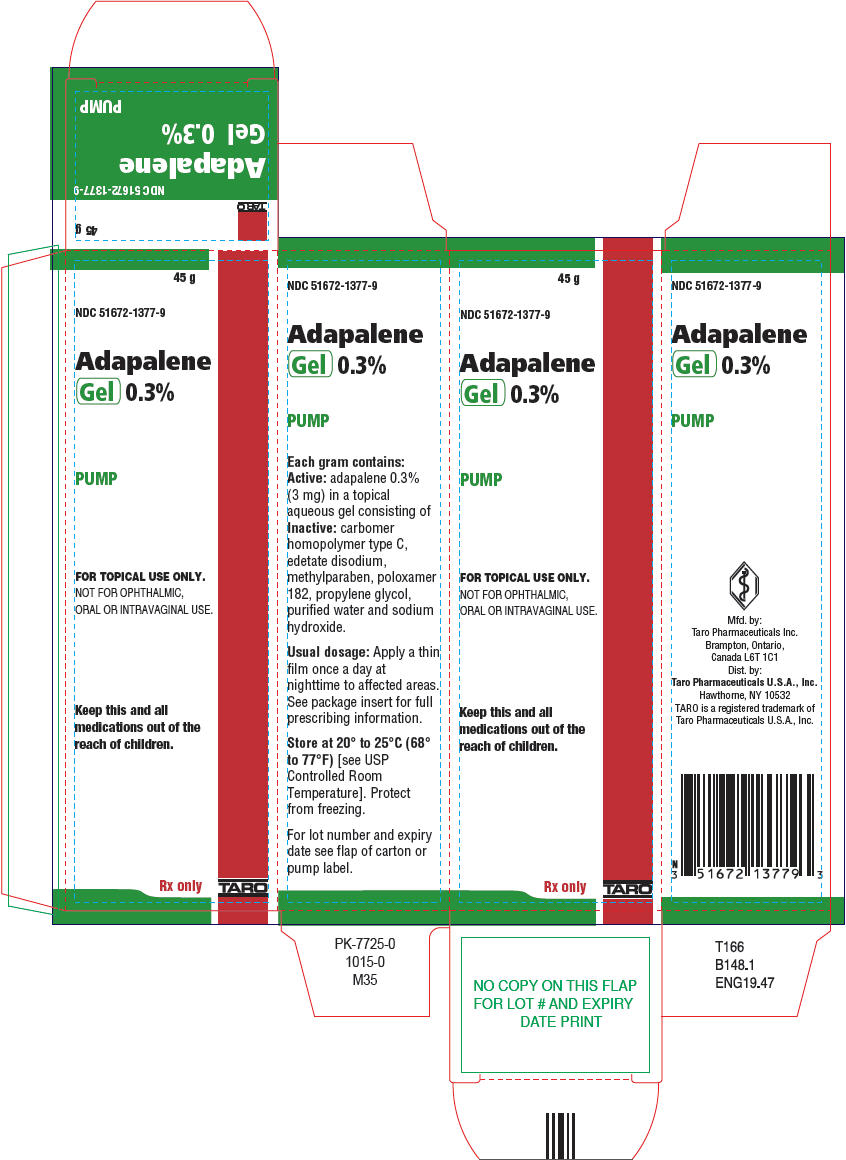
PRINCIPAL DISPLAY PANEL - 45 g Bottle Carton 45 g NDC 51672-1377-9 Adapalene Gel 0.3% PUMP FOR TOPICAL USE ONLY. NOT FOR OPHTHALMIC, ORAL OR INTRAVAGINAL USE. Keep this and all medications out of the reach of children. Rx only TARO PRINCIPAL DISPLAY PANEL - 45 g Bottle Carton