
Clindamycin Phosphate 10 mg/g Aerosol, Foam — NDC 51672-4194-7 (Billing 51672-4194-07)
This is a package of Clindamycin Phosphate 10 mg/g Aerosol, Foam from Sun Pharmaceutical Industries, Inc., marketed since Oct 2022 and currently FDA-listed; retail pharmacies pay about $1.83 per g (NADAC).
NDC database record
One package, one record: these facts belong to NDC 51672-4194-7 alone.
- Record
- FDA NDC Directory package listing · Human prescription drug
- Code segments
- 51672 labeler · 4194 product · 7 package
- Package marketed since
- Oct 1, 2022
- Sample package
- No — commercial package
- Listing certified through
- Dec 31, 2027
- Barcode (UPC-A, from the NDC)
- 3 5167241947 9
- Medicaid fills, this package
- 149 prescriptions in the last four reported quarters
- FDA record last changed
- Jul 24, 2026
Other active recalls for Clindamycin Phosphate (different manufacturers) — 6 · tap to view
Identity & classification
Regulatory identifiers FDA, NLM and CMS codes for this package
Drug-database identifiers Medi-Span GPI and First Databank GCN / HICL / AHFS classification
- GSN (GCN sequence number): 058418
- GCN: 23848
- GPI-14 (Medi-Span): 90051010103905
- HICL (First Databank): 004045
- AHFS class code: 08:12.28.20
- RxCUI (RxNorm): 477451
Where does this data come from?
- FDA openFDA NDC Directory · synced Oct 1, 2026
- FDA label on DailyMed · label index refreshed Oct 3, 2026
- RxNorm (NLM RxNav) · catalog refreshed Oct 1, 2026
- Medi-Span GPI (licensed)
- First Databank (licensed) · refreshed Oct 1, 2026
RxNorm drug class
This medicine belongs to the Lincosamide Antibacterial class.
Where does this data come from?
- RxClass (NLM) · catalog refreshed Oct 1, 2026
Clinical
Topical clindamycin is used to treat acne. Clindamycin is in a class of medications called lincomycin antibiotics. It works by slowing or stopping the growth of bacteria that cause acne and by decreasing swelling.
Read the full MedlinePlus article ↗- It treats serious bacterial infections, such as anaerobic infections, skin, lung, abdominal, gynecological, and bone and joint infections, depending on the product. It is often use...
- Swallow them with a full glass of water and stay upright for at least 30 minutes afterward. This helps prevent irritation of your throat. Take it as often as your prescriber says a...
- Rash, nausea, vomiting, stomach pain and itching are among the more commonly reported effects. Call your doctor right away if you get severe, watery or bloody diarrhea, even weeks...
- What side effects are normal, and when should I call you?
Patient education
Supplement & herbal interactions
Clindamycin may be associated with lower levels of 7 nutrients — worth a chat with your pharmacist, not a cause for alarm.
Where does this data come from?
- MedlinePlus (NLM) · refreshed Oct 1, 2026
- FDA label on DailyMed · label index refreshed Oct 3, 2026
Ask a licensed pharmacist directly — free, answered by our team.
Pricing
A drug doesn't have one price. Each row is a different public payment system, and none is what you'd pay at the counter — that depends on your insurance. The ⓘ on each row explains what it measures.
| Price system | Per g | Per package |
|---|---|---|
| Retail pharmacies payNADAC · weekly | $1.831 | $183.05 / 100 g |
| Medicaid paysCMS SDUD · 12 mo | $2.70 | $270.10 / 100 g |
| Medicare drug plans payPart D · Q2 2026 | $3.28 | $328.00 / 100 g |
Where does this data come from?
- CMS NADAC weekly file · file of Sep 30, 2026
- CMS ASP pricing files · refreshed Sep 20, 2026
- CMS Medicaid State Drug Utilization Data · through Q1 2026
- CMS Part D plan pricing files · refreshed Sep 24, 2026
- VA National Acquisition Center price file
Packaging — all sizes for this product
| Package NDC | Description | Per unit | Per pack | Marketing start | Marketing end | Status |
|---|---|---|---|---|---|---|
| 51672-4194-03 51672-4194-3 Main listing | 1 CAN in 1 CARTON / 50 g in 1 CAN | $2.21 / g | $110.48 | 2022-10-01 | — | Active |
| 51672-4194-07 You're viewing this | 1 CAN in 1 CARTON / 100 g in 1 CAN | $1.83 / g | $183.05 | 2022-10-01 | — | Active |
This pack has the lowest per-g cost of the 2 priced pack sizes ($1.83 NADAC).
This pack accounts for about 30% of this product's recent Medicaid fills; most go to a different pack size. See all packs ↓
Pack size FAQ
What quantity is in this package?
What NDC number is used to bill for this package of Clindamycin Phosphate 10 mg/g Aerosol, Foam?
Prices are the latest CMS NADAC pharmacy acquisition cost per NDC; per-pack figures are per-unit × pack quantity, shown only when the pack is denominated in the same measure NADAC prices.
Therapeutic equivalents
| Product | Labeler | Pack | NADAC/unit | TE | Status | Price vs. this |
|---|---|---|---|---|---|---|
| Clindacin 10 mg/g 43538-0179-10 | Medimetriks | 1 can | $1.830 | AT | Availability likely | — |
| Clindamycin Phosphate 10 mg/gthis 51672-4194-07 | Sun | 1 can | $1.830 | AT | Availability likely | — |
| Clindamycin Phosphate 10 mg/g 45802-0660-32 | Padagis | 1 can | $2.210 | AT | Availability likely | +21% |
| Clindamycin Phosphate 10 mg/g 68462-0605-27 | GLENMARK | 1 can | $2.210 | AT | Availability likely | +21% |
| Clindamycin Phosphate 10 mg/g 63629-8628-01 | Bryant | 1 can | — | AT | FDA listed | — |
| Clindamycin Phosphate 10 mg/g 63629-8629-01 | Bryant | 1 can | — | AT | FDA listed | — |
Where does this data come from?
- FDA openFDA NDC Directory · synced Oct 1, 2026
- FDA Orange Book · refreshed Oct 3, 2026
- CMS NADAC weekly file · file of Sep 30, 2026
Availability & generic status
This product is an FDA-approved generic. Other versions of the same drug are listed under Therapeutic equivalents, least expensive first.
Where does this data come from?
- FDA Orange Book · refreshed Oct 3, 2026
What it looks like
Where does this data come from?
- FDA label on DailyMed · label index refreshed Oct 3, 2026
Inactive Ingredients / Excipients
Inactive ingredients, also called excipients, are components of the drug product other than the active ingredient. They may include fillers, dyes, coatings, preservatives, flavors, or other formulation ingredients.
💡 Tap an ingredient (hover on desktop) to see what it is and why it’s used.
-
UNII 3K9958V90M
A liquid solvent derived from fermentation or chemical synthesis. In medicines, alcohol dissolves active ingredients, helps preserve the product, and improves how the body absorbs certain drugs.
-
UNII 936JST6JCN
Cetyl alcohol is a waxy, fatty substance derived from plant or animal sources. It acts as an emulsifier and thickener in medicines, helping blend oil and water components and giving products a smooth, creamy texture.
-
UNII CAL22UVI4M
A synthetic emulsifier derived from sorbitol and fatty acids. It helps mix oil and water-based ingredients together and improves the texture and stability of the medicine.
-
UNII 6DC9Q167V3
Propylene glycol is a clear liquid derived from petroleum or vegetable sources. It acts as a solvent, humectant, and preservative in medicines, helping dissolve active ingredients and maintain product stability.
-
UNII 2KR89I4H1Y
Stearyl alcohol is a waxy, fatty substance derived from natural oils or made synthetically. It acts as an emulsifier and thickener in medicines, helping mix ingredients together and give the product the right texture.
-
UNII 059QF0KO0R
Water is a liquid solvent that dissolves and mixes ingredients together in liquid medicines, syrups, and injections. It helps distribute the active drug evenly throughout the product.
6 inactive ingredients listed in the exact product block matched to this NDC.
Where does this data come from?
ingredient classCode="IACT" elements from the exact product block matched by this NDC. Label-section narrative from DailyMed / the openFDA label index is shown separately when available.- FDA label on DailyMed · label index refreshed Oct 3, 2026
- FDA openFDA NDC Directory · synced Oct 1, 2026
Inactive ingredient FAQ
Are inactive ingredients the same for every manufacturer?
Why might an inactive ingredient be missing?
Can inactive ingredients matter?
Manufacturer & labeler
More NDCs from Sun Pharmaceutical Industries, Inc. labeler code 51672
- Felbamate 600 mg/5mL Suspension NDC 51672-4172-1
- Imiquimod 37.5 mg/g Cream NDC 51672-4174-6
- Felbamate 400 mg Tablet NDC 51672-4185-1
- Felbamate 600 mg Tablet NDC 51672-4186-1
- Betamethasone Valerate 1.2 mg/g Aerosol, Foam NDC 51672-4188-3
- Clobetasol Propionate .5 mg/g Aerosol, Foam NDC 51672-4193-3
- Deferiprone 500 mg Tablet NDC 51672-4196-1
- Dapsone 25 mg Tablet NDC 51672-4197-2
- Dapsone 100 mg Tablet NDC 51672-4198-2
- Clobazam 10 mg Tablet NDC 51672-4202-1
- Clobazam 20 mg Tablet NDC 51672-4203-1
- Perampanel 2 mg Tablet, Film Coated NDC 51672-4204-3
Where does this data come from?
- FDA openFDA NDC Directory · synced Oct 1, 2026
- Drugs@FDA
Full prescribing information FDA SPL
🎯 Indications and Usage ▾
1 INDICATIONS AND USAGE Clindamycin phosphate foam is indicated for topical application in the treatment of acne vulgaris in patients 12 years and older. Clindamycin phosphate foam is a lincosamide product indicated for acne vulgaris in patients 12 years and older. ( 1 )
⏱️ Dosage and Administration ▾
2 DOSAGE AND ADMINISTRATION Clindamycin phosphate foam is for topical use only, and not for oral, ophthalmic, or intravaginal use. Apply clindamycin phosphate foam once daily to affected areas after the skin is washed with mild soap and allowed to fully dry. Use enough to cover the entire affected area.
If there has been no improvement after 6 to 8 weeks or if the condition becomes worse, treatment should be discontinued. The contents of clindamycin phosphate foam are flammable; avoid fire, flame and/or smoking during and immediately following application. For topical use only; not for oral, ophthalmic, or intravaginal use.
( 2 ) Apply clindamycin phosphate foam once daily to affected areas. ( 2 ) Flammable; avoid fire, flame and/or smoking during and immediately following application. ( 2 )
💊 Dosage Forms and Strengths ▾
3 DOSAGE FORMS AND STRENGTHS Clindamycin phosphate foam is a white to off-white thermolabile foam. Clindamycin phosphate foam, 1% contains 10 mg of clindamycin as clindamycin phosphate, USP per gram. Foam containing 1% clindamycin as clindamycin phosphate. ( 3 )
⛔ Contraindications ▾
4 CONTRAINDICATIONS Clindamycin phosphate foam is contraindicated in individuals with a history of regional enteritis or ulcerative colitis, or a history of antibiotic-associated colitis (including pseudomembranous colitis). Clindamycin phosphate foam is contraindicated in individuals with a history of regional enteritis or ulcerative colitis, or a history of antibiotic-associated colitis, (including pseudomembranous colitis). ( 4 )
⚠️ Warnings and Cautions ▾
5 WARNINGS AND PRECAUTIONS Colitis: Clindamycin can cause severe colitis, which may result in death. Diarrhea, bloody diarrhea, and colitis (including pseudomembranous colitis) have been reported with the use of clindamycin. Clindamycin phosphate foam should be discontinued if significant diarrhea occurs. ( 5.1 )
5.1Colitis Systemic absorption of clindamycin has been demonstrated following topical use of this product. Diarrhea, bloody diarrhea, and colitis (including pseudomembranous colitis) have been reported with the use of topical clindamycin. If significant diarrhea occurs, clindamycin phosphate foam should be discontinued [see Adverse Reactions (6.2) ].
Severe colitis has occurred following oral or parenteral administration of clindamycin with an onset of up to several weeks following cessation of therapy. Antiperistaltic agents such as opiates and diphenoxylate with atropine may prolong and/or worsen severe colitis. Severe colitis may result in death.
Studies indicate a toxin(s) produced by Clostridia is one primary cause of antibiotic-associated colitis. The colitis is usually characterized by severe persistent diarrhea and severe abdominal cramps and may be associated with the passage of blood and mucus. Stool cultures for Clostridium difficile and stool assay for C. difficile toxin may be helpful diagnostically.
5.2Irritation Clindamycin phosphate foam can cause irritation. Concomitant topical acne therapy should be used with caution since a possible cumulative irritancy effect may occur, especially with the use of peeling, desquamating, or abrasive agents. If irritation or dermatitis occurs, clindamycin should be discontinued.
Avoid contact of clindamycin phosphate foam with eyes, mouth, lips, other mucous membranes or areas of broken skin. If contact occurs, rinse thoroughly with water. Clindamycin phosphate foam should be prescribed with caution in atopic individuals.
🤒 Adverse Reactions ▾
6 ADVERSE REACTIONS The most common adverse reactions (>1%) are headache and application site reactions including burning, pruritus, and dryness. ( 6.1 ) To report SUSPECTED ADVERSE REACTIONS, contact Taro Pharmaceuticals U.S.A., Inc. at 1-866-923-4914 or FDA at 1-800-FDA-1088 or www.fda.gov/medwatch .
6.1Clinical Trials Experience Because clinical trials are conducted under widely varying conditions, adverse reaction rates observed in the clinical trials of a drug cannot be directly compared to rates in the clinical trials of another drug and may not reflect the rates observed in clinical practice. A total of 439 subjects with mild to moderate acne vulgaris were treated once daily for 12 weeks with clindamycin phosphate foam. The incidence of adverse reactions occurring in ≥1% of the subjects in clinical trials comparing clindamycin phosphate foam and its vehicle is presented in Table 1.
Table 1: Adverse Reactions Occurring in ≥1% of Subjects Adverse Reactions Number (%) of Subjects Clindamycin Phosphate Foam N = 439 Vehicle Foam N = 154 Headache 12 (3%) 1 (1%) Application site burning 27 (6%) 14 (9%) Application site pruritus 5 (1%) 5 (3%) Application site dryness 4 (1%) 5 (3%) Application site reaction, not otherwise specified 3 (1%) 4 (3%) In a contact sensitization study, none of the 203 subjects developed evidence of allergic contact sensitization to clindamycin phosphate foam.
6.2Postmarketing Experience The following adverse reactions have been identified during post approval use of clindamycin phosphate foam: application site pain, application site erythema, diarrhea, urticaria, abdominal pain, hypersensitivity, rash, abdominal discomfort, nausea, seborrhea, application site rash, dizziness, pain of skin, colitis (including pseudomembranous colitis), and hemorrhagic diarrhea. Because these reactions are reported voluntarily from a population of uncertain size, it is not always possible to reliably estimate their frequency or establish a causal relationship to drug exposure.
Abdominal pain and gastrointestinal disturbances, as well as gram-negative folliculitis, have also been reported in association with the use of topical formulations of clindamycin. Orally and parenterally administered clindamycin have been associated with severe colitis, which may end fatally.
🔄 Drug Interactions ▾
7 DRUG INTERACTIONS
7.1Erythromycin Clindamycin phosphate foam should not be used in combination with topical or oral erythromycin-containing products due to possible antagonism to its clindamycin component. In vitro studies have shown antagonism between these two antimicrobials. The clinical significance of this in vitro antagonism is not known.
7.2Neuromuscular Blocking Agents Clindamycin has been shown to have neuromuscular blocking properties that may enhance the action of other neuromuscular blocking agents. Therefore, clindamycin phosphate foam should be used with caution in patients receiving such agents.
👥 Use in Specific Populations ▾
8 USE IN SPECIFIC POPULATIONS
8.1Pregnancy Risk Summary There are no available data on clindamycin phosphate foam use in pregnant women to inform a drug-associated risk for adverse developmental outcomes. Animal reproduction studies have not been conducted with clindamycin phosphate foam. No evidence of fetal harm or malformations was observed in pregnant rats and mice administered daily subcutaneous or oral doses of clindamycin salts during organogenesis at doses that produced exposures up to 84 and 42 times, respectively, the maximum recommended human dose (MRHD) of clindamycin phosphate foam based on body surface area (BSA) comparisons and assuming 100% absorption [see Data ].
In the U.S. general population, the estimated background risk of major birth defects and miscarriage in clinically recognized pregnancies is 2 to 4% and 15 to 20%, respectively. Data Animal Data Reproduction studies have been conducted in rats and mice using subcutaneous or oral doses of clindamycin phosphate, clindamycin hydrochloride or clindamycin palmitate hydrochloride administered daily during organogenesis at doses up to the equivalent of 432 mg/kg/day clindamycin phosphate. These studies produced no evidence of fetal harm or malformations in rats or mice at exposures 84 or 42 times, respectively, the MRHD of clindamycin phosphate (i.e., 5 milliliters of clindamycin phosphate foam) based on BSA comparison and assuming 100% absorption.
8.2Lactation Risk Summary There is no information on the presence of clindamycin in human milk, or the effects on the breast-fed child, or the effects on milk production following use of clindamycin phosphate foam. However, orally and parenterally administered clindamycin has been reported to appear in breast milk. The developmental and health benefits of breastfeeding should be considered along with the mother's clinical need for clindamycin phosphate foam and any potential adverse effects on the breast-fed child from clindamycin phosphate foam or from the underlying maternal condition.
Clinical Considerations If used during lactation and clindamycin phosphate foam is applied to the chest, care should be taken to avoid accidental ingestion by the infant.
8.4Pediatric Use Safety and effectiveness of clindamycin phosphate foam in children under the age of 12 have not been studied.
8.5Geriatric Use The clinical study with clindamycin phosphate foam did not include sufficient numbers of subjects aged 65 and over to determine if they respond differently than younger subjects.
🤰 Pregnancy ▾
8.1Pregnancy Risk Summary There are no available data on clindamycin phosphate foam use in pregnant women to inform a drug-associated risk for adverse developmental outcomes. Animal reproduction studies have not been conducted with clindamycin phosphate foam. No evidence of fetal harm or malformations was observed in pregnant rats and mice administered daily subcutaneous or oral doses of clindamycin salts during organogenesis at doses that produced exposures up to 84 and 42 times, respectively, the maximum recommended human dose (MRHD) of clindamycin phosphate foam based on body surface area (BSA) comparisons and assuming 100% absorption [see Data ].
In the U.S. general population, the estimated background risk of major birth defects and miscarriage in clinically recognized pregnancies is 2 to 4% and 15 to 20%, respectively. Data Animal Data Reproduction studies have been conducted in rats and mice using subcutaneous or oral doses of clindamycin phosphate, clindamycin hydrochloride or clindamycin palmitate hydrochloride administered daily during organogenesis at doses up to the equivalent of 432 mg/kg/day clindamycin phosphate. These studies produced no evidence of fetal harm or malformations in rats or mice at exposures 84 or 42 times, respectively, the MRHD of clindamycin phosphate (i.e., 5 milliliters of clindamycin phosphate foam) based on BSA comparison and assuming 100% absorption.
🧒 Pediatric Use ▾
8.4Pediatric Use Safety and effectiveness of clindamycin phosphate foam in children under the age of 12 have not been studied.
🧓 Geriatric Use ▾
8.5Geriatric Use The clinical study with clindamycin phosphate foam did not include sufficient numbers of subjects aged 65 and over to determine if they respond differently than younger subjects.
🧬 Clinical Pharmacology ▾
12 CLINICAL PHARMACOLOGY
12.1Mechanism of Action Mechanism of action of clindamycin in acne vulgaris is unknown [see Microbiology (12.4) ].
12.2Pharmacodynamics Pharmacodynamics of clindamycin phosphate foam is unknown.
12.3Pharmacokinetics In an open label, parallel group study in 24 subjects with acne vulgaris, 12 subjects (3 male and 9 female) applied 4 grams of clindamycin phosphate foam once-daily for five days, and 12 subjects (7 male and 5 female) applied 4 grams of a clindamycin gel, 1%, once daily for five days. On Day 5, the mean C max and AUC (0-12) were 23% and 9% lower, respectively, for clindamycin phosphate foam than for the clindamycin gel, 1%. Following multiple applications of clindamycin phosphate foam, less than 0.024% of the total dose was excreted unchanged in the urine over 12 hours on Day 5.
12.4Microbiology No microbiology studies were conducted in the clinical trials with this product. Clindamycin binds to the 50S ribosomal subunits of susceptible bacteria and prevents elongation of peptide chains by interfering with peptidyl transfer, thereby suppressing protein synthesis. Clindamycin has been shown to have in vitro activity against Propionibacterium acnes (P. acnes) , an organism that has been associated with acne vulgaris; however, the clinical significance of this activity against P. acnes was not examined in clinical studies with clindamycin phosphate foam.
P. acnes resistance to clindamycin has been documented. Inducible Clindamycin Resistance The treatment of acne with antimicrobials is associated with the development of antimicrobial resistance in P. acnes as well as other bacteria (e.g. Staphylococcus aureus, Streptococcus pyogenes ).
The use of clindamycin may result in developing inducible resistance in these organisms. This resistance is not detected by routine susceptibility testing. Cross Resistance Resistance to clindamycin is often associated with resistance to erythromycin.
🧬 Mechanism of Action ▾
12.1Mechanism of Action Mechanism of action of clindamycin in acne vulgaris is unknown [see Microbiology (12.4) ].
📦 How Supplied / Storage and Handling ▾
16 HOW SUPPLIED/STORAGE AND HANDLING
16.1How Supplied Clindamycin phosphate foam, 1% contains 10 mg of clindamycin as clindamycin phosphate, USP per gram. The white to off-white thermolabile foam is available as follows: 100 gram aerosol can - NDC 51672-4194-7 50 gram aerosol can - NDC 51672-4194-3
16.2Storage and Handling Store at 20° to 25°C (68° to 77°F ) [see USP Controlled Room Temperature]. Flammable. Avoid fire, flame or smoking during and immediately following application. Contents under pressure. Do not puncture or incinerate. Do not expose to heat or store at temperature above 120°F (49°C). Keep out of reach of children.
📦 Storage and Handling ▾
16.2Storage and Handling Store at 20° to 25°C (68° to 77°F ) [see USP Controlled Room Temperature]. Flammable. Avoid fire, flame or smoking during and immediately following application. Contents under pressure. Do not puncture or incinerate. Do not expose to heat or store at temperature above 120°F (49°C). Keep out of reach of children.
📋 Description ▾
11 DESCRIPTION Clindamycin phosphate foam contains clindamycin (1%) as clindamycin phosphate. Clindamycin phosphate is a water-soluble ester of the semi-synthetic antibiotic produced by a 7(S)-chloro-substitution of the 7(R)-hydroxyl group of the parent antibiotic, lincomycin. The chemical name for clindamycin phosphate is methyl 7-chloro-6,7,8-trideoxy-6-(1-methyl- trans -4-propyl-L-2-pyrrolidinecarboxamido)-1-thio-L- threo- α - D -galacto -octopyranoside 2-(dihydrogen phosphate).
The structural formula for clindamycin phosphate is represented below: Molecular Formula: C 18 H 34 ClN 2 O 8 PS Molecular Weight: 504.97 g/mol Clindamycin phosphate foam contains clindamycin (1%) as clindamycin phosphate, USP at a concentration equivalent to 10 mg clindamycin per gram in a thermolabile hydroethanolic foam vehicle consisting of cetyl alcohol, dehydrated alcohol, polysorbate 60, propylene glycol, purified water, and stearyl alcohol pressurized with a hydrocarbon (propane/butane) propellant. Chemical Structure
💬 Information for Patients ▾
17 PATIENT COUNSELING INFORMATION See FDA-Approved patient labeling (Patient Information) .
17.1Instructions for Use Patients should be advised to wash their skin with mild soap and allow it to dry before applying clindamycin phosphate foam. Patients should use enough clindamycin phosphate foam to cover the face and to apply once daily. Patients should dispense clindamycin phosphate foam directly into the cap or onto a cool surface. Patients should wash their hands after applying clindamycin phosphate foam.
17.2Skin Irritation Clindamycin phosphate foam may cause irritation such as erythema, scaling, itching, burning, or stinging. Patients should be advised to discontinue use if excessive irritancy or dermatitis occur.
17.3Colitis In the event a patient treated with clindamycin phosphate foam experiences severe diarrhea or gastrointestinal discomfort, clindamycin phosphate foam should be discontinued and a physician should be contacted.
🧬 Pharmacokinetics ▾
12.3Pharmacokinetics In an open label, parallel group study in 24 subjects with acne vulgaris, 12 subjects (3 male and 9 female) applied 4 grams of clindamycin phosphate foam once-daily for five days, and 12 subjects (7 male and 5 female) applied 4 grams of a clindamycin gel, 1%, once daily for five days. On Day 5, the mean C max and AUC (0-12) were 23% and 9% lower, respectively, for clindamycin phosphate foam than for the clindamycin gel, 1%. Following multiple applications of clindamycin phosphate foam, less than 0.024% of the total dose was excreted unchanged in the urine over 12 hours on Day 5.
🧬 Pharmacodynamics ▾
12.2Pharmacodynamics Pharmacodynamics of clindamycin phosphate foam is unknown.
🔬 Clinical Studies ▾
14 CLINICAL STUDIES In one multicenter, randomized, double-blind, vehicle-controlled clinical trial, subjects with mild to moderate acne vulgaris used clindamycin phosphate foam or the vehicle foam once daily for twelve weeks. Treatment response, defined as the proportion of subjects clear or almost clear, based on the Investigator Static Global Assessment (ISGA), and the mean percent reductions in lesion counts at the end of treatment in this study are shown in Table 2. Table 2: Efficacy Results at Week 12 Efficacy Parameters Clindamycin Phosphate Foam N = 386 Vehicle Foam N = 127 Treatment response (ISGA) 31% 18% P<0.05 Percent reduction in lesion counts Inflammatory Lesions 49% 35% Noninflammatory Lesions 38% 27% Total Lesions 43% 31%
🧪 Nonclinical Toxicology ▾
13 NONCLINICAL TOXICOLOGY
13.1Carcinogenesis, Mutagenesis, Impairment of Fertility The carcinogenicity of a 1.2% clindamycin phosphate gel similar to clindamycin phosphate foam was evaluated by daily topical administration to mice for two years. The topical doses used in this study were approximately 3 and 15 times higher than the MRHD of clindamycin phosphate from clindamycin phosphate foam, based on BSA comparison and assuming 100% absorption. No significant increase in tumors was noted in the treated animals.
The genotoxic potential of clindamycin was evaluated in an in vitro Ames assay and in an in vivo rat micronucleus test. Both tests were negative. Reproduction studies in rats using oral doses of clindamycin hydrochloride or clindamycin palmitate hydrochloride have revealed no evidence of impaired fertility.
📄 Carcinogenesis, Mutagenesis, Impairment of Fertility ▾
13.1Carcinogenesis, Mutagenesis, Impairment of Fertility The carcinogenicity of a 1.2% clindamycin phosphate gel similar to clindamycin phosphate foam was evaluated by daily topical administration to mice for two years. The topical doses used in this study were approximately 3 and 15 times higher than the MRHD of clindamycin phosphate from clindamycin phosphate foam, based on BSA comparison and assuming 100% absorption. No significant increase in tumors was noted in the treated animals.
The genotoxic potential of clindamycin was evaluated in an in vitro Ames assay and in an in vivo rat micronucleus test. Both tests were negative. Reproduction studies in rats using oral doses of clindamycin hydrochloride or clindamycin palmitate hydrochloride have revealed no evidence of impaired fertility.
📄 Patient Package Insert ▾
PATIENT INFORMATION Clindamycin Phosphate (klin'' da mye' sin fos' fate) Foam, 1% This Patient Information has been approved by the U.S. Food and Drug Administration. Revised: 1/2021 Important Information: Clindamycin phosphate foam is for use on the skin only.
Do not use clindamycin phosphate foam in your eyes, mouth or vagina. What is Clindamycin Phosphate Foam? Clindamycin phosphate foam is a prescription medicine used on the skin (topical) to treat acne vulgaris in people 12 years and older.
It is not known if clindamycin phosphate foam is safe and effective in children under 12 years of age. Who should not use Clindamycin Phosphate Foam? Do not use clindamycin phosphate foam if you: have Crohn's disease have ulcerative colitis have had inflammation of the colon (colitis) or severe diarrhea with past antibiotic use Tell your doctor if you are not sure if you have any of the conditions listed above.
What should I tell my doctor before using Clindamycin Phosphate Foam? Before using clindamycin phosphate foam, tell your doctor about all of your medical conditions, including if you: have or have had bowel problems (such as Crohn's disease, ulcerative colitis, colitis) have or have had eczema or other skin problems are planning to have surgery. Clindamycin phosphate foam may affect how certain medicines work that may be given during surgery. are pregnant or plan to become pregnant.
It is not known if clindamycin phosphate foam may harm your unborn baby. are breastfeeding or plan to breastfeed. It is not known if clindamycin phosphate foam passes into your breast milk. Talk to your doctor about using clindamycin phosphate foam while breastfeeding.
If you use clindamycin phosphate foam while breastfeeding and clindamycin phosphate foam is applied on the chest, take care to avoid getting clindamycin phosphate foam into your baby's mouth. Tell your doctor about all the medicines you take including prescription and over-the-counter medicines, vitamins and herbal supplements. Clindamycin phosphate foam may affect the way other medicines work and other medicines may affect how clindamycin phosphate foam works.
Especially tell your doctor if you take medicine by mouth that contains erythromycin or use products on your skin that contain erythromycin. Know the medicines you take. Keep a list of them to show your doctor and pharmacist when you get a new medicine.
How should I use Clindamycin Phosphate Foam? Use clindamycin phosphate foam exactly as your doctor tells you to use it. See the detailed " Instructions for Use " for directions about how to apply clindamycin phosphate foam correctly.
Wash your skin with mild soap and water and dry before applying clindamycin phosphate foam. Apply clindamycin phosphate foam 1 time each day to the affected skin area. You should apply enough clindamycin phosphate foam to cover the entire affected area.
Dispense clindamycin phosphate foam directly into the cap. Do not dispense clindamycin phosphate foam directly onto your hands or face, because the foam will begin to melt on contact with warm skin. Wash your hands after applying clindamycin phosphate foam.
What should I avoid while using Clindamycin Phosphate Foam? Clindamycin phosphate foam is flammable. Avoid fire, flames, or smoking during and right after you apply clindamycin phosphate foam to your skin.
Avoid getting clindamycin phosphate foam in or near your eyes, mouth, lips, or broken skin. If you get clindamycin phosphate foam in your eyes, mouth, on lips or broken skin, rinse well with water. What are possible side effects with Clindamycin Phosphate Foam?
Clindamycin phosphate foam may cause serious side effects, including: Inflammation of the colon (colitis). Diarrhea, bloody diarrhea, and colitis has happened in people who use clindamycin phosphate foam. Stop using clindamycin phosphate foam and call your doctor right away if you have severe stomach (abdominal) cramps, watery diarrhea, or bloody diarrhea during treatment, and for several… [Excerpted — this section continues on DailyMed.]
📖 Instructions for Use ▾
Instructions for Use Clindamycin Phosphate (klin'' da mye' sin fos' fate) Foam, 1% Important Information: Clindamycin phosphate foam is for use on the skin only. Do not use clindamycin phosphate foam in your eyes, mouth or vagina. Step 1: Remove the clear cap from the clindamycin phosphate foam can.
Step 2: Hold the can upright and firmly press the nozzle to dispense clindamycin phosphate foam into the clear cap. Dispense enough clindamycin phosphate foam to cover the entire affected area. If the can seems warm or the foam seems runny, run the can under cold water.
Step 3: Pick up small amounts of clindamycin phosphate foam with your fingertips and gently rub the foam into the affected area until the foam disappears. Step 4: Wash your hands after applying clindamycin phosphate foam. Throw away any of the unused medicine that you dispensed out of the can.
How should I store Clindamycin Phosphate Foam? Store at 20° to 25°C (68° to 77°F) [see USP Controlled Room Temperature]. Keep clindamycin phosphate foam away from heat.
Never throw the can into a fire, even if the can is empty. Do not store clindamycin phosphate foam at temperatures above 120°F (49°C). Do not break through (puncture) the clindamycin phosphate foam can.
Keep clindamycin phosphate foam and all medicines out of the reach of children. The Patient Information and Instructions for Use have been approved by the U.S. Food and Drug Administration.
Mfd. by: Taro Pharmaceutical Industries Ltd. Haifa Bay, Israel 2624761 Dist. by: Taro Pharmaceuticals U.S.A., Inc. Hawthorne, NY 10532 Issued: January 2021 5201411-0121-0 80 Step 1 Step 2 Step 2 Step 3
📄 Package Label / Principal Display Panel ▾
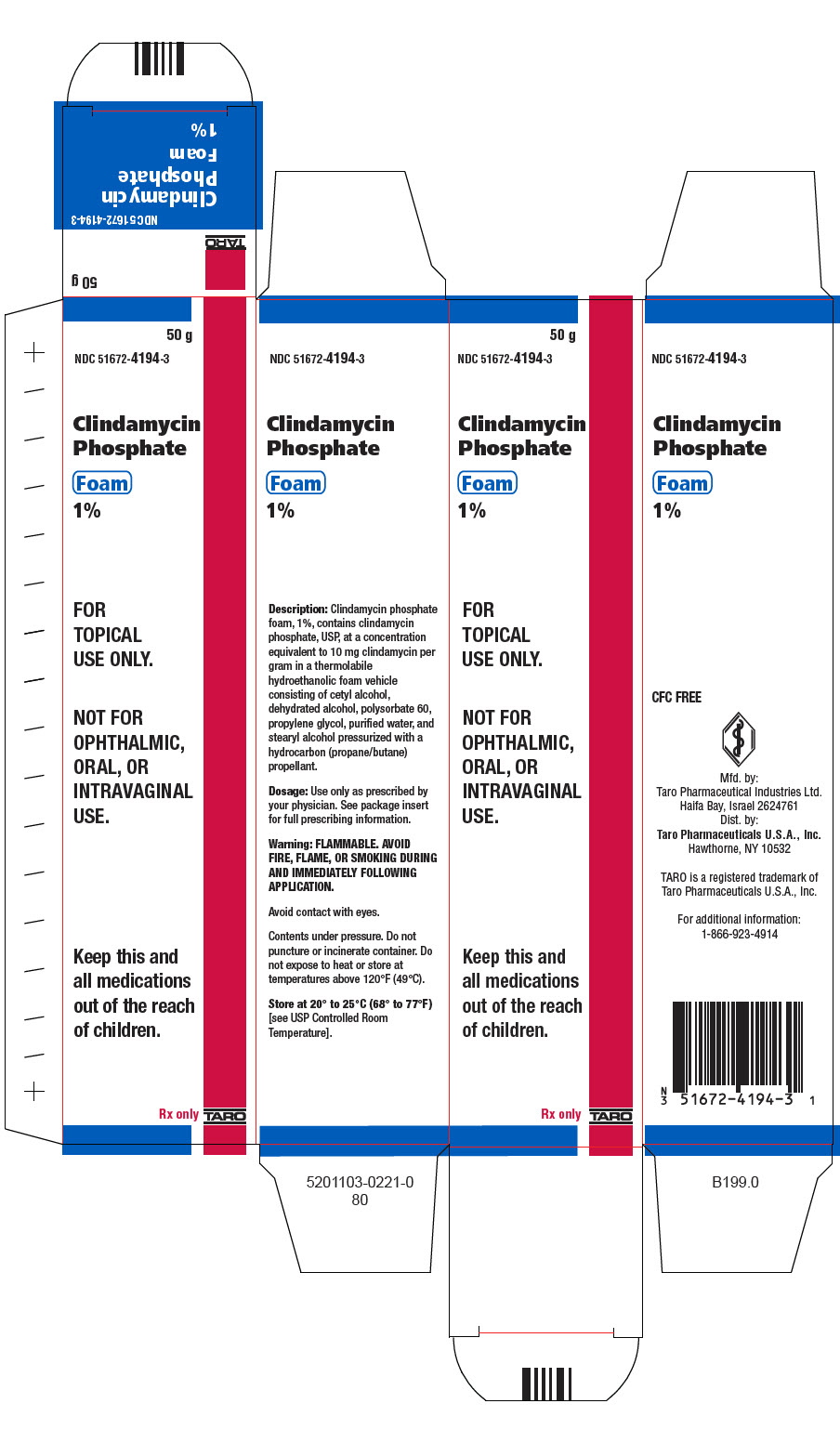
PRINCIPAL DISPLAY PANEL - 50 g Can Carton 50 g NDC 51672-4194-3 Clindamycin Phosphate Foam 1% FOR TOPICAL USE ONLY. NOT FOR OPHTHALMIC, ORAL, OR INTRAVAGINAL USE. Keep this and all medications out of the reach of children. Rx only TARO PRINCIPAL DISPLAY PANEL - 50 g Can Carton