
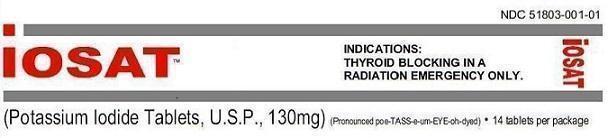
IOSAT Potassium Iodide 130 mg Tablet, 14-count
🆔 Identity & classification
Where does this data come from?
🏷️ RxNorm drug class
This medicine belongs to the Expectorants class.
Where does this data come from?
🏭 Manufacturer & labeler
Where does this data come from?
🩺 Clinical
Potassium iodide is used to protect the thyroid gland from taking in radioactive iodine that may be released during a nuclear radiation emergency. Radioactive iodine can damage the thyroid gland. You should only take potassium iodide if there is a nuclear radiation emergency and public officials tell you that you should take it. Potassium iodide is in a class of medications called anti-thyroid medications. It works by blocking radioactive iodine from entering the thyroid gland. Potassium iodide can protect you from the effects of radioactive iodine that may be released during a nuclear radiati...
Read the full MedlinePlus article ↗- It's reasonable to have it on hand if public health authorities in your area recommend it — especially if you live near a nuclear facility. But the key rule is: only take it when p...
- Should I keep potassium iodide at home just in case, or only take it if there's actually an emergency?
- No — taking more than one dose every 24 hours will not give you more protection. Your thyroid can only hold a certain amount of iodine at a time, so once it's full, extra doses jus...
- What if I take an extra dose? Will it protect me better?
Patient education
Supplement & herbal interactions
Some supplements/herbs that may interact with Potassium Iodide (prescription drug) — tap one for details:
Where does this data come from?
Ask a licensed pharmacist directly — free, answered by our team.
💊 What it looks like
Where does this data come from?
🧪 Inactive Ingredients / Excipients
Inactive ingredients, also called excipients, are components of the drug product other than the active ingredient. They may include fillers, dyes, coatings, preservatives, flavors, or other formulation ingredients.
💡 Tap an ingredient (hover on desktop) to see what it is and why it’s used.
-
UNII OP1R32D61U
Microcrystalline cellulose is a purified form of cellulose, a natural fiber from plant sources. It acts as a binder and filler in tablets and capsules, helping hold ingredients together and give the medicine its shape and size.
-
UNII 70097M6I30
Magnesium stearate is a salt made from magnesium and stearic acid, a fatty substance. It's used in tablets and capsules as a lubricant and glidant to help ingredients flow smoothly during manufacturing and prevent sticking.
-
UNII ETJ7Z6XBU4
Silicon dioxide is a naturally occurring mineral used as a glidant and anti-caking agent. It helps powder ingredients flow smoothly and prevents clumping during manufacturing and storage.
-
UNII L0IYT1O31N
A salt derived from sulfur compounds, sodium thiosulfate serves as a buffer and stabilizer in medicines. It helps maintain the product's pH balance and chemical stability.
4 inactive ingredients listed in the exact product block matched to this NDC.
Label-section wording can be broader than the structured product block and may mention additional formulation ingredients.
Where does this data come from?
ingredient classCode="IACT" elements from the exact product block matched by this NDC. Label-section narrative from DailyMed / the openFDA label index is shown separately when available.Inactive ingredient FAQ
Are inactive ingredients the same for every manufacturer?
Why might an inactive ingredient be missing?
Can inactive ingredients matter?
💲 Pricing
A drug doesn't have one price. Each row is a different public payment system, and none is what you'd pay at the counter — that depends on your insurance. The ⓘ on each row explains what it measures.
| Price system | Per each | Per package |
|---|---|---|
| Retail pharmacies payNADAC · weekly | Not in the retail survey — common for institutional, discontinued, or low-volume packs. | |
| Medicaid paysCMS SDUD · 12 mo | No recent Medicaid claims on file for this NDC — rare and low-volume NDCs are suppressed in the public data. | |
| Medicare drug plans payPart D · quarterly | No Part D plan price is available for this NDC in our data. | |
Where does this data come from?
🔁 Therapeutic equivalents
| Product | Labeler | Pack | NADAC/unit | TE | Status | Price vs. this |
|---|---|---|---|---|---|---|
| Thyrosafe 130 mg 50633-0920-20 | BTG | 8400 tablets | — | — | FDA listed | — |
| Iosat 130 mgthis 51803-0001-01 | Anbex | 14 tablets | — | — | FDA listed | — |
Where does this data come from?
⏳ Availability & generic status
The FDA lists approved generic versions of this medicine, but that does not always mean a pharmacy can get one today. Patent rules, launch agreements, supply and pricing can affect when generics actually arrive.
Where does this data come from?
🔬 Reported adverse events (FAERS)
Top reported reactions
Reporter sex
Serious outcomes
Where does this data come from?
📦 Packaging — all sizes for this product
| Package NDC | Description | Marketing start | Status |
|---|---|---|---|
| 51803-0001-01 You're viewing this | 14 TABLET in 1 PACKAGE (51803-001-01) | 1982-10-14 | Active |
| 51803-0001-10 | 10 PACKAGE in 1 BAG (51803-001-10) / 14 TABLET in 1 PACKAGE (51803-001-01) | 2016-08-16 | Active |
Pack size FAQ
What quantity is in NDC 51803-0001-01?
What is the difference between NDC 51803-0001-01 and NDC 51803-0001-10?
What NDC number is used to bill for this package of IOSAT Potassium Iodide 130 mg Tablet?
🧭 About this NDC listing & data coverage
What data is (and isn’t) available for this NDC — tap to expand
| NDC identity (package / product / labeler codes) | ✓ Available |
| Labeler | ✓ Available |
| Product & package description | ✓ Available |
| Marketing category & status | ✓ Available |
| Active ingredient / dosage form / route | ✓ Available |
| FDA label (SPL via DailyMed) | ✓ Available |
| Package photos | ✓ Available |
| Inactive ingredients (structured) | ✓ Available |
| NADAC pharmacy acquisition price (CMS) | — Not published for this NDC CMS publishes NADAC only for NDCs reported in its retail-pharmacy survey. |
| Orange Book / therapeutic-equivalence data | — Not published for this NDC Applies only to products approved under an NDA/ANDA; many listings are out of scope. |
| HCPCS J-code billing crosswalk | — Not published for this NDC Most self-administered / retail products have no J-code — that is normal. |
| Medicaid utilization (CMS SDUD) | — Not published for this NDC CMS reports utilization only for NDCs with Medicaid claims above its privacy threshold. |
Questions about this listing
Why is there no price listed?
Is the NDC printed on the package the same as the 11-digit billing NDC?
What do the three segments of this NDC mean?
Is this package still being marketed?
Does this product come in other package sizes?
Who lists this product with the FDA?
Do I need a prescription for this product?
Where does this data come from?
📄 FDA label — Drug Facts FDA SPL
🎯 Indications and Usage ▾
Uses Helps prevent radioactive iodine from getting into the thyroid gland during a nuclear radiation emergency. Use along with other emergency measures recommended by public officials.
INDICATIONS IOSAT™ (Potassium Iodide tablets, USP, 130 mg) is a thyroid blocking medicine that is used in a nuclear radiation emergency only.
⏱️ Dosage and Administration ▾
Directions use as directed by public officials in the event of a nuclear radiation emergency do not take more than 1 dose in 24 hours tablets can be whole or crushed and mixed in milk, baby formula, water, orange juice, flat soda like cola, or raspberry syrup The liquid mixture should be given to infants, young children, and others who cannot swallow tablets; see consumer package insert on how to make a liquid mixture. Age Dose Adults over 18 years 1 tablet (whole or crushed) daily (130 mg) Children over 12 years to 18 years who weigh at least 150 pounds 1 tablet (whole or crushed) daily (130 mg) Children over 12 years to 18 years who weigh less than 150 pounds 1/2 tablet (whole or crushed) daily (65 mg) Children over 3 years to 12 years 1/2 tablet (whole or crushed) daily (65 mg) Children over 1 month to 3 years 32.5 mg daily as directed in the consumer package insert Birth to 1 month 16.25 mg daily as directed in the consumer package insert If pregnant, breastfeeding, have a baby up to 1 month of age or have thyroid disease (except nodular thyroid disease with heart disease), take as directed above and contact a doctor as soon as possible.
⚠️ Warnings ▾
Warnings Allergy alert: Iodine may cause an allergic reaction with 1 or more of the following symptoms: shortness of breath or wheezing swelling skin rash trouble breathing, speaking or swallowing fever and joint pain Do not use if you have ever had an allergic reaction to iodine nodular thyroid disease with heart disease hypocomplementemic vasculitis dermatitis herpetiformis Stop use and ask a doctor if you have an allergic reaction. Get medical help right away if you have trouble breathing, speaking or swallowing; shortness of breath; wheezing; swelling of the mouth, tongue or throat; or rash. irregular heartbeat or chest pain.
Get medical help right away. swelling of the hands or feet, fever, or joint pain. Keep out of reach of children. In case of overdose, get medical help or contact a Poison Control Center right away.
WARNING People who are allergic to iodine, have dermatitis herpetiformis or hypocomplementemic vasculitis, or have nodular thyroid disease with heart disease should not take KI. Keep out of the reach of children. In case of an allergic reaction (difficulty breathing, speaking or swallowing; wheezing; shortness of breath or swelling of the mouth or throat), call 911 or get medical care right away.
In case of overdose, get medical help or call a Poison Control Center right away. HOW POTASSIUM IODIDE WORKS Certain forms of iodine help your thyroid gland work right. Most people get the iodine they need from foods like iodized salt or fish.
The thyroid can “store” or hold only a certain amount of iodine. In nuclear radiation emergency, radioactive iodine may be released in the air. This material may be breathed or swallowed.
It may enter the thyroid gland and damage it. The damage would probably not show itself for years. Children are most likely to have thyroid damage.
If you take KI, it will block or reduce the chances that radioactive iodine will enter your thyroid gland. WHO SHOULD NOT TAKE POTASSIUM IODIDE People should avoid KI if they are allergic to iodine, have dermatitis herpetiformis or hypocomplementemic vasculitis, or have nodular thyroid disease with heart disease, because these conditions may increase the chances of side effects to iodine. HOW AND WHEN TO TAKE POTASSIUM IODIDE KI should be taken as soon as possible after public officials tell you.
If you are told to repeat the dose, you should take the second dose 24 hours after the first dose. Do not take it sooner. More KI will not help you because the thyroid can “hold” only certain amounts of iodine.
Taking more than 1 dose per day will increase the chances of side effects. The public officials will tell you how many days to take KI. You should take KI until the chances of major exposure to radioactive iodine by breathing or swallowing stops.
SIDE EFFECTS Short-term use of KI at the recommended dose is safe. You should not take this drug for longer than you are told. Possible side effects include: swelling of the salivary glands, nausea, vomiting, diarrhea, stomach ache, fever, headache, metallic taste, and allergic reactions.
Allergic reaction can include skin rashes such as hives swelling of various parts of the body such as the face, lips, tongue, throat, hands or feet fever with joint pain trouble breathing, speaking or swallowing wheezing or shortness of breath Get medical attention right away if you have trouble breathing, speaking or swallowing; wheezing; shortness of breath; or swelling of the mouth, tongue or throat. Taking iodide, in rare cases, may cause overactivity of the thyroid gland, underactivity of the thyroid gland, or enlargement of the thyroid gland (goiter).
Symptoms of an overactive thyroid gland may include an irregular heartbeat and chest pain. Patients with thyroid disease are more likely to get these side effects. Babies under 1 month of age are more likely to get an underactive thyroid gland (hypothyroidism).
WHAT TO DO IF SIDE EFFECTS OCCUR Stop taking KI and call a doctor if you have one of the following symptoms…
📦 How Supplied / Storage and Handling ▾
HOW SUPPLIED IOSAT™ (Potassium Iodide Tablets, USP 130 mg) Each white, round tablet, cross-scored on one side and the IOSAT name on the other, contains 130 mg potassium iodide. NDC 51803-001-01: 14 Unit dose, Foil Sealed, 130 mg Tablets. NDC 51803-001-10: 10 X 14 Unit dose, Foiled Sealed 130 mg tablets (140 tablets) in a Clear Plastic Bag.
Also available: IOSAT™ (Potassium Iodide Tablets, USP 65 mg) Packages of 20 tablets. Each white, round tablet, cross-scored on one side and the IOSAT name on the other, contains 65 mg potassium iodide. NDC 51803-002-01: 2 X 10 Unit dose, Foil Sealed, 65 mg Tablets (20 Tablets).
📦 Storage and Handling ▾
STORAGE AND HANDLING Store at 20-25°C (68-77°F). Keep dry and foil intact.
🧪 Active Ingredient ▾
Active Ingredients (in each tablet ) Potassium iodide 130 mg
🧪 Inactive Ingredients ▾
Inactive ingredients magnesium stearate, microcrystalline cellulose, silica gel, sodium thiosulfate
🎯 Purpose ▾
Purpose Thyroid blocking
📋 Description ▾
DESCRIPTION Each white, round, cross-scored—the name IOSAT stamped on one side—tablet contains 130 mg of potassium iodide.