
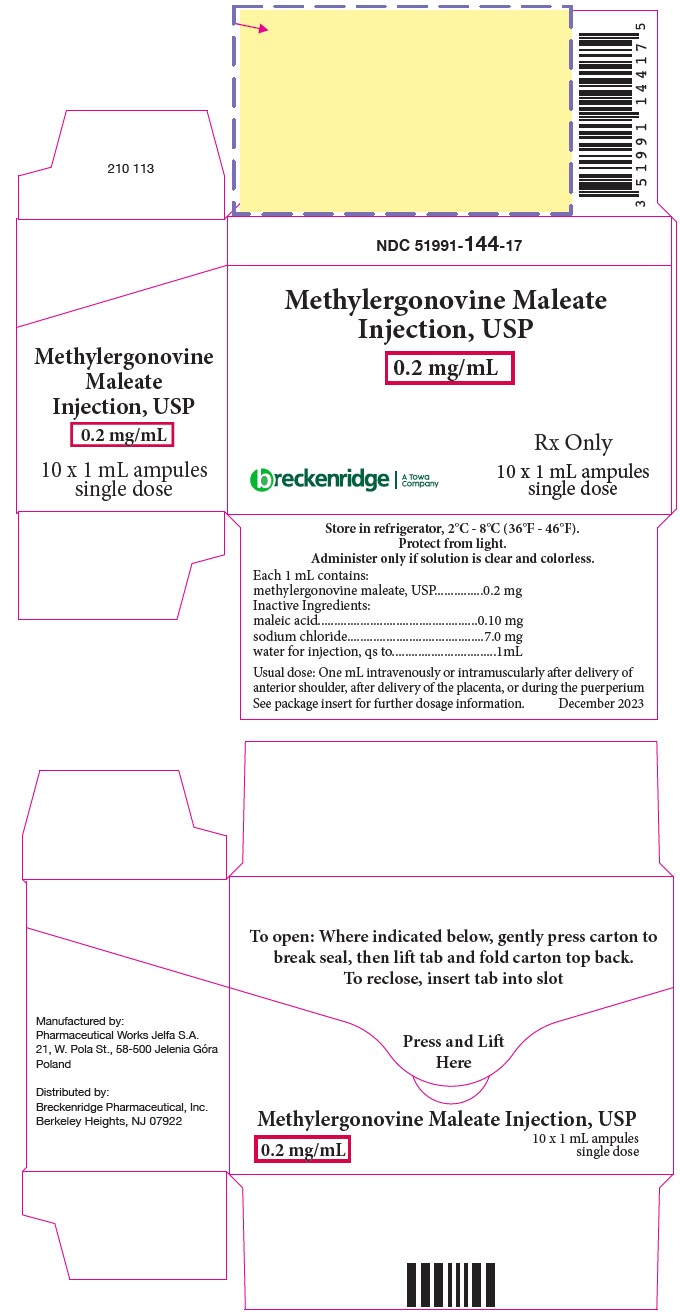
METHYLERGONOVINE MALEATE .2 mg/mL Injection, 10 ampules — NDC 51991-144-17 (Billing 51991-0144-17)
This is a package of 10 ampules of METHYLERGONOVINE MALEATE .2 mg/mL Injection from Breckenridge Pharmaceutical, Inc., marketed since Nov 2016 and currently FDA-listed. It is this product's only package size.
Other active recalls for Methylergonovine Maleate (different manufacturers) — 1 · tap to view
Identity & classification
Regulatory identifiers FDA, NLM and CMS codes for this package
Drug-database identifiers Medi-Span GPI and First Databank GCN / HICL / AHFS classification
- GSN (GCN sequence number): 003278
- GCN: 11340
- GPI-14 (Medi-Span): 29000020102005
- HICL (First Databank): 001446
- AHFS class code: 76:00.00.00
- RxCUI (RxNorm): 996828
Where does this data come from?
- FDA openFDA NDC Directory · synced Oct 1, 2026
- FDA label on DailyMed · label index refreshed Oct 1, 2026
- RxNorm (NLM RxNav) · catalog refreshed Oct 1, 2026
- Medi-Span GPI (licensed)
- First Databank (licensed) · refreshed Oct 1, 2026
RxNorm drug class
This medicine belongs to the Ergot Derivative class.
Where does this data come from?
- RxClass (NLM) · catalog refreshed Oct 1, 2026
Clinical
- It helps your uterus contract after delivery. That helps control heavy bleeding and helps the uterus shrink back to normal size. It can also be used to control uterine bleeding dur...
- The injection is given by your care team. If you are prescribed tablets, you take them by mouth several times a day after delivery, for no more than a week. Follow your prescriber’...
- Cramping or belly pain is common because the uterus is contracting. Nausea and vomiting can happen. Your blood pressure can go up or down, and headache can occur.
- Get help right away for chest pain, trouble breathing, a sudden severe headache, a seizure, or signs of stroke. Also report numb, tingling or cold fingers and toes, a rash or swell...
Patient education
Supplement & herbal interactions
Some supplements/herbs that may interact with Methylergonovine Maleate — tap one for details:
Where does this data come from?
- MedlinePlus (NLM) · refreshed Oct 1, 2026
- FDA label on DailyMed · label index refreshed Oct 1, 2026
Ask a licensed pharmacist directly — free, answered by our team.
Pricing
A drug doesn't have one price. Each row is a different public payment system, and none is what you'd pay at the counter — that depends on your insurance. The ⓘ on each row explains what it measures.
| Price system | Per each | Per package |
|---|---|---|
| Retail pharmacies payNADAC · weekly | Not in the retail survey — common for institutional, discontinued, or low-volume packs. | |
| Medicaid paysCMS SDUD · 12 mo | $35.59 | $355.88 / 10 ampules |
| Medicare drug plans payPart D · quarterly | No Part D plan price is available for this NDC in our data. | |
| Medicare Part B allowsASP · J2210 | $21.552 / J2210 unit | — |
Where does this data come from?
- CMS NADAC weekly file
- CMS ASP pricing files · refreshed Sep 20, 2026
- CMS Medicaid State Drug Utilization Data · through Q4 2025
- CMS Part D plan pricing files · refreshed Sep 24, 2026
- VA National Acquisition Center price file
Billing & reimbursement
Where does this data come from?
- CMS ASP NDC-HCPCS crosswalk · refreshed Sep 22, 2026
- DMEPDAC NDC-HCPCS crosswalk
- openFDA NSDE billing units · refreshed Sep 7, 2026
Packaging — all sizes for this product
| Package NDC | Description | Marketing start | Marketing end | Status |
|---|---|---|---|---|
| 51991-0144-17 You're viewing this Main listing | 10 AMPULE in 1 BOX / 1 mL in 1 AMPULE | 2016-11-07 | — | Active |
Therapeutic equivalents
| Product | Labeler | Pack | NADAC/unit | TE | Status | Price vs. this |
|---|---|---|---|---|---|---|
| Methylergonovine Maleate .2 mg/mL 00517-0740-20 | American | 20 vials | — | AP | FDA listed | — |
| Methylergonovine Maleate .2 mg/mL 51662-1556-01 | HF | 1 ml | — | AP | FDA listed | — |
| Methylergonovine Maleate .2 mg/mL 51662-1668-01 | HF | 1 ml | — | AP | FDA listed | — |
| Methylergonovine Maleate .2 mg/mLthis 51991-0144-17 | Breckenridge | 10 ampules | — | AP | FDA listed | — |
| Methylergonovine Maleate .2 mg/mL 63629-2074-01 | Bryant | 10 bottles | — | AP | FDA listed | — |
| Methylergonovine Maleate .2 mg/mL 63704-0004-01 | Pharmacist | 10 ampules | — | AP | FDA listed | — |
| Methylergonovine Maleate .2 mg/mL 72162-1592-02 | Bryant | 10 ampules | — | AP | FDA listed | — |
Where does this data come from?
- FDA openFDA NDC Directory · synced Oct 1, 2026
- FDA Orange Book · refreshed Sep 3, 2026
- CMS NADAC weekly file
Availability & generic status
This product is an FDA-approved generic. Other versions of the same drug are listed under Therapeutic equivalents, least expensive first.
Where does this data come from?
- FDA Orange Book · refreshed Sep 3, 2026
Inactive Ingredients / Excipients
Inactive ingredients, also called excipients, are components of the drug product other than the active ingredient. They may include fillers, dyes, coatings, preservatives, flavors, or other formulation ingredients.
💡 Tap an ingredient (hover on desktop) to see what it is and why it’s used.
-
UNII 91XW058U2C
Maleic acid is an organic acid derived from maleic anhydride. In medicines, it acts as a buffer to help maintain the proper pH level and may also serve as a preservative or stabilizing agent in the formulation.
-
UNII 451W47IQ8X
Sodium chloride is common table salt. It's used in medicines as a buffer to maintain proper pH, as a filler to add bulk, or to adjust the osmotic balance in liquid formulations.
-
UNII 059QF0KO0R
Water is a liquid solvent that dissolves and mixes ingredients together in liquid medicines, syrups, and injections. It helps distribute the active drug evenly throughout the product.
3 inactive ingredients listed in the exact product block matched to this NDC.
Where does this data come from?
ingredient classCode="IACT" elements from the exact product block matched by this NDC. Label-section narrative from DailyMed / the openFDA label index is shown separately when available.- FDA label on DailyMed · label index refreshed Oct 1, 2026
- FDA openFDA NDC Directory · synced Oct 1, 2026
Inactive ingredient FAQ
Are inactive ingredients the same for every manufacturer?
Why might an inactive ingredient be missing?
Can inactive ingredients matter?
Manufacturer & labeler
Where does this data come from?
- FDA openFDA NDC Directory · synced Oct 1, 2026
- Drugs@FDA
Full prescribing information FDA SPL
🎯 Indications and Usage ▾
INDICATIONS AND USAGE Following delivery of the placenta, for routine management of uterine atony, hemorrhage and subinvolution of the uterus. For control of uterine hemorrhage in the second stage of labor following delivery of the anterior shoulder.
⏱️ Dosage and Administration ▾
DOSAGE AND ADMINISTRATION Parenteral drug products should be inspected visually for particulate matter and discoloration prior to administration. Intramuscularly 1 mL, 0.2 mg, after delivery of the anterior shoulder, after delivery of the placenta, or during the puerperium. May be repeated as required, at intervals of 2-4 hours. Intravenously 1 mL, 0.2 mg, administered slowly over a period of no less than 60 seconds (See WARNINGS .)
⛔ Contraindications ▾
CONTRAINDICATIONS Hypertension; toxemia; pregnancy; and hypersensitivity.
⚠️ Warnings ▾
WARNINGS General This drug should not be administered I.V. routinely because of the possibility of inducing sudden hypertensive and cerebrovascular accidents. If I.V. administration is considered essential as a lifesaving measure, methylergonovine maleate should be given slowly over a period of no less than 60 seconds with careful monitoring of blood pressure. Intra-arterial or periarterial injection should be strictly avoided.
Caution should be exercised in the presence of impaired hepatic or renal function. Coronary artery disease Patients with coronary artery disease or risk factors for coronary artery disease (e.g., smoking, obesity, diabetes, high cholesterol) may be more susceptible to developing myocardial ischemia and infarction associated with methylergonovine-induced vasospasm. Risk of Adverse Reactions or Reduced Therapeutic Effect Due to Drug Interactions The concomitant use of Methylergonovine Maleate and certain drugs may result in potentially significant drug interactions, some of which may lead to adverse reactions or reduced therapeutic effect of Methylergonovine Maleate or the concomitant drug.
(see CONTRAINDICATION and DRUG INTERACTION ) Medication errors Inadvertent administration of Methylergonovine Maleate Injection to newborn infants has been reported. In these cases of inadvertent neonatal exposure, symptoms such as respiratory depression, convulsions, cyanosis and oliguria have been reported. Usual treatment is symptomatic.
However, in severe cases, respiratory and cardiovascular support is required. Methylergonovine Maleate Injection has been administered instead of vitamin K and Hepatitis B vaccine, medications which are routinely administered to the newborn. Due to the potential for accidental neonatal exposure, Methylergonovine Maleate Injection should be stored separately from medications intended for neonatal administration.
🤒 Adverse Reactions ▾
ADVERSE REACTIONS Clinical trials experience Common Adverse Reactions The most common adverse reaction is hypertension associated in several cases with seizure and/or headache. Hypotension has also been reported. Abdominal pain (caused by uterine contractions), nausea and vomiting have occurred occasionally.
Rare Adverse Reactions Rarely observed reactions have included: acute myocardial infarction, transient chest pains, vasoconstriction, vasospasm, coronary arterial spasm, bradycardia, tachycardia, dyspnea, hematuria, thrombophlebitis, water intoxication, hallucinations, leg cramps, dizziness, tinnitus, nasal congestion, diarrhea, diaphoresis, palpitation, rash, and foul taste. There have been rare isolated reports of anaphylaxis, without a proven causal relationship to the drug product. Post marketing Experience The following adverse drug reactions have been derived from post-marketing experience with Methylergonovine Maleate Injection via spontaneous case reports.
Because these reactions are reported voluntarily from a population of uncertain size, it is not possible to reliably estimate their frequency which is therefore categorized as not known. Nervous system disorders Cerebrovascular accident, paraesthesia Cardiac disorders Ventricular fibrillation, ventricular tachycardia, angina pectoris, atrioventricular block
🔄 Drug Interactions ▾
Drug Interactions CYP 3A4 Inhibitors (e.g., Macrolide Antibiotics and Protease Inhibitors) There have been rare reports of serious adverse events in connection with the coadministration of certain ergot alkaloid drugs (e.g., dihydroergotamine and ergotamine) and potent CYP 3A4 inhibitors, resulting in vasospasm leading to cerebral ischemia and/or ischemia of the extremities. Although there have been no reports of such interactions with methylergonovine alone, strong and moderate CYP 3A4 inhibitors should not be co-administered with methylergonovine.
Examples of some of the strong CYP 3A4 inhibitors include saquinavir, grapefruit juice, nefazodone, macrolide antibiotics (e.g., troleandomycin, clarithromycin), HIV protease or reverse transcriptase inhibitors (e.g., ritonavir, indinavir, nelfinavir) or azole antifungals (e.g., ketoconazole, itraconazole, voriconazole). Moderate inhibitors include fluconazole, fluvoxamine and clotrimazole. Weak CYP 3A4 inhibitors should be administered with caution.
Weak inhibitors include chlorzoxazone, cilostazol, and ranitidine. These lists are not exhaustive, and the prescriber should consider the effects on CYP 3A4 of other agents being considered for concomitant use with methylergonovine. CYP3A4 inducers Drugs (e.g. nevirapine, rifampin) that are strong inducers of CYP3A4 are likely to decrease the pharmacological action of Methylergonovine Maleate Injection.
Beta-blockers Caution should be exercised when Methylergonovine Maleate Injection is used concurrently with beta-blockers. Concomitant administration with beta-blockers may enhance the vasoconstrictive action of ergot alkaloids. Anesthetics Anesthetics like halothane and methoxyflurane may reduce the oxytocic potency of Methylergonovine Maleate Injection.
Glyceryl trinitrate and other antianginal drugs Methylergonovine maleate produces vasoconstriction and can be expected to reduce the effect of glyceryl trinitrate and other antianginal drugs. No pharmacokinetic interactions involving other cytochrome P450 isoenzymes are known. Caution should be exercised when Methylergonovine Maleate Injection is used concurrently with other vasoconstrictors, ergot alkaloids, or prostaglandins.
🤰 Pregnancy ▾
Pregnancy Use of Methylergonovine Maleate is contraindicated during pregnancy because of its uterotonic effects. (See INDICATIONS AND USAGE ) Animal reproductive studies have not been conducted with Methylergonovine Maleate. It is not known whether Methylergonovine Maleate can cause fetal harm or can affect reproductive capacity.
🧒 Pediatric Use ▾
Pediatric Use Safety and effectiveness in pediatric patients have not been established.
🧓 Geriatric Use ▾
Geriatric Use Clinical studies of methylergonovine maleate did not include sufficient number of subjects aged 65 and over to determine whether they respond differently from younger subjects. Other reported clinical experience has not identified differences in response between the elderly and younger patients. In general dose selection for an elderly patient should be cautious, usually starting at the low end of the dosing range, reflecting the greater frequency of decreased hepatic, renal, or cardiac function, and of concomitant disease or other drug therapy.
🆘 Overdosage ▾
OVERDOSAGE Symptoms of acute overdose may include: nausea, vomiting, oliguria, abdominal pain, numbness, tingling of the extremities, rise in blood pressure, in severe cases followed by hypotension, respiratory depression, hypothermia, convulsions, and coma. Because reports of overdosage with methylergonovine maleate are infrequent, the lethal dose in humans has not been established. The oral LD 50 (in mg/kg) for the mouse is 187, the rat 93, and the rabbit 4.5.
Several cases of accidental Methylergonovine Maleate Injection in newborn infants have been reported, and in such cases 0.2 mg represents an overdose of great magnitude. However, recovery occurred in all but one case following a period of respiratory depression, hypothermia, hypertonicity with jerking movements, and convulsions. Also, several children 1-3 years of age have accidentally ingested up to 10 tablets (2 mg) with no apparent ill effects.
A postpartum patient took 4 tablets at one time in error and reported paresthesias and clamminess as her only symptoms. Treatment of acute overdosage is symptomatic and includes the usual procedures of: 1. removal of offending drug by inducing emesis, gastric lavage, catharsis, and supportive diuresis. 2. maintenance of adequate pulmonary ventilation, especially if convulsions or coma develop.
3. correction of hypotension with pressor drugs as needed. 4. control of convulsions with standard anticonvulsant agents. 5. control of peripheral vasospasm with warmth to the extremities if needed.
🧬 Clinical Pharmacology ▾
CLINICAL PHARMACOLOGY Mechanism of Action Methylergonovine maleate acts directly on the smooth muscle of the uterus and increases the tone, rate, and amplitude of rhythmic contractions. Thus, it induces a rapid and sustained tetanic uterotonic effect which shortens the third stage of labor and reduces blood loss. Pharmacodynamics The onset of action after IV administration is immediate; after IM administration, 2-5 minutes, and after oral administration, 5-10 minutes.
Pharmacokinetics Pharmacokinetic studies following an IV injection have shown that methylergonovine is rapidly distributed from plasma to peripheral tissues within 2-3 minutes or less. The bioavailability after oral administration was reported to be about 60% with no accumulation after repeated doses. During delivery, with intramuscular injection, bioavailability increased to 78%.
Ergot alkaloids are mostly eliminated by hepatic metabolism and excretion, and the decrease in bioavailability following oral administration is probably a result of first-pass metabolism in the liver. Bioavailability studies conducted in fasting healthy female volunteers have shown that oral absorption of a 0.2 mg methylergonovine tablet was fairly rapid with a mean peak plasma concentration of 3243 ± 1308 pg/mL observed at 1.12 ± 0.82 hours. A delayed gastrointestinal absorption (T max about 3 hours) of methylergonovine maleate tablet might be observed in postpartum women during continuous treatment with this oxytocic agent.
For a 0.2 mg intramuscular (IM) injection, a mean peak plasma concentration of 5918 ± 1952 pg/mL was observed at 0.41 ± 0.21 hours. The extent of absorption of the tablet, based upon methylergonovine plasma concentrations, was found to be equivalent to that of the IM solution given orally, and the extent of oral absorption of the IM solution was proportional to the dose following administration of 0.1, 0.2, and 0.4 mg. When given intramuscularly, the extent of absorption of methylergonovine maleate solution was about 25% greater than the tablet.
The volume of distribution (Vd ss /F) of intramuscularly administered methylergonovine was calculated to be 56.1 ± 17.0 liters, and the plasma clearance (CLp/F) was calculated to be 14.4 ± 4.5 liters per hour. The decline of plasma level of intramuscularly administered methylergonovine was biphasic with a mean elimination half-life of 3.39 hours (range 1.5 to 12.7 hours).
🧬 Mechanism of Action ▾
Mechanism of Action Methylergonovine maleate acts directly on the smooth muscle of the uterus and increases the tone, rate, and amplitude of rhythmic contractions. Thus, it induces a rapid and sustained tetanic uterotonic effect which shortens the third stage of labor and reduces blood loss.
📦 How Supplied / Storage and Handling ▾
HOW SUPPLIED Ampules 1 mL size Boxes of 10 NDC 51991-144-17 Store and Dispense Ampules: Store in refrigerator, 2°C-8°C (36°F-46°F). Protect from light. Administer only if solution is clear and colorless.
📦 Storage and Handling ▾
Store and Dispense Ampules: Store in refrigerator, 2°C-8°C (36°F-46°F). Protect from light. Administer only if solution is clear and colorless.
📋 Description ▾
DESCRIPTION Methylergonovine Maleate Injection, USP is a semi-synthetic ergot alkaloid used for the prevention and control of postpartum hemorrhage. Methylergonovine Maleate Injection, USP is available in sterile ampules of 1 mL, containing 0.2 mg methylergonovine maleate for intramuscular or intravenous injection. Ampules: 1 mL, clear, colorless solution.
Active Ingredient: methylergonovine maleate, USP, 0.2 mg. Inactive Ingredients: maleic acid, 0.10 mg; sodium chloride, 7.0 mg; water for injection, qs to 1 mL. Chemically, methylergonovine maleate is designated as ergoline-8-carboxamide, 9,10-didehydro- N -[l-(hydroxymethyl)propyl ]-6-methyl-, [8β( S )]-, ( Z )-2-butenedioate (1:1) (salt).
Its structural formula is C 20 H 25 N 3 O 2 ∙C 4 H 4 O 4 Mol. wt. - 455.51 Chemical Structure
Medicaid utilization & spend
Medicare Part D spend CMS · PART D · 2026 (Q1)
About this NDC listing & data coverage
What data is (and isn’t) available for this NDC — tap to expand
| NDC identity (package / product / labeler codes) | ✓ Available |
| Labeler | ✓ Available |
| Product & package description | ✓ Available |
| Marketing category & status | ✓ Available |
| Active ingredient / dosage form / route | ✓ Available |
| FDA label (SPL via DailyMed) | ✓ Available |
| Package photos | ✓ Available |
| Inactive ingredients (structured) | ✓ Available |
| NADAC pharmacy acquisition price (CMS) | — Not published for this NDC CMS publishes NADAC only for NDCs reported in its retail-pharmacy survey. |
| Orange Book / therapeutic-equivalence data | ✓ Available |
| HCPCS J-code billing crosswalk | ✓ Available |
| Medicaid utilization (CMS SDUD) | ✓ Available |