
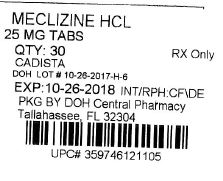
MECLIZINE HYDROCHLORIDE Meclizine Hydrocloride 25 mg Tablet, 30-count
🆔 Identity & classification
Where does this data come from?
🏭 Manufacturer & labeler
Where does this data come from?
🩺 Clinical
- Meclizine is mainly used to prevent and treat the nausea, vomiting, and dizziness that comes with motion sickness — whether you're on a boat, in a car, or on a plane. It's also use...
- For the best chance of preventing motion sickness, take meclizine about one hour before you start traveling. After that first dose, you can take it once every 24 hours as needed fo...
- Yes, drowsiness is the most common side effect — it's actually worth planning around. Avoid driving or operating heavy machinery until you know how it affects you. And definitely s...
- This one requires a conversation with your doctor. Human studies haven't clearly linked meclizine to birth defects, but animal studies did show fetal harm at doses similar to what...
Patient education
Supplement & herbal interactions
Where does this data come from?
Ask a licensed pharmacist directly — free, answered by our team.
💊 What it looks like
Where does this data come from?
🧪 Inactive Ingredients / Excipients
Inactive ingredients, also called excipients, are components of the drug product other than the active ingredient. They may include fillers, dyes, coatings, preservatives, flavors, or other formulation ingredients.
💡 Tap an ingredient (hover on desktop) to see what it is and why it’s used.
-
UNII LMI26O6933
Alumina is a white powder form of aluminum oxide. It's used as a filler to add bulk to tablets and capsules, and sometimes as a thickening or anti-caking agent in powdered formulations.
-
UNII OP1R32D61U
Microcrystalline cellulose is a purified form of cellulose, a natural fiber from plant sources. It acts as a binder and filler in tablets and capsules, helping hold ingredients together and give the medicine its shape and size.
-
UNII M28OL1HH48
Croscarmellose sodium is a plant-based substance derived from cellulose. It acts as a disintegrant, helping tablets and capsules break down quickly in the digestive system so the medicine can be absorbed.
-
UNII 35SW5USQ3G
A synthetic yellow dye used to color medicines. It helps make tablets, capsules, and liquids visually distinct so patients can easily identify their medication.
-
UNII EWQ57Q8I5X
Lactose monohydrate is a natural sugar derived from milk. It serves as a filler and binder in tablets and capsules, helping create the proper size, texture, and consistency of the medicine.
-
UNII 70097M6I30
Magnesium stearate is a salt made from magnesium and stearic acid, a fatty substance. It's used in tablets and capsules as a lubricant and glidant to help ingredients flow smoothly during manufacturing and prevent sticking.
-
UNII ETJ7Z6XBU4
Silicon dioxide is a naturally occurring mineral used as a glidant and anti-caking agent. It helps powder ingredients flow smoothly and prevents clumping during manufacturing and storage.
7 inactive ingredients listed in the exact product block matched to this NDC.
Where does this data come from?
ingredient classCode="IACT" elements from the exact product block matched by this NDC. Label-section narrative from DailyMed / the openFDA label index is shown separately when available.Inactive ingredient FAQ
Are inactive ingredients the same for every manufacturer?
Why might an inactive ingredient be missing?
Can inactive ingredients matter?
💲 Pricing
A drug doesn't have one price. Each row is a different public payment system, and none is what you'd pay at the counter — that depends on your insurance. The ⓘ on each row explains what it measures.
| Price system | Per each | Per package |
|---|---|---|
| Retail pharmacies payNADAC · weekly | Not in the retail survey — common for institutional, discontinued, or low-volume packs. | |
| Medicaid paysCMS SDUD · 12 mo | No recent Medicaid claims on file for this NDC — rare and low-volume NDCs are suppressed in the public data. | |
| Medicare drug plans payPart D · quarterly | No Part D plan price is available for this NDC in our data. | |
Where does this data come from?
🔁 Therapeutic equivalents
| Product | Labeler | Pack | NADAC/unit | TE | Status | Price vs. this |
|---|---|---|---|---|---|---|
| Meclizine Hydrochloride 25 mgthis 53808-1116-01 | DOH | 30 tablets | — | AA | Discontinued | — |
Where does this data come from?
⏳ Availability & generic status
This product is an FDA-approved generic. Other versions of the same drug are listed under Therapeutic equivalents, least expensive first.
Where does this data come from?
🔬 Reported adverse events (FAERS)
Top reported reactions
Age at onset
Reporter sex
Where does this data come from?
📦 Packaging — all sizes for this product
| Package NDC | Description | Marketing start | Status |
|---|---|---|---|
| 53808-1116-01 You're viewing this | 30 TABLET in 1 BLISTER PACK (53808-1116-1) | 2017-10-26 | Inactivated by FDA |
🧭 About this NDC listing & data coverage
What data is (and isn’t) available for this NDC — tap to expand
| NDC identity (package / product / labeler codes) | ✓ Available |
| Labeler | ✓ Available |
| Product & package description | ✓ Available |
| Marketing category & status | ✓ Available |
| Active ingredient / dosage form / route | ✓ Available |
| FDA label (SPL via DailyMed) | ✓ Available |
| Package photos | ✓ Available |
| Inactive ingredients (structured) | ✓ Available |
| NADAC pharmacy acquisition price (CMS) | — Not published for this NDC CMS publishes NADAC only for NDCs reported in its retail-pharmacy survey. |
| Orange Book / therapeutic-equivalence data | ✓ Available |
| HCPCS J-code billing crosswalk | — Not published for this NDC Most self-administered / retail products have no J-code — that is normal. |
| Medicaid utilization (CMS SDUD) | — Not published for this NDC CMS reports utilization only for NDCs with Medicaid claims above its privacy threshold. |
Questions about this listing
Why is there no price listed?
What does the discontinued status mean for this NDC?
Is the NDC printed on the package the same as the 11-digit billing NDC?
What do the three segments of this NDC mean?
Who lists this product with the FDA?
Do I need a prescription for this product?
Where does this data come from?
📄 Full prescribing information FDA SPL
🎯 Indications and Usage ▾
INDICATIONS AND USAGE Meclizine hydrochloride tablets are indicated for the treatment of vertigo associated with diseases affecting the vestibular system.
⏱️ Dosage and Administration ▾
DOSAGE AND ADMINISTRATION For the treatment of vertigo associated with diseases affecting the vestibular system, the recommended dose is 25 to 100 mg daily, in divided dosage, depending upon clinical response.
⛔ Contraindications ▾
CONTRAINDICATIONS Meclizine hydrochloride tablets are contraindicated in individuals who have shown a previous hypersensitivity to it.
⚠️ Warnings ▾
WARNINGS Since drowsiness may, on occasion, occur with use of this drug, patients should be warned of this possibility and cautioned against driving a car or operating dangerous machinery. Patients should avoid alcoholic beverages while taking this drug. Due to its potential anticholinergic action, this drug should be used with caution in patients with asthma, glaucoma, or enlargement of the prostate gland.
🤒 Adverse Reactions ▾
ADVERSE REACTIONS Anaphylactoid reaction, drowsiness, dry mouth, headache, fatigue, vomiting and, on rare occasions, blurred vision have been reported. To report SUSPECTED ADVERSE REACTIONS, contact Jubilant Cadista Pharmaceuticals Inc. at 1-800-313-4623 or FDA at 1-800-FDA-1088 or www.fda.gov/medwatch.
🧬 Clinical Pharmacology ▾
CLINICAL PHARMACOLOGY Meclizine hydrochloride is an antihistamine that shows marked protective activity against nebulized histamine and lethal doses of intravenously injected histamine in guinea pigs. It has a marked effect in blocking the vasodepressor response to histamine, but only a slight blocking action against acetylcholine. Its activity is relatively weak in inhibiting the spasmogenic action of histamine on isolated guinea pig ileum.
Pharmacokinetics The available pharmacokinetic information for meclizine following oral administration has been summarized from published literature. Absorption Meclizine is absorbed after oral administration with maximum plasma concentrations reaching at a median T max value of 3 hours post-dose (range: 1.5 to 6 hours) for the tablet dosage form. Distribution Drug distribution characteristics for meclizine in humans are unknown.
Metabolism The metabolic fate of meclizine in humans is unknown. In an in vitro metabolic study using human hepatic microsome and recombinant CYP enzyme, CYP2D6 was found to be the dominant enzyme for metabolism of meclizine. The genetic polymorphism of CYP2D6 that results in extensive-, poor-, intermediate- and ultra-rapid metabolizer phenotypes could contribute to large inter-individual variability in meclizine exposure.
Elimination Meclizine has a plasma elimination half-life of about 5-6 hours in humans.
📦 How Supplied / Storage and Handling ▾
HOW SUPPLIED Meclizine hydrochloride tablets, USP are available in the following strengths: 12.5 mg (Blue, oval shaped tablets, debossed with “TL 122” with score on one side and plain on the other side.) 25 mg (Yellow, oval shaped tablets, debossed with “TL 121” with score on one side and plain on the other side.) They are supplied by DOH CENTRAL PHARMACY as follows: NDC Strength Quantity/Form Color Source Prod. Code 53808-1116-1 25 MG 30 Tablets in a Blister Pack YELLOW 59746-121 Store at 20 to 25°C (68 to 77°F) [See USP Controlled Room Temperature].
Manufactured By: Jubilant Cadista Pharmaceuticals Inc. Salisbury, MD 21801, USA This Product was Repackaged By: DOH CENTRAL PHARMACY 104 HAMILTON PARK DR # 2 TALLAHASSEE, FL 32304 USA
📋 Description ▾
DESCRIPTION Chemically, Meclizine HCl is 1-( p -chloro-α-phenylbenzyl)-4-( m -methylbenzyl) piperazine dihydrochloride monohydrate. C 25 H 27 ClN 2 • 2HCl • H 2 O Molecular Weight 481 . 88 Meclizine hydrochloride tablets, USP are available in two different strengths: 12.5 mg and 25 mg.
In addition each tablet contains the following inactive ingredients: Colloidal Silicon Dioxide, Croscarmellose Sodium, Lactose Monohydrate, Magnesium Stearate, Microcrystalline Cellulose. Also, Meclizine hydrochloride tablets USP, 12.5 mg contains FD&C Blue #1 Aluminum Lake (11-13%) and Meclizine hydrochloride tablets USP, 25 mg contains D&C Yellow #10 Aluminum Lake (15-20%). Structure of Meclizine HCl