
Isosulfan Blue 50 mg/5mL Injection, Solution — NDC 55150-240-06 (Billing 55150-0240-06)
This is a package of Isosulfan Blue 50 mg/5mL Injection, Solution from Eugia US LLC, marketed since Feb 2016 and currently FDA-listed.
Identity & classification
Regulatory identifiers FDA, NLM and CMS codes for this package
Drug-database identifiers Medi-Span GPI and First Databank GCN / HICL / AHFS classification
- GSN (GCN sequence number): 011705
- GCN: 11110
- GPI-14 (Medi-Span): 94200061002020
- HICL (First Databank): 004533
- AHFS class code: 36:46.00.00
Where does this data come from?
- FDA openFDA NDC Directory · synced Oct 1, 2026
- FDA label on DailyMed · label index refreshed Oct 1, 2026
- RxNorm (NLM RxNav) · catalog refreshed Oct 1, 2026
- Medi-Span GPI (licensed)
- First Databank (licensed) · refreshed Oct 1, 2026
Clinical
Patient education
Supplement & herbal interactions
Where does this data come from?
- MedlinePlus (NLM) · refreshed Oct 1, 2026
- FDA label on DailyMed · label index refreshed Oct 1, 2026
Ask a licensed pharmacist directly — free, answered by our team.
Pricing
A drug doesn't have one price. Each row is a different public payment system, and none is what you'd pay at the counter — that depends on your insurance. The ⓘ on each row explains what it measures.
| Price system | Per mL | Per package |
|---|---|---|
| Retail pharmacies payNADAC · weekly | Not in the retail survey — common for institutional, discontinued, or low-volume packs. | |
| Medicaid paysCMS SDUD · 12 mo | No recent Medicaid claims on file for this NDC — rare and low-volume NDCs are suppressed in the public data. | |
| Medicare drug plans payPart D · quarterly | No Part D plan price is available for this NDC in our data. | |
Where does this data come from?
- CMS NADAC weekly file
- CMS ASP pricing files · refreshed Sep 20, 2026
- CMS Medicaid State Drug Utilization Data · refreshed Oct 3, 2026
- CMS Part D plan pricing files · refreshed Sep 24, 2026
- VA National Acquisition Center price file
Packaging — all sizes for this product
| Package NDC | Description | Marketing start | Marketing end | Status |
|---|---|---|---|---|
| 55150-0240-05 55150-240-05 Main listing | 6 VIAL in 1 CARTON / 5 mL in 1 VIAL | 2016-02-02 | — | Active |
| 55150-0240-06 You're viewing this | 6 VIAL in 1 CARTON / 5 mL in 1 VIAL | 2016-02-02 | — | Active |
Pack size FAQ
What quantity is in this package?
What NDC number is used to bill for this package of Isosulfan Blue 50 mg/5mL Injection, Solution?
Therapeutic equivalents
| Product | Labeler | Pack | NADAC/unit | TE | Status | Price vs. this |
|---|---|---|---|---|---|---|
| Isosulfan Blue 50 mg/5mLthis 55150-0240-06 | Eugia | 6 vials | — | AP | FDA listed | — |
Where does this data come from?
- FDA openFDA NDC Directory · synced Oct 1, 2026
- FDA Orange Book · refreshed Sep 3, 2026
- CMS NADAC weekly file
Availability & generic status
This product is an FDA-approved generic. Other versions of the same drug are listed under Therapeutic equivalents, least expensive first.
Where does this data come from?
- FDA Orange Book · refreshed Sep 3, 2026
Inactive Ingredients / Excipients
Inactive ingredients, also called excipients, are components of the drug product other than the active ingredient. They may include fillers, dyes, coatings, preservatives, flavors, or other formulation ingredients.
💡 Tap an ingredient (hover on desktop) to see what it is and why it’s used.
-
UNII 4J9FJ0HL51
Potassium phosphate, monobasic is a salt compound used in medicines as a pH buffer and electrolyte source. It helps stabilize the acidity level of liquid and powdered formulations.
-
UNII 94255I6E2T
Sodium phosphate dibasic dihydrate is a salt that helps control the acidity level of a medicine. It acts as a buffer and pH regulator to keep the medication stable and effective.
-
UNII 059QF0KO0R
Water is a liquid solvent that dissolves and mixes ingredients together in liquid medicines, syrups, and injections. It helps distribute the active drug evenly throughout the product.
3 inactive ingredients listed in the exact product block matched to this NDC.
Where does this data come from?
ingredient classCode="IACT" elements from the exact product block matched by this NDC. Label-section narrative from DailyMed / the openFDA label index is shown separately when available.- FDA label on DailyMed · label index refreshed Oct 1, 2026
- FDA openFDA NDC Directory · synced Oct 1, 2026
Inactive ingredient FAQ
Are inactive ingredients the same for every manufacturer?
Why might an inactive ingredient be missing?
Can inactive ingredients matter?
Manufacturer & labeler
Where does this data come from?
- FDA openFDA NDC Directory · synced Oct 1, 2026
- Drugs@FDA
Full prescribing information FDA SPL
🎯 Indications and Usage ▾
1 INDICATIONS AND USAGE Isosulfan blue injection 1% upon subcutaneous administration, delineates the lymphatic vessels draining the region of injection. It is an adjunct to lymphography in: primary and secondary lymphedema of the extremities; chyluria, chylous ascites or chylothorax; lymph node involvement by primary or secondary neoplasm; lymph node response to therapeutic modalities (1.1).
1.1Lymphatic Vessel Delineation Isosulfan blue injection 1% upon subcutaneous administration, delineates lymphatic vessels draining the region of injection. It is an adjunct to lymphography in: primary and secondary lymphedema of the extremities; chyluria, chylous ascites or chylothorax; lymph node involvement by primary or secondary neoplasm; and lymph node response to therapeutic modalities.
⏱️ Dosage and Administration ▾
2 DOSAGE AND ADMINISTRATION Isosulfan blue injection 1% is to be administered subcutaneously, one-half (1/2) mL into three (3) interdigital spaces of each extremity per study. A maximum dose of 3 mL (30 mg) isosulfan blue is, therefore, injected (2.1).
2.1Subcutaneous administration Isosulfan blue injection 1% is to be administered subcutaneously, one-half (1/2) mL into three (3) interdigital spaces of each extremity per study. A maximum dose of 3 mL (30 mg) isosulfan blue is, therefore, injected.
💊 Dosage Forms and Strengths ▾
3 DOSAGE FORMS AND STRENGTHS 1% aqueous solution (isosulfan blue) 1% aqueous solution (isosulfan blue)
⛔ Contraindications ▾
4 CONTRAINDICATIONS Isosulfan blue injection 1% is contraindicated in those individuals with known hypersensitivity to triphenylmethane or related compounds. Hypersensitivity to triphenylmethane or related compounds (4).
⚠️ Warnings and Cautions ▾
5 WARNINGS AND PRECAUTIONS Life-threatening anaphylactic reactions have occurred after isosulfan blue 1% administration. Monitor patients closely for at least 60 minutes after administration of isosulfan blue 1% (5.1). The admixture of isosulfan blue 1% with local anesthetics results in an immediate precipitation of 4 to 9% drug complex.
Use a separate syringe for anesthetics (5.2). Isosulfan blue 1% interferes with measurements in peripheral blood pulse oximetry. Arterial blood gas analysis may be needed (5.3).
5.1Hypersensitivity Reactions Life-threatening anaphylactic reactions (respiratory distress, shock, angioedema) have occurred after isosulfan blue 1% administration. Reactions are more likely to occur in patients with a history of bronchial asthma, allergies, drug reactions or previous reactions to triphenylmethane dyes. Monitor patients closely for at least 60 minutes after administration of isosulfan blue 1%.
Trained personnel should be available to administer emergency care including resuscitation.
5.2Precipitation of Isosulfan Blue 1% by Lidocaine The admixture of isosulfan blue 1% (with local anesthetics (i.e. lidocaine)) in the same syringe results in an immediate precipitation of 4 to 9% drug complex. Use a separate syringe to administer a local anesthetic.
5.3Interference with Oxygen Saturation and Methemoglobin Measurements Isosulfan blue 1% interferes with measurements of oxygen saturation in peripheral blood by pulse oximetry and can cause falsely low readings. The interference effect is maximal at 30 minutes and minimal generally by four hours after administration. Arterial blood gas analysis may be needed to verify decreased arterial partial pressure of oxygen.
Isosulfan blue 1% may also cause falsely elevated readings of methemoglobin by arterial blood gas analyzer. Therefore, co-oximetry may be needed to verify methemoglobin level.
🤒 Adverse Reactions ▾
6 ADVERSE REACTIONS Hypersensitivity Reactions : Hypersensitivity reactions occurring approximately 2% of patients and include life-threatening anaphylactic reactions with respiratory distress, shock, angioedema, urticaria, pruritus. A death has been reported following I.V. administration of a similar compound (6) . To report SUSPECTED ADVERSE REACTIONS, contact Eugia US LLC at 1-866-850-2876 or FDA at 1-800-FDA-1088 or www.fda.gov/medwatch .
6.1Postmarketing Experience Hypersensitivity Reactions: Case series report an overall incidence of hypersensitivity reactions in approximately 2% of patients. Life-threatening anaphylactic reactions have occurred. Manifestations include respiratory distress, shock, angioedema, urticaria, pruritus.
A death has been reported following administration of a similar compound employed to estimate the depth of a severe burn. Reactions are more likely to occur in patients with a personal or family history of bronchial asthma, significant allergies, drug reactions or previous reactions to triphenylmethane dyes [see Warnings and Precautions (5)]. Laboratory Tests: Isosulfan blue 1% interferes with measurements of oxygen saturation by pulse oximetry and of methemoglobin by gas analyzer [see Warnings and Precautions (5)].
Skin: transient or long-term (tattooing) blue coloration.
🔄 Drug Interactions ▾
7 DRUG INTERACTIONS No drug interactions have been identified with isosulfan blue 1%. No drug interactions have been identified for isosulfan blue 1% (7).
👥 Use in Specific Populations ▾
8 USE IN SPECIFIC POPULATIONS Caution should be exercised when isosulfan blue 1% is administered to nursing mothers (8.3). Safety and effectiveness of isosulfan blue 1% in children has not been established (8.4).
8.3Nursing Mothers It is not known whether this drug is excreted in human milk. Because many drugs are excreted in human milk, caution should be exercised when isosulfan blue 1% is administered to a nursing mother.
8.4Pediatric Use Safety and effectiveness of isosulfan blue 1% in children have not been established.
🧒 Pediatric Use ▾
8.4Pediatric Use Safety and effectiveness of isosulfan blue 1% in children have not been established.
🆘 Overdosage ▾
10 OVERDOSAGE Do not exceed indicated recommended dosage as overdosage levels have not been identified for isosulfan blue 1%.
🧬 Clinical Pharmacology ▾
12 CLINICAL PHARMACOLOGY
12.2Pharmacodynamics Following subcutaneous administration, isosulfan blue 1% binds to serum proteins and is picked up by the lymphatic vessels. Thus, the lymphatic vessels are delineated by the blue dye.
12.3Pharmacokinetics Up to 10% of the subcutaneously administered dose of isosulfan blue 1% is excreted unchanged in the urine in 24 hours in human.
📦 How Supplied / Storage and Handling ▾
16 HOW SUPPLIED/STORAGE AND HANDLING Isosulfan blue injection 1% is a sterile, non-pyrogenic, aqueous dark blue color solution and is supplied as follows: Isosulfan blue injection 1% 50 mg per 5 mL (10 mg / mL): 5 mL Single-Dose Vials in a Carton of 6 NDC 55150-240-05 Store at 20° to 25°C (68° to 77°F) [see USP Controlled Room Temperature]. Avoid excessive heat. Discard unused portion. The vial stoppers are not made with natural rubber latex.
📋 Description ▾
11 DESCRIPTION The chemical name of isosulfan blue is N-[4-[[4-(diethylamino)phenyl] (2,5-disulfophenyl) methylene]-2,5-cyclohexadien-1-ylidene]-N-ethylethanaminium hydroxide, inner salt, sodium salt. Isosulfan blue is a greenish blue color hygroscopic powder. Its structural formula is: Isosulfan blue injection 1% is a sterile, non-pyrogenic, aqueous dark blue color solution for subcutaneous administration.
Phosphate buffer in water for injection is added in sufficient quantity to yield a final pH of 6.8 to 7.4. Each mL of solution contains 10 mg isosulfan blue, 6.6 mg sodium monohydrogen phosphate and 2.7 mg potassium dihydrogen phosphate. The solution contains no preservative.
Isosulfan blue injection 1% is a contrast agent for the delineation of lymphatic vessels. isosulfan-str
💬 Information for Patients ▾
17 PATIENT COUNSELING INFORMATION Inform patients that urine color may be blue for 24 hours following administration of isosulfan blue injection 1%. Distributed by: Eugia US LLC 279 Princeton-Hightstown Rd. E. Windsor, NJ 08520 Manufactured by: Eugia Pharma Specialities Limited Hyderabad - 500032 India
🍼 Nursing Mothers ▾
8.3Nursing Mothers It is not known whether this drug is excreted in human milk. Because many drugs are excreted in human milk, caution should be exercised when isosulfan blue 1% is administered to a nursing mother.
🧬 Pharmacokinetics ▾
12.3Pharmacokinetics Up to 10% of the subcutaneously administered dose of isosulfan blue 1% is excreted unchanged in the urine in 24 hours in human.
🧬 Pharmacodynamics ▾
12.2Pharmacodynamics Following subcutaneous administration, isosulfan blue 1% binds to serum proteins and is picked up by the lymphatic vessels. Thus, the lymphatic vessels are delineated by the blue dye.
🧪 Nonclinical Toxicology ▾
13 NONCLINICAL TOXICOLOGY
13.1Carcinogenesis, Mutagenesis, Impairment of Fertility Long-term studies in animals have not been performed to evaluate the carcinogenic potential of isosulfan blue 1%. Reproduction studies in animals have not been conducted and, therefore, it is unknown if a problem concerning mutagenesis or impairment of fertility in either males or females exists.
13.2Teratogenic Effects Pregnancy Category C. Animal reproduction studies have not been conducted with isosulfan blue 1%. It is not known whether isosulfan blue 1% can cause fetal harm when administered to a pregnant woman or can affect reproduction capacity. Isosulfan blue 1% should be given to a pregnant woman only if clearly needed.
📄 Carcinogenesis, Mutagenesis, Impairment of Fertility ▾
13.1Carcinogenesis, Mutagenesis, Impairment of Fertility Long-term studies in animals have not been performed to evaluate the carcinogenic potential of isosulfan blue 1%. Reproduction studies in animals have not been conducted and, therefore, it is unknown if a problem concerning mutagenesis or impairment of fertility in either males or females exists.
📄 Package Label / Principal Display Panel ▾
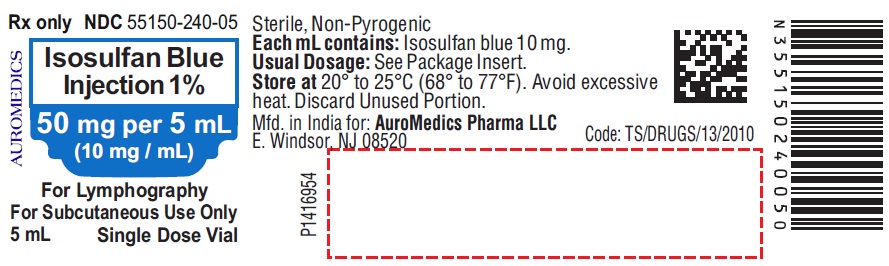
PACKAGE LABEL-PRINCIPAL DISPLAY PANEL - 1% [50 mg per 5 mL (10 mg / mL)] - Container Label Rx only NDC 55150-240-05 Isosulfan Blue Injection 1% 50 mg per 5 mL (10 mg / mL) For Lymphography For Subcutaneous Use Only 5 mL Single-Dose Vial isosulfan-fig1
PACKAGE LABEL-PRINCIPAL DISPLAY PANEL - 1% [50 mg per 5 mL (10 mg / mL)] - Container-Carton (6 Vials) Rx only NDC 55150-240-05 Isosulfan Blue Injection 1% 50 mg per 5 mL (10 mg / mL) For Lymphography For Subcutaneous Use Only Sterile 6 X 5 mL Non-Pyrogenic Single-Dose Vials eugia isosulfan-fig2
About this NDC listing & data coverage
What data is (and isn’t) available for this NDC — tap to expand
| NDC identity (package / product / labeler codes) | ✓ Available |
| Labeler | ✓ Available |
| Product & package description | ✓ Available |
| Marketing category & status | ✓ Available |
| Active ingredient / dosage form / route | ✓ Available |
| FDA label (SPL via DailyMed) | ✓ Available |
| Package photos | ✓ Available |
| Inactive ingredients (structured) | ✓ Available |
| NADAC pharmacy acquisition price (CMS) | — Not published for this NDC CMS publishes NADAC only for NDCs reported in its retail-pharmacy survey. |
| Orange Book / therapeutic-equivalence data | ✓ Available |
| HCPCS J-code billing crosswalk | — Not published for this NDC Most self-administered / retail products have no J-code — that is normal. |
| Medicaid utilization (CMS SDUD) | — Not published for this NDC CMS reports utilization only for NDCs with Medicaid claims above its privacy threshold. |