
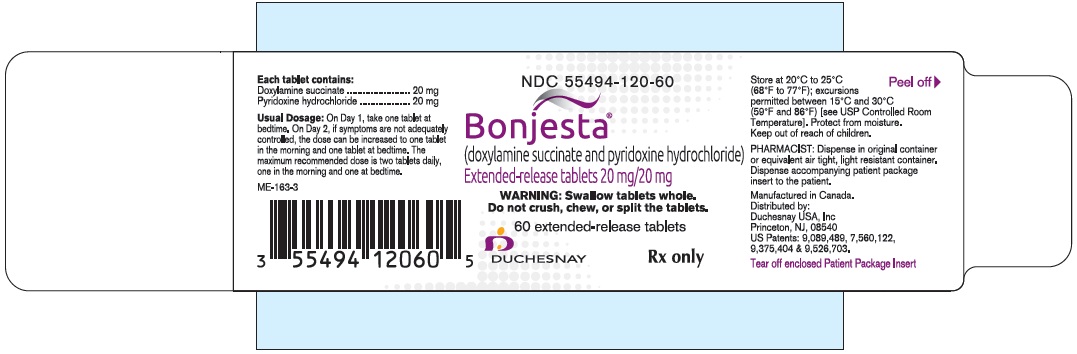
Bonjesta doxylamine succinate and pyridoxine hydrochloride 20 mg; 20 mg Tablet, Extended Release, 6-count — NDC 55494-120-99 (Billing 55494-0120-99)
This is a package of 6 tablets of Bonjesta doxylamine succinate and pyridoxine hydrochloride 20 mg; 20 mg Tablet, Extended Release from Duchesnay USA, Inc., marketed since Feb 2018 and currently FDA-listed.
NDC database record
One package, one record: these facts belong to NDC 55494-120-99 alone.
- Record
- FDA NDC Directory package listing · Human prescription drug
- Code segments
- 55494 labeler · 120 product · 99 package
- Package marketed since
- Feb 19, 2018
- Sample package
- Yes — professional sample, not for sale
- Listing certified through
- Dec 31, 2026
- Barcode (UPC)
- 0355494120605
- FDA record last changed
- Jul 24, 2026
Other active recalls for Doxylamine Succinate And Pyridoxine Hydrochloride (different manufacturers) — 1 · tap to view
Identity & classification
Regulatory identifiers FDA, NLM and CMS codes for this package
Drug-database identifiers Medi-Span GPI and First Databank GCN / HICL / AHFS classification
- GSN (GCN sequence number): 076841
- GCN: 42645
- GPI-14 (Medi-Span): 50309902100430
- HICL (First Databank): 001970
- AHFS class code: 48:04.04.00
- RxCUI (RxNorm): 1999651
Where does this data come from?
- FDA openFDA NDC Directory · synced Oct 1, 2026
- FDA label on DailyMed · label index refreshed Oct 5, 2026
- RxNorm (NLM RxNav) · catalog refreshed Oct 1, 2026
- Medi-Span GPI (licensed)
- First Databank (licensed) · refreshed Oct 1, 2026
RxNorm drug class
This medicine belongs to the Antihistamine class.
Where does this data come from?
- RxClass (NLM) · catalog refreshed Oct 1, 2026
Clinical
- It treats nausea and vomiting of pregnancy in women who have not improved with conservative management. It has not been studied in hyperemesis gravidarum.
- Take it daily on an empty stomach with a glass of water, and swallow it whole. Don't crush, chew or split it. Take it every day rather than only when you feel sick, and follow your...
- Sleepiness is the most common side effect. Avoid driving or operating heavy machinery until your provider says it's safe.
- No. Alcohol and other sedating medicines can cause severe drowsiness, leading to falls or accidents. Never combine it with an MAO inhibitor.
Patient education
Supplement & herbal interactions
Where does this data come from?
- MedlinePlus (NLM) · refreshed Oct 1, 2026
- FDA label on DailyMed · label index refreshed Oct 5, 2026
Ask a licensed pharmacist directly — free, answered by our team.
Pricing
A drug doesn't have one price. Each row is a different public payment system, and none is what you'd pay at the counter — that depends on your insurance. The ⓘ on each row explains what it measures.
| Price system | Per each | Per package |
|---|---|---|
| Retail pharmacies payNADAC · weekly | Not in the retail survey — common for institutional, discontinued, or low-volume packs. | |
| Medicaid paysCMS SDUD · 12 mo | No recent Medicaid claims on file for this NDC — rare and low-volume NDCs are suppressed in the public data. | |
| Medicare drug plans payPart D · quarterly | No Part D plan price is available for this NDC in our data. | |
Where does this data come from?
- CMS NADAC weekly file
- CMS ASP pricing files · refreshed Sep 20, 2026
- CMS Medicaid State Drug Utilization Data · refreshed Oct 5, 2026
- CMS Part D plan pricing files · refreshed Sep 24, 2026
- VA National Acquisition Center price file
Packaging — all sizes for this product
| Package NDC | Description | Per unit | Per pack | Marketing start | Marketing end | Status |
|---|---|---|---|---|---|---|
| 55494-0120-10 55494-120-10 | 100 TABLET, EXTENDED RELEASE in 1 BOTTLE | — | — | 2018-02-19 | — | Active |
| 55494-0120-60 55494-120-60 Main listing | 60 TABLET, EXTENDED RELEASE in 1 BOTTLE | $11.12 / ea | $666.92 | 2018-02-19 | — | Active |
| 55494-0120-99 You're viewing this | 6 TABLET, EXTENDED RELEASE in 1 BOTTLE Sample | — | — | 2018-02-19 | — | Active |
| 55494-0120-94 55494-120-94 | 1 BLISTER PACK in 1 CARTON / 4 TABLET, EXTENDED RELEASE in 1 BLISTER PACK Sample | — | — | 2025-02-26 | — | Active |
This pack shows little to no recent Medicaid volume — the 60 tablets pack carries most fills. See all packs ↓
Pack size FAQ
What quantity is in this package?
How does this package differ from NDC 55494-0120-94?
What NDC number is used to bill for this package of Bonjesta doxylamine succinate and pyridoxine hydrochloride 20 mg; 20 mg Tablet, Extended Release?
Prices are the latest CMS NADAC pharmacy acquisition cost per NDC; per-pack figures are per-unit × pack quantity, shown only when the pack is denominated in the same measure NADAC prices.
Therapeutic equivalents
| Product | Labeler | Pack | NADAC/unit | TE | Status | Price vs. this |
|---|---|---|---|---|---|---|
| Bonjesta 20 mg/1; 20 mgthis 55494-0120-99 | Duchesnay | 6 tablets | — | — | FDA listed | — |
Where does this data come from?
- FDA openFDA NDC Directory · synced Oct 1, 2026
- FDA Orange Book · refreshed Oct 3, 2026
- CMS NADAC weekly file
Availability & generic status
The FDA lists approved generic versions of this medicine, but that does not always mean a pharmacy can get one today. Patent rules, launch agreements, supply and pricing can affect when generics actually arrive.
Why the date isn’t exact: Generic timing can change because patents may be challenged, settled, licensed, added, removed, or worked around with a narrower label — and FDA approval does not always mean a pharmacy can get the generic today.
🛈 What do these terms mean?
- Patent
- Legal protection listed in the Orange Book that may delay generic approval or launch. Issued by the U.S. Patent & Trademark Office.
- Substance patent
- Covers the active drug molecule itself — the hardest to design around. A generic generally can’t launch until it expires.
- Formulation (product) patent
- Covers a specific formulation or dosage form. A generic can sometimes work around it with a different formulation.
- Method-of-use patent
- A patent covering one specific approved use of the drug — not necessarily the whole molecule. A generic can sometimes launch with a “skinny label” that carves out the protected use and keeps the others.
- Skinny label
- A generic label that omits a still-patented use when the FDA allows it — letting a generic reach the market for the unprotected uses.
- Exclusivity
- FDA-granted marketing protection, separate from patents — e.g. 5-yr new chemical entity, 7-yr orphan drug, or a +6-month pediatric extension.
- Paragraph IV
- A generic applicant’s formal challenge to a listed patent. It can potentially lead to earlier generic entry, but often involves litigation or a settlement.
- RLD / RS
- Reference Listed Drug — the brand product the FDA uses as the reference for generic applications. Reference Standard — the product the FDA expects generics to compare against in bioequivalence testing.
- TE / AB rating
- FDA therapeutic-equivalence rating. An AB rating generally means the FDA considers a generic therapeutically equivalent to — and substitutable for — the brand.
- LOE (loss of exclusivity)
- The latest patent or exclusivity currently listed — the loss-of-exclusivity / latest-listed-protection date shown on this page. Paragraph-IV challenges and settlements can move the real date earlier; FDA approval and a manufacturer’s decision to market can move it later.
Built from the FDA Orange Book. The bars above are scaled to each protection’s expiry; the red LOE marker is the last one to lapse.
| Patent | Type | Use code | Expires |
|---|---|---|---|
| US 9937132 ↗ | Method of use | U-1382 | Feb 18, 2033 |
| US 9375404 ↗ | Method of use | U-1382 | Feb 18, 2033 |
| US 9526703 ↗ | Method of use | U-1382 | Feb 18, 2033 |
| US 9089489 ↗ | Method of use | U-1382 | Feb 18, 2033 |
Is there a generic version of BONJESTA ER 20-20 MG TABLET?
The FDA approved a generic — why can’t I get it at my pharmacy yet?
Why do different websites show different generic release dates?
What does “FDA listed” mean?
What does a patent or protection date mean here?
What does “current Orange Book estimate” mean?
Can a generic come out before the last patent expires?
Can a generic come out after the listed dates?
What is the difference between patents and exclusivity?
Why are there multiple patent dates?
Where does this data come from?
- FDA Orange Book · refreshed Oct 3, 2026
What it looks like
Where does this data come from?
- FDA label on DailyMed · label index refreshed Oct 5, 2026
Inactive Ingredients / Excipients
Inactive ingredients, also called excipients, are components of the drug product other than the active ingredient. They may include fillers, dyes, coatings, preservatives, flavors, or other formulation ingredients.
🧪 Avoiding an ingredient? See Doxylamine and Pyridoxine inactive ingredients by manufacturer: every current product's list side by side, so you can ask your pharmacy for the version that does not list it.
💡 Tap an ingredient (hover on desktop) to see what it is and why it’s used.
-
UNII 3K9958V90M
A liquid solvent derived from fermentation or chemical synthesis. In medicines, alcohol dissolves active ingredients, helps preserve the product, and improves how the body absorbs certain drugs.
-
UNII 5138Q19F1X
Ammonia is a colorless gas made from nitrogen and hydrogen. It's used in medicines as a pH buffer to maintain the correct acidity level and help keep the product stable.
-
UNII 8PJ61P6TS3
Butyl alcohol is a clear liquid organic solvent derived from petroleum or natural sources. In medicines, it helps dissolve active ingredients and serves as a solvent in liquid formulations and some topical products.
-
UNII R12CBM0EIZ
A natural wax derived from a Brazilian palm tree, used as a coating and polish on tablets and capsules. It creates a smooth, shiny finish that protects the medicine and improves appearance.
-
UNII OP1R32D61U
Microcrystalline cellulose is a purified form of cellulose, a natural fiber from plant sources. It acts as a binder and filler in tablets and capsules, helping hold ingredients together and give the medicine its shape and size.
-
UNII M28OL1HH48
Croscarmellose sodium is a plant-based substance derived from cellulose. It acts as a disintegrant, helping tablets and capsules break down quickly in the digestive system so the medicine can be absorbed.
-
UNII 2LRS185U6K
D&C Red No. 27 is a synthetic red colorant used in medicines and cosmetics. It gives tablets, capsules, or liquids their red or reddish color so products are visually identifiable.
-
UNII 92RU3N3Y1O
Dimethicone is a silicone-based oil that acts as an anti-foaming agent and lubricant in medicines. It reduces gas bubbles in liquid formulations and helps coat and protect the stomach lining when ingested.
-
UNII L06K8R7DQK
A synthetic blue dye approved by the FDA for use in medications and foods. It serves as a colorant to make pills and liquids visually distinct and easier to identify.
-
UNII 1K09F3G675
Ferric oxide red is an inorganic iron compound used as a colorant in medicines. It gives tablets, capsules, or other dosage forms a red or reddish tint for identification and appearance.
-
UNII XM0M87F357
A dark iron oxide compound that gives medicines their black or dark color. It's used as a colorant in tablets and capsules to help identify the product and make it visually distinctive.
-
UNII 3NXW29V3WO
Hypromellose is a plant-based thickener made from cellulose. It's used in medicines as a binder to hold ingredients together, a coating for tablets, and a thickener for liquids.
-
UNII ND2M416302
Isopropyl alcohol is a clear liquid solvent derived from petroleum. In medicines, it dissolves active ingredients and other components, helps the product flow smoothly, and aids in sterilization during manufacturing.
-
UNII 70097M6I30
Magnesium stearate is a salt made from magnesium and stearic acid, a fatty substance. It's used in tablets and capsules as a lubricant and glidant to help ingredients flow smoothly during manufacturing and prevent sticking.
-
UNII C2E1CI501T
Magnesium trisilicate is a mineral compound that acts as an antacid and absorbent in medicines. It helps neutralize stomach acid and can absorb moisture and gases, making it useful in tablets and powders.
-
UNII NX76LV5T8J
A synthetic plastic polymer made from methacrylic acid and ethyl acrylate. It's used as a coating or binder to control how and where the medicine dissolves in your digestive system.
-
UNII G2M7P15E5P
Polyethylene glycol 3350 is a synthetic polymer used as a solvent, humectant, and thickening agent in medicines. It helps dissolve other ingredients, retain moisture in the product, and achieve the desired consistency.
-
UNII 6DC9Q167V3
Propylene glycol is a clear liquid derived from petroleum or vegetable sources. It acts as a solvent, humectant, and preservative in medicines, helping dissolve active ingredients and maintain product stability.
-
UNII 46N107B71O
Shellac is a natural resin secreted by the lac beetle. It's used as a coating on tablets and capsules to control how quickly the medicine dissolves and to improve appearance and stability.
-
UNII ETJ7Z6XBU4
Silicon dioxide is a naturally occurring mineral used as a glidant and anti-caking agent. It helps powder ingredients flow smoothly and prevents clumping during manufacturing and storage.
-
UNII 8MDF5V39QO
A white powder form of baking soda that acts as a buffer and pH regulator in medicines. It helps maintain the right acid-base balance and may aid tablet disintegration.
-
UNII 368GB5141J
A detergent and foaming agent derived from coconut or palm oil. In medications, it helps break down and mix oil and water-based ingredients, aids in tablet disintegration, and improves how the drug dissolves and spreads in the mouth or digestive system.
-
UNII 7SEV7J4R1U
A powder made from a naturally occurring mineral. In medicines, talc works as a glidant and anti-caking agent, helping tablets and capsules flow smoothly during manufacturing and preventing clumping.
-
UNII 15FIX9V2JP
Titanium dioxide is a bright white mineral powder commonly used as a colorant and opacifying agent. It makes pills and tablets white or lighter in color and helps make coatings non-transparent.
-
UNII 8Z96QXD6UM
Triethyl citrate is a clear liquid derived from citric acid. It acts as a plasticizer and solvent in tablet coatings and film formulations, helping the coating remain flexible and adhere properly to the medicine.
25 inactive ingredients listed in the exact product block matched to this NDC.
Where does this data come from?
ingredient classCode="IACT" elements from the exact product block matched by this NDC. Label-section narrative from DailyMed / the openFDA label index is shown separately when available.- FDA label on DailyMed · label index refreshed Oct 5, 2026
- FDA openFDA NDC Directory · synced Oct 1, 2026
Inactive ingredient FAQ
Are inactive ingredients the same for every manufacturer?
Why might an inactive ingredient be missing?
Can inactive ingredients matter?
Manufacturer & labeler
More NDCs from Duchesnay USA, Inc. labeler code 55494
Where does this data come from?
- FDA openFDA NDC Directory · synced Oct 1, 2026
- Drugs@FDA
Full prescribing information FDA SPL
🎯 Indications and Usage ▾
1 INDICATIONS AND USAGE BONJESTA is indicated for the treatment of nausea and vomiting of pregnancy in women who do not respond to conservative management. Limitations of Use BONJESTA has not been studied in women with hyperemesis gravidarum. BONJESTA is a fixed dose combination drug product of 20 mg doxylamine succinate, an antihistamine, and 20 mg pyridoxine hydrochloride, a Vitamin B 6 analog, indicated for the treatment of nausea and vomiting of pregnancy in women who do not respond to conservative management.
( 1 )
⏱️ Dosage and Administration ▾
2 DOSAGE AND ADMINISTRATION On Day 1, take one tablet at bedtime. On Day 2, if symptoms are not adequately controlled, the dose can be increased to one tablet in the morning and one tablet at bedtime. The maximum recommended dose is two tablets daily, one in the morning and one at bedtime, as described in the full prescribing information. ( 2 )
2.1Dosage Information Initially, take one BONJESTA extended-release tablet orally at bedtime (Day 1). If this dose adequately controls symptoms the next day, continue taking one tablet daily at bedtime only. However, if symptoms persist on Day 2, increase the daily dose to one tablet in the morning and one tablet at bedtime.
The maximum recommended dose is two tablets per day, one in the morning and one at bedtime. Take on an empty stomach with a glass of water [ see Clinical Pharmacology (12.3) ]. Swallow tablets whole.
Do not crush, chew, or split BONJESTA tablets. Take daily and not on an as needed basis. Reassess the woman for continued need for BONJESTA as her pregnancy progresses.
💊 Dosage Forms and Strengths ▾
3 DOSAGE FORMS AND STRENGTHS BONJESTA extended-release tablets are pink, round, film coated tablets containing 20 mg doxylamine succinate and 20 mg pyridoxine hydrochloride, imprinted on one side with the pink image of a pregnant woman and a "D" on the other side. Extended-release tablets containing 20 mg doxylamine succinate and 20 mg pyridoxine hydrochloride. ( 3 )
⛔ Contraindications ▾
4 CONTRAINDICATIONS BONJESTA is contraindicated in women with any of the following conditions: Known hypersensitivity to doxylamine succinate, other ethanolamine derivative antihistamines, pyridoxine hydrochloride or any inactive ingredient in the formulation Monoamine oxidase (MAO) inhibitors intensify and prolong the adverse central nervous system effects of BONJESTA [ see Drug Interactions (7.1) ] . Known hypersensitivity to doxylamine succinate, other ethanolamine derivative antihistamines, pyridoxine hydrochloride or any inactive ingredient in the formulation ( 4 ) Monoamine oxidase (MAO) inhibitors ( 4 , 7 )
⚠️ Warnings and Cautions ▾
5 WARNINGS AND PRECAUTIONS Somnolence: BONJESTA may cause somnolence. Avoid engaging in activities requiring complete mental alertness, such as driving or operating heavy machinery, while using BONJESTA until cleared to do so by a healthcare provider ( 5.1 ) Central nervous system (CNS) depressants: Concurrent use with alcohol or other CNS depressants is not recommended ( 5.1 ) Anticholinergic actions: Use with caution in patients with increased intraocular pressure, narrow angle glaucoma, stenosing peptic ulcer, pyloroduodenal obstruction and urinary bladder-neck obstruction ( 5.2 ) Interference with urine drug screen: BONJESTA may interfere with urine screening for methadone, opiates and PCP ( 5.3 )
5.1Somnolence and Severe Drowsiness BONJESTA may cause somnolence due to the anticholinergic properties of doxylamine succinate, an antihistamine. Women should avoid engaging in activities requiring complete mental alertness, such as driving or operating heavy machinery, while using BONJESTA until cleared to do so by their healthcare provider. BONJESTA use is not recommended if a woman is concurrently using central nervous system (CNS) depressants including alcohol.
The combination may result in severe drowsiness leading to falls or accidents [ see Drug Interactions (7.1) ] .
5.2Concomitant Medical Conditions BONJESTA has anticholinergic properties and, therefore, should be used with caution in women with: increased intraocular pressure, narrow angle glaucoma, stenosing peptic ulcer, pyloroduodenal obstruction or urinary bladder-neck obstruction.
5.3Interference with Urine Screen for Methadone, Opiates and Phencyclidine Phosphate (PCP) There have been reports of false positive urine screening tests for methadone, opiates, and PCP with doxylamine succinate/pyridoxine hydrochloride use [see Drug Interactions (7.3)].
🤒 Adverse Reactions ▾
6 ADVERSE REACTIONS The following adverse reactions are discussed elsewhere in the labeling: • Somnolence [ see Warnings and Precautions (5.1) ] • Falls or other accidents resulting from the effect of the combined use of BONJESTA with CNS depressants including alcohol [ see Warnings and Precautions (5.1) ] The most common adverse reaction (≥5 percent and exceeding the rate in placebo) with combination 10 mg doxylamine succinate and 10 mg pyridoxine hydrochloride tablets is somnolence. ( 6 ) To report SUSPECTED ADVERSE REACTIONS, contact Duchesnay Inc. at 1-855-722-7734 or [email protected] or FDA at 1-800-FDA-1088 or www.fda.gov/medwatch.
6.1Clinical Trial Experience Because clinical trials are conducted under widely varying conditions, adverse reaction rates observed in the clinical trials of a drug cannot be directly compared to rates in the clinical trials of another drug and may not reflect the rates observed in clinical practice. The safety and efficacy of combination 10 mg doxylamine succinate and 10 mg pyridoxine hydrochloride tablets compared to placebo was studied in a double-blind, randomized, multi-center trial in 261 women with nausea and vomiting of pregnancy.
The mean gestational age at enrollment was 9.3 weeks, range 7 to 14 weeks gestation [ see Clinical Studies (14) ] . Adverse reactions that occurred at an incidence ≥5 percent and exceeded the incidence for placebo are summarized in Table 1. Table 1: Number (Percent) of Women with ≥ 5 Percent Adverse Reactions in a 15-Day Placebo-Controlled Trial of Combination 10 mg Doxylamine Succinate and 10 mg Pyridoxine Hydrochloride Tablets (Only Those Adverse Reactions Occurring at an Incidence ≥ 5 Percent and at a Higher Incidence than Placebo are Shown) Adverse Reaction Combination 10 mg Doxylamine Succinate and 10 mg Pyridoxine Hydrochloride Tablets (N = 133) Placebo (n = 128) Somnolence 19 (14.3%) 15 (11.7%)
6.2Postmarketing Experience The following adverse events, listed alphabetically, have been identified during post-approval use of the combination of 10 mg doxylamine succinate and 10 mg pyridoxine hydrochloride. Because these reactions are reported voluntarily from a population of uncertain size, it is not always possible to reliably estimate their frequency or establish a causal relationship to drug exposure . Cardiac disorders : dyspnea, palpitation, tachycardia Ear and labyrinth disorders : vertigo Eye disorders : vision blurred, visual disturbances Gastrointestinal disorders : abdominal distension, abdominal pain, constipation, diarrhea General disorders and administration site conditions : chest discomfort, fatigue, irritability, malaise Immune system disorders : hypersensitivity Nervous system disorders : dizziness, headache, migraines, paresthesia, psychomotor hyperactivity Psychiatric disorders : anxiety, disorientation, insomnia, nightmares Renal and urinary disorders : dysuria, urinary retention Skin and subcutaneous tissue disorders : hyperhidrosis, pruritus, rash, rash maculopapular
🔄 Drug Interactions ▾
7 DRUG INTERACTIONS Severe drowsiness can occur when used in combination with alcohol or other sedating medications. ( 7 )
7.1Drug Interactions Use of BONJESTA is contraindicated in women who are taking monoamine oxidase inhibitors (MAOIs), which prolong and intensify the adverse central nervous system effects (the anticholinergic effects) of antihistamines. Concurrent use of alcohol and other CNS depressants (such as hypnotic sedatives and tranquilizers) with BONJESTA is not recommended.
7.2Drug-Food Interactions A food-effect trial demonstrated that the delay in the onset of action of BONJESTA may be further delayed, and a reduction in absorption may occur when tablets are taken with food [see Dosage and Administration (2) , Clinical Pharmacology (12.3) ] . Therefore, BONJESTA should be taken on an empty stomach with a glass of water [ see Dosage and Administration (2 )].
7.3False Positive Urine Tests for Methadone, Opiates and PCP False positive drug screens for methadone, opiates, and PCP can occur with doxylamine succinate/pyridoxine hydrochloride use. Confirmatory tests, such as Gas Chromatography Mass Spectrometry (GC-MS), should be used to confirm the identity of the substance in the event of a positive immunoassay result.
7.1Drug Interactions Use of BONJESTA is contraindicated in women who are taking monoamine oxidase inhibitors (MAOIs), which prolong and intensify the adverse central nervous system effects (the anticholinergic effects) of antihistamines. Concurrent use of alcohol and other CNS depressants (such as hypnotic sedatives and tranquilizers) with BONJESTA is not recommended.
👥 Use in Specific Populations ▾
8 USE IN SPECIFIC POPULATIONS BONJESTA is intended for use in pregnant women. ( 8.1 )
8.1Pregnancy Risk Summary BONJESTA is intended for the treatment of nausea and vomiting of pregnancy in women who do not respond to conservative management. Maternal risks are discussed throughout the labeling. No increased risk for congenital malformations has been reported in epidemiologic studies in pregnant women.
In the U.S. general population, the estimated background risks for major birth defects and miscarriage in clinically recognized pregnancies are 2-4% and 15-20%, respectively. Data Human Data The combination of doxylamine succinate and pyridoxine hydrochloride has been the subject of many epidemiological studies (cohort, case control and meta-analyses) designed to detect possible teratogenicity. A meta-analysis of 16 cohort and 11 case-control studies published between 1963 and 1991 reported no increased risk for malformations from first trimester exposures to doxylamine succinate and pyridoxine hydrochloride, with or without dicyclomine hydrochloride.
A second meta-analysis of 12 cohort and 5 case-control studies published between 1963 and 1985 reported no statistically significant relationships between fetal abnormalities and the first trimester use of the combination of doxylamine succinate and pyridoxine hydrochloride with or without dicyclomine hydrochloride.
8.2Lactation Risk Summary Women should not breastfeed while using BONJESTA. The molecular weight of doxylamine succinate is low enough that passage into breast milk can be expected. Excitement, irritability and sedation have been reported in nursing infants presumably exposed to doxylamine succinate through breast milk.
Infants with apnea or other respiratory syndromes may be particularly vulnerable to the sedative effects of BONJESTA resulting in worsening of their apnea or respiratory conditions. Pyridoxine hydrochloride is excreted into breast milk. There have been no reports of adverse events in infants presumably exposed to pyridoxine hydrochloride through breast milk.
8.4Pediatric Use The safety and effectiveness of BONJESTA in children under 18 years of age have not been established. Fatalities have been reported from doxylamine overdose in children. The overdose cases have been characterized by coma, grand mal seizures and cardiorespiratory arrest.
Children appear to be at a high risk for cardiorespiratory arrest. A toxic dose for children of more than 1.8 mg/kg has been reported. A 3 year old child died 18 hours after ingesting 1,000 mg doxylamine succinate.
However, there is no correlation between the amount of doxylamine ingested, the doxylamine plasma level and clinical symptomatology.
🤰 Pregnancy ▾
8.1Pregnancy Risk Summary BONJESTA is intended for the treatment of nausea and vomiting of pregnancy in women who do not respond to conservative management. Maternal risks are discussed throughout the labeling. No increased risk for congenital malformations has been reported in epidemiologic studies in pregnant women.
In the U.S. general population, the estimated background risks for major birth defects and miscarriage in clinically recognized pregnancies are 2-4% and 15-20%, respectively. Data Human Data The combination of doxylamine succinate and pyridoxine hydrochloride has been the subject of many epidemiological studies (cohort, case control and meta-analyses) designed to detect possible teratogenicity. A meta-analysis of 16 cohort and 11 case-control studies published between 1963 and 1991 reported no increased risk for malformations from first trimester exposures to doxylamine succinate and pyridoxine hydrochloride, with or without dicyclomine hydrochloride.
A second meta-analysis of 12 cohort and 5 case-control studies published between 1963 and 1985 reported no statistically significant relationships between fetal abnormalities and the first trimester use of the combination of doxylamine succinate and pyridoxine hydrochloride with or without dicyclomine hydrochloride.
🧒 Pediatric Use ▾
8.4Pediatric Use The safety and effectiveness of BONJESTA in children under 18 years of age have not been established. Fatalities have been reported from doxylamine overdose in children. The overdose cases have been characterized by coma, grand mal seizures and cardiorespiratory arrest.
Children appear to be at a high risk for cardiorespiratory arrest. A toxic dose for children of more than 1.8 mg/kg has been reported. A 3 year old child died 18 hours after ingesting 1,000 mg doxylamine succinate.
However, there is no correlation between the amount of doxylamine ingested, the doxylamine plasma level and clinical symptomatology.
🆘 Overdosage ▾
10 OVERDOSAGE
10.1Signs and Symptoms of Overdose BONJESTA is an extended-release formulation, therefore, signs and symptoms of intoxication may not be apparent immediately. Signs and symptoms of overdose may include restlessness, dryness of mouth, dilated pupils, sleepiness, vertigo, mental confusion and tachycardia. At toxic doses, doxylamine exhibits anticholinergic effects, including seizures, rhabdomyolysis, acute renal failure and death.
10.2Management of Overdose If treatment is needed, it consists of gastric lavage or activated charcoal, whole bowel irrigation and symptomatic treatment. For additional information about overdose treatment, call a poison control center ( 1-800-222-1222 ).
🧬 Clinical Pharmacology ▾
12 CLINICAL PHARMACOLOGY
12.1Mechanism of Action The mechanism of action of BONJESTA is unknown.
12.3Pharmacokinetics The pharmacokinetics of BONJESTA has been characterized in healthy non-pregnant adult women. Absorption In a single-dose, crossover clinical trial conducted in 48 healthy, premenopausal women under fasting conditions, one BONJESTA (20 mg doxylamine succinate and 20 mg pyridoxine) tablet was bioequivalent to two combination tablets of 10 mg doxylamine succinate and 10 mg pyridoxine hydrochloride based on the exposure (AUC) and peak concentration (C max ) of doxylamine and baseline corrected pyridoxal 5′-phosphate.
Mean ± SD plasma (whole blood for pyridoxal) pharmacokinetic (PK) parameters are summarized in Table 2. Table 2 – Mean ± SD Single-Dose Pharmacokinetics of BONJESTA in Healthy Premenopausal Adult Women BONJESTA Mean±SD AUC 0-t (ng•h/mL) AUC 0-inf (ng•h/mL) AUC 0-72 (ng•h/mL) C max (ng/mL) T max Median (range) (h) Doxylamine N=48 1367.0 ± 356.7 1425.8 ± 405.1 --- 92.3 ± 15.7 4.5 (2.5-5.5) Pyridoxine N=47 42.3 ± 14.7 42.5 ± 14.7 --- 47.1 ± 18.7 0.5 (0.5-4.7) Pyridoxal Baseline corrected values N=48 N=46 for AUC 0-inf 203.7 ± 51.7 233.6 ± 55.9 --- 58.9 ± 17.0 3.0 (0.8-5.0) Pyridoxal 5′-Phosphate N=48 --- --- 1076.2 ± 382.2 30.1 ± 9.2 9.0 (3.0-16.0) In a multiple-dose, crossover clinical trial conducted in 31 healthy, premenopausal women, one BONJESTA (20 mg doxylamine succinate and 20 mg pyridoxine) tablet given twice daily for 11 days was bioequivalent to one combination tablet of 10 mg doxylamine succinate and 10 mg pyridoxine hydrochloride given three times daily (1 tablet in the morning, 1 tablet in the afternoon and 2 tablets at bedtime), based on the exposure (AUC) and peak concentration (Cmax) of doxylamine and baseline corrected pyridoxal 5′-phosphate.
Mean ± SD plasma (whole blood for pyridoxal) PK parameters are summarized in Table 3. Table 3 – Mean ± SD Multiple-Dose (Day 11) Pharmacokinetic Parameters of BONJESTA (given twice daily) in Healthy Premenopausal Adult Women BONJESTA Mean±SD AUC 0-24 (ng•h/mL) AUC 0-12 (ng•h/mL) AUC 0-6 (ng•h/mL) C max (ng/mL) T max Median (range) (h) Doxylamine N=34 2879.4 ± 696.0 1573.2 ± 406.5 883.6 ± 228.5 173.6 ± 45.5 3.5 (1.0-20.0) Pyridoxine N=34 80.0 ± 22.7 46.3 ± 15.4 45.3 ± 16.3 48.2 ± 23.7 1.5 (0.3-16.5) Pyridoxal Baseline corrected values N=34 1511.3 ± 300.0 848.1 ± 183.6 647.2 ± 149.6 189.6 ± 48.3 3.0 (2.0-15.0) Pyridoxal 5′-Phosphate N=34 1742.3 ± 554.3 831.7 ± 274.5 426.2 ± 144.0 85.9 ± 26.2 15.0 (2.0-24.0) Food Effect In a single-dose, crossover clinical trial conducted in 23 healthy, premenopausal women, the administration of a high fat, high calorie meal delayed the absorption of doxylamine, pyridoxine, and pyridoxine metabolites.
This delay is associated with lower peak concentrations of doxylamine, pyridoxine, and pyridoxal. The extent of absorption for pyridoxine was decreased. The effect of food on the peak concentration and the extent of absorption of the pyridoxine component is more complex because the pyridoxine metabolites such as pyridoxal, pyridoxamine, pyridoxal 5′-phosphate, and pyridoxamine 5′-phosphate also contribute to the biological activity.
Food significantly reduces the bioavailability of pyridoxine, lowering its C max and AUC by approximately 67% and 37%, respectively, compared to fasting conditions. Similarly, food significantly reduces pyridoxal C max by approximately 46% compared to fasting conditions. In contrast, food did not affect pyridoxal 5′-phosphate Cmax and AUC.
Table 4 – Mean ± SD Pharmacokinetic Parameters of Doxylamine and Pyridoxine Metabolites Following a Single Dose Administration of BONJESTA Under Fed and Fasted Conditions in Healthy Premenopausal Adult Women BONJESTA N=23 AUC 0-t (ng•h/mL) AUC 0-inf (ng•h/mL) C max (ng/mL) T max Profile of Subject 20 was excluded , Median (range) (h) T 1/2el (h) Doxylamine Mean±SD Fasted 1273.7 ± 276.2 1321.9 ± 315.5 85.9 ± 10.6 3.5 (2.5-5.5) 11.9 ±
2.2Fed 1242.8 ± 254.0… [Excerpted — this section continues on DailyMed.]
🧬 Mechanism of Action ▾
12.1Mechanism of Action The mechanism of action of BONJESTA is unknown.
📦 How Supplied / Storage and Handling ▾
16 HOW SUPPLIED/STORAGE AND HANDLING
16.1How supplied BONJESTA extended-release tablets are supplied in a high-density polyethylene bottle with a polypropylene child-resistant cap and a silica gel desiccant canister. Each pink, round, film-coated, extended-release tablet contains 20 mg doxylamine succinate and 20 mg pyridoxine hydrochloride, and is imprinted on one side with the pink image of a pregnant woman and a "D" on the other side. BONJESTA tablets are provided as follows: NDC 55494-120-60 Bottles of 60 NDC 55494-120-10 Bottles of 100
16.2Storage and Handling Store at 20°C to 25°C (68°F to 77°F); excursions permitted between 15°C and 30°C (59°F and 86°F) [see USP Controlled Room Temperature]. Keep bottle tightly closed and protect from moisture. Do not remove desiccant canister from bottle.
📋 Description ▾
11 DESCRIPTION BONJESTA extended-release tablets consist of an enteric-coated core containing 10 mg doxylamine succinate and 10 mg pyridoxine hydrochloride, and an immediate release coating of 10 mg doxylamine succinate and 10 mg pyridoxine hydrochloride. BONJESTA tablets are round, pink, film-coated, multilayer, extended-release tablets containing a total of 20 mg doxylamine succinate and 20 mg pyridoxine hydrochloride. Tablets are imprinted on one side with the pink image of a pregnant woman and a “D” on the other side.
Inactive ingredients are as follows: ammonium hydroxide, n-butanol, carnauba wax powder, colloidal silicon dioxide, croscarmellose sodium, D&C Red#27 aluminum lake, denatured alcohol, ferrosoferric oxide, FD&C Blue #2 aluminum lake, hypromellose, iron oxide red, isopropyl alcohol, magnesium stearate, magnesium trisilicate, methacrylic acid copolymer, microcrystalline cellulose 102, PEG 3350, propylene glycol, shellac glaze, simethicone, sodium bicarbonate, sodium lauryl sulfate, talc, titanium dioxide, triethyl citrate.
BONJESTA is certified Kosher, Kosher for Passover and Halal . Doxylamine Succinate Doxylamine succinate is classified as an antihistamine. The chemical name for doxylamine succinate is ethanamine, N,N-dimethyl-2-[1-phenyl-1-(2-pyridinyl)ethoxy]-, butanedioate (1:1).
The empirical formula is C 17 H 22 N 2 O • C 4 H 6 O 4 and the molecular mass is 388.46. The structural formula is: Doxylamine succinate is a white to creamy white powder that is very soluble in water and alcohol, freely soluble in chloroform and very slightly soluble in ether and benzene. Pyridoxine Hydrochloride Pyridoxine hydrochloride is a vitamin B 6 analog.
The chemical name for pyridoxine hydrochloride is 3,4-pyridinedimethanol, 5-hydroxy-6-methyl-, hydrochloride. The empirical formula is C 8 H 11 NO 3 • HCl and the molecular mass is 205.64. The structural formula is: Pyridoxine hydrochloride is a white or practically white crystalline powder that is freely soluble in water, slightly soluble in alcohol and insoluble in ether. structure-1 structure-2 Kosher Symbol Halal Symbol
💬 Information for Patients ▾
17 PATIENT COUNSELING INFORMATION See FDA-approved patient labeling ( Patient Information ) Somnolence Inform women to avoid engaging in activities requiring complete mental alertness, such as driving or operating heavy machinery, while using BONJESTA until cleared to do so. Inform women of the importance of not taking BONJESTA with alcohol or sedating medications, including other antihistamines (present in some cough and cold medications), opiates and sleep aids because somnolence could worsen leading to falls or other accidents.
Interference with urine drug screening Inform women that use of BONJESTA may result in false positive urine drug screening for methadone, opiates and PCP. BONJESTA is a registered trademark of Duchesnay Inc. U.S.
Patent Nos. 9,089,489, 7,560,122, 9,375,404 & 9,526,703. Manufactured by: Duchesnay Inc.
950 boul. Michèle-Bohec Blainville, Québec Canada J7C 5E2 Distributed by: Duchesnay USA, Inc. Princeton, NJ 08540 Tel: 1-855-722-7734 Fax: 1-888-588-8508 www.duchesnayusa.com ©2018, Duchesnay Inc.
All rights reserved.
🧬 Pharmacokinetics ▾
12.3Pharmacokinetics The pharmacokinetics of BONJESTA has been characterized in healthy non-pregnant adult women. Absorption In a single-dose, crossover clinical trial conducted in 48 healthy, premenopausal women under fasting conditions, one BONJESTA (20 mg doxylamine succinate and 20 mg pyridoxine) tablet was bioequivalent to two combination tablets of 10 mg doxylamine succinate and 10 mg pyridoxine hydrochloride based on the exposure (AUC) and peak concentration (C max ) of doxylamine and baseline corrected pyridoxal 5′-phosphate.
Mean ± SD plasma (whole blood for pyridoxal) pharmacokinetic (PK) parameters are summarized in Table 2. Table 2 – Mean ± SD Single-Dose Pharmacokinetics of BONJESTA in Healthy Premenopausal Adult Women BONJESTA Mean±SD AUC 0-t (ng•h/mL) AUC 0-inf (ng•h/mL) AUC 0-72 (ng•h/mL) C max (ng/mL) T max Median (range) (h) Doxylamine N=48 1367.0 ± 356.7 1425.8 ± 405.1 --- 92.3 ± 15.7 4.5 (2.5-5.5) Pyridoxine N=47 42.3 ± 14.7 42.5 ± 14.7 --- 47.1 ± 18.7 0.5 (0.5-4.7) Pyridoxal Baseline corrected values N=48 N=46 for AUC 0-inf 203.7 ± 51.7 233.6 ± 55.9 --- 58.9 ± 17.0 3.0 (0.8-5.0) Pyridoxal 5′-Phosphate N=48 --- --- 1076.2 ± 382.2 30.1 ± 9.2 9.0 (3.0-16.0) In a multiple-dose, crossover clinical trial conducted in 31 healthy, premenopausal women, one BONJESTA (20 mg doxylamine succinate and 20 mg pyridoxine) tablet given twice daily for 11 days was bioequivalent to one combination tablet of 10 mg doxylamine succinate and 10 mg pyridoxine hydrochloride given three times daily (1 tablet in the morning, 1 tablet in the afternoon and 2 tablets at bedtime), based on the exposure (AUC) and peak concentration (Cmax) of doxylamine and baseline corrected pyridoxal 5′-phosphate.
Mean ± SD plasma (whole blood for pyridoxal) PK parameters are summarized in Table 3. Table 3 – Mean ± SD Multiple-Dose (Day 11) Pharmacokinetic Parameters of BONJESTA (given twice daily) in Healthy Premenopausal Adult Women BONJESTA Mean±SD AUC 0-24 (ng•h/mL) AUC 0-12 (ng•h/mL) AUC 0-6 (ng•h/mL) C max (ng/mL) T max Median (range) (h) Doxylamine N=34 2879.4 ± 696.0 1573.2 ± 406.5 883.6 ± 228.5 173.6 ± 45.5 3.5 (1.0-20.0) Pyridoxine N=34 80.0 ± 22.7 46.3 ± 15.4 45.3 ± 16.3 48.2 ± 23.7 1.5 (0.3-16.5) Pyridoxal Baseline corrected values N=34 1511.3 ± 300.0 848.1 ± 183.6 647.2 ± 149.6 189.6 ± 48.3 3.0 (2.0-15.0) Pyridoxal 5′-Phosphate N=34 1742.3 ± 554.3 831.7 ± 274.5 426.2 ± 144.0 85.9 ± 26.2 15.0 (2.0-24.0) Food Effect In a single-dose, crossover clinical trial conducted in 23 healthy, premenopausal women, the administration of a high fat, high calorie meal delayed the absorption of doxylamine, pyridoxine, and pyridoxine metabolites.
This delay is associated with lower peak concentrations of doxylamine, pyridoxine, and pyridoxal. The extent of absorption for pyridoxine was decreased. The effect of food on the peak concentration and the extent of absorption of the pyridoxine component is more complex because the pyridoxine metabolites such as pyridoxal, pyridoxamine, pyridoxal 5′-phosphate, and pyridoxamine 5′-phosphate also contribute to the biological activity.
Food significantly reduces the bioavailability of pyridoxine, lowering its C max and AUC by approximately 67% and 37%, respectively, compared to fasting conditions. Similarly, food significantly reduces pyridoxal C max by approximately 46% compared to fasting conditions. In contrast, food did not affect pyridoxal 5′-phosphate Cmax and AUC.
Table 4 – Mean ± SD Pharmacokinetic Parameters of Doxylamine and Pyridoxine Metabolites Following a Single Dose Administration of BONJESTA Under Fed and Fasted Conditions in Healthy Premenopausal Adult Women BONJESTA N=23 AUC 0-t (ng•h/mL) AUC 0-inf (ng•h/mL) C max (ng/mL) T max Profile of Subject 20 was excluded , Median (range) (h) T 1/2el (h) Doxylamine Mean±SD Fasted 1273.7 ± 276.2 1321.9 ± 315.5 85.9 ± 10.6 3.5 (2.5-5.5) 11.9 ±
2.2Fed 1242.8 ± 254.0 1281.4 ± 282.9 64.5 ± 15.2 6.5 (2.0-24.0) 12.7 ±
2.60Pyridoxine Mean±SD Fasted 34.7 ± 10.6 35.1 ±… [Excerpted — this section continues on DailyMed.]
🔬 Clinical Studies ▾
14 CLINICAL STUDIES There have been no efficacy and safety trials conducted with BONJESTA. A double-blind, randomized, multi-center, placebo-controlled study was conducted to support the safety and efficacy of 10 mg doxylamine succinate and 10 mg pyridoxine hydrochloride tablets (a different formulation and dosage strength than BONJESTA) in the treatment of nausea and vomiting of pregnancy. Adult women 18 years of age or older and 7 to 14 weeks gestation (median 9 weeks of gestation) with nausea and vomiting of pregnancy were randomized to 14 days of 10 mg doxylamine succinate and 10 mg pyridoxine hydrochloride tablets or placebo.
Two tablets of 10 mg doxylamine succinate and 10 mg pyridoxine hydrochloride were administered at bedtime on Day 1. If symptoms of nausea and vomiting persisted into the afternoon hours of Day 2, the woman was directed to take her usual dose of two tablets at bedtime that night and, beginning on Day 3, to take one tablet in the morning and two tablets at bedtime. Based upon assessment of remaining symptoms at her clinic visit on Day 4 (± 1 day), the woman may have been directed to take an additional tablet mid-afternoon.
A maximum of four tablets (one in the morning, one in the mid-afternoon and two at bedtime) were taken daily. Over the treatment period, 19% of 10 mg doxylamine succinate and 10 mg pyridoxine hydrochloride tablet-treated women remained on 2 tablets daily, 21% received 3 tablets daily, and 60% received 4 tablets daily. The primary efficacy endpoint was the change from baseline at Day 15 in the Pregnancy Unique-Quantification of Emesis (PUQE) score.
The PUQE score incorporates the number of daily vomiting episodes, number of daily heaves, and length of daily nausea in hours, for an overall score of symptoms rated from 3 (no symptoms) to 15 (most severe). At baseline, the mean PUQE score was 9.0 in the 10 mg doxylamine succinate and 10 mg pyridoxine hydrochloride tablets arm and 8.8 in the placebo arm. There was a 0.7 (95% confidence interval 0.2 to 1.2 with p-value 0.006) mean decrease (improvement in nausea and vomiting symptoms) from baseline in PUQE score at Day 15 with 10 mg doxylamine succinate and 10 mg pyridoxine hydrochloride tablets compared to placebo (see Table 6).
Table 6 – Change from Baseline in the Primary Endpoint, Pregnancy Unique-Quantification of Emesis (PUQE) Score at Day 15. (Intent-to-Treat Population with Last-Observation Carried Forward) PUQE Score The Pregnancy-Unique Quantification of Emesis and Nausea (PUQE) score incorporated the number of daily vomiting episodes, number of daily heaves, and length of daily nausea in hours, for an overall score of symptoms rated from 3 (no symptoms) to 15 (most severe). Baseline was defined as the PUQE score completed at the enrollment visit.
Combination 10 mg Doxylamine Succinate and 10 mg Pyridoxine Hydrochloride Tablets N=131 Placebo N=125 Treatment Difference [95% Confidence Interval] Baseline Change from baseline at Day 15 9.0 ± 2.1 -4.8 ± 2.7 8.8 ± 2.1 -3.9 ± 2.6 -0.7 [-1.2, -0.2]
🧪 Nonclinical Toxicology ▾
13 NONCLINICAL TOXICOLOGY
13.1Carcinogenesis, Mutagenesis and Impairment of Fertility Carcinogenicity Two-year carcinogenicity studies in rats and mice have been conducted with doxylamine succinate. Doxylamine succinate is not likely to have human carcinogenic potential. The carcinogenic potential of pyridoxine hydrochloride has not been evaluated.
📄 Carcinogenesis, Mutagenesis, Impairment of Fertility ▾
13.1Carcinogenesis, Mutagenesis and Impairment of Fertility Carcinogenicity Two-year carcinogenicity studies in rats and mice have been conducted with doxylamine succinate. Doxylamine succinate is not likely to have human carcinogenic potential. The carcinogenic potential of pyridoxine hydrochloride has not been evaluated.
📄 Patient Package Insert ▾
Patient Package Insert Patient Information BONJESTA (bonn jest ah) (doxylamine succinate and pyridoxine hydrochloride) extended-release tablets, for oral use What is BONJESTA? BONJESTA is a prescription medicine used to treat nausea and vomiting of pregnancy in women who have not improved with change in diet or other non-medicine treatments. It is not known if BONJESTA is safe and effective in women with severe nausea and vomiting of pregnancy, a condition called hyperemesis gravidarum.
Women with this condition may need to be hospitalized. It is not known if BONJESTA is safe and effective in children under 18 years of age. Do not take BONJESTA if you: are allergic to doxylamine succinate, other ethanolamine derivative antihistamines, pyridoxine hydrochloride or any of the ingredients in BONJESTA.
See the end of this Patient Information leaflet for a complete list of ingredients in BONJESTA. take monoamine oxidase inhibitors (MAOIs). Ask your healthcare provider or pharmacist if you are not sure if you take an MAOI, including Marplan, Nardil, Emsam, Eldepryl, Zelapar, and Parnate. Before taking BONJESTA, tell your healthcare provider about all of your medical conditions, including if you: have eye problems called increased intraocular pressure or narrow angle glaucoma. have a stomach problem called stenosing peptic ulcer or pyloroduodenal obstruction. have a bladder problem called urinary bladder-neck obstruction. are breastfeeding or plan to breastfeed.
BONJESTA can pass into your breast milk and may harm your baby. You should not breastfeed while using BONJESTA. Tell your healthcare provider about all the medicines you take , including prescription and over-the-counter medicines, vitamins, and herbal supplements.
How should I take BONJESTA? Talk to your healthcare provider about how much BONJESTA to take and when to take it. Take BONJESTA everyday as prescribed by your healthcare provider.
Do not stop taking BONJESTA without talking to your healthcare provider first. See the following schedule for the right way you should start taking BONJESTA: Start with 1 tablet by mouth at bedtime. If your nausea and vomiting is better or controlled on Day 2, continue to take 1 tablet each day at bedtime.
If you still have nausea and vomiting on Day 2, start taking 1 tablet in the morning and 1 tablet at bedtime each day. Do not take more than 2 tablets (1 in the morning and 1 at bedtime) each day. Take BONJESTA on an empty stomach with a glass of water.
Take BONJESTA tablets whole. Do not crush, chew, or break BONJESTA tablets before swallowing. If you cannot swallow BONJESTA tablets whole, tell your healthcare provider.
If you take too much BONJESTA (overdose), you may have the following symptoms: restlessness, dry mouth, the pupils of your eyes become larger (dilated), sleepiness, dizziness, confusion, fast heart rate, seizures, muscle pain or weakness, urination changes and build-up of fluid in the body. If you have these symptoms and they are severe, they may lead to death. If you take too much BONJESTA, call your poison control center at 1-800-222-1222.
What are the possible side effects of BONJESTA? BONJESTA may cause serious side effects, including drowsiness. Drowsiness is a common side effect when taking BONJESTA, but can also be severe: Do not drive, operate heavy machinery, or do other activities that need your full attention unless your healthcare provider says that you may do so.
Do not drink alcohol, or take other central nervous system depressants such as cough and cold medicines, certain pain medicines, and medicines that help you sleep while you take BONJESTA. Severe drowsiness can happen or become worse causing falls or accidents. BONJESTA may cause false positive urine drug screening test for methadone, opiates and PCP.
These are not all the possible side effects of BONJESTA. Call your doctor for medical advice about side effects. You may report side effects to FDA at 1-800-FDA-1088.
How should I store BONJESTA? Store… [Excerpted — this section continues on DailyMed.]
📄 Recent Major Changes ▾
Warnings and Precautions, Concomitant Medical Conditions ( 5.2 ) 10/2022
📄 Package Label / Principal Display Panel ▾
Package/Label Display Panel Bottle Label-Outside Front Cover with Imprint Area for Lot & Expiry NDC 55494-120-60 Bonjesta ® (doxylamine succinate and pyridoxine hydrochloride) Extended-release tablets 20mg/20mg WARNING: Swallow tablets whole. Do not crush, chew, or split the tablets. 60 extended-release tablets DUCHESNAY Rx only Bottle Label – Inside Cover Bottle Label-Outside Front Cover with Imprint Area for Lot & Expiry Bottle Label – Inside Cover
Medicaid utilization by pack size
Medicare Part D spend CMS · PART D · 2025 (Q1-Q4)
Reported adverse events (FAERS)
Top reported reactions
Age at onset
Reporter sex
Where does this data come from?
About this NDC listing & data coverage
What data is (and isn’t) available for this NDC — tap to expand
| NDC identity (package / product / labeler codes) | ✓ Available |
| Labeler | ✓ Available |
| Product & package description | ✓ Available |
| Marketing category & status | ✓ Available |
| Active ingredient / dosage form / route | ✓ Available |
| FDA label (SPL via DailyMed) | ✓ Available |
| Package photos | ✓ Available |
| Inactive ingredients (structured) | ✓ Available |
| NADAC pharmacy acquisition price (CMS) | — Not published for this NDC CMS publishes NADAC only for NDCs reported in its retail-pharmacy survey. |
| Orange Book / therapeutic-equivalence data | ✓ Available |
| HCPCS J-code billing crosswalk | — Not published for this NDC Most self-administered / retail products have no J-code — that is normal. |
| Medicaid utilization (CMS SDUD) | — Not published for this NDC CMS reports utilization only for NDCs with Medicaid claims above its privacy threshold. |