
Osphena Ospemifene 60 mg Tablet, Film Coated, 15-count — NDC 55494-580-18 (Billing 55494-0580-18)
This is a package of 15 tablets of Osphena Ospemifene 60 mg Tablet, Film Coated from Duchesnay USA, Inc., marketed since Apr 2023 and currently FDA-listed.
NDC database record
One package, one record: these facts belong to NDC 55494-580-18 alone.
- Record
- FDA NDC Directory package listing · Human prescription drug
- Code segments
- 55494 labeler · 580 product · 18 package
- Package marketed since
- Apr 1, 2023
- Sample package
- Yes — professional sample, not for sale
- Listing certified through
- Dec 31, 2026
- Barcode (UPC-A, from the NDC)
- 3 5549458018 8
- FDA record last changed
- Jul 24, 2026
Identity & classification
Regulatory identifiers FDA, NLM and CMS codes for this package
Drug-database identifiers Medi-Span GPI and First Databank GCN / HICL / AHFS classification
- GSN (GCN sequence number): 070705
- GCN: 34336
- GPI-14 (Medi-Span): 30053050000330
- HICL (First Databank): 040096
- AHFS class code: 68:16.12.00
- RxCUI (RxNorm): 1370976
Where does this data come from?
- FDA openFDA NDC Directory · synced Oct 1, 2026
- FDA label on DailyMed · label index refreshed Oct 5, 2026
- RxNorm (NLM RxNav) · catalog refreshed Oct 1, 2026
- Medi-Span GPI (licensed)
- First Databank (licensed) · refreshed Oct 1, 2026
RxNorm drug class
This medicine belongs to the Estrogen Agonist/Antagonist class.
Where does this data come from?
- RxClass (NLM) · catalog refreshed Oct 1, 2026
Clinical
- It treats moderate to severe painful sex and moderate to severe vaginal dryness caused by menopause. Both are symptoms of vulvar and vaginal atrophy. It is not meant for anything e...
- Take one tablet by mouth once a day with food. Food helps your body absorb it. Your prescriber should use it for the shortest time that works for you and check in periodically on w...
- The most common ones are hot flushes, vaginal discharge, muscle spasms, headache, sweating and night sweats. Some women have vaginal bleeding. Tell your doctor about any bleeding t...
- Signs of a stroke or a blood clot in the leg or lung need emergency care. Stop the medicine if you suspect either. Also seek help for hives, rash, itching or swelling that could be...
Patient education
Supplement & herbal interactions
Some supplements/herbs that may interact with Ospemifene — tap one for details:
Where does this data come from?
- MedlinePlus (NLM) · refreshed Oct 1, 2026
- FDA label on DailyMed · label index refreshed Oct 5, 2026
Ask a licensed pharmacist directly — free, answered by our team.
Pricing
A drug doesn't have one price. Each row is a different public payment system, and none is what you'd pay at the counter — that depends on your insurance. The ⓘ on each row explains what it measures.
| Price system | Per each | Per package |
|---|---|---|
| Retail pharmacies payNADAC · weekly | Not in the retail survey — common for institutional, discontinued, or low-volume packs. | |
| Medicaid paysCMS SDUD · 12 mo | No recent Medicaid claims on file for this NDC — rare and low-volume NDCs are suppressed in the public data. | |
| Medicare drug plans payPart D · Q2 2026 | $8.72 | $130.76 / 15 tablets |
Where does this data come from?
- CMS NADAC weekly file
- CMS ASP pricing files · refreshed Sep 20, 2026
- CMS Medicaid State Drug Utilization Data · refreshed Oct 5, 2026
- CMS Part D plan pricing files · refreshed Sep 24, 2026
- VA National Acquisition Center price file
Packaging — all sizes for this product
| Package NDC | Description | Per unit | Per pack | Marketing start | Marketing end | Status |
|---|---|---|---|---|---|---|
| 55494-0580-18 You're viewing this | 1 BLISTER PACK in 1 PACKAGE / 15 TABLET, FILM COATED in 1 BLISTER PACK Sample | — | — | 2023-04-01 | — | Active |
| 55494-0580-30 55494-580-30 Main listing | 30 TABLET, FILM COATED in 1 BOTTLE | $8.17 / ea | $245.19 | 2023-08-01 | — | Active |
| 55494-0580-55 55494-580-55 | 1 BLISTER PACK in 1 PACKAGE / 5 TABLET, FILM COATED in 1 BLISTER PACK Sample | — | — | 2023-04-01 | — | Active |
| 55494-0580-90 55494-580-90 | 90 TABLET, FILM COATED in 1 BOTTLE | $8.17 / ea | $735.56 | 2023-04-01 | — | Active |
This pack shows little to no recent Medicaid volume — the 30 tablets pack carries most fills. See all packs ↓
Pack size FAQ
What quantity is in this package?
How does this package differ from NDC 55494-0580-55?
What NDC number is used to bill for this package of Osphena Ospemifene 60 mg Tablet, Film Coated?
Prices are the latest CMS NADAC pharmacy acquisition cost per NDC; per-pack figures are per-unit × pack quantity, shown only when the pack is denominated in the same measure NADAC prices.
Therapeutic equivalents
| Product | Labeler | Pack | NADAC/unit | TE | Status | Price vs. this |
|---|---|---|---|---|---|---|
| Osphena 60 mgthis 55494-0580-18 | Duchesnay | 15 tablets | — | — | FDA listed | — |
Where does this data come from?
- FDA openFDA NDC Directory · synced Oct 1, 2026
- FDA Orange Book · refreshed Oct 3, 2026
- CMS NADAC weekly file
Availability & generic status
The FDA lists approved generic versions of this medicine, but that does not always mean a pharmacy can get one today. Patent rules, launch agreements, supply and pricing can affect when generics actually arrive.
Why the date isn’t exact: Generic timing can change because patents may be challenged, settled, licensed, added, removed, or worked around with a narrower label — and FDA approval does not always mean a pharmacy can get the generic today.
🛈 What do these terms mean?
- Patent
- Legal protection listed in the Orange Book that may delay generic approval or launch. Issued by the U.S. Patent & Trademark Office.
- Substance patent
- Covers the active drug molecule itself — the hardest to design around. A generic generally can’t launch until it expires.
- Formulation (product) patent
- Covers a specific formulation or dosage form. A generic can sometimes work around it with a different formulation.
- Method-of-use patent
- A patent covering one specific approved use of the drug — not necessarily the whole molecule. A generic can sometimes launch with a “skinny label” that carves out the protected use and keeps the others.
- Skinny label
- A generic label that omits a still-patented use when the FDA allows it — letting a generic reach the market for the unprotected uses.
- Exclusivity
- FDA-granted marketing protection, separate from patents — e.g. 5-yr new chemical entity, 7-yr orphan drug, or a +6-month pediatric extension.
- Paragraph IV
- A generic applicant’s formal challenge to a listed patent. It can potentially lead to earlier generic entry, but often involves litigation or a settlement.
- RLD / RS
- Reference Listed Drug — the brand product the FDA uses as the reference for generic applications. Reference Standard — the product the FDA expects generics to compare against in bioequivalence testing.
- TE / AB rating
- FDA therapeutic-equivalence rating. An AB rating generally means the FDA considers a generic therapeutically equivalent to — and substitutable for — the brand.
- LOE (loss of exclusivity)
- The latest patent or exclusivity currently listed — the loss-of-exclusivity / latest-listed-protection date shown on this page. Paragraph-IV challenges and settlements can move the real date earlier; FDA approval and a manufacturer’s decision to market can move it later.
Built from the FDA Orange Book. The bars above are scaled to each protection’s expiry; the red LOE marker is the last one to lapse.
| Patent | Type | Use code | Expires |
|---|---|---|---|
| US 8236861 ↗ | Method of use | U-905 | Aug 11, 2026 |
| US 8236861 ↗ | Method of use | U-1369 | Aug 11, 2026 |
| US 8236861 ↗ | Method of use | U-1370 | Aug 11, 2026 |
| US 8642079 ↗ | Drug product | — | Jul 9, 2028 |
Is there a generic version of OSPHENA 60 MG TABLET?
The FDA approved a generic — why can’t I get it at my pharmacy yet?
Why do different websites show different generic release dates?
What does “FDA listed” mean?
What does a patent or protection date mean here?
What does “current Orange Book estimate” mean?
Can a generic come out before the last patent expires?
Can a generic come out after the listed dates?
What is the difference between patents and exclusivity?
Why are there multiple patent dates?
Where does this data come from?
- FDA Orange Book · refreshed Oct 3, 2026
What it looks like
Where does this data come from?
- FDA label on DailyMed · label index refreshed Oct 5, 2026
Inactive Ingredients / Excipients
Inactive ingredients, also called excipients, are components of the drug product other than the active ingredient. They may include fillers, dyes, coatings, preservatives, flavors, or other formulation ingredients.
🧪 Avoiding an ingredient? See Ospemifene inactive ingredients by manufacturer: every current product's list side by side, so you can ask your pharmacy for the version that does not list it.
💡 Tap an ingredient (hover on desktop) to see what it is and why it’s used.
-
UNII 3NXW29V3WO
Hypromellose is a plant-based thickener made from cellulose. It's used in medicines as a binder to hold ingredients together, a coating for tablets, and a thickener for liquids.
-
UNII EWQ57Q8I5X
Lactose monohydrate is a natural sugar derived from milk. It serves as a filler and binder in tablets and capsules, helping create the proper size, texture, and consistency of the medicine.
-
UNII 70097M6I30
Magnesium stearate is a salt made from magnesium and stearic acid, a fatty substance. It's used in tablets and capsules as a lubricant and glidant to help ingredients flow smoothly during manufacturing and prevent sticking.
-
UNII 3OWL53L36A
A natural sugar alcohol derived from seaweed or synthesized in the lab. It's used as a filler to add bulk, a sweetener in sugar-free formulas, and a disintegrant to help tablets break apart in the stomach.
-
UNII OP1R32D61U
Microcrystalline cellulose is a purified form of cellulose, a natural fiber from plant sources. It acts as a binder and filler in tablets and capsules, helping hold ingredients together and give the medicine its shape and size.
-
UNII 3WJQ0SDW1A
Polyethylene glycol is a synthetic liquid or solid polymer used in medicines as a solvent, lubricant, and humectant. It helps dissolve active ingredients, reduces friction during manufacturing, and retains moisture in the final product.
-
UNII FZ989GH94E
Povidone is a synthetic polymer made from a plastic-like material. It acts as a binder to hold tablet ingredients together and as a disintegrant to help the tablet break apart in your stomach so the medicine can be absorbed.
-
UNII ETJ7Z6XBU4
Silicon dioxide is a naturally occurring mineral used as a glidant and anti-caking agent. It helps powder ingredients flow smoothly and prevents clumping during manufacturing and storage.
-
UNII 5856J3G2A2
A starch-based powder made from potatoes and processed with sodium. It acts as a disintegrant, helping the tablet or capsule break apart quickly in the stomach so the medicine can be absorbed.
-
UNII O8232NY3SJ
A plant-based carbohydrate derived from corn kernels. It acts as a filler to add bulk, a binder to hold ingredients together, and a disintegrant to help the tablet break apart in your stomach for absorption.
-
UNII 15FIX9V2JP
Titanium dioxide is a bright white mineral powder commonly used as a colorant and opacifying agent. It makes pills and tablets white or lighter in color and helps make coatings non-transparent.
-
UNII XHX3C3X673
Triacetin is a clear, oily liquid made from glycerin and acetic acid. It works as a plasticizer and solvent in medicines, helping soften coatings and improve how liquids mix together in formulations.
12 inactive ingredients listed in the exact product block matched to this NDC.
Where does this data come from?
ingredient classCode="IACT" elements from the exact product block matched by this NDC. Label-section narrative from DailyMed / the openFDA label index is shown separately when available.- FDA label on DailyMed · label index refreshed Oct 5, 2026
- FDA openFDA NDC Directory · synced Oct 1, 2026
Inactive ingredient FAQ
Are inactive ingredients the same for every manufacturer?
Why might an inactive ingredient be missing?
Can inactive ingredients matter?
Manufacturer & labeler
More NDCs from Duchesnay USA, Inc. labeler code 55494
Where does this data come from?
- FDA openFDA NDC Directory · synced Oct 1, 2026
- Drugs@FDA
Full prescribing information FDA SPL
🚨 Boxed Warning ▾
WARNING: ENDOMETRIAL CANCER and CARDIOVASCULAR DISORDERS WARNING: ENDOMETRIAL CANCER and CARDIOVASCULAR DISORDERS See full prescribing information for complete boxed warning. OSPHENA is an estrogen agonist/antagonist with tissue selective effects. In the endometrium, OSPHENA has estrogen agonistic effects.
There is an increased risk of endometrial cancer in a woman with a uterus who uses unopposed estrogens. Perform adequate diagnostic measures, including directed and random endometrial sampling when indicated, to rule out malignancy in postmenopausal women with undiagnosed persistent or recurring abnormal genital bleeding [see Warnings and Precautions (5.2) ]. Estrogen-alone therapy has an increased risk of stroke and deep vein thrombosis (DVT).
OSPHENA 60 mg had cerebral thromboembolic and hemorrhagic stroke incidence rates of 1.13 and 3.39 per thousand women years, respectively vs. 3.15 and 0 per thousand women years, respectively with placebo. For deep vein thrombosis, the incidence rate for OSPHENA 60 mg is 2.26 per thousand women years (2 reported cases) vs.
3.15per thousand women years (1 reported case) with placebo [see Warnings and Precautions (5.1) ]. Endometrial Cancer OSPHENA is an estrogen agonist/antagonist with tissue selective effects. In the endometrium, OSPHENA has estrogen agonistic effects.
There is an increased risk of endometrial cancer in a woman with a uterus who uses unopposed estrogens. Perform adequate diagnostic measures, including directed and random endometrial sampling when indicated, to rule out malignancy in postmenopausal women with undiagnosed persistent or recurring abnormal genital bleeding [see Warnings and Precautions (5.2) ]. Cardiovascular Disorders In the clinical trials for OSPHENA (duration of treatment up to 15 months), the incidence rates of thromboembolic and hemorrhagic stroke were 1.13 and 3.39 per thousand women years, respectively in the OSPHENA 60 mg treatment group and 3.15 and 0 with placebo [see Warnings and Precautions (5.1) ].
The incidence of DVT was 2.26 per thousand women years (2 reported cases) in the OSPHENA 60 mg treatment group and 3.15 per thousand women years (1 reported case) with placebo [see Warnings and Precautions (5.1) ]. OSPHENA should be prescribed for the shortest duration consistent with treatment goals and risks for the individual woman. Increased risks of stroke and deep vein thrombosis (DVT) are reported in postmenopausal women (50 to 79 years of age) during 7.1 years of treatment with daily oral conjugated estrogens (CE) [0.625 mg]-alone, relative to placebo as part of the Women's Health Initiative (WHI) [see Warnings and Precautions (5.1) ].
🎯 Indications and Usage ▾
1 INDICATIONS AND USAGE OSPHENA is indicated for: OSPHENA is an estrogen agonist/antagonist indicated for: The treatment of moderate to severe dyspareunia, a symptom of vulvar and vaginal atrophy, due to menopause. ( 1.1 ) The treatment of moderate to severe vaginal dryness, a symptom of vulvar and vaginal atrophy, due to menopause. ( 1.2 )
1.1The Treatment of Moderate to Severe Dyspareunia, a Symptom of Vulvar and Vaginal Atrophy, due to Menopause.
1.2The Treatment of Moderate to Severe Vaginal Dryness, a Symptom of Vulvar and Vaginal Atrophy, due to Menopause.
⏱️ Dosage and Administration ▾
2 DOSAGE AND ADMINISTRATION OSPHENA is an estrogen agonist/antagonist which has agonistic effects on the endometrium [see Warnings and Precautions (5.2) ]. Use OSPHENA for the shortest duration consistent with treatment goals and risks for the individual woman. Reevaluate postmenopausal women periodically as clinically appropriate to determine if treatment is still necessary. One tablet taken orally once daily with food. ( 2.1 , 2.2 )
2.1Treatment of Moderate to Severe Dyspareunia, a Symptom of Vulvar and Vaginal Atrophy, Due to Menopause One 60 mg tablet taken orally with food once daily.
2.2Treatment of Moderate to Severe Vaginal Dryness, a Symptom of Vulvar and Vaginal Atrophy, Due to Menopause One 60 mg tablet taken orally with food once daily.
💊 Dosage Forms and Strengths ▾
3 DOSAGE FORMS AND STRENGTHS OSPHENA tablets are white to off-white, oval, biconvex, film coated tablets containing 60 mg of ospemifene and engraved with "60" on one side. Tablet: 60 mg ( 3 )
⛔ Contraindications ▾
4 CONTRAINDICATIONS OSPHENA is contraindicated in women with any of the following conditions: Undiagnosed abnormal genital bleeding. Estrogen-dependent neoplasia. Active DVT, PE, or a history of these conditions.
Active arterial thromboembolic disease (for example, stroke and MI), or a history of these conditions. Hypersensitivity (for example, angioedema, urticaria, rash, pruritus) to OSPHENA or any ingredients. OSPHENA is contraindicated in women who are or may become pregnant.
OSPHENA may cause fetal harm when administered to a pregnant woman. Ospemifene was embryo-fetal lethal with labor difficulties and increased pup deaths in rats at doses below clinical exposures, and embryo-fetal lethal in rabbits at 10 times the clinical exposure based on mg/m 2 . If this drug is used during pregnancy, or if a woman becomes pregnant while taking this drug, she should be apprised of the potential hazard to a fetus.
Undiagnosed abnormal genital bleeding ( 4 ) Estrogen-dependent neoplasia ( 4 , 5.2 ) Active DVT, pulmonary embolism (PE), or a history of these conditions ( 4 , 5.1 ) Active arterial thromboembolic disease (for example, stroke and myocardial infarction [MI]), or a history of these conditions ( 4 , 5.1 ) Hypersensitivity (for example, angioedema, urticaria, rash, pruritus) to OSPHENA or any ingredients ( 4 ) Known or suspected pregnancy ( 4 , 8.1 )
⚠️ Warnings and Cautions ▾
5 WARNINGS AND PRECAUTIONS Venous Thromboembolism: Risk of DVT and PE ( 5.1 ) Known, suspected, or history of breast cancer ( 5.2 ) Severe Hepatic Impairment ( 5.3 , 8.7 , 12.3 )
5.1Cardiovascular Disorders Manage appropriately any risk factors for cardiovascular disorders, arterial vascular disease (for example, hypertension, diabetes mellitus, tobacco use, hypercholesterolemia, and obesity) and/or venous thromboembolism (VTE) (for example, personal history or family history of VTE, obesity, and systemic lupus erythematosus). Stroke In the clinical trials for OSPHENA (duration of treatment up to 15 months), the incidence rates of thromboembolic and hemorrhagic stroke were 1.13 and 3.39 per thousand women years, respectively in OSPHENA 60 mg treatment group and 3.15 and 0 per thousand women years in placebo.
Immediately discontinue OSPHENA if a thromboembolic or hemorrhagic stroke occurs or is suspected. The WHI estrogen-alone substudy reported a statistically significant increased risk of stroke in women 50 to 79 years of age receiving daily CE (0.625 mg)-alone compared to women in the same age group receiving placebo (45 versus 33 strokes per ten thousand women years, respectively). The increase in risk was demonstrated in year 1 and persisted.
Coronary Heart Disease Two cases of myocardial infarction (MI) occurred in women receiving 60 mg of ospemifene in the OSPHENA clinical trials. The WHI estrogen-alone substudy reported no overall effect on coronary heart disease (CHD) events (defined as nonfatal MI, silent MI, or CHD death) in women receiving estrogen-alone compared to placebo. Venous Thromboembolism Two cases of DVT occurred in women receiving OSPHENA 60 mg in the OSPHENA clinical trials.
Immediately discontinue OSPHENA if a VTE occurs or is suspected. If feasible, discontinue OSPHENA at least 4 to 6 weeks before surgery of the type associated with an increased risk of thromboembolism, or during periods of prolonged immobilization. In the WHI estrogen-alone substudy, the risk of VTE (DVT and PE) was increased for women receiving daily CE (0.625 mg)-alone compared to placebo (30 versus 22 per ten thousand women years), although only the increased risk of DVT reached statistical significance (23 versus 15 per ten thousand women years).
The increase in VTE risk was demonstrated during the first 2 years.
5.2Malignant Neoplasms Endometrial Cancer OSPHENA is an estrogen agonist/antagonist with tissue selective effects. In the endometrium, OSPHENA has agonistic effects. In the OSPHENA clinical trials (60 mg treatment group), no cases of endometrial cancer were seen with exposure up to 52 weeks.
There was a single case of simple hyperplasia without atypia. Endometrial thickening equal to 5 mm or greater was seen in the OSPHENA up to 52 weeks treatment groups at a rate of 101.4 per thousand women vs. 20.9 per thousand women for placebo.
The incidence of any type of proliferative (weakly plus active plus disordered) endometrium was 26.3 per thousand women in the OSPHENA up to 52 weeks treatment groups vs. 0 per thousand women for placebo. Uterine polyps occurred at an incidence of 19.6 per thousand women in the OSPHENA up to 52 weeks treatment groups vs.
8.3per thousand women for placebo. An increased risk of endometrial cancer has been reported with the use of unopposed estrogen therapy in a woman with a uterus. The reported endometrial cancer risk among unopposed estrogen users is about 2 to 12 times greater than in non-users, and appears dependent on duration of treatment and on estrogen dose.
Most studies show no significant increased risk associated with the use of estrogens for less than 1 year. The greatest risk appears to be associated with prolonged use, with increased risks of 15- to 24-fold for 5 to 10 years or more. This risk has been shown to persist for at least 8 to 15 years after estrogen therapy is discontinued.
Adding a progestin to postmenopausal estrogen therapy has been shown to reduce the risk of endome… [Excerpted — this section continues on DailyMed.]
🤒 Adverse Reactions ▾
6 ADVERSE REACTIONS The following serious adverse reactions are discussed elsewhere in the labeling: Cardiovascular Disorders [see Boxed Warning , Warnings and Precautions (5.1) ] Malignant Neoplasms [see Boxed Warning , Warnings and Precautions (5.2) ] The most common adverse reactions (≥1 percent) with OSPHENA are: hot flush, vaginal discharge, muscle spasms, headache, hyperhidrosis, vaginal hemorrhage, night sweats. ( 6.1 ) To report SUSPECTED ADVERSE REACTIONS, contact Duchesnay Inc. at 1-855-OSPHENA (1-855-677-4362) or FDA at 1-800-FDA-1088 or www.fda.gov/medwatch.
6.1Clinical Trials Experience Because clinical trials are conducted under widely varying conditions, adverse reaction rates observed in the clinical trials of a drug cannot be directly compared to rates in the clinical trials of another drug and may not reflect the rates observed in practice. The safety of OSPHENA has been assessed in ten phase 2/3 trials (N=2209) with doses ranging from 5 to 90 mg per day. The duration of treatment in these studies ranged from 6 weeks to 15 months.
The majority of women (N=1683) had treatment exposure up to 12 weeks; 847 had up to 52 weeks (1 year) of exposure. The incidence rates of thromboembolic and hemorrhagic stroke were 1.13 per thousand women years (1 reported case of thromboembolic stroke) and 3.39 per thousand women years (3 reported cases of hemorrhagic stroke), respectively in OSPHENA 60 mg treatment group and 3.15 (1 case of thromboembolic stroke) and 0 per thousand women years, respectively in placebo. There were 2 reported cases of DVT among the 1459 women in the OSPHENA 60 mg treatment group and 1 case of DVT among the 1136 women in the placebo group.
Table 1 lists adverse reactions occurring more frequently in the OSPHENA 60 mg treatment group than in placebo and at a frequency ≥1% in the 12-week, double-blind, placebo-controlled clinical trials. Table 2 lists adverse reactions occurring more frequently in the OSPHENA 60 mg treatment group than in placebo and at a frequency ≥1% in all clinical trials up to 52-weeks. Table 1: Adverse Reactions Reported More Commonly in the OSPHENA Treatment Group (60 mg Once Daily) and at Frequency ≥1.0% in the 12 Week Double-Blind, Controlled Clinical Trials with OSPHENA vs.
Placebo Ospemifene 60 mg (N=1459) % Placebo (N=1136) % Vascular Disorders Hot flush 6.5
2.6Reproductive System and Breast Disorders Vaginal discharge 3.8
0.4Musculoskeletal and Connective Tissue Disorders Muscle spasms 1.8
0.6Skin and Subcutaneous Tissue Disorders Hyperhidrosis 1.1
0.2Table 2: Adverse Reactions Reported More Commonly in the OSPHENA Treatment Group (60 mg Once Daily) and at Frequency ≥1.0% in All Clinical Trials up to 52 Weeks (Safety Population) Ospemifene 60 mg All Trials (N=847) % Placebo (N=165) % Nervous System Disorders Headaches 2.8
2.4Vascular Disorders Hot flush 12.2
4.2Musculoskeletal and Connective Tissue Disorders Muscle spasms 4.5
2.4Skin and Subcutaneous Tissue Disorders Hyperhidrosis 2.5
1.8Night sweats 1.2
0.0Reproductive System and Breast Disorders Vaginal discharge 6.0
0.6Vaginal hemorrhage 1.3 0.0
6.2Postmarketing Experience The following adverse reactions have been identified during post-approval use of ospemifene. Because these reactions are reported voluntarily from a population of uncertain size, it is not possible to reliably estimate their frequency or establish a causal relationship to drug exposure. Neoplasms Benign, Malignant and Unspecified (incl. cysts and polyps): endometrial hyperplasia, endometrial cancer Immune System Disorders: allergic conditions including hypersensitivity, angioedema Nervous System Disorders: headache Vascular Disorders: deep vein thrombosis, thrombosis, pulmonary embolism Skin and Subcutaneous Tissue Disorders: rash, rash erythematous, rash generalized, pruritus, urticaria
🔄 Drug Interactions ▾
7 DRUG INTERACTIONS OSPHENA is primarily metabolized by CYP3A4 and CYP2C9. CYP2C19 and other pathways contribute to the metabolism of ospemifene. Do not use estrogens or estrogen agonist/antagonist concomitantly with OSPHENA.
( 7.1 , 12.3 ) Do not use fluconazole concomitantly with OSPHENA. Fluconazole increases serum concentrations of OSPHENA. ( 7.2 , 12.3 ) Do not use rifampin concomitantly with OSPHENA.
Rifampin decreases serum concentration of OSPHENA. ( 7.2 , 12.3 )
7.1Estrogens and Estrogen Agonist/Antagonist Do not use OSPHENA concomitantly with estrogens and estrogen agonists/antagonists. The safety of concomitant use of OSPHENA with estrogens and estrogen agonists/antagonists has not been studied.
7.2Fluconazole Do not use OSPHENA concomitantly with fluconazole, a moderate CYP3A / strong CYP2C9 / moderate CYP2C19 inhibitor. Fluconazole increases the systemic exposure of ospemifene by 2.7-fold. Administration of fluconazole with ospemifene may increase the risk of OSPHENA-related adverse reactions [see Clinical Pharmacology (12.3) ] .
7.3Rifampin Rifampin, a strong CYP3A4 / moderate CYP2C9 / moderate CYP2C19 inducer, decreases the systemic exposure of ospemifene by 58%. Therefore, co-administration of OSPHENA with drugs such as rifampin which induce CYP3A4, CYP2C9 and/or CYP2C19 activity would be expected to decrease the systemic exposure of ospemifene, which may decrease the clinical effect [see Clinical Pharmacology (12.3) ] .
7.4Ketoconazole Ketoconazole, a strong CYP3A4 inhibitor, increases the systemic exposure of ospemifene by 1.4-fold. Administration of ketoconazole chronically with ospemifene may increase the risk of OSPHENA-related adverse reactions [see Clinical Pharmacology (12.3) ] .
7.5Warfarin Repeated administration of ospemifene had no effect on the pharmacokinetics of a single 10 mg dose of warfarin. No study was conducted with multiple doses of warfarin. The effect of ospemifene on clotting time such as the International Normalized Ratio (INR) or prothrombin time (PT) was not studied [see Clinical Pharmacology (12.3) ] .
7.6Highly Protein-Bound Drugs Ospemifene is more than 99% bound to serum proteins and might affect the protein binding of other drugs. Use of OSPHENA with other drug products that are highly protein-bound may lead to increased exposure of either that drug or ospemifene [see Clinical Pharmacology (12.3) ] .
7.7Multiple Enzyme Inhibition Co-administration of OSPHENA with a drug known to inhibit CYP3A4 and CYP2C9 isoenzymes may increase the risk of OSPHENA-related adverse reactions.
👥 Use in Specific Populations ▾
8 USE IN SPECIFIC POPULATIONS
8.1Pregnancy Risk Summary Not Recommended During Pregnancy OSPHENA is contraindicated in women who are or may become pregnant. If this drug is used during pregnancy, or if a woman becomes pregnant while taking this drug, she should be apprised of the potential hazard to a fetus [see Contraindications (4) ]. Based on animal data, OSPHENA is likely to increase the risk of adverse outcomes during pregnancy and labor.
Adverse findings at maternally toxic doses included embryofetal lethality in rats and rabbits, and neonatal mortality and difficult labor in rats. The reproductive effects observed are consistent with and are considered to be related to estrogen receptor activity of OSPHENA. In the U.S. general population, the estimated background risk of major birth defects and miscarriage in clinically recognized pregnancies is 2% to 4% and 15% to 20%, respectively.
Data Animal Data The effects of ospemifene on embryo-fetal development were studied in rats (0.1, 1, or 4 mg/kg/day) and rabbits (3, 10, or 30 mg/kg/day) when treated from implantation through organogenesis [Gestation Day (GD) 6-16 in the rat and GD6-18 in the rabbit. In rabbits, there was an increase in the incidence of total resorptions at 30 mg/kg/day (10 times the human exposure based on body surface area mg/m 2 )]. Drug-induced malformations were not observed in either rats or rabbits.
The effects of ospemifene on pre- and postnatal development were studied in pregnant rats (0.01, 0.05, and 0.25 mg/kg/day) treated from implantation (GD6) through lactation (Lactation Day (LD) 21). Pregnant rats given 0.05 or 0.25 mg/kg/day ospemifene (0.8% to 4% the human exposure based on body surface area mg/m 2 ) had a significantly prolonged and difficult gestation, increased post-implantation loss, increased number of dead pups at birth, and an increased incidence of postnatal loss. Ospemifene did not induce adverse effects in the surviving offspring of pregnant rats at drug exposures up to 4% the human exposure.
8.2Lactation Risk Summary It is not known whether OSPHENA is excreted in human breast milk. There are no data on the effects of OSPHENA on the breastfed child or the effects on milk production. Ospemifene was excreted in rat milk [see Data ].
The developmental and health benefits of breastfeeding should be considered along with the mother’s clinical need for OSPHENA and any potential adverse effects on the breastfed child from OSPHENA or from the underlying maternal condition. Data In a nonclinical study, ospemifene was excreted in rat milk and detected at concentrations higher than that in maternal plasma.
8.4Pediatric Use OSPHENA is not indicated in pediatric patients. Clinical studies have not been conducted in the pediatric population.
8.5Geriatric Use Of the 2209 OSPHENA-treated women enrolled in the ten phase 2/3 trials of OSPHENA, >19 percent were 65 years of age or older. No clinically meaningful differences in safety or effectiveness were observed between these women and younger women less than 65 years of age.
8.6Renal Impairment The pharmacokinetics of ospemifene in women with severe renal impairment (CrCL <30 mL/min) was similar to those in women with normal renal function [see Clinical Pharmacology (12.3) ]. No dose adjustment of OSPHENA is required in women with renal impairment.
8.7Hepatic Impairment The pharmacokinetics of ospemifene has not been studied in women with severe hepatic impairment (Child-Pugh Class C); therefore, do not use OSPHENA in women with severe hepatic impairment [see Warnings and Precautions (5.3) , and Clinical Pharmacology (12.3) ]. No clinically important pharmacokinetic differences with OSPHENA were observed between women with mild to moderate hepatic impairment and healthy women [see Clinical Pharmacology (12.3) ]. No dose adjustment of OSPHENA is required in women with mild (Child-Pugh Class A) or moderate (Child-Pugh Class B) hepatic impairment.
🤰 Pregnancy ▾
8.1Pregnancy Risk Summary Not Recommended During Pregnancy OSPHENA is contraindicated in women who are or may become pregnant. If this drug is used during pregnancy, or if a woman becomes pregnant while taking this drug, she should be apprised of the potential hazard to a fetus [see Contraindications (4) ]. Based on animal data, OSPHENA is likely to increase the risk of adverse outcomes during pregnancy and labor.
Adverse findings at maternally toxic doses included embryofetal lethality in rats and rabbits, and neonatal mortality and difficult labor in rats. The reproductive effects observed are consistent with and are considered to be related to estrogen receptor activity of OSPHENA. In the U.S. general population, the estimated background risk of major birth defects and miscarriage in clinically recognized pregnancies is 2% to 4% and 15% to 20%, respectively.
Data Animal Data The effects of ospemifene on embryo-fetal development were studied in rats (0.1, 1, or 4 mg/kg/day) and rabbits (3, 10, or 30 mg/kg/day) when treated from implantation through organogenesis [Gestation Day (GD) 6-16 in the rat and GD6-18 in the rabbit. In rabbits, there was an increase in the incidence of total resorptions at 30 mg/kg/day (10 times the human exposure based on body surface area mg/m 2 )]. Drug-induced malformations were not observed in either rats or rabbits.
The effects of ospemifene on pre- and postnatal development were studied in pregnant rats (0.01, 0.05, and 0.25 mg/kg/day) treated from implantation (GD6) through lactation (Lactation Day (LD) 21). Pregnant rats given 0.05 or 0.25 mg/kg/day ospemifene (0.8% to 4% the human exposure based on body surface area mg/m 2 ) had a significantly prolonged and difficult gestation, increased post-implantation loss, increased number of dead pups at birth, and an increased incidence of postnatal loss. Ospemifene did not induce adverse effects in the surviving offspring of pregnant rats at drug exposures up to 4% the human exposure.
🧒 Pediatric Use ▾
8.4Pediatric Use OSPHENA is not indicated in pediatric patients. Clinical studies have not been conducted in the pediatric population.
🧓 Geriatric Use ▾
8.5Geriatric Use Of the 2209 OSPHENA-treated women enrolled in the ten phase 2/3 trials of OSPHENA, >19 percent were 65 years of age or older. No clinically meaningful differences in safety or effectiveness were observed between these women and younger women less than 65 years of age.
🧬 Clinical Pharmacology ▾
12 CLINICAL PHARMACOLOGY
12.1Mechanism of Action OSPHENA is an estrogen receptor agonist/antagonist with tissue selective effects. Its biological actions are mediated through binding to estrogen receptors. This binding results in activation of estrogenic pathways in some tissues (agonism) and blockade of estrogenic pathways in others (antagonism).
12.2Pharmacodynamics Generally, a serum estrogen concentration does not predict an individual woman’s therapeutic response to OSPHENA nor her risk for adverse outcomes.
12.3Pharmacokinetics Absorption Following a single oral administration of OSPHENA 60 mg tablet in postmenopausal women under fasted condition, peak median serum concentration was reached at approximately 2 hours (range: 1 to 8 hours) post-dose (see Figure 2 ). Mean ospemifene C max and AUC 0-inf were 533 ng/mL and 4165 ng∙hr/mL, respectively. After a single oral administration of OSPHENA 60 mg tablet in postmenopausal women with a high fat/high calorie (860 kcal) meal, C max was reached at approximately 2.5 hours (range: 1 to 6 hours) post-dose.
Mean ospemifene C max and AUC 0-inf were 1198 ng/mL and 7521 ng∙hr/mL, respectively. The absolute bioavailability of ospemifene was not evaluated. Ospemifene exhibits less than dose-proportional pharmacokinetics from 25 to 200 mg with ospemifene capsule formulation.
Accumulation of ospemifene with respect to AUC 0-inf was approximately 2 after twelve weeks of daily administration. Steady-state was reached after nine days of ospemifene administration. Figure 2: Mean Serum Concentration Profile of Ospemifene Following a Single Oral Administration of OSPHENA 60 mg Tablet in Postmenopausal Women Under Fed (N=28) and Fasted (N=91) Conditions Figure 2 Food Effect In general, food increased the bioavailability of ospemifene by approximately 2-3 fold.
In a cross-study comparison, single dose OSPHENA 60 mg tablet administered with a high fat/high calorie meal (860 kcal) in postmenopausal women increased C max and AUC 0-inf by 2.3- and 1.7-fold, respectively, compared to fasted condition. Elimination half-life and time to maximum concentration (T max ) were unchanged in the presence of food. In two food effect studies in healthy males using different ospemifene tablet formulations, C max and AUC 0-inf increased by 2.3- and 1.8-fold, respectively, with a low fat/low calorie meal (300 kcal) and increased by 3.6- and 2.7-fold, respectively, with a high fat/high calorie meal (860 kcal), compared to fasted condition.
OSPHENA should be taken with food [see Dosage and Administration (2.1) ]. Distribution OSPHENA is highly (>99 percent) bound to serum proteins. The apparent volume of distribution is 448 L.
Metabolism In vitro experiments with human liver microsomes indicated that ospemifene primarily undergoes metabolism via CYP3A4, CYP2C9, and CYP2C19. The major metabolite was 4-hydroxyospemifene. The apparent total body clearance is
9.16L/hr using a population approach. Excretion The apparent terminal half-life of ospemifene in postmenopausal women is approximately 26 hours. Following an oral administration of ospemifene, approximately 75% and 7% of the dose were excreted in feces and urine, respectively.
Less than 0.2% of the ospemifene dose was excreted unchanged in urine. Use in Specific Populations Pediatric The pharmacokinetics of ospemifene in pediatric patients has not been evaluated [see Use in Specific Populations (8.4) ]. Geriatric No differences in ospemifene pharmacokinetics were detected with regard to age (range 40 to 80 years) [see Use in Specific Populations (8.5) ].
Race Race did not have a clinically relevant effect on ospemifene pharmacokinetics. Renal Impairment In women with severe renal impairment (CrCL <30 mL/min), the C max and AUC 0-inf for ospemifene following a single 60 mg dose administered with a high fat/high calorie meal were lower by 21% and higher by 20%, respectively [see Use in Specific Populations (8.6) ]. Hepatic Impairment In women with mild hepatic i… [Excerpted — this section continues on DailyMed.]
🧬 Mechanism of Action ▾
12.1Mechanism of Action OSPHENA is an estrogen receptor agonist/antagonist with tissue selective effects. Its biological actions are mediated through binding to estrogen receptors. This binding results in activation of estrogenic pathways in some tissues (agonism) and blockade of estrogenic pathways in others (antagonism).
📦 How Supplied / Storage and Handling ▾
16 HOW SUPPLIED/STORAGE AND HANDLING
16.1How Supplied OSPHENA tablets are white to off-white, oval, biconvex, film coated tablets containing 60 mg of ospemifene and engraved with "60" on one side. They are available as follows: NDC 55494-580-90 Bottle of 90 tablets NDC 55494-580-30 Bottle of 30 tablets
16.2Storage and Handling Store at 20ºC to 25ºC (68ºF to 77ºF); excursions permitted to 15ºC to 30ºC (59ºF to 86ºF) [see USP Controlled Room Temperature].
📦 Storage and Handling ▾
16.2Storage and Handling Store at 20ºC to 25ºC (68ºF to 77ºF); excursions permitted to 15ºC to 30ºC (59ºF to 86ºF) [see USP Controlled Room Temperature].
📋 Description ▾
11 DESCRIPTION OSPHENA is an estrogen agonist/antagonist. OSPHENA is not a hormone. The chemical structure of ospemifene is shown in Figure 1.
Figure 1: Chemical Structure The chemical designation is Z-2-[4-(4-chloro-1,2-diphenylbut-1-enyl)phenoxy]ethanol, and has the empirical formula C 24 H 23 ClO 2 , which corresponds to a molecular weight of 378.9. Ospemifene is a white to off-white crystalline powder that is insoluble in water and soluble in ethanol. Each OSPHENA tablet contains 60 mg of ospemifene.
Inactive ingredients include colloidal silicon dioxide, hypromellose, lactose monohydrate, magnesium stearate, mannitol, microcrystalline cellulose, polyethylene glycol, povidone, pregelatinized starch, sodium starch glycolate, titanium dioxide, and triacetin. Figure 1
💬 Information for Patients ▾
17 PATIENT COUNSELING INFORMATION Advise women to read the FDA-approved labeling (Patient Information). Hypersensitivity Reactions Inform postmenopausal women who have had hypersensitivity reactions to OSPHENA, such as angioedema, urticaria, rash, and pruritus, that they should not use OSPHENA [see Contraindications (4) ] . Vaginal Bleeding Inform postmenopausal women to report unusual vaginal bleeding to their healthcare providers as soon as possible [see Warnings and Precautions (5.2) ] .
Hot Flashes or Flushes OSPHENA may initiate or increase the occurrence of hot flashes in some women [see Adverse Reactions (6.1) ] .
🧬 Pharmacokinetics ▾
12.3Pharmacokinetics Absorption Following a single oral administration of OSPHENA 60 mg tablet in postmenopausal women under fasted condition, peak median serum concentration was reached at approximately 2 hours (range: 1 to 8 hours) post-dose (see Figure 2 ). Mean ospemifene C max and AUC 0-inf were 533 ng/mL and 4165 ng∙hr/mL, respectively. After a single oral administration of OSPHENA 60 mg tablet in postmenopausal women with a high fat/high calorie (860 kcal) meal, C max was reached at approximately 2.5 hours (range: 1 to 6 hours) post-dose.
Mean ospemifene C max and AUC 0-inf were 1198 ng/mL and 7521 ng∙hr/mL, respectively. The absolute bioavailability of ospemifene was not evaluated. Ospemifene exhibits less than dose-proportional pharmacokinetics from 25 to 200 mg with ospemifene capsule formulation.
Accumulation of ospemifene with respect to AUC 0-inf was approximately 2 after twelve weeks of daily administration. Steady-state was reached after nine days of ospemifene administration. Figure 2: Mean Serum Concentration Profile of Ospemifene Following a Single Oral Administration of OSPHENA 60 mg Tablet in Postmenopausal Women Under Fed (N=28) and Fasted (N=91) Conditions Figure 2 Food Effect In general, food increased the bioavailability of ospemifene by approximately 2-3 fold.
In a cross-study comparison, single dose OSPHENA 60 mg tablet administered with a high fat/high calorie meal (860 kcal) in postmenopausal women increased C max and AUC 0-inf by 2.3- and 1.7-fold, respectively, compared to fasted condition. Elimination half-life and time to maximum concentration (T max ) were unchanged in the presence of food. In two food effect studies in healthy males using different ospemifene tablet formulations, C max and AUC 0-inf increased by 2.3- and 1.8-fold, respectively, with a low fat/low calorie meal (300 kcal) and increased by 3.6- and 2.7-fold, respectively, with a high fat/high calorie meal (860 kcal), compared to fasted condition.
OSPHENA should be taken with food [see Dosage and Administration (2.1) ]. Distribution OSPHENA is highly (>99 percent) bound to serum proteins. The apparent volume of distribution is 448 L.
Metabolism In vitro experiments with human liver microsomes indicated that ospemifene primarily undergoes metabolism via CYP3A4, CYP2C9, and CYP2C19. The major metabolite was 4-hydroxyospemifene. The apparent total body clearance is
9.16L/hr using a population approach. Excretion The apparent terminal half-life of ospemifene in postmenopausal women is approximately 26 hours. Following an oral administration of ospemifene, approximately 75% and 7% of the dose were excreted in feces and urine, respectively.
Less than 0.2% of the ospemifene dose was excreted unchanged in urine. Use in Specific Populations Pediatric The pharmacokinetics of ospemifene in pediatric patients has not been evaluated [see Use in Specific Populations (8.4) ]. Geriatric No differences in ospemifene pharmacokinetics were detected with regard to age (range 40 to 80 years) [see Use in Specific Populations (8.5) ].
Race Race did not have a clinically relevant effect on ospemifene pharmacokinetics. Renal Impairment In women with severe renal impairment (CrCL <30 mL/min), the C max and AUC 0-inf for ospemifene following a single 60 mg dose administered with a high fat/high calorie meal were lower by 21% and higher by 20%, respectively [see Use in Specific Populations (8.6) ]. Hepatic Impairment In women with mild hepatic impairment (Child-Pugh Class A), the C max and AUC 0-inf for ospemifene following a single 60 mg dose administered with a high fat/high calorie meal were lower by 21% and 9.1%, respectively, compared to women with normal hepatic function.
In women with moderate hepatic impairment (Child-Pugh Class B), the C max and AUC 0-inf for ospemifene following a single 60 mg dose administered with a high fat/high calorie meal were higher by 1% and 29%, respectively, compared to women with normal hepatic function. The effect of… [Excerpted — this section continues on DailyMed.]
🧬 Pharmacodynamics ▾
12.2Pharmacodynamics Generally, a serum estrogen concentration does not predict an individual woman’s therapeutic response to OSPHENA nor her risk for adverse outcomes.
🔬 Clinical Studies ▾
14 CLINICAL STUDIES The effectiveness and safety of OSPHENA on moderate to severe symptoms of vulvar and vaginal atrophy in postmenopausal women were examined in four placebo-controlled clinical trials (three 12-week efficacy trials and one 52-week long-term safety trial). In the four placebo-controlled trials, a total of 1100 women received placebo and 1416 women received 60 mg OSPHENA. Trial 1 was a 12-week, randomized, double-blind, placebo-controlled, parallel-group trial that enrolled 826 generally healthy postmenopausal women between 41 to 81 years of age (mean 59 years of age) who at baseline had ≤5 percent superficial cells on a vaginal smear, a vaginal pH >5.0, and who identified at least one moderate to severe vaginal symptom that was considered the most bothersome to her (vaginal dryness, pain during intercourse [dyspareunia], or vaginal irritation/itching).
Treatment groups included 30 mg ospemifene (n=282), 60 mg ospemifene (n=276), and placebo (n=268). All women were assessed for improvement in the mean change from baseline to Week 12 for the co-primary efficacy variables of: most bothersome symptom (MBS) of vulvar and vaginal atrophy (defined as the individual moderate to severe symptom that was identified by the woman as most bothersome at baseline), percentage of vaginal superficial and vaginal parabasal cells on a vaginal smear, and vaginal pH. Following completion of 12-weeks, women with an intact uterus were allowed to enroll in a 40-week double-blind extension study, and women without an intact uterus were allowed to enroll in a 52-week open-label extension study.
Trial 2 was a 12-week, randomized, double-blind, placebo-controlled, parallel-group trial that enrolled 919 generally healthy postmenopausal women between 41 to 79 years of age (mean 59 years of age) who at baseline had ≤5 percent superficial cells on a vaginal smear, a vaginal pH >5.0, and who identified either moderate to severe vaginal dryness (dryness cohort) or moderate to severe dyspareunia (dyspareunia cohort) as most bothersome to her at baseline. Treatment groups included 60 mg ospemifene (n=463) and placebo (n=456).
Primary endpoints and study conduct were similar to those in Trial 1. Trial 3 was a 12-week, randomized, double-blind, placebo-controlled, parallel-group trial that enrolled 631 generally healthy postmenopausal women between 40 and 80 years of age (mean 60 years of age) who at baseline had ≤5 percent superficial cells on a vaginal smear, a vaginal pH >5.0, and had moderate to severe vaginal dryness as the self-reported most bothersome symptom of VVA. Treatment groups included 60 mg ospemifene (n=316) and placebo (n=315).
Primary endpoints and study conduct were similar to those in Trials 1 and 2. In Trial 3, 52 healthy postmenopausal women in the 60 mg ospemifene treatment group and 53 in placebo received treatment for up to 52-weeks. Trial 4 was a 52-week, randomized, double-blind, placebo-controlled, long-term safety trial that enrolled 426 generally healthy postmenopausal women between 49 to 79 years of age (mean 62 years of age) with an intact uterus.
Treatment groups included 60 mg ospemifene (n=363) and placebo (n=63). Effects on Dyspareunia in Postmenopausal Women In Trials 1 and 2, the modified intent-to-treat population of women treated with ospemifene when compared to placebo demonstrated a statistically significant improvement (least square mean change from baseline to Week 12) in the moderate to severe most bothersome symptom of dyspareunia (Trial 1, p=0.0012 and Trial 2, p<0.0001). See Table 3 .
A statistically significant increase in the proportion of superficial cells and a corresponding statistically significant decrease in the proportion of parabasal cells on a vaginal smear were also demonstrated (p<0.0001 for both trials). The mean reduction in vaginal pH between baseline and Week 12 was also statistically significant (p<0.0001 for both trials). Table 3: Week 12 Effects on Dyspareunia (the Woman's Self-Ide… [Excerpted — this section continues on DailyMed.]
🧪 Nonclinical Toxicology ▾
13 NONCLINICAL TOXICOLOGY
13.1Carcinogenesis, Mutagenesis, Impairment of Fertility Carcinogenesis In a 2-year carcinogenicity study in female mice, ospemifene was orally administered at 100, 400, or 1500 mg/kg/day. No evaluation for carcinogenicity was conducted in male mice. There was significant increase in adrenal subcapsular cell adenomas at 4 and 5 times the human exposure based on AUC, and adrenal cortical tumors at 5 times the human exposure.
In the ovary, an increase in sex cord/stromal tumors, tubulostromal tumors, granulosa cell tumors, and luteomas was also seen. These findings occurred at doses 2 to 5 times the human exposure based on AUC and are probably related to estrogenic/antiestrogenic effect of ospemifene in mice. In a 2-year carcinogenicity study in rats, ospemifene was orally administered at 10, 50, or 300 mg/kg/day.
A significant increase in thymomas was recorded for males and thymomas for females at all ospemifene dose levels, or 0.3 to 1.2 times the human exposure based on AUC. In the liver, an increase in hepatocellular tumors was recorded for females at all ospemifene dose levels. Mutagenesis Ospemifene was not genotoxic in vitro in the Ames test in strains of Salmonella typhimurium or at the thymidine kinase (tk) locus of mouse lymphoma L5178Y cells in the absence and in the presence of a metabolic activator system.
In in vivo testing, ospemifene was not genotoxic in a standard mouse bone marrow micronucleus test or in a determination of DNA adducts in the liver of rats. Impairment of Fertility The effect of ospemifene on fertility was not directly evaluated. In female rats and monkeys, decreases in ovarian and uterine weights, decreased corpora lutea number, increased ovarian cysts, uterine atrophy, and disrupted cycles were observed when given repeated daily oral doses.
In male rats, atrophy of the prostate and seminal vesicles was noted. The effects on reproductive organs observed in animals are consistent with the estrogen receptor activity of ospemifene and potential for impairment of fertility.
📄 Carcinogenesis, Mutagenesis, Impairment of Fertility ▾
13.1Carcinogenesis, Mutagenesis, Impairment of Fertility Carcinogenesis In a 2-year carcinogenicity study in female mice, ospemifene was orally administered at 100, 400, or 1500 mg/kg/day. No evaluation for carcinogenicity was conducted in male mice. There was significant increase in adrenal subcapsular cell adenomas at 4 and 5 times the human exposure based on AUC, and adrenal cortical tumors at 5 times the human exposure.
In the ovary, an increase in sex cord/stromal tumors, tubulostromal tumors, granulosa cell tumors, and luteomas was also seen. These findings occurred at doses 2 to 5 times the human exposure based on AUC and are probably related to estrogenic/antiestrogenic effect of ospemifene in mice. In a 2-year carcinogenicity study in rats, ospemifene was orally administered at 10, 50, or 300 mg/kg/day.
A significant increase in thymomas was recorded for males and thymomas for females at all ospemifene dose levels, or 0.3 to 1.2 times the human exposure based on AUC. In the liver, an increase in hepatocellular tumors was recorded for females at all ospemifene dose levels. Mutagenesis Ospemifene was not genotoxic in vitro in the Ames test in strains of Salmonella typhimurium or at the thymidine kinase (tk) locus of mouse lymphoma L5178Y cells in the absence and in the presence of a metabolic activator system.
In in vivo testing, ospemifene was not genotoxic in a standard mouse bone marrow micronucleus test or in a determination of DNA adducts in the liver of rats. Impairment of Fertility The effect of ospemifene on fertility was not directly evaluated. In female rats and monkeys, decreases in ovarian and uterine weights, decreased corpora lutea number, increased ovarian cysts, uterine atrophy, and disrupted cycles were observed when given repeated daily oral doses.
In male rats, atrophy of the prostate and seminal vesicles was noted. The effects on reproductive organs observed in animals are consistent with the estrogen receptor activity of ospemifene and potential for impairment of fertility.
📄 Patient Package Insert ▾
This Patient Information has been approved by the U.S. Food and Drug Administration Revised: 02/2025 PATIENT INFORMATION OSPHENA ® (os fee' nah) (ospemifene) tablets, for oral use Read this Patient Information before you start taking OSPHENA and each time you get a refill. There may be new information.
This information does not take the place of talking to your healthcare provider about your medical condition or your treatment. What is the most important information I should know about OSPHENA? OSPHENA is a medicine that works like estrogen in the lining of the uterus (womb) but can work differently in other parts of the body.
OSPHENA may increase your chance of getting cancer of the lining of the uterus (womb) . Vaginal bleeding after menopause may be a warning sign of cancer of the lining of the uterus (womb). Your healthcare provider should check any unusual vaginal bleeding to find out the cause.
Tell your healthcare provider right away if you have any unusual vaginal bleeding while you are taking OSPHENA. OSPHENA may increase your chance of getting strokes and blood clots . What is OSPHENA?
OSPHENA is a prescription medicine that contains ospemifene. OSPHENA is used after menopause for women with or without a uterus to treat : Moderate to severe pain during sexual intercourse due to changes in and around your vagina. Moderate to severe vaginal dryness due to changes in and around your vagina.
Who should not take OSPHENA? Do not start taking OSPHENA if you: have unusual vaginal bleeding. Vaginal bleeding after menopause may be a warning sign of cancer of the lining of the uterus (womb).
Your healthcare provider should check any unusual vaginal bleeding to find out the cause. currently have or have had certain cancers . If you have or have had cancer, talk with your healthcare provider about whether you should take OSPHENA. currently have or have had blood clots. had a stroke or heart attack. are allergic to ospemifene or any of the ingredients in OSPHENA. Allergic reaction to OSPHENA can include swelling of the face or tongue (angioedema), hives (urticaria), rash, and itching (pruritus).
See the end of this Patient Information leaflet for a complete list of ingredients in OSPHENA. are pregnant or plan to become pregnant . OSPHENA is not for pregnant women. What should I tell my healthcare provider before taking OSPHENA?
Before you take OSPHENA, tell your healthcare provider about all of your medical conditions, including if you: have any unusual vaginal bleeding. have or have had certain cancers. See " Who should not take OSPHENA? " have liver problems. You should not use OSPHENA if you have certain liver problems. are going to have surgery or will be on bed rest.
Your healthcare provider will let you know if you need to stop taking OSPHENA. are breastfeeding or plan to breastfeed. It is not known if OSPHENA can pass into your breast milk. Tell your healthcare provider about all medicines you take , including prescription and over-the-counter medicines, vitamins, and herbal supplements.
Some medicines may affect how OSPHENA works. OSPHENA may also affect how other medicines work. Know the medicines you take.
Keep a list of your medicines and show it to your healthcare provider and pharmacist each time you get a new medicine. How should I take OSPHENA? Take OSPHENA exactly how your healthcare provider tells you to take it.
Take 1 OSPHENA tablet by mouth each day with food. You and your healthcare provider should talk regularly about the dose of OSPHENA you are taking and whether or not you still need treatment with OSPHENA. What are the possible side effects of OSPHENA?
OSPHENA may cause serious side effects, including: See " What is the most important information I should know about OSPHENA? " Serious, but less common side effects include: stroke blood clots cancer of the lining of the uterus (womb) Call your healthcare provider right away if you get any of the following warning signs or any other unusual symptoms that con… [Excerpted — this section continues on DailyMed.]
📄 Recent Major Changes ▾
Warnings and Precautions, Malignant Neoplasms ( 5.2 ) 02/2025
📄 Package Label / Principal Display Panel ▾
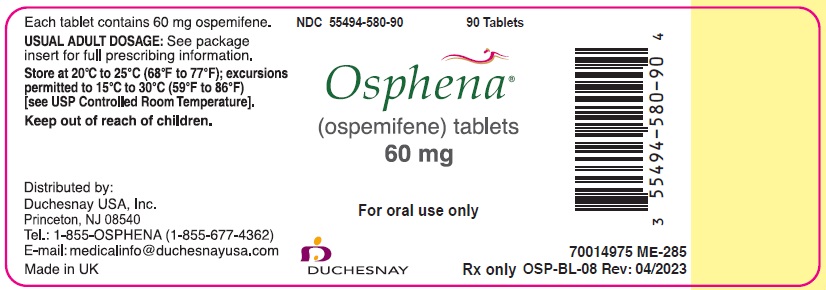
PRINCIPAL DISPLAY PANEL - 60 mg Tablet Bottle Label NDC 55494-580-90 90 Tablets Osphena ® (ospemifene) tablets 60 mg For oral use only DUCHESNAY Rx only PRINCIPAL DISPLAY PANEL - 60 mg Tablet Bottle Label
Medicaid utilization by pack size
Medicare Part D spend CMS · PART D · 2026 (Q1)
About this NDC listing & data coverage
What data is (and isn’t) available for this NDC — tap to expand
| NDC identity (package / product / labeler codes) | ✓ Available |
| Labeler | ✓ Available |
| Product & package description | ✓ Available |
| Marketing category & status | ✓ Available |
| Active ingredient / dosage form / route | ✓ Available |
| FDA label (SPL via DailyMed) | ✓ Available |
| Package photos | ✓ Available |
| Inactive ingredients (structured) | ✓ Available |
| NADAC pharmacy acquisition price (CMS) | — Not published for this NDC CMS publishes NADAC only for NDCs reported in its retail-pharmacy survey. |
| Orange Book / therapeutic-equivalence data | ✓ Available |
| HCPCS J-code billing crosswalk | — Not published for this NDC Most self-administered / retail products have no J-code — that is normal. |
| Medicaid utilization (CMS SDUD) | — Not published for this NDC CMS reports utilization only for NDCs with Medicaid claims above its privacy threshold. |