
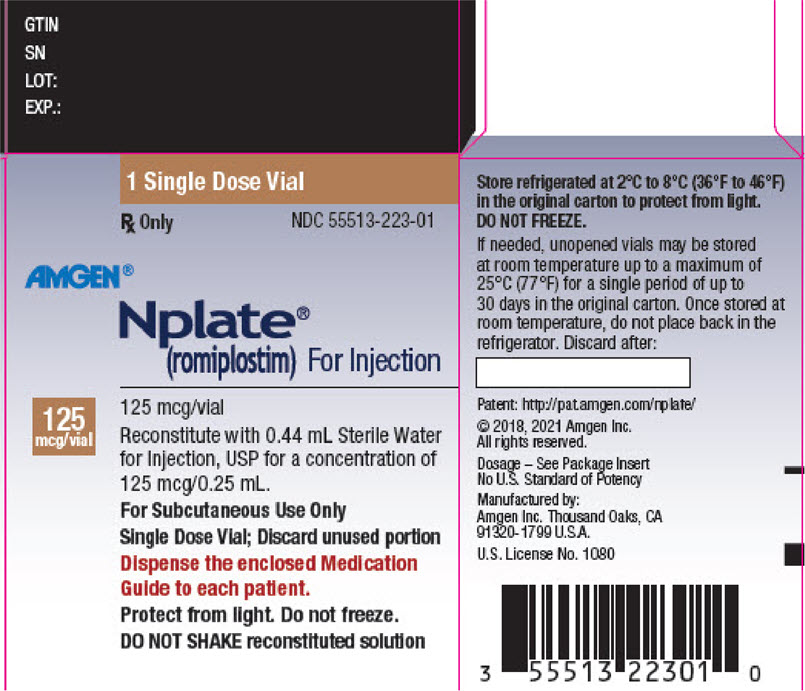
Nplate romiplostim 125 ug/.25mL Injection, Powder, Lyophilized, For Solution, 1 vial — NDC 55513-223-01 (Billing 55513-0223-01)
This is a package of 1 vial of Nplate romiplostim 125 ug/.25mL Injection, Powder, Lyophilized, For Solution from Amgen, Inc, marketed since Aug 2019 and currently FDA-listed. It is the main listing for this product, which comes in 2 package sizes.
NDC database record
One package, one record: these facts belong to NDC 55513-223-01 alone.
- Record
- FDA NDC Directory package listing · Human prescription drug
- Code segments
- 55513 labeler · 223 product · 01 package
- Package marketed since
- Aug 2, 2019
- Sample package
- No — commercial package
- Listing certified through
- Dec 31, 2027
- Billing quantity
- 1 EA per package
- Barcode (UPC)
- 0355513221016, 0355513222013
- Medicaid fills, this package
- 9,992 prescriptions in the last four reported quarters
- FDA record last changed
- Jul 24, 2026
Identity & classification
Regulatory identifiers FDA, NLM and CMS codes for this package
Drug-database identifiers Medi-Span GPI and First Databank GCN / HICL / AHFS classification
- GSN (GCN sequence number): 078494
- GCN: 44829
- GPI-14 (Medi-Span): 82405060002110
- HICL (First Databank): 035798
- AHFS class code: 20:16.00.00
- RxCUI (RxNorm): 1728092
Where does this data come from?
- FDA openFDA NDC Directory · synced Oct 8, 2026
- FDA label on DailyMed · label index refreshed Oct 8, 2026
- RxNorm (NLM RxNav) · catalog refreshed Oct 8, 2026
- Medi-Span GPI (licensed)
- First Databank (licensed) · refreshed Oct 8, 2026
RxNorm drug class
This medicine belongs to the Thrombopoietin Receptor Agonist class.
Where does this data come from?
- RxClass (NLM) · catalog refreshed Oct 8, 2026
Clinical
Romiplostim injection is used to treat immune thrombocytopenia (ITP; a condition that causes an abnormally low number of platelets in the blood) and Hematopoietic Syndrome of Acute Radiation Syndrome (HS-ARS; a syndrome that occurs when the bone marrow is damaged by radiation exposure). and in people that have been exposed to high levels of radiation (acute radiation syndrome). Romiplostim is in a class of medications called thrombopoietin receptor agonists. It works by causing the bone marrow to produce more platelets.
Read the full MedlinePlus article ↗- Nplate works by attaching to a receptor in your bone marrow that normally responds to your body's own platelet-stimulating protein, thrombopoietin. When it activates that receptor,...
- What exactly is Nplate doing in my body?
- For ITP, Nplate is given once a week as an injection under the skin. Your doctor will check your platelet count regularly — weekly at first — and adjust your dose up or down based...
- How often will I need to get these injections?
Patient education
Supplement & herbal interactions
Where does this data come from?
- MedlinePlus (NLM) · refreshed Oct 8, 2026
- FDA label on DailyMed · label index refreshed Oct 8, 2026
Ask a licensed pharmacist directly — free, answered by our team.
Pricing
A drug doesn't have one price. Each row is a different public payment system, and none is what you'd pay at the counter — that depends on your insurance. The ⓘ on each row explains what it measures.
| Price system | Per mL | Per package |
|---|---|---|
| Retail pharmacies payNADAC · weekly | Not in the retail survey — common for institutional, discontinued, or low-volume packs. | |
| Medicaid paysCMS SDUD · 12 mo | $1,151.74 | $287.93 / 0.25 ml |
| Medicare drug plans payPart D · quarterly | No Part D plan price is available for this NDC in our data. | |
| Medicare Part B allowsASP · J2802 | $11.617 / J2802 unit | — |
Where does this data come from?
- CMS NADAC weekly file
- CMS ASP pricing files · refreshed Sep 20, 2026
- CMS Medicaid State Drug Utilization Data · through Q1 2026
- CMS Part D plan pricing files · refreshed Sep 24, 2026
- VA National Acquisition Center price file
Billing & reimbursement
Where does this data come from?
- CMS ASP NDC-HCPCS crosswalk · refreshed Sep 22, 2026
- DMEPDAC NDC-HCPCS crosswalk
- openFDA NSDE billing units · refreshed Oct 7, 2026
Packaging — all sizes for this product
| Package NDC | Description | Marketing start | Marketing end | Status |
|---|---|---|---|---|
| 55513-0223-01 You're viewing this Main listing | 1 VIAL, SINGLE-DOSE in 1 CARTON / .25 mL in 1 VIAL, SINGLE-DOSE | 2019-08-02 | — | Active |
| 55513-0223-21 55513-223-21 | 1 VIAL, SINGLE-DOSE in 1 CARTON / .25 mL in 1 VIAL, SINGLE-DOSE | 2025-08-01 | — | Active |
In Medicaid, this is the most-dispensed pack of this product — about 94% of fills over the last four reported quarters. See all packs ↓
Pack size FAQ
What quantity is in this package?
How does this package differ from NDC 55513-0223-21?
What NDC number is used to bill for this package of Nplate romiplostim 125 ug/.25mL Injection, Powder, Lyophilized, For Solution?
Therapeutic equivalents
| Product | Labeler | Pack | NADAC/unit | TE | Status | Price vs. this |
|---|---|---|---|---|---|---|
| Nplate 125 ug/.25mLthis 55513-0223-01 | Amgen, | 1 vial | — | — | FDA listed | — |
Where does this data come from?
- FDA openFDA NDC Directory · synced Oct 8, 2026
- FDA Purple Book · refreshed Oct 5, 2026
- CMS NADAC weekly file
Availability & biosimilar status
Biologics have no small-molecule generics; biosimilar competition is tracked in the FDA Purple Book.
Where does this data come from?
- FDA Purple Book · refreshed Oct 5, 2026
Inactive Ingredients / Excipients
Inactive ingredients, also called excipients, are components of the drug product other than the active ingredient. They may include fillers, dyes, coatings, preservatives, flavors, or other formulation ingredients.
🧪 Avoiding an ingredient? See Romiplostim Injection inactive ingredients by manufacturer: every current product's list side by side, so you can ask your pharmacy for the version that does not list it.
💡 Tap an ingredient (hover on desktop) to see what it is and why it’s used.
-
2.5 mmol / 0.25 mL
UNII 4QD397987E
An amino acid used as a buffer and stabilizer in medications. It helps maintain the pH balance and protects the active drug from breaking down during storage and use.
-
UNII QTT17582CB
A strong acid used to adjust and maintain the proper pH level in liquid medicines, ensuring stability and preventing breakdown of active ingredients.
-
10 mg / 0.25 mL
UNII 3OWL53L36A
A natural sugar alcohol derived from seaweed or synthesized in the lab. It's used as a filler to add bulk, a sweetener in sugar-free formulas, and a disintegrant to help tablets break apart in the stomach.
-
0.01 mg / 0.25 mL
UNII 7T1F30V5YH
A synthetic emulsifier derived from sorbitol and oleic acid. It helps mix oil and water-based ingredients together and keeps them from separating in liquid formulations.
-
5 mg / 0.25 mL
UNII C151H8M554
A natural sugar derived from sugar cane or sugar beets. It's used as a sweetener, filler, and binder to improve taste, add bulk, and help hold tablet or capsule ingredients together.
5 inactive ingredients listed in the exact product block matched to this NDC.
Where does this data come from?
ingredient classCode="IACT" elements from the exact product block matched by this NDC. Label-section narrative from DailyMed / the openFDA label index is shown separately when available.- FDA label on DailyMed · label index refreshed Oct 8, 2026
- FDA openFDA NDC Directory · synced Oct 8, 2026
Inactive ingredient FAQ
Are inactive ingredients the same for every manufacturer?
Why might an inactive ingredient be missing?
Can inactive ingredients matter?
Manufacturer & labeler
More NDCs from Amgen, Inc labeler code 55513
- Neulasta pegfilgrastim Kit NDC 55513-192-01
- MVASI bevacizumab-awwb 100 mg/4mL Injection, Solution NDC 55513-206-01
- MVASI bevacizumab-awwb 400 mg/16mL Injection, Solution NDC 55513-207-01
- NEUPOGEN Filgrastim 480 ug/.8mL Injection, Solution NDC 55513-209-10
- Nplate romiplostim 250 ug/.5mL Injection, Powder, Lyophilized, For Solution NDC 55513-221-01
- Nplate romiplostim 500 ug/mL Injection, Powder, Lyophilized, For Solution NDC 55513-222-01
- Riabni rituximab-arrx 100 mg/10mL Injection, Solution NDC 55513-224-01
- EPOGEN epoetin alfa 3000 [iU]/mL Solution NDC 55513-267-10
- EPOGEN epoetin alfa 10000 [iU]/mL Solution NDC 55513-283-10
- Riabni rituximab-arrx 500 mg/50mL Injection, Solution NDC 55513-326-01
- Otezla apremilast Kit NDC 55513-369-55
- AMJEVITA adalimumab-atto 20 mg/.2mL Injection NDC 55513-399-01
Where does this data come from?
- FDA openFDA NDC Directory · synced Oct 8, 2026
- Drugs@FDA
Full prescribing information FDA SPL
🎯 Indications and Usage ▾
1 INDICATIONS AND USAGE Nplate is a thrombopoietin receptor agonist indicated for the treatment of thrombocytopenia in: Adult patients with immune thrombocytopenia (ITP) who have had an insufficient response to corticosteroids, immunoglobulins, or splenectomy. ( 1.1 ) Pediatric patients 1 year of age and older with ITP for at least 6 months who have had an insufficient response to corticosteroids, immunoglobulins, or splenectomy. ( 1.1 ) Nplate is indicated to increase survival in adults and in pediatric patients (including term neonates) acutely exposed to myelosuppressive doses of radiation (Hematopoietic Syndrome of Acute Radiation Syndrome [HS-ARS]).
( 1.2 ) Limitations of Use: Nplate is not indicated for the treatment of thrombocytopenia due to myelodysplastic syndrome (MDS) or any cause of thrombocytopenia other than ITP. Nplate should be used only in patients with ITP whose degree of thrombocytopenia and clinical condition increases the risk for bleeding. Nplate should not be used in an attempt to normalize platelet counts.
( 1 )
1.1Patients with Immune Thrombocytopenia (ITP) Nplate is indicated for the treatment of thrombocytopenia in: Adult patients with immune thrombocytopenia (ITP) who have had an insufficient response to corticosteroids, immunoglobulins, or splenectomy. Pediatric patients 1 year of age and older with ITP for at least 6 months who have had an insufficient response to corticosteroids, immunoglobulins, or splenectomy.
1.2Patients with Hematopoietic Syndrome of Acute Radiation Syndrome Nplate is indicated to increase survival in adults and in pediatric patients (including term neonates) acutely exposed to myelosuppressive doses of radiation [see Clinical Studies (14.3) ] . Limitations of Use: Nplate is not indicated for the treatment of thrombocytopenia due to myelodysplastic syndrome (MDS) or any cause of thrombocytopenia other than ITP [see Warnings and Precautions ( 5.1 )] . Nplate should be used only in patients with ITP whose degree of thrombocytopenia and clinical condition increases the risk for bleeding.
Nplate should not be used in an attempt to normalize platelet counts [see Warnings and Precautions ( 5.2 )] .
⏱️ Dosage and Administration ▾
2 DOSAGE AND ADMINISTRATION Patients with Immune Thrombocytopenia (ITP) Recommended Initial Dose: 1 mcg/kg once weekly as a subcutaneous injection. Adjust dose based on platelet response. ( 2.1 ) Patients acutely exposed to myelosuppressive doses of radiation Recommended Dose: 10 mcg/kg administered once as a subcutaneous injection.
Administer the dose as soon as possible after suspected or confirmed exposure to myelosuppressive doses of radiation. ( 2.2 ) See Full Prescribing Information for instructions on reconstitution, preparation, and administration. ( 2.3 ) Reconstitution and Dilution of Nplate Single Dose Vials
2.1Patients with Immune Thrombocytopenia (ITP) Use the lowest dose of Nplate to achieve and maintain a platelet count ≥ 50 × 10 9 /L as necessary to reduce the risk for bleeding. Administer Nplate as a weekly subcutaneous injection with dose adjustments based upon the platelet count response. The prescribed Nplate dose may consist of a very small volume (e.g., 0.15 mL).
Administer Nplate only with a syringe that contains 0.01 mL graduations. Discontinue Nplate if the platelet count does not increase to a level sufficient to avoid clinically important bleeding after 4 weeks of Nplate therapy at the maximum weekly dose of 10 mcg/kg [see Warnings and Precautions ( 5.3 )] . Obtain complete blood counts (CBCs), including platelet counts, weekly during the dose adjustment phase of Nplate therapy and then monthly following establishment of a stable Nplate dose.
Obtain CBCs, including platelet counts, weekly for at least 2 weeks following discontinuation of Nplate. For Adult Patients with ITP The initial dose of Nplate is 1 mcg/kg. Actual body weight at initiation of treatment should always be used when calculating the initial dose.
In adults, future dose adjustments are based on changes in platelet counts only. Adjust the weekly dose of Nplate by increments of 1 mcg/kg until the patient achieves a platelet count ≥ 50 × 10 9 /L as necessary to reduce the risk for bleeding; do not exceed a maximum weekly dose of 10 mcg/kg. In clinical studies, most adult patients who responded to Nplate achieved and maintained platelet counts ≥ 50 × 10 9 /L with a median dose of 2-3 mcg/kg.
Adjust the dose as follows for adult patients: If the platelet count is < 50 × 10 9 /L, increase the dose by 1 mcg/kg. If platelet count is > 200 × 10 9 /L and ≤ 400 × 10 9 /L for 2 consecutive weeks, reduce the dose by 1 mcg/kg. If platelet count is > 400 × 10 9 /L, do not dose.
Continue to assess the platelet count weekly. After the platelet count has fallen to < 200 × 10 9 /L, resume Nplate at a dose reduced by 1 mcg/kg. For Pediatric Patients with ITP The initial dose of Nplate is 1 mcg/kg.
Actual body weight at initiation of treatment should always be used when calculating initial dose. In pediatric patients, future dose adjustments are based on changes in platelet counts and changes in body weight. Reassessment of body weight is recommended every 12 weeks.
Adjust the weekly dose of Nplate by increments of 1 mcg/kg until the patient achieves a platelet count ≥ 50 × 10 9 /L as necessary to reduce the risk for bleeding; do not exceed a maximum weekly dose of 10 mcg/kg. In a pediatric placebo-controlled clinical study, the median of the most frequent dose of Nplate received by patients during weeks 17 through 24 was 5.5 mcg/kg. Adjust the dose as follows for pediatric patients: If the platelet count is < 50 × 10 9 /L, increase the dose by 1 mcg/kg.
If platelet count is > 200 × 10 9 /L and ≤ 400 × 10 9 /L for 2 consecutive weeks, reduce the dose by 1 mcg/kg. If platelet count is > 400 × 10 9 /L, do not dose. Continue to assess the platelet count weekly.
After the platelet count has fallen to < 200 × 10 9 /L, resume Nplate at a dose reduced by 1 mcg/kg.
2.2Patients with Hematopoietic Syndrome of Acute Radiation Syndrome For Adult and Pediatric Patients (including term neonates) The recommended dose of Nplate is 10 mcg/kg administered once as a subcu… [Excerpted — this section continues on DailyMed.]
💊 Dosage Forms and Strengths ▾
3 DOSAGE FORMS AND STRENGTHS For injection: 125 mcg, 250 mcg or 500 mcg of Nplate as a sterile, lyophilized, solid white powder in single-dose vials. For injection: 125 mcg, 250 mcg or 500 mcg of romiplostim as a lyophilized powder in single-dose vials. ( 3 )
⛔ Contraindications ▾
4 CONTRAINDICATIONS None. None ( 4 )
⚠️ Warnings and Cautions ▾
5 WARNINGS AND PRECAUTIONS In some patients with MDS, Nplate increases blast cell counts and increases the risk of progression to acute myelogenous leukemia. ( 5.1 ) Thrombotic/thromboembolic complications have resulted from increases in platelet counts with Nplate use. Portal vein thrombosis has been reported in patients with chronic liver disease receiving Nplate.
( 5.2 ) Severe thrombocytopenia may persist during Nplate treatment due to neutralizing antibodies or other causes. ( 5.3 )
5.1Risk of Progression of Myelodysplastic Syndromes to Acute Myelogenous Leukemia Progression from myelodysplastic syndromes (MDS) to acute myelogenous leukemia (AML) has been observed in adult clinical trials with Nplate. A randomized, double-blind, placebo-controlled trial enrolling adult patients with severe thrombocytopenia and International Prognostic Scoring System (IPSS) low or intermediate-1 risk MDS was terminated due to more cases of AML observed in the Nplate arm. This trial consisted of a 58-week study period with a 5-year long-term follow-up phase.
The patients were randomized 2:1 to treatment with Nplate or placebo (167 Nplate, 83 placebo). During the 58-week study period, progression to AML occurred in 10 (6.0%) patients in the Nplate arm and 4 (4.8%) patients in the placebo arm (hazard ratio [95%CI] = 1.20 [0.38, 3.84]). Of the 250 patients, 210 (84.0%) entered the long-term follow-up phase of this study.
With 5 years of follow-up, 29 (11.6%) patients showed progression to AML, including 20/168 (11.9%) patients in the Nplate arm versus 9/82 (11.0%) patients in the placebo arm (HR [95% CI] = 1.06 [0.48, 2.33]). The incidence of death (overall survival) was 55.7% (93/167) in the Nplate arm versus 54.2% (45/83) in the placebo arm (HR [95% CI] = 1.03 [0.72, 1.47]). In the baseline low IPSS group, there was a higher incidence of death in the Nplate arm [41.3% (19/46)] compared to the placebo arm [30.4% (7/23)] (HR [95% CI] = 1.59 [0.67, 3.80]).
In a single-arm trial of Nplate given to 72 patients with thrombocytopenia-related MDS, 8 (11.1%) patients were reported as having possible disease progression, of which 3 (4.2%) had confirmation of AML during follow-up. In addition, in 3 (4.2%) patients, increased peripheral blood blast cell counts decreased to baseline after discontinuation of Nplate. Nplate is not indicated for the treatment of thrombocytopenia due to MDS or any cause of thrombocytopenia other than ITP.
5.2Thrombotic/Thromboembolic Complications Thrombotic/thromboembolic complications have resulted from increases in platelet counts with Nplate use secondary to drug-induced thrombocytosis, regardless of the underlying disease. Thrombotic/ thromboembolic events including deep vein thrombosis (1.4%), pulmonary embolism (1.2%) and myocardial infarction (0.8%) have been observed with the use of Nplate in the ITP population. Other thrombotic events including transient ischemic attack have been reported.
These events have occurred regardless of platelet counts. Portal vein thrombosis has been reported in patients with and without chronic liver disease receiving Nplate. In patients with ITP, to minimize the risk for thrombotic/thromboembolic complications, do not use Nplate in an attempt to normalize platelet counts.
Follow the dose adjustment guidelines [see Dosage and Administration ( 2.1 )] . In the absence of myelosuppression induced by acute exposure to radiation, Nplate administration might cause excessive increases in platelet counts and may cause thrombotic and thromboembolic complications [see Clinical Pharmacology (12.2) ].
5.3Loss of Response to Nplate Hyporesponsiveness or failure to maintain a platelet response with Nplate may occur due to neutralizing antibodies or other causes [see Adverse Reactions ( 6.3 )] . Discontinue Nplate if the platelet count does not increase to a level sufficient to avoid clinically important bleeding after 4 weeks at the highest weekly dose of 10 mcg/kg.
🤒 Adverse Reactions ▾
6 ADVERSE REACTIONS The following clinically significant adverse reactions are discussed in greater detail in other sections: Progression of Myelodysplastic Syndromes [see Warnings and Precautions ( 5.1 )] Thrombotic/Thromboembolic Complications [see Warnings and Precautions ( 5.2 )] Loss of Response to Nplate [see Warnings and Precautions ( 5.3 )] In adult patients, the most common adverse reactions (≥ 5% higher patient incidence in Nplate versus placebo) are arthralgia, dizziness, insomnia, myalgia, pain in extremity, abdominal pain, shoulder pain, dyspepsia, and paresthesia.
Headache was the most commonly reported adverse reaction that did not occur at ≥ 5% higher patient incidence in Nplate versus placebo. ( 6.1 ) In pediatric patients, the most common adverse reactions (≥ 25%) are: contusion, upper respiratory tract infection, and oropharyngeal pain. ( 6.1 ) To report SUSPECTED ADVERSE REACTIONS, contact Amgen Inc. at 1-800-77-AMGEN (1-800-772-6436) or FDA at 1-800-FDA-1088 or www.fda.gov/medwatch.
6.1Clinical Trials Experience Because clinical trials are conducted under widely varying conditions, adverse reaction rates observed in the clinical trials of a drug cannot be directly compared to rates in the clinical trials of another drug and may not reflect the rates observed in practice. Adults The data described below reflect Nplate exposure to 271 adult patients with ITP, aged 18 to 88, of whom 62% were female. Nplate was studied in two randomized, placebo-controlled, double-blind studies that were identical in design, with the exception that Study 1 evaluated non-splenectomized patients with ITP and Study 2 evaluated splenectomized patients with ITP.
Data are also reported from an open-label, single-arm study in which patients received Nplate over an extended period of time. Overall, Nplate was administered to 114 patients for at least 52 weeks and 53 patients for at least 96 weeks. In the placebo-controlled studies, headache was the most commonly reported adverse drug reaction, occurring in 35% of patients receiving Nplate and 32% of patients receiving placebo.
For those patients receiving Nplate, 14 (48%) of headaches were mild, 9 (31%) were moderate, and 6 (21%) were severe. Table 3 presents adverse drug reactions from Studies 1 and 2 with a ≥ 5% higher patient incidence in Nplate versus placebo. Table 3.
Adverse Reactions Identified in Two Placebo-Controlled Studies Adverse Reactions by Body System Nplate (%) (n = 84) Placebo (%) (n = 41) Musculoskeletal and Connective Tissue Disorders Arthralgia 22 (26%) 8 (20%) Myalgia 12 (14%) 1 (2%) Pain in Extremity 11 (13%) 2 (5%) Shoulder Pain 7 (8%) 0 Nervous System Disorders Dizziness 14 (17%) 0 Paresthesia 5 (6%) 0 Psychiatric Disorders Insomnia 13 (16%) 3 (7%) Gastrointestinal Disorders Abdominal pain 9 (11%) 0 Dyspepsia 6 (7%) 0 MedDRA version 9 is used. Among 291 adult patients with ITP who received Nplate in the single-arm extension study, the incidence rates of the adverse reactions occurred in a pattern similar to those reported in the placebo-controlled clinical studies.
The safety profile of Nplate was similar across patients, regardless of ITP duration. The following adverse reactions (at least 5% incidence and at least 5% more frequent with Nplate compared with placebo or standard of care) occurred in Nplate patients with ITP duration up to 12 months: bronchitis, sinusitis, vomiting, arthralgia, myalgia, headache, dizziness, diarrhea, upper respiratory tract infection, cough, nausea and oropharyngeal pain. The adverse reaction of thrombocytosis occurred with an incidence of 2% in adults with ITP duration up to 12 months.
Bone Marrow Reticulin Formation and Collagen Fibrosis Nplate administration may increase the risk for development or progression of reticulin fiber formation within the bone marrow. This formation may improve upon discontinuation of Nplate. In a clinical trial, one patient with ITP and hemolytic anemia developed marrow fibrosis with collagen dur… [Excerpted — this section continues on DailyMed.]
🔄 Drug Interactions ▾
7 DRUG INTERACTIONS Nplate may be used with other medical ITP therapies, such as corticosteroids, danazol, azathioprine, intravenous immunoglobulin (IVIG), and anti-D immunoglobulin [see Clinical Studies ( 14.1 )] .
👥 Use in Specific Populations ▾
8 USE IN SPECIFIC POPULATIONS Pregnancy: May cause fetal harm. ( 8.1 ) Lactation: Advise not to breastfeed. ( 8.2 )
8.1Pregnancy Risk Summary Based on findings from animal reproduction studies, Nplate may cause fetal harm when administered to a pregnant woman. Available data with Nplate use in pregnant women are insufficient to draw conclusions about any drug-associated risk for major birth defects, miscarriage, or adverse maternal or fetal outcomes. In animal reproduction and developmental toxicity studies, romiplostim crossed the placenta, and adverse fetal effects included thrombocytosis, postimplantation loss, and an increase in pup mortality (see Data ).
The estimated background risk of major birth defects and miscarriage for the indicated population is unknown. All pregnancies have a background risk of birth defect, loss, or other adverse outcomes. In the U.S. general population, the estimated background risks of major birth defects and miscarriage in clinically recognized pregnancies is 2-4% and 15-20%, respectively.
Data Animal Data In rat and rabbit embryo-fetal development toxicity studies, no evidence of fetal harm was observed at romiplostim doses up to 11 times (rats) and 82 times (rabbits) the maximum human dose (MHD) based on systemic exposure (AUC). In mice at doses 5 times the MHD, reductions in maternal body weight and increased postimplantation loss occurred. In a prenatal and postnatal development study in rats, at doses 11 times the MHD, there was an increase in perinatal pup mortality.
Romiplostim crossed the placental barrier in rats and increased fetal platelet counts at clinically equivalent and higher doses.
8.2Lactation Risk Summary There is no information regarding the presence of romiplostim in human milk, the effects on the breastfed child, or the effects on milk production. Maternal IgG is known to be present in human milk. The effects of local gastrointestinal exposure and limited systemic exposure in the breastfed child to romiplostim are unknown.
Due to the potential for serious adverse reactions in a breastfed child from Nplate, advise women not to breastfeed during treatment with Nplate.
8.4Pediatric Use Safety and effectiveness of Nplate have been established in pediatric patients age 1 year and older with ITP for at least 6 months evaluated in two randomized, placebo-controlled studies. Long-term safety in the same population using Nplate for a median duration of 3 years was also evaluated in a single arm, open-label study [ see Adverse Reactions ( 6.1 ), Clinical Studies ( 14.2 ) ] . The pharmacokinetics of romiplostim have been evaluated in pediatric patients 1 year and older with ITP [ see Clinical Pharmacology ( 12.3 ) ] .
See Dosage and Administration ( 2.1 ) for dosing recommendations for pediatric patients 1 year and older. The safety and efficacy of Nplate in pediatric patients younger than 1 year with ITP have not been established. Serum concentrations of romiplostim in pediatric patients with ITP were within the range observed in adult patients with ITP receiving the same dose range of romiplostim.
The use of Nplate to increase survival in pediatric patients (including term neonates) acutely exposed to myelosuppressive doses of radiation is based on efficacy studies conducted in adult animals. Efficacy studies of Nplate could not be conducted in humans with acute radiation syndrome for ethical and feasibility reasons. A similar response to Nplate is expected in the pediatric and adult patients based on the mechanism of action of the drug and pharmacokinetics of Nplate in pediatric patients 1 year and older with ITP [see Dosage and Administration (2.2) and Clinical Pharmacology (12.3) ] .
8.5Geriatric Use Of the 271 patients who received Nplate in ITP clinical studies, 55 (20%) were age 65 and over, and 27 (10%) were 75 and over. No overall differences in safety or efficacy have been observed between older and younger patients in the placebo-controlled studies, but greater sen… [Excerpted — this section continues on DailyMed.]
🤰 Pregnancy ▾
8.1Pregnancy Risk Summary Based on findings from animal reproduction studies, Nplate may cause fetal harm when administered to a pregnant woman. Available data with Nplate use in pregnant women are insufficient to draw conclusions about any drug-associated risk for major birth defects, miscarriage, or adverse maternal or fetal outcomes. In animal reproduction and developmental toxicity studies, romiplostim crossed the placenta, and adverse fetal effects included thrombocytosis, postimplantation loss, and an increase in pup mortality (see Data ).
The estimated background risk of major birth defects and miscarriage for the indicated population is unknown. All pregnancies have a background risk of birth defect, loss, or other adverse outcomes. In the U.S. general population, the estimated background risks of major birth defects and miscarriage in clinically recognized pregnancies is 2-4% and 15-20%, respectively.
Data Animal Data In rat and rabbit embryo-fetal development toxicity studies, no evidence of fetal harm was observed at romiplostim doses up to 11 times (rats) and 82 times (rabbits) the maximum human dose (MHD) based on systemic exposure (AUC). In mice at doses 5 times the MHD, reductions in maternal body weight and increased postimplantation loss occurred. In a prenatal and postnatal development study in rats, at doses 11 times the MHD, there was an increase in perinatal pup mortality.
Romiplostim crossed the placental barrier in rats and increased fetal platelet counts at clinically equivalent and higher doses.
🧒 Pediatric Use ▾
8.4Pediatric Use Safety and effectiveness of Nplate have been established in pediatric patients age 1 year and older with ITP for at least 6 months evaluated in two randomized, placebo-controlled studies. Long-term safety in the same population using Nplate for a median duration of 3 years was also evaluated in a single arm, open-label study [ see Adverse Reactions ( 6.1 ), Clinical Studies ( 14.2 ) ] . The pharmacokinetics of romiplostim have been evaluated in pediatric patients 1 year and older with ITP [ see Clinical Pharmacology ( 12.3 ) ] .
See Dosage and Administration ( 2.1 ) for dosing recommendations for pediatric patients 1 year and older. The safety and efficacy of Nplate in pediatric patients younger than 1 year with ITP have not been established. Serum concentrations of romiplostim in pediatric patients with ITP were within the range observed in adult patients with ITP receiving the same dose range of romiplostim.
The use of Nplate to increase survival in pediatric patients (including term neonates) acutely exposed to myelosuppressive doses of radiation is based on efficacy studies conducted in adult animals. Efficacy studies of Nplate could not be conducted in humans with acute radiation syndrome for ethical and feasibility reasons. A similar response to Nplate is expected in the pediatric and adult patients based on the mechanism of action of the drug and pharmacokinetics of Nplate in pediatric patients 1 year and older with ITP [see Dosage and Administration (2.2) and Clinical Pharmacology (12.3) ] .
🧓 Geriatric Use ▾
8.5Geriatric Use Of the 271 patients who received Nplate in ITP clinical studies, 55 (20%) were age 65 and over, and 27 (10%) were 75 and over. No overall differences in safety or efficacy have been observed between older and younger patients in the placebo-controlled studies, but greater sensitivity of some older individuals cannot be ruled out. In general, dose adjustment for an elderly patient should be cautious, reflecting the greater frequency of decreased hepatic, renal, or cardiac function, and of concomitant disease or other drug therapy.
🆘 Overdosage ▾
10 OVERDOSAGE Overdoses due to medication errors have been reported in patients receiving Nplate. In the event of overdose, platelet counts may increase excessively and result in thrombotic/thromboembolic complications. In this case, discontinue Nplate and monitor platelet counts. Reinitiate treatment with Nplate in accordance with dosing and administration recommendations [see Dosage and Administration ( 2.1 , 2.3 )] .
🧬 Clinical Pharmacology ▾
12 CLINICAL PHARMACOLOGY
12.1Mechanism of Action Nplate increases platelet production through binding and activation of the TPO receptor, a mechanism analogous to endogenous TPO.
12.2Pharmacodynamics In clinical studies, treatment with Nplate resulted in dose-dependent increases in platelet counts. After a single subcutaneous dose of 1 to 10 mcg/kg Nplate in patients with ITP, the peak platelet count was 1.3 to 14.9 times greater than the baseline platelet count over a 2- to 3-week period. The platelet counts were above 50 × 10 9 /L for seven out of eight patients with ITP who received six weekly doses of Nplate at 1 mcg/kg.
In a clinical study, peak platelet count increased 4.7 to 7.3 fold (mean: 5.8 fold) above baseline values in healthy adults (n = 4) administered a single 10 mcg/kg IV dose of Nplate. Results from population modeling and simulation indicate that a single 10 mcg/kg subcutaneous dose of Nplate would result in clinically relevant effects on incidence rate and duration of severe thrombocytopenia in patients acutely exposed to myelosuppressive doses of radiation.
12.3Pharmacokinetics Patients with Immune Thrombocytopenia (ITP) In the long-term extension study in adult patients with ITP receiving weekly treatment of Nplate subcutaneously, the pharmacokinetics of romiplostim over the dose range of 3 to 15 mcg/kg indicated that peak serum concentrations of romiplostim were observed about 7 to 50 hours post dose (median: 14 hours) with half-life values ranging from 1 to 34 days (median: 3.5 days). The serum concentrations varied among patients and did not correlate with the dose administered.
The elimination of serum romiplostim is in part dependent on the TPO receptor on platelets. As a result, for a given dose, patients with high platelet counts are associated with low serum concentrations and vice versa. In another ITP clinical study, no accumulation in serum concentrations was observed (n = 4) after six weekly doses of Nplate (3 mcg/kg).
The accumulation at higher doses of romiplostim is unknown. Patients Acutely Exposed to Myelosuppressive Doses of Radiation The pharmacokinetics of romiplostim is not available in patients acutely exposed to myelosuppressive doses of radiation. Specific Populations Pediatric Patients Serum concentrations of romiplostim in pediatric patients with ITP were within the range observed in adult patients with ITP receiving the same dose range of romiplostim.
Similar to adults with ITP, romiplostim pharmacokinetics are highly variable in pediatric patients with ITP.
🧬 Mechanism of Action ▾
12.1Mechanism of Action Nplate increases platelet production through binding and activation of the TPO receptor, a mechanism analogous to endogenous TPO.
📦 How Supplied / Storage and Handling ▾
16 HOW SUPPLIED/STORAGE AND HANDLING Nplate (romiplostim) for injection is supplied as a sterile, preservative-free, solid white lyophilized powder in single-dose vials of 125 mcg (NDC-55513-223-01, NDC-55513-223-21), 250 mcg (NDC 55513-221-01, NDC 55513-221-21) and 500 mcg (NDC 55513-222-01, NDC 55513-222-21) of romiplostim. Store Nplate vials in the refrigerator at 2°C to 8°C (36°F to 46°F) in the original carton to protect from light. Do not freeze.
If needed, unopened Nplate vials may be stored in the original carton at room temperature up to a maximum of 25°C (77°F) for a single period of up to 30 days. The new expiration date must be written in the space provided on the carton. Once stored at room temperature, do not place back in the refrigerator.
If not used within the 30 days, discard Nplate.
📋 Description ▾
11 DESCRIPTION Romiplostim is a thrombopoietin receptor agonist (TPO-RA). Romiplostim, a member of the TPO mimetic class, is an Fc-peptide fusion protein (peptibody). The peptibody molecule contains two identical single-chain subunits, each consisting of human immunoglobulin IgG1 Fc domain, covalently linked at the C-terminus to a peptide containing two thrombopoietin receptor-binding domains.
Romiplostim has no amino acid sequence homology to endogenous TPO. Romiplostim is produced by recombinant DNA technology in Escherichia coli (E . coli) . Nplate (romiplostim) for injection is supplied as a sterile, preservative-free, lyophilized, solid white powder for subcutaneous use.
Nplate is supplied as either 125 mcg per vial, 250 mcg per vial or 500 mcg per vial of romiplostim and requires reconstitution with Sterile Water for Injection to obtain a concentration of 500 mcg/mL. Each single-dose 125 mcg vial of Nplate contains the following: 125 mcg of romiplostim, L-histidine (0.7 mg), mannitol (18 mg), polysorbate 20 (0.02 mg), sucrose (9 mg), and sufficient HCl to adjust the pH to a target of 5. Reconstitution with 0.44 mL of Sterile Water for Injection provides a resulting concentration of 125 mcg/0.25 mL.
Each single-dose 250 mcg vial of Nplate contains the following: 250 mcg romiplostim, L-histidine (1.2 mg), mannitol (30 mg), polysorbate 20 (0.03 mg), sucrose (15 mg), and sufficient HCl to adjust the pH to a target of 5. Reconstitution with 0.72 mL of Sterile Water for Injection provides a resulting concentration of 250 mcg/0.5 mL. Each single-dose 500 mcg vial of Nplate contains the following: 500 mcg romiplostim, L-histidine (1.9 mg), mannitol (50 mg), polysorbate 20 (0.05 mg), sucrose (25 mg), and sufficient HCl to adjust the pH to a target of 5.
Reconstitution with 1.2 mL of Sterile Water for Injection provides a resulting concentration of 500 mcg/mL.
💬 Information for Patients ▾
17 PATIENT COUNSELING INFORMATION Advise the patient to read the FDA-approved patient labeling ( Medication Guide ). Advise patients acutely exposed to myelosuppressive doses of radiation (Hematopoietic Syndrome of Acute Radiation Syndrome) that efficacy studies of Nplate for this indication could not be conducted in humans for ethical and feasibility reasons and that, therefore, approval of this use was based on efficacy studies conducted in animals [see Clinical Studies (14.3) ] . Inform patients of the following risks and considerations for Nplate: Nplate therapy is administered to achieve and maintain a platelet count ≥ 50 × 10 9 /L as necessary to reduce the risk for bleeding; Nplate is not used to normalize platelet counts.
Following discontinuation of Nplate, thrombocytopenia and risk of bleeding may develop that is worse than that experienced prior to the Nplate therapy. Nplate therapy may increase the risk of reticulin fiber formation within the bone marrow. This formation may improve upon discontinuation.
Detection of peripheral blood cell abnormalities may necessitate a bone marrow examination. Too much Nplate may result in excessive platelet counts and a risk for thrombotic/thromboembolic complications. Nplate stimulates certain bone marrow cells to make platelets and increases the risk of progression to acute myelogenous leukemia in patients with myelodysplastic syndromes.
Platelet counts and CBCs must be performed weekly until a stable Nplate dose has been achieved; thereafter, platelet counts and CBCs must be performed monthly while taking Nplate. Patients must be closely monitored with weekly platelet counts and CBCs for at least 2 weeks following Nplate discontinuation. Even with Nplate therapy, patients should continue to avoid situations or medications that may increase the risk for bleeding.
Pregnancy: Advise pregnant women of the potential risk to a fetus. Advise females of reproductive potential to inform their prescriber of a known or suspected pregnancy [see Use in Specific Populations ( 8.1 )] . Lactation: Advise women not to breastfeed during treatment with Nplate [see Use in Specific Populations ( 8.2 )] .
Nplate ® (romiplostim) Manufactured by: Amgen Inc. One Amgen Center Drive Thousand Oaks, California 91320-1799 U.S. License No.
1080 Patent: http://pat.amgen.com/nplate/ © 2008-2025 Amgen Inc. All rights reserved. www.nplate.com 1xxxxx V21
💬 Medication Guide ▾
This Medication Guide has been approved by the U.S. Food and Drug Administration. Revised: 03/2025 MEDICATION GUIDE Nplate ® (N-plāt) (romiplostim) for injection What is the most important information I should know about Nplate?
Nplate can cause serious side effects, including: Worsening of a precancerous blood condition to a blood cancer (leukemia). Nplate is not for use in people with a precancerous condition called myelodysplastic syndromes (MDS), or for any condition other than immune thrombocytopenia (ITP). If you have MDS and receive Nplate, your MDS condition may worsen and become an acute leukemia.
If MDS worsens to become acute leukemia you may die sooner from the acute leukemia. Higher risk for blood clots. You may have a higher risk of getting a blood clot if your platelet count becomes high during treatment with Nplate.
Blood clots in the veins of your legs (deep vein thrombosis, DVT), lungs (pulmonary embolism, PE), heart attack and strokes have happened in people with ITP during treatment with Nplate. You may get blood clots in the veins of your liver (portal vein thrombosis) with or without chronic liver disease. This may affect your liver function.
Injection of too much Nplate may cause a dangerous increase in your blood platelet count and serious side effects. Your healthcare provider may change your dose or stop Nplate depending upon the change in your blood platelet count. You must have blood platelet counts done before you start, during, and after Nplate therapy is stopped ( see “How will I receive Nplate?” ).
See “What are the possible side effects of Nplate?” for other side effects of Nplate. What is Nplate? Nplate is a prescription medicine used to treat low blood platelet counts (thrombocytopenia) in: adults with immune thrombocytopenia (ITP) when certain medicines or surgery to remove your spleen have not worked well enough. children 1 year of age and older with ITP for at least 6 months when certain medicines or surgery to remove your spleen have not worked well enough.
Nplate is a prescription medicine also used to treat people including newborns who have been exposed to high levels of radiation (acute radiation syndrome). The effectiveness of Nplate for this use was only studied in animals, because it could not be studied in people. Nplate is not for use in people with a precancerous condition called myelodysplastic syndrome (MDS), or low platelet count caused by any condition other than ITP.
Nplate is only used if your low platelet count and medical condition increase your risk of bleeding. Nplate is used to try to keep your platelet count about 50,000 per microliter in order to lower the risk for bleeding. Nplate is not used to make your platelet count normal.
It is not known if Nplate is safe and effective in children under the age of 1. Before receiving Nplate, first speak to your healthcare provider and understand the benefits and risks of Nplate. Be sure to tell your healthcare provider about all of your medical conditions, including if you: have had surgery to remove your spleen (splenectomy) have a bone marrow problem, including a blood cancer or MDS have or had a blood clot have chronic liver disease. have bleeding problems are pregnant or plan to become pregnant.
Nplate may harm your unborn baby. Tell your healthcare provider if you become pregnant or think you may be pregnant during treatment with Nplate. are breastfeeding or plan to breastfeed. Nplate may pass into your breast milk and harm your baby.
Do not breastfeed during treatment with Nplate. Tell your healthcare provider about all the medicines you take , including prescription and over-the-counter medicines, vitamins, and herbal products. Know the medicines you take.
Keep a list of them and show it to your healthcare provider or pharmacist when you get a new medicine. How will I receive Nplate? Nplate for ITP is given by your healthcare provider as an injection under the skin (subcutaneous) one time each week.
Nplate is given by… [Excerpted — this section continues on DailyMed.]
🧬 Pharmacokinetics ▾
12.3Pharmacokinetics Patients with Immune Thrombocytopenia (ITP) In the long-term extension study in adult patients with ITP receiving weekly treatment of Nplate subcutaneously, the pharmacokinetics of romiplostim over the dose range of 3 to 15 mcg/kg indicated that peak serum concentrations of romiplostim were observed about 7 to 50 hours post dose (median: 14 hours) with half-life values ranging from 1 to 34 days (median: 3.5 days). The serum concentrations varied among patients and did not correlate with the dose administered.
The elimination of serum romiplostim is in part dependent on the TPO receptor on platelets. As a result, for a given dose, patients with high platelet counts are associated with low serum concentrations and vice versa. In another ITP clinical study, no accumulation in serum concentrations was observed (n = 4) after six weekly doses of Nplate (3 mcg/kg).
The accumulation at higher doses of romiplostim is unknown. Patients Acutely Exposed to Myelosuppressive Doses of Radiation The pharmacokinetics of romiplostim is not available in patients acutely exposed to myelosuppressive doses of radiation. Specific Populations Pediatric Patients Serum concentrations of romiplostim in pediatric patients with ITP were within the range observed in adult patients with ITP receiving the same dose range of romiplostim.
Similar to adults with ITP, romiplostim pharmacokinetics are highly variable in pediatric patients with ITP.
🧬 Pharmacodynamics ▾
12.2Pharmacodynamics In clinical studies, treatment with Nplate resulted in dose-dependent increases in platelet counts. After a single subcutaneous dose of 1 to 10 mcg/kg Nplate in patients with ITP, the peak platelet count was 1.3 to 14.9 times greater than the baseline platelet count over a 2- to 3-week period. The platelet counts were above 50 × 10 9 /L for seven out of eight patients with ITP who received six weekly doses of Nplate at 1 mcg/kg.
In a clinical study, peak platelet count increased 4.7 to 7.3 fold (mean: 5.8 fold) above baseline values in healthy adults (n = 4) administered a single 10 mcg/kg IV dose of Nplate. Results from population modeling and simulation indicate that a single 10 mcg/kg subcutaneous dose of Nplate would result in clinically relevant effects on incidence rate and duration of severe thrombocytopenia in patients acutely exposed to myelosuppressive doses of radiation.
🔬 Clinical Studies ▾
14 CLINICAL STUDIES
14.1Adults with ITP The safety and efficacy of Nplate in adults with ITP were assessed in two double-blind, placebo-controlled clinical studies, an open-label single-arm study, and in an open-label extension study. Studies 1 (NCT00102336) and 2 (NCT00102323) In Studies 1 and 2, patients with ITP who had completed at least one prior treatment and had a platelet count of ≤ 30 × 10 9 /L prior to study entry were randomized (2:1) to 24 weeks of Nplate (1 mcg/kg subcutaneous [SC]) or placebo. The median time since ITP diagnosis for Studies 1 and 2 was 2.1 years (range 0.1 to 31.6) and 8 years (range 0.6 to 44.8), respectively.
Prior ITP treatments in both study groups included corticosteroids, immunoglobulins, rituximab, cytotoxic therapies, danazol, and azathioprine. Patients already receiving ITP medical therapies at a constant dosing schedule were allowed to continue receiving these medical treatments throughout the studies. Rescue therapies (i.e., corticosteroids, IVIG, platelet transfusions, and anti-D immunoglobulin) were permitted for bleeding, wet purpura, or if the patient was at immediate risk for hemorrhage.
Patients received single weekly SC injections of Nplate, with individual dose adjustments to maintain platelet counts (50 × 10 9 /L to 200 × 10 9 /L). Study 1 evaluated patients who had not undergone a splenectomy. The patients had been diagnosed with ITP for approximately 2 years and had received a median of three prior ITP treatments.
Overall, the median platelet count was 19 × 10 9 /L at study entry. During the study, the median weekly Nplate dose was 2 mcg/kg (25 th –75 th percentile: 1–3 mcg/kg). Study 2 evaluated patients who had undergone a splenectomy.
The patients had been diagnosed with ITP for approximately 8 years and had received a median of six prior ITP treatments. Overall, the median platelet count was 14 × 10 9 /L at study entry. During the study, the median weekly Nplate dose was 3 mcg/kg (25 th –75 th percentile: 2–7 mcg/kg).
Study 1 and 2 outcomes are shown in Table 5. A durable platelet response was the achievement of a weekly platelet count ≥ 50 × 10 9 /L for any 6 of the last 8 weeks of the 24-week treatment period in the absence of rescue medication at any time. A transient platelet response was the achievement of any weekly platelet counts ≥ 50 × 10 9 /L for any 4 weeks during the treatment period without a durable platelet response.
An overall platelet response was the achievement of either a durable or a transient platelet response. Platelet responses were excluded for 8 weeks after receiving rescue medications. Table 5.
Results from Placebo-Controlled Studies All p values < 0.05 for platelet response and rescue therapy comparisons between Nplate and placebo. Outcomes Study 1 Non-splenectomized Patients Study 2 Splenectomized Patients Nplate (n = 41) Placebo (n = 21) Nplate (n = 42) Placebo (n = 21) Platelet Responses and Rescue Therapy Durable Platelet Response, n (%) 25 (61%) 1 (5%) 16 (38%) 0 (0%) Overall Platelet Response, n (%) 36 (88%) 3 (14%) 33 (79%) 0 (0%) Number of Weeks with Platelet Counts ≥ 50 × 10 9 /L, average 15 1 12 0 Requiring Rescue Therapy, n (%) 8 (20%) 13 (62%) 11 (26%) 12 (57%) Reduction/Discontinuation of Baseline Concurrent ITP Medical Therapy Receiving Therapy at Baseline (n = 11) (n = 10) (n = 12) (n = 6) Patients Who Had > 25% Dose Reduction in Concurrent Therapy, n (%) 4/11 (36%) 2/10 (20%) 4/12 (33%) 1/6 (17%) Patients Who Discontinued Baseline Therapy, n (%) For multiple concomitant baseline therapies, all therapies were discontinued.
4/11 (36%) 3/10 (30%) 8/12 (67%) 0/6 (0%) In Studies 1 and 2, nine patients reported a serious bleeding event [five (6%) Nplate, four (10%) placebo]. Bleeding events that were Grade 2 severity or higher occurred in 15% of patients treated with Nplate and 34% of patients treated with placebo. Study 3 ( NCT01143038) Study 3 was a single-arm, open-label study designed to assess the safety and efficacy of Nplate… [Excerpted — this section continues on DailyMed.]
🧪 Nonclinical Toxicology ▾
13 NONCLINICAL TOXICOLOGY
13.1Carcinogenesis, Mutagenesis, Impairment of Fertility The carcinogenic potential of romiplostim has not been evaluated. The mutagenic potential of romiplostim has not been evaluated. Romiplostim had no effect on the fertility of rats at doses up to 37 times the MHD based on systemic exposure.
13.2Animal Toxicology and/or Pharmacology In a 4-week repeat-dose toxicity study in which rats were dosed subcutaneously three times per week, romiplostim caused extramedullary hematopoiesis, bone hyperostosis, and marrow fibrosis at clinically equivalent and higher doses. In this study, these findings were not observed in animals after a 4-week post treatment recovery period. Studies of long-term treatment with romiplostim in rats have not been conducted; therefore, it is not known if the fibrosis of the bone marrow is reversible in rats after long-term treatment.
📄 Carcinogenesis, Mutagenesis, Impairment of Fertility ▾
13.1Carcinogenesis, Mutagenesis, Impairment of Fertility The carcinogenic potential of romiplostim has not been evaluated. The mutagenic potential of romiplostim has not been evaluated. Romiplostim had no effect on the fertility of rats at doses up to 37 times the MHD based on systemic exposure.
📄 Recent Major Changes ▾
Warnings and Precautions, Thrombotic/Thromboembolic Complications ( 5.2 ) 02/2025 Warnings and Precautions, Loss of Response to Nplate ( 5.3 ) 02/2025
📄 Package Label / Principal Display Panel ▾
PRINCIPAL DISPLAY PANEL - 500 mcg Vial Carton 1 Single Dose Vial Rx Only NDC 55513-222-01 AMGEN ® Nplate ® (romiplostim) For Injection 500 mcg/vial 500 mcg/vial Reconstitute with 1.2 mL Sterile Water for Injection, USP for a concentration of 500 mcg/1 mL. For Subcutaneous Use Only Single Dose Vial; Discard unused portion Dispense the enclosed Medication Guide to each patient. Protect from light.
Do not freeze. DO NOT SHAKE reconstituted solution Principal Display Panel - 500 mcg Vial Carton
PRINCIPAL DISPLAY PANEL - 125 mcg Vial Carton 1 Single Dose Vial Rx Only NDC 55513-223-01 AMGEN ® Nplate ® (romiplostim) For Injection 125 mcg/vial 125 mcg/vial Reconstitute with 0.44 mL Sterile Water for Injection, USP for a concentration of 125 mcg/0.25 mL. For Subcutaneous Use Only Single Dose Vial; Discard unused portion Dispense the enclosed Medication Guide to each patient. Protect from light.
Do not freeze. DO NOT SHAKE reconstituted solution Principal Display Panel - 125 mcg Vial Carton
PRINCIPAL DISPLAY PANEL - 250 mcg Vial Carton 1 Single Dose Vial Rx Only NDC 55513-221-01 AMGEN ® Nplate ® (romiplostim) For Injection 250 mcg/vial 250 mcg/vial Reconstitute with 0.72 mL Sterile Water for Injection, USP for a concentration of 250 mcg/0.5 mL. For Subcutaneous Use Only Single Dose Vial; Discard unused portion Dispense the enclosed Medication Guide to each patient. Protect from light.
Do not freeze. DO NOT SHAKE reconstituted solution Principal Display Panel - 250 mcg Vial Carton
Medicaid utilization & spend
Medicaid utilization by pack size
Medicare Part D spend CMS · PART D · 2026 (Q1)
About this NDC listing & data coverage
What data is (and isn’t) available for this NDC — tap to expand
| NDC identity (package / product / labeler codes) | ✓ Available |
| Labeler | ✓ Available |
| Product & package description | ✓ Available |
| Marketing category & status | ✓ Available |
| Active ingredient / dosage form / route | ✓ Available |
| FDA label (SPL via DailyMed) | ✓ Available |
| Package photos | ✓ Available |
| Inactive ingredients (structured) | ✓ Available |
| NADAC pharmacy acquisition price (CMS) | — Not published for this NDC CMS publishes NADAC only for NDCs reported in its retail-pharmacy survey. |
| Orange Book / therapeutic-equivalence data | — Not published for this NDC Applies only to products approved under an NDA/ANDA; many listings are out of scope. |
| HCPCS J-code billing crosswalk | ✓ Available |
| Medicaid utilization (CMS SDUD) | ✓ Available |