
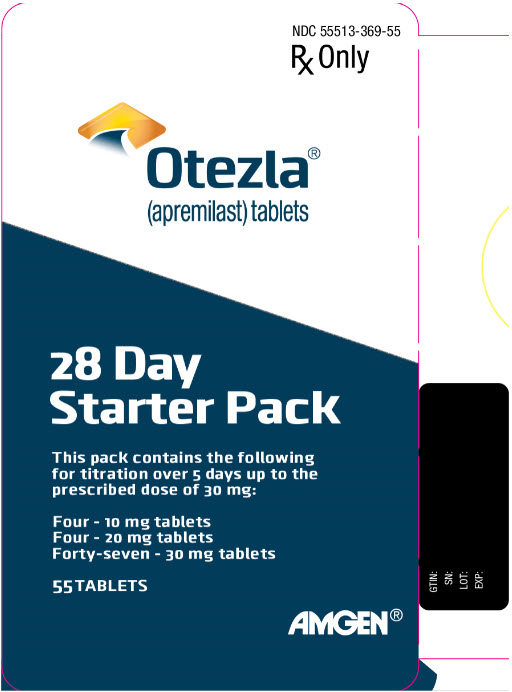
Otezla apremilast Kit, 1 kit — NDC 55513-369-55 (Billing 55513-0369-55)
This is a package of 1 kit of Otezla apremilast Kit from Amgen, Inc, marketed since Feb 2020 and currently FDA-listed; retail pharmacies pay about $98.55 per kit (NADAC). It is this product's only package size.
NDC database record
One package, one record: these facts belong to NDC 55513-369-55 alone.
- Record
- FDA NDC Directory package listing · Human prescription drug
- Code segments
- 55513 labeler · 369 product · 55 package
- Package marketed since
- Feb 26, 2020
- Sample package
- No — commercial package
- Listing certified through
- Dec 31, 2027
- Billing quantity
- 1 EA per package
- Barcode (UPC)
- 0355513137607
- Medicaid fills, this package
- 2,565 prescriptions in the last four reported quarters
- FDA record last changed
- Sep 24, 2026
Identity & classification
Regulatory identifiers FDA, NLM and CMS codes for this package
Drug-database identifiers Medi-Span GPI and First Databank GCN / HICL / AHFS classification
- GSN (GCN sequence number): 073370
- GCN: 37765
- HICL (First Databank): 040967
- AHFS class code: 90:24.24.92
- RxCUI (RxNorm): 1492732
Where does this data come from?
- FDA openFDA NDC Directory · synced Oct 8, 2026
- FDA label on DailyMed · label index refreshed Oct 8, 2026
- RxNorm (NLM RxNav) · catalog refreshed Oct 8, 2026
- Medi-Span GPI (licensed)
- First Databank (licensed) · refreshed Oct 8, 2026
RxNorm drug class
This medicine belongs to the Phosphodiesterase 4 Inhibitor class.
Where does this data come from?
- RxClass (NLM) · catalog refreshed Oct 8, 2026
Clinical
Apremilast is used to treat psoriatic arthritis (a condition that causes joint pain and swelling and scales on the skin). plaque psoriasis (skin disease in which red, scaly patches form on some areas of the body). ulcers in the mouth in people with Behcet's syndrome (a disorder that causes blood vessel swelling in the body). Apremilast is in a class of medications called phosphodiesterase inhibitors. It works by blocking the action of certain natural substances in the body that cause inflammation.
Read the full MedlinePlus article ↗- It treats psoriatic arthritis, plaque psoriasis, and oral ulcers from Behçet's Disease in adults. Children 6 and older can use it for psoriatic arthritis and moderate to severe pla...
- Take it by mouth, with or without food, and swallow the tablet whole. Otezla starts with a 5-day build-up to ease stomach side effects. Follow your prescriber's directions.
- Diarrhea, nausea, headache, and cold-like symptoms are most common. They often show up in the first weeks and tend to improve. Call your doctor if diarrhea, nausea or vomiting is s...
- Yes. Apremilast is linked to more depression, and weight loss can occur. Tell your doctor about mood changes or weight loss you can't explain.
Patient education
Supplement & herbal interactions
Some supplements/herbs that may interact with Apremilast — tap one for details:
Where does this data come from?
- MedlinePlus (NLM) · refreshed Oct 8, 2026
- FDA label on DailyMed · label index refreshed Oct 8, 2026
Ask a licensed pharmacist directly — free, answered by our team.
Pricing
A drug doesn't have one price. Each row is a different public payment system, and none is what you'd pay at the counter — that depends on your insurance. The ⓘ on each row explains what it measures.
| Price system | Per ea | Per package |
|---|---|---|
| Retail pharmacies payNADAC · weekly | $98.551 | $98.55 / 1 kit |
| Medicaid paysCMS SDUD · 12 mo | $94.30 | $94.30 / 1 kit |
| Medicare drug plans payPart D · Q2 2026 | $100.49 | $100.49 / 1 kit |
Where does this data come from?
- CMS NADAC weekly file · file of Oct 7, 2026
- CMS ASP pricing files · refreshed Sep 20, 2026
- CMS Medicaid State Drug Utilization Data · through Q1 2026
- CMS Part D plan pricing files · refreshed Sep 24, 2026
- VA National Acquisition Center price file
Packaging — all sizes for this product
| Package NDC | Description | Marketing start | Marketing end | Status |
|---|---|---|---|---|
| 55513-0369-55 You're viewing this Main listing | 1 BLISTER PACK in 1 CARTON / 1 KIT in 1 BLISTER PACK | 2020-02-26 | — | Active |
Therapeutic equivalents
| Product | Labeler | Pack | NADAC/unit | TE | Status | Price vs. this |
|---|---|---|---|---|---|---|
| Otezlathis 55513-0369-55 | Amgen, | 1 kit | $98.551 | AB | Availability likely | — |
| Otezla 55513-0996-95 | Amgen, | 4 tablets | — | AB | FDA listed | — |
| Otezla 55513-0485-96 | Amgen, | 1 kit | — | AB | FDA listed | — |
| Otezla 55513-0516-41 | Amgen, | 4 tablets | — | — | FDA listed | — |
| Otezla 55513-0508-55 | Amgen, | 4 tablets | — | AB | FDA listed | — |
Where does this data come from?
- FDA openFDA NDC Directory · synced Oct 8, 2026
- FDA Orange Book · refreshed Oct 3, 2026
- CMS NADAC weekly file · file of Oct 7, 2026
Availability & generic status
The FDA lists approved generic versions of this medicine, but that does not always mean a pharmacy can get one today. Patent rules, launch agreements, supply and pricing can affect when generics actually arrive.
Why the date isn’t exact: Generic timing can change because patents may be challenged, settled, licensed, added, removed, or worked around with a narrower label — and FDA approval does not always mean a pharmacy can get the generic today.
🛈 What do these terms mean?
- Patent
- Legal protection listed in the Orange Book that may delay generic approval or launch. Issued by the U.S. Patent & Trademark Office.
- Substance patent
- Covers the active drug molecule itself — the hardest to design around. A generic generally can’t launch until it expires.
- Formulation (product) patent
- Covers a specific formulation or dosage form. A generic can sometimes work around it with a different formulation.
- Method-of-use patent
- A patent covering one specific approved use of the drug — not necessarily the whole molecule. A generic can sometimes launch with a “skinny label” that carves out the protected use and keeps the others.
- Skinny label
- A generic label that omits a still-patented use when the FDA allows it — letting a generic reach the market for the unprotected uses.
- Exclusivity
- FDA-granted marketing protection, separate from patents — e.g. 5-yr new chemical entity, 7-yr orphan drug, or a +6-month pediatric extension.
- Paragraph IV
- A generic applicant’s formal challenge to a listed patent. It can potentially lead to earlier generic entry, but often involves litigation or a settlement.
- RLD / RS
- Reference Listed Drug — the brand product the FDA uses as the reference for generic applications. Reference Standard — the product the FDA expects generics to compare against in bioequivalence testing.
- TE / AB rating
- FDA therapeutic-equivalence rating. An AB rating generally means the FDA considers a generic therapeutically equivalent to — and substitutable for — the brand.
- LOE (loss of exclusivity)
- The latest patent or exclusivity currently listed — the loss-of-exclusivity / latest-listed-protection date shown on this page. Paragraph-IV challenges and settlements can move the real date earlier; FDA approval and a manufacturer’s decision to market can move it later.
Built from the FDA Orange Book. The bars above are scaled to each protection’s expiry; the red LOE marker is the last one to lapse.
| Patent | Type | Use code | Expires |
|---|---|---|---|
| US 9872854 ↗ | Method of use | U-2232 | May 29, 2034 |
| US 9872854 ↗ | Method of use | U-2233 | May 29, 2034 |
| US 9872854 ↗ | Method of use | U-2232 | May 29, 2034 |
| US 10092541 ↗ | Method of use | U-2403 | May 29, 2034 |
| US 10092541 ↗ | Method of use | U-2403 | May 29, 2034 |
| US 10092541 ↗ | Method of use | U-2659 | May 29, 2034 |
| US 10092541 ↗ | Method of use | U-2659 | May 29, 2034 |
| US 10092541 ↗ | Method of use | U-2659 | May 29, 2034 |
| US 9872854 ↗ | Method of use | U-2232 | May 29, 2034 |
| US 9872854 ↗ | Method of use | U-2233 | May 29, 2034 |
| US 9872854 ↗ | Method of use | U-2233 | May 29, 2034 |
| US 10092541 ↗ | Method of use | U-2403 | May 29, 2034 |
| US 12576034 ↗ | Method of use | U-4291 | Nov 30, 2033 |
| US 12576034 ↗ | Method of use | U-1858 | Nov 30, 2033 |
| US 12576034 ↗ | Method of use | U-4290 | Nov 30, 2033 |
| US 12576034 ↗ | Method of use | U-4291 | Nov 30, 2033 |
| US 12576034 ↗ | Method of use | U-1858 | Nov 30, 2033 |
| US 12576034 ↗ | Method of use | U-4290 | Nov 30, 2033 |
| US 12576034 ↗ | Method of use | U-4291 | Nov 30, 2033 |
| US 12576034 ↗ | Method of use | U-1858 | Nov 30, 2033 |
| US 12576034 ↗ | Method of use | U-4290 | Nov 30, 2033 |
| US 7427638 ↗ | Drug substance | — | Feb 16, 2028 |
| US 7427638 ↗ | Drug substance | — | Feb 16, 2028 |
| US 7427638 ↗ | Drug substance | — | Feb 16, 2028 |
| US 7427638*PED ↗ | Drug product | — | Aug 16, 2028 |
| US 7427638*PED ↗ | Drug product | — | Aug 16, 2028 |
| US 7427638*PED ↗ | Drug product | — | Aug 16, 2028 |
| US 9872854*PED ↗ | Drug product | — | Nov 29, 2034 |
| US 9872854*PED ↗ | Drug product | — | Nov 29, 2034 |
| US 9872854*PED ↗ | Drug product | — | Nov 29, 2034 |
| US 10092541*PED ↗ | Drug product | — | Nov 29, 2034 |
| US 10092541*PED ↗ | Drug product | — | Nov 29, 2034 |
| US 10092541*PED ↗ | Drug product | — | Nov 29, 2034 |
| US 12576034*PED ↗ | Drug product | — | May 30, 2034 |
| US 12576034*PED ↗ | Drug product | — | May 30, 2034 |
| US 12576034*PED ↗ | Drug product | — | May 30, 2034 |
| Code | What it grants | Expires |
|---|---|---|
| M-299 | New indication / labeling change (3-year) | Jul 20, 2026 |
| NPP | New Patient Population | Apr 25, 2027 |
| ODE-248 | Orphan Drug Exclusivity (7-year) | Jul 19, 2026 |
| M-299 | New indication / labeling change (3-year) | Jul 20, 2026 |
| NPP | New Patient Population | Apr 25, 2027 |
| ODE-248 | Orphan Drug Exclusivity (7-year) | Jul 19, 2026 |
| M-299 | New indication / labeling change (3-year) | Jul 20, 2026 |
| NPP | New Patient Population | Apr 25, 2027 |
| ODE-248 | Orphan Drug Exclusivity (7-year) | Jul 19, 2026 |
| PED | Pediatric Exclusivity (+6 months) | Jan 19, 2027 |
| PED | Pediatric Exclusivity (+6 months) | Jan 19, 2027 |
| PED | Pediatric Exclusivity (+6 months) | Jan 19, 2027 |
| PED | Pediatric Exclusivity (+6 months) | Oct 25, 2027 |
| PED | Pediatric Exclusivity (+6 months) | Oct 25, 2027 |
| PED | Pediatric Exclusivity (+6 months) | Oct 25, 2027 |
| PED | Pediatric Exclusivity (+6 months) | Jan 20, 2027 |
| PED | Pediatric Exclusivity (+6 months) | Jan 20, 2027 |
| PED | Pediatric Exclusivity (+6 months) | Jan 20, 2027 |
Is there a generic version of OTEZLA 10-20-30MG START 28 DAY?
The FDA approved a generic — why can’t I get it at my pharmacy yet?
Why do different websites show different generic release dates?
What does “FDA listed” mean?
What does a patent or protection date mean here?
What does “current Orange Book estimate” mean?
Can a generic come out before the last patent expires?
Can a generic come out after the listed dates?
What is the difference between patents and exclusivity?
Why are there multiple patent dates?
Where does this data come from?
- FDA Orange Book · refreshed Oct 3, 2026
What it looks like
Where does this data come from?
- FDA label on DailyMed · label index refreshed Oct 8, 2026
Inactive Ingredients / Excipients
Inactive ingredients, also called excipients, are components of the drug product other than the active ingredient. They may include fillers, dyes, coatings, preservatives, flavors, or other formulation ingredients.
🧪 Avoiding an ingredient? See Apremilast inactive ingredients by manufacturer: every current product's list side by side, so you can ask your pharmacy for the version that does not list it.
Where does this data come from?
IACT rows and label-wide narrative are kept separate; availability and product-level specificity depend on the submitted label.- FDA label on DailyMed · label index refreshed Oct 8, 2026
- FDA openFDA NDC Directory · synced Oct 8, 2026
Inactive ingredient FAQ
Are inactive ingredients the same for every manufacturer?
Why might an inactive ingredient be missing?
Can inactive ingredients matter?
Manufacturer & labeler
More NDCs from Amgen, Inc labeler code 55513
- Nplate romiplostim 500 ug/mL Injection, Powder, Lyophilized, For Solution NDC 55513-222-01
- Nplate romiplostim 125 ug/.25mL Injection, Powder, Lyophilized, For Solution NDC 55513-223-01
- Riabni rituximab-arrx 100 mg/10mL Injection, Solution NDC 55513-224-01
- EPOGEN epoetin alfa 3000 [iU]/mL Solution NDC 55513-267-10
- EPOGEN epoetin alfa 10000 [iU]/mL Solution NDC 55513-283-10
- Riabni rituximab-arrx 500 mg/50mL Injection, Solution NDC 55513-326-01
- AMJEVITA adalimumab-atto 20 mg/.2mL Injection NDC 55513-399-01
- AMJEVITA adalimumab-atto 40 mg/.8mL Injection NDC 55513-400-01
- AMJEVITA adalimumab-atto 40 mg/.8mL Injection NDC 55513-410-01
- AMJEVITA adalimumab-atto 20 mg/.4mL Injection NDC 55513-411-01
- AMJEVITA adalimumab-atto 10 mg/.2mL Injection NDC 55513-413-01
- EPOGEN epoetin alfa 20000 [iU]/mL Solution NDC 55513-478-10
Where does this data come from?
- FDA openFDA NDC Directory · synced Oct 8, 2026
- Drugs@FDA
Full prescribing information FDA SPL
🎯 Indications and Usage ▾
1 INDICATIONS AND USAGE OTEZLA/OTEZLA XR, an inhibitor of phosphodiesterase 4 (PDE4), is indicated for the treatment of: Adult patients with: Active psoriatic arthritis ( 1.1 ) Plaque psoriasis who are candidates for phototherapy or systemic therapy ( 1.2 ) Oral ulcers associated with Behçet's Disease ( 1.3 ) Pediatric patients 6 years of age and older with: Active psoriatic arthritis ( 1.1 ) Moderate to severe plaque psoriasis who are candidates for phototherapy or systemic therapy ( 1.2 ) In the pediatric population, OTEZLA is indicated for patients weighing at least 20 kg, and OTEZLA XR is indicated for patients weighing at least 50 kg.
1.1Psoriatic Arthritis OTEZLA is indicated for the treatment of adult patients and pediatric patients 6 years of age and older and weighing at least 20 kg with active psoriatic arthritis. OTEZLA XR is indicated for the treatment of adult patients and pediatric patients 6 years of age and older and weighing at least 50 kg with active psoriatic arthritis.
1.2Plaque Psoriasis OTEZLA/OTEZLA XR is indicated for the treatment of adult patients with plaque psoriasis who are candidates for phototherapy or systemic therapy. OTEZLA is indicated for the treatment of pediatric patients 6 years of age and older and weighing at least 20 kg with moderate to severe plaque psoriasis who are candidates for phototherapy or systemic therapy. OTEZLA XR is indicated for the treatment of pediatric patients 6 years of age and older and weighing at least 50 kg with moderate to severe plaque psoriasis who are candidates for phototherapy or systemic therapy.
1.3Oral Ulcers Associated with Behçet's Disease OTEZLA/OTEZLA XR is indicated for the treatment of adult patients with oral ulcers associated with Behçet's Disease.
⏱️ Dosage and Administration ▾
2 DOSAGE AND ADMINISTRATION To reduce the risk of gastrointestinal symptoms, titrate to recommended dosage as follows: Adults with Psoriatic Arthritis, Plaque Psoriasis, or Behçet's Disease See Table 1 for the initial titration schedule. Recommended maintenance dosage is OTEZLA 30 mg twice daily or OTEZLA XR 75 mg once daily ( 2.1 ) Pediatric Patients 6 Years of Age and Older and Weighing at Least 20 kg with Psoriatic Arthritis or Moderate to Severe Plaque Psoriasis See Table 2 for the initial titration schedule ( 2.1 ) For patients weighing 50 kg or more : Recommended maintenance dosage is OTEZLA 30 mg twice daily or OTEZLA XR 75 mg once daily ( 2.1 ) For patients weighing 20 kg to less than 50 kg : Recommended maintenance dosage is OTEZLA 20 mg twice daily ( 2.1 ) Dosage in Patients with Severe Renal Impairment : Adult Patients : For initial dosage titration, titrate using only morning schedule listed in Table 1 and skip afternoon doses.
Recommended maintenance dosage is OTEZLA 30 mg once daily ( 2.3 ) Pediatric Patients 6 Years of Age and Older and Weighing at Least 20 kg with Psoriatic Arthritis or Moderate to Severe Plaque Psoriasis : For initial dosage titration, titrate using only morning schedule for appropriate body weight category in Table 2 and skip afternoon doses ( 2.3 ) For patients weighing 50 kg or more: Recommended maintenance dosage is OTEZLA 30 mg once daily ( 2.3 ) For patients weighing 20 kg to less than 50 kg: Recommended maintenance dosage is OTEZLA 20 mg once daily ( 2.3 )
2.1Recommended Dosage in Adult and Pediatric Patients with Psoriatic Arthritis, Plaque Psoriasis, and Behçet's Disease Adult Patients with Psoriatic Arthritis, Plaque Psoriasis, or Behçet's Disease The recommended initial dosage titration from Day 1 to Day 5 is shown in Table 1. Following the 5-day titration with OTEZLA, the recommended maintenance dosage is OTEZLA 30 mg twice daily or OTEZLA XR 75 mg once daily taken orally starting on Day 6. This titration is intended to reduce the gastrointestinal symptoms associated with initial therapy.
Table 1. Dosage Titration Schedule for Adult Patients with Psoriatic Arthritis, Plaque Psoriasis, or Behçet's Disease OTEZLA Dosage Titration OTEZLA tablets should be used for the initial titration regardless of whether OTEZLA or OTEZLA XR will be used for the maintenance dosage. OTEZLA/OTEZLA XR Maintenance Dosage Day 1 Day 2 Day 3 Day 4 Day 5 Day 6 & thereafter AM AM PM AM PM AM PM AM PM BID = twice daily; QD = once daily 10 mg 10 mg 10 mg 10 mg 20 mg 20 mg 20 mg 20 mg 30 mg OTEZLA 30 mg BID OR OTEZLA XR 75 mg QD Pediatric Patients 6 Years of Age and Older and Weighing at Least 20 kg with Psoriatic Arthritis Moderate to Severe Plaque Psoriasis The recommended dosage for pediatric patients 6 years of age and older and weighing at least 20 kg with psoriatic arthritis or moderate to severe plaque psoriasis is based on body weight.
Following the appropriate initial titration schedule shown in Table 2, the recommended maintenance dosage is: For pediatric patients who weigh at least 50 kg: OTEZLA 30 mg twice daily or OTEZLA XR 75 mg once daily taken orally For pediatric patients who weigh from 20 kg to less than 50 kg: OTEZLA 20 mg twice daily taken orally The initial titration is intended to reduce the gastrointestinal symptoms associated with initial therapy. Table 2. Dosage Titration Schedule for Pediatric Patients 6 Years of Age and Older and Weighing at Least 20 kg with Psoriatic Arthritis or Moderate to Severe Plaque Psoriasis OTEZLA Dosage Titration OTEZLA tablets should be used for the initial titration regardless of whether OTEZLA or OTEZLA XR will be used for the maintenance dosage.
OTEZLA/OTEZLA XR Maintenance Dosage Body Weight Day 1 Day 2 Day 3 Day 4 Day 5 Day 6 & thereafter AM AM PM AM PM AM PM AM PM BID = twice daily; QD = once daily 50 kg or more 10 mg 10 mg 10 mg 10 mg 20 mg 20 mg 20 mg 20 mg 30 mg OTEZLA 30 mg BID OR OTEZLA XR 75 mg QD 20 kg to less than 50 kg 10 mg 10 mg 10 mg 10 m… [Excerpted — this section continues on DailyMed.]
💊 Dosage Forms and Strengths ▾
3 DOSAGE FORMS AND STRENGTHS OTEZLA is available as diamond-shaped, film-coated tablets in the following dosage strengths: 10-mg pink tablet engraved with "APR" on one side and "10" on the other side 20-mg brown tablet engraved with "APR" on one side and "20" on the other side 30-mg beige tablet engraved with "APR" on one side and "30" on the other side OTEZLA XR is available as 75 mg round, biconvex, pink, film-coated extended-release tablets with "APR 75" printed in black on one side and a hole or indentation on either side of the tablet, which may or may not be visible.
OTEZLA Tablets: 10 mg, 20 mg, 30 mg ( 3 ) OTEZLA XR Tablets: 75 mg ( 3 )
⛔ Contraindications ▾
4 CONTRAINDICATIONS OTEZLA/OTEZLA XR is contraindicated in patients with a known hypersensitivity to apremilast or to any of the excipients in the formulation [see Warnings and Precautions (5.1) , see Adverse Reactions (6.1) ] . Known hypersensitivity to apremilast or to any of the excipients in the formulation ( 4 )
⚠️ Warnings and Cautions ▾
5 WARNINGS AND PRECAUTIONS Hypersensitivity : Cases of angioedema and anaphylaxis have been reported during post marketing surveillance. Avoid the use of OTEZLA/OTEZLA XR in patients with known hypersensitivity to apremilast or to any of the excipients in the formulation. If signs or symptoms of serious hypersensitivity reactions develop during treatment, discontinue OTEZLA/OTEZLA XR and institute appropriate therapy ( 5.1 ) Diarrhea, Nausea, and Vomiting : Consider OTEZLA/OTEZLA XR dosage reduction or suspension if patients develop severe diarrhea, nausea, or vomiting ( 5.2 ) Depression : Advise patients, their caregivers, and families to be alert for the emergence or worsening of depression, suicidal thoughts or other mood changes and if such changes occur to contact their healthcare provider.
Carefully weigh risks and benefits of treatment with OTEZLA/OTEZLA XR in patients with a history of depression and/or suicidal thoughts or behavior ( 5.3 ) Weight Decrease : Monitor weight regularly. If unexplained or clinically significant weight loss occurs, evaluate weight loss and consider discontinuation of OTEZLA/OTEZLA XR ( 5.4 ) Drug Interactions : Use with strong cytochrome P450 enzyme inducers (e.g., rifampin, phenobarbital, carbamazepine, phenytoin) is not recommended because loss of efficacy may occur ( 5.5 , 7.1 )
5.1Hypersensitivity Hypersensitivity reactions, including cases of angioedema and anaphylaxis, have been reported during post marketing surveillance. Avoid the use of OTEZLA/OTEZLA XR in patients with known hypersensitivity to apremilast or to any of the excipients in the formulation. If signs or symptoms of serious hypersensitivity reactions develop during treatment, discontinue OTEZLA/OTEZLA XR and institute appropriate therapy.
5.2Diarrhea, Nausea, and Vomiting There have been reports of severe diarrhea, nausea, and vomiting associated with the use of OTEZLA. Most events occurred within the first few weeks of treatment. In some cases, patients were hospitalized.
Patients 65 years of age or older and patients taking medications that can lead to volume depletion or hypotension may be at a higher risk of complications from severe diarrhea, nausea, or vomiting. Monitor patients who are more susceptible to complications of diarrhea or vomiting. Patients who reduced dosage or discontinued OTEZLA generally improved quickly.
Consider OTEZLA/OTEZLA XR dosage reduction or suspension if patients develop severe diarrhea, nausea, or vomiting.
5.3Depression Treatment with apremilast is associated with an increased incidence of depression. Before using OTEZLA/OTEZLA XR in patients with a history of depression and/or suicidal thoughts or behavior, carefully weigh the risks and benefits of treatment with OTEZLA/OTEZLA XR. Advise patients, their caregivers, and families of the need to be alert for the emergence or worsening of depression, suicidal thoughts or other mood changes, and if such changes occur to contact their healthcare provider.
Carefully evaluate the risks and benefits of continuing treatment with OTEZLA/OTEZLA XR if such events occur. Psoriatic Arthritis : During the 16-week placebo-controlled period of the 3 controlled clinical trials, 1.0% (10/998) of subjects treated with OTEZLA reported depression or depressed mood compared to 0.8% (4/495) treated with placebo. During the clinical trials, 0.3% (4/1441) of subjects treated with OTEZLA discontinued treatment due to depression or depressed mood compared with none in placebo treated subjects (0/495).
Depression was reported as serious in 0.2% (3/1441) of subjects exposed to OTEZLA, compared to none in placebo-treated subjects (0/495). Instances of suicidal ideation and behavior have been observed in 0.2% (3/1441) of subjects while receiving OTEZLA, compared to none in placebo treated subjects (0/495). In the clinical trials, 2 subjects who received placebo committed suicide compared to none in OTEZLA-treated subjects.
Plaque Psoriasis : During the 16-week plac… [Excerpted — this section continues on DailyMed.]
🤒 Adverse Reactions ▾
6 ADVERSE REACTIONS The following adverse reactions are described elsewhere in the labeling: Hypersensitivity [see Warnings and Precautions (5.1) ] Diarrhea, Nausea, and Vomiting [see Warnings and Precautions (5.2) ] Depression [see Warnings and Precautions (5.3) ] Weight Decrease [see Warnings and Precautions (5.4) ] Drug Interactions [see Warnings and Precautions (5.5) ] Psoriatic Arthritis : The most common adverse reactions (≥ 5%) are diarrhea, nausea, and headache ( 6.1 ) Plaque Psoriasis : The most common adverse reactions (≥ 5%) are diarrhea, nausea, upper respiratory tract infection, and headache, including tension headache ( 6.1 ) Behçet's Disease : The most common adverse reactions (≥ 10%) are diarrhea, nausea, headache, and upper respiratory tract infection ( 6.1 ) To report SUSPECTED ADVERSE REACTIONS, contact Amgen Inc. at 1-800-77-AMGEN (1-800-772-6436) or FDA at 1-800-FDA-1088 or www.fda.gov/medwatch.
6.1Clinical Trials Experience Because clinical trials are conducted under widely varying conditions, adverse reaction rates observed in the clinical trials of a drug cannot be directly compared to rates in the clinical trials of another drug and may not reflect the rates observed in clinical practice. Psoriatic Arthritis Clinical Trials OTEZLA was evaluated in three multicenter, randomized, double-blind, placebo-controlled trials (PsA-1, PsA-2, and PsA-3) of similar design in adult subjects with active psoriatic arthritis [see Clinical Studies (14.1) ] .
Across the three trials, there were 1493 subjects randomized equally to placebo, OTEZLA 20 mg twice daily or OTEZLA 30 mg twice daily. Titration was used over the first 5 days [see Dosage and Administration (2.1) ] . Placebo subjects whose tender and swollen joint counts had not improved by at least 20% were re-randomized 1:1 in a blinded fashion to either OTEZLA 20 mg twice daily or 30 mg twice daily at week 16 while OTEZLA subjects remained on their initial treatment.
Subjects ranged in age from 18 to 83 years, with an overall median age of 51 years. The majority of the most common adverse reactions presented in Table 3 occurred within the first 2 weeks of treatment and tended to resolve over time with continued dosing. Diarrhea, headache, and nausea were the most commonly reported adverse reactions.
The most common adverse reactions leading to discontinuation for subjects taking OTEZLA were nausea (1.8%), diarrhea (1.8%), and headache (1.2%). The proportion of subjects with psoriatic arthritis who discontinued treatment due to any adverse reaction was 4.6% for subjects taking OTEZLA 30 mg twice daily and 1.2% for placebo-treated subjects. Table 3.
Adverse Reactions Reported in ≥ 2% of Adult Subjects with Active Psoriatic Arthritis on OTEZLA 30 mg Twice Daily and ≥ 1% than That Observed in Subjects on Placebo up to Day 112 (Week 16) Placebo OTEZLA 30 mg BID BID = twice daily. Adverse Reactions Day 1 to 5 (N = 495) n (%) n (%) indicates number of subjects and percent. Day 6 to Day 112 (N = 490) n (%) Day 1 to 5 (N = 497) n (%) Day 6 to Day 112 (N = 493) n (%) Diarrhea Of the reported gastrointestinal adverse reactions, 1 subject experienced a serious adverse reaction of nausea and vomiting in OTEZLA 30 mg twice daily; 1 subject treated with OTEZLA 20 mg twice daily experienced a serious adverse reaction of diarrhea; 1 subject treated with OTEZLA 30 mg twice daily experienced a serious adverse reaction of headache.
6 (1.2) 8 (1.6) 46 (9.3) 38 (7.7) Nausea 7 (1.4) 15 (3.1) 37 (7.4) 44 (8.9) Headache 9 (1.8) 11 (2.2) 24 (4.8) 29 (5.9) Upper respiratory tract infection Of the reported adverse drug reactions none were serious. 3 (0.6) 9 (1.8) 3 (0.6) 19 (3.9) Vomiting 2 (0.4) 2 (0.4) 4 (0.8) 16 (3.2) Nasopharyngitis 1 (0.2) 8 (1.6) 1 (0.2) 13 (2.6) Abdominal pain upper 0 (0.0) 1 (0.2) 3 (0.6) 10 (2.0) Moderate to Severe Plaque Psoriasis Clinical Trials Adverse Reactions from Clinical Trials in Adults The safety of OTEZLA was assessed in 1426 subjects in three randomiz… [Excerpted — this section continues on DailyMed.]
🔄 Drug Interactions ▾
7 DRUG INTERACTIONS
7.1Strong CYP450 Inducers Co-administration with strong CYP450 inducers (such as rifampin) decreases apremilast exposure and may result in loss of efficacy of OTEZLA/OTEZLA XR [see Warnings and Precautions (5.5) and Clinical Pharmacology (12.3) ] .
👥 Use in Specific Populations ▾
8 USE IN SPECIFIC POPULATIONS Severe Renal Impairment : Increased systemic exposure of OTEZLA has been observed. For adults and for pediatric patients weighing 50 kg or more, reduce dosage to OTEZLA 30 mg once daily. For pediatric patients weighing 20 kg to less than 50 kg, reduce dosage to OTEZLA 20 mg once daily ( 2.3 , 8.6 ).
8.1Pregnancy Risk Summary Available data with OTEZLA use in pregnant women have not identified a drug-associated risk of major birth defects or adverse maternal or fetal outcomes (see Data ) . In animal embryo-fetal development studies, the administration of apremilast to pregnant cynomolgus monkeys during organogenesis resulted in dose-related increases in abortion/embryo-fetal death at dose exposures approximately 2-times the maximum recommended human therapeutic dose (MRHD) and no adverse effect at an exposure of 1.4-times the MRHD.
When apremilast was administered to pregnant mice during organogenesis, there were no apremilast-induced malformations up to exposures 4-times the MRHD. Based on findings from animal reproduction studies, OTEZLA/OTEZLA XR may increase the risk for fetal loss (see Data ) . Advise pregnant women of the potential risk of fetal loss.
The background risk of major birth defects and miscarriage for the indicated populations is unknown. All pregnancies have a background risk of birth defect, loss, or other adverse outcomes. In the U.S. general population, the estimated background risk of major birth defects and miscarriage in clinically recognized pregnancies is 2% to 4% and 15% to 20%, respectively.
Data Human Data A pregnancy registry conducted by the Organization of Teratology Information Specialists (OTIS) in the United States and Canada assessed the risk of major birth defects in liveborn infants of women with psoriatic arthritis, psoriasis, or Behçet's Disease exposed to apremilast in the first trimester. The study compared pregnant women treated with apremilast (n = 15) with disease matched pregnant women who were not exposed to apremilast (n = 106). In the apremilast-exposed cohort, there were no reports of liveborn infants with major birth defects nor miscarriages.
One stillbirth was reported in the apremilast exposed cohort. These data are limited by the small sample size of apremilast-exposed pregnancies. Animal Data In an embryo-fetal developmental study, pregnant cynomolgus monkeys were administered apremilast at doses of 20, 50, 200, or 1000 mg/kg/day during the period of organogenesis (gestation Days [GD] 20 through 50).
There was a dose -related increase in spontaneous abortions, with most abortions occurring during Weeks 3 to 4 of dosing in the first trimester, at doses approximately 2-times the MRHD and greater (on an area under the curve [AUC] basis at doses ≥ 50 mg/kg/day). No abortifacient effects were observed at a dose approximately 1.4-times the MRHD (on an AUC basis at a dose of 20 mg/kg/day). Although there was no evidence for a teratogenic effect at doses of 20 mg/kg/day and greater when examined at Day 100, aborted fetuses were not examined.
In an embryo-fetal development study in mice, apremilast was administered at doses of 250, 500, or 750 mg/kg/day to dams during organogenesis (GD 6 through 15). In a combined fertility and embryo-fetal development study in mice, apremilast was administered at doses of 10, 20, 40, or 80 mg/kg/day starting 15 days before cohabitation and continuing through GD 15. No teratogenic findings attributed to apremilast were observed in either study; however, there was an increase in post-implantation loss at doses corresponding to a systemic exposure of approximately 2-times the MRHD and greater (≥ 20 mg/kg/day).
At doses of ≥ 20 mg/kg/day skeletal variations included incomplete ossification sites of tarsals, skull, sternebra, and vertebrae. No effects were observed at a dose approximately 1.3-times the MRHD (10 mg/kg/day). Apremilast distributed across the placenta into the fetal compartment in mice and monkeys.
In a pre… [Excerpted — this section continues on DailyMed.]
🤰 Pregnancy ▾
8.1Pregnancy Risk Summary Available data with OTEZLA use in pregnant women have not identified a drug-associated risk of major birth defects or adverse maternal or fetal outcomes (see Data ) . In animal embryo-fetal development studies, the administration of apremilast to pregnant cynomolgus monkeys during organogenesis resulted in dose-related increases in abortion/embryo-fetal death at dose exposures approximately 2-times the maximum recommended human therapeutic dose (MRHD) and no adverse effect at an exposure of 1.4-times the MRHD.
When apremilast was administered to pregnant mice during organogenesis, there were no apremilast-induced malformations up to exposures 4-times the MRHD. Based on findings from animal reproduction studies, OTEZLA/OTEZLA XR may increase the risk for fetal loss (see Data ) . Advise pregnant women of the potential risk of fetal loss.
The background risk of major birth defects and miscarriage for the indicated populations is unknown. All pregnancies have a background risk of birth defect, loss, or other adverse outcomes. In the U.S. general population, the estimated background risk of major birth defects and miscarriage in clinically recognized pregnancies is 2% to 4% and 15% to 20%, respectively.
Data Human Data A pregnancy registry conducted by the Organization of Teratology Information Specialists (OTIS) in the United States and Canada assessed the risk of major birth defects in liveborn infants of women with psoriatic arthritis, psoriasis, or Behçet's Disease exposed to apremilast in the first trimester. The study compared pregnant women treated with apremilast (n = 15) with disease matched pregnant women who were not exposed to apremilast (n = 106). In the apremilast-exposed cohort, there were no reports of liveborn infants with major birth defects nor miscarriages.
One stillbirth was reported in the apremilast exposed cohort. These data are limited by the small sample size of apremilast-exposed pregnancies. Animal Data In an embryo-fetal developmental study, pregnant cynomolgus monkeys were administered apremilast at doses of 20, 50, 200, or 1000 mg/kg/day during the period of organogenesis (gestation Days [GD] 20 through 50).
There was a dose -related increase in spontaneous abortions, with most abortions occurring during Weeks 3 to 4 of dosing in the first trimester, at doses approximately 2-times the MRHD and greater (on an area under the curve [AUC] basis at doses ≥ 50 mg/kg/day). No abortifacient effects were observed at a dose approximately 1.4-times the MRHD (on an AUC basis at a dose of 20 mg/kg/day). Although there was no evidence for a teratogenic effect at doses of 20 mg/kg/day and greater when examined at Day 100, aborted fetuses were not examined.
In an embryo-fetal development study in mice, apremilast was administered at doses of 250, 500, or 750 mg/kg/day to dams during organogenesis (GD 6 through 15). In a combined fertility and embryo-fetal development study in mice, apremilast was administered at doses of 10, 20, 40, or 80 mg/kg/day starting 15 days before cohabitation and continuing through GD 15. No teratogenic findings attributed to apremilast were observed in either study; however, there was an increase in post-implantation loss at doses corresponding to a systemic exposure of approximately 2-times the MRHD and greater (≥ 20 mg/kg/day).
At doses of ≥ 20 mg/kg/day skeletal variations included incomplete ossification sites of tarsals, skull, sternebra, and vertebrae. No effects were observed at a dose approximately 1.3-times the MRHD (10 mg/kg/day). Apremilast distributed across the placenta into the fetal compartment in mice and monkeys.
In a pre and postnatal study in mice, apremilast was administered to pregnant female mice at doses of 10, 80, or 300 mg/kg/day from Day 6 of gestation through Day 20 of lactation, with weaning on Day 21. Dystocia, reduced viability, and reduced birth weights occurred at doses corresponding to ≥ 4-times the MRHD (on an AUC basis at doses ≥… [Excerpted — this section continues on DailyMed.]
🧒 Pediatric Use ▾
8.4Pediatric Use OTEZLA Plaque Psoriasis The safety and effectiveness of OTEZLA have been established in pediatric patients 6 years of age and older and weighing at least 20 kg with moderate to severe plaque psoriasis who are candidates for phototherapy or systemic therapy. Use of OTEZLA in these patients is supported by evidence from a 52-week adequate and well-controlled clinical trial (PSOR-6) in 245 pediatric subjects 6 years of age and older with moderate to severe plaque psoriasis. Weight loss in OTEZLA-treated pediatric subjects was comparable to weight loss observed in adults [see Warnings and Precautions (5.4) , Adverse Reactions (6.1) and Clinical Studies (14.3) ] .
Closely monitor growth (height and weight) in pediatric patients treated with OTEZLA. Pediatric patients who are not growing or gaining weight as expected may need to have their treatment interrupted. The safety and effectiveness of OTEZLA have not been established in pediatric patients below the age of 6 years or weighing less than 20 kg with moderate to severe plaque psoriasis.
Psoriatic Arthritis The safety and effectiveness of OTEZLA have been established for pediatric patients 6 years of age and older and weighing at least 20 kg with psoriatic arthritis. Use of OTEZLA in these patients is supported by evidence from adequate and well controlled trials of OTEZLA in adults with psoriatic arthritis, pharmacokinetic data from adult patients with psoriatic arthritis, adult patients with psoriasis, and pediatric patients with psoriasis, and safety data from a clinical trial in 245 pediatric patients 6 years of age and older with psoriasis.
Steady-state exposure of OTEZLA in pediatric patients with psoriatic arthritis is estimated to be comparable to adults with psoriatic arthritis and pediatric patients with psoriasis [see Clinical Pharmacology (12.3) ] . Closely monitor growth (height and weight) in OTEZLA-treated pediatric patients. Pediatric patients who are not growing or gaining weight as expected may need to have their treatment interrupted [see Warnings and Precautions (5.4) ] .
The safety and effectiveness of OTEZLA have not been established in pediatric patients below the age of 6 years or weighing less than 20 kg with psoriatic arthritis. Behçet's Disease The safety and effectiveness of OTEZLA have not been established in pediatric patients with psoriatic arthritis or oral ulcers associated with Behçet's Disease. OTEZLA XR Plaque Psoriasis and Psoriatic Arthritis The safety and effectiveness of OTEZLA XR have been established for the treatment of moderate to severe plaque psoriasis and psoriatic arthritis in pediatric patients 6 years of age and older and weighing at least 50 kg.
Use of OTEZLA XR in these patients is supported by pharmacokinetic data from healthy adults demonstrating comparable PK exposure between OTEZLA XR 75 mg once daily and OTEZLA 30 mg twice daily, which is the recommended OTEZLA dosage for pediatric patients weighing at least 50 kg [see Dosage and Administration (2.1) , Clinical Pharmacology (12.3) ] . Closely monitor growth (height and weight) in pediatric patients treated with OTEZLA XR. Pediatric patients who are not growing or gaining weight as expected may need to have their treatment interrupted.
The safety and effectiveness of OTEZLA XR have not been established in pediatric patients below the age of 6 years or weighing less than 50 kg with moderate to severe plaque psoriasis or psoriatic arthritis. Behçet's Disease The safety and effectiveness of OTEZLA XR have not been established in pediatric patients with oral ulcers associated with Behçet's Disease.
🧓 Geriatric Use ▾
8.5Geriatric Use Of the 1493 patients who enrolled in Trials PsA-1, PsA-2, and PsA-3, a total of 146 (9.8%) psoriatic arthritis patients were 65 years of age and older, including 19 (1.3%) patients 75 years and older. No overall differences were observed in the safety profile of geriatric patients ≥ 65 years of age and younger adult patients < 65 years of age in the clinical trials. Of the 1257 subjects who enrolled in two placebo-controlled plaque psoriasis trials (PSOR-1 and PSOR-2), a total of 108 (8.6%) plaque psoriasis patients were 65 years of age and older, including 9 (0.7%) patients who were 75 years of age and older.
No overall differences were observed in the safety or effectiveness in geriatric patients ≥ 65 years of age and younger adult patients < 65 years of age in the clinical trials. Because patients 65 years of age or older may be at a higher risk of complications such as volume depletion or hypotension from severe diarrhea, nausea, or vomiting, monitor geriatric patients closely for such complications [see Warnings and Precautions (5.2) ] .
🧬 Clinical Pharmacology ▾
12 CLINICAL PHARMACOLOGY
12.1Mechanism of Action Apremilast is an oral small molecule inhibitor of phosphodiesterase 4 (PDE4) specific for cyclic adenosine monophosphate (cAMP). PDE4 inhibition results in increased intracellular cAMP levels. The specific mechanism(s) by which apremilast exerts its therapeutic action is not well defined.
12.2Pharmacodynamics In clinical studies, apremilast decreased IL-17, IL-22 and TNF-alpha levels circulating in blood and reduced expression of these pro-inflammatory cytokine genes in skin. The clinical implications of these pharmacodynamic responses remain unclear.
12.3Pharmacokinetics Absorption OTEZLA when taken orally is absorbed with an absolute bioavailability of ~73%, with peak plasma concentrations (C max ) occurring at a median time (t max ) of ~2.5 hours. Co-administration with food does not alter the extent of absorption of OTEZLA. OTEZLA XR when taken orally is absorbed with peak plasma concentrations (C max ) occurring at a median time (t max ) of ~6 hours.
OTEZLA XR 75 mg administered once daily demonstrates comparable PK exposure (steady-state AUC and C max ) to OTEZLA 30 mg twice daily. When administered with a high-fat meal, OTEZLA XR t max was delayed by 3 hours and C max and AUC were increased by ~28% compared to fasted conditions. Therefore, OTEZLA XR may be taken without regard to meals.
Distribution Human plasma protein binding of apremilast is approximately 68%. Mean apparent volume of distribution (Vd) is 87 L. Metabolism Following oral administration in humans, apremilast is a major circulating component (45%) followed by inactive metabolite M12 (39%), a glucuronide conjugate of O-demethylated apremilast.
It is extensively metabolized in humans with up to 23 metabolites identified in plasma, urine and feces. Apremilast is metabolized by both cytochrome (CYP) oxidative metabolism with subsequent glucuronidation and non-CYP mediated hydrolysis. In vitro , CYP metabolism of apremilast is primarily mediated by CYP3A4, with minor contributions from CYP1A2 and CYP2A6.
Elimination The plasma clearance of apremilast is about 10 L/hr in healthy subjects, with a terminal elimination half-life of approximately 6-9 hours. Following oral administration of radiolabeled apremilast, about 58% and 39% of the radioactivity is recovered in urine and feces, respectively, with about 3% and 7% of the radioactive dose recovered as apremilast in urine and feces, respectively. Specific Populations Patients with Hepatic Impairment: The pharmacokinetics of apremilast is not affected by moderate or severe hepatic impairment.
Patients with Renal Impairment: The pharmacokinetics of apremilast is not affected by mild or moderate renal impairment. In 8 adult subjects with severe renal impairment administered a single dose of 30 mg OTEZLA, the AUC and C max of apremilast increased by approximately 88% and 42%, respectively [see Dosage and Administration (2.3) and Use in Specific Populations (8.6) ] . The effects of renal impairment have not been studied for OTEZLA XR [see Dosage and Administration (2.3) and Use in Specific Populations (8.6) ] .
Geriatric Patients: A single oral dose of 30-mg apremilast was studied in young adults and elderly healthy subjects. The apremilast exposure in elderly subjects (65 to 85 years of age) was about 13% higher in AUC and about 6% higher in C max than in young subjects (18 to 55 years of age) [see Use in Specific Populations (8.5) ] . Pediatric Patients : The pharmacokinetics of OTEZLA were evaluated in a clinical trial in pediatric subjects 6 to 17 years of age with moderate to severe plaque psoriasis at the recommended pediatric dosage regimen [see Dosage and Administration (2.1) and Clinical Studies (14.3) ] .
Population pharmacokinetic analysis indicated that steady-state exposure (AUC and C max ) of OTEZLA in pediatric subjects receiving the pediatric maintenance dosage regimen (20 or 30 mg twice daily, based on body weight) was comparable to steady-state ex… [Excerpted — this section continues on DailyMed.]
🧬 Mechanism of Action ▾
12.1Mechanism of Action Apremilast is an oral small molecule inhibitor of phosphodiesterase 4 (PDE4) specific for cyclic adenosine monophosphate (cAMP). PDE4 inhibition results in increased intracellular cAMP levels. The specific mechanism(s) by which apremilast exerts its therapeutic action is not well defined.
📦 How Supplied / Storage and Handling ▾
16 HOW SUPPLIED/STORAGE AND HANDLING OTEZLA is available as diamond-shaped, film-coated tablets in the following dosage strengths: 10 mg pink tablet engraved with "APR" on one side and "10" on the other side; 20 mg brown tablet engraved with "APR" on one side and "20" on the other side; 30 mg beige tablet engraved with "APR" on one side and "30" on the other side. Tablets are supplied in the strengths and package configurations listed in Table 14. Table 14.
OTEZLA Package Configurations Package configuration Tablet strength NDC number Configurations for 30 mg BID Dosage 28-day treatment initiation pack 55-tablet blister pack including tablets for titration and maintenance dosage: 4 tablets (10 mg each), 4 tablets (20 mg each), and 47 tablets (30 mg each) 55513-369-55 60-count bottle 30 mg 55513-137-60 Configurations for 20 mg BID Dosage 28-day treatment initiation pack 55-tablet blister pack including tablets for titration and maintenance dosage: 4 tablets (10 mg each) and 51 tablets (20 mg each) 55513-508-55 60-count bottle 20 mg 55513-497-60 OTEZLA XR is available as 75 mg round, biconvex, pink, film-coated extended-release tablets with "APR 75" printed in black on one side and a hole or indentation on either side of the tablet, which may or may not be visible.
Tablets are supplied in the strengths and package configurations listed in Table 15. Table 15. OTEZLA XR Package Configurations Package configuration Tablet strength NDC number 28-day treatment initiation pack The 28-day treatment initiation pack provides the first 14 days of treatment with OTEZLA (titration schedule on Days 1–5 and maintenance dosage of 30 mg twice daily on Days 6–14), followed by a switch to OTEZLA XR 75 mg once daily for the subsequent 14 days.
41-tablet blister titration pack including tablets for titration and maintenance dosage: OTEZLA: 4 tablets (10 mg each), 4 tablets (20 mg each), and 19 tablets (30 mg each) and OTEZLA XR: 14 tablets (75 mg each) 55513-516-41 Bottles of 30 OTEZLA XR : 30 tablets (75 mg each) 55513-519-30 Storage and Handling Store OTEZLA tablets below 30°C (86°F). Store OTEZLA XR tablets between 20°C and 25°C (68°F and 77°F); excursions permitted between 15°C and 30°C (59°F and 86°F) [see USP Controlled Room Temperature].
📦 Storage and Handling ▾
Storage and Handling Store OTEZLA tablets below 30°C (86°F). Store OTEZLA XR tablets between 20°C and 25°C (68°F and 77°F); excursions permitted between 15°C and 30°C (59°F and 86°F) [see USP Controlled Room Temperature].
📋 Description ▾
11 DESCRIPTION The active ingredient in OTEZLA/OTEZLA XR tablets is apremilast. Apremilast drug substance is non-hygroscopic. Apremilast drug substance is practically insoluble in water and slightly soluble in alcohol.
Apremilast is a phosphodiesterase 4 (PDE4) inhibitor. Apremilast is known chemically as N-[2-[(1S)-1-(3-ethoxy-4-methoxyphenyl)-2-(methylsulfonyl)ethyl]-2,3-dihydro-1,3-dioxo-1H-isoindol-4-yl]acetamide. Its empirical formula is C 22 H 24 N 2 O 7 S and the molecular weight is 460.5.
The chemical structure is: OTEZLA (apremilast) tablets are supplied in 10 mg, 20 mg, and 30 mg strengths for oral administration. Each tablet contains apremilast as the active ingredient and the following inactive ingredients: croscarmellose sodium, iron oxide red, iron oxide yellow (20 and 30 mg only), iron oxide black (30 mg only), lactose monohydrate, magnesium stearate, microcrystalline cellulose, polyethylene glycol, polyvinyl alcohol, talc, titanium dioxide. OTEZLA XR (apremilast) extended-release tablets are supplied in a 75 mg strength for oral administration.
Each tablet contains apremilast as the active ingredient and the following inactive ingredients: cellulose acetate, colloidal silicon dioxide, ferrosoferric oxide, hydroxypropyl methylcellulose acetate succinate, hypromellose, iron oxide red, magnesium stearate, mannitol, microcrystalline cellulose, polyethylene glycol, polyethylene oxide, sodium chloride, titanium dioxide. Chemical Structure
💬 Information for Patients ▾
17 PATIENT COUNSELING INFORMATION Administration Instructions Instruct patients to take OTEZLA/OTEZLA XR only as prescribed [see Dosage and Administration (2.1 and 2.3) ] . Advise patients to take OTEZLA/OTEZLA XR with or without food. Instruct patients to swallow tablets whole and not to crush, split, or chew prior to swallowing [see Dosage and Administration (2.4) ] .
Hypersensitivity Inform patients that hypersensitivity reactions can occur following administration of OTEZLA/OTEZLA XR. Instruct patients to contact their healthcare provider if they experience symptoms of an allergic reaction [see Warnings and Precautions (5.1) ] . Diarrhea, Nausea, and Vomiting Advise patients of the potential complications of severe diarrhea, nausea, or vomiting and instruct them to contact their healthcare provider if they experience these adverse reactions, especially if the patient is 65 years of age or older [see Warnings and Precautions (5.2) ] .
Depression Inform patients that treatment with OTEZLA/OTEZLA XR is associated with an increased incidence of depression. Advise patients, their caregivers, and families of the need to be alert for the emergence or worsening of depression, suicidal thoughts or other mood changes, and if such changes occur to contact their healthcare provider [see Warnings and Precautions (5.3) ] . Weight Decrease Inform patients that treatment with OTEZLA/OTEZLA XR is associated with potential weight loss.
Instruct patients or caregivers to have their or their child's weight monitored regularly and, if unexplained or clinically significant weight loss occurs, to contact their healthcare provider for evaluation of the weight loss [see Warnings and Precautions (5.4) ] . Pregnancy Advise pregnant patients and patients of reproductive potential of the potential risk to a fetus. Advise patients to inform their prescriber of a known or suspected pregnancy [see Use in Specific Populations (8.1) ] .
Residual Tablet Shell Patients receiving OTEZLA XR may notice an inert tablet shell passing in the stool or via colostomy. Patients should be informed that the active medication has already been absorbed by the time the patient sees the inert tablet shell.
🧬 Pharmacokinetics ▾
12.3Pharmacokinetics Absorption OTEZLA when taken orally is absorbed with an absolute bioavailability of ~73%, with peak plasma concentrations (C max ) occurring at a median time (t max ) of ~2.5 hours. Co-administration with food does not alter the extent of absorption of OTEZLA. OTEZLA XR when taken orally is absorbed with peak plasma concentrations (C max ) occurring at a median time (t max ) of ~6 hours.
OTEZLA XR 75 mg administered once daily demonstrates comparable PK exposure (steady-state AUC and C max ) to OTEZLA 30 mg twice daily. When administered with a high-fat meal, OTEZLA XR t max was delayed by 3 hours and C max and AUC were increased by ~28% compared to fasted conditions. Therefore, OTEZLA XR may be taken without regard to meals.
Distribution Human plasma protein binding of apremilast is approximately 68%. Mean apparent volume of distribution (Vd) is 87 L. Metabolism Following oral administration in humans, apremilast is a major circulating component (45%) followed by inactive metabolite M12 (39%), a glucuronide conjugate of O-demethylated apremilast.
It is extensively metabolized in humans with up to 23 metabolites identified in plasma, urine and feces. Apremilast is metabolized by both cytochrome (CYP) oxidative metabolism with subsequent glucuronidation and non-CYP mediated hydrolysis. In vitro , CYP metabolism of apremilast is primarily mediated by CYP3A4, with minor contributions from CYP1A2 and CYP2A6.
Elimination The plasma clearance of apremilast is about 10 L/hr in healthy subjects, with a terminal elimination half-life of approximately 6-9 hours. Following oral administration of radiolabeled apremilast, about 58% and 39% of the radioactivity is recovered in urine and feces, respectively, with about 3% and 7% of the radioactive dose recovered as apremilast in urine and feces, respectively. Specific Populations Patients with Hepatic Impairment: The pharmacokinetics of apremilast is not affected by moderate or severe hepatic impairment.
Patients with Renal Impairment: The pharmacokinetics of apremilast is not affected by mild or moderate renal impairment. In 8 adult subjects with severe renal impairment administered a single dose of 30 mg OTEZLA, the AUC and C max of apremilast increased by approximately 88% and 42%, respectively [see Dosage and Administration (2.3) and Use in Specific Populations (8.6) ] . The effects of renal impairment have not been studied for OTEZLA XR [see Dosage and Administration (2.3) and Use in Specific Populations (8.6) ] .
Geriatric Patients: A single oral dose of 30-mg apremilast was studied in young adults and elderly healthy subjects. The apremilast exposure in elderly subjects (65 to 85 years of age) was about 13% higher in AUC and about 6% higher in C max than in young subjects (18 to 55 years of age) [see Use in Specific Populations (8.5) ] . Pediatric Patients : The pharmacokinetics of OTEZLA were evaluated in a clinical trial in pediatric subjects 6 to 17 years of age with moderate to severe plaque psoriasis at the recommended pediatric dosage regimen [see Dosage and Administration (2.1) and Clinical Studies (14.3) ] .
Population pharmacokinetic analysis indicated that steady-state exposure (AUC and C max ) of OTEZLA in pediatric subjects receiving the pediatric maintenance dosage regimen (20 or 30 mg twice daily, based on body weight) was comparable to steady-state exposure in adult subjects at the 30 mg twice daily dosage. Male and Female Patients: In pharmacokinetic trials in healthy volunteers, the extent of exposure in females was about 31% higher and C max was about 8% higher than that in male subjects. Racial or Ethnic Groups: The pharmacokinetics of apremilast in Chinese and Japanese healthy male subjects is comparable to that in White healthy male subjects.
In addition, apremilast exposure is similar among White subjects (including Hispanic or Latino and not Hispanic or Latino subjects) and Black or African American subjects. Drug Interactions In vitro data… [Excerpted — this section continues on DailyMed.]
🧬 Pharmacodynamics ▾
12.2Pharmacodynamics In clinical studies, apremilast decreased IL-17, IL-22 and TNF-alpha levels circulating in blood and reduced expression of these pro-inflammatory cytokine genes in skin. The clinical implications of these pharmacodynamic responses remain unclear.
🔬 Clinical Studies ▾
14 CLINICAL STUDIES
14.1Adult Psoriatic Arthritis The safety and efficacy of OTEZLA was evaluated in three multicenter, randomized, double-blind, placebo-controlled trials (PsA-1 [NCT01172938], PsA-2 [NCT01212757], and PsA-3 [NCT01212770]) of similar design. A total of 1493 adult subjects with active PsA (≥ 3 swollen joints and ≥ 3 tender joints) despite prior or current treatment with disease-modifying antirheumatic drug (DMARD) therapy were randomized. Subjects enrolled in these trials had a diagnosis of PsA for at least 6 months.
One qualifying psoriatic skin lesion of at least 2 cm in diameter was required in Trial PsA-3. Previous treatment with a biologic, including TNF blockers was allowed (up to 10% could be TNF blocker therapeutic failures). Across the three trials, subjects were randomly assigned to placebo (n = 496), OTEZLA 20 mg (n = 500), or OTEZLA 30 mg (n = 497) given orally twice daily.
Titration was used over the first 5 days [see Dosage and Administration (2.1) ] . Subjects were allowed to receive stable doses of concomitant methotrexate [MTX (≤ 25 mg/week)], sulfasalazine [SSZ (≤ 2 g/day)], leflunomide [LEF (≤ 20 mg/day)], low dose oral corticosteroids (equivalent to ≤ 10 mg of prednisone a day), and/or nonsteroidal anti-inflammatory drugs (NSAIDs) during the trial. Treatment assignments were stratified based on small molecule DMARD use at baseline in Trials PsA-1, PsA-2 and PsA-3.
There was an additional stratification of body surface area (BSA) > 3% with psoriasis in Trial PsA-3. The subjects who were therapeutic failures of > 3 agents for PsA (small molecules or biologics), or > 1 biologic TNF blocker were excluded. The primary endpoint was the percentage of subjects achieving American College of Rheumatology (ACR) 20 response at Week 16.
Placebo-controlled efficacy data were collected and analyzed through Week 24. Subjects whose tender and swollen joint counts had not improved by at least 20% were considered non-responders at Week 16. Placebo non-responders were re-randomized 1:1 in a blinded fashion to either OTEZLA 20 mg twice daily or 30 mg twice daily following the titration schema [see Dosage and Administration (2.1) ] .
OTEZLA subjects remained on their initial treatment. At Week 24, all remaining placebo subjects were re-randomized to either 20 mg twice daily or 30 mg twice daily. Subjects with subtypes of PsA were enrolled across the three trials, including symmetric polyarthritis (62.0%), asymmetric oligoarthritis (27.0%), distal interphalangeal (DIP) joint arthritis (6.0%), arthritis mutilans (3.0%), and predominant spondylitis (2.1%).
The median duration of PsA disease was 5 years. Subjects received concomitant therapy with at least one DMARD (65.0%), MTX (55.0%), SSZ (9.0%), LEF (7.0%), low dose oral corticosteroids (14.0%), and NSAIDs (71.0%). Prior treatment with small molecule DMARDs only was reported in 76.0% of subjects and prior treatment with biologic DMARDs was reported in 22.0% of subjects, which includes 9.0% who had failed prior biologic DMARD treatment.
Clinical Response in Subjects with Psoriatic Arthritis The percent of subjects achieving ACR 20, 50 and 70 responses in Trials PsA-1, PsA-2, and PsA-3 are presented in Table 6 below. OTEZLA ± DMARDs, compared with Placebo ± DMARDs resulted in a greater improvement in signs and symptoms of psoriatic arthritis as demonstrated by the proportion of subjects with an ACR 20 response at Week 16. Table 6.
Proportion of Adult Subjects With Active Psoriatic Arthritis With ACR Responses in Trials PsA-1, PsA-2 and PsA-3 PsA-1 PsA-2 PsA-3 N N is number of randomized and treated subjects. Placebo ± DMARDs N = 168 OTEZLA 30 mg twice daily ± DMARDs N = 168 Placebo ± DMARDs N = 159 OTEZLA 30 mg twice daily ± DMARDs N = 162 Placebo ± DMARDs N = 169 OTEZLA 30 mg twice daily ± DMARDs N = 167 ACR 20 Week 16 19% 38% Statistically significantly different from placebo (p < 0.05). 19% 32% 18% 41% ACR 50 Week 16 6% 16% 5% 11% 8% 15% ACR 70 Week 16 1% 4% 1%… [Excerpted — this section continues on DailyMed.]
🧪 Nonclinical Toxicology ▾
13 NONCLINICAL TOXICOLOGY
13.1Carcinogenesis, Mutagenesis, Impairment of Fertility Long-term studies were conducted in mice and rats with apremilast to evaluate its carcinogenic potential. No evidence of apremilast-induced tumors was observed in mice at oral doses up to approximately 9-times the MRHD on an AUC basis (1000 mg/kg/day) or in rats at oral doses up to approximately 0.08- and 1.1-times the MRHD, (20 mg/kg/day in males and 3 mg/kg/day in females, respectively). Apremilast tested negative in the Ames assay, in vitro chromosome aberration assay of human peripheral blood lymphocytes, and the in vivo mouse micronucleus assay.
In a fertility study of male mice, apremilast at oral doses up to approximately 3-times the MRHD based on AUC (up to 50 mg/kg/day) produced no effects on male fertility. In a fertility study of female mice, apremilast was administered at oral doses of 10, 20, 40, or 80 mg/kg/day. At doses ≥ 1.8-times the MRHD (≥ 20 mg/kg/day), estrous cycles were prolonged, due to lengthening of diestrus which resulted in a longer interval until mating.
Mice that became pregnant at doses of 20 mg/kg/day and greater also had increased incidences of early post-implantation losses. There was no effect of apremilast approximately 1.0-times the MRHD (10 mg/kg/day).
📄 Carcinogenesis, Mutagenesis, Impairment of Fertility ▾
13.1Carcinogenesis, Mutagenesis, Impairment of Fertility Long-term studies were conducted in mice and rats with apremilast to evaluate its carcinogenic potential. No evidence of apremilast-induced tumors was observed in mice at oral doses up to approximately 9-times the MRHD on an AUC basis (1000 mg/kg/day) or in rats at oral doses up to approximately 0.08- and 1.1-times the MRHD, (20 mg/kg/day in males and 3 mg/kg/day in females, respectively). Apremilast tested negative in the Ames assay, in vitro chromosome aberration assay of human peripheral blood lymphocytes, and the in vivo mouse micronucleus assay.
In a fertility study of male mice, apremilast at oral doses up to approximately 3-times the MRHD based on AUC (up to 50 mg/kg/day) produced no effects on male fertility. In a fertility study of female mice, apremilast was administered at oral doses of 10, 20, 40, or 80 mg/kg/day. At doses ≥ 1.8-times the MRHD (≥ 20 mg/kg/day), estrous cycles were prolonged, due to lengthening of diestrus which resulted in a longer interval until mating.
Mice that became pregnant at doses of 20 mg/kg/day and greater also had increased incidences of early post-implantation losses. There was no effect of apremilast approximately 1.0-times the MRHD (10 mg/kg/day).
📄 Package Label / Principal Display Panel ▾
PRINCIPAL DISPLAY PANEL - 60 Tablet Bottle Label NDC 55513-137-60 Otezla ® (apremilast) tablets 30 mg Rx Only 60 Tablets Principal Display Panel - 60 Tablet Bottle Label
PRINCIPAL DISPLAY PANEL - 28 Day Treatment Initiation Pack NDC 55513-369-55 Otezla ® (apremilast) tablets 10 mg, 20 mg, 30 mg 28 Day Treatment Initiation Pack This pack contains the following for titration over 5 days up to the prescribed dose of 30 mg: Four - 10 mg tablets Four - 20 mg tablets Forty-seven - 30 mg tablets 55 TABLETS Rx Only AMGEN ® PRINCIPAL DISPLAY PANEL - 28 Day Treatment Initiation Pack
PRINCIPAL DISPLAY PANEL - 14 Day Treatment Initiation Pack - 55513-485-95 NDC 55513-485-95 Otezla ® (apremilast) tablets 10 mg, 20 mg, 30 mg 14 Day Treatment Initiation Pack SAMPLE - NOT FOR SALE This pack contains the following for titration over 5 days up to the prescribed dose of 30 mg: Four - 10 mg tablets Four - 20 mg tablets Nineteen - 30 mg tablets 27 TABLETS Rx Only AMGEN ® PRINCIPAL DISPLAY PANEL - 14 Day Treatment Initiation Pack - 55513-485-95
PRINCIPAL DISPLAY PANEL - 14 Day Treatment Initiation Pack - 55513-485-96 NDC 55513-485-96 14 Day Treatment Initiation Pack SAMPLE - NOT FOR SALE Each pack contains the following for titration over 5 days up to the prescribed dose of 30 mg: Four - 10 mg tablets Four - 20 mg tablets Nineteen - 30 mg tablets Five starter packs each containing 27 TABLETS Rx Only AMGEN ® Otezla ® (apremilast) tablets PRINCIPAL DISPLAY PANEL - 14 Day Treatment Initiation Pack - 55513-485-96
PRINCIPAL DISPLAY PANEL - 60 Tablet Bottle Label NDC 55513-497-60 Otezla ® (apremilast) tablets 20 mg Rx Only 60 Tablets PRINCIPAL DISPLAY PANEL - 60 Tablet Bottle Label
PRINCIPAL DISPLAY PANEL - 28 Day Treatment Initiation Pack - 55513-508-55 NDC 55513-508-55 Otezla ® (apremilast) tablets 10 mg, 20 mg 28 Day Treatment Initiation Pack This pack contains the following for titration over 3 days up to the prescribed dose of 20 mg: Four - 10 mg tablets Fifty-one - 20 mg tablets 55 TABLETS Rx Only AMGEN ® PRINCIPAL DISPLAY PANEL - 28 Day Treatment Initiation Pack - 55513-508-55
PRINCIPAL DISPLAY PANEL - 14 Day Treatment Initiation Pack - 55513-996-95 NDC 55513-996-95 14 Day Treatment Initiation Pack SAMPLE - NOT FOR SALE Each pack contains the following for titration over 3 days up to the prescribed dose of 20 mg: Four - 10 mg tablets Twenty-three - 20 mg tablets Three starter packs each containing 27 TABLETS Rx Only AMGEN ® Otezla ® (apremilast) tablets PRINCIPAL DISPLAY PANEL - 14 Day Treatment Initiation Pack - 55513-996-95
PRINCIPAL DISPLAY PANEL - 14 Day Treatment Initiation Pack - 55513-996-96 NDC 55513-996-96 Otezla ® (apremilast) tablets 10 mg, 20 mg 14 Day Treatment Initiation Pack SAMPLE - NOT FOR SALE This pack contains the following for titration over 3 days up to the prescribed dose of 20 mg: Four - 10 mg tablets Twenty-three - 20 mg tablets 27 TABLETS Rx Only AMGEN ® PRINCIPAL DISPLAY PANEL - 14 Day Treatment Initiation Pack - 55513-996-96
PRINCIPAL DISPLAY PANEL - 75 mg Tablet Bottle Label Once-daily NDC 55513-519-30 Otezla XR™ (apremilast) extended-release tablets 75 mg Rx Only 30 Tablets PRINCIPAL DISPLAY PANEL - 75 mg Tablet Bottle Label
PRINCIPAL DISPLAY PANEL - 28 Day Treatment Initiation Pack - 55513-516-41 NDC 55513-516-41 Otezla ® (apremilast) tablets 10 mg, 20 mg, 30 mg Otezla XR™ (apremilast) extended-release tablets 75 mg 28 Day Treatment Initiation Pack This pack contains the following for titration up to 30 mg twice daily and transition to the prescribed dose of 75 mg once daily. Four - 10 mg tablets Four - 20 mg tablets Nineteen - 30 mg tablets Fourteen - 75 mg extended-release tablets Contains a total of 41 tablets. Rx Only AMGEN PRINCIPAL DISPLAY PANEL - 28 Day Treatment Initiation Pack - 55513-516-41
Medicaid utilization & spend
Medicare Part D spend CMS · PART D · 2026 (Q1)
Reported adverse events (FAERS)
Top reported reactions
Age at onset
Reporter sex
Serious outcomes
Where does this data come from?
About this NDC listing & data coverage
Kit / multi-component package
This NDC identifies a kit — a package containing more than one component. Structured data (pricing, ingredients, equivalents) is often reported per component rather than for the kit NDC itself, which can make this page look thinner than the components' own pages.
What data is (and isn’t) available for this NDC — tap to expand
| NDC identity (package / product / labeler codes) | ✓ Available |
| Labeler | ✓ Available |
| Product & package description | ✓ Available |
| Marketing category & status | ✓ Available |
| Active ingredient / dosage form / route | ✓ Available |
| FDA label (SPL via DailyMed) | ✓ Available |
| Package photos | ✓ Available |
| Inactive ingredients (structured) | — Not published for this NDC The labeler did not submit a structured excipient list, or no SPL is available. |
| NADAC pharmacy acquisition price (CMS) | ✓ Available |
| Orange Book / therapeutic-equivalence data | ✓ Available |
| HCPCS J-code billing crosswalk | — Not published for this NDC Most self-administered / retail products have no J-code — that is normal. |
| Medicaid utilization (CMS SDUD) | ✓ Available |