
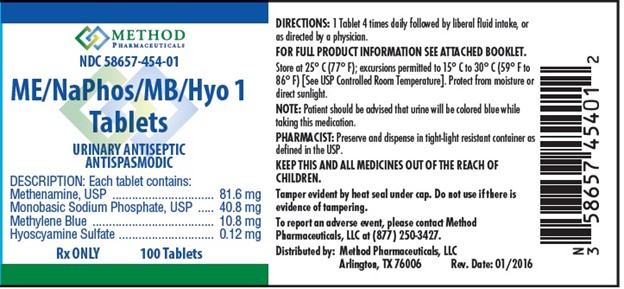
Me NaPhos MB Hyo 1 Urinary Antiseptic Antispasmodic 81.6 mg; 40.8 mg; 10.8 mg; .12 mg Tablet, 100-count — NDC 58657-454-01 (Billing 58657-0454-01)
This is a package of 100 tablets of Me NaPhos MB Hyo 1 Urinary Antiseptic Antispasmodic 81.6 mg; 40.8 mg; 10.8 mg; .12 mg Tablet from Method Pharmaceuticals, marketed since Dec 2015 and currently FDA-listed; retail pharmacies pay about $3.98 per tablet (NADAC). It is this product's only package size.
Identity & classification
Regulatory identifiers FDA, NLM and CMS codes for this package
Drug-database identifiers Medi-Span GPI and First Databank GCN / HICL / AHFS classification
- GSN (GCN sequence number): 066593
- GCN: 28868
- GPI-14 (Medi-Span): 16992004200325
- HICL (First Databank): 037115
- AHFS class code: 08:36.00.00
- RxCUI (RxNorm): 1050325
Where does this data come from?
- FDA openFDA NDC Directory · synced Oct 1, 2026
- FDA label on DailyMed · label index refreshed Oct 1, 2026
- RxNorm (NLM RxNav) · catalog refreshed Oct 1, 2026
- Medi-Span GPI (licensed)
- First Databank (licensed) · refreshed Oct 1, 2026
RxNorm drug class
This medicine belongs to the Belladonna alkaloids, tertiary amines class.
Where does this data come from?
- RxClass (NLM) · catalog refreshed Oct 1, 2026
Clinical
This is an oral tablet containing four active ingredients: hyoscyamine sulfate (an antispasmodic agent typically used to reduce muscle spasms), methenamine and methylene blue anhydrous (urinary antiseptics commonly used to address urinary tract symptoms), and sodium phosphate monobasic monohydrate (a phosphate salt often included in urinary formulations). The combination is intended to function as a urinary antiseptic and antispasmodic. This product is marketed without an approved FDA application.
Patient education
Supplement & herbal interactions
Where does this data come from?
- MedlinePlus (NLM) · refreshed Oct 1, 2026
- FDA label on DailyMed · label index refreshed Oct 1, 2026
Ask a licensed pharmacist directly — free, answered by our team.
Pricing
A drug doesn't have one price. Each row is a different public payment system, and none is what you'd pay at the counter — that depends on your insurance. The ⓘ on each row explains what it measures.
| Price system | Per ea | Per package |
|---|---|---|
| Retail pharmacies payNADAC · weekly | $3.976 | $397.61 / 100 tablets |
| Medicaid paysCMS SDUD · 12 mo | $2.62 | $262.07 / 100 tablets |
| Medicare drug plans payPart D · quarterly | No Part D plan price is available for this NDC in our data. | |
Where does this data come from?
- CMS NADAC weekly file · file of Sep 30, 2026
- CMS ASP pricing files · refreshed Sep 20, 2026
- CMS Medicaid State Drug Utilization Data · through Q1 2026
- CMS Part D plan pricing files · refreshed Sep 24, 2026
- VA National Acquisition Center price file
Packaging — all sizes for this product
| Package NDC | Description | Marketing start | Marketing end | Status |
|---|---|---|---|---|
| 58657-0454-01 You're viewing this Main listing | 100 TABLET in 1 BOTTLE | 2015-12-01 | — | Active |
Therapeutic equivalents
| Product | Labeler | Pack | NADAC/unit | TE | Status | Price vs. this |
|---|---|---|---|---|---|---|
| Urogesic Blue 81.6 mg/1; 40.8 mg/1; 10.8 mg/1; .12 mg 00485-0151-01 | EDWARDS | 100 tablets | $3.976 | — | Availability likely | — |
| Me NaPhos MB Hyo 1 81.6 mg/1; 40.8 mg/1; 10.8 mg/1; .12 mgthis 58657-0454-01 | Method | 100 tablets | $3.976 | — | Availability likely | — |
Where does this data come from?
- FDA openFDA NDC Directory · synced Oct 1, 2026
- FDA Orange Book · refreshed Sep 3, 2026
- CMS NADAC weekly file · file of Sep 30, 2026
Availability & generic status
We did not find an FDA-approved generic match for this exact strength, form and route.
Where does this data come from?
- FDA Orange Book · refreshed Sep 3, 2026
What it looks like
Where does this data come from?
- FDA label on DailyMed · label index refreshed Oct 1, 2026
Inactive Ingredients / Excipients
Inactive ingredients, also called excipients, are components of the drug product other than the active ingredient. They may include fillers, dyes, coatings, preservatives, flavors, or other formulation ingredients.
💡 Tap an ingredient (hover on desktop) to see what it is and why it’s used.
-
UNII OP1R32D61U
Microcrystalline cellulose is a purified form of cellulose, a natural fiber from plant sources. It acts as a binder and filler in tablets and capsules, helping hold ingredients together and give the medicine its shape and size.
-
UNII M28OL1HH48
Croscarmellose sodium is a plant-based substance derived from cellulose. It acts as a disintegrant, helping tablets and capsules break down quickly in the digestive system so the medicine can be absorbed.
-
UNII H3R47K3TBD
FD&C Blue No. 1 is a synthetic blue dye approved for use in foods and medicines. It serves as a colorant to give the medication its distinctive appearance and help with product identification.
-
UNII 70097M6I30
Magnesium stearate is a salt made from magnesium and stearic acid, a fatty substance. It's used in tablets and capsules as a lubricant and glidant to help ingredients flow smoothly during manufacturing and prevent sticking.
4 inactive ingredients listed in the exact product block matched to this NDC.
Label-section wording can be broader than the structured product block and may mention additional formulation ingredients.
Where does this data come from?
ingredient classCode="IACT" elements from the exact product block matched by this NDC. Label-section narrative from DailyMed / the openFDA label index is shown separately when available.- FDA label on DailyMed · label index refreshed Oct 1, 2026
- FDA openFDA NDC Directory · synced Oct 1, 2026
Inactive ingredient FAQ
Are inactive ingredients the same for every manufacturer?
Why might an inactive ingredient be missing?
Can inactive ingredients matter?
Manufacturer & labeler
Where does this data come from?
- FDA openFDA NDC Directory · synced Oct 1, 2026
- Drugs@FDA
Full prescribing information FDA SPL
🎯 Indications and Usage ▾
INDICATION AND USAGE ME/NaPhos/MB/Hyo 1 Tablets is indicated for the treatment of symptoms of irritative voiding. Indicated for the relief of local symptoms, such as hypermotility which accompany lower urinary tract infections and as antispasmodic. Indicated for the relief of urinary tract symptoms caused by diagnostic procedures.
⏱️ Dosage and Administration ▾
DOSAGE AND ADMINISTRATION Adults One tablet orally 4 times per day followed by liberal fluid intake. Older Children Dosage must be individualized by physician. Not recommended for use in children up to 6 years of age.
⚠️ Warnings ▾
WARNINGS Do not exceed recommended dosage. If rapid pulse, dizziness, or blurring of vision occurs discontinue use immediately.
🤒 Adverse Reactions ▾
ADVERSE REACTIONS Cardiovascula r – rapid pulse, flushing Central Nervous System – blurred vision, dizziness Respiratory – shortness of breath or troubled breathing Genitourinary – difficulty micturition, acute urinary retention Gastrointestinal – dry mouth, nausea/vomiting
🔄 Drug Interactions ▾
Drug Interactions because of this product's effect on gastrointestinal motility and gastric emptying, it may decrease the absorption of other oral medications during concurrent use such as: urinary alkalizers; thiazide diuretics (may cause the urine to become alkaline reducing the effectiveness of methenamine by inhibiting its conversion to formaldehyde); antimuscarinics (concurrent use may intensify antimuscarinic effects of hyoscyamine because of secondary antimuscarinic activities of these medications); antacids/antidiarrheals (may reduce absorption of hyoscyamine, concurrent use with antacids may cause urine to become alkaline reducing effectiveness of methenamine by inhibiting its conversion to formaldehyde) doses of these medications should be spaced 1 hour apart from doses of hyoscyamine; antimyasthenics (concurrent use with hyoscyamine may further reduce intestinal motility); ketoconazole (patients should be advised to take this combination at least 2 hours after ketoconazole); monoamine oxidase (MAO) Inhibitors (concurrent use may intensify antimuscarinic side effects, opioid (narcotic) analgesics may result in increased risk of severe constipation); sulfonamides (these drugs may precipitate with formaldehyde in the urine, increasing the danger of crystalluria).
Patients should be advised that the urine may become blue to blue green and the feces may be discolored as a result of the excretion of methylene blue.
🧒 Pediatric Use ▾
Pediatric infants and young children are especially susceptible to the toxic effect of the belladonna alkaloids.
🧓 Geriatric Use ▾
Geriatric use with caution in elderly patients as they may respond to usual doses of hyoscyamine with excitement, agitation, drowsiness, or confusion.
🆘 Overdosage ▾
OVERDOSAGE Emesis or gastric lavage. Slow intravenous administration of physostigmine in doses of 1 mg to 4 mg (0.5 mg to 1 mg in children), repeated as needed in one to two hours to reverse severe antimuscarinic symptoms. Administration of small doses of diazepam to control excitement and seizures. Artificial respiration with oxygen if needed for respiratory depression. Adequate hydration. Symptomatic treatment as necessary.
🧬 Clinical Pharmacology ▾
CLINICAL PHARMACOLOGY HYOSCYAMINE is a parasympatholytic which relaxes smooth muscles and thus produces an antispasmodic effect. It is well absorbed from the gastrointestinal tract and is rapidly distributed throughout body tissues. Most is excreted in the urine within 12 hours, 13% to 50% being unchanged.
Its biotransformation is hepatic. Its protein binding is moderate. METHENAMINE degrades in an acidic urine environment releasing formaldehyde which provides bactericidal or bacteriostatic action.
It is well absorbed from the gastrointestinal tract. 70% to 90% reaches the urine unchanged at which point it is hydrolyzed if the urine is acidic. Within 24 hours it is almost completely (90%) excreted; of this amount at pH 5, approximately 20% is formaldehyde.
Protein binding: some formaldehyde is bound to substances in the urine and surrounding tissues. Methenamine is freely distributed to body tissue and fluids but is not clinically significant as it does not hydrolyze at pH greater than 6.8. METHYLENE BLU E possesses weak antiseptic properties.
It is well absorbed in the gastrointestinal tract and is rapidly reduced to leukomethylene blue which is stabilized in some combination form in the urine. 75% is excreted unchanged. MONOBASIC SODIUM PHOSPHATE helps to maintain an acid pH in the urine necessary for the degradation of methenamine.
📦 How Supplied / Storage and Handling ▾
HOW SUPPLIED ME/NaPhos/MB/Hyo 1 Tablets are light blue to blue, oval, biconvex tablets debossed with "M455" with scoreline on one side and plain on the other side. Supplied in bottles of 100 tablets (NDC 58657-454-01).
🧪 Inactive Ingredients ▾
Inactive Ingredients include: Microcrystalline Cellulose, Mannitol, Croscarmellose Sodium, Magnesium Stearate, FD&C Blue #1 HYOSCYAMINE SULFATE is an alkaloid of belladonna. Exists as a white crystalline powder. Affected by light It is very soluble in water; freely soluble in alcohol; practically insoluble in ether.
METHENAMINE exists as colorless, lustrous crystals or white crystalline powder. Its solutions are alkaline to litmus. Freely soluble in water; soluble in alcohol and in chloroform.
METHYLENE BLUE exists as dark green crystals. It is soluble in water and in chloroform; sparingly soluble in alcohol. MONOBASIC SODIUM PHOSPHAT E exists as a white crystalline powder.
Its solutions are acidic to litmus. It is freely soluble in water and practically insoluble in alcohol. This product is not an Orange Book (OB) rated product, therefore all prescriptions using this product shall be pursuant to state statutes as applicable.
There are no claims of bioequivalence or therapeutic equivalence.
📋 Description ▾
Description Each tablet contains: Methenamine, USP ................................. 81.6 mg Monobasic Sodium Phosphate, USP ......... 40.8 mg Methylene Blue ....................................... 10.8 mg Hyoscyamine Sulfate ............................... 0.12 mg
📄 Other Information ▾
CAUTION RX ONLY STORAGE Store at 25° C (77° F); excursions permitted to 15° C to 30° C (59° F to 86° F) [See USP Controlled Room Temperature]. Keep container tightly closed. Distributed By: Method Pharmaceuticals, LLC Arlington, TX 76006 Rev. Date: 01/2016
⚠️ Precautions ▾
PRECAUTIONS (Pregnancy Category C) hyoscyamine and methenamine cross the placenta. Studies have not been done in animals or humans. It is not known whether ME/NaPhos/MB/Hyo 1 Tablets cause fetal harm when administered to a pregnant woman or can affect reproduction capacity. ME/NaPhos/MB/Hyo 1 Tablets should be given to a pregnant woman only if clearly needed.
🔒 Drug Abuse and Dependence ▾
DRUG ABUSE AND DEPENDENCE A dependence on the use of ME/NaPhos/MB/Hyo 1 Tablets has not been reported and due to the nature of its ingredients, abuse of ME/NaPhos/MB/Hyo 1 Tablets is not expected.
📄 Package Label / Principal Display Panel ▾
Distributed by: Method Pharmaceuticals, LLC Arlington, TX 76006 Rev. Date: 01/2016 Pinciple Display Panel Booklet lab booklet
Medicaid utilization & spend
Medicare Part D spend CMS · PART D · 2026 (Q1)
About this NDC listing & data coverage
Listed without an FDA application
This product's marketing category indicates it is marketed without an approved FDA application (no NDA, ANDA, or BLA on file). Having an NDC does not by itself establish FDA approval — the NDC Directory is a listing system, not an approval decision. Approval-linked data such as Orange Book therapeutic-equivalence ratings therefore does not apply.
What data is (and isn’t) available for this NDC — tap to expand
| NDC identity (package / product / labeler codes) | ✓ Available |
| Labeler | ✓ Available |
| Product & package description | ✓ Available |
| Marketing category & status | ✓ Available |
| Active ingredient / dosage form / route | ✓ Available |
| FDA label (SPL via DailyMed) | ✓ Available |
| Package photos | ✓ Available |
| Inactive ingredients (structured) | ✓ Available |
| NADAC pharmacy acquisition price (CMS) | ✓ Available |
| Orange Book / therapeutic-equivalence data | — Not published for this NDC Applies only to products approved under an NDA/ANDA; many listings are out of scope. |
| HCPCS J-code billing crosswalk | — Not published for this NDC Most self-administered / retail products have no J-code — that is normal. |
| Medicaid utilization (CMS SDUD) | ✓ Available |