
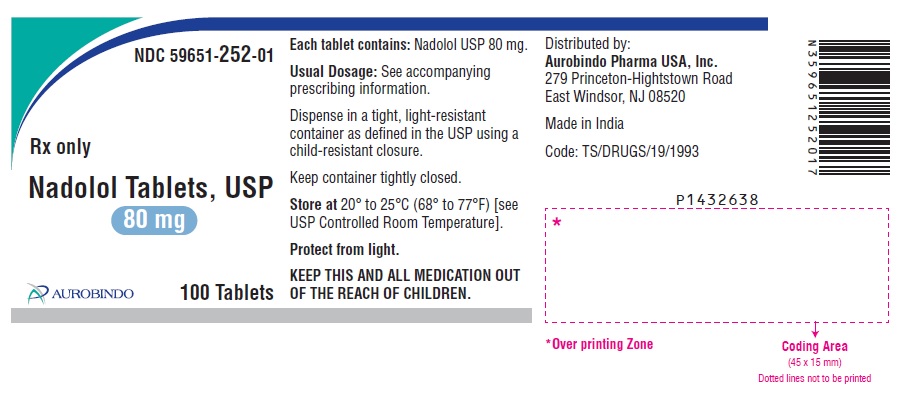
Nadolol 80 mg Tablet, 100-count — NDC 59651-252-01 (Billing 59651-0252-01)
This is a package of 100 tablets of Nadolol 80 mg Tablet from Aurobindo Pharma Limited, marketed since Oct 2021 and currently FDA-listed; retail pharmacies pay about $0.2737 per tablet (NADAC). It is this product's only package size.
NDC database record
One package, one record: these facts belong to NDC 59651-252-01 alone.
- Record
- FDA NDC Directory package listing · Human prescription drug
- Code segments
- 59651 labeler · 252 product · 01 package
- Package marketed since
- Oct 29, 2021
- Sample package
- No — commercial package
- Listing certified through
- Dec 31, 2026
- Billing quantity
- 100 EA per package
- Barcode (UPC-A, from the NDC)
- 3 5965125201 7
- Medicaid fills, this package
- 456 prescriptions in the last four reported quarters
- FDA record last changed
- Jul 24, 2026
Identity & classification
Regulatory identifiers FDA, NLM and CMS codes for this package
Drug-database identifiers Medi-Span GPI and First Databank GCN / HICL / AHFS classification
- GSN (GCN sequence number): 005137
- GCN: 20653
- GPI-14 (Medi-Span): 33100010000310
- HICL (First Databank): 002103
- AHFS class code: 12:16.08.08
- RxCUI (RxNorm): 198006
Where does this data come from?
- FDA openFDA NDC Directory · synced Oct 1, 2026
- FDA label on DailyMed · label index refreshed Oct 1, 2026
- RxNorm (NLM RxNav) · catalog refreshed Oct 1, 2026
- Medi-Span GPI (licensed)
- First Databank (licensed) · refreshed Oct 1, 2026
RxNorm drug class
This medicine belongs to the beta-Adrenergic Blocker class.
Where does this data come from?
- RxClass (NLM) · catalog refreshed Oct 1, 2026
Clinical
- Nadolol is a beta-blocker. It is used for long-term management of angina, which is chest pain from the heart, and to treat high blood pressure. It can be used alone or with other b...
- You take nadolol by mouth, usually once a day, with or without food. Your doctor will choose and adjust your dose, so follow your label. Try to take it at the same time every day.
- No, please don't stop it suddenly. Stopping a beta-blocker abruptly can make angina worse and may even lead to a heart attack. If you need to come off it, your doctor will lower th...
- Most people have mild effects, if any. These can include a slow heartbeat, dizziness, tiredness, cold fingers and toes, or stomach upset. Call your doctor if you faint, feel wheezy...
Patient education
Supplement & herbal interactions
Some supplements/herbs that may interact with Nadolol — tap one for details:
Nadolol may be associated with lower levels of 1 nutrient — worth a chat with your pharmacist, not a cause for alarm.
Where does this data come from?
- MedlinePlus (NLM) · refreshed Oct 1, 2026
- FDA label on DailyMed · label index refreshed Oct 1, 2026
Ask a licensed pharmacist directly — free, answered by our team.
Pricing
A drug doesn't have one price. Each row is a different public payment system, and none is what you'd pay at the counter — that depends on your insurance. The ⓘ on each row explains what it measures.
| Price system | Per ea | Per package |
|---|---|---|
| Retail pharmacies payNADAC · weekly | $0.274 | $27.37 / 100 tablets |
| Medicaid paysCMS SDUD · 12 mo | $0.8042 | $80.42 / 100 tablets |
| Medicare drug plans payPart D · Q2 2026 | $1.01 | $100.97 / 100 tablets |
Where does this data come from?
- CMS NADAC weekly file · file of Sep 30, 2026
- CMS ASP pricing files · refreshed Sep 20, 2026
- CMS Medicaid State Drug Utilization Data · through Q1 2026
- CMS Part D plan pricing files · refreshed Sep 24, 2026
- VA National Acquisition Center price file
Packaging — all sizes for this product
| Package NDC | Description | Marketing start | Marketing end | Status |
|---|---|---|---|---|
| 59651-0252-01 You're viewing this Main listing | 100 TABLET in 1 BOTTLE | 2021-10-29 | — | Active |
Therapeutic equivalents
| Product | Labeler | Pack | NADAC/unit | TE | Status | Price vs. this |
|---|---|---|---|---|---|---|
| Nadolol 80 mgthis 59651-0252-01 | Aurobindo | 100 tablets | $0.274 | AB | Availability likely | — |
| Nadolol 80 mg 68001-0632-00 | BluePoint | 100 tablets | $0.274 | AB | Availability likely | — |
| Nadolol 80 mg 68001-0692-00 | BluePoint | 100 tablets | $0.274 | AB | Availability likely | — |
| Nadolol 80 mg 68382-0734-01 | Zydus | 100 tablets | $0.274 | AB | Availability likely | — |
| Nadolol 80 mg 76282-0349-01 | Exelan | 100 tablets | $0.274 | AB | Availability likely | — |
| Nadolol 80 mg 76385-0135-01 | UNICHEM | 100 tablets | $0.274 | AB | Availability likely | — |
| Nadolol 80 mg 68001-0319-00 | BluePoint | 100 tablets | $0.287 | AB | FDA listed | +5% |
| Nadolol 80 mg 72664-0213-01 | VGYAAN | 100 tablets | $0.384 | AB | FDA listed | +40% |
| Nadolol 80 mg 46708-0404-30 | Alembic | 30 tablets | — | AB | FDA listed | — |
| Nadolol 80 mg 51407-0979-01 | Golden | 100 tablets | — | AB | FDA listed | — |
| Nadolol 80 mg 62332-0404-30 | Alembic | 30 tablets | — | AB | FDA listed | — |
| Nadolol 80 mg 69097-0869-02 | Cipla | 30 tablets | — | AB | FDA listed | — |
| Nadolol 80 mg 69238-1125-01 | Amneal | 1000 tablets | — | AB | FDA listed | — |
| Nadolol 80 mg 70771-1091-00 | Zydus | 1000 tablets | — | AB | FDA listed | — |
| Nadolol 80 mg 71335-0697-01 | Bryant | 30 tablets | — | AB | FDA listed | — |
| Nadolol 80 mg 71335-2131-01 | Bryant | 30 tablets | — | AB | FDA listed | — |
| Nadolol 80 mg 71335-3127-01 | Bryant | 30 tablets | — | AB | FDA listed | — |
| Nadolol 80 mg 72162-2198-01 | Bryant | 100 tablets | — | AB | FDA listed | — |
Where does this data come from?
- FDA openFDA NDC Directory · synced Oct 1, 2026
- FDA Orange Book · refreshed Oct 3, 2026
- CMS NADAC weekly file · file of Sep 30, 2026
Availability & generic status
This product is an FDA-approved generic. Other versions of the same drug are listed under Therapeutic equivalents, least expensive first.
Where does this data come from?
- FDA Orange Book · refreshed Oct 3, 2026
What it looks like
Where does this data come from?
- FDA label on DailyMed · label index refreshed Oct 1, 2026
Inactive Ingredients / Excipients
Inactive ingredients, also called excipients, are components of the drug product other than the active ingredient. They may include fillers, dyes, coatings, preservatives, flavors, or other formulation ingredients.
Where does this data come from?
IACT rows and label-wide narrative are kept separate; availability and product-level specificity depend on the submitted label.- FDA label on DailyMed · label index refreshed Oct 1, 2026
- FDA openFDA NDC Directory · synced Oct 1, 2026
Inactive ingredient FAQ
Are inactive ingredients the same for every manufacturer?
Why might an inactive ingredient be missing?
Can inactive ingredients matter?
Manufacturer & labeler
More NDCs from Aurobindo Pharma Limited labeler code 59651
- Midodrine Hydrochloride 2.5 mg Tablet NDC 59651-246-01
- Midodrine Hydrochloride 5 mg Tablet NDC 59651-247-01
- Midodrine Hydrochloride 10 mg Tablet NDC 59651-248-01
- Desmopressin Acetate .1 mg Tablet NDC 59651-249-01
- Desmopressin Acetate .2 mg Tablet NDC 59651-250-01
- Nadolol 40 mg Tablet NDC 59651-251-01
- Propafenone Hydrochloride 150 mg Tablet, Film Coated NDC 59651-256-01
- Propafenone Hydrochloride 225 mg Tablet, Film Coated NDC 59651-257-01
- Propafenone Hydrochloride 300 mg Tablet, Film Coated NDC 59651-258-01
- Clozapine 12.5 mg Tablet, Orally Disintegrating NDC 59651-260-01
- Clozapine 25 mg Tablet, Orally Disintegrating NDC 59651-261-01
- Clozapine 100 mg Tablet, Orally Disintegrating NDC 59651-262-01
Where does this data come from?
- FDA openFDA NDC Directory · synced Oct 1, 2026
- Drugs@FDA
Full prescribing information FDA SPL
🎯 Indications and Usage ▾
INDICATIONS AND USAGE Angina Pectoris Nadolol tablets are indicated for the long-term management of patients with angina pectoris. Hypertension Nadolol tablets are indicated for the treatment of hypertension, to lower blood pressure. Lowering blood pressure reduces the risk of fatal and nonfatal cardiovascular events, primarily strokes and myocardial infarctions.
These benefits have been seen in controlled trials of antihypertensive drugs from a wide variety of pharmacologic classes including the class to which this drug principally belongs. There are no controlled trials demonstrating risk reduction with nadolol tablets. Control of high blood pressure should be part of comprehensive cardiovascular risk management, including, as appropriate, lipid control, diabetes management, antithrombotic therapy, smoking cessation, exercise, and limited sodium intake.
Many patients will require more than one drug to achieve blood pressure goals. For specific advice on goals and management, see published guidelines, such as those of the National High Blood Pressure Education Program’s Joint National Committee on Prevention, Detection, Evaluation, and Treatment of High Blood Pressure (JNC). Numerous antihypertensive drugs, from a variety of pharmacologic classes and with different mechanisms of action, have been shown in randomized controlled trials to reduce cardiovascular morbidity and mortality, and it can be concluded that it is blood pressure reduction, and not some other pharmacologic property of the drugs, that is largely responsible for those benefits.
The largest and most consistent cardiovascular outcome benefit has been a reduction in the risk of stroke, but reductions in myocardial infarction and cardiovascular mortality also have been seen regularly. Elevated systolic or diastolic pressure causes increased cardiovascular risk, and the absolute risk increase per mmHg is greater at higher blood pressures, so that even modest reductions of severe hypertension can provide substantial benefit. Relative risk reduction from blood pressure reduction is similar across populations with varying absolute risk, so the absolute benefit is greater in patients who are at higher risk independent of their hypertension (for example, patients with diabetes or hyperlipidemia), and such patients would be expected to benefit from more aggressive treatment to a lower blood pressure goal.
Some antihypertensive drugs have smaller blood pressure effects (as monotherapy) in black patients, and many antihypertensive drugs have additional approved indications and effects (e.g., on angina, heart failure, or diabetic kidney disease). These considerations may guide selection of therapy. Nadolol tablets may be used alone or in combination with other antihypertensive agents, especially thiazide-type diuretics.
⏱️ Dosage and Administration ▾
DOSAGE AND ADMINISTRATION DOSAGE MUST BE INDIVIDUALIZED. NADOLOL MAY BE ADMINISTERED WITHOUT REGARD TO MEALS. Angina Pectoris The usual initial dose is 40 mg nadolol once daily.
Dosage may be gradually increased in 40 to 80 mg increments at 3 to 7 day intervals until optimum clinical response is obtained or there is pronounced slowing of the heart rate. The usual maintenance dose is 40 or 80 mg administered once daily. Doses up to 160 or 240 mg administered once daily may be needed.
The usefulness and safety in angina pectoris of dosage exceeding 240 mg per day have not been established. If treatment is to be discontinued, reduce the dosage gradually over a period of one to two weeks (see WARNINGS ). Hypertension The usual initial dose is 40 mg nadolol once daily, whether it is used alone or in addition to diuretic therapy.
Dosage may be gradually increased in 40 to 80 mg increments until optimum blood pressure reduction is achieved. The usual maintenance dose is 40 or 80 mg administered once daily. Doses up to 240 or 320 mg administered once daily may be needed.
Dosage Adjustment in Renal Failure Absorbed nadolol is excreted principally by the kidneys and, although nonrenal elimination does occur, dosage adjustments are necessary in patients with renal impairment. The following dose intervals are recommended: Creatinine Clearance (mL/min/1.73 m 2 ) Dosage Interval (hours) >50 24 31 to 50 24 to 36 10 to 30 24 to 48 <10 40 to 60
⛔ Contraindications ▾
CONTRAINDICATIONS Nadolol is contraindicated in bronchial asthma, sinus bradycardia and greater than first degree conduction block, cardiogenic shock, and overt cardiac failure (see WARNINGS ).
⚠️ Warnings ▾
WARNINGS Cardiac Failure Sympathetic stimulation may be a vital component supporting circulatory function in patients with congestive heart failure, and its inhibition by beta-blockade may precipitate more severe failure. Although beta-blockers should be avoided in overt congestive heart failure, if necessary, they can be used with caution in patients with a history of failure who are well-compensated, usually with digitalis and diuretics. Beta-adrenergic blocking agents do not abolish the inotropic action of digitalis on heart muscle.
IN PATIENTS WITHOUT A HISTORY OF HEART FAILURE, continued use of beta-blockers can, in some cases, lead to cardiac failure. Therefore, at the first sign or symptom of heart failure, the patient should be digitalized and/or treated with diuretics, and the response observed closely, or nadolol should be discontinued (gradually, if possible). Exacerbation of Ischemic Heart Disease Following Abrupt Withdrawal – Hypersensitivity to catecholamines has been observed in patients withdrawn from beta-blocker therapy; exacerbation of angina and, in some cases, myocardial infarction have occurred after abrupt discontinuation of such therapy.
When discontinuing chronically administered nadolol, particularly in patients with ischemic heart disease, the dosage should be gradually reduced over a period of one to two weeks and the patient should be carefully monitored. If angina markedly worsens or acute coronary insufficiency develops, nadolol administration should be reinstituted promptly, at least temporarily, and other measures appropriate for the management of unstable angina should be taken. Patients should be warned against interruption or discontinuation of therapy without the physician's advice.
Because coronary artery disease is common and may be unrecognized, it may be prudent not to discontinue nadolol therapy abruptly even in patients treated only for hypertension. Nonallergic Bronchospasm (e.g., chronic bronchitis, emphysema) PATIENTS WITH BRONCHOSPASTIC DISEASES SHOULD IN GENERAL NOT RECEIVE BETA-BLOCKERS. Nadolol should be administered with caution since it may block bronchodilation produced by endogenous or exogenous catecholamine stimulation of beta 2 receptors.
Major Surgery Chronically administered beta-blocking therapy should not be routinely withdrawn prior to major surgery; however, the impaired ability of the heart to respond to reflex adrenergic stimuli may augment the risks of general anesthesia and surgical procedures. Diabetes and Hypoglycemia Beta blockers may prevent early warning signs of hypoglycemia, such as tachycardia, and increase the risk for severe or prolonged hypoglycemia at any time during treatment, especially in patients with diabetes mellitus or children and patients who are fasting (i.e., surgery, not eating regularly, or are vomiting).
If severe hypoglycemia occurs, patients should be instructed to seek emergency treatment. Beta-blockade also reduces the release of insulin in response to hyperglycemia; therefore, it may be necessary to adjust the dose of antidiabetic drugs. Thyrotoxicosis Beta-adrenergic blockade may mask certain clinical signs (e.g., tachycardia) of hyperthyroidism.
Patients suspected of developing thyrotoxicosis should be managed carefully to avoid abrupt withdrawal of beta-adrenergic blockade which might precipitate a thyroid storm.
🤒 Adverse Reactions ▾
ADVERSE REACTIONS Most adverse effects have been mild and transient and have rarely required withdrawal of therapy. Cardiovascular Bradycardia with heart rates of less than 60 beats per minute occurs commonly, and heart rates below 40 beats per minute and/or symptomatic bradycardia were seen in about 2 of 100 patients. Symptoms of peripheral vascular insufficiency, usually of the Raynaud type, have occurred in approximately 2 of 100 patients.
Cardiac failure, hypotension, and rhythm/conduction disturbances have each occurred in about 1 of 100 patients. Single instances of first degree and third degree heart block have been reported; intensification of AV block is a known effect of beta-blockers (see also CONTRAINDICATIONS , WARNINGS , and PRECAUTIONS ). Central Nervous System Dizziness or fatigue has been reported in approximately 2 of 100 patients; paresthesias, sedation, and change in behavior have each been reported in approximately 6 of 1000 patients.
Respiratory Bronchospasm has been reported in approximately 1 of 1000 patients (see CONTRAINDICATIONS and WARNINGS ). Gastrointestinal Nausea, diarrhea, abdominal discomfort, constipation, vomiting, indigestion, anorexia, bloating, and flatulence have been reported in 1 to 5 of 1000 patients. Miscellaneous Each of the following has been reported in 1 to 5 of 1000 patients: rash; pruritus; headache; dry mouth, eyes, or skin; impotence or decreased libido; facial swelling; weight gain; slurred speech; cough; nasal stuffiness; sweating; tinnitus; blurred vision.
Reversible alopecia has been reported infrequently. The following adverse reactions have been reported in patients taking nadolol and/or other beta-adrenergic blocking agents, but no causal relationship to nadolol has been established. Central Nervous System Reversible mental depression progressing to catatonia; visual disturbances; hallucinations; an acute reversible syndrome characterized by disorientation for time and place, short-term memory loss, emotional lability with slightly clouded sensorium, and decreased performance on neuropsychometrics.
Gastrointestinal Mesenteric arterial thrombosis; ischemic colitis; elevated liver enzymes. Hematologic Agranulocytosis; thrombocytopenic or nonthrombocytopenic purpura. Allergic Fever combined with aching and sore throat; laryngospasm; respiratory distress.
Miscellaneous Pemphigoid rash; hypertensive reaction in patients with pheochromocytoma; sleep disturbances; Peyronie's disease. The oculomucocutaneous syndrome associated with the beta-blocker practolol has not been reported with nadolol. To report SUSPECTED ADVERSE REACTIONS, contact Aurobindo Pharma USA, Inc. at 1-866-850-2876 or FDA at 1-800-FDA-1088 or www.fda.gov/medwatch.
🔄 Drug Interactions ▾
DRUG INTERACTIONS When administered concurrently, the following drugs may interact with beta-adrenergic receptor blocking agents: Anesthetics, general - exaggeration of the hypotension induced by general anesthetics (see WARNINGS , Major Surgery ). Antidiabetic drugs (oral agents and insulin) - hypoglycemia or hyperglycemia; adjust dosage of antidiabetic drug accordingly (see WARNINGS , Diabetes and Hypoglycemia ). Catecholamine-depleting drugs (e.g., reserpine) - additive effect; monitor closely for evidence of hypotension and/or excessive bradycardia (e.g., vertigo, syncope, postural hypotension).
Digitalis glycosides- Both digitalis glycosides and beta-blockers slow atrioventricular conduction and decrease heart rate. Concomitant use can increase the risk of bradycardia. Response to Treatment for Anaphylactic Reaction - While taking beta-blockers, patients with a history of severe anaphylactic reaction to a variety of allergens may be more reactive to repeated challenge, either accidental, diagnostic, or therapeutic.
Such patients may be unresponsive to the usual doses of epinephrine used to treat allergic reaction.
🤰 Pregnancy ▾
PREGNANCY In animal reproduction studies with nadolol, evidence of embryo- and fetotoxicity was found in rabbits, but not in rats or hamsters, at doses 5 to 10 times greater (on a mg/kg basis) than the maximum indicated human dose. No teratogenic potential was observed in any of these species. There are no adequate and well-controlled studies in pregnant women.
Nadolol should be used during pregnancy only if the potential benefit justifies the potential risk to the fetus. Neonates whose mothers are receiving nadolol at parturition have exhibited bradycardia, hypoglycemia, and associated symptoms.
🧒 Pediatric Use ▾
PEDIATRIC USE Safety and effectiveness in pediatric patients have not been established.
🆘 Overdosage ▾
OVERDOSAGE Nadolol can be removed from the general circulation by hemodialysis. In addition to gastric lavage, the following measures should be employed, as appropriate. In determining the duration of corrective therapy, note must be taken of the long duration of the effect of nadolol.
Excessive Bradycardia Administer atropine (0.25 to 1 mg). If there is no response to vagal blockade, administer isoproterenol cautiously. Cardiac Failure Administer a digitalis glycoside and diuretic.
It has been reported that glucagon may also be useful in this situation. Hypotension Administer vasopressors, e.g., epinephrine or norepinephrine. (There is evidence that epinephrine may be the drug of choice.) Bronchospasm Administer a beta 2 -stimulating agent and/or a theophylline derivative.
🧬 Clinical Pharmacology ▾
CLINICAL PHARMACOLOGY Nadolol is a nonselective beta-adrenergic receptor blocking agent. Clinical pharmacology studies have demonstrated beta-blocking activity by showing (1) reduction in heart rate and cardiac output at rest and on exercise, (2) reduction of systolic and diastolic blood pressure at rest and on exercise, (3) inhibition of isoproterenol-induced tachycardia, and (4) reduction of reflex orthostatic tachycardia. Nadolol specifically competes with beta-adrenergic receptor agonists for available beta receptor sites; it inhibits both the beta 1 receptors located chiefly in cardiac muscle and the beta 2 receptors located chiefly in the bronchial and vascular musculature, inhibiting the chronotropic, inotropic, and vasodilator responses to beta-adrenergic stimulation proportionately.
Nadolol has no intrinsic sympathomimetic activity and, unlike some other beta-adrenergic blocking agents, nadolol has little direct myocardial depressant activity and does not have an anesthetic-like membrane-stabilizing action. Animal and human studies show that nadolol slows the sinus rate and depresses AV conduction. In dogs, only minimal amounts of nadolol were detected in the brain relative to amounts in blood and other organs and tissues.
Nadolol has low lipophilicity as determined by octanol/water partition coefficient, a characteristic of certain beta-blocking agents that has been correlated with the limited extent to which these agents cross the blood-brain barrier, their low concentration in the brain, and low incidence of CNS-related side effects. In controlled clinical studies, nadolol at doses of 40 to 320 mg/day has been shown to decrease both standing and supine blood pressure, the effect persisting for approximately 24 hours after dosing. The mechanism of the antihypertensive effects of beta-adrenergic receptor blocking agents has not been established; however, factors that may be involved include (1) competitive antagonism of catecholamines at peripheral (non-CNS) adrenergic neuron sites (especially cardiac) leading to decreased cardiac output, (2) a central effect leading to reduced tonic-sympathetic nerve outflow to the periphery, and (3) suppression of renin secretion by blockade of the beta-adrenergic receptors responsible for renin release from the kidneys.
While cardiac output and arterial pressure are reduced by nadolol therapy, renal hemodynamics are stable, with preservation of renal blood flow and glomerular filtration rate. By blocking catecholamine-induced increases in heart rate, velocity and extent of myocardial contraction, and blood pressure, nadolol generally reduces the oxygen requirements of the heart at any given level of effort, making it useful for many patients in the long-term management of angina pectoris. On the other hand, nadolol can increase oxygen requirements by increasing left ventricular fiber length and end diastolic pressure, particularly in patients with heart failure.
Although beta-adrenergic receptor blockade is useful in treatment of angina and hypertension, there are also situations in which sympathetic stimulation is vital. For example, in patients with severely damaged hearts, adequate ventricular function may depend on sympathetic drive. Beta-adrenergic blockade may worsen AV block by preventing the necessary facilitating effects of sympathetic activity on conduction.
Beta 2 -adrenergic blockade results in passive bronchial constriction by interfering with endogenous adrenergic bronchodilator activity in patients subject to bronchospasm and may also interfere with exogenous bronchodilators in such patients. Absorption of nadolol after oral dosing is variable, averaging about 30 percent. Peak serum concentrations of nadolol usually occur in three to four hours after oral administration and the presence of food in the gastrointestinal tract does not affect the rate or extent of nadolol absorption.
Approximately 30 percent of the nadolol present in serum is reversibly bound to plasma… [Excerpted — this section continues on DailyMed.]
📦 How Supplied / Storage and Handling ▾
HOW SUPPLIED Nadolol Tablets USP, 20 mg are light blue colored, round, uncoated mottled tablets with scoreline on one side and ‘NA’ and ‘20’ debossed on other side. They are supplied as follows: Bottles of 100 NDC 59651-589-01 Nadolol Tablets USP, 40 mg are light blue colored, round, biconvex, uncoated mottled tablets with scoreline separating ‘NA’ and ‘40’ debossed on one side and plain on other side. They are supplied as follows: Bottles of 100 NDC 59651-251-01 Nadolol Tablets USP, 80 mg are light blue colored, round, biconvex, uncoated mottled tablets with scoreline separating ‘NA’ and ‘80’ debossed on one side and plain on other side.
They are supplied as follows: Bottles of 100 NDC 59651-252-01 STORAGE Store at 20° to 25°C (68° to 77°F) [see USP Controlled Room Temperature]. Protect from light. Keep container tightly closed.
Distributed by: Aurobindo Pharma USA, Inc. 279 Princeton-Hightstown Road East Windsor, NJ 08520 Manufactured by: Aurobindo Pharma Limited Hyderabad-500 032, India Revised: 01/2024
📋 Description ▾
DESCRIPTION Nadolol tablets USP are a synthetic nonselective beta-adrenergic receptor blocking agent designated chemically as 1-( tert -butylamino)-3-[(5,6,7,8-tetrahydro- cis -6,7-dihydroxy-1-naphthyl)oxy]-2-propanol. Structural formula: Nadolol is a white to off-white powder. It is soluble in methanol, sparingly soluble in ethanol, slightly soluble in acetone and isopropyl alcohol, very slightly soluble in water pH 2, pH 7 and pH 10.
Nadolol tablets USP are available for oral administration as 20 mg, 40 mg, and 80 mg tablets. Inactive ingredients: citric acid anhydrous, corn starch, FD&C Blue No. 2, magnesium stearate, microcrystalline cellulose and povidone. str
💬 Information for Patients ▾
INFORMATION FOR PATIENTS Interruption or Discontinuation of Therapy Patients, especially those with evidence of coronary artery insufficiency, should be warned against interruption or discontinuation of nadolol therapy without the physician's advice. Although cardiac failure rarely occurs in properly selected patients, patients being treated with beta-adrenergic blocking agents should be advised to consult the physician at the first sign or symptom of impending failure. The patient should also be advised of a proper course in the event of an inadvertently missed dose.
Hypoglycemia Inform patients or caregivers that there is a risk of hypoglycemia when nadolol is given to patients who are fasting or who are vomiting. Monitor for symptoms of hypoglycemia.
⚠️ Precautions ▾
PRECAUTIONS Impaired Renal Function Nadolol should be used with caution in patients with impaired renal function (see DOSAGE AND ADMINISTRATION ). INFORMATION FOR PATIENTS Interruption or Discontinuation of Therapy Patients, especially those with evidence of coronary artery insufficiency, should be warned against interruption or discontinuation of nadolol therapy without the physician's advice. Although cardiac failure rarely occurs in properly selected patients, patients being treated with beta-adrenergic blocking agents should be advised to consult the physician at the first sign or symptom of impending failure.
The patient should also be advised of a proper course in the event of an inadvertently missed dose. Hypoglycemia Inform patients or caregivers that there is a risk of hypoglycemia when nadolol is given to patients who are fasting or who are vomiting. Monitor for symptoms of hypoglycemia.
DRUG INTERACTIONS When administered concurrently, the following drugs may interact with beta-adrenergic receptor blocking agents: Anesthetics, general - exaggeration of the hypotension induced by general anesthetics (see WARNINGS , Major Surgery ). Antidiabetic drugs (oral agents and insulin) - hypoglycemia or hyperglycemia; adjust dosage of antidiabetic drug accordingly (see WARNINGS , Diabetes and Hypoglycemia ). Catecholamine-depleting drugs (e.g., reserpine) - additive effect; monitor closely for evidence of hypotension and/or excessive bradycardia (e.g., vertigo, syncope, postural hypotension).
Digitalis glycosides- Both digitalis glycosides and beta-blockers slow atrioventricular conduction and decrease heart rate. Concomitant use can increase the risk of bradycardia. Response to Treatment for Anaphylactic Reaction - While taking beta-blockers, patients with a history of severe anaphylactic reaction to a variety of allergens may be more reactive to repeated challenge, either accidental, diagnostic, or therapeutic.
Such patients may be unresponsive to the usual doses of epinephrine used to treat allergic reaction. CARCINOGENESIS, MUTAGENESIS, IMPAIRMENT OF FERTILITY In chronic oral toxicologic studies (one to two years) in mice, rats, and dogs, nadolol did not produce any significant toxic effects. In two-year oral carcinogenic studies in rats and mice, nadolol did not produce any neoplastic, preneoplastic, or non-neoplastic pathologic lesions.
In fertility and general reproductive performance studies in rats, nadolol caused no adverse effects. PREGNANCY In animal reproduction studies with nadolol, evidence of embryo- and fetotoxicity was found in rabbits, but not in rats or hamsters, at doses 5 to 10 times greater (on a mg/kg basis) than the maximum indicated human dose. No teratogenic potential was observed in any of these species.
There are no adequate and well-controlled studies in pregnant women. Nadolol should be used during pregnancy only if the potential benefit justifies the potential risk to the fetus. Neonates whose mothers are receiving nadolol at parturition have exhibited bradycardia, hypoglycemia, and associated symptoms.
NURSING MOTHERS Nadolol is excreted in human milk. Because of the potential for adverse effects in nursing infants, a decision should be made whether to discontinue nursing or to discontinue therapy taking into account the importance of nadolol to the mother. PEDIATRIC USE Safety and effectiveness in pediatric patients have not been established.
🍼 Nursing Mothers ▾
NURSING MOTHERS Nadolol is excreted in human milk. Because of the potential for adverse effects in nursing infants, a decision should be made whether to discontinue nursing or to discontinue therapy taking into account the importance of nadolol to the mother.
📄 Carcinogenesis, Mutagenesis, Impairment of Fertility ▾
CARCINOGENESIS, MUTAGENESIS, IMPAIRMENT OF FERTILITY In chronic oral toxicologic studies (one to two years) in mice, rats, and dogs, nadolol did not produce any significant toxic effects. In two-year oral carcinogenic studies in rats and mice, nadolol did not produce any neoplastic, preneoplastic, or non-neoplastic pathologic lesions. In fertility and general reproductive performance studies in rats, nadolol caused no adverse effects.
📄 Package Label / Principal Display Panel ▾
PACKAGE LABEL.PRINCIPAL DISPLAY PANEL - 20 mg (100 Tablets Bottle) NDC 59651-589-01 Rx only Nadolo Tablets, USP 20 mg AUROBINDO 100 Tablets PACKAGE LABEL.PRINCIPAL DISPLAY PANEL - 20 mg (100 Tablets Bottle)
PACKAGE LABEL.PRINCIPAL DISPLAY PANEL - 40 mg (100 Tablets Bottle) NDC 59651-251-01 Rx only Nadolo Tablets, USP 40 mg AUROBINDO 100 Tablets PACKAGE LABEL.PRINCIPAL DISPLAY PANEL - 40 mg (100 Tablets Bottle)
PACKAGE LABEL.PRINCIPAL DISPLAY PANEL - 80 mg (100 Tablets Bottle) NDC 59651-252-01 Rx only Nadolo Tablets, USP 80 mg AUROBINDO 100 Tablets PACKAGE LABEL.PRINCIPAL DISPLAY PANEL - 80 mg (100 Tablets Bottle)