
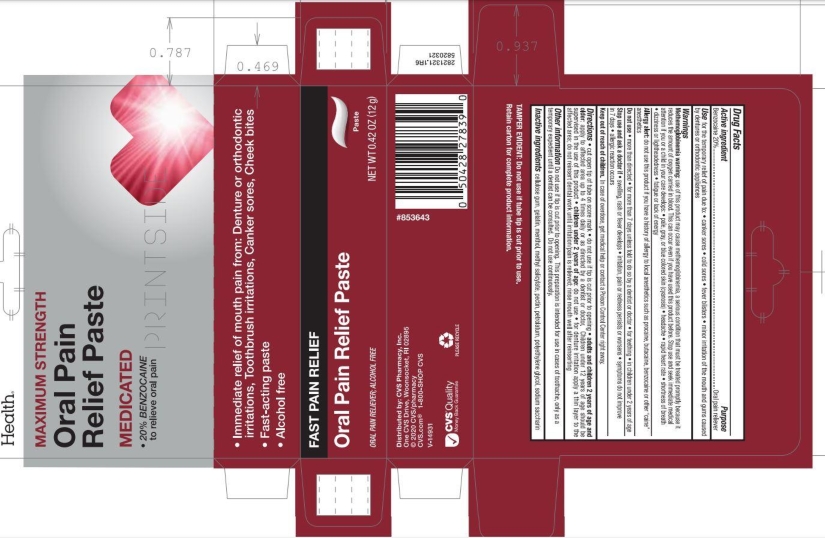
CVS Maximum Strength Benzocaine 20 g/100g Paste, Dentifrice — NDC 59779-123-19 (Billing 59779-0123-19)
This is a package of CVS Maximum Strength Benzocaine 20 g/100g Paste, Dentifrice from CVS Pharmacy, marketed since Jan 2011 and currently FDA-listed. It is this product's only package size.
NDC database record
One package, one record: these facts belong to NDC 59779-123-19 alone.
- Record
- FDA NDC Directory package listing · Human OTC drug
- Code segments
- 59779 labeler · 123 product · 19 package
- Package marketed since
- Jan 20, 2011
- Sample package
- No — commercial package
- Listing certified through
- Dec 31, 2027
- Barcode (UPC-A, from the NDC)
- 3 5977912319 0
- FDA record last changed
- Jul 24, 2026
Other active recalls for Benzocaine (different manufacturers) — 6 · tap to view
Identity & classification
Regulatory identifiers FDA, NLM and CMS codes for this package
- RxCUI (RxNorm): 562785
Where does this data come from?
- FDA openFDA NDC Directory · synced Oct 8, 2026
- FDA label on DailyMed · label index refreshed Oct 8, 2026
- RxNorm (NLM RxNav) · catalog refreshed Oct 1, 2026
- Medi-Span GPI (licensed)
- First Databank (licensed) · refreshed Oct 8, 2026
RxNorm drug class
This medicine belongs to the Standardized Chemical Allergen class.
Where does this data come from?
- RxClass (NLM) · catalog refreshed Oct 1, 2026
Clinical
This is an over-the-counter topical paste applied to the gums and teeth, marketed under FDA's monograph rules for oral pain-relief products. The active ingredient is benzocaine, a local anesthetic commonly used to numb minor mouth and gum pain. Maximum strength formulations like this one contain a higher concentration of benzocaine than standard versions and are typically used for temporary relief of tooth soreness, canker sores, or sore gums.
Patient education
Supplement & herbal interactions
Some supplements/herbs that may interact with Benzocaine — tap one for details:
Where does this data come from?
- MedlinePlus (NLM) · refreshed Oct 8, 2026
- FDA label on DailyMed · label index refreshed Oct 8, 2026
Ask a licensed pharmacist directly — free, answered by our team.
Pricing
A drug doesn't have one price. Each row is a different public payment system, and none is what you'd pay at the counter — that depends on your insurance. The ⓘ on each row explains what it measures.
| Price system | Per g | Per package |
|---|---|---|
| Retail pharmacies payNADAC · weekly | Not in the retail survey — common for institutional, discontinued, or low-volume packs. | |
| Medicaid paysCMS SDUD · 12 mo | No recent Medicaid claims on file for this NDC — rare and low-volume NDCs are suppressed in the public data. | |
| Medicare drug plans payPart D · quarterly | No Part D plan price is available for this NDC in our data. | |
Where does this data come from?
- CMS NADAC weekly file
- CMS ASP pricing files · refreshed Sep 20, 2026
- CMS Medicaid State Drug Utilization Data · refreshed Oct 8, 2026
- CMS Part D plan pricing files · refreshed Sep 24, 2026
- VA National Acquisition Center price file
Packaging — all sizes for this product
| Package NDC | Description | Marketing start | Marketing end | Status |
|---|---|---|---|---|
| 59779-0123-19 You're viewing this Main listing | 1 TUBE in 1 CARTON / 12 g in 1 TUBE | 2011-01-20 | — | Active |
Therapeutic equivalents
| Product | Labeler | Pack | NADAC/unit | TE | Status | Price vs. this |
|---|---|---|---|---|---|---|
| Walgreens Maximum Strength 20 g/100g 00363-5337-19 | Walgreens | 1 tube | — | — | FDA listed | — |
| CVS Maximum Strength 20 g/100gthis 59779-0123-19 | CVS | 1 tube | — | — | FDA listed | — |
| MyMedic Oral Pain Relief Gel 20 g/100g 43473-0306-01 | Nantong | 75 g | — | — | FDA listed | — |
| Quality Choice Maximum Strength Oral Pain Relieving 20 g/100g 63868-0953-11 | Chain | 1 tube | — | — | FDA listed | — |
| TopCare Oral Pain Relief Maximum Strength 20 g/100g 36800-0512-29 | Topco | 1 tube | — | — | FDA listed | — |
| Blt 1 20 g/100g 70372-0727-01 | CENTURA | 5 g | — | — | FDA listed | — |
| CVS Maximum Strength Boil Relief 20 g/100g 59779-0444-28 | CVS | 1 tube | — | — | FDA listed | — |
| Boil Ease 20 g/100g 63736-0040-28 | Insight | 1 tube | — | — | FDA listed | — |
| Goodsense Oral Pain Relief 20 g/100g 50804-0191-10 | Geiss, | 1 tube | — | — | FDA listed | — |
Where does this data come from?
- FDA openFDA NDC Directory · synced Oct 8, 2026
- FDA Orange Book · refreshed Oct 3, 2026
- CMS NADAC weekly file
Availability & generic status
We did not find an FDA-approved generic match for this exact strength, form and route.
Where does this data come from?
- FDA Orange Book · refreshed Oct 3, 2026
What it looks like
Where does this data come from?
- FDA label on DailyMed · label index refreshed Oct 8, 2026
Inactive Ingredients / Excipients
Inactive ingredients, also called excipients, are components of the drug product other than the active ingredient. They may include fillers, dyes, coatings, preservatives, flavors, or other formulation ingredients.
💡 Tap an ingredient (hover on desktop) to see what it is and why it’s used.
-
UNII K679OBS311
Carboxymethylcellulose sodium is a plant-derived thickening agent made from cellulose. In medicines, it acts as a binder to hold ingredients together, a disintegrant to help the tablet break apart, or a thickener in liquids.
-
UNII 2G86QN327L
Gelatin is a protein derived from animal collagen, commonly used in medicines as a gelling agent and capsule material. It helps create soft or hard capsule shells that hold and release medication, and can also thicken liquid formulations.
-
UNII L7T10EIP3A
A cooling compound from mint plants used as a flavoring agent and to create a fresh sensation in medicines. It helps mask bitter tastes and improve how the product feels in the mouth.
-
UNII LAV5U5022Y
Methyl salicylate is a naturally derived liquid compound commonly found in wintergreen plants. In medicines, it's used as a flavoring agent and penetrating solvent to help distribute active ingredients evenly throughout topical products.
-
UNII 89NA02M4RX
Pectin is a natural fiber extracted from fruit and plants. It's used in medicines as a thickener, binder, and gelling agent to create the right texture and help the product hold together.
-
UNII 4T6H12BN9U
Petrolatum is a purified mineral oil-based jelly derived from petroleum. In medicines, it acts as an emollient, lubricant, and moisture barrier to soften skin, reduce friction, and help prevent water loss from formulations.
-
UNII U076Q6Q621
Polyethylene glycol 1000 is a synthetic compound made from ethylene oxide. It serves as a solvent, lubricant, and humectant in medicines, helping dissolve active ingredients and improve how the product flows and feels.
-
UNII FST467XS7D
Saccharin is an artificial sweetener derived from benzoic sulfinilanide. It's added to medicines to improve taste and make them easier to take, especially in liquid or chewable formulations.
8 inactive ingredients listed in the exact product block matched to this NDC.
Label-section wording can be broader than the structured product block and may mention additional formulation ingredients.
Where does this data come from?
ingredient classCode="IACT" elements from the exact product block matched by this NDC. Label-section narrative from DailyMed / the openFDA label index is shown separately when available.- FDA label on DailyMed · label index refreshed Oct 8, 2026
- FDA openFDA NDC Directory · synced Oct 8, 2026
Inactive ingredient FAQ
Are inactive ingredients the same for every manufacturer?
Why might an inactive ingredient be missing?
Can inactive ingredients matter?
Manufacturer & labeler
More NDCs from CVS Pharmacy labeler code 59779
- CVS Pharmacy Glycerin Laxative 2 g Suppository NDC 59779-109-00
- Nasal Decongestant Non-Drowsy Pseudoephedrine HCl 30 mg Tablet, Film Coated NDC 59779-112-08
- Salicylic Acid Medicated Corn Removers 40 mg/91 Patch NDC 59779-115-09
- Salicylic acid Medicated Callus Removers Extra Thick 40 mg/41 Patch NDC 59779-116-04
- CVS Therapeutic Menthol Gel 2 g/100g Gel NDC 59779-118-08
- CVS Extra Whitening Fluoride .15 g/100g; 5 g/100g Paste, Dentifrice NDC 59779-122-29
- Childrens Pain and Fever Acetaminophen 160 mg/5mL Suspension NDC 59779-126-26
- Salicylic Acid Wart Remover Medicated Discs 40 mg/181 Patch NDC 59779-136-18
- Plantar Wart Remover Salicylic Acid 400 mg/g Patch NDC 59779-138-24
- Salicylic Acid Corn and Callus Remover Kit .17 mg/151mL Liquid NDC 59779-139-15
- acid controller original strength Famotidine 10 mg Tablet, Film Coated NDC 59779-141-39
- Back and Body Extra Strength Aspirin, Caffeine 500 mg; 32.5 mg Tablet, Film Coated NDC 59779-143-12
Where does this data come from?
- FDA openFDA NDC Directory · synced Oct 8, 2026
- Drugs@FDA
FDA label — Drug Facts FDA SPL
🎯 Indications and Usage ▾
Use for the temporary relief of pain due to canker sores cold sores fever blisters minor irritation of the mouth and gums caused by dentures or orthodontic appliances
⏱️ Dosage and Administration ▾
Directions cut open tip of tube on scoremark adults and children 2 years of age and older: apply to the affected area up to 4 times daily or as directed by a dentist or doctor. Children under 12 years of age should be supervised in the use of this product. children under 2 years of age: ask a dentist or doctor. for denture irritation apply a thin layer to the affected area; do not reinsert dental work until irritation/pain is relieved; rinse mouth well after reinserting
⚠️ Warnings ▾
Warnings Allergy alert: do not use this product if you have a history of allergy to local anesthetics such as procaine, butacaine, benzocaine or other “caine” anesthetics When using this product avoid contact with the eyes do not use more than directed do not use for more than 7 days unless directed by a dentist or doctor. Stop use and ask a doctor if sore mouth symptoms do not improve in 7 days swelling, rash or fever develops irritation, pain or redness persists or worsens Keep out of reach of children. In case of overdose, get medical help or contact a Poison Control Center right away.
🧪 Active Ingredient ▾
Active ingredient Benzocaine 20%
🧪 Inactive Ingredients ▾
Inactive ingredients Cellulose Gum, Gelatin, Menthol, Methyl Salicylate, Pectin, Petrolatum, Polyethylene Glycol, Sodium Saccharin.
🎯 Purpose ▾
Purpose Oral pain reliever
📄 When Using This Product ▾
When using this product avoid contact with the eyes do not use more than directed do not use for more than 7 days unless directed by a dentist or doctor.
📄 Stop Use and Ask a Doctor If ▾
Stop use and ask a doctor if sore mouth symptoms do not improve in 7 days swelling, rash or fever develops irritation, pain or redness persists or worsens
📄 Keep Out of Reach of Children ▾
Keep out of reach of children. In case of overdose, get medical help or contact a Poison Control Center right away.
📄 Other Information ▾
Other Information Do not use if tip is cut prior to opening. This preparation is intended for use in cases of toothache, only as a tempory expedient until a dentist can be consulted. Do not use continuously. This formula will stay in place for extended duration of relief.
📄 Package Label / Principal Display Panel ▾
Carton R6
About this NDC listing & data coverage
What data is (and isn’t) available for this NDC — tap to expand
| NDC identity (package / product / labeler codes) | ✓ Available |
| Labeler | ✓ Available |
| Product & package description | ✓ Available |
| Marketing category & status | ✓ Available |
| Active ingredient / dosage form / route | ✓ Available |
| FDA label (SPL via DailyMed) | ✓ Available |
| Package photos | ✓ Available |
| Inactive ingredients (structured) | ✓ Available |
| NADAC pharmacy acquisition price (CMS) | — Not published for this NDC CMS publishes NADAC only for NDCs reported in its retail-pharmacy survey. |
| Orange Book / therapeutic-equivalence data | — Not published for this NDC Applies only to products approved under an NDA/ANDA; many listings are out of scope. |
| HCPCS J-code billing crosswalk | — Not published for this NDC Most self-administered / retail products have no J-code — that is normal. |
| Medicaid utilization (CMS SDUD) | — Not published for this NDC CMS reports utilization only for NDCs with Medicaid claims above its privacy threshold. |