
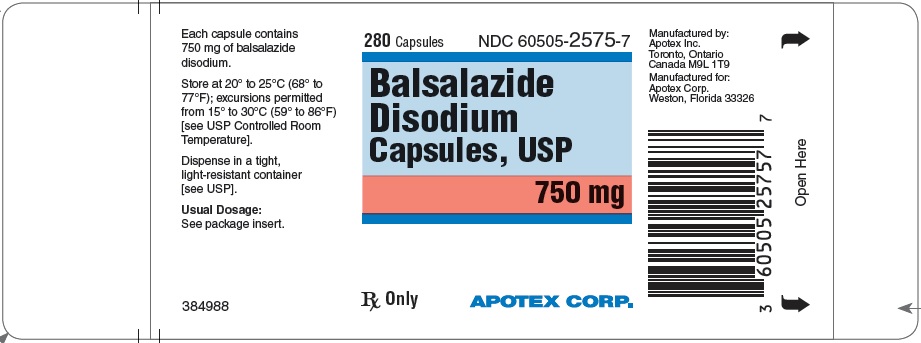
Balsalazide Disodium 750 mg Capsule, 280-count — NDC 60505-2575-7 (Billing 60505-2575-07)
This is a package of 280 capsules of Balsalazide Disodium 750 mg Capsule from Apotex Corp., marketed since Dec 2007 and currently FDA-listed; retail pharmacies pay about $0.3443 per capsule (NADAC). It is the main listing for this product, which comes in 4 package sizes.
NDC database record
One package, one record: these facts belong to NDC 60505-2575-7 alone.
- Record
- FDA NDC Directory package listing · Human prescription drug
- Code segments
- 60505 labeler · 2575 product · 7 package
- Package marketed since
- Dec 28, 2007
- Sample package
- No — commercial package
- Listing certified through
- Dec 31, 2027
- Billing quantity
- 280 EA per package
- Barcode (UPC-A, from the NDC)
- 3 6050525757 7
- Medicaid fills, this package
- 3,191 prescriptions in the last four reported quarters
- FDA record last changed
- Sep 24, 2026
Identity & classification
Regulatory identifiers FDA, NLM and CMS codes for this package
Drug-database identifiers Medi-Span GPI and First Databank GCN / HICL / AHFS classification
- GSN (GCN sequence number): 040304
- GCN: 95348
- HICL (First Databank): 018569
- AHFS class code: 56:36.00.00
- RxCUI (RxNorm): 885857
Where does this data come from?
- FDA openFDA NDC Directory · synced Oct 8, 2026
- FDA label on DailyMed · label index refreshed Oct 8, 2026
- RxNorm (NLM RxNav) · catalog refreshed Oct 8, 2026
- Medi-Span GPI (licensed)
- First Databank (licensed) · refreshed Oct 8, 2026
RxNorm drug class
This medicine belongs to the Aminosalicylate class.
Where does this data come from?
- RxClass (NLM) · catalog refreshed Oct 8, 2026
Clinical
- It treats mildly to moderately active ulcerative colitis, which is inflammation of the colon lining. It is used in adults and children 5 and older. It works right in the colon rath...
- Swallow them whole, three times a day, with or without food. Don't crush, chew or cut them. If swallowing is hard, you can open a capsule onto a little applesauce and eat it right...
- The most common are headache, belly pain, diarrhea, nausea, vomiting, colds or respiratory infections and joint pain. Call me or your doctor if cramping, bloody diarrhea, fever or...
- Yes. Your kidney function should be checked before you start and from time to time afterward. If you are 65 or older, or take azathioprine or 6-mercaptopurine, blood counts should...
Patient education
Supplement & herbal interactions
Some supplements/herbs that may interact with Balsalazide Disodium — tap one for details:
Where does this data come from?
- MedlinePlus (NLM) · refreshed Oct 8, 2026
- FDA label on DailyMed · label index refreshed Oct 8, 2026
Ask a licensed pharmacist directly — free, answered by our team.
Pricing
A drug doesn't have one price. Each row is a different public payment system, and none is what you'd pay at the counter — that depends on your insurance. The ⓘ on each row explains what it measures.
| Price system | Per ea | Per package |
|---|---|---|
| Retail pharmacies payNADAC · weekly | $0.344 | $96.40 / 280 capsules |
| Medicaid paysCMS SDUD · 12 mo | $0.3948 | $110.54 / 280 capsules |
| Medicare drug plans payPart D · Q2 2026 | $0.5097 | $142.72 / 280 capsules |
Where does this data come from?
- CMS NADAC weekly file · file of Oct 7, 2026
- CMS ASP pricing files · refreshed Sep 20, 2026
- CMS Medicaid State Drug Utilization Data · through Q1 2026
- CMS Part D plan pricing files · refreshed Sep 24, 2026
- VA National Acquisition Center price file
Packaging — all sizes for this product
| Package NDC | Description | Per unit | Per pack | Marketing start | Marketing end | Status |
|---|---|---|---|---|---|---|
| 60505-2575-00 60505-2575-0 | 10 BLISTER PACK in 1 CARTON / 10 CAPSULE in 1 BLISTER PACK | — | — | 2007-12-28 | — | Active |
| 60505-2575-03 60505-2575-3 | 30 CAPSULE in 1 BOTTLE | — | — | 2007-12-28 | — | Active |
| 60505-2575-04 60505-2575-4 | 350 CAPSULE in 1 BOTTLE | — | — | 2007-12-28 | — | Active |
| 60505-2575-07 You're viewing this Main listing | 280 CAPSULE in 1 BOTTLE | $0.3443 / ea | $96.39 | 2007-12-28 | — | Active |
In Medicaid, this is the most-dispensed pack of this product — about 100% of fills over the last four reported quarters. See all packs ↓
Pack size FAQ
What quantity is in this package?
How does this package differ from NDC 60505-2575-03?
What NDC number is used to bill for this package of Balsalazide Disodium 750 mg Capsule?
Prices are the latest CMS NADAC pharmacy acquisition cost per NDC; per-pack figures are per-unit × pack quantity, shown only when the pack is denominated in the same measure NADAC prices.
Therapeutic equivalents
| Product | Labeler | Pack | NADAC/unit | TE | Status | Price vs. this |
|---|---|---|---|---|---|---|
| Balsalazide Disodium 750 mg 00054-0079-28 | Hikma | 280 capsules | $0.344 | AB | Availability likely | — |
| Balsalazide Disodium 750 mg 50268-0102-13 | AvPAK | 30 capsules | $0.344 | AB | Availability likely | — |
| Balsalazide Disodium 750 mgthis 60505-2575-07 | Apotex | 280 capsules | $0.344 | AB | Availability likely | — |
| balsalazide disodium 750 mg 70710-1626-01 | Zydus | 280 capsules | $0.344 | AB | Availability likely | — |
| balsalazide disodium 750 mg 80005-0126-25 | Carnegie | 280 capsules | $0.344 | AB | Availability likely | — |
| Balsalazide Disodium 750 mg 51407-0820-28 | Golden | 280 capsules | — | AB | FDA listed | — |
| balsalazide disodium 750 mg 70771-1841-01 | Zydus | 280 capsules | — | AB | FDA listed | — |
| Balsalazide Disodium 750 mg 72162-2095-02 | Bryant | 280 capsules | — | AB | FDA listed | — |
| Balsalazide Disodium 750 mg 72789-0149-69 | PD-Rx | 280 capsules | — | AB | FDA listed | — |
Where does this data come from?
- FDA openFDA NDC Directory · synced Oct 8, 2026
- FDA Orange Book · refreshed Oct 3, 2026
- CMS NADAC weekly file · file of Oct 7, 2026
Availability & generic status
This product is an FDA-approved generic. Other versions of the same drug are listed under Therapeutic equivalents, least expensive first.
Where does this data come from?
- FDA Orange Book · refreshed Oct 3, 2026
What it looks like
Where does this data come from?
- FDA label on DailyMed · label index refreshed Oct 8, 2026
Inactive Ingredients / Excipients
Inactive ingredients, also called excipients, are components of the drug product other than the active ingredient. They may include fillers, dyes, coatings, preservatives, flavors, or other formulation ingredients.
🧪 Avoiding an ingredient? See Balsalazide inactive ingredients by manufacturer: every current product's list side by side, so you can ask your pharmacy for the version that does not list it.
💡 Tap an ingredient (hover on desktop) to see what it is and why it’s used.
-
UNII 5138Q19F1X
Ammonia is a colorless gas made from nitrogen and hydrogen. It's used in medicines as a pH buffer to maintain the correct acidity level and help keep the product stable.
-
UNII 1K09F3G675
Ferric oxide red is an inorganic iron compound used as a colorant in medicines. It gives tablets, capsules, or other dosage forms a red or reddish tint for identification and appearance.
-
UNII 2G86QN327L
Gelatin is a protein derived from animal collagen, commonly used in medicines as a gelling agent and capsule material. It helps create soft or hard capsule shells that hold and release medication, and can also thicken liquid formulations.
-
UNII 70097M6I30
Magnesium stearate is a salt made from magnesium and stearic acid, a fatty substance. It's used in tablets and capsules as a lubricant and glidant to help ingredients flow smoothly during manufacturing and prevent sticking.
-
UNII 6DC9Q167V3
Propylene glycol is a clear liquid derived from petroleum or vegetable sources. It acts as a solvent, humectant, and preservative in medicines, helping dissolve active ingredients and maintain product stability.
-
UNII 46N107B71O
Shellac is a natural resin secreted by the lac beetle. It's used as a coating on tablets and capsules to control how quickly the medicine dissolves and to improve appearance and stability.
-
UNII ETJ7Z6XBU4
Silicon dioxide is a naturally occurring mineral used as a glidant and anti-caking agent. It helps powder ingredients flow smoothly and prevents clumping during manufacturing and storage.
-
UNII 15FIX9V2JP
Titanium dioxide is a bright white mineral powder commonly used as a colorant and opacifying agent. It makes pills and tablets white or lighter in color and helps make coatings non-transparent.
8 inactive ingredients listed in the exact product block matched to this NDC.
Where does this data come from?
ingredient classCode="IACT" elements from the exact product block matched by this NDC. Label-section narrative from DailyMed / the openFDA label index is shown separately when available.- FDA label on DailyMed · label index refreshed Oct 8, 2026
- FDA openFDA NDC Directory · synced Oct 8, 2026
Inactive ingredient FAQ
Are inactive ingredients the same for every manufacturer?
Why might an inactive ingredient be missing?
Can inactive ingredients matter?
Manufacturer & labeler
More NDCs from Apotex Corp. labeler code 60505
- Modafinil 100 mg Tablet NDC 60505-2526-1
- Modafinil 200 mg Tablet NDC 60505-2527-1
- ziprasidone hydrochloride Ziprasidone HCl 20 mg Capsule NDC 60505-2528-6
- ziprasidone hydrochloride Ziprasidone HCl 40 mg Capsule NDC 60505-2529-6
- ziprasidone hydrochloride Ziprasidone HCl 60 mg Capsule NDC 60505-2530-6
- ziprasidone hydrochloride Ziprasidone HCl 80 mg Capsule NDC 60505-2531-6
- Atorvastatin Calcium 10 mg Tablet, Film Coated NDC 60505-2578-0
- Atorvastatin Calcium 20 mg Tablet, Film Coated NDC 60505-2579-0
- Atorvastatin Calcium 40 mg Tablet, Film Coated NDC 60505-2580-0
- Tizanidine Hydrochloride 2 mg Capsule, Gelatin Coated NDC 60505-2648-3
- Tizanidine Hydrochloride 4 mg Capsule, Gelatin Coated NDC 60505-2649-3
- Tizanidine Hydrochloride 6 mg Capsule, Gelatin Coated NDC 60505-2650-3
Where does this data come from?
- FDA openFDA NDC Directory · synced Oct 8, 2026
- Drugs@FDA
Full prescribing information FDA SPL
🎯 Indications and Usage ▾
1 INDICATIONS AND USAGE Balsalazide disodium capsules are indicated for the treatment of mildly to moderately active ulcerative colitis in patients 5 years of age and older. Limitations of Use Safety and effectiveness of balsalazide beyond 8 weeks in pediatric patients 5 years to 17 years of age and 12 weeks in adults have not been established. Balsalazide is an aminosalicylate indicated for the treatment of mildly to moderately active ulcerative colitis in patients 5 years of age and older.
( 1 ) Limitations of Use: Safety and effectiveness of balsalazide beyond 8 weeks in children (ages 5 to 17 years) and 12 weeks in adults have not been established. ( 1 )
⏱️ Dosage and Administration ▾
2 DOSAGE AND ADMINISTRATION Administration Instructions Evaluate renal function before initiating therapy with balsalazide disodium capsules. ( 2.1) Swallow capsules whole. Do not cut, break, crush or chew.
( 2.1 ) For patients who cannot swallow intact capsules, the capsules may be opened and sprinkled on applesauce, then chewed and swallowed immediately. ( 2.1 ) Teeth and/or tongue staining may occur when administered sprinkled on applesauce. ( 2.1 ) Drink an adequate amount of fluids.
( 2.1 , 5.8 ) Take balsalazide disodium capsules with or without food. ( 2.1 ) Dosage Adults: The recommended dosage is 2.25 g (three 750 mg capsules) three times daily for 8 weeks. Some adult patients required treatment for up to 12 weeks in clinical trials.
( 2.2 ) Pediatric Patients 5 Years to 17 Years of Age: The recommended dosage is either: 2.25 g (three 750 mg capsules) three times for up to 8 weeks. OR: 750 mg (one capsule) three times daily for up to 8 weeks. ( 2.2 )
2.1Important Preparation and Administration Instructions Evaluate renal function before initiating therapy with balsalazide disodium capsules [see Warnings and Precaution (5.1) ]. Swallow balsalazide disodium capsules whole. Do not cut, break, crush or chew the capsules.
For patients who cannot swallow intact capsules, balsalazide disodium capsules may also be administered by opening the capsule and sprinkling the capsule contents on applesauce. If the capsules are opened for sprinkling, color variation of the powder inside the capsules ranges from orange to yellow and is expected due to color variation of the active pharmaceutical ingredient. Place a small amount (approximately 10 mL) of applesauce into a clean container.
Carefully open the capsules. Sprinkle the capsule contents on the applesauce. Mix the capsule contents with the applesauce.
The contents may be chewed, if necessary. Consume the entire amount of applesauce mixture immediately. Do not store the applesauce mixture for future use.
Teeth and/or tongue staining may occur in some patients when administered sprinkled on applesauce. Drink an adequate amount of fluids [see Warnings and Precautions ( 5.8 )]. Take balsalazide disodium capsules with or without food [see Clinical Pharmacology ( 12.3 )].
2.2Recommended Dosage in Adults and Pediatric Patients 5 Years to 17 Years of Age Adults The recommended dosage in adults is 2.25 g (three 750 mg capsules) three times daily for up to 8 weeks. Some patients in the adult clinical trials required treatment for up to 12 weeks. Pediatric Patients 5 Years to 17 Years of Age The recommended dosage in pediatric patients 5 years to 17 years of age is either : 2.25 g (three 750 mg capsules) three times daily for up to 8 weeks; OR: 750 mg (one capsule) three times daily for up to 8 weeks.
Use of balsalazide in the pediatric population for more than 8 weeks has not been evaluated in clinical trials [see Clinical Studies ( 14 )] .
💊 Dosage Forms and Strengths ▾
3 DOSAGE FORMS AND STRENGTHS Balsalazide disodium capsules, USP are available as opaque white capsules containing 750 mg balsalazide disodium, imprinted with “APO B750” in red ink. Capsules: 750 mg ( 3 )
⛔ Contraindications ▾
4 CONTRAINDICATIONS Balsalazide disodium capsules is contraindicated in patients with known or suspected hypersensitivity to salicylates, aminosalicylates, or to any of the components of balsalazide disodium capsules or balsalazide metabolites [see Warnings and Precautions ( 5.3 ), Adverse Reactions ( 6.2 ), Description ( 11 )]. Known or suspected hypersensitivity to salicylates, aminosalicylates, or any of the components of balsalazide disodium capsules or balsalazide metabolites. ( 4 , 5.3 )
⚠️ Warnings and Cautions ▾
5 WARNINGS AND PRECAUTIONS Renal Impairment: Assess renal function at the beginning of treatment and periodically during treatment. Evaluate the risks and benefits in patients with known renal impairment or taking nephrotoxic drugs; monitor renal function. Discontinue if renal function deteriorates.
( 5.1 , 7.1 , 8.6 ) Mesalamine-Induced Acute Intolerance Syndrome: Symptoms may be difficult to distinguish from an exacerbation of ulcerative colitis; monitor for worsening symptoms; discontinue treatment if acute intolerance syndrome is suspected. ( 5.2 ) Hypersensitivity Reactions, including Myocarditis and Pericarditis: Evaluate patients immediately and discontinue if a hypersensitivity reaction is suspected. ( 5.3 ) Hepatic Failure: Evaluate the risks and benefits in patients with known liver impairment.
( 5.4 ) Severe Cutaneous Adverse Reactions: Discontinue at the first signs or symptoms of severe cutaneous adverse reactions or other signs of hypersensitivity and consider further evaluation ( 5.5 ) Upper Gastrointestinal Tract Obstruction: Avoid in patients with pyloric stenosis or other organic or functional obstruction. ( 5.6 ) Photosensitivity: Advise patients with pre-existing skin conditions to avoid sun exposure, wear protective clothing, and use a broad-spectrum sunscreen when outdoors. ( 5.7 ) Nephrolithiasis: Stones containing mesalamine, the active moiety in balsalazide disodium capsules, are undetectable by standard radiography or computed tomography (CT).
Ensure adequate fluid intake during treatment with balsalazide disodium capsules ( 5.8 ) Interference with Laboratory Tests: Use of mesalamine may lead to spuriously elevated test results when measuring urinary normetanephrine by liquid chromatography with electrochemical detection. ( 5.9 )
5.1Renal Impairment Renal impairment, including minimal change disease, acute and chronic interstitial nephritis, and renal failure, has been reported in patients given products such as balsalazide disodium capsules that release mesalamine into the gastrointestinal tract. Evaluate renal function prior to initiation of balsalazide disodium capsules and periodically while on therapy. Evaluate the risks and benefits of using balsalazide disodium capsules in patients with known renal impairment, a history of renal disease or taking nephrotoxic drugs.
Discontinue balsalazide disodium capsules if renal function deteriorates while on therapy [see Drug Interactions (7.1), Use in Specific Populations ( 8.6 )].
5.2Mesalamine-Induced Acute Intolerance Syndrome Balsalazide is converted to mesalamine, which has been associated with an acute intolerance syndrome that may be difficult to distinguish from an exacerbation of ulcerative colitis. Although the exact frequency of occurrence has not been determined, it has occurred in 3% of patients in controlled clinical trials of mesalamine or sulfasalazine. Symptoms include cramping, acute abdominal pain and bloody diarrhea, sometimes fever, headache, and rash.
Monitor patients for worsening of these symptoms while on treatment. If acute intolerance syndrome is suspected, promptly discontinue treatment with balsalazide disodium capsules.
5.3Hypersensitivity Reactions Some patients have experienced a hypersensitivity reaction to sulfasalazine may have a similar reaction to balsalazide disodium capsules or to other compounds that contain or are converted to mesalamine. Mesalamine-induced hypersensitivity reactions may present as internal organ involvement, including myocarditis, pericarditis, nephritis, hepatitis, pneumonitis and hematologic abnormalities. Evaluate patients immediately if signs or symptoms of a hypersensitivity reaction are present.
Discontinue balsalazide disodium capsules if an alternative etiology for the signs and symptoms cannot be established.
5.4Hepatic Failure There have been reports of hepatic failure in patients with pre-existing liver disease who have been administered mesalamine. Because balsalazide is converted t… [Excerpted — this section continues on DailyMed.]
🤒 Adverse Reactions ▾
6 ADVERSE REACTIONS The following clinically significant adverse reactions are described elsewhere in labeling: Renal Impairment [see Warnings and Precautions ( 5.1 )] Mesalamine-Induced Acute Intolerance Syndrome [see Warnings and Precautions ( 5.2 )] Hypersensitivity Reactions [see Warnings and Precautions ( 5.3 )] Hepatic Failure [see Warnings and Precautions ( 5.4 )] Severe Cutaneous Adverse Reactions [see Warnings and Precautions ( 5.5 )] Upper Gastrointestinal Tract Obstruction [see Warnings and Precautions ( 5.6 )] Photosensitivity [see Warnings and Precautions ( 5.7 )] Nephrolithiasis [see Warnings and Precautions ( 5.8 )] Most common adverse reactions (≥3%) are: headache, abdominal pain, diarrhea, nausea, vomiting, respiratory infection, and arthralgia.
Adverse reactions in pediatric patients were similar. ( 6.1 ) To report SUSPECTED ADVERSE REACTIONS, contact Apotex at 1-800-706-5575 or FDA at 1-800-FDA-1088 or www.fda.gov/medwatch.
6.1Clinical Trials Experience Because clinical trials are conducted under widely varying conditions, adverse reaction rates observed in the clinical trials of a drug cannot be directly compared to rates in the clinical trials of another drug and may not reflect the rates observed in practice. Adult Ulcerative Colitis During clinical development, 259 adult patients with active ulcerative colitis were exposed to 6.75 g/day balsalazide in 4 controlled trials. In the 4 controlled clinical trials patients receiving a balsalazide dose of 6.75 g/day most frequently reported the following adverse reactions: headache (8%), abdominal pain (6%), diarrhea (5%), nausea (5%), vomiting (4%), respiratory infection (4%), and arthralgia (4%).
Withdrawal from therapy due to adverse reactions was comparable among patients on balsalazide and placebo. Adverse reactions reported by 1% or more of patients who participated in the 4 well-controlled, Phase 3 trials are presented by treatment group (Table 1). The number of placebo patients (35), however, is too small for valid comparisons.
Some adverse reactions, such as abdominal pain, fatigue, and nausea were reported more frequently in women than in men. Abdominal pain, rectal bleeding, and anemia can be part of the clinical presentation of ulcerative colitis. Table 1: Adverse Reactions Occurring in ≥ 1 % of Adult Balsalazide Patients in Controlled Trials* Adverse Reaction Balsalazide Capsules 6.75 g/day [N=259] Placebo [N=35] Abdominal pain Diarrhea Arthralgia Rhinitis Insomnia Fatigue Flatulence Fever Dyspepsia Pharyngitis Coughing Anorexia Urinary tract infection Myalgia Flu-like disorder Dry mouth Cramps Constipation 16 (6%) 14 (5%) 9 (4%) 6 (2%) 6 (2%) 6 (2%) 5 (2%) 5 (2%) 5 (2%) 4 (2%) 4 (2%) 4 (2%) 3 (1%) 3 (1%) 3 (1%) 3 (1%) 3 (1%) 3 (1%) 1 (3%) 1 (3%) 0% 0% 0% 0% 0% 0% 0% 0% 0% 0% 0% 0% 0% 0% 0% 0% *Adverse reactions occurring in at least 1 % of balsalazide patients which were less frequent than placebo for the same adverse reaction were not included in the table.
Pediatric Ulcerative Colitis In a clinical trial in 68 pediatric patients aged 5 to 17 years with mildly to moderately active ulcerative colitis who received 6.75 g/day or 2.25 g/day balsalazide disodium for 8 weeks, the most frequently reported adverse reactions were headache (15%), abdominal pain upper (13%), abdominal pain (12%), vomiting (10%), diarrhea (9%), colitis ulcerative (6%), nasopharyngitis (6%), and pyrexia (6%) [see Table 2] . One patient who received balsalazide disodium 6.75 g/day and 3 patients who received balsalazide disodium 2.25 g/day discontinued treatment because of adverse reactions.
In addition, 2 patients in each dose group discontinued because of a lack of efficacy. Adverse reactions reported by 3% or more of pediatric patients within either treatment group in the Phase 3 trial are presented in Table 2. Table 2: Treatment-Emergent Adverse Reactions Reported by ≥3% of Patients in Either Treatment Group in a Controlled Study of 68 Pediatric Patients balsalazide disodi… [Excerpted — this section continues on DailyMed.]
🔄 Drug Interactions ▾
Nephrotoxic Agents including NSAIDs: Increased risk of nephrotoxicity; monitor for changes in renal function and mesalamine-related adverse reactions. ( 7.1 ) Azathioprine or 6-Mercaptopurine: Increased risk of blood disorders; monitor complete blood cell counts and platelet counts. ( 7.2 )
👥 Use in Specific Populations ▾
8 USE IN SPECIFIC POPULATIONS Geriatric Patients: Increased risk of blood dyscrasias; monitor blood cell counts and platelet counts. ( 8.5 )
8.1Pregnancy Risk Summary Published data from meta-analyses, cohort studies and case series on the use of mesalamine, the active moiety of balsalazide, during pregnancy have not reliably informed an association with mesalamine and major birth defects, miscarriage, or adverse maternal or fetal outcomes (see Data). There are adverse effects on maternal and fetal outcomes associated with ulcerative colitis in pregnancy (see Clinical Considerations). In animal reproduction studies, there were no adverse developmental effects observed after oral administration of balsalazide disodium in pregnant rats and rabbits during organogenesis at doses up to 2.4 and 4.7 times, respectively, the maximum recommended human dose (MRHD) (see Data).
The estimated background risk of major birth defects and miscarriage for the indicated population is unknown. All pregnancies have a background risk of birth defect, loss, or other adverse outcomes. In the U.S. general population, the estimated background risk of major birth defects and miscarriage in clinically recognized pregnancies is 2% to 4% and 15% to 20%, respectively.
Clinical Considerations Disease-associated maternal and embryo/fetal risk Published data suggest that increased disease activity is associated with the risk of developing adverse pregnancy outcomes in women with ulcerative colitis. Adverse pregnancy outcomes include preterm delivery (before 37 weeks of gestation), low birth weight (less than 2,500 g) infants, and small for gestational age at birth. Data Human Data Published data from meta-analyses, cohort studies and case series on the use of mesalamine, the active moiety of balsalazide, during early pregnancy (first trimester) and throughout pregnancy have not reliably informed an association of mesalamine and major birth defects, miscarriage, or adverse maternal or fetal outcomes.
There is no clear evidence that mesalamine exposure in early pregnancy is associated with an increased risk in major congenital malformations, including cardiac malformations. Published epidemiologic studies have important methodological limitations which hinder interpretation of the data, including inability to control for confounders, such as underlying maternal disease, and maternal use of concomitant medications, and missing information on the dose and duration of use for mesalamine products. Animal Data Reproduction studies were performed in rats and rabbits following administration of balsalazide during organogenesis at oral doses up to 2 g/kg/day, 2.4 and 4.7 times the MRHD based on body surface area for the rat and rabbit, respectively, and revealed no adverse embryofetal developmental effects due to balsalazide disodium.
8.2Lactation Risk Summary Data from published literature report the presence of mesalamine and its metabolite, N acetyl-5 aminosalicylic acid, in human milk in small amounts with relative infant doses (RID) of 0.1% or less for mesalamine (see Data). There are case reports of diarrhea in breastfed infants exposed to mesalamine (see Clinical Considerations). There is no information on the effects of the drug on milk production.
The lack of clinical data during lactation precludes a clear determination of the risk of balsalazide to an infant during lactation; therefore, the developmental and health benefits of breastfeeding should be considered along with the mother’s clinical need for balsalazide and any potential adverse effects on the breastfed child from balsalazide or from the underlying maternal condition. Clinical Considerations Advise the caregiver to monitor breastfed infants for diarrhea. Data In published lactation studies, maternal mesalamine doses from various oral and rectal mesalamine formulations and products ranged from 500 mg to 4.8 g daily.
The average concentration of mesalamine in milk ranged from non-detectable to 0.5… [Excerpted — this section continues on DailyMed.]
🤰 Pregnancy ▾
8.1Pregnancy Risk Summary Published data from meta-analyses, cohort studies and case series on the use of mesalamine, the active moiety of balsalazide, during pregnancy have not reliably informed an association with mesalamine and major birth defects, miscarriage, or adverse maternal or fetal outcomes (see Data). There are adverse effects on maternal and fetal outcomes associated with ulcerative colitis in pregnancy (see Clinical Considerations). In animal reproduction studies, there were no adverse developmental effects observed after oral administration of balsalazide disodium in pregnant rats and rabbits during organogenesis at doses up to 2.4 and 4.7 times, respectively, the maximum recommended human dose (MRHD) (see Data).
The estimated background risk of major birth defects and miscarriage for the indicated population is unknown. All pregnancies have a background risk of birth defect, loss, or other adverse outcomes. In the U.S. general population, the estimated background risk of major birth defects and miscarriage in clinically recognized pregnancies is 2% to 4% and 15% to 20%, respectively.
Clinical Considerations Disease-associated maternal and embryo/fetal risk Published data suggest that increased disease activity is associated with the risk of developing adverse pregnancy outcomes in women with ulcerative colitis. Adverse pregnancy outcomes include preterm delivery (before 37 weeks of gestation), low birth weight (less than 2,500 g) infants, and small for gestational age at birth. Data Human Data Published data from meta-analyses, cohort studies and case series on the use of mesalamine, the active moiety of balsalazide, during early pregnancy (first trimester) and throughout pregnancy have not reliably informed an association of mesalamine and major birth defects, miscarriage, or adverse maternal or fetal outcomes.
There is no clear evidence that mesalamine exposure in early pregnancy is associated with an increased risk in major congenital malformations, including cardiac malformations. Published epidemiologic studies have important methodological limitations which hinder interpretation of the data, including inability to control for confounders, such as underlying maternal disease, and maternal use of concomitant medications, and missing information on the dose and duration of use for mesalamine products. Animal Data Reproduction studies were performed in rats and rabbits following administration of balsalazide during organogenesis at oral doses up to 2 g/kg/day, 2.4 and 4.7 times the MRHD based on body surface area for the rat and rabbit, respectively, and revealed no adverse embryofetal developmental effects due to balsalazide disodium.
🧒 Pediatric Use ▾
8.4Pediatric Use The safety and effectiveness of balsalazide disodium has been established for the treatment of mildly to moderately active ulcerative colitis in pediatric and adolescent patients 5 years to 17 years of age. Use of balsalazide disodium for this indication is supported by evidence from adequate and well-controlled clinical studies in adults with additional pharmacokinetic and safety data in pediatric patients aged 5 years to 17 years [see Adverse Reactions ( 6.1 ), Clinical Pharmacology ( 12.3 ), and Clinical Studies (14.2)].
Based on the limited data available, dosing can be initiated at either 6.75 or 2.25 g/day [see Dosage and Administration ( 2.2 )]. The safety and effectiveness of balsalazide disodium capsules in pediatric patients below the age of 5 years have not been established.
🆘 Overdosage ▾
10 OVERDOSAGE Balsalazide disodium capsules is an aminosalicylate, and symptoms of salicylate toxicity include: nausea, vomiting and abdominal pain, tachypnea, hyperpnea, tinnitus, and neurologic symptoms (headache, dizziness, confusion, seizures). Severe salicylate intoxication may lead to electrolyte and blood pH imbalance and potentially to other organ (e.g., renal and liver) damage. There is no specific antidote for balsalazide overdose; however, conventional therapy for salicylate toxicity may be beneficial in the event of acute overdosage and may include gastrointestinal tract decontamination to prevent further absorption.
Proper medical care should be sought immediately with appropriate supportive care, including the possible use of emesis, cathartics, and activated charcoal to prevent further absorption. Correct fluid and electrolyte imbalance by the administration of appropriate intravenous therapy and maintain adequate renal function.
🧬 Clinical Pharmacology ▾
12 CLINICAL PHARMACOLOGY
12.1Mechanism of Action Balsalazide disodium is delivered intact to the colon where it is cleaved by bacterial azoreduction to release equimolar quantities of mesalamine, which is the therapeutically active portion of the molecule, and the 4-aminobenzoyl-β-alanine carrier moiety. The carrier moiety released when balsalazide disodium is cleaved is only minimally absorbed and is largely inert. The mechanism of action of 5-ASA is not fully understood, but appears to be a local anti-inflammatory effect on colonic epithelial cells.
Mucosal production of arachidonic acid metabolites, both through the cyclooxygenase pathways, i.e., prostanoids, and through the lipoxygenase pathways, i.e., leukotrienes and hydroxyeicosatetraenoic acids, is increased in patients with ulcerative colitis, and it is possible that 5-ASA diminishes inflammation by blocking production of arachidonic acid metabolites in the colon.
12.3Pharmacokinetics Balsalazide disodium capsules contain a powder of balsalazide disodium that is insoluble in acid and designed to be delivered to the colon as the intact prodrug. Upon reaching the colon, bacterial azoreductases cleave the compound to release 5-ASA, the therapeutically active portion of the molecule, and 4-aminobenzoyl-β-alanine. The 5-ASA is further metabolized to yield N-acetyl-5-aminosalicylic acid (N-Ac-5-ASA), a second key metabolite.
Absorption In a study of adult patients with ulcerative colitis, who received balsalazide, 1.5 g twice daily, for over 1 year, systemic drug exposure, based on mean AUC values, was up to 60 times greater (0.008 mcg·hr/mL to 0.480 mcg·hr/mL) when compared to that obtained in healthy subjects who received the same dose. Effect of Food The plasma pharmacokinetics of balsalazide and its key metabolites from a crossover study in healthy subjects are summarized in Table 3. In this study, a single oral dose of balsalazide 2.25 g was administered to healthy volunteers as intact capsules (3 x 750 mg) under fasting conditions, as intact capsules (3 x 750 mg) after a high-fat meal, and unencapsulated (3 x 750 mg) as sprinkles on applesauce.
Table 3: Plasma Pharmacokinetics for Balsalazide and Key Metabolites (5-ASA and N-Ac-5-ASA) with Administration of Balsalazide Following a Fast, a High-Fat Meal, and Drug Contents Sprinkled on Applesauce (Mean ± SD) Fasting N = 17 High-Fat Meal N = 17 Sprinkled N = 17 C max (mcg/mL) Balsalazide 0.51 ± 0.32 0.45 ± 0.39 0.21 ± 0.12 5-ASA 0.22 ± 0.12 0.11 ± 0.136 0.29 ±
0.17N-Ac-5-ASA 0.88 ± 0.39 0.64 ± 0.534 1.04 ±
0.57AUC last mcg·hr/mL) Balsalazide 1.35 ± 0.73 1.52 ± 1.01 0.87 ± 0.48 5-ASA 2.59 ± 1.46 2.10 ± 2.58 2.99 ±
1.70N-Ac-5-ASA 17.8 ± 8.14 17.7 ± 13.7 20 ±
11.4T max (h) Balsalazide 0.8 ± 0.85 1.2 ± 1.11 1.6 ± 0.44 5-ASA 8.2 ± 1.98 22 ± 8.23 8.7 ±
1.99N-Ac-5-ASA 9.9 ± 2.49 20.2 ± 8.94 10.8 ±
5.39A relatively low systemic exposure was observed under all three administered conditions (fasting, fed with high-fat meal, sprinkled on applesauce), which reflects the variable, but minimal absorption of balsalazide disodium and its metabolites. The data indicate that both C max and AUC last were lower, while T max was markedly prolonged, under fed (high-fat meal) compared to fasted conditions. Moreover, the data suggest that dosing balsalazide disodium as a sprinkle or as a capsule provides highly variable, but relatively similar mean pharmacokinetic parameter values.
No inference can be made as to how the systemic exposure differences of balsalazide and its metabolites in this study might predict the clinical efficacy under different dosing conditions (i.e., fasted, fed with high-fat meal, or sprinkled on applesauce) since clinical efficacy after balsalazide disodium administration is presumed to be primarily due to the local effects of 5-ASA on the colonic mucosa [see Dosage and Administration ( 2.1 )]. Distribution The binding of balsalazide to human plasma proteins was ≥ 99%.
Elimination Metabolism The products of the… [Excerpted — this section continues on DailyMed.]
🧬 Mechanism of Action ▾
12.1Mechanism of Action Balsalazide disodium is delivered intact to the colon where it is cleaved by bacterial azoreduction to release equimolar quantities of mesalamine, which is the therapeutically active portion of the molecule, and the 4-aminobenzoyl-β-alanine carrier moiety. The carrier moiety released when balsalazide disodium is cleaved is only minimally absorbed and is largely inert. The mechanism of action of 5-ASA is not fully understood, but appears to be a local anti-inflammatory effect on colonic epithelial cells.
Mucosal production of arachidonic acid metabolites, both through the cyclooxygenase pathways, i.e., prostanoids, and through the lipoxygenase pathways, i.e., leukotrienes and hydroxyeicosatetraenoic acids, is increased in patients with ulcerative colitis, and it is possible that 5-ASA diminishes inflammation by blocking production of arachidonic acid metabolites in the colon.
📦 How Supplied / Storage and Handling ▾
16 HOW SUPPLIED/STORAGE AND HANDLING Balsalazide Disodium Capsules, USP are available as white, opaque capsules imprinted “APO B750” in red ink. Balsalazide Disodium Capsules, USP are supplied as follows: Bottles of 30 (NDC 60505-2575-3) Bottles of 280 (NDC 60505-2575-7) Bottles of 350 (NDC 60505-2575-4) Unit Dose Blister Packs of 10 strips of 10 capsules (NDC 60505-2575-0) Storage Store at 20ºC to 25ºC (68ºF to 77ºF); excursions permitted between 15ºC and 30ºC (59ºF and 86ºF). See USP Controlled Room Temperature.
📋 Description ▾
11 DESCRIPTION Each balsalazide disodium capsule, USP contains 750 mg of balsalazide disodium, a prodrug that is enzymatically cleaved in the colon to produce mesalamine (5-aminosalicylic acid or 5-ASA), an aminosalicylate. Each capsule of balsalazide (750 mg) is equivalent to 267 mg of mesalamine. Balsalazide disodium has the chemical name (E)-5-[[-4-[[(2- carboxyethyl)amino]carbonyl] phenyl]azo]-2-hydroxybenzoic acid, disodium salt, dihydrate.
Its structural formula is: Molecular Weight: 437.31 g/mol Molecular Formula: C 17 H 13 N 3 O 6 Na 2 •2H 2 O Balsalazide disodium is a stable, odorless orange to yellow microcrystalline powder. It is freely soluble in water and isotonic saline, sparingly soluble in methanol and ethanol, and practically insoluble in all other organic solvents. Inactive Ingredients: Each hard gelatin capsule contains colloidal silicon dioxide, gelatin, magnesium stearate and titanium dioxide.
The capsule imprinting ink contains propylene glycol, strong ammonia solution, shellac and red iron oxide. The sodium content of each capsule is approximately 86 mg.
💬 Information for Patients ▾
17 PATIENT COUNSELING INFORMATION Renal Impairment Inform patients that balsalazide disodium capsules may decrease their renal function, especially if they have known renal impairment or are taking nephrotoxic drugs, including NSAIDs, and periodic monitoring of renal function will be performed while they are on therapy. Advise patients to complete all blood tests ordered by their healthcare provider [see Warnings and Precautions ( 5.1 ), Drug Interactions ( 7.1 )]. Mesalamine-Induced Acute Intolerance Syndrome and Other Hypersensitivity Reactions Inform patients of the signs and symptoms of hypersensitivity reactions.
Instruct patients to stop taking balsalazide disodium capsules and report to their healthcare provider if they experience new or worsening symptoms of Acute Intolerance Syndrome (cramping, abdominal pain, bloody diarrhea, fever, headache, and rash) or other symptoms suggestive of mesalamine-induced hypersensitivity [see Warnings and Precautions ( 5.2 , 5.3 )]. Hepatic Failure Inform patients with known liver disease of the signs and symptoms of worsening liver function and advise them to report to their healthcare provider if they experience such signs or symptoms [see Warnings and Precautions ( 5.4 )].
Severe Cutaneous Adverse Reactions Inform patients of the signs and symptoms of severe cutaneous adverse reactions. Instruct patients to stop taking balsalazide disodium capsules and report to their healthcare provider at first appearance of a severe cutaneous adverse reaction or other sign of hypersensitivity [see Warnings and Precautions ( 5.5 )]. Upper Gastrointestinal Tract Obstruction Advise patients to contact their healthcare provider if they experience signs and symptoms of upper gastrointestinal tract obstruction [see Warnings and Precautions ( 5.6 )].
Photosensitivity Advise patients with pre-existing skin conditions to avoid sun exposure, wear protective clothing, and use a broad-spectrum sunscreen when outdoors [see Warnings and Precautions ( 5.7 )]. Nephrolithiasis Instruct patients to drink an adequate amount of fluids during treatment in order to minimize the risk of kidney stone formation and to contact their healthcare provider if they experience signs or symptoms of a kidney stone (e.g., severe side or back pain, blood in the urine) [see Warnings and Precautions ( 5.8 )].
Blood Disorders Inform elderly patients and those taking azathioprine or 6-mercaptopurine of the risk for blood disorders and the need for periodic monitoring of complete blood cell counts and platelet counts while on therapy. Advise patients to complete all blood tests ordered by their healthcare provider [see Drug Interactions ( 7.2 ), Use in Specific Populations ( 8.5 )]. Administration Instruct patients: Swallow balsalazide disodium capsules whole.
Do not cut, break, crush or chew the capsules. For patients who cannot swallow intact capsules, balsalazide disodium capsules may also be administered by opening the capsule and sprinkling the capsule contents on applesauce. If the capsules are opened for sprinkling, color variation of the powder inside the capsules ranges from orange to yellow and is expected due to color variation of the active pharmaceutical ingredient.
Place a small amount (approximately 10 mL) of applesauce into a clean container. Carefully open the capsules. Sprinkle the capsule contents on the applesauce.
Mix the capsule contents with the applesauce. The contents may be chewed, if necessary. Consume the entire amount of applesauce mixture immediately.
Do not store the applesauce mixture for future use. Teeth and/or tongue staining may occur in some patients who use balsalazide disodium capsules in sprinkle form with food. Drink an adequate amount of fluids.
Take balsalazide disodium capsules without regard to meals [see Clinical Pharmacology ( 12.3 )] . Urine may become discolored reddish-brown while taking balsalazide disodium capsules when it comes in contact with surfaces or water treated with hypochlori… [Excerpted — this section continues on DailyMed.]
🧬 Pharmacokinetics ▾
12.3Pharmacokinetics Balsalazide disodium capsules contain a powder of balsalazide disodium that is insoluble in acid and designed to be delivered to the colon as the intact prodrug. Upon reaching the colon, bacterial azoreductases cleave the compound to release 5-ASA, the therapeutically active portion of the molecule, and 4-aminobenzoyl-β-alanine. The 5-ASA is further metabolized to yield N-acetyl-5-aminosalicylic acid (N-Ac-5-ASA), a second key metabolite.
Absorption In a study of adult patients with ulcerative colitis, who received balsalazide, 1.5 g twice daily, for over 1 year, systemic drug exposure, based on mean AUC values, was up to 60 times greater (0.008 mcg·hr/mL to 0.480 mcg·hr/mL) when compared to that obtained in healthy subjects who received the same dose. Effect of Food The plasma pharmacokinetics of balsalazide and its key metabolites from a crossover study in healthy subjects are summarized in Table 3. In this study, a single oral dose of balsalazide 2.25 g was administered to healthy volunteers as intact capsules (3 x 750 mg) under fasting conditions, as intact capsules (3 x 750 mg) after a high-fat meal, and unencapsulated (3 x 750 mg) as sprinkles on applesauce.
Table 3: Plasma Pharmacokinetics for Balsalazide and Key Metabolites (5-ASA and N-Ac-5-ASA) with Administration of Balsalazide Following a Fast, a High-Fat Meal, and Drug Contents Sprinkled on Applesauce (Mean ± SD) Fasting N = 17 High-Fat Meal N = 17 Sprinkled N = 17 C max (mcg/mL) Balsalazide 0.51 ± 0.32 0.45 ± 0.39 0.21 ± 0.12 5-ASA 0.22 ± 0.12 0.11 ± 0.136 0.29 ±
0.17N-Ac-5-ASA 0.88 ± 0.39 0.64 ± 0.534 1.04 ±
0.57AUC last mcg·hr/mL) Balsalazide 1.35 ± 0.73 1.52 ± 1.01 0.87 ± 0.48 5-ASA 2.59 ± 1.46 2.10 ± 2.58 2.99 ±
1.70N-Ac-5-ASA 17.8 ± 8.14 17.7 ± 13.7 20 ±
11.4T max (h) Balsalazide 0.8 ± 0.85 1.2 ± 1.11 1.6 ± 0.44 5-ASA 8.2 ± 1.98 22 ± 8.23 8.7 ±
1.99N-Ac-5-ASA 9.9 ± 2.49 20.2 ± 8.94 10.8 ±
5.39A relatively low systemic exposure was observed under all three administered conditions (fasting, fed with high-fat meal, sprinkled on applesauce), which reflects the variable, but minimal absorption of balsalazide disodium and its metabolites. The data indicate that both C max and AUC last were lower, while T max was markedly prolonged, under fed (high-fat meal) compared to fasted conditions. Moreover, the data suggest that dosing balsalazide disodium as a sprinkle or as a capsule provides highly variable, but relatively similar mean pharmacokinetic parameter values.
No inference can be made as to how the systemic exposure differences of balsalazide and its metabolites in this study might predict the clinical efficacy under different dosing conditions (i.e., fasted, fed with high-fat meal, or sprinkled on applesauce) since clinical efficacy after balsalazide disodium administration is presumed to be primarily due to the local effects of 5-ASA on the colonic mucosa [see Dosage and Administration ( 2.1 )]. Distribution The binding of balsalazide to human plasma proteins was ≥ 99%.
Elimination Metabolism The products of the azoreduction of this compound, 5-ASA and 4-aminobenzoyl-β-alanine, and their N-acetylated metabolites have been identified in plasma, urine and feces. Excretion Following single-dose administration of 2.25 g balsalazide (three 750 mg capsules) under fasting conditions in healthy subjects, mean urinary recovery of balsalazide, 5-ASA, and N-Ac-5-ASA was 0.20%, 0.22% and 10.2%, respectively. In a multiple-dose study in healthy subjects receiving a balsalazide dose of two 750 mg capsules twice daily (3 g/day) for 10 days, mean urinary recovery of balsalazide, 5-ASA, and N-Ac-5-ASA was 0.1%, 0%, and 11.3%, respectively.
During this study, subjects received their morning dose 0.5 hours after being fed a standard meal, and subjects received their evening dose 2 hours after being fed a standard meal. In a study with 10 healthy subjects, 65% of a single 2.25-gram dose of balsalazide was recovered as 5-ASA, 4-aminobenzoyl-β-alanine, a… [Excerpted — this section continues on DailyMed.]
🔬 Clinical Studies ▾
14 CLINICAL STUDIES Adult Studies Two randomized, double-blind studies were conducted in adults. In the first trial, 103 patients with active mild-to-moderate ulcerative colitis with sigmoidoscopy findings of friable or spontaneously bleeding mucosa were randomized and treated with balsalazide 6.75 g/day or balsalazide 2.25 g/day. The primary efficacy endpoint was reduction of rectal bleeding and improvement of at least one of the other assessed symptoms (stool frequency, patient functional assessment, abdominal pain, sigmoidoscopic grade, and physician’s global assessment [PGA]).
Outcome assessment for rectal bleeding at each interim period (weeks 2, 4, and 8) encompassed a 4-day period (96 hours). Results demonstrated a statistically significant difference between high and low doses of balsalazide (Figure 1). Figure 1: Percentage of Patients Improved at 8 Weeks A second study, conducted in Europe, confirmed findings of symptomatic improvement.
Pediatric Studies A clinical trial was conducted comparing two doses (6.75 g/day and 2.25 g/day) of balsalazide disodium in 68 pediatric patients (age 5 to 17, 23 males and 45 females) with mildly to moderately active ulcerative colitis. 28/33 (85%) patients randomized to 6.75 g/day and 25/35 (71%) patients randomized to 2.25 g/day completed the study. The primary endpoint for this study was the proportion of subjects with clinical improvement (defined as a reduction of at least 3 points in the Modified Sutherland Ulcerative Colitis Activity Index [MUCAI] from baseline to 8 weeks).
Fifteen (45%) patients in the balsalazide disodium 6.75 g/day group and 13 (37%) patients in the balsalazide disodium 2.25 g/day group showed this clinical improvement. In both groups, patients with higher MUCAI total scores at baseline were likely to experience greater improvement. Rectal bleeding improved in 64% of patients treated with balsalazide disodium 6.75 g/day and 54% of patients treated with balsalazide disodium 2.25 g/day.
Colonic mucosal appearance upon endoscopy improved in 61% of patients treated with balsalazide disodium 6.75 g/day and 46% of patients treated with balsalazide disodium 2.25 g/day.
🧪 Nonclinical Toxicology ▾
13 NONCLINICAL TOXICOLOGY
13.1Carcinogenesis, Mutagenesis, Impairment of Fertility In a 24-month rat (Sprague Dawley) carcinogenicity study, oral (dietary) balsalazide disodium at doses up to 2 g/kg/day was not tumorigenic. For a 50-kg person of average height this dose represents 2.4 times the recommended human dose on a body surface area basis. Balsalazide disodium was not genotoxic in the following in vitro or in vivo tests: Ames test, human lymphocyte chromosomal aberration test, and mouse lymphoma cell (L5178Y/TK+/-) forward mutation test, or mouse micronucleus test.
However, it was genotoxic in the in vitro Chinese hamster lung cell (CH V79/HGPRT) forward mutation test. 4-aminobenzoyl-β-alanine, a metabolite of balsalazide disodium, was not genotoxic in the Ames test and the mouse lymphoma cell (L5178Y/TK+/-) forward mutation test but was positive in the human lymphocyte chromosomal aberration test. N-acetyl-4-aminobenzoyl-β-alanine, a conjugated metabolite of balsalazide disodium, was not genotoxic in Ames test, the mouse lymphoma cell (L5178Y/TK+/-) forward mutation test, or the human lymphocyte chromosomal aberration test.
Balsalazide disodium at oral doses up to 2 g/kg/day, 2.4 times the recommended human dose based on body surface area, was found to have no effect on fertility and reproductive performance in rats.
13.2Animal Toxicology and/or Pharmacology Renal Toxicity In animal studies conducted at doses up to 2,000 mg/kg (approximately 21 times the recommended 6.75 g/day dose on a mg/kg basis for a 70 kg person), balsalazide demonstrated no nephrotoxic effects in rats or dogs. Overdosage A single oral dose of balsalazide disodium at 5 g/kg or 4-aminobenzoyl-β-alanine, a metabolite of balsalazide disodium, at 1 g/kg was non-lethal in mice and rats. No symptoms of acute toxicity were seen at these doses.
📄 Carcinogenesis, Mutagenesis, Impairment of Fertility ▾
13.1Carcinogenesis, Mutagenesis, Impairment of Fertility In a 24-month rat (Sprague Dawley) carcinogenicity study, oral (dietary) balsalazide disodium at doses up to 2 g/kg/day was not tumorigenic. For a 50-kg person of average height this dose represents 2.4 times the recommended human dose on a body surface area basis. Balsalazide disodium was not genotoxic in the following in vitro or in vivo tests: Ames test, human lymphocyte chromosomal aberration test, and mouse lymphoma cell (L5178Y/TK+/-) forward mutation test, or mouse micronucleus test.
However, it was genotoxic in the in vitro Chinese hamster lung cell (CH V79/HGPRT) forward mutation test. 4-aminobenzoyl-β-alanine, a metabolite of balsalazide disodium, was not genotoxic in the Ames test and the mouse lymphoma cell (L5178Y/TK+/-) forward mutation test but was positive in the human lymphocyte chromosomal aberration test. N-acetyl-4-aminobenzoyl-β-alanine, a conjugated metabolite of balsalazide disodium, was not genotoxic in Ames test, the mouse lymphoma cell (L5178Y/TK+/-) forward mutation test, or the human lymphocyte chromosomal aberration test.
Balsalazide disodium at oral doses up to 2 g/kg/day, 2.4 times the recommended human dose based on body surface area, was found to have no effect on fertility and reproductive performance in rats.
📄 Package Label / Principal Display Panel ▾
Representative sample of labeling (see HOW SUPPLIED section for complete listing): PRINCIPAL DISPLAY PANEL - 750 mg BOTTLE LABEL APOTEX CORP. NDC 60505-2575-7 Balsalazide Disodium Capsules 750 mg Rx 280 count bottle