
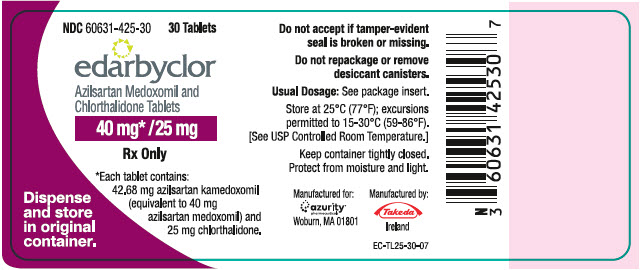
Edarbyclor Azilsartan kamedoxomil and chlorthalidone 40 mg; 25 mg Tablet, 30-count
🆔 Identity & classification
Where does this data come from?
🏷️ RxNorm drug class
This medicine belongs to the Angiotensin 2 Receptor Blocker class.
Where does this data come from?
🏭 Manufacturer & labeler
Where does this data come from?
🩺 Clinical
Azilsartan is used alone or in combination with other medications to treat high blood pressure. Azilsartan is in a class of medications called angiotensin II receptor antagonists. It works by blocking the action of certain natural substances that tighten the blood vessels, allowing the blood to flow more smoothly and the heart to pump more efficiently. High blood pressure is a common condition, and when not treated it can cause damage to the brain, heart, blood vessels, kidneys, and other parts of the body. Damage to these organs may cause heart disease, a heart attack, heart failure, stroke,...
Read the full MedlinePlus article ↗- Edarbyclor combines two different blood-pressure medicines — azilsartan and chlorthalidone — into one convenient tablet. They work in different ways: azilsartan relaxes blood vesse...
- What exactly is Edarbyclor and why did my doctor prescribe two medicines in one pill?
- Good news — food doesn't affect how well Edarbyclor works, so you can take it with or without a meal. As for timing, once a day is what matters most. Pick a time that's easy to rem...
- Can I take Edarbyclor with food, and does it matter what time of day I take it?
Patient education
Supplement & herbal interactions
Where does this data come from?
Ask a licensed pharmacist directly — free, answered by our team.
💊 What it looks like
Where does this data come from?
🧪 Inactive Ingredients / Excipients
Inactive ingredients, also called excipients, are components of the drug product other than the active ingredient. They may include fillers, dyes, coatings, preservatives, flavors, or other formulation ingredients.
💡 Tap an ingredient (hover on desktop) to see what it is and why it’s used.
-
UNII 3K9958V90M
A liquid solvent derived from fermentation or chemical synthesis. In medicines, alcohol dissolves active ingredients, helps preserve the product, and improves how the body absorbs certain drugs.
-
UNII 8PJ61P6TS3
Butyl alcohol is a clear liquid organic solvent derived from petroleum or natural sources. In medicines, it helps dissolve active ingredients and serves as a solvent in liquid formulations and some topical products.
-
UNII 68401960MK
Crospovidone is a synthetic polymer made from polyvinylpyrrolidone. It acts as a disintegrant, helping tablets break apart quickly in the stomach so the medicine dissolves and absorbs into the body.
-
UNII 1K09F3G675
Ferric oxide red is an inorganic iron compound used as a colorant in medicines. It gives tablets, capsules, or other dosage forms a red or reddish tint for identification and appearance.
-
UNII XM0M87F357
A dark iron oxide compound that gives medicines their black or dark color. It's used as a colorant in tablets and capsules to help identify the product and make it visually distinctive.
-
UNII 88XHZ13131
Fumaric acid is an organic acid used in medications as a buffer and pH regulator. It helps maintain the proper acidity level in the medicine and may aid in tablet disintegration.
-
UNII RFW2ET671P
Hydroxypropyl cellulose is a plant-derived thickening agent made from cellulose. It acts as a binder to hold tablet ingredients together and as a film-former to coat tablets or control how fast the medicine releases.
-
UNII 3NXW29V3WO
Hypromellose is a plant-based thickener made from cellulose. It's used in medicines as a binder to hold ingredients together, a coating for tablets, and a thickener for liquids.
-
UNII 70097M6I30
Magnesium stearate is a salt made from magnesium and stearic acid, a fatty substance. It's used in tablets and capsules as a lubricant and glidant to help ingredients flow smoothly during manufacturing and prevent sticking.
-
UNII 3OWL53L36A
A natural sugar alcohol derived from seaweed or synthesized in the lab. It's used as a filler to add bulk, a sweetener in sugar-free formulas, and a disintegrant to help tablets break apart in the stomach.
-
UNII OP1R32D61U
Microcrystalline cellulose is a purified form of cellulose, a natural fiber from plant sources. It acts as a binder and filler in tablets and capsules, helping hold ingredients together and give the medicine its shape and size.
-
UNII Q662QK8M3B
Polyethylene glycol 8000 is a synthetic polymer made from ethylene oxide. It acts as a binder and filler in tablets and capsules, helping hold ingredients together and add bulk to the medicine.
-
UNII 46N107B71O
Shellac is a natural resin secreted by the lac beetle. It's used as a coating on tablets and capsules to control how quickly the medicine dissolves and to improve appearance and stability.
-
UNII 55X04QC32I
A strong alkaline chemical used to adjust and maintain the pH balance of liquid medicines. It helps keep the medicine stable and ensures it stays effective during storage.
-
UNII 7SEV7J4R1U
A powder made from a naturally occurring mineral. In medicines, talc works as a glidant and anti-caking agent, helping tablets and capsules flow smoothly during manufacturing and preventing clumping.
-
UNII 15FIX9V2JP
Titanium dioxide is a bright white mineral powder commonly used as a colorant and opacifying agent. It makes pills and tablets white or lighter in color and helps make coatings non-transparent.
-
UNII 059QF0KO0R
Water is a liquid solvent that dissolves and mixes ingredients together in liquid medicines, syrups, and injections. It helps distribute the active drug evenly throughout the product.
17 inactive ingredients listed in the exact product block matched to this NDC.
Where does this data come from?
ingredient classCode="IACT" elements from the exact product block matched by this NDC. Label-section narrative from DailyMed / the openFDA label index is shown separately when available.Inactive ingredient FAQ
Are inactive ingredients the same for every manufacturer?
Why might an inactive ingredient be missing?
Can inactive ingredients matter?
💲 Pricing
A drug doesn't have one price. Each row is a different public payment system, and none is what you'd pay at the counter — that depends on your insurance. The ⓘ on each row explains what it measures.
| Price system | Per ea | Per package |
|---|---|---|
| Retail pharmacies payNADAC · weekly | $8.490 | $254.71 / 30 tablets |
| Medicaid paysCMS SDUD · 12 mo | $8.63 | $259.01 / 30 tablets |
| Medicare drug plans payPart D · Q2 2026 | $8.72 | $261.56 / 30 tablets |
Where does this data come from?
🔁 Therapeutic equivalents
| Product | Labeler | Pack | NADAC/unit | TE | Status | Price vs. this |
|---|---|---|---|---|---|---|
| Edarbyclor 40 mg/1; 25 mgthis 60631-0425-30 | Azurity | 30 tablets | $8.490 | AB | Availability likely | — |
| Edarbyclor 40 mg/1; 25 mg 75929-0230-03 | Pharma | 30 tablets | — | AB | Discontinued | — |
Where does this data come from?
⏳ Availability & generic status
The FDA lists approved generic versions of this medicine, but that does not always mean a pharmacy can get one today. Patent rules, launch agreements, supply and pricing can affect when generics actually arrive.
Why the date isn’t exact: Generic timing can change because patents may be challenged, settled, licensed, added, removed, or worked around with a narrower label — and FDA approval does not always mean a pharmacy can get the generic today.
🛈 What do these terms mean?
- Patent
- Legal protection listed in the Orange Book that may delay generic approval or launch. Issued by the U.S. Patent & Trademark Office.
- Substance patent
- Covers the active drug molecule itself — the hardest to design around. A generic generally can’t launch until it expires.
- Formulation (product) patent
- Covers a specific formulation or dosage form. A generic can sometimes work around it with a different formulation.
- Method-of-use patent
- A patent covering one specific approved use of the drug — not necessarily the whole molecule. A generic can sometimes launch with a “skinny label” that carves out the protected use and keeps the others.
- Skinny label
- A generic label that omits a still-patented use when the FDA allows it — letting a generic reach the market for the unprotected uses.
- Exclusivity
- FDA-granted marketing protection, separate from patents — e.g. 5-yr new chemical entity, 7-yr orphan drug, or a +6-month pediatric extension.
- Paragraph IV
- A generic applicant’s formal challenge to a listed patent. It can potentially lead to earlier generic entry, but often involves litigation or a settlement.
- RLD / RS
- Reference Listed Drug — the brand product the FDA uses as the reference for generic applications. Reference Standard — the product the FDA expects generics to compare against in bioequivalence testing.
- TE / AB rating
- FDA therapeutic-equivalence rating. An AB rating generally means the FDA considers a generic therapeutically equivalent to — and substitutable for — the brand.
- LOE (loss of exclusivity)
- The latest patent or exclusivity currently listed — the loss-of-exclusivity / latest-listed-protection date shown on this page. Paragraph-IV challenges and settlements can move the real date earlier; FDA approval and a manufacturer’s decision to market can move it later.
Built from the FDA Orange Book. The bars above are scaled to each protection’s expiry; the red LOE marker is the last one to lapse.
| Patent | Type | Use code | Expires |
|---|---|---|---|
| US 9387249 ↗ | Method of use | U-3 | Jul 1, 2031 |
| US 9387249 ↗ | Method of use | U-3 | Jul 1, 2031 |
| US 9169238 ↗ | Drug product | — | Feb 4, 2030 |
| US 9169238 ↗ | Drug product | — | Feb 4, 2030 |
| US 9066936 ↗ | Drug product | — | Mar 26, 2028 |
| US 9066936 ↗ | Drug product | — | Mar 26, 2028 |
Is there a generic version of EDARBYCLOR 40-25 MG TABLET?
The FDA approved a generic — why can’t I get it at my pharmacy yet?
Why do different websites show different generic release dates?
What does “FDA listed” mean?
What does a patent or protection date mean here?
What does “current Orange Book estimate” mean?
Can a generic come out before the last patent expires?
Can a generic come out after the listed dates?
What is the difference between patents and exclusivity?
Why are there multiple patent dates?
Where does this data come from?
🗺️ Medicaid utilization & spend
📊 Medicare Part D spend CMS · PART D · 2026 (Q1)
📦 Packaging — all sizes for this product
| Package NDC | Description | Marketing start | Status |
|---|---|---|---|
| 60631-0425-30 You're viewing this | 30 TABLET in 1 BOTTLE (60631-425-30) | 2013-02-01 | Active |
📄 Full prescribing information FDA SPL
🚨 Boxed Warning ▾
WARNING: FETAL TOXICITY When pregnancy is detected, discontinue Edarbyclor as soon as possible [see Warnings and Precautions (5.1) and Use in Specific Populations (8.1) ]. Drugs that act directly on the renin-angiotensin system can cause injury and death to the developing fetus [see Warnings and Precautions (5.1) and Use in Specific Populations (8.1) ]. WARNING: FETAL TOXICITY See full prescribing information for complete boxed warning.
When pregnancy is detected, discontinue EDARBYCLOR as soon as possible ( 5.1 , 8.1 ) Drugs that act directly on the renin-angiotensin system can cause injury and death to the developing fetus ( 5.1 , 8.1 )
🎯 Indications and Usage ▾
1 INDICATIONS AND USAGE Edarbyclor is indicated for the treatment of hypertension, to lower blood pressure. Edarbyclor may be used in patients whose blood pressure is not adequately controlled on monotherapy. Edarbyclor may be used as initial therapy if a patient is likely to need multiple drugs to achieve blood pressure goals.
Lowering blood pressure reduces the risk of fatal and nonfatal cardiovascular events, primarily strokes and myocardial infarctions. These benefits have been seen in controlled trials of antihypertensive drugs from a wide variety of pharmacologic classes including thiazide-like diuretics such as chlorthalidone and ARBs such as azilsartan medoxomil. There are no controlled trials demonstrating risk reduction with Edarbyclor.
Control of high blood pressure should be part of comprehensive cardiovascular risk management, including, as appropriate, lipid control, diabetes management, antithrombotic therapy, smoking cessation, exercise, and limited sodium intake. Many patients will require more than one drug to achieve blood pressure goals. For specific advice on goals and management of high blood pressure, see published guidelines, such as those of the National High Blood Pressure Education Program's Joint National Committee on Prevention, Detection, Evaluation, and Treatment of High Blood Pressure (JNC).
Numerous antihypertensive drugs, from a variety of pharmacologic classes and with different mechanisms of action, have been shown in randomized controlled trials to reduce cardiovascular morbidity and mortality, and it can be concluded that it is blood pressure reduction, and not some other pharmacologic property of the drugs, that is largely responsible for those benefits. The largest and most consistent cardiovascular outcome benefit has been a reduction in the risk of stroke, but reductions in myocardial infarction and cardiovascular mortality also have been seen regularly.
Elevated systolic or diastolic pressure causes increased cardiovascular risk, and the absolute risk increase per mmHg is greater at higher blood pressures, so that even modest reductions of severe hypertension can provide substantial benefit. Relative risk reduction from blood pressure reduction is similar across populations with varying absolute risk, so the absolute benefit is greater in patients who are at higher risk independent of their hypertension (for example, patients with diabetes or hyperlipidemia), and such patients would be expected to benefit from more aggressive treatment to a lower blood pressure goal.
Some antihypertensive drugs have smaller blood pressure effects (as monotherapy) in black patients; however, the blood pressure effect of Edarbyclor in blacks is similar to that in non-blacks. Many antihypertensive drugs have additional approved indications and effects (e.g., on angina, heart failure, or diabetic kidney disease). These considerations may guide selection of therapy.
The choice of Edarbyclor as initial therapy for hypertension should be based on an assessment of potential benefits and risks including whether the patient is likely to tolerate the starting dose of Edarbyclor. Patients with moderate-to-severe hypertension are at a relatively high risk of cardiovascular events (e.g., stroke, heart attack, and heart failure), kidney failure, and vision problems, so prompt treatment is clinically relevant. Consider the patient's baseline blood pressure, target goal and the incremental likelihood of achieving the goal with a combination product, such as Edarbyclor, versus a monotherapy product when deciding upon initial therapy.
Individual blood pressure goals may vary based on the patient's risk. Data from an 8-week, active-controlled, factorial trial provide estimates of the probability of reaching a target blood pressure with Edarbyclor compared with azilsartan medoxomil or chlorthalidone monotherapy [see Clinical Studies (14) ] . Figures 1.a-1.d provide estimates of the likelihood of achieving target clinic sy…
⏱️ Dosage and Administration ▾
2 DOSAGE AND ADMINISTRATION Starting dose is 40/12.5 mg once daily ( 2.1 ) Edarbyclor may be used to provide additional blood pressure lowering for patients not adequately controlled on azilsartan medoxomil 80 mg or chlorthalidone 25 mg ( 2.1 ) Dose may be increased to 40/25 mg after 2 to 4 weeks as needed to achieve blood pressure goals ( 2.1 ) Maximal dose is 40/25 mg ( 2.1 ) May be administered with other antihypertensive agents ( 2.1 ) Edarbyclor may be administered with or without food ( 2.1 ) Replace volume in volume-depleted patients prior to use ( 2.2 )
2.1Dosing Information The recommended starting dose of Edarbyclor is 40/12.5 mg taken orally once daily. Most of the antihypertensive effect is apparent within 1 to 2 weeks. The dosage may be increased to 40/25 mg after 2 to 4 weeks as needed to achieve blood pressure goals.
Edarbyclor doses above 40/25 mg are probably not useful. Patients titrated to the individual components (azilsartan medoxomil and chlorthalidone) may instead receive the corresponding dose of Edarbyclor. Edarbyclor may be administered with other antihypertensive agents as needed.
2.2Prior to Dosing Correct any volume depletion prior to administration of Edarbyclor, particularly in patients with impaired renal function or those treated with high doses of diuretics [see Warnings and Precautions (5.2) ]. Patients who experience dose-limiting adverse reactions on chlorthalidone may be switched to Edarbyclor, initially with a lower dose of chlorthalidone [see Warnings and Precautions (5.4) ].
2.3Handling Instructions Do not repackage Edarbyclor. Dispense and store Edarbyclor in its original container to protect Edarbyclor from light and moisture.
💊 Dosage Forms and Strengths ▾
3 DOSAGE FORMS AND STRENGTHS Edarbyclor is supplied in the following dosage strengths: 40/12.5 mg: pale red, round, biconvex, film-coated tablets, approximately 9.7 mm in diameter, with "A/C" and "40/12.5" imprinted on one side. Each tablet contains 40 mg of azilsartan medoxomil and 12.5 mg of chlorthalidone. 40/25 mg: light red, round, biconvex, film-coated tablets, approximately 9.7 mm in diameter, with "A/C" and "40/25" imprinted on one side.
Each tablet contains 40 mg of azilsartan medoxomil and 25 mg of chlorthalidone. Tablets (azilsartan/chlorthalidone): 40/12.5 mg and 40/25 mg ( 3 )
⛔ Contraindications ▾
4 CONTRAINDICATIONS Edarbyclor is contraindicated in patients with anuria [see Warnings and Precautions (5.3) ]. Do not coadminister aliskiren-containing products with Edarbyclor in patients with diabetes [see Drug Interactions (7) ] . Anuria ( 4 ) Do not coadminister aliskiren-containing products with Edarbyclor in patients with diabetes ( 4 )
⚠️ Warnings and Cautions ▾
5 WARNINGS AND PRECAUTIONS In patients with an activated renin-angiotensin-aldosterone system (RAAS), such as volume- and/or salt-depleted patients, Edarbyclor can cause excessive hypotension. Correct volume or salt depletion prior to administration of Edarbyclor ( 5.2 ) In patients with renal artery stenosis, Edarbyclor may cause renal failure ( 5.3 ) Monitor renal function in patients with renal impairment. Consider discontinuing Edarbyclor with progressive renal impairment ( 5.3 ) Monitor serum electrolytes periodically ( 5.4 )
5.1Fetal Toxicity Azilsartan medoxomil Edarbyclor can cause fetal harm when administered to a pregnant woman. Use of drugs that act on the renin-angiotensin system during the second and third trimesters of pregnancy reduces fetal renal function and increases fetal and neonatal morbidity and death. Resulting oligohydramnios can be associated with fetal lung hypoplasia and skeletal deformations.
Potential neonatal adverse effects include skull hypoplasia, anuria, hypotension, renal failure, and death. When pregnancy is detected, discontinue Edarbyclor as soon as possible [see Use in Specific Populations (8.1) ]. Chlorthalidone Thiazides cross the placental barrier and appear in cord blood.
Adverse reactions include fetal or neonatal jaundice and thrombocytopenia.
5.2Hypotension in Volume- or Salt-Depleted Patients In patients with an activated renin-angiotensin system, such as volume- or salt-depleted patients (e.g., those being treated with high doses of diuretics), symptomatic hypotension may occur after initiation of treatment with Edarbyclor. Such patients are probably not good candidates to start therapy with more than one drug; therefore, correct volume prior to administration of Edarbyclor. If hypotension does occur, the patient should be placed in the supine position and, if necessary, given an intravenous infusion of normal saline .
A transient hypotensive response is not a contraindication to further treatment, which usually can be continued without difficulty once the blood pressure has stabilized.
5.3Impaired Renal Function Edarbyclor Monitor for worsening renal function in patients with renal impairment. Consider withholding or discontinuing Edarbyclor if progressive renal impairment becomes evident . Azilsartan medoxomil As a consequence of inhibiting the renin-angiotensin system, changes in renal function may be anticipated in susceptible individuals treated with Edarbyclor.
In patients whose renal function may depend on the activity of the renin-angiotensin system (e.g., patients with severe congestive heart failure, renal artery stenosis, or volume depletion), treatment with angiotensin-converting enzyme inhibitors and angiotensin receptor blockers has been associated with oliguria or progressive azotemia and rarely with acute renal failure and death. Similar results may be anticipated in patients treated with Edarbyclor [see Drug Interactions (7) , Use in Specific Populations (8.6) and Clinical Pharmacology (12.3) ].
In studies of ACE inhibitors in patients with unilateral or bilateral renal artery stenosis, increases in serum creatinine or blood urea nitrogen have been reported. There has been no long-term use of azilsartan medoxomil in patients with unilateral or bilateral renal artery stenosis, but similar results are expected. Chlorthalidone In patients with renal disease, chlorthalidone may precipitate azotemia.
If progressive renal impairment becomes evident, as indicated by increased blood urea nitrogen, consider withholding or discontinuing diuretic therapy.
5.4Serum Electrolyte Imbalances Thiazide diuretics can cause hyponatremia and hypokalemia. Drugs that inhibit the renin angiotensin system can cause hyperkalemia. Hypokalemia is a dose-dependent adverse reaction that may develop with chlorthalidone. Co-administration of digitalis may exacerbate the adverse effects of hypokalemia. Monitor serum electrolytes periodically. Edarbyclor attenuates chlorthalidone-associated h…
🤒 Adverse Reactions ▾
6 ADVERSE REACTIONS The following potential adverse reactions with Edarbyclor, azilsartan medoxomil, or chlorthalidone and similar agents are included in more detail in the Warnings and Precautions section of the label: Fetal toxicity [see Warnings and Precautions (5.1) ] Hypotension in Volume- or Salt-Depleted Patients [see Warnings and Precautions (5.2) ] Impaired Renal Function [see Warnings and Precautions (5.3) ] Hypokalemia [see Warnings and Precautions (5.4) ] Hyperuricemia [see Warnings and Precautions (5.5) ] Most common adverse reactions (incidence ≥2%) are dizziness and fatigue ( 6.1 ) To report SUSPECTED ADVERSE REACTIONS, contact Azurity Pharmaceuticals, Inc. at 1-800-461-7449 or FDA at 1-800-FDA-1088 or www.fda.gov/medwatch.
6.1Clinical Trials Experience Because clinical trials are conducted under widely varying conditions, adverse reaction rates observed in the clinical trials of a drug cannot be directly compared to rates in the clinical trials of another drug and may not reflect the rates observed in practice. Edarbyclor has been evaluated for safety in more than 3900 patients with hypertension; more than 700 patients were treated for at least 6 months and more than 280 for at least 1 year. Adverse reactions have generally been mild and transient in nature.
Common adverse reactions that occurred in the 8-week factorial design trial in at least 2% of Edarbyclor-treated patients and greater than azilsartan medoxomil or chlorthalidone are presented in Table 1. Table 1. Adverse Reactions Occurring at an Incidence of ≥2% of Edarbyclor-treated Patients and > Azilsartan medoxomil or Chlorthalidone Preferred Term Azilsartan medoxomil 20, 40, 80 mg (N=470) Chlorthalidone 12.5, 25 mg (N=316) Edarbyclor 40 / 12.5, 40 / 25 mg (N=302) Dizziness 1.7% 1.9% 8.9% Fatigue 0.6% 1.3% 2.0% Hypotension and syncope were reported in 1.7% and 0.3%, respectively, of patients treated with Edarbyclor.
Study discontinuation because of adverse reactions occurred in 8.3% of patients treated with the recommended doses of Edarbyclor compared with 3.2% of patients treated with azilsartan medoxomil and 3.2% of patients treated with chlorthalidone. The most common reasons for discontinuation of therapy with Edarbyclor were serum creatinine increased (3.6%) and dizziness (2.3%). The adverse reaction profile obtained from 52 weeks of open-label combination therapy with azilsartan medoxomil plus chlorthalidone or Edarbyclor was similar to that observed during the double-blind, active controlled trials.
In 3 double-blind, active controlled, titration studies, in which Edarbyclor was titrated to higher doses in a step-wise manner, adverse reactions and discontinuations for adverse events were less frequent than in the fixed-dose factorial trial. Azilsartan medoxomil A total of 4814 patients were evaluated for safety when treated with azilsartan medoxomil at doses of 20, 40 or 80 mg in clinical trials. This includes 1704 patients treated for at least 6 months, of these, 588 were treated for at least 1 year.
Generally, adverse reactions were mild, not dose related and similar regardless of age, gender and race. Adverse reactions with a plausible relationship to treatment that have been reported with an incidence of ≥0.3% and greater than placebo in more than 3300 patients treated with azilsartan medoxomil in controlled trials are listed below: Gastrointestinal Disorders: diarrhea, nausea General Disorders and Administration Site Conditions: asthenia, fatigue Musculoskeletal and Connective Tissue Disorders: muscle spasm Nervous System Disorders: dizziness, dizziness postural Respiratory, Thoracic and Mediastinal Disorders: cough Chlorthalidone The following adverse reactions have been observed in clinical trials of chlorthalidone: rash, headache, dizziness, GI upset, and elevations of uric acid and cholesterol.
Clinical Laboratory Findings with Edarbyclor In the factorial design trial, clinically relevant changes in standard laboratory parameters were…
🔄 Drug Interactions ▾
7 DRUG INTERACTIONS Renal clearance of lithium is reduced by diuretics, such as chlorthalidone increasing the risk of lithium toxicity ( 7 ) NSAIDS increase risk of renal dysfunction and interfere with antihypertensive effect ( 7 ) Dual inhibition of the renin-angiotensin system: Increased risk of renal impairment, hypotension, and hyperkalemia ( 7 ) Lithium: Increases in serum lithium concentrations and lithium toxicity ( 7 )
7.1Non-Steroidal Anti-Inflammatory Agents including Selective Cyclooxygenase-2 Inhibitors (COX-2 Inhibitors) In patients who are elderly, volume-depleted (including those on diuretic therapy), or who have compromised renal function, co-administration of NSAIDs, including selective COX-2 inhibitors, with angiotensin II receptor antagonists, including azilsartan, may result in deterioration of renal function, including possible acute renal failure. These effects are usually reversible. Monitor renal function periodically in patients receiving Edarbyclor and NSAID therapy.
The antihypertensive effect of Edarbyclor may be attenuated by NSAIDs, including selective COX-2 inhibitors.
7.2Dual Blockade of the Renin-Angiotensin System (RAS) Dual blockade of the RAS with angiotensin receptor blockers, ACE inhibitors, or aliskiren is associated with increased risks of hypotension, hyperkalemia, and changes in renal function (including acute renal failure) compared to monotherapy. Most patients receiving the combination of two RAS inhibitors do not obtain any additional benefit compared to monotherapy. In general, avoid combined use of RAS inhibitors.
Closely monitor blood pressure, renal function and electrolytes in patients on Edarbyclor and other agents that affect the RAS. Do not coadminister aliskiren with Edarbyclor in patients with diabetes. Avoid use of aliskiren with Edarbyclor in patients with renal impairment (GFR <60 mL/min).
7.3Lithium Increases in serum lithium concentrations and lithium toxicity have been reported during concomitant administration of lithium with angiotensin II receptor agonists. Lithium renal clearance is reduced by diuretics, such as chlorthalidone. Monitor serum lithium levels during concomitant use.
👥 Use in Specific Populations ▾
8 USE IN SPECIFIC POPULATIONS Lactation: Breastfeeding is not recommended.
8.1Pregnancy Risk Summary Edarbyclor can cause fetal harm when administered to a pregnant woman. Use of drugs that act on the renin-angiotensin system during the second and third trimesters of pregnancy reduces fetal renal function and increases fetal and neonatal morbidity and death ( see Clinical Considerations ). Most epidemiologic studies examining fetal abnormalities after exposure to antihypertensive use in the first trimester have not distinguished drugs affecting the renin-angiotensin system from other antihypertensive agents.
When pregnancy is detected, discontinue Edarbyclor as soon as possible. The estimated background risk of major birth defects and miscarriage for the indicated population is unknown. All pregnancies have a background risk of birth defect, loss, or other adverse outcomes.
In the U.S. general population, the estimated background risk of major birth defects and miscarriage in clinically recognized pregnancies is 2-4% and 15-20%, respectively. Clinical Considerations Disease-associated maternal and/or embryo/fetal risk Hypertension in pregnancy increases the maternal risk for pre-eclampsia, gestational diabetes, premature delivery, and delivery complications (e.g., need for cesarean section, and post-partum hemorrhage). Hypertension increases the fetal risk for intrauterine growth restriction and intrauterine death.
Pregnant women with hypertension should be carefully monitored and managed accordingly. Fetal/Neonatal adverse reactions Oligohydramnios in pregnant women who use drugs affecting the renin-angiotensin system in the second and third trimesters can result in the following: reduced fetal renal function leading to anuria and renal failure, fetal lung hypoplasia, skeletal deformations, including skull hypoplasia, hypotension and death. Perform serial ultrasound examinations to assess the intra-amniotic environment.
Fetal testing may be appropriate, based on the week of pregnancy. Patients and physicians should be aware, however, that oligohydramnios may not appear until after the fetus has sustained irreversible injury. Closely observe infants with histories of in utero exposure to Edarbyclor for hypotension, oliguria, and hyperkalemia.
In neonates with a history of in utero exposure to Edarbyclor, if oliguria or hypotension occurs, support blood pressure and renal perfusion. Exchange transfusions or dialysis may be required as a means of reversing hypotension and/or substituting for disordered renal function . Chlorthalidone Thiazides cross the placenta, and use of thiazides during pregnancy is associated with a risk of fetal or neonatal jaundice, thrombocytopenia, and possible other adverse reactions that have occurred in adults.
Data Animal Data Edarbyclor The safety profiles of azilsartan medoxomil and chlorthalidone monotherapy have been individually established. To characterize the toxicological profile for Edarbyclor, a 13-week repeat-dose toxicity study was conducted in rats. The results of this study indicated that the combined administration of azilsartan medoxomil, M-II, and chlorthalidone resulted in increased exposures to chlorthalidone.
Pharmacologically-mediated toxicity, including suppression of body weight gain and decreased food consumption in male rats, and increases in blood urea nitrogen in both sexes, was enhanced by coadministration of azilsartan medoxomil, M-II, and chlorthalidone. With the exception of these findings, there were no toxicologically synergistic effects in this study. In an embryo-fetal developmental study in rats, there was no teratogenicity or increase in fetal mortality in the litters of dams receiving azilsartan medoxomil, M-II and chlorthalidone concomitantly at maternally toxic doses.
Azilsartan medoxomil Reproductive Toxicology: In peri- and postnatal rat development studies, adverse effects on pup viability, delayed incisor eruption and dilatation of the renal pelvis along…
🤰 Pregnancy ▾
8.1Pregnancy Risk Summary Edarbyclor can cause fetal harm when administered to a pregnant woman. Use of drugs that act on the renin-angiotensin system during the second and third trimesters of pregnancy reduces fetal renal function and increases fetal and neonatal morbidity and death ( see Clinical Considerations ). Most epidemiologic studies examining fetal abnormalities after exposure to antihypertensive use in the first trimester have not distinguished drugs affecting the renin-angiotensin system from other antihypertensive agents.
When pregnancy is detected, discontinue Edarbyclor as soon as possible. The estimated background risk of major birth defects and miscarriage for the indicated population is unknown. All pregnancies have a background risk of birth defect, loss, or other adverse outcomes.
In the U.S. general population, the estimated background risk of major birth defects and miscarriage in clinically recognized pregnancies is 2-4% and 15-20%, respectively. Clinical Considerations Disease-associated maternal and/or embryo/fetal risk Hypertension in pregnancy increases the maternal risk for pre-eclampsia, gestational diabetes, premature delivery, and delivery complications (e.g., need for cesarean section, and post-partum hemorrhage). Hypertension increases the fetal risk for intrauterine growth restriction and intrauterine death.
Pregnant women with hypertension should be carefully monitored and managed accordingly. Fetal/Neonatal adverse reactions Oligohydramnios in pregnant women who use drugs affecting the renin-angiotensin system in the second and third trimesters can result in the following: reduced fetal renal function leading to anuria and renal failure, fetal lung hypoplasia, skeletal deformations, including skull hypoplasia, hypotension and death. Perform serial ultrasound examinations to assess the intra-amniotic environment.
Fetal testing may be appropriate, based on the week of pregnancy. Patients and physicians should be aware, however, that oligohydramnios may not appear until after the fetus has sustained irreversible injury. Closely observe infants with histories of in utero exposure to Edarbyclor for hypotension, oliguria, and hyperkalemia.
In neonates with a history of in utero exposure to Edarbyclor, if oliguria or hypotension occurs, support blood pressure and renal perfusion. Exchange transfusions or dialysis may be required as a means of reversing hypotension and/or substituting for disordered renal function . Chlorthalidone Thiazides cross the placenta, and use of thiazides during pregnancy is associated with a risk of fetal or neonatal jaundice, thrombocytopenia, and possible other adverse reactions that have occurred in adults.
Data Animal Data Edarbyclor The safety profiles of azilsartan medoxomil and chlorthalidone monotherapy have been individually established. To characterize the toxicological profile for Edarbyclor, a 13-week repeat-dose toxicity study was conducted in rats. The results of this study indicated that the combined administration of azilsartan medoxomil, M-II, and chlorthalidone resulted in increased exposures to chlorthalidone.
Pharmacologically-mediated toxicity, including suppression of body weight gain and decreased food consumption in male rats, and increases in blood urea nitrogen in both sexes, was enhanced by coadministration of azilsartan medoxomil, M-II, and chlorthalidone. With the exception of these findings, there were no toxicologically synergistic effects in this study. In an embryo-fetal developmental study in rats, there was no teratogenicity or increase in fetal mortality in the litters of dams receiving azilsartan medoxomil, M-II and chlorthalidone concomitantly at maternally toxic doses.
Azilsartan medoxomil Reproductive Toxicology: In peri- and postnatal rat development studies, adverse effects on pup viability, delayed incisor eruption and dilatation of the renal pelvis along with hydronephrosis were seen when azilsartan medoxomil was administered to…
🧒 Pediatric Use ▾
8.4Pediatric Use Safety and effectiveness of Edarbyclor in pediatric patients under 18 years of age have not been established.
🧓 Geriatric Use ▾
8.5Geriatric Use Edarbyclor No dose adjustment with Edarbyclor is necessary in elderly patients. Of the total patients in clinical studies with Edarbyclor, 24% were elderly (65 years of age or older); 5.7% were 75 years and older. No overall differences in safety or effectiveness were observed between elderly patients and younger patients, but greater sensitivity of some older individuals cannot be ruled out [see Clinical Pharmacology (12.3) ].
🆘 Overdosage ▾
10 OVERDOSAGE Limited data are available related to overdosage in humans. Azilsartan medoxomil Limited data are available related to overdosage in humans. During controlled clinical trials in healthy subjects, once daily doses up to 320 mg of azilsartan medoxomil were administered for 7 days and were well tolerated.
In the event of an overdose, supportive therapy should be instituted as dictated by the patient's clinical status. Azilsartan is not dialyzable. Chlorthalidone Symptoms of acute overdosage include nausea, weakness, dizziness, and disturbances of electrolyte balance.
The oral LD50 of the drug in the mouse and the rat is more than 25,000 mg/kg body weight. The minimum lethal dose (MLD) in humans has not been established. There is no specific antidote, but gastric lavage is recommended, followed by supportive treatment.
Where necessary, this may include intravenous dextrose-saline with potassium, administered with caution.
🧬 Clinical Pharmacology ▾
12 CLINICAL PHARMACOLOGY
12.1Mechanism of Action The active ingredients of Edarbyclor target two separate mechanisms involved in blood pressure regulation. Azilsartan medoxomil Angiotensin II is formed from angiotensin I in a reaction catalyzed by angiotensin-converting enzymes (ACE, kinase II). Angiotensin II is the principle pressor agent of the renin-angiotensin system, with effects that include vasoconstriction, stimulation of synthesis and release of aldosterone, cardiac stimulation, and renal reabsorption of sodium.
Azilsartan medoxomil is an orally administered prodrug that is rapidly converted by esterases during absorption to the active moiety, azilsartan. Azilsartan blocks the vasoconstrictor and aldosterone-secreting effects of angiotensin II by selectively blocking the binding of angiotensin II to the AT 1 receptor in many tissues, such as vascular smooth muscle and the adrenal gland. Its action is, therefore, independent of the pathway for angiotensin II synthesis.
An AT 2 receptor is also found in many tissues, but this receptor is not known to be associated with cardiovascular homeostasis. Azilsartan has more than a 10,000-fold greater affinity for the AT 1 receptor than for the AT 2 receptor. Blockade of the renin-angiotensin system with ACE inhibitors, which inhibit the biosynthesis of angiotensin II from angiotensin I, is widely used in the treatment of hypertension.
ACE inhibitors also inhibit the degradation of bradykinin, a reaction catalyzed by ACE. Because azilsartan does not inhibit ACE (kinase II), it should not affect bradykinin levels. Whether this difference has clinical relevance is not yet known.
Azilsartan does not bind to or block other receptors or ion channels known to be important in cardiovascular regulation. Blockade of the angiotensin II receptor inhibits the negative regulatory feedback of angiotensin II on renin secretion, but the resulting increased plasma renin activity and angiotensin II circulating levels do not overcome the effect of azilsartan on blood pressure. Chlorthalidone Chlorthalidone produces diuresis with increased excretion of sodium and chloride.
The site of action appears to be the distal renal tubule (early convoluted part), inhibiting NaCl reabsorption (by antagonizing the Na+-Cl-cotransporter) and promoting Ca++ reabsorption (by an unknown mechanism). The enhanced delivery of Na+ and water to the cortical collecting tubule and/or the increased flow rate leads to increased secretion and elimination of K+ and H+. The diuretic effects of chlorthalildone lead to decreased extracellular fluid volume, plasma volume, cardiac output, total exchangeable sodium, glomerular filtration rate, and renal plasma flow.
Although the mechanism of action of chlorthalidone and related drugs is not wholly clear, sodium and water depletion appear to provide a basis for its antihypertensive effect.
12.2Pharmacodynamics Edarbyclor Edarbyclor tablets have been shown to be effective in lowering blood pressure. Both azilsartan medoxomil and chlorthalidone lower blood pressure by reducing peripheral resistance but through complementary mechanisms. Azilsartan medoxomil Azilsartan inhibits the pressor effects of an angiotensin II infusion in a dose-related manner.
An azilsartan single dose equivalent to 32 mg azilsartan medoxomil inhibited the maximal pressor effect by approximately 90% at peak, and approximately 60% at 24 hours. Plasma angiotensin I and II concentrations and plasma renin activity increased while plasma aldosterone concentrations decreased after single and repeated administration of azilsartan medoxomil to healthy subjects; no clinically significant effects on serum potassium or sodium were observed. Chlorthalidone The diuretic effect of chlorthalidone occurs in approximately 2.6 hours and continues for up to 72 hours.
12.3Pharmacokinetics Edarbyclor Following oral administration of Edarbyclor, peak plasma concentrations of azilsartan and chlorthalidone are reached at 3 and 1 h…
🧬 Mechanism of Action ▾
12.1Mechanism of Action The active ingredients of Edarbyclor target two separate mechanisms involved in blood pressure regulation. Azilsartan medoxomil Angiotensin II is formed from angiotensin I in a reaction catalyzed by angiotensin-converting enzymes (ACE, kinase II). Angiotensin II is the principle pressor agent of the renin-angiotensin system, with effects that include vasoconstriction, stimulation of synthesis and release of aldosterone, cardiac stimulation, and renal reabsorption of sodium.
Azilsartan medoxomil is an orally administered prodrug that is rapidly converted by esterases during absorption to the active moiety, azilsartan. Azilsartan blocks the vasoconstrictor and aldosterone-secreting effects of angiotensin II by selectively blocking the binding of angiotensin II to the AT 1 receptor in many tissues, such as vascular smooth muscle and the adrenal gland. Its action is, therefore, independent of the pathway for angiotensin II synthesis.
An AT 2 receptor is also found in many tissues, but this receptor is not known to be associated with cardiovascular homeostasis. Azilsartan has more than a 10,000-fold greater affinity for the AT 1 receptor than for the AT 2 receptor. Blockade of the renin-angiotensin system with ACE inhibitors, which inhibit the biosynthesis of angiotensin II from angiotensin I, is widely used in the treatment of hypertension.
ACE inhibitors also inhibit the degradation of bradykinin, a reaction catalyzed by ACE. Because azilsartan does not inhibit ACE (kinase II), it should not affect bradykinin levels. Whether this difference has clinical relevance is not yet known.
Azilsartan does not bind to or block other receptors or ion channels known to be important in cardiovascular regulation. Blockade of the angiotensin II receptor inhibits the negative regulatory feedback of angiotensin II on renin secretion, but the resulting increased plasma renin activity and angiotensin II circulating levels do not overcome the effect of azilsartan on blood pressure. Chlorthalidone Chlorthalidone produces diuresis with increased excretion of sodium and chloride.
The site of action appears to be the distal renal tubule (early convoluted part), inhibiting NaCl reabsorption (by antagonizing the Na+-Cl-cotransporter) and promoting Ca++ reabsorption (by an unknown mechanism). The enhanced delivery of Na+ and water to the cortical collecting tubule and/or the increased flow rate leads to increased secretion and elimination of K+ and H+. The diuretic effects of chlorthalildone lead to decreased extracellular fluid volume, plasma volume, cardiac output, total exchangeable sodium, glomerular filtration rate, and renal plasma flow.
Although the mechanism of action of chlorthalidone and related drugs is not wholly clear, sodium and water depletion appear to provide a basis for its antihypertensive effect.
📦 How Supplied / Storage and Handling ▾
16 HOW SUPPLIED/STORAGE AND HANDLING Edarbyclor is supplied as fixed dose combination tablets that are round, biconvex, film-coated, and 9.7 mm in diameter. Strength Color Imprinting NDC Number 60631-xxx-xx Bottle of 30 40 / 12.5 mg Pale red A/C 40/12.5 412-30 40 / 25 mg Light red A/C 40/25 425-30 Store at 25°C (77°F), excursions permitted to 15°-30°C (59°-86°F) [see USP Controlled Room Temperature]. Keep container tightly closed.
Protect from moisture and light. Do not repackage; dispense and store in original container.
📦 Storage and Handling ▾
Store at 25°C (77°F), excursions permitted to 15°-30°C (59°-86°F) [see USP Controlled Room Temperature]. Keep container tightly closed. Protect from moisture and light. Do not repackage; dispense and store in original container.
📋 Description ▾
11 DESCRIPTION Edarbyclor is a combination of azilsartan medoxomil (angiotensin II receptor blocker; as its potassium salt) and chlorthalidone (thiazide-like diuretic). Azilsartan medoxomil, a prodrug, is hydrolyzed to azilsartan in the gastrointestinal tract during absorption. Azilsartan is an angiotensin II receptor blocker.
Chlorthalidone is a monosulfamyl thiazide-like diuretic that differs chemically from thiazide diuretics by the lack of a benzothiadiazine structure. The potassium salt of azilsartan medoxomil, azilsartan kamedoxomil, is chemically described as (5-Methyl-2-oxo-1,3-dioxol-4-yl)methyl 2-ethoxy-1-{[2'-(5-oxo-4,5-dihydro-1,2,4-oxadiazol-3-yl)biphenyl-4-yl]methyl}-1 H -benzimidazole-7-carboxylate monopotassium salt. Its empirical formula is C 30 H 23 KN 4 O 8.
Chlorthalidone is chemically described as 2-chloro-5(1-hydroxy-3-oxo-1- isoindolinyl) benzenesulfonamide. Its empirical formula is C 14 H 11 ClN 2 O 4 S. The structural formula for azilsartan medoxomil is The structural formula for chlorthalidone is Azilsartan kamedoxomil is a white to nearly white powder with a molecular weight of 606.62.
It is practically insoluble in water and freely soluble in methanol. Chlorthalidone is a white to yellowish white powder with a molecular weight of 338.76. Chlorthalidone is practically insoluble in water, in ether, and in chloroform; soluble in methanol; slightly soluble in ethanol.
Edarbyclor is available for oral use as tablets. The tablets have a characteristic odor. Each Edarbyclor tablet contains 42.68 mg of azilsartan kamedoxomil, which is equivalent to containing azilsartan medoxomil 40 mg plus 12.5 or 25 mg of chlorthalidone.
Each tablet of Edarbyclor also contains the following inactive ingredients: mannitol, microcrystalline cellulose, fumaric acid, sodium hydroxide, hydroxypropyl cellulose, crospovidone, magnesium stearate, hypromellose 2910, talc, titanium dioxide, ferric oxide red, polyethylene glycol 8000, and printing ink gray F1. Chemical Structure Chemical Structure
💬 Information for Patients ▾
17 PATIENT COUNSELING INFORMATION See FDA-approved patient labeling (Patient Information) . Tell patients that if they miss a dose, they should take it later in the same day, but not to double the dose on the following day. Pregnancy Tell female patients of childbearing potential about the consequences of exposure to Edarbyclor during pregnancy.
Discuss treatment options with women planning to become pregnant. Tell patients to report pregnancies to their physicians as soon as possible. Symptomatic Hypotension Advise patients to report light-headedness.
Advise patients, if syncope occurs, to have someone call the doctor or seek medical attention, and to discontinue Edarbyclor. Inform patients that dehydration from excessive perspiration, vomiting, or diarrhea may lead to an excessive fall in blood pressure. Inform patients to consult with their healthcare provider if these symptoms occur.