
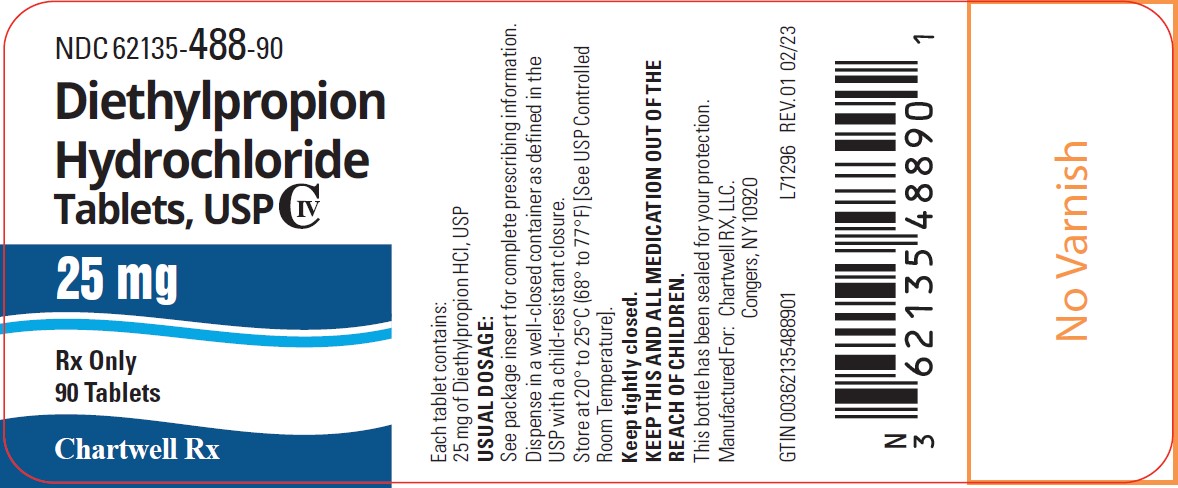
Diethylpropion Hydrochloride 25 mg Tablet, 90-count — NDC 62135-488-90 (Billing 62135-0488-90)
This is a package of 90 tablets of Diethylpropion Hydrochloride 25 mg Tablet from Chartwell RX, LLC., marketed since Jul 2011 and currently FDA-listed; retail pharmacies pay about $0.2380 per tablet (NADAC). It is this product's only package size.
NDC database record
One package, one record: these facts belong to NDC 62135-488-90 alone.
- Record
- FDA NDC Directory package listing · Human prescription drug
- Code segments
- 62135 labeler · 488 product · 90 package
- Package marketed since
- Apr 3, 2023
- Sample package
- No — commercial package
- Listing certified through
- Dec 31, 2026
- Billing quantity
- 90 EA per package
- Barcode (UPC)
- 0362135488901
- FDA record last changed
- Jul 24, 2026
Identity & classification
Regulatory identifiers FDA, NLM and CMS codes for this package
Drug-database identifiers Medi-Span GPI and First Databank GCN / HICL / AHFS classification
- GSN (GCN sequence number): 005163
- GCN: 20771
- HICL (First Databank): 002113
- AHFS class code: 28:20.08.04
- RxCUI (RxNorm): 978654
Where does this data come from?
- FDA openFDA NDC Directory · synced Oct 1, 2026
- FDA label on DailyMed · label index refreshed Oct 6, 2026
- RxNorm (NLM RxNav) · catalog refreshed Oct 1, 2026
- Medi-Span GPI (licensed)
- First Databank (licensed) · refreshed Oct 1, 2026
RxNorm drug class
This medicine belongs to the Sympathomimetic Amine Anorectic class.
Where does this data come from?
- RxClass (NLM) · catalog refreshed Oct 1, 2026
Clinical
Diethylpropion decreases appetite. It is used on a short-term basis (a few weeks), in combination with diet, to help you lose weight. This medication is sometimes prescribed for other uses; ask your doctor or pharmacist for more information.
Read the full MedlinePlus article ↗- It's a short-term prescription aid to help you eat less as part of a calorie-restricted diet plan. It works on your central nervous system to help suppress appetite — though scient...
- What exactly is diethylpropion supposed to do for me?
- It does matter, and it depends on which form you have. If you have the regular (immediate-release) tablet, you take it three times a day, about an hour before each meal — and you c...
- How do I take it — and does it matter what time of day?
Patient education
Supplement & herbal interactions
Where does this data come from?
- MedlinePlus (NLM) · refreshed Oct 1, 2026
- FDA label on DailyMed · label index refreshed Oct 6, 2026
Ask a licensed pharmacist directly — free, answered by our team.
Pricing
A drug doesn't have one price. Each row is a different public payment system, and none is what you'd pay at the counter — that depends on your insurance. The ⓘ on each row explains what it measures.
| Price system | Per ea | Per package |
|---|---|---|
| Retail pharmacies payNADAC · weekly | $0.238 | $21.42 / 90 tablets |
| Medicaid paysCMS SDUD · 12 mo | No recent Medicaid claims on file for this NDC — rare and low-volume NDCs are suppressed in the public data. | |
| Medicare drug plans payPart D · quarterly | No Part D plan price is available for this NDC in our data. | |
Where does this data come from?
- CMS NADAC weekly file · file of Sep 30, 2026
- CMS ASP pricing files · refreshed Sep 20, 2026
- CMS Medicaid State Drug Utilization Data · refreshed Oct 6, 2026
- CMS Part D plan pricing files · refreshed Sep 24, 2026
- VA National Acquisition Center price file
Packaging — all sizes for this product
| Package NDC | Description | Marketing start | Marketing end | Status |
|---|---|---|---|---|
| 62135-0488-90 You're viewing this Main listing | 90 TABLET in 1 BOTTLE | 2023-04-03 | — | Active |
Therapeutic equivalents
| Product | Labeler | Pack | NADAC/unit | TE | Status | Price vs. this |
|---|---|---|---|---|---|---|
| Diethylpropion Hydrochloride 25 mg 00527-1475-01 | Lannett | 100 tablets | $0.238 | AA | Availability likely | — |
| Diethylpropion Hydrochloride 25 mg 10702-0044-01 | KVK-TECH, | 100 tablets | $0.238 | AA | Availability likely | — |
| Diethylpropion Hydrochloride 25 mgthis 62135-0488-90 | Chartwell | 90 tablets | $0.238 | AA | Availability likely | — |
| Diethylpropion Hydrochloride 25 mg 17224-0730-28 | Calvin | 28 tablets | — | AA | FDA listed | — |
| Diethylpropion Hydrochloride 25 mg 43063-0348-01 | PD-Rx | 100 tablets | — | AA | FDA listed | — |
| Diethylpropion Hydrochloride 25 mg 50090-2580-04 | A-S | 28 tablets | — | AA | FDA listed | — |
| Diethylpropion Hydrochloride 25 mg 63187-0947-21 | Proficient | 21 tablets | — | AA | FDA listed | — |
| Diethylpropion Hydrochloride 25 mg 68071-3400-00 | NuCare | 112 tablets | — | AA | FDA listed | — |
| Diethylpropion Hydrochloride 25 mg 68071-3836-01 | NuCare | 100 tablets | — | AA | FDA listed | — |
| Diethylpropion Hydrochloride 25 mg 71335-0175-00 | Bryant | 42 tablets | — | AA | FDA listed | — |
| Diethylpropion Hydrochloride 25 mg 71335-1779-00 | Bryant | 42 tablets | — | AA | FDA listed | — |
| Diethylpropion Hydrochloride 25 mg 72789-0117-28 | PD-Rx | 28 tablets | — | AA | FDA listed | — |
| Diethylpropion Hydrochloride 25 mg 84053-0044-21 | Martek | 21 tablets | — | AA | FDA listed | — |
Where does this data come from?
- FDA openFDA NDC Directory · synced Oct 1, 2026
- FDA Orange Book · refreshed Oct 3, 2026
- CMS NADAC weekly file · file of Sep 30, 2026
Availability & generic status
This product is an FDA-approved generic. Other versions of the same drug are listed under Therapeutic equivalents, least expensive first.
Where does this data come from?
- FDA Orange Book · refreshed Oct 3, 2026
What it looks like
Where does this data come from?
- FDA label on DailyMed · label index refreshed Oct 6, 2026
Inactive Ingredients / Excipients
Inactive ingredients, also called excipients, are components of the drug product other than the active ingredient. They may include fillers, dyes, coatings, preservatives, flavors, or other formulation ingredients.
🧪 Avoiding an ingredient? See Diethylpropion inactive ingredients by manufacturer: every current product's list side by side, so you can ask your pharmacy for the version that does not list it.
💡 Tap an ingredient (hover on desktop) to see what it is and why it’s used.
-
UNII OP1R32D61U
Microcrystalline cellulose is a purified form of cellulose, a natural fiber from plant sources. It acts as a binder and filler in tablets and capsules, helping hold ingredients together and give the medicine its shape and size.
-
UNII EWQ57Q8I5X
Lactose monohydrate is a natural sugar derived from milk. It serves as a filler and binder in tablets and capsules, helping create the proper size, texture, and consistency of the medicine.
-
UNII 3OWL53L36A
A natural sugar alcohol derived from seaweed or synthesized in the lab. It's used as a filler to add bulk, a sweetener in sugar-free formulas, and a disintegrant to help tablets break apart in the stomach.
-
UNII FZ989GH94E
Povidone is a synthetic polymer made from a plastic-like material. It acts as a binder to hold tablet ingredients together and as a disintegrant to help the tablet break apart in your stomach so the medicine can be absorbed.
-
UNII 7SEV7J4R1U
A powder made from a naturally occurring mineral. In medicines, talc works as a glidant and anti-caking agent, helping tablets and capsules flow smoothly during manufacturing and preventing clumping.
-
UNII W4888I119H
Tartaric acid is a natural organic acid found in grapes and tamarinds. In medicines, it works as a buffer to control acidity, an antioxidant to prevent spoilage, and sometimes a flavoring or binding agent.
-
UNII H92E6QA4FV
Zinc stearate is a fine white powder made from zinc and stearic acid. It works as a lubricant and glidant to help the tablet or capsule move smoothly through manufacturing equipment and prevents sticking.
7 inactive ingredients listed in the exact product block matched to this NDC.
Where does this data come from?
ingredient classCode="IACT" elements from the exact product block matched by this NDC. Label-section narrative from DailyMed / the openFDA label index is shown separately when available.- FDA label on DailyMed · label index refreshed Oct 6, 2026
- FDA openFDA NDC Directory · synced Oct 1, 2026
Inactive ingredient FAQ
Are inactive ingredients the same for every manufacturer?
Why might an inactive ingredient be missing?
Can inactive ingredients matter?
Manufacturer & labeler
More NDCs from Chartwell RX, LLC. labeler code 62135
- Cephalexin 125 mg/5mL Powder, For Suspension NDC 62135-480-42
- Cephalexin 250 mg/5mL Powder, For Suspension NDC 62135-481-42
- Quinapril 5 mg Tablet, Film Coated NDC 62135-484-60
- Quinapril 10 mg Tablet, Film Coated NDC 62135-485-90
- Quinapril 20 mg Tablet, Film Coated NDC 62135-486-90
- Quinapril 40 mg Tablet, Film Coated NDC 62135-487-90
- Diethylpropion Hydrochloride ER 75 mg Tablet, Extended Release NDC 62135-489-30
- Anastrozole 1 mg Tablet NDC 62135-490-30
- Letrozole 2.5 mg Tablet, Film Coated NDC 62135-491-30
- Loxapine 5 mg Capsule NDC 62135-492-60
- Loxapine 10 mg Capsule NDC 62135-493-60
- Ultramicrosize Griseofulvin 125 mg Tablet NDC 62135-494-01
Where does this data come from?
- FDA openFDA NDC Directory · synced Oct 1, 2026
- Drugs@FDA
Full prescribing information FDA SPL
🎯 Indications and Usage ▾
INDICATIONS AND USAGE Diethylpropion hydrochloride tablets, 25 mg are indicated in the management of exogenous obesity as a short-term adjunct (a few weeks) in a regimen of weight reduction based on caloric restriction in patients with an initial body mass index (BMI) of 30 kg/m 2 or higher and who have not responded to appropriate weight reducing regimen (diet and/or exercise) alone. Below is a chart of BMI based on various heights and weights. BMI is calculated by taking the patient's weight, in kilograms (kg), divided by the patient's height, in meters (m), squared.
Metric conversions are as follows: pounds divided by 2.2 = kg; inches × 0.0254 = meters. Body Mass Index (BMI), kg/m 2 Weight (pounds) Height (feet, inches) 5'0" 5'3" 5'6" 5'9" 6'0" 6'3" 140 27 25 23 21 19 18 150 29 27 24 22 20 19 160 31 28 26 24 22 20 170 33 30 28 25 23 21 180 35 32 29 27 25 23 190 37 34 31 28 26 24 200 39 36 32 30 27 25 210 41 37 34 31 29 26 220 43 39 36 33 30 28 230 45 41 37 34 31 29 240 47 43 39 36 33 30 250 49 44 40 37 34 31 The usefulness of agents of this class (See CLINICAL PHARMACOLOGY ) should be measured against possible risk factors inherent in their use such as those described below.
Diethylpropion hydrochloride tablets, 25 mg are indicated for use as monotherapy only.
⏱️ Dosage and Administration ▾
DOSAGE AND ADMINISTRATION Diethylpropion Hydrochloride Tablets, 25 mg: One 25 mg tablet three times daily, one hour before meals, and in midevening if desired to overcome night hunger. Geriatric use: This drug is known to be substantially excreted by the kidney, and the risk of toxic reactions to this drug may be greater in patients with impaired renal function. Because elderly patients are more likely to have decreased renal function, care should be taken in dose selection, and it may be useful to monitor renal function (See PRECAUTIONS , Geriatric Use ).
⛔ Contraindications ▾
CONTRAINDICATIONS Pulmonary hypertension, advanced arteriosclerosis, hyperthyroidism, known hypersensitivity or idiosyncrasy to the sympathomimetic amines, glaucoma, severe hypertension (See PRECAUTIONS ). Agitated states. Patients with a history of drug abuse. Use in combination with other anorectic agents is contraindicated. During or within 14 days following the administration of monoamine oxidase inhibitors, hypertensive crises may result.
⚠️ Warnings ▾
WARNINGS Diethylpropion hydrochloride tablets, 25 mg should not be used in combination with other anorectic agents, including prescribed drugs, over-the-counter preparations, and herbal products. In a case-control epidemiological study, the use of anorectic agents, including diethylpropion, was associated with an increased risk of developing pulmonary hypertension, a rare, but often fatal disorder. The use of anorectic agents for longer than 3 months was associated with a 23-fold increase in the risk of developing pulmonary hypertension.
Increased risk of pulmonary hypertension with repeated courses of therapy cannot be excluded. The onset or aggravation of exertional dyspnea, or unexplained symptoms of angina pectoris, syncope, or lower extremity edema suggest the possibility of occurrence of pulmonary hypertension. Under these circumstances, diethylpropion hydrochloride tablets USP, 25 mg should be immediately discontinued, and the patient should be evaluated for the possible presence of pulmonary hypertension.
Valvular heart disease associated with the use of some anorectic agents such as fenfluramine and dexfenfluramine has been reported. Possible contributing factors include use for extended periods of time, higher than recommended dose, and/or use in combination with other anorectic drugs. Valvulopathy has been very rarely reported with diethylpropion hydrochloride tablets, 25 mg monotherapy, but the causal relationship remains uncertain.
The potential risk of possible serious adverse effects such as valvular heart disease and pulmonary hypertension should be assessed carefully against the potential benefit of weight loss. Baseline cardiac evaluation should be considered to detect preexisting valvular heart diseases or pulmonary hypertension prior to initiation of diethylpropion hydrochloride tablets, 25 mg treatment. Diethylpropion hydrochloride tablets, 25 mg are not recommended in patients with known heart murmur or valvular heart disease.
Echocardiogram during and after treatment could be useful for detecting any valvular disorders which may occur. To limit unwarranted exposure and risks, treatment with diethylpropion hydrochloride tablets, 25 mg should be continued only if the patient has satisfactory weight loss within the first 4 weeks of treatment (e.g., weight loss of at least 4 pounds, or as determined by the physician and patient). Diethylpropion hydrochloride tablets, 25 mg are not recommended for patients who used any anorectic agents within the prior year.
If tolerance develops, the recommended dose should not be exceeded in an attempt to increase the effect; rather, the drug should be discontinued. Diethylpropion hydrochloride tablets, 25 mg may impair the ability of the patient to engage in potentially hazardous activities such as operating machinery or driving a motor vehicle; the patient should therefore be cautioned accordingly. Prolonged use of diethylpropion hydrochloride may induce dependence with withdrawal syndrome on cessation of therapy.
Hallucinations have occurred rarely following high doses of the drug. Several cases of toxic psychosis have been reported following the excessive use of the drug and some have been reported in which the recommended dose appears not to have been exceeded. Psychosis abated after the drug was discontinued.
When central nervous system active agents are used, consideration must always be given to the possibility of adverse interactions with alcohol.
🤒 Adverse Reactions ▾
ADVERSE REACTIONS Cardiovascular: Precordial pain, arrhythmia (including ventricular), ECG changes, tachycardia, elevation of blood pressure, palpitation and rare reports of pulmonary hypertension. Valvular heart disease associated with the use of some anorectic agents such as fenfluramine and dexfenfluramine, both independently and especially when used in combination, have been reported. Valvulopathy has been very rarely reported with diethylpropion hydrochloride tablets, 25 mg monotherapy, but the causal relationship remains uncertain.
Central Nervous System: In a few epileptics an increase in convulsive episodes has been reported; rarely psychotic episodes at recommended doses; dyskinesia, blurred vision, overstimulation, nervousness, restlessness, dizziness, jitteriness, insomnia, anxiety, euphoria, depression, dysphoria, tremor, mydriasis, drowsiness, malaise, headache, and cerebrovascular accident Gastrointestinal: Vomiting, diarrhea, abdominal discomfort, dryness of the mouth, unpleasant taste, nausea, constipation, other gastrointestinal disturbances Allergic: Urticaria, rash, ecchymosis, erythema Endocrine: Impotence, changes in libido, gynecomastia, menstrual upset Hematopoietic System: Bone marrow depression, agranulocytosis, leukopenia Miscellaneous: A variety of miscellaneous adverse reactions has been reported by physicians.
These include complaints such as dysuria, dyspnea, hair loss, muscle pain, increased sweating, and polyuria.
🆘 Overdosage ▾
OVERDOSAGE Manifestations of acute overdosage include restlessness, tremor, hyperreflexia, rapid respiration, confusion, assaultiveness, hallucinations, panic states, and mydriasis. Fatigue and depression usually follow the central stimulation. Cardiovascular effects include tachycardia, arrhythmias, hypertension or hypotension and circulatory collapse.
Gastrointestinal symptoms include nausea, vomiting, diarrhea, and abdominal cramps. Overdose of pharmacologically similar compounds has resulted in convulsions, coma and death. The reported oral LD 50 for mice is 600 mg/kg, for rats is 250 mg/kg and for dogs is 225 mg/kg.
Management of acute diethylpropion hydrochloride intoxication is largely symptomatic and includes lavage and sedation with a barbiturate. Experience with hemodialysis or peritoneal dialysis is inadequate to permit recommendation in this regard. Intravenous phentolamine has been suggested on pharmacologic grounds for possible acute, severe hypertension, if this complicates diethylpropion hydrochloride tablets, 25 mg overdosage.
🧬 Clinical Pharmacology ▾
CLINICAL PHARMACOLOGY Diethylpropion hydrochloride is a sympathomimetic amine with some pharmacologic activity similar to that of the prototype drugs of this class used in obesity, the amphetamines. Actions include some central nervous system stimulation and elevation of blood pressure. Tolerance has been demonstrated with all drugs of this class in which these phenomena have been looked for.
Drugs of this class used in obesity are commonly known as "anorectics" or "anorexigenics". It has not been established, however, that the action of such drugs in treating obesity is primarily one of appetite suppression. For example, other central nervous system actions or metabolic effects may be involved.
Adult obese subjects instructed in dietary management and treated with "anorectic" drugs lose more weight on the average than those treated with placebo and diet, as determined in relatively short-term clinical trials. The magnitude of increased weight loss of drug-treated patients over placebo-treated patients averages some fraction of a pound a week. However, individual weight loss may vary substantially from patient to patient.
The rate of weight loss is greatest in the first weeks of therapy for both drug and placebo subjects and tends to decrease in succeeding weeks. The possible origins of the increased weight loss due to the various drug effects are not established. The amount of weight loss associated with the use of an "anorectic" drug varies from trial to trial, and the increased weight loss appears to be related in part to variables other than the drug prescribed, such as the physician/investigator relationship, the population treated, and the diet prescribed.
Studies do not permit conclusions as to the relative importance of the drug and non-drug factors on weight loss. The natural history of obesity is measured in years, whereas most studies cited are restricted to a few weeks duration; thus, the total impact of drug-induced weight loss over that of diet alone is unknown. Diethylpropion is rapidly absorbed from the GI tract after oral administration and is extensively metabolized through a complex pathway of biotransformation involving N-dealkylation and reduction.
Many of these metabolites are biologically active and may participate in the therapeutic action of diethylpropion hydrochloride tablets, 25 mg. Due to the varying lipid solubilities of these metabolites, their circulating levels are affected by urinary pH. Diethylpropion and/or its active metabolites are believed to cross the blood-brain barrier and the placenta.
Diethylpropion and its metabolites are excreted mainly by the kidney. It has been reported that between 75-106% of the dose is recovered in the urine within 48 hours after dosing. Using a phosphorescence assay that is specific for basic compounds containing benzoyl group, the plasma half-life of the aminoketone metabolites is estimated to be between 4 to 6 hours.
📦 How Supplied / Storage and Handling ▾
HOW SUPPLIED Diethylpropion Hydrochloride Tablets, USP, 25 mg are supplied in bottles of 90 (NDC 62135-488-90). Each white to off-white round flat-faced beveled edge tablet is debossed "LCI" on one side and "1475" on the other side. Keep tightly closed. Store at 20 to 25°C (68 to 77°F) [See USP Controlled Room Temperature]. Protect from excessive heat. Manufactured for: Chartwell RX, LLC. Congers, NY 10920 L71297 Revised 03/2023
📋 Description ▾
DESCRIPTION Diethylpropion Hydrochloride Tablets, USP, 25 mg are available for oral administration as tablets containing 25 mg diethylpropion hydrochloride, USP. The inactive ingredients in each tablet are: microcrystalline cellulose, lactose monohydrate, mannitol, tartaric acid, povidone, talc, and zinc stearate. Diethylpropion hydrochloride is a sympathomimetic agent.
The chemical name for diethylpropion hydrochloride is 1-phenyl-2-diethyl-amino-1-propanone hydrochloride. Its chemical structure is: image description
⚠️ Precautions ▾
PRECAUTIONS General Caution is to be exercised in prescribing diethylpropion hydrochloride tablets, 25 mg for patients with hypertension or with symptomatic cardiovascular disease, including arrhythmias. Diethylpropion hydrochloride tablets, 25 mg should not be administered to patients with severe hypertension. Reports suggest that diethylpropion hydrochloride may increase convulsions in some epileptics.
Therefore, epileptics receiving diethylpropion hydrochloride tablets, 25 mg should be carefully monitored. Titration of dose or discontinuance of diethylpropion hydrochloride tablets, 25 mg may be necessary. The least amount feasible should be prescribed or dispensed at one time in order to minimize the possibility of overdosage.
Information for Patient The patient should be cautioned about concomitant use of alcohol or other CNS-active drugs and diethylpropion hydrochloride tablets, 25 mg (See WARNINGS ). The patient should be advised to observe caution when driving or engaging in any potentially hazardous activity. Laboratory Tests None Drug Interactions Because diethylpropion hydrochloride tablets, 25 mg are monoamines, hypertension may result when either agent is used with monoamine oxidase (MAO) inhibitors (See CONTRAINDICATIONS ).
Efficacy of diethylpropion with other anorectic agents has not been studied and the combined use may have the potential for serious cardiac problems; therefore, the concomitant use with other anorectic agents is contraindicated. Antidiabetic drug requirements (i.e., insulin) may be altered. Concurrent use with general anesthetics may result in arrhythmias.
The pressor effects of diethylpropion and those of other drugs may be additive when the drugs are used concomitantly; conversely, diethylpropion may interfere with antihypertensive drugs (i.e., guanethidine, a-methyldopa). Concurrent use of phenothiazines may antagonize the anorectic effect of diethylpropion. Carcinogenesis, Mutagenesis, and Impairment of Fertility No long-term animal studies have been done to evaluate diethylpropion hydrochloride for carcinogenicity.
Mutagenicity studies have not been conducted. Animal reproduction studies have revealed no evidence of impairment of fertility (See Pregnancy ). Pregnancy Teratogenic Effects: Pregnancy Category B.
Reproduction studies have been performed in rats at doses up to 1.6 times the human dose (based on mg/m 2 ) and have revealed no evidence of impaired fertility or harm to the fetus due to diethylpropion hydrochloride. There are, however, no adequate and well-controlled studies in pregnant women. Because animal reproduction studies are not always predictive of human response, this drug should be used during pregnancy only if clearly needed.
Spontaneous reports of congenital malformations have been recorded in humans, but no causal relationship to diethylpropion has been established. Non-Teratogenic Effects. Abuse with diethylpropion hydrochloride during pregnancy may result in withdrawal symptoms in the human neonate.
Nursing Mothers Since diethylpropion hydrochloride and/or its metabolites have been shown to be excreted in human milk, caution should be exercised when diethylpropion hydrochloride tablets, 25 mg are administered to a nursing woman. Geriatric Use Clinical studies of diethylpropion hydrochloride tablets, 25 mg did not include sufficient numbers of subjects aged 65 and over to determine whether they respond differently from younger subjects. Other reported clinical experience has not identified differences in responses between the elderly and younger patients.
In general, dose selection for an elderly patient should be cautious, usually starting at the low end of the dosing range, reflecting the greater frequency of decreased hepatic, renal, or cardiac function, and of concomitant disease or other drug therapy. This drug is known to be substantially excreted by the kidney, and the risk of toxic reactions to this drug may be greater in patients with impaired renal function.… [Excerpted — this section continues on DailyMed.]
🔒 Drug Abuse and Dependence ▾
DRUG ABUSE AND DEPENDENCE Diethylpropion hydrochloride tablets, 25 mg are schedule IV controlled substances. Diethylpropion hydrochloride has some chemical and pharmacologic similarities to the amphetamines and other related stimulant drugs that have been extensively abused. There have been reports of subjects becoming psychologically dependent on diethylpropion.
The possibility of abuse should be kept in mind when evaluating the desirability of including a drug as part of a weight reduction program. Abuse of amphetamines and related drugs may be associated with varying degrees of psychologic dependence and social dysfunction which, in the case of certain drugs, may be severe. There are reports of patients who have increased the dosage to many times that recommended.
Abrupt cessation following prolonged high dosage administration results in extreme fatigue and mental depression; changes are also noted on the sleep EEG. Manifestations of chronic intoxication with anorectic drugs include severe dermatoses, marked insomnia, irritability, hyperactivity, and personality changes. The most severe manifestation of chronic intoxication is psychosis, often clinically indistinguishable from schizophrenia.
📄 Package Label / Principal Display Panel ▾
PACKAGE LABEL.PRINCIPAL DISPLAY PANEL Diethylpropion Hydrochloride Tablets USP, 25mg- NDC 62135-488-90- 90's Bottle Label image description