
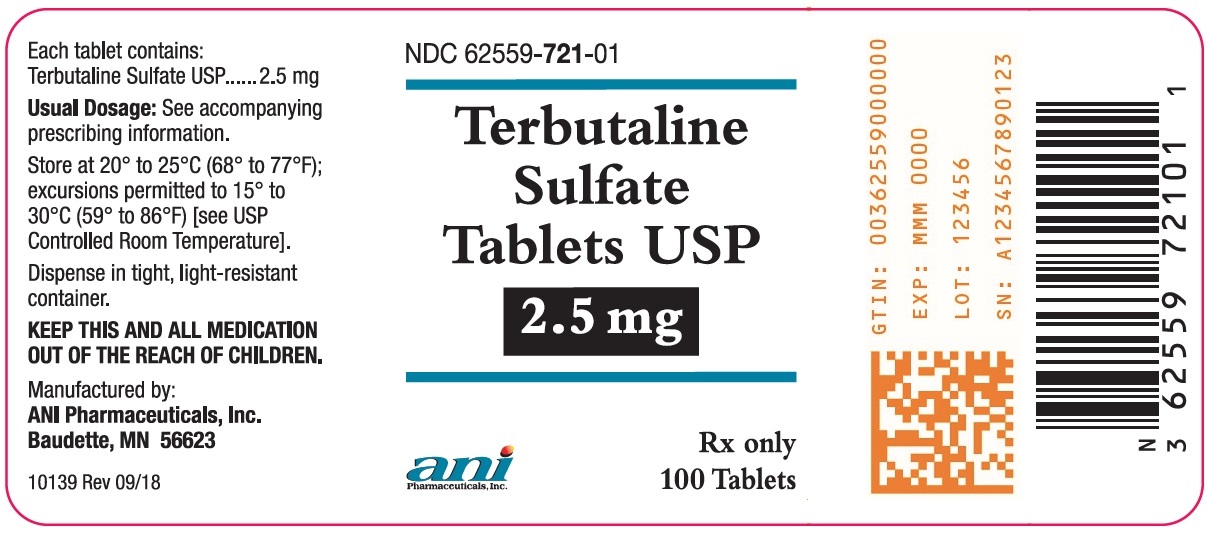
Terbutaline Sulfate 2.5 mg Tablet, 100-count — NDC 62559-721-01 (Billing 62559-0721-01)
This is a package of 100 tablets of Terbutaline Sulfate 2.5 mg Tablet from ANI Pharmaceuticals, Inc., marketed since Oct 2018 and currently FDA-listed; retail pharmacies pay about $0.9468 per tablet (NADAC). It is this product's only package size.
NDC database record
One package, one record: these facts belong to NDC 62559-721-01 alone.
- Record
- FDA NDC Directory package listing · Human prescription drug
- Code segments
- 62559 labeler · 721 product · 01 package
- Package marketed since
- Oct 16, 2018
- Sample package
- No — commercial package
- Listing certified through
- Dec 31, 2026
- Billing quantity
- 100 EA per package
- Barcode (UPC)
- 0362559721011, 0362559722018
- FDA record last changed
- Jul 24, 2026
Identity & classification
Regulatory identifiers FDA, NLM and CMS codes for this package
Drug-database identifiers Medi-Span GPI and First Databank GCN / HICL / AHFS classification
- GSN (GCN sequence number): 005025
- GCN: 20072
- GPI-14 (Medi-Span): 44201060200305
- HICL (First Databank): 002071
- AHFS class code: 12:12.08.12
- RxCUI (RxNorm): 857677
Where does this data come from?
- FDA openFDA NDC Directory · synced Oct 8, 2026
- FDA label on DailyMed · label index refreshed Oct 8, 2026
- RxNorm (NLM RxNav) · catalog refreshed Oct 1, 2026
- Medi-Span GPI (licensed)
- First Databank (licensed) · refreshed Oct 8, 2026
RxNorm drug class
This medicine belongs to the Selective beta-2-adrenoreceptor agonists class.
Where does this data come from?
- RxClass (NLM) · catalog refreshed Oct 1, 2026
Clinical
- Terbutaline is a bronchodilator — it relaxes and opens up the airways in your lungs. It's approved to prevent and relieve bronchospasm (that tight, wheezy feeling when your airways...
- The injection form works quite fast — you can notice an improvement in airflow within about 5 minutes, with a more significant benefit kicking in within 15 minutes. The tablet form...
- The most common things people notice are shakiness (tremor), nervousness, headache, dizziness, and a faster or pounding heartbeat. These are usually temporary and tend to settle do...
- What side effects should I expect — and which ones should make me call my doctor?
Patient education
Supplement & herbal interactions
Terbutaline may be associated with lower levels of 2 nutrients — worth a chat with your pharmacist, not a cause for alarm.
Where does this data come from?
- MedlinePlus (NLM) · refreshed Oct 8, 2026
- FDA label on DailyMed · label index refreshed Oct 8, 2026
Ask a licensed pharmacist directly — free, answered by our team.
Pricing
A drug doesn't have one price. Each row is a different public payment system, and none is what you'd pay at the counter — that depends on your insurance. The ⓘ on each row explains what it measures.
| Price system | Per ea | Per package |
|---|---|---|
| Retail pharmacies payNADAC · weekly | $0.947 | $94.68 / 100 tablets |
| Medicaid paysCMS SDUD · 12 mo | No recent Medicaid claims on file for this NDC — rare and low-volume NDCs are suppressed in the public data. | |
| Medicare drug plans payPart D · Q2 2026 | $1.69 | $168.66 / 100 tablets |
Where does this data come from?
- CMS NADAC weekly file · file of Oct 7, 2026
- CMS ASP pricing files · refreshed Sep 20, 2026
- CMS Medicaid State Drug Utilization Data · refreshed Oct 8, 2026
- CMS Part D plan pricing files · refreshed Sep 24, 2026
- VA National Acquisition Center price file
Packaging — all sizes for this product
| Package NDC | Description | Marketing start | Marketing end | Status |
|---|---|---|---|---|
| 62559-0721-01 You're viewing this Main listing | 100 TABLET in 1 BOTTLE | 2018-10-16 | — | Active |
Therapeutic equivalents
| Product | Labeler | Pack | NADAC/unit | TE | Status | Price vs. this |
|---|---|---|---|---|---|---|
| Terbutaline Sulfate 2.5 mg 00115-2611-01 | Amneal | 100 tablets | $0.947 | AB | Availability likely | — |
| Terbutaline Sulfate 2.5 mg 00527-1318-01 | Lannett | 100 tablets | $0.947 | AB | Availability likely | — |
| Terbutaline Sulfate 2.5 mg 24979-0132-01 | Upsher-Smith | 100 tablets | $0.947 | AB | Availability likely | — |
| Terbutaline Sulfate 2.5 mg 62135-0524-90 | Chartwell | 90 tablets | $0.947 | AB | Availability likely | — |
| Terbutaline Sulfate 2.5 mgthis 62559-0721-01 | ANI | 100 tablets | $0.947 | AB | Availability likely | — |
| Terbutaline Sulfate 2.5 mg 71205-0938-00 | Proficient | 100 tablets | — | AB | FDA listed | — |
Where does this data come from?
- FDA openFDA NDC Directory · synced Oct 8, 2026
- FDA Orange Book · refreshed Oct 3, 2026
- CMS NADAC weekly file · file of Oct 7, 2026
Availability & generic status
FDA-approved generic versions are listed, and recent pricing/market data suggests they may be available — see Therapeutic equivalents.
Where does this data come from?
- FDA Orange Book · refreshed Oct 3, 2026
Inactive Ingredients / Excipients
Inactive ingredients, also called excipients, are components of the drug product other than the active ingredient. They may include fillers, dyes, coatings, preservatives, flavors, or other formulation ingredients.
🧪 Avoiding an ingredient? See Terbutaline inactive ingredients by manufacturer: every current product's list side by side, so you can ask your pharmacy for the version that does not list it.
💡 Tap an ingredient (hover on desktop) to see what it is and why it’s used.
-
UNII EWQ57Q8I5X
Lactose monohydrate is a natural sugar derived from milk. It serves as a filler and binder in tablets and capsules, helping create the proper size, texture, and consistency of the medicine.
-
UNII 70097M6I30
Magnesium stearate is a salt made from magnesium and stearic acid, a fatty substance. It's used in tablets and capsules as a lubricant and glidant to help ingredients flow smoothly during manufacturing and prevent sticking.
-
UNII OP1R32D61U
Microcrystalline cellulose is a purified form of cellulose, a natural fiber from plant sources. It acts as a binder and filler in tablets and capsules, helping hold ingredients together and give the medicine its shape and size.
-
UNII U725QWY32X
Povidone K30 is a synthetic polymer made from petroleum. It acts as a binder to hold tablet ingredients together and as a disintegrant to help the tablet break apart in the stomach so the medicine can be absorbed.
-
UNII O8232NY3SJ
A plant-based carbohydrate derived from corn kernels. It acts as a filler to add bulk, a binder to hold ingredients together, and a disintegrant to help the tablet break apart in your stomach for absorption.
5 inactive ingredients listed in the exact product block matched to this NDC.
Where does this data come from?
ingredient classCode="IACT" elements from the exact product block matched by this NDC. Label-section narrative from DailyMed / the openFDA label index is shown separately when available.- FDA label on DailyMed · label index refreshed Oct 8, 2026
- FDA openFDA NDC Directory · synced Oct 8, 2026
Inactive ingredient FAQ
Are inactive ingredients the same for every manufacturer?
Why might an inactive ingredient be missing?
Can inactive ingredients matter?
Manufacturer & labeler
More NDCs from ANI Pharmaceuticals, Inc. labeler code 62559
- ARIMIDEX Anastrozole 1 mg Tablet NDC 62559-670-30
- CASODEX Bicalutamide 50 mg Tablet NDC 62559-680-30
- Candesartan cilexetil 4 mg Tablet NDC 62559-686-99
- Candesartan cilexetil 8 mg Tablet NDC 62559-687-99
- Candesartan cilexetil 16 mg Tablet NDC 62559-688-99
- Candesartan cilexetil 32 mg Tablet NDC 62559-689-98
- Terbutaline Sulfate 5 mg Tablet NDC 62559-722-01
- Felbamate 400 mg Tablet NDC 62559-730-01
- Felbamate 600 mg Tablet NDC 62559-731-01
- Thyroid 15 mg Tablet NDC 62559-740-01
- Thyroid 30 mg Tablet NDC 62559-741-01
- Thyroid 60 mg Tablet NDC 62559-742-01
Where does this data come from?
- FDA openFDA NDC Directory · synced Oct 8, 2026
- Drugs@FDA
Full prescribing information FDA SPL
🚨 Boxed Warning ▾
WARNING: TOCOYSIS Oral terbutaline sulfate has not been approved for and should not be used for acute or maintenance tocolysis. In particular, terbutaline sulfate should not be used for maintenance tocolysis in the outpatient or home setting. During pregnancy, serious adverse reactions, including death, have been reported after administration of terbutaline sulfate to pregnant women.
In the mother, these adverse reactions include increased heart rate, transient hyperglycemia, hypokalemia, cardiac arrhythmias, pulmonary edema and myocardial ischemia. Increased fetal heart rate and neonatal hypoglycemia may occur as a result of maternal administration. [See Contraindications-Tocolysis ]
🎯 Indications and Usage ▾
INDICATIONS AND USAGE Terbutaline Sulfate Tablets USP are indicated for the prevention and reversal of bronchospasm in patients 12 years of age and older with asthma and reversible bronchospasm associated with bronchitis and emphysema.
⏱️ Dosage and Administration ▾
DOSAGE AND ADMINISTRATION Adults The usual oral dose of terbutaline sulfate tablets for adults is 5 mg administered at approximately six-hour intervals, three times daily, during the hours the patient is usually awake. If side effects are particularly disturbing, the dose may be reduced to 2.5 mg three times daily, and still provide a clinically significant improvement in pulmonary function. The total dose within 24 hours should not exceed 15 mg.
Children Terbutaline sulfate tablets are not recommended for use in children below the age of 12 years. A dosage of 2.5 mg three times daily is recommended for children 12 to 15 years of age. The total dose within 24 hours should not exceed 7.5 mg.
If a previously effective dosage regimen fails to provide the usual relief, medical advice should be sought immediately as this is often a sign of seriously worsening asthma that would require reassessment of therapy.
⛔ Contraindications ▾
CONTRAINDICATIONS 1. Tocolysis Oral terbutaline sulfate is contraindicated for the treatment of acute or maintenance tocolysis [see Boxed Warning: Tocolysis ] . 2. Hypersensitivity Terbutaline sulfate is contraindicated in patients known to be hypersensitive to sympathomimetic amines or any component of this drug product.
⚠️ Warnings ▾
WARNINGS Deterioration of Asthma Asthma may deteriorate acutely over a period of hours or chronically over several days or longer. If the patient needs more doses of terbutaline sulfate tablets than usual, this may be a marker of destabilization of asthma and requires reevaluation of the patient and the treatment regimen, giving special consideration to the possible need for anti-inflammatory treatment, e.g., corticosteroids. Use of Anti-Inflammatory Agents The use of beta-adrenergic agonist bronchodilators alone may not be adequate to control asthma in many patients.
Early consideration should be given to adding anti-inflammatory agents, e.g., corticosteroids. Cardiovascular Effects Terbutaline sulfate, like all other beta-adrenergic agonists, can produce a clinically significant cardiovascular effect in some patients as measured by pulse rate, blood pressure, and/or symptoms. Although such effects are uncommon after administration of terbutaline sulfate tablets at recommended doses, if they occur, the drug may need to be discontinued.
In addition, beta-agonists have been reported to produce electrocardiogram (ECG) changes, such as flattening of the T wave, prolongation of the QTc interval, and ST segment depression. The clinical significance of these findings is unknown. Therefore, terbutaline sulfate tablets, like all sympathomimetic amines, should be used with caution in patients with cardiovascular disorders, especially coronary insufficiency, cardiac arrhythmias, and hypertension.
Seizures There have been rare reports of seizures in patients receiving terbutaline; seizures did not recur in these patients after the drug was discontinued.
🤒 Adverse Reactions ▾
ADVERSE REACTIONS Adverse reactions observed with terbutaline sulfate are similar to those commonly seen with other sympathomimetic amines. All of these reactions are generally transient in nature and usually do not require treatment. The frequency of these side effects appears to diminish with continued therapy.
The following table lists the adverse reactions seen in 199 patients treated with terbutaline sulfate tablets during six double-blind crossover studies and four double-blind parallel studies (short- and long-term) performed in the United States. Percent Incidence of Adverse Reactions (Total Daily Dosage Range 5 to 15 mg) Terbutaline N=199 Reaction % Nervous System Nervousness
35.0 Tremor
15.0 Somnolence
5.5 Dizziness
3.5 Anxiety
1.0 Insomnia
1.5 Cardiovascular Palpitations
5.0 Tachycardia
3.5 Extrasystoles ventricular
1.5 Vasodilations
1.0 Digestive Nausea
3.0 Dry mouth
1.5 Body as a Whole Headache
7.5 Asthenia
2.0 Skin and Appendages Sweating
1.0The following adverse reactions each occurred in fewer than 1% of patients: hallucinations, rash, paresthesia, hypertonia, (muscle cramps), vomiting. There have been rare reports of elevations in liver enzymes and of hypersensitivity vasculitis. To report SUSPECTED ADVERSE REACTIONS, contact ANI Pharmaceuticals, Inc. at 1-800-308-6755 or FDA at 1-800-FDA-1088 or www.fda.gov/medwatch.
🔄 Drug Interactions ▾
Drug Interactions The concomitant use of terbutaline sulfate tablets with other sympathomimetic agents is not recommended, since the combined effect on the cardiovascular system may be deleterious to the patient. However, this does not preclude the use of an aerosol bronchodilator of the adrenergic-stimulant type for the relief of an acute bronchospasm in patients receiving chronic oral therapy with terbutaline sulfate tablets.
🧒 Pediatric Use ▾
Pediatric Use Terbutaline sulfate tablets are not recommended for patients under the age of 12 years because of insufficient clinical data to establish safety and effectiveness [see Dosage and Administration ] .
🧓 Geriatric Use ▾
Geriatric Use Clinical studies of terbutaline sulfate did not include sufficient numbers of subjects aged 65 and over to determine whether they respond differently from younger subjects. Other reported clinical experience has not identified differences in responses between the elderly and younger patients. In general, dose selection for an elderly patient should be cautious, usually starting at the low end of the dosing range, reflecting the greater frequency of decreased hepatic, renal, or cardiac function, and of concomitant disease or other drug therapy.
🆘 Overdosage ▾
OVERDOSAGE The median subcutaneous lethal dose of terbutaline sulfate in mature rats is approximately 165 mg/kg (approximately 90 times the maximum recommended daily oral dose for adults on a mg/m 2 basis). The median subcutaneous lethal dose of terbutaline sulfate in young rats is approximately 2000 mg/kg (approximately 1100 times the maximum recommended daily oral dose for adults on a mg/m2 basis). The expected symptoms with overdosage are those of excessive beta-adrenergic stimulation and/or occurrence or exaggeration of any of the symptoms listed under ADVERSE REACTIONS, e.g., seizures, angina, hypertension or hypotension, tachycardia with rates up to 200 beats per minute, arrhythmias, nervousness, headache, tremor, dry mouth, palpitation, nausea, dizziness, fatigue, malaise, and insomnia.
Hypokalemia may also occur. There is no specific antidote. Treatment consists of discontinuation of terbutaline sulfate tablets together with appropriate symptomatic therapy.
The judicious use of a cardioselective beta-receptor blocker may be considered, bearing in mind that such medication can produce bronchospasm. There is insufficient evidence to determine if dialysis is beneficial for overdosage of terbutaline sulfate. In the alert patient who has taken excessive oral medication, the stomach should be emptied by induced emesis followed by lavage.
In the unconscious patient, the airway should be secured with a cuffed endotracheal tube before lavage, and emesis should not be induced. Instillation of activated charcoal slurry may help reduce absorption of terbutaline. Adequate respiratory exchange should be maintained, and cardiac and respiratory support provided as needed.
The patient should be monitored until signs and symptoms of overdosage have subsided.
🧬 Clinical Pharmacology ▾
CLINICAL PHARMACOLOGY In vitro and in vivo pharmacologic studies have demonstrated that terbutaline exerts a preferential effect on beta 2 -adrenergic receptors. While it is recognized that beta 2 -adrenergic receptors are the predominant receptors in bronchial smooth muscle, data indicate that there is a population of beta 2 -receptors in the human heart, existing in a concentration between 10% to 50%. The precise function of these receptors has not been established [see Warnings ] .
In controlled clinical studies in patients given terbutaline sulfate orally, proportionally greater changes occurred in pulmonary function parameters than in heart rate or blood pressure. While this suggests a relative preference for the beta 2 -receptors in man, the usual cardiovascular effects commonly associated with other sympathomimetic agents were also observed with terbutaline sulfate. The pharmacologic effects of beta-adrenergic agonists, including terbutaline, are at least in part attributable to stimulation through beta-adrenergic receptors of intracellular adenyl cyclase, the enzyme which catalyzes the conversion of adenosine triphosphate (ATP) to cyclic 3', 5'-adenosine monophosphate (cAMP).
Increased cAMP levels are associated with relaxation of bronchial smooth muscle and inhibition of release of mediators of immediate hypersensitivity from cells, especially from mast cells. Controlled clinical studies have shown that terbutaline sulfate relieves bronchospasm in chronic obstructive pulmonary disease by significantly increasing pulmonary function (e.g., an increase of 15% or more in FEV 1 and in FEF 25%-75% ). After administration of terbutaline sulfate tablets, a measurable change in flow rate usually occurs within 30 minutes, and a clinically significant improvement in pulmonary function occurs within 60 to 120 minutes.
The maximum effect usually occurs within 120 to 180 minutes. Terbutaline sulfate also produces a clinically significant decrease in airway and pulmonary resistance, which persists for 4 hours or longer. Significant bronchodilator action (as measured by airway resistance, FEF 25%-75% or PEFR) has also been demonstrated for up to 8 hours in some studies.
In studies comparing the effectiveness of terbutaline sulfate with that of ephedrine for up to 3 months, both drugs maintained a significant improvement in pulmonary function throughout this period of treatment. Preclinical Studies in laboratory animals (minipigs, rodents, and dogs) have demonstrated the occurrence of cardiac arrhythmias and sudden death (with histologic evidence of myocardial necrosis) when beta-agonists and methylxanthines were administered concurrently. The clinical significance of these findings is unknown.
Pharmacokinetics Oral administration of 5 mg terbutaline sulfate tablets or 5 mg terbutaline sulfate in solution in 17 healthy, adult, male subjects, resulted in mean (SD) peak plasma terbutaline concentration of 8.3 (3.9) and 8.6 (3.6) ng/mL, which were observed at median (range) times of 2 (1 to 3) and 1.5 (0.5 to 3.0) hours after dosing. The mean (SD) AUC (0 to 48) values were 54.6 (26.8) and 53.1 (23.5) hr•ng/mL, and corresponded to a bioavailability of 103% for the tablet relative to the solution. After oral administration of terbutaline, 51 to 62 mcg/kg of body weight, to 3 healthy male subjects, peak serum levels of 3.1 to 6.2 ng/mL were observed 1 to 3 hours later.
In the same study, after 3 days only 30% to 50% of the dose was recovered from urine and the remainder from the feces, which may indicate poor absorption. After an oral dose to asthmatic patients, the elimination half-life of terbutaline was approximately 3.4 hours. In comparison to oral dosing, subcutaneous administration of 0.5 mg of terbutaline sulfate to 17 healthy, adult, male subjects resulted in a mean (SD) peak plasma terbutaline concentration of 9.6 (3.6) ng/mL, which was observed at a median (range) time of 0.5 (0.08 to 1.0) hours after dosing.
The mean (SD) AUC (0… [Excerpted — this section continues on DailyMed.]
📦 How Supplied / Storage and Handling ▾
HOW SUPPLIED Terbutaline Sulfate Tablets USP are available as: 2.5 mg: White to faintly yellow, oval, biconvex tablets debossed with ‘ANI’ and ‘721’ on one side and bisected on the reverse side. They are packaged in high density polyethylene (HDPE) bottles of 100 tablets (NDC 62559-721-01). 5 mg: White to faintly yellow, round, biconvex tablets debossed with ‘ANI’ and ‘722’ on one side and bisected on the reverse side.
They are packaged in high density polyethylene (HDPE) bottles of 100 tablets (NDC 62559-722-01). Store at 20° to 25°C (68° to 77°F); excursions permitted to 15° to 30°C (59° to 86°F) [see USP Controlled Room Temperature]. Dispense in tight, light-resistant container (as defined in the USP).
Manufactured by: ANI Pharmaceuticals, Inc. Baudette, MN 56623 10141 Rev 09/18 ani.jpg
📋 Description ▾
DESCRIPTION Terbutaline sulfate USP, the active ingredient of Terbutaline Sulfate Tablets USP, is a beta-adrenergic agonist bronchodilator available as tablets of 2.5 mg (2.05 mg of the free base) and 5 mg (4.1 mg of the free base) for oral administration. Terbutaline sulfate is ±-α-[( tert -butylamino)methyl]-3,5-dihydroxybenzyl alcohol sulfate (2:1) (salt). The empirical formula is (C 12 H 19 NO 3 ) 2 • H 2 SO 4 and the structural formula is: Terbutaline sulfate USP is a white to gray-white crystalline powder.
It is odorless or has a faint odor of acetic acid. It is soluble in water and in 0.1N hydrochloric acid, slightly soluble in methanol, and insoluble in chloroform. Its molecular weight is 548.65.
Inactive Ingredients: Microcrystalline cellulose, lactose monohydrate, magnesium stearate, povidone, and corn starch. WARNING: TOCOYSIS Oral terbutaline sulfate has not been approved for and should not be used for acute or maintenance tocolysis. In particular, terbutaline sulfate should not be used for maintenance tocolysis in the outpatient or home setting.
During pregnancy, serious adverse reactions, including death, have been reported after administration of terbutaline sulfate to pregnant women. In the mother, these adverse reactions include increased heart rate, transient hyperglycemia, hypokalemia, cardiac arrhythmias, pulmonary edema and myocardial ischemia. Increased fetal heart rate and neonatal hypoglycemia may occur as a result of maternal administration. [See Contraindications-Tocolysis ] structure
💬 Information for Patients ▾
Information for Patients The action of terbutaline sulfate tablets should last up to 6 hours or longer. Terbutaline sulfate tablets should not be used more frequently than recommended. Do not increase the dose or frequency of terbutaline sulfate tablets without consulting your physician.
If you find that treatment with terbutaline sulfate tablets becomes less effective for symptomatic relief, your symptoms become worse, and/or you need to use the product more frequently than usual, you should seek medical attention immediately. While taking terbutaline sulfate tablets, other inhaled drugs and asthma medications should be taken only as directed by your physician. Common adverse effects include palpitations, chest pain, rapid heart rate, tremor or nervousness.
If you are pregnant or nursing, contact your physician about use of terbutaline sulfate tablets. Effective and safe use of terbutaline sulfate tablets includes an understanding of the way that it should be administered.
⚠️ Precautions ▾
PRECAUTIONS General Terbutaline, as with all sympathomimetic amines, should be used with caution in patients with cardiovascular disorders, including ischemic heart disease, hypertension, and cardiac arrhythmias; hyperthyroidism; diabetes mellitus; hypersensitivity to sympathomimetic amines; and convulsive disorders. Significant changes in systolic and diastolic blood pressure have been seen and could be expected to occur in some patients after use of any beta-adrenergic bronchodilator. Immediate hypersensitivity reactions and exacerbation of bronchospasm have been reported after terbutaline administration.
Beta-adrenergic agonist medications may produce significant hypokalemia in some patients, possibly through intracellular shunting, which has the potential to produce adverse cardiovascular effects. The decrease is usually transient, not requiring supplementation. Large doses of intravenous terbutaline sulfate have been reported to aggravate preexisting diabetes and ketoacidosis.
Information for Patients The action of terbutaline sulfate tablets should last up to 6 hours or longer. Terbutaline sulfate tablets should not be used more frequently than recommended. Do not increase the dose or frequency of terbutaline sulfate tablets without consulting your physician.
If you find that treatment with terbutaline sulfate tablets becomes less effective for symptomatic relief, your symptoms become worse, and/or you need to use the product more frequently than usual, you should seek medical attention immediately. While taking terbutaline sulfate tablets, other inhaled drugs and asthma medications should be taken only as directed by your physician. Common adverse effects include palpitations, chest pain, rapid heart rate, tremor or nervousness.
If you are pregnant or nursing, contact your physician about use of terbutaline sulfate tablets. Effective and safe use of terbutaline sulfate tablets includes an understanding of the way that it should be administered. Drug Interactions The concomitant use of terbutaline sulfate tablets with other sympathomimetic agents is not recommended, since the combined effect on the cardiovascular system may be deleterious to the patient.
However, this does not preclude the use of an aerosol bronchodilator of the adrenergic-stimulant type for the relief of an acute bronchospasm in patients receiving chronic oral therapy with terbutaline sulfate tablets. Monoamine Oxidase Inhibitors and Tricyclic Antidepressants Terbutaline sulfate should be administered with extreme caution to patients being treated with monoamine oxidase inhibitors or tricyclic antidepressants, or within 2 weeks of discontinuation of such agents, since the action of terbutaline sulfate on the vascular system may be potentiated.
Beta-Blockers Beta-adrenergic receptor blocking agents not only block the pulmonary effect of beta-agonists, such as terbutaline sulfate, but may produce severe bronchospasm in asthmatic patients. Therefore, patients with asthma should not normally be treated with beta-blockers. However, under certain circumstances, e.g., as prophylaxis after myocardial infarction, there may be no acceptable alternatives to the use of beta-adrenergic blocking agents in patients with asthma.
In this setting, cardioselective beta-blockers could be considered, although they should be administered with caution. Diuretics The ECG changes and/or hypokalemia that may result from the administration of non-potassium sparing diuretics (such as loop or thiazide diuretics) can be acutely worsened by beta-agonists, especially when the recommended dose of the beta-agonist is exceeded. Although the clinical significance of these effects is not known, caution is advised in the co-administration of beta-agonists with non-potassium sparing diuretics.
Carcinogenesis, Mutagenesis, and Impairment of Fertility In a 2-year study in Sprague-Dawley rats, terbutaline sulfate caused a significant and dose-related increase in the incidence of benign leiomyom… [Excerpted — this section continues on DailyMed.]
🍼 Nursing Mothers ▾
Nursing Mothers It is not known whether this drug is excreted in human milk. Therefore, terbutaline sulfate tablets should be used during nursing only if the potential benefit justifies the possible risk to the newborn.
🧬 Pharmacokinetics ▾
Pharmacokinetics Oral administration of 5 mg terbutaline sulfate tablets or 5 mg terbutaline sulfate in solution in 17 healthy, adult, male subjects, resulted in mean (SD) peak plasma terbutaline concentration of 8.3 (3.9) and 8.6 (3.6) ng/mL, which were observed at median (range) times of 2 (1 to 3) and 1.5 (0.5 to 3.0) hours after dosing. The mean (SD) AUC (0 to 48) values were 54.6 (26.8) and 53.1 (23.5) hr•ng/mL, and corresponded to a bioavailability of 103% for the tablet relative to the solution. After oral administration of terbutaline, 51 to 62 mcg/kg of body weight, to 3 healthy male subjects, peak serum levels of 3.1 to 6.2 ng/mL were observed 1 to 3 hours later.
In the same study, after 3 days only 30% to 50% of the dose was recovered from urine and the remainder from the feces, which may indicate poor absorption. After an oral dose to asthmatic patients, the elimination half-life of terbutaline was approximately 3.4 hours. In comparison to oral dosing, subcutaneous administration of 0.5 mg of terbutaline sulfate to 17 healthy, adult, male subjects resulted in a mean (SD) peak plasma terbutaline concentration of 9.6 (3.6) ng/mL, which was observed at a median (range) time of 0.5 (0.08 to 1.0) hours after dosing.
The mean (SD) AUC (0 to 48) and total body clearance values were 29.4 (14.2) hr•ng/mL, and 311 (112) mL/min, respectively. The terminal half-life was determined in 9 of the 17 subjects and had a mean (SD) of 5.7 (2.0) hours. About 90% of the drug was excreted in the urine at 96 hours after subcutaneous administration, with about 60% of this being unchanged drug.
The sulfate conjugate is a major metabolite of terbutaline, and urinary excretion is the primary route of elimination. There are no reports of any clinical pharmacokinetic studies investigating dose proportionality, effect of food, or special population studies with terbutaline.
📄 Carcinogenesis, Mutagenesis, Impairment of Fertility ▾
Carcinogenesis, Mutagenesis, and Impairment of Fertility In a 2-year study in Sprague-Dawley rats, terbutaline sulfate caused a significant and dose-related increase in the incidence of benign leiomyomas of the mesovarium at dietary doses of 50 mg/kg, and above (approximately 25 times the maximum recommended daily oral dose for adults on a mg/m 2 basis). In a 21-month study in CD-1 mice, terbutaline sulfate showed no evidence of tumorigenicity at dietary doses up to 200 mg/kg (approximately 55 times the maximum recommended daily oral dose for adults on a mg/m 2 basis).
The mutagenicity potential of terbutaline sulfate has not been determined. Reproduction studies in rats using terbutaline sulfate demonstrated no impairment of fertility at oral doses up to 50 mg/kg (approximately 25 times the maximum recommended daily oral dose for adults on a mg/m 2 basis).
📄 Package Label / Principal Display Panel ▾
PACKAGE/LABEL PRINCIPAL DISPLAY PANEL Terbutaline Sulfate Tablets USP 2.5 mg NDC 62559-721-01 Rx only 100 Tablets Label-2_5mg
PACKAGE/LABEL PRINCIPAL DISPLAY PANEL Terbutaline Sulfate Tablets USP 5 mg NDC 62559-722-01 Rx only 100 Tablets Label-5mg