
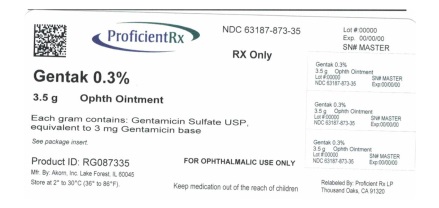
Gentak Gentamicin Sulfate 3 mg/g Ointment, 1 tube
🆔 Identity & classification
Where does this data come from?
🏷️ RxNorm drug class
This medicine belongs to the Aminoglycoside Antibacterial class.
Where does this data come from?
🏭 Manufacturer & labeler
Where does this data come from?
🩺 Clinical
Ophthalmic gentamicin is used to treat certain eye infections. Gentamicin is in a class of medications called antibiotics. It works by killing the bacteria that cause infection.
Read the full MedlinePlus article ↗- Gentamicin topical is used for a wide range of bacterial skin infections. That includes common ones like impetigo, boils, infected eczema, infected cuts or scrapes, pustular acne,...
- What kinds of skin infections does gentamicin topical actually treat?
- It depends on the type of skin involved. The cream is better for wet, oozy infections or greasy conditions like infected seborrheic dermatitis or pustular acne — and it's also easi...
- Apply a small amount to the affected area three to four times a day. You can cover it with a gauze dressing afterward if you'd like. If you're treating impetigo, gently remove any...
Patient education
Supplement & herbal interactions
Gentamicin (IV) may be associated with lower levels of 8 nutrients — worth a chat with your pharmacist, not a cause for alarm.
Where does this data come from?
Ask a licensed pharmacist directly — free, answered by our team.
🧪 Inactive Ingredients / Excipients
Inactive ingredients, also called excipients, are components of the drug product other than the active ingredient. They may include fillers, dyes, coatings, preservatives, flavors, or other formulation ingredients.
💡 Tap an ingredient (hover on desktop) to see what it is and why it’s used.
-
0.5 mg / 1 g
UNII A2I8C7HI9T
Methylparaben is a preservative derived from benzoic acid that prevents growth of bacteria, fungi, and mold in medicines. It extends the product's shelf life and maintains safety during storage.
-
UNII T5L8T28FGP
Mineral oil is a clear, odorless liquid derived from crude oil. It acts as a lubricant and emollient in medications, helping pills slide smoothly during manufacturing and aiding moisture retention in topical products.
-
UNII 4T6H12BN9U
Petrolatum is a purified mineral oil-based jelly derived from petroleum. In medicines, it acts as an emollient, lubricant, and moisture barrier to soften skin, reduce friction, and help prevent water loss from formulations.
-
0.1 mg / 1 g
UNII Z8IX2SC1OH
Propylparaben is a chemical preservative used to prevent bacterial and fungal growth in medicines and personal care products. It helps extend shelf life and maintain product safety during storage.
4 inactive ingredients listed in the exact product block matched to this NDC.
Where does this data come from?
ingredient classCode="IACT" elements from the exact product block matched by this NDC. Label-section narrative from DailyMed / the openFDA label index is shown separately when available.Inactive ingredient FAQ
Are inactive ingredients the same for every manufacturer?
Why might an inactive ingredient be missing?
Can inactive ingredients matter?
💲 Pricing
A drug doesn't have one price. Each row is a different public payment system, and none is what you'd pay at the counter — that depends on your insurance. The ⓘ on each row explains what it measures.
| Price system | Per g | Per package |
|---|---|---|
| Retail pharmacies payNADAC · weekly | Not in the retail survey — common for institutional, discontinued, or low-volume packs. | |
| Medicaid paysCMS SDUD · 12 mo | No recent Medicaid claims on file for this NDC — rare and low-volume NDCs are suppressed in the public data. | |
| Medicare drug plans payPart D · quarterly | No Part D plan price is available for this NDC in our data. | |
Where does this data come from?
🔁 Therapeutic equivalents
| Product | Labeler | Pack | NADAC/unit | TE | Status | Price vs. this |
|---|---|---|---|---|---|---|
| Gentak 3 mg/gthis 63187-0873-35 | Proficient | 1 tube | — | — | FDA listed | — |
Where does this data come from?
⏳ Availability & generic status
This product is an FDA-approved generic. Other versions of the same drug are listed under Therapeutic equivalents, least expensive first.
Where does this data come from?
📊 Medicare Part D spend CMS · PART D · 2026 (Q1)
📦 Packaging — all sizes for this product
| Package NDC | Description | Marketing start | Status |
|---|---|---|---|
| 63187-0873-35 You're viewing this | 1 TUBE in 1 CARTON (63187-873-35) / 3.5 g in 1 TUBE | 2017-07-03 | Active |
🧭 About this NDC listing & data coverage
What data is (and isn’t) available for this NDC — tap to expand
| NDC identity (package / product / labeler codes) | ✓ Available |
| Labeler | ✓ Available |
| Product & package description | ✓ Available |
| Marketing category & status | ✓ Available |
| Active ingredient / dosage form / route | ✓ Available |
| FDA label (SPL via DailyMed) | ✓ Available |
| Package photos | ✓ Available |
| Inactive ingredients (structured) | ✓ Available |
| NADAC pharmacy acquisition price (CMS) | — Not published for this NDC CMS publishes NADAC only for NDCs reported in its retail-pharmacy survey. |
| Orange Book / therapeutic-equivalence data | — Not published for this NDC Applies only to products approved under an NDA/ANDA; many listings are out of scope. |
| HCPCS J-code billing crosswalk | — Not published for this NDC Most self-administered / retail products have no J-code — that is normal. |
| Medicaid utilization (CMS SDUD) | — Not published for this NDC CMS reports utilization only for NDCs with Medicaid claims above its privacy threshold. |
Questions about this listing
Why is there no price listed?
Is the NDC printed on the package the same as the 11-digit billing NDC?
What do the three segments of this NDC mean?
Is this package still being marketed?
Who lists this product with the FDA?
Do I need a prescription for this product?
Where does this data come from?
📄 Full prescribing information FDA SPL
🎯 Indications and Usage ▾
INDICATIONS AND USAGE Gentamicin sulfate ophthalmic ointment is indicated in the topical treatment of ocular bacterial infections including conjunctivitis, keratitis, keratoconjunctivitis, corneal ulcers, blepharitis, blepharonconjunctivitis: acute meibomianitis, and dacryocystitis, caused by susceptible strains of the following microorganisms: Staphylococcus aureus, Staphylococcus epidermidis, Streptococcus pyogenes, Streptococcus pneumoniae, Enterobacter aerogenes, Escherichia coli, Haemophilus influenzae, Klebsiella pneumoniae, Neisseria gonorrhoeae, Pseudomonas aeruginosa, and Serratia marcescens.
⏱️ Dosage and Administration ▾
DOSAGE AND ADMINISTRATION Apply a small amount (approximately 1/2 inch ribbon) of ointment to the affected eye(s) two or three times a day.
⛔ Contraindications ▾
CONTRAINDICATIONS Gentamicin sulfate ophthalmic ointment is con-traindicated in patients with known hypersensitivity to any of the components.
⚠️ Warnings ▾
WARNINGS NOT FOR INJECTION INTO THE EYE. Gentamicin sulfate ophthalmic ointment is not for injection. It should never be injected subconjunctivally, nor should it be directly introduced into the anterior chamber of the eye.
🤒 Adverse Reactions ▾
ADVERSE REACTIONS Bacterial and fungal corneal ulcers have developed during treatment with gentamicin ophthalmic preparations. The most frequently reported adverse reactions are ocular burning and irritation upon drug instillation, non-specific conjunctivitis, conjunctival epithelial defects and conjunctival hyperemia. Other adverse reactions which have occurred rarely are allergic reactions, thrombocytopenic purpura and hallucinations.
🤰 Pregnancy ▾
Pregnancy: Pregnancy Category C. Gentamicin has been shown to depress body weights, kidney weights and median glomerular counts in newborn rats when administered systemically to pregnant rats in daily doses approximately 500 times the maximum recommended ophthalmic human dose. There are no adequate and well-controlled studies in pregnant women.
Gentamicin should be used during pregnancy only if the potential benefit justifies the potential risk to the fetus.
🧒 Pediatric Use ▾
Pediatric Use: Safety and effectiveness in neonates have not been established.
🧬 Clinical Pharmacology ▾
CLINICAL PHARMACOLOGY Microbiology: Gentamicin sulfate is active in vitro against many strains of the following microorganisms: Staphylococcus aureus, Staphylococcus epidermidis, Streptococcus pyogenes, Streptococcus pneumoniae, Enterobacter aerogenes, Escherichia coli, Haemophilus influenzae, Klebsiella pneumoniae, Neisseria gonorrhoeae, Pseudomonas aeruginosa, and Serratia marcescens.
📦 How Supplied / Storage and Handling ▾
HOW SUPPLIED GENTAK ® Gentamicin sulfate ophthalmic ointment USP, 0.3% is supplied in 3.5 g tube, box of one. (NDC 63187-873-35) STORAGE: Store at 2° to 30°C (36° to 86°F). Akorn Manufactured by: Akorn, Inc. Lake Forest, IL 60045 Relabeled by: Proficient Rx LP. Thousand Oaks, CA 91320 GKO00N Rev. 09/08
📦 Storage and Handling ▾
STORAGE: Store at 2° to 30°C (36° to 86°F). Akorn Manufactured by: Akorn, Inc. Lake Forest, IL 60045 Relabeled by: Proficient Rx LP. Thousand Oaks, CA 91320 GKO00N Rev. 09/08
📋 Description ▾
DESCRIPTION GENTAK ® Gentamicin sulfate is a water soluble antibiotic of the aminoglycoside group. Gentamicin sulfate ophthalmic ointment is a sterile ointment for ophthalmic use. Each gram contains gentamicin sulfate equivalent to 3 mg gentamicin in a base of white petrolatum and mineral oil, with methylparaben and propylparaben as preservatives.
Gentamicin is obtained from cultures of Micromonospora purpurea. It is a mixture of the sulfate salts of gentamicin C 1 C 2 , and C 1A . All three components appear to have similar antimicrobial activities.
Gentamicin sulfate occurs as a white to buff powder and is soluble in water and insoluble in alcohol. The structural formula is as follows: Figure
💬 Information for Patients ▾
Information for patients: To avoid contamination, do not touch tip of container to the eye, eyelid or any surface.