
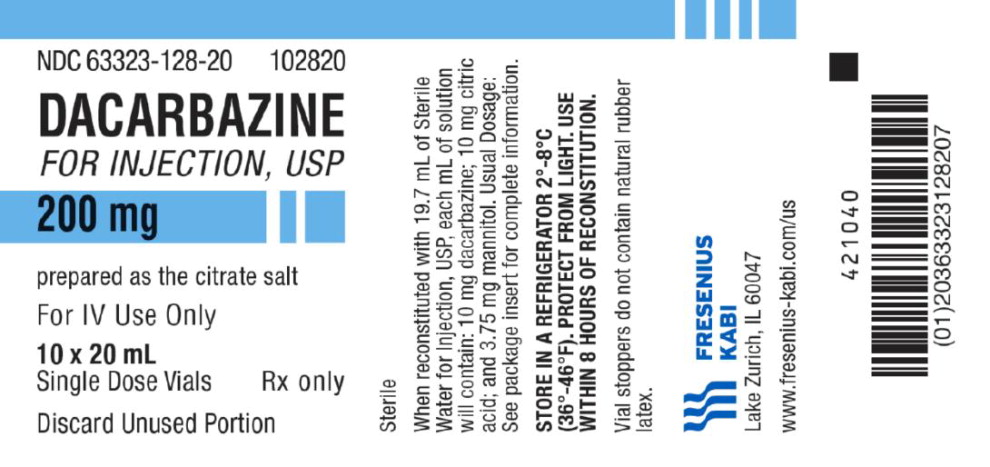
Dacarbazine 10 mg/mL Injection, Powder, For Solution
🆔 Identity & classification
Where does this data come from?
🏷️ RxNorm drug class
This medicine belongs to the Alkylating Drug class.
Where does this data come from?
🏭 Manufacturer & labeler
Where does this data come from?
🩺 Clinical
Dacarbazine is used to treat melanoma (a type of skin cancer) that has spread to other parts of your body. Dacarbazine is also used in combination with other medications to treat Hodgkin's lymphoma (Hodgkin's disease; a type of cancer that begins in a type of white blood cells that normally fights infection). Dacarbazine is in a class of medications known as purine analogs. It works by slowing or stopping the growth of cancer cells in your body.
Read the full MedlinePlus article ↗- Dacarbazine is a chemotherapy drug used for two types of cancer. It's approved to treat metastatic malignant melanoma — that's an advanced skin cancer that has spread to other area...
- No, you won't take this one at home. Dacarbazine is given as an IV infusion — directly into a vein — by trained healthcare professionals in a clinic or hospital. Treatment is given...
- How is dacarbazine given — do I take it at home?
- Nausea and vomiting are very common, especially in the first couple of doses — more than 90% of people experience this. The good news is it usually gets better after the first day...
Patient education
Supplement & herbal interactions
Some supplements/herbs that may interact with Dacarbazine — tap one for details:
Dacarbazine may be associated with lower levels of 1 nutrient — worth a chat with your pharmacist, not a cause for alarm.
Where does this data come from?
Ask a licensed pharmacist directly — free, answered by our team.
🧪 Inactive Ingredients / Excipients
Inactive ingredients, also called excipients, are components of the drug product other than the active ingredient. They may include fillers, dyes, coatings, preservatives, flavors, or other formulation ingredients.
💡 Tap an ingredient (hover on desktop) to see what it is and why it’s used.
-
10 mg / 1 mL
UNII 2968PHW8QP
A weak organic acid derived from citrus fruits or made through fermentation. It works as a buffer to control pH, a preservative to extend shelf life, and a flavoring agent in medications.
-
3.75 mg / 1 mL
UNII 3OWL53L36A
A natural sugar alcohol derived from seaweed or synthesized in the lab. It's used as a filler to add bulk, a sweetener in sugar-free formulas, and a disintegrant to help tablets break apart in the stomach.
2 inactive ingredients listed in the exact product block matched to this NDC.
Where does this data come from?
ingredient classCode="IACT" elements from the exact product block matched by this NDC. Label-section narrative from DailyMed / the openFDA label index is shown separately when available.Inactive ingredient FAQ
Are inactive ingredients the same for every manufacturer?
Why might an inactive ingredient be missing?
Can inactive ingredients matter?
💲 Pricing
A drug doesn't have one price. Each row is a different public payment system, and none is what you'd pay at the counter — that depends on your insurance. The ⓘ on each row explains what it measures.
| Price system | Per mL | Per package |
|---|---|---|
| Retail pharmacies payNADAC · weekly | Not in the retail survey — common for institutional, discontinued, or low-volume packs. | |
| Medicaid paysCMS SDUD · 12 mo | $10.88 | $2,175.92 / 200 ml |
| Medicare drug plans payPart D · quarterly | No Part D plan price is available for this NDC in our data. | |
| Medicare Part B allowsASP · J9130 | $3.463 / J9130 unit | — |
Where does this data come from?
🧾 Billing & reimbursement
Where does this data come from?
🔁 Therapeutic equivalents
| Product | Labeler | Pack | NADAC/unit | TE | Status | Price vs. this |
|---|---|---|---|---|---|---|
| Dacarbazine 200 mg 00143-9245-10 | Hikma | 10 vials | — | AP | FDA listed | — |
| Dacarbazine 10 mg/mLthis 63323-0128-20 | Fresenius | 10 vials | — | — | FDA listed | — |
| Dacarbazine 200 mg/20mL 71288-0174-21 | Meitheal | 10 vials | — | AP | FDA listed | — |
| Dacarbazine 10 mg/mL 63323-0127-10 | Fresenius | 10 vials | — | — | FDA listed | — |
Where does this data come from?
⏳ Availability & generic status
This product is an FDA-approved generic. Other versions of the same drug are listed under Therapeutic equivalents, least expensive first.
Where does this data come from?
🗺️ Medicaid utilization & spend
📊 Medicare Part D spend CMS · PART D · 2026 (Q1)
🔬 Reported adverse events (FAERS)
Top reported reactions
Reporter sex
Serious outcomes
Where does this data come from?
📦 Packaging — all sizes for this product
| Package NDC | Description | Marketing start | Status |
|---|---|---|---|
| 63323-0128-20 You're viewing this | 10 VIAL, SINGLE-DOSE in 1 TRAY (63323-128-20) / 20 mL in 1 VIAL, SINGLE-DOSE (63323-128-00) | 2001-09-07 | Active |
🧭 About this NDC listing & data coverage
What data is (and isn’t) available for this NDC — tap to expand
| NDC identity (package / product / labeler codes) | ✓ Available |
| Labeler | ✓ Available |
| Product & package description | ✓ Available |
| Marketing category & status | ✓ Available |
| Active ingredient / dosage form / route | ✓ Available |
| FDA label (SPL via DailyMed) | ✓ Available |
| Package photos | ✓ Available |
| Inactive ingredients (structured) | ✓ Available |
| NADAC pharmacy acquisition price (CMS) | — Not published for this NDC CMS publishes NADAC only for NDCs reported in its retail-pharmacy survey. |
| Orange Book / therapeutic-equivalence data | — Not published for this NDC Applies only to products approved under an NDA/ANDA; many listings are out of scope. |
| HCPCS J-code billing crosswalk | ✓ Available |
| Medicaid utilization (CMS SDUD) | ✓ Available |
Questions about this listing
Why is there no price listed?
Is the NDC printed on the package the same as the 11-digit billing NDC?
What do the three segments of this NDC mean?
Is this package still being marketed?
Who lists this product with the FDA?
Do I need a prescription for this product?
Does this product have a billing J-code?
Where does this data come from?
📄 Full prescribing information FDA SPL
🚨 Boxed Warning ▾
WARNING It is recommended that dacarbazine be administered under the supervision of a qualified physician experienced in the use of cancer chemotherapeutic agents. 1. Hemopoietic depression is the most common toxicity with dacarbazine (see WARNINGS ).
2. Hepatic necrosis has been reported (see WARNINGS ). 3.
Studies have demonstrated this agent to have a carcinogenic and teratogenic effect when used in animals. 4. In treatment of each patient, the physician must weigh carefully the possibility of achieving therapeutic benefit against the risk of toxicity.
🎯 Indications and Usage ▾
INDICATIONS AND USAGE Dacarbazine for Injection is indicated in the treatment of metastatic malignant melanoma. In addition, Dacarbazine for Injection is also indicated for Hodgkin’s disease as a second-line therapy when used in combination with other effective agents.
⏱️ Dosage and Administration ▾
DOSAGE AND ADMINISTRATION Malignant Melanoma The recommended dosage is 2 to 4.5 mg/kg/day for 10 days. Treatment may be repeated at 4 week intervals. 2 An alternate recommended dosage is 250 mg/square meter body surface/day I.V. for 5 days.
Treatment may be repeated every 3 weeks. 3,4 Hodgkin's Disease The recommended dosage of Dacarbazine for Injection, USP in the treatment of Hodgkin’s disease is 150 mg/square meter body surface/day for 5 days, in combination with other effective drugs. Treatment may be repeated every 4 weeks.
5 An alternative recommended dosage is 375 mg/square meter body surface on day 1, in combination with other effective drugs, to be repeated every 15 days. 6 Dacarbazine for Injection, USP 100 mg/vial and 200 mg/vial are reconstituted with 9.9 mL and 19.7 mL, respectively, of Sterile Water for Injection, USP. The resulting solution contains 10 mg/mL of dacarbazine having a pH of 3.0 to 4.0.
The calculated dose of the resulting solution is drawn into a syringe and administered only intravenously. The reconstituted solution may be further diluted with 5% Dextrose Injection or Sodium Chloride Injection and administered as an intravenous infusion. After reconstitution and prior to use, the solution in the vial may be stored at 4°C for up to 72 hours or at normal room conditions (temperature and light) for up to 8 hours.
If the reconstituted solution is further diluted in 5% Dextrose Injection or Sodium Chloride Injection, the resulting solution may be stored at 4°C for up to 24 hours or at normal room conditions for up to 8 hours. Procedures for proper handling and disposal of anticancer drugs should be considered. Several guidelines on this subject have been published.
7-13 There is no general agreement that all of the procedures recommended in the guidelines are necessary or appropriate. Parenteral drug products should be inspected visually for particulate matter and discoloration prior to administration, whenever solution and container permit.
Malignant Melanoma The recommended dosage is 2 to 4.5 mg/kg/day for 10 days. Treatment may be repeated at 4 week intervals. 2 An alternate recommended dosage is 250 mg/square meter body surface/day I.V. for 5 days. Treatment may be repeated every 3 weeks. 3,4
Hodgkin's Disease The recommended dosage of Dacarbazine for Injection, USP in the treatment of Hodgkin’s disease is 150 mg/square meter body surface/day for 5 days, in combination with other effective drugs. Treatment may be repeated every 4 weeks. 5 An alternative recommended dosage is 375 mg/square meter body surface on day 1, in combination with other effective drugs, to be repeated every 15 days.
6 Dacarbazine for Injection, USP 100 mg/vial and 200 mg/vial are reconstituted with 9.9 mL and 19.7 mL, respectively, of Sterile Water for Injection, USP. The resulting solution contains 10 mg/mL of dacarbazine having a pH of 3.0 to 4.0. The calculated dose of the resulting solution is drawn into a syringe and administered only intravenously.
The reconstituted solution may be further diluted with 5% Dextrose Injection or Sodium Chloride Injection and administered as an intravenous infusion. After reconstitution and prior to use, the solution in the vial may be stored at 4°C for up to 72 hours or at normal room conditions (temperature and light) for up to 8 hours. If the reconstituted solution is further diluted in 5% Dextrose Injection or Sodium Chloride Injection, the resulting solution may be stored at 4°C for up to 24 hours or at normal room conditions for up to 8 hours.
Procedures for proper handling and disposal of anticancer drugs should be considered. Several guidelines on this subject have been published. 7-13 There is no general agreement that all of the procedures recommended in the guidelines are necessary or appropriate.
Parenteral drug products should be inspected visually for particulate matter and discoloration prior to administration, whenever solution and container permit.
⛔ Contraindications ▾
CONTRAINDICATIONS Dacarbazine for Injection is contraindicated in patients who have demonstrated a hypersensitivity to it in the past.
⚠️ Warnings ▾
WARNINGS Hemopoietic depression is the most common toxicity with dacarbazine for injection and involves primarily the leukocytes and platelets, although, anemia may sometimes occur. Leukopenia and thrombocytopenia may be severe enough to cause death. The possible bone marrow depression requires careful monitoring of white blood cells, red blood cells, and platelet levels.
Hemopoietic toxicity may warrant temporary suspension or cessation of therapy with dacarbazine for injection. Hepatic toxicity accompanied by hepatic vein thrombosis and hepatocellular necrosis resulting in death, has been reported. The incidence of such reactions has been low; approximately 0.01% of patients treated.
This toxicity has been observed mostly when dacarbazine for injection has been administered concomitantly with other antineoplastic drugs; however, it has also been reported in some patients treated with dacarbazine for injection alone. Anaphylaxis can occur following the administration of dacarbazine for injection.
🤒 Adverse Reactions ▾
ADVERSE REACTIONS To report SUSPECTED ADVERSE REACTIONS, contact Fresenius Kabi USA, LLC at 1-800-551-7176 or FDA at 1-800-FDA-1088 or www.fda.gov/medwatch. Symptoms of anorexia, nausea, and vomiting are the most frequently noted of all toxic reactions. Over 90% of patients are affected with the initial few doses.
The vomiting lasts 1-12 hours and is incompletely and unpredictably palliated with phenobarbital and/or prochlorperazine. Rarely, intractable nausea and vomiting have necessitated discontinuance of therapy with dacarbazine for injection. Rarely, dacarbazine has caused diarrhea.
Some helpful suggestions include restricting the patient’s oral intake of food for 4-6 hours prior to treatment. The rapid toleration of these symptoms suggests that a central nervous system mechanism may be involved, and usually these symptoms subside after the first 1 or 2 days. There are a number of minor toxicities that are infrequently noted.
Patients have experienced an influenza-like syndrome of fever to 39°C, myalgias and malaise. These symptoms occur usually after large single doses, may last for several days, and they may occur with successive treatments. Alopecia has been noted as has facial flushing and facial paresthesia.
There have been few reports of significant liver or renal function test abnormalities in man. However, these abnormalities have been observed more frequently in animal studies. Erythematous and urticarial rashes have been observed infrequently after administration of dacarbazine for injection.
Rarely, photosensitivity reactions may occur.
🆘 Overdosage ▾
OVERDOSAGE Give supportive treatment and monitor blood cell counts.
🧬 Clinical Pharmacology ▾
CLINICAL PHARMACOLOGY After intravenous administration of dacarbazine for injection, the volume of distribution exceeds total body water content suggesting localization in some body tissue, probably the liver. Its disappearance from the plasma is biphasic with initial half-life of 19 minutes and a terminal half-life of 5 hours. 1 In a patient with renal and hepatic dysfunctions, the half-lives were lengthened to 55 minutes and 7.2 hours.
1 The average cumulative excretion of unchanged dacarbazine in the urine is 40% of the injected dose in 6 hours. 1 Dacarbazine is subject to renal tubular secretion rather than glomerular filtration. At therapeutic concentrations dacarbazine is not appreciably bound to human plasma protein.
In man, dacarbazine for injection is extensively degraded. Besides unchanged dacarbazine, 5-aminoimidazole -4 carboxamide (AIC) is a major metabolite of dacarbazine excreted in the urine. AIC is not derived endogenously but from the injected dacarbazine, because the administration of radioactive dacarbazine labeled with 14 C in the imidazole portion of the molecule (dacarbazine-2- 14 C) gives rise to AIC-2- 14 C.
1 Although the exact mechanism of action of dacarbazine is not known, three hypotheses have been offered: 1. inhibition of DNA synthesis by acting as a purine analog 2. action as an alkylating agent 3. interaction with SH groups
📦 How Supplied / Storage and Handling ▾
HOW SUPPLIED DACARBAZINE FOR INJECTION, USP is available in the following forms: Product Code Unit of Sale Strength Each 102710 NDC 63323-127-10 Unit of 10 100 mg NDC 63323-127-00 10 mL Single Dose Vial 102820 NDC 63323-128-20 Unit of 10 200 mg NDC 63323-128-00 20 mL Single Dose Vial STORE IN A REFRIGERATOR 2°-8°C (36°-46°F). PROTECT FROM LIGHT. USE WITHIN 8 HOURS OF RECONSTITUTION. Vial stoppers do not contain natural rubber latex.
📋 Description ▾
DESCRIPTION Dacarbazine for Injection, USP is a white to pale yellow colored solid which is light sensitive. Each vial contains 100 mg of dacarbazine, or 200 mg of dacarbazine (the active ingredient), citric acid and mannitol. Dacarbazine for Injection, USP is reconstituted and administered intravenously (pH 3-4).
Dacarbazine for Injection, USP is an anticancer agent. Chemically, dacarbazine is 5-(3,3-Dimethyl-1-triazeno) imidazole-4-carboxamide with the following structural formula: M.W. 182.19 C 6 H 10 N 6 O structure