
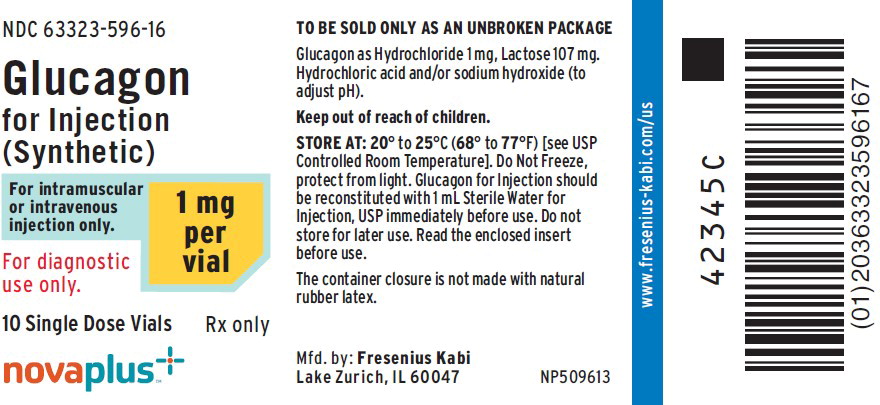
Glucagon 1 mg/mL Injection, Powder, Lyophilized, For Solution, 10 vials — NDC 63323-596-16 (Billing 63323-0596-16)
This is a package of 10 vials of Glucagon 1 mg/mL Injection, Powder, Lyophilized, For Solution from Fresenius Kabi USA, LLC, marketed since May 2015 and currently FDA-listed.
NDC database record
One package, one record: these facts belong to NDC 63323-596-16 alone.
- Record
- FDA NDC Directory package listing · Human prescription drug
- Code segments
- 63323 labeler · 596 product · 16 package
- Listing certified through
- Dec 31, 2026
- Billing quantity
- 10 EA per package
- Barcode (UPC)
- 0363323596033
- FDA record last changed
- Oct 8, 2026
Other active recalls for Glucagon (different manufacturers) — 1 · tap to view
Identity & classification
Regulatory identifiers FDA, NLM and CMS codes for this package
Drug-database identifiers Medi-Span GPI and First Databank GCN / HICL / AHFS classification
- GSN (GCN sequence number): 074063
- GCN: 38585
- GPI-14 (Medi-Span): 94200041052110
- HICL (First Databank): 017284
- AHFS class code: 36:00.00.00
- RxCUI (RxNorm): 310497
Where does this data come from?
- FDA openFDA NDC Directory · synced Oct 8, 2026
- FDA label on DailyMed · label index refreshed Oct 8, 2026
- RxNorm (NLM RxNav) · catalog refreshed Oct 8, 2026
- Medi-Span GPI (licensed)
- First Databank (licensed) · refreshed Oct 8, 2026
RxNorm drug class
This medicine belongs to the Antihypoglycemic Agent class.
Where does this data come from?
- RxClass (NLM) · catalog refreshed Oct 8, 2026
Clinical
Glucagon injection is used for emergency treatment of very low blood sugar (severe hypoglycemia). It is also used to slow down movement in the digestive system during certain X-ray lab tests. Glucagon is in a class of medications called glycogenolytic agents. It works by causing the liver to release stored sugar to the blood. It also works by relaxing digestive muscles for X-ray lab testing.
Read the full MedlinePlus article ↗- Glucagon injection is an emergency treatment for severe low blood sugar — the kind where someone with diabetes is unconscious, having a seizure, or can't swallow anything safely. I...
- What is glucagon injection used for, and when would I actually need it?
- Your liver stores sugar in a form called glycogen, kind of like a backup fuel tank. Glucagon tells the liver to break that stored sugar down and release it into the bloodstream, ra...
- How does glucagon injection actually work to raise blood sugar?
Patient education
Supplement & herbal interactions
Some supplements/herbs that may interact with Glucagon — tap one for details:
Glucagon may be associated with lower levels of 1 nutrient — worth a chat with your pharmacist, not a cause for alarm.
Where does this data come from?
- MedlinePlus (NLM) · refreshed Oct 8, 2026
- FDA label on DailyMed · label index refreshed Oct 8, 2026
Ask a licensed pharmacist directly — free, answered by our team.
Pricing
A drug doesn't have one price. Each row is a different public payment system, and none is what you'd pay at the counter — that depends on your insurance. The ⓘ on each row explains what it measures.
| Price system | Per mL | Per package |
|---|---|---|
| Retail pharmacies payNADAC · weekly | Not in the retail survey — common for institutional, discontinued, or low-volume packs. | |
| Medicaid paysCMS SDUD · 12 mo | No recent Medicaid claims on file for this NDC — rare and low-volume NDCs are suppressed in the public data. | |
| Medicare drug plans payPart D · Q2 2026 | $213.35 | $2,133.46 / 10 ml |
| Medicare Part B allowsASP · J1611 | $129.281 / J1611 unit | — |
Where does this data come from?
- CMS NADAC weekly file
- CMS ASP pricing files · refreshed Sep 20, 2026
- CMS Medicaid State Drug Utilization Data · refreshed Oct 9, 2026
- CMS Part D plan pricing files · refreshed Sep 24, 2026
- VA National Acquisition Center price file
Billing & reimbursement
Where does this data come from?
- CMS ASP NDC-HCPCS crosswalk · refreshed Sep 22, 2026
- DMEPDAC NDC-HCPCS crosswalk
- openFDA NSDE billing units · refreshed Oct 7, 2026
Packaging — all sizes for this product
| Package NDC | Description | Marketing start | Marketing end | Status |
|---|---|---|---|---|
| 63323-0596-16 You're viewing this | 10 VIAL, SINGLE-DOSE in 1 TRAY / 1 mL in 1 VIAL, SINGLE-DOSE | 2015-05-08 | — | Active |
| 63323-0596-13 63323-596-13 Main listing | 10 VIAL, SINGLE-DOSE in 1 TRAY / 1 mL in 1 VIAL, SINGLE-DOSE | 2015-05-08 | — | Active |
Pack size FAQ
What quantity is in this package?
How does this package differ from NDC 63323-0596-13?
What NDC number is used to bill for this package of Glucagon 1 mg/mL Injection, Powder, Lyophilized, For Solution?
Therapeutic equivalents
| Product | Labeler | Pack | NADAC/unit | TE | Status | Price vs. this |
|---|---|---|---|---|---|---|
| Glucagon 00378-8067-90 | Mylan | 1 kit | $154.203 | AP | Availability likely | — |
| Glucagon 00548-5850-00 | Amphastar | 1 kit | $154.203 | AP | Availability likely | — |
| Glucagon 69097-0027-50 | Cipla | 1 kit | $154.203 | AP | Availability likely | — |
| Glucagon 70748-0311-01 | Lupin | 1 kit | $154.203 | AP | Availability likely | — |
| Glucagon 63323-0582-82 | Fresenius | 1 kit | $240.404 | — | Availability likely | — |
| Glucagon 50090-6550-00 | A-S | 1 kit | — | AP | FDA listed | — |
| Glucagon 51662-1498-01 | HF | 1 kit | — | — | FDA listed | — |
| Glucagon 63323-0593-03 | Fresenius | 1 kit | — | — | FDA listed | — |
| Glucagon 63323-0594-03 | Fresenius | 1 kit | — | — | FDA listed | — |
| Glucagon 1 mg/mLthis 63323-0596-16 | Fresenius | 10 vials | — | — | FDA listed | — |
| Glucagon 85766-0043-01 | Sportpharm | 1 kit | — | AP | FDA listed | — |
| Glucagon 85766-0065-01 | Sportpharm | 1 kit | — | AP | FDA listed | — |
Where does this data come from?
- FDA openFDA NDC Directory · synced Oct 8, 2026
- FDA Orange Book · refreshed Oct 9, 2026
- CMS NADAC weekly file
Availability & generic status
We did not find an FDA-approved generic match for this exact strength, form and route.
Where does this data come from?
- FDA Orange Book · refreshed Oct 9, 2026
Inactive Ingredients / Excipients
Inactive ingredients, also called excipients, are components of the drug product other than the active ingredient. They may include fillers, dyes, coatings, preservatives, flavors, or other formulation ingredients.
🧪 Avoiding an ingredient? See Glucagon Injection inactive ingredients by manufacturer: every current product's list side by side, so you can ask your pharmacy for the version that does not list it.
💡 Tap an ingredient (hover on desktop) to see what it is and why it’s used.
-
UNII QTT17582CB
A strong acid used to adjust and maintain the proper pH level in liquid medicines, ensuring stability and preventing breakdown of active ingredients.
-
UNII EWQ57Q8I5X
Lactose monohydrate is a natural sugar derived from milk. It serves as a filler and binder in tablets and capsules, helping create the proper size, texture, and consistency of the medicine.
-
UNII 55X04QC32I
A strong alkaline chemical used to adjust and maintain the pH balance of liquid medicines. It helps keep the medicine stable and ensures it stays effective during storage.
3 inactive ingredients listed in the exact product block matched to this NDC.
Where does this data come from?
ingredient classCode="IACT" elements from the exact product block matched by this NDC. Label-section narrative from DailyMed / the openFDA label index is shown separately when available.- FDA label on DailyMed · label index refreshed Oct 8, 2026
- FDA openFDA NDC Directory · synced Oct 8, 2026
Inactive ingredient FAQ
Are inactive ingredients the same for every manufacturer?
Why might an inactive ingredient be missing?
Can inactive ingredients matter?
Manufacturer & labeler
More NDCs from Fresenius Kabi USA, LLC labeler code 63323
- Glucagon Kit NDC 63323-582-82
- Enoxaparin Sodium 80 mg/.8mL Injection NDC 63323-584-65
- Enoxaparin Sodium 100 mg/mL Injection NDC 63323-586-65
- Enoxaparin Sodium 150 mg/mL Injection NDC 63323-589-94
- Glucagon Kit NDC 63323-593-03
- Glucagon Kit NDC 63323-594-03
- Deferoxamine 95 mg/mL Injection, Powder, Lyophilized, For Solution NDC 63323-597-10
- Deferoxamine 95 mg/mL Injection, Powder, Lyophilized, For Solution NDC 63323-599-30
- Propranolol 1 mg/mL Injection, Solution NDC 63323-604-01
- Enoxaparin Sodium 100 mg/mL Injection NDC 63323-605-84
- Enoxaparin Sodium 60 mg/.6mL Injection NDC 63323-607-88
- Enoxaparin Sodium 120 mg/.8mL Injection NDC 63323-609-90
Where does this data come from?
- FDA openFDA NDC Directory · synced Oct 8, 2026
- Drugs@FDA
Full prescribing information FDA SPL
🎯 Indications and Usage ▾
1 INDICATIONS AND USAGE Glucagon for Injection is indicated for use as a diagnostic aid during radiologic examinations to temporarily inhibit movement of the gastrointestinal tract. Limitations of Use : Glucagon for Injection is not indicated for the emergency treatment of hypoglycemia because it is not packaged with a syringe and diluent necessary for rapid preparation and administration during an emergency outside of a healthcare facility. Glucagon for Injection is a gastrointestinal motility inhibitor indicated for use as a diagnostic aid during radiologic examinations to temporarily inhibit movement of the gastrointestinal (GI) tract ( 1 ) Limitations of Use: Glucagon for Injection is not indicated for the emergency treatment of hypoglycemia ( 1 )
⏱️ Dosage and Administration ▾
2 DOSAGE AND ADMINISTRATION Reconstitute lyophilized powder with Sterile Water for Injection before use ( 2.2 , 2.3 ) Determine dose based on diagnostic procedure, route of administration and procedure duration ( 2.1 ): To inhibit stomach and small bowel motility the dose is 0.2 mg to 0.5 mg given intravenously or 1 mg given intramuscularly To inhibit colon motility the dose is 0.5 mg to 0.75 mg given intravenously or 1 mg to 2 mg given intramuscularly
2.1Recommended Dose Determine the dose based on the type of diagnostic procedure, the route of administration and expected procedure duration [see Clinical Pharmacology ( 12.2 )] . The usual dose to inhibit movement of the: Stomach and small bowel is 0.2 mg to 0.5 mg given intravenously or 1 mg given intramuscularly. Colon is 0.5 mg to 0.75 mg given intravenously or 1 mg to 2 mg given intramuscularly.
Bolus doses above 1 mg administered intravenously have caused nausea and vomiting and are not recommended [see Adverse Reactions ( 6 )] .
2.2Reconstitution of the Lyophilized Powder Glucagon for Injection is a lyophilized powder, which requires reconstitution with Sterile Water for Injection prior to intravenous or intramuscular use. Using a syringe, withdraw 1 mL of Sterile Water for Injection and inject into the vial containing Glucagon for Injection lyophilized powder. Shake the vial gently until the powder is completely dissolved and no particles remain in the reconstituted solution.
Visually inspect the reconstituted solution for particulate matter and discoloration prior to administration. The reconstituted solution should be clear and of water-like consistency. Discard the reconstituted solution if there are signs of gel formation or particles.
The reconstituted solution has a concentration of approximately 1 mg of glucagon per mL. Use the reconstituted glucagon immediately after reconstitution.
2.3Important Administration Instructions Glucagon for Injection must be administered by medical personnel. The timing of administration of Glucagon for Injection depends upon the organ under examination and route of administration [see Clinical Pharmacology ( 12.2 )] . If given intravenously, administer Glucagon for Injection as a bolus over a time period of 1 minute.
Discard any unused portion. After the end of the diagnostic procedure, give oral carbohydrates to patients who have been fasting, if this is compatible with the diagnostic procedure.
2.1Recommended Dose Determine the dose based on the type of diagnostic procedure, the route of administration and expected procedure duration [see Clinical Pharmacology ( 12.2 )] . The usual dose to inhibit movement of the: Stomach and small bowel is 0.2 mg to 0.5 mg given intravenously or 1 mg given intramuscularly. Colon is 0.5 mg to 0.75 mg given intravenously or 1 mg to 2 mg given intramuscularly.
Bolus doses above 1 mg administered intravenously have caused nausea and vomiting and are not recommended [see Adverse Reactions ( 6 )] .
2.2Reconstitution of the Lyophilized Powder Glucagon for Injection is a lyophilized powder, which requires reconstitution with Sterile Water for Injection prior to intravenous or intramuscular use. Using a syringe, withdraw 1 mL of Sterile Water for Injection and inject into the vial containing Glucagon for Injection lyophilized powder. Shake the vial gently until the powder is completely dissolved and no particles remain in the reconstituted solution.
Visually inspect the reconstituted solution for particulate matter and discoloration prior to administration. The reconstituted solution should be clear and of water-like consistency. Discard the reconstituted solution if there are signs of gel formation or particles.
The reconstituted solution has a concentration of approximately 1 mg of glucagon per mL. Use the reconstituted glucagon immediately after reconstitution.
2.3Important Administration Instructions Glucagon for Injection must be administered by medical personnel. The timing of administratio… [Excerpted — this section continues on DailyMed.]
💊 Dosage Forms and Strengths ▾
3 DOSAGE FORMS AND STRENGTHS For injection: 1 mg of lyophilized powder in single dose vial for reconstitution. For Injection: 1 mg lyophilized powder in single dose vial for reconstitution ( 3 )
⛔ Contraindications ▾
4 CONTRAINDICATIONS Glucagon for Injection is contraindicated in patients with: Pheochromocytoma [see Warnings and Precautions ( 5.1 )] because of the risk of increased blood pressure Insulinoma [see Warnings and Precautions ( 5.2 )] because of the risk of hypoglycemia Glucagonoma [see Warnings and Precautions ( 5.2 )] because of the risk of hypoglycemia Pheochromocytoma ( 4 , 5.1 ) Insulinoma ( 4 , 5.2 ) Glucagonoma ( 4 , 5.2 )
⚠️ Warnings and Cautions ▾
5 WARNINGS AND PRECAUTIONS Hyperglycemia in patients with diabetes : Monitor blood glucose and treat with insulin if indicated ( 5.3 ) Increased blood pressure and heart rate in patients with cardiac disease : Monitor patients with known cardiac disease ( 5.4 ) Allergic reactions including anaphylactic shock with breathing difficulties, and hypotension, generalized rash : Discontinue and treat as indicated ( 5.5 )
5.1Hypertension in Patients with Pheochromocytoma Glucagon for Injection is contraindicated in patients with pheochromocytoma because glucagon may stimulate the release of catecholamines from the tumor, which may result in a sudden and marked increase in blood pressure.
5.2Hypoglycemia in Patients with Insulinoma or Glucagonoma Glucagon for Injection is contraindicated in patients with insulinoma or glucagonoma as it may cause secondary hypoglycemia. Test patients suspected of having glucagonoma for blood levels of glucagon prior to treatment, and monitor for changes in blood glucose levels during treatment. If a patient develops symptoms of hypoglycemia after a dose of Glucagon for Injection, administer glucose orally or intravenously.
5.3Hyperglycemia in Patients with Diabetes Mellitus Treatment with Glucagon for Injection in patients with diabetes mellitus may cause hyperglycemia. Monitor diabetic patients for changes in blood glucose levels during treatment. If patients develop symptoms of hyperglycemia after a dose of Glucagon for Injection, administer insulin.
5.4Blood Pressure and Heart Rate Increase in Patients with Cardiac Disease Glucagon for Injection may increase myocardial oxygen demand, blood pressure, and pulse rate which may be life-threatening in patients with cardiac disease. Cardiac monitoring is recommended in patients with cardiac disease during glucagon treatment, and an increase in blood pressure and pulse rate may require therapy.
5.5Hypersensitivity and Allergic Reactions Generalized allergic reactions and hypersensitivity, including generalized rash, and anaphylactic shock with breathing difficulties, and hypotension, have been reported with glucagon treatment or lactose. Discontinue Glucagon for Injection and administer standard treatment for anaphylaxis if needed.
5.1Hypertension in Patients with Pheochromocytoma Glucagon for Injection is contraindicated in patients with pheochromocytoma because glucagon may stimulate the release of catecholamines from the tumor, which may result in a sudden and marked increase in blood pressure.
5.2Hypoglycemia in Patients with Insulinoma or Glucagonoma Glucagon for Injection is contraindicated in patients with insulinoma or glucagonoma as it may cause secondary hypoglycemia. Test patients suspected of having glucagonoma for blood levels of glucagon prior to treatment, and monitor for changes in blood glucose levels during treatment. If a patient develops symptoms of hypoglycemia after a dose of Glucagon for Injection, administer glucose orally or intravenously.
5.3Hyperglycemia in Patients with Diabetes Mellitus Treatment with Glucagon for Injection in patients with diabetes mellitus may cause hyperglycemia. Monitor diabetic patients for changes in blood glucose levels during treatment. If patients develop symptoms of hyperglycemia after a dose of Glucagon for Injection, administer insulin.
5.4Blood Pressure and Heart Rate Increase in Patients with Cardiac Disease Glucagon for Injection may increase myocardial oxygen demand, blood pressure, and pulse rate which may be life-threatening in patients with cardiac disease. Cardiac monitoring is recommended in patients with cardiac disease during glucagon treatment, and an increase in blood pressure and pulse rate may require therapy.
5.5Hypersensitivity and Allergic Reactions Generalized allergic reactions and hypersensitivity, including generalized rash, and anaphylactic shock with breathing difficulties, and hypotension, have been reported with glucagon treatment or lactose. Discontinue Gluca… [Excerpted — this section continues on DailyMed.]
🤒 Adverse Reactions ▾
6 ADVERSE REACTIONS The following serious adverse reactions are described below and elsewhere in the labeling: Hypertension in patients with Pheochromocytoma [see Contraindications ( 4 ) and Warnings and Precautions ( 5.1 )] Hypoglycemia in Patients with Insulinoma and Glucagonoma [see Contraindications ( 4 ) and Warnings and Precautions ( 5.2 )] Hyperglycemia in Patients with Diabetes Mellitus [see Warnings and Precautions ( 5.3 )] Hypersensitivity and Allergic Reactions; generalized allergic reactions including generalized rash, and in some cases anaphylactic shock with breathing difficulties, and hypotension [see Warnings and Precautions ( 5.5 )] Adverse Reactions from Clinical Trials Because clinical trials are conducted under widely varying conditions, adverse reaction rates observed in the clinical trials of a drug cannot be directly compared to the rates in clinical trials of another drug and may not reflect the rates observed in practice.
In an open-label clinical study of Glucagon for Injection, 29 healthy volunteers received a single dose of 1 mg Glucagon for Injection intramuscularly. Table 1 shows the most common adverse reactions that were not present at baseline and occurred in at least 5% of patients. Table 1: Adverse Reactions in Healthy Volunteers Who Received Glucagon for Injection, 1 mg Administered Intramuscularly (N=29) % of Patients Vomiting 17 Nausea 7 Adverse Reactions from the Literature and Other Clinical Studies The following adverse reactions have been identified from the literature and clinical studies with the use of glucagon.
Therefore, it is not possible to reliably estimate their frequency. Nausea and vomiting occurred with doses above 1 mg administered by rapid intravenous injection (within 1 to 2 seconds) . Doses above 1 mg are not recommended for intravenous use [see Dosage and Administration ( 2.1 )].
Hypotension was reported up to 2 hours after administration in patients receiving glucagon as premedication for upper GI endoscopy procedures. A temporary increase in both blood pressure and pulse rate occurred following the administration of glucagon. Patients taking beta-blockers experienced a temporary increase in both pulse and blood pressure that was greater than normal [see Drug Interactions ( 7 )] .
Other adverse reactions included hypoglycemia and hypoglycemic coma, as described in postmarketing reports. Patients taking indomethacin may be more likely to experience hypoglycemia following glucagon administration [see Drug Interactions ( 7 )] . Adverse reactions seen with glucagon are transient changes in blood pressure, increase in heart rate, hypersensitivity reactions, nausea and vomiting, and hypoglycemia ( 6 ) To report SUSPECTED ADVERSE REACTIONS, contact Fresenius Kabi USA, LLC at 1-800-551-7176 or FDA at 1-800-FDA-1088 or www.fda.gov/medwatch.
🔄 Drug Interactions ▾
7 DRUG INTERACTIONS Table 2 includes clinically significant drug interactions with Glucagon for Injection. Table 2: Clinically Significant Drug Interactions with Glucagon for Injection Beta-Blockers Clinical Impact: The concomitant use of beta-blockers and Glucagon for Injection may increase the risk of a temporary increase in heart rate and blood pressure. Intervention: The increase in blood pressure and heart rate may require therapy in patients with coronary artery disease.
Insulin Clinical Impact: Insulin reacts antagonistically towards glucagon. Intervention: Monitor blood glucose when Glucagon for Injection is used as a diagnostic aid in diabetes patients. Indomethacin Clinical Impact: The concomitant use of indomethacin and Glucagon for Injection may lead to hypoglycemia.
Intervention: Monitor blood glucose levels during glucagon treatment of patients taking indomethacin. Anticholinergic Drugs Clinical Impact: The concomitant use of anticholinergic drugs and Glucagon for Injection increase the risk of gastrointestinal adverse reactions due to additive effects on inhibition of gastrointestinal motility. Intervention: Concomitant use is not recommended.
Warfarin Clinical Impact: Glucagon may increase the anticoagulant effect of warfarin. Intervention: Monitor patients for unusual bruising or bleeding, as adjustments in warfarin dosage may be required. Beta-blockers : May cause a greater increase in both heart rate and blood pressure ( 7 ) Insulin : Reacts antagonistically towards glucagon; monitor glucose ( 7 ) Indomethacin : May produce hypoglycemia; monitor glucose ( 7 ) Anticholinergic Drugs : Concomitant use not recommended due to increased gastrointestinal adverse reactions ( 7 ) Warfarin : May increase anticoagulant effect of warfarin; may require an adjustment in warfarin dosage ( 7 )
👥 Use in Specific Populations ▾
8 USE IN SPECIFIC POPULATIONS
8.1Pregnancy Pregnancy Category B. Reproduction studies were performed in rats and rabbits with another glucagon product at doses of 0.4, 2, and 10 mg per kg. These doses represent exposures of up to 100 and 200 times the human dose based on mg/m 2 for rats and rabbits, respectively, and revealed no evidence of harm to the fetus.
There are, however, no adequate and well-controlled studies in pregnant women. Glucagon does not cross the human placental barrier.
8.3Nursing Mothers It is not known whether glucagon is excreted in human milk. Because many drugs are excreted in human milk, caution should be exercised when glucagon is administered to a nursing woman. No clinical studies have been performed in nursing mothers, however, glucagon is a peptide and intact glucagon is not absorbed from the GI tract.
Therefore, even if the infant ingested glucagon it would be unlikely to have any effect on the infant. Additionally, glucagon has a short plasma half-life thus limiting amounts available to the child.
8.4Pediatric Use Safety and effectiveness of Glucagon for Injection have not been established in pediatric patients for use as a diagnostic aid during radiologic examinations to temporarily inhibit movement of the gastrointestinal tract.
🤰 Pregnancy ▾
8.1Pregnancy Pregnancy Category B. Reproduction studies were performed in rats and rabbits with another glucagon product at doses of 0.4, 2, and 10 mg per kg. These doses represent exposures of up to 100 and 200 times the human dose based on mg/m 2 for rats and rabbits, respectively, and revealed no evidence of harm to the fetus.
There are, however, no adequate and well-controlled studies in pregnant women. Glucagon does not cross the human placental barrier.
🧒 Pediatric Use ▾
8.4Pediatric Use Safety and effectiveness of Glucagon for Injection have not been established in pediatric patients for use as a diagnostic aid during radiologic examinations to temporarily inhibit movement of the gastrointestinal tract.
🆘 Overdosage ▾
10 OVERDOSAGE If overdosage occurs, the patient may experience nausea, vomiting, inhibition of GI tract motility, increase in blood pressure and heart rate, and decrease in serum potassium. In case of suspected overdosage, monitor and correct hypokalemia. If the patient develops a severe increase in blood pressure, phentolamine mesylate may be effective in lowering blood pressure for the short time that control would be needed.
🧬 Clinical Pharmacology ▾
12 CLINICAL PHARMACOLOGY
12.1Mechanism of Action Extra hepatic effects of glucagon include relaxation of the smooth muscle of the stomach, small bowel, and colon.
12.2Pharmacodynamics Table 3 displays the pharmacodynamics properties of Glucagon for Injection as a diagnostic aid during radiologic examination. Table 3: Pharmacodynamic Properties of Glucagon for Injection as a Diagnostic Aid Route of Administration Dose a Time of Onset of Action for GI Smooth Muscle Relaxation Duration of Smooth Muscle Relaxation Intravenous 0.25 to 0.5 mg 45 seconds 9 to 17 minutes Intramuscular 1 mg 8 to 10 minutes 12 to 27 minutes 2 mg 4 to 7 minutes 21 to 32 minutes a Select from these doses based on type of diagnostic procedure, route of administration and procedure duration.
12.3Pharmacokinetics Absorption Following intramuscular administration of 1 mg dose, the maximum plasma glucagon concentrations of 3391 pg/mL were attained approximately 10 minutes after dosing. Metabolism The mean apparent half-life of glucagon was 26 minutes after intramuscular administration. Glucagon is degraded in the liver, kidney, and plasma.
🧬 Mechanism of Action ▾
12.1Mechanism of Action Extra hepatic effects of glucagon include relaxation of the smooth muscle of the stomach, small bowel, and colon.
📦 How Supplied / Storage and Handling ▾
16 HOW SUPPLIED/STORAGE AND HANDLING
16.1How Supplied Glucagon for Injection is supplied as a sterile, lyophilized white powder in a vial. Presentation/ Product Code Unit of Sale NDC Strength Description/Unit of Use NDC 10 Single dose vials NP509613 63323-596-16 1 mg per vial 1 mL single dose vial of Glucagon for Injection (NDC 63323-596-08) Diagnostic Kit NP509603 63323-594-03 1 mg per vial 1 mL single dose vial of Glucagon for Injection (NDC 63323-596-06) with 1 mL single dose vial of Sterile Water for Injection, USP for reconstitution (NDC 63323-185-03) The container closure is not made with natural rubber latex.
16.2Recommended Storage Before Reconstitution The package containing Glucagon for Injection vials may be stored up to 24 months at 20° to 25° C (68° to 77° F) [see USP Controlled Room Temperature] prior to reconstitution. Do not freeze. Keep in the original package to protect from light.
After Reconstitution The Glucagon for Injection must be reconstituted with Sterile Water for Injection prior to use. Use reconstituted glucagon solution immediately. Discard any unused portion [see Dosage and Administration ( 2.3 )] .
16.1How Supplied Glucagon for Injection is supplied as a sterile, lyophilized white powder in a vial. Presentation/ Product Code Unit of Sale NDC Strength Description/Unit of Use NDC 10 Single dose vials NP509613 63323-596-16 1 mg per vial 1 mL single dose vial of Glucagon for Injection (NDC 63323-596-08) Diagnostic Kit NP509603 63323-594-03 1 mg per vial 1 mL single dose vial of Glucagon for Injection (NDC 63323-596-06) with 1 mL single dose vial of Sterile Water for Injection, USP for reconstitution (NDC 63323-185-03) The container closure is not made with natural rubber latex.
16.2Recommended Storage Before Reconstitution The package containing Glucagon for Injection vials may be stored up to 24 months at 20° to 25° C (68° to 77° F) [see USP Controlled Room Temperature] prior to reconstitution. Do not freeze. Keep in the original package to protect from light.
After Reconstitution The Glucagon for Injection must be reconstituted with Sterile Water for Injection prior to use. Use reconstituted glucagon solution immediately. Discard any unused portion [see Dosage and Administration ( 2.3 )] .
📋 Description ▾
11 DESCRIPTION Glucagon for Injection, for intravenous or intramuscular use, is a gastrointestinal motility inhibitor that is produced by solid phase peptide synthesis. Glucagon is a single-chain polypeptide containing 29 amino acid residues. The chemical structure of the glucagon polypeptide is identical to human glucagon and to glucagon extracted from beef and pork pancreas.
The structure of glucagon is: C 153 H 225 N 43 O 49 S Molecular Weight = 3483 Glucagon for Injection is a sterile, lyophilized white powder in a 3 mL vial. The reconstituted solution contains 1 mg of glucagon as hydrochloride per mL and lactose monohydrate (107 mg). Glucagon for Injection is supplied at pH 2.5 to 3.5 and is soluble in water. structure
💬 Information for Patients ▾
17 PATIENT COUNSELING INFORMATION Inform patients that generalized allergic reactions have been reported with glucagon treatment including generalized rash, and in some cases anaphylactic shock with breathing difficulties, and hypotension. Advise patients to monitor and report any signs or symptoms of a hypersensitivity reaction [ see Warnings and Precautions ( 5.5 )] . Inform patients that hypoglycemia has occurred with treatment with glucagon.
Inform patients of the symptoms of hypoglycemia and how to treat it. Advise patients to avoid driving or operating machinery until ingesting a meal. Advise patients to inform their health care provider if hypoglycemia occurs so that treatment may be given if necessary [ see Adverse Reactions ( 6 )] .
Inform patients with diabetes mellitus that treatment with Glucagon for Injection may increase their risk of hyperglycemia [see Warnings and Precautions ( 5.3 )]. Inform patients with cardiac disease that treatment with Glucagon for Injection may increase their risk of a transient increase in blood pressure and heart rate [see Warnings and Precautions ( 5.4 )].
🍼 Nursing Mothers ▾
8.3Nursing Mothers It is not known whether glucagon is excreted in human milk. Because many drugs are excreted in human milk, caution should be exercised when glucagon is administered to a nursing woman. No clinical studies have been performed in nursing mothers, however, glucagon is a peptide and intact glucagon is not absorbed from the GI tract.
Therefore, even if the infant ingested glucagon it would be unlikely to have any effect on the infant. Additionally, glucagon has a short plasma half-life thus limiting amounts available to the child.
🧬 Pharmacokinetics ▾
12.3Pharmacokinetics Absorption Following intramuscular administration of 1 mg dose, the maximum plasma glucagon concentrations of 3391 pg/mL were attained approximately 10 minutes after dosing. Metabolism The mean apparent half-life of glucagon was 26 minutes after intramuscular administration. Glucagon is degraded in the liver, kidney, and plasma.
🧬 Pharmacodynamics ▾
12.2Pharmacodynamics Table 3 displays the pharmacodynamics properties of Glucagon for Injection as a diagnostic aid during radiologic examination. Table 3: Pharmacodynamic Properties of Glucagon for Injection as a Diagnostic Aid Route of Administration Dose a Time of Onset of Action for GI Smooth Muscle Relaxation Duration of Smooth Muscle Relaxation Intravenous 0.25 to 0.5 mg 45 seconds 9 to 17 minutes Intramuscular 1 mg 8 to 10 minutes 12 to 27 minutes 2 mg 4 to 7 minutes 21 to 32 minutes a Select from these doses based on type of diagnostic procedure, route of administration and procedure duration.
🧪 Nonclinical Toxicology ▾
13 NONCLINICAL TOXICOLOGY
13.1Carcinogenesis, Mutagenesis, Impairment of Fertility Carcinogenesis Long term studies in animals to evaluate carcinogenic potential have not been performed. Mutagenesis Synthetic glucagon was negative in the bacterial reverse mutation assay (Ames test). The clastogenic potential of synthetic glucagon in the Chinese Hamster Ovary (CHO) assay was positive in the absence of metabolic activation.
Doses of 100 and 200 mg/kg of glucagon of both pancreatic and recombinant origins gave slightly higher incidences of micronucleus formation in male mice but there was no effect in females. The weight of evidence indicates that synthetic and recombinant glucagon are not different and do not pose a genotoxic risk to humans. Impairment of Fertility Glucagon was not tested in animal fertility studies.
Studies in rats have shown that pancreatic glucagon does not cause impaired fertility.
📄 Carcinogenesis, Mutagenesis, Impairment of Fertility ▾
13.1Carcinogenesis, Mutagenesis, Impairment of Fertility Carcinogenesis Long term studies in animals to evaluate carcinogenic potential have not been performed. Mutagenesis Synthetic glucagon was negative in the bacterial reverse mutation assay (Ames test). The clastogenic potential of synthetic glucagon in the Chinese Hamster Ovary (CHO) assay was positive in the absence of metabolic activation.
Doses of 100 and 200 mg/kg of glucagon of both pancreatic and recombinant origins gave slightly higher incidences of micronucleus formation in male mice but there was no effect in females. The weight of evidence indicates that synthetic and recombinant glucagon are not different and do not pose a genotoxic risk to humans. Impairment of Fertility Glucagon was not tested in animal fertility studies.
Studies in rats have shown that pancreatic glucagon does not cause impaired fertility.
📄 Package Label / Principal Display Panel ▾
PACKAGE LABEL - PRINCIPAL DISPLAY - Glucagon Kit 1 mg Vial Label NP509603 Glucagon for Injection (Synthetic) 1 mg per vial For intramuscular or intravenous injection. For diagnostic use only. Reconstitute with Sterile Water for Injection, USP Rx only vial
PACKAGE LABEL - PRINCIPAL DISPLAY - Glucagon Kit Sterile Water 1 mL Vial Label Sterile Water for Injection, USP 1 mL per vial FOR DRUG DILUENT USE ONLY Contains no antimicrobial or other added substance. Do not give intravenously unless rendered nearly Isotonic. Discard unused portion. 1 mL Single Dose Vial Rx only vial
PACKAGE LABEL - PRINCIPAL DISPLAY - Glucagon Kit 1 mg Vial Carton Panel 63323-594-03 NP509603 Glucagon for Injection (Synthetic) For intramuscular or intravenous injection only. 1 mg per vial FOR DIAGNOSTIC USE ONLY. Reconstitute with Sterile Water for Injection, USP immediately before use.
Each kit contains: One single dose vial with 1 mg of Glucagon for Injection One single dose vial with 1 mL of Sterile Water for Injection, USP Single Dose Vials Rx only carton
PACKAGE LABEL - PRINCIPAL DISPLAY - Glucagon 1 mg Vial Label NP509613 Glucagon for Injection (Synthetic) 1 mg per vial For intramuscular or intravenous injection. For diagnostic use only. Reconstitute with Sterile Water for Injection, USP Rx only vial
PACKAGE LABEL - PRINCIPAL DISPLAY - Glucagon 1 mg Vial Tray Label NDC 63323-596-16 Glucagon for Injection (Synthetic) For intramuscular or intravenous injection only. 1 mg per vial For diagnostic use only. 10 Single Dose Vials Rx only tray
Medicaid utilization by pack size
Medicare Part D spend CMS · PART D · 2026 (Q1)
Reported adverse events (FAERS)
Top reported reactions
Age at onset
Reporter sex
Serious outcomes
Where does this data come from?
About this NDC listing & data coverage
What data is (and isn’t) available for this NDC — tap to expand
| NDC identity (package / product / labeler codes) | ✓ Available |
| Labeler | ✓ Available |
| Product & package description | ✓ Available |
| Marketing category & status | ✓ Available |
| Active ingredient / dosage form / route | ✓ Available |
| FDA label (SPL via DailyMed) | ✓ Available |
| Package photos | ✓ Available |
| Inactive ingredients (structured) | ✓ Available |
| NADAC pharmacy acquisition price (CMS) | — Not published for this NDC CMS publishes NADAC only for NDCs reported in its retail-pharmacy survey. |
| Orange Book / therapeutic-equivalence data | — Not published for this NDC Applies only to products approved under an NDA/ANDA; many listings are out of scope. |
| HCPCS J-code billing crosswalk | ✓ Available |
| Medicaid utilization (CMS SDUD) | — Not published for this NDC CMS reports utilization only for NDCs with Medicaid claims above its privacy threshold. |