
Trisenox Arsenic Trioxide 2 mg/mL Injection, Solution — NDC 63459-601-06 (Billing 63459-0601-06)
This is a package of Trisenox Arsenic Trioxide 2 mg/mL Injection, Solution from Cephalon, LLC, marketed since Dec 2017 and currently FDA-listed. It is this product's only package size.
NDC database record
One package, one record: these facts belong to NDC 63459-601-06 alone.
- Record
- FDA NDC Directory package listing · Human prescription drug
- Code segments
- 63459 labeler · 601 product · 06 package
- Package marketed since
- Dec 22, 2017
- Sample package
- No — commercial package
- Listing certified through
- Dec 31, 2027
- Barcode (UPC-A, from the NDC)
- 3 6345960106 9
- Medicaid fills, this package
- 11 prescriptions in the last four reported quarters
- FDA record last changed
- Oct 8, 2026
Identity & classification
Regulatory identifiers FDA, NLM and CMS codes for this package
Drug-database identifiers Medi-Span GPI and First Databank GCN / HICL / AHFS classification
- GSN (GCN sequence number): 077987
- GCN: 44165
- HICL (First Databank): 021734
- AHFS class code: 10:00.00.00
Where does this data come from?
- FDA openFDA NDC Directory · synced Oct 8, 2026
- FDA label on DailyMed · label index refreshed Oct 6, 2026
- RxNorm (NLM RxNav) · catalog refreshed Oct 1, 2026
- Medi-Span GPI (licensed)
- First Databank (licensed) · refreshed Oct 8, 2026
Clinical
Arsenic trioxide is used in combination with tretinoin to treat acute promyelocytic leukemia (APL; a type of cancer in which there are too many immature blood cells in the blood and bone marrow) in certain people as a first treatment. It is also used to treat APL in certain people who have not been helped by other types of chemotherapy or whose condition has improved but then worsened following treatment with a retinoid and other types of chemotherapy treatment(s). Arsenic trioxide is in a class of medications called anti-neoplastics. It works by slowing or stopping the growth of cancer cells.
Read the full MedlinePlus article ↗- It treats acute promyelocytic leukemia (APL), a type of blood cancer with a specific genetic marker. It is used for newly diagnosed low-risk APL along with tretinoin, and for APL t...
- It is given through an IV, usually over about 2 hours, by your healthcare team. You will have frequent blood tests and heart tracings to keep you safe. Your team will set the exact...
- Tell your team immediately about fever, trouble breathing, rapid weight gain, swelling, or low blood pressure. Also report fainting, a racing or irregular heartbeat, confusion, sei...
- What symptoms should I report right away?
Patient education
Supplement & herbal interactions
Some supplements/herbs that may interact with Arsenic Trioxide (prescription drug) — tap one for details:
Where does this data come from?
- MedlinePlus (NLM) · refreshed Oct 1, 2026
- FDA label on DailyMed · label index refreshed Oct 6, 2026
Ask a licensed pharmacist directly — free, answered by our team.
Pricing
A drug doesn't have one price. Each row is a different public payment system, and none is what you'd pay at the counter — that depends on your insurance. The ⓘ on each row explains what it measures.
| Price system | Per mL | Per package |
|---|---|---|
| Retail pharmacies payNADAC · weekly | Not in the retail survey — common for institutional, discontinued, or low-volume packs. | |
| Medicaid paysCMS SDUD · 12 mo | $210.10 | $12,606.26 / 60 ml |
| Medicare drug plans payPart D · quarterly | No Part D plan price is available for this NDC in our data. | |
| Medicare Part B allowsASP · J9017 | $5.069 / J9017 unit | — |
Where does this data come from?
- CMS NADAC weekly file
- CMS ASP pricing files · refreshed Sep 20, 2026
- CMS Medicaid State Drug Utilization Data · through Q1 2026
- CMS Part D plan pricing files · refreshed Sep 24, 2026
- VA National Acquisition Center price file
Billing & reimbursement
Where does this data come from?
- CMS ASP NDC-HCPCS crosswalk · refreshed Sep 22, 2026
- DMEPDAC NDC-HCPCS crosswalk
- openFDA NSDE billing units · refreshed Oct 7, 2026
Packaging — all sizes for this product
| Package NDC | Description | Marketing start | Marketing end | Status |
|---|---|---|---|---|
| 63459-0601-06 You're viewing this Main listing | 10 VIAL, SINGLE-DOSE in 1 CARTON / 6 mL in 1 VIAL, SINGLE-DOSE | 2017-12-22 | — | Active |
Therapeutic equivalents
| Product | Labeler | Pack | NADAC/unit | TE | Status | Price vs. this |
|---|---|---|---|---|---|---|
| Arsenic Trioxide 2 mg/mL 00781-3498-94 | Sandoz | 1 vial | — | AP | FDA listed | — |
| Arsenic Trioxide 2 mg/mL 23155-0870-41 | Heritage | 10 vials | — | AP | FDA listed | — |
| Arsenic Trioxide 2 mg/mL 25021-0227-06 | Sagent | 10 vials | — | AP | FDA listed | — |
| Arsenic trioxide 2 mg/mL 49315-0007-10 | Zydus | 10 vials | — | AP | FDA listed | — |
| Arsenic Trioxide 2 mg/mL 55150-0366-10 | Eugia | 1 vial | — | — | FDA listed | — |
| Trisenox 2 mg/mLthis 63459-0601-06 | Cephalon, | 10 vials | — | AP | FDA listed | — |
| Arsenic Trioxide 2 mg/mL 68083-0462-10 | Gland | 10 vials | — | AP | FDA listed | — |
| Arsenic Trioxide 2 mg/mL 70121-1658-01 | Amneal | 10 vials | — | AP | FDA listed | — |
| Arsenic trioxide 2 mg/mL 70710-1610-06 | Zydus | 10 vials | — | AP | FDA listed | — |
| Arsenic trioxide 2 mg/mL 70710-1896-06 | Zydus | 10 vials | — | AP | FDA listed | — |
| Arsenic Trioxide 2 mg/2mL 72205-0172-07 | Novadoz | 10 vials | — | AP | FDA listed | — |
| Arsenic Trioxide 2 mg/mL 81607-0006-07 | Orbicular | 10 vials | — | AP | FDA listed | — |
| Arsenic Trioxide 2 mg/mL 83090-0010-01 | Sintetica | 1 vial | — | AP | FDA listed | — |
Where does this data come from?
- FDA openFDA NDC Directory · synced Oct 8, 2026
- FDA Orange Book · refreshed Oct 3, 2026
- CMS NADAC weekly file
Availability & generic status
The FDA lists approved generic versions of this medicine, but that does not always mean a pharmacy can get one today. Patent rules, launch agreements, supply and pricing can affect when generics actually arrive.
Where does this data come from?
- FDA Orange Book · refreshed Oct 3, 2026
Inactive Ingredients / Excipients
Inactive ingredients, also called excipients, are components of the drug product other than the active ingredient. They may include fillers, dyes, coatings, preservatives, flavors, or other formulation ingredients.
🧪 Avoiding an ingredient? See Arsenic Trioxide Injection inactive ingredients by manufacturer: every current product's list side by side, so you can ask your pharmacy for the version that does not list it.
Where does this data come from?
IACT rows and label-wide narrative are kept separate; availability and product-level specificity depend on the submitted label.- FDA label on DailyMed · label index refreshed Oct 6, 2026
- FDA openFDA NDC Directory · synced Oct 8, 2026
Inactive ingredient FAQ
Are inactive ingredients the same for every manufacturer?
Why might an inactive ingredient be missing?
Can inactive ingredients matter?
Manufacturer & labeler
More NDCs from Cephalon, LLC labeler code 63459
- TREANDA Bendamustine Hydrochloride 25 mg/5mL Injection, Powder, Lyophilized, For Solution NDC 63459-390-08
- TREANDA Bendamustine Hydrochloride 100 mg/20mL Injection, Powder, Lyophilized, For Solution NDC 63459-391-20
- Tiagabine Hydrochloride 2 mg Tablet, Film Coated NDC 63459-402-30
- Tiagabine Hydrochloride 4 mg Tablet, Film Coated NDC 63459-404-30
- Tiagabine Hydrochloride 12 mg Tablet, Film Coated NDC 63459-412-30
- Tiagabine hydrochloride 16 mg Tablet, Film Coated NDC 63459-416-30
- AMRIX Cyclobenzaprine Hydrochloride 15 mg Capsule, Extended Release NDC 63459-700-60
- AMRIX Cyclobenzaprine Hydrochloride 30 mg Capsule, Extended Release NDC 63459-701-60
- GRANIX tbo-filgrastim 300 ug/.5mL Injection, Solution NDC 63459-910-11
- GRANIX tbo-filgrastim 480 ug/.8mL Injection, Solution NDC 63459-912-11
- GRANIX tbo-filgrastim 300 ug/mL Injection, Solution NDC 63459-918-59
- GRANIX tbo-filgrastim 480 ug/1.6mL Injection, Solution NDC 63459-920-59
Where does this data come from?
- FDA openFDA NDC Directory · synced Oct 8, 2026
- Drugs@FDA
Full prescribing information FDA SPL
🚨 Boxed Warning ▾
WARNING: DIFFERENTIATION SYNDROME, CARDIAC CONDUCTION ABNORMALITIES AND ENCEPHALOPATHY INCLUDING WERNICKE'S Differentiation Syndrome: Patients with acute promyelocytic leukemia (APL) treated with TRISENOX have experienced differentiation syndrome, which may be life-threatening or fatal. Signs and symptoms may include unexplained fever, dyspnea, hypoxia, acute respiratory distress, pulmonary infiltrates, pleural or pericardial effusions, weight gain, peripheral edema, hypotension, renal insufficiency, hepatopathy, and multi-organ dysfunction, in the presence or absence of leukocytosis.
If differentiation syndrome is suspected, immediately initiate high-dose corticosteroids and hemodynamic monitoring until resolution. Temporarily withhold TRISENOX [see Dosage and Administration ( 2.3 ), Warnings and Precautions ( 5.1 )]. Cardiac Conduction Abnormalities: TRISENOX can cause QTc interval prolongation, complete atrioventricular block and torsade de pointes, which can be fatal.
Before administering TRISENOX, assess the QTc interval, correct electrolyte abnormalities, and consider discontinuing drugs known to prolong QTc interval. Do not administer TRISENOX to patients with a ventricular arrhythmia or prolonged QTc interval. Withhold TRISENOX until resolution and resume at reduced dose for QTc prolongation [see Dosage and Administration ( 2.3 ), Warnings and Precautions ( 5.2 )].
Encephalopathy: Serious encephalopathy, including Wernicke's, has occurred with TRISENOX. Wernicke's is a neurologic emergency. Consider testing thiamine levels in patients at risk for thiamine deficiency.
Administer parenteral thiamine in patients with or at risk for thiamine deficiency. Monitor patients for neurological symptoms and nutritional status while receiving TRISENOX. If Wernicke's encephalopathy is suspected, immediately interrupt TRISENOX and initiate parenteral thiamine.
Monitor until symptoms resolve or improve and thiamine levels normalize [see Warnings and Precautions ( 5.3 )] . WARNING: DIFFERENTIATION SYNDROME, CARDIAC CONDUCTION ABNORMALITIES, and ENCEPHALOPATHY INCLUDING WERNICKE'S See full prescribing information for complete boxed warning. Patients with acute promyelocytic leukemia (APL) treated with TRISENOX have experienced symptoms of differentiation syndrome, which may be life-threatening or fatal.
If differentiation syndrome is suspected, immediately initiate high-dose corticosteroids and hemodynamic monitoring until resolution. Temporarily withhold TRISENOX. ( 2.3 , 5.1 ) TRISENOX can cause QTc interval prolongation, complete atrioventricular block and torsade de pointes, which can be fatal.
Before administering TRISENOX, assess the QTc interval, correct electrolyte abnormalities, and consider discontinuing drugs known to prolong QTc interval. Do not administer TRISENOX to patients with ventricular arrhythmia or prolonged QTc interval. Withhold TRISENOX until resolution and resume at reduced dose for QTc prolongation.
( 2.3 , 5.2 ) Serious encephalopathy, including Wernicke's, has occurred with TRISENOX. If Wernicke's encephalopathy is suspected, immediately interrupt TRISENOX and initiate parenteral thiamine. Monitor until symptoms resolve or improve and thiamine levels normalize.
( 5.3 )
🎯 Indications and Usage ▾
1 INDICATIONS AND USAGE TRISENOX is an arsenical indicated: In combination with tretinoin for treatment of adults with newly-diagnosed low-risk acute promyelocytic leukemia (APL) whose APL is characterized by the presence of the t(15;17) translocation or PML/RAR-alpha gene expression. ( 1.1 ) For induction of remission and consolidation in patients with APL who are refractory to, or have relapsed from, retinoid and anthracycline chemotherapy, and whose APL is characterized by the presence of the t(15;17) translocation or PML/RAR-alpha gene expression.
( 1.2 )
1.1Newly-Diagnosed Low-Risk APL TRISENOX is indicated in combination with tretinoin for treatment of adults with newly-diagnosed low-risk acute promyelocytic leukemia (APL) whose APL is characterized by the presence of the t(15;17) translocation or PML/RAR-alpha gene expression.
1.2Relapsed or Refractory APL TRISENOX is indicated for induction of remission and consolidation in patients with APL who are refractory to, or have relapsed from, retinoid and anthracycline chemotherapy, and whose APL is characterized by the presence of the t(15;17) translocation or PML/RAR-alpha gene expression.
⏱️ Dosage and Administration ▾
2 DOSAGE AND ADMINISTRATION Newly-diagnosed low-risk APL: Induction: Administer 0.15 mg/kg/day intravenously daily in combination with tretinoin until bone marrow remission. Do not exceed 60 days. ( 2.1 ) Consolidation: Administer 0.15 mg/kg/day intravenously daily for 5 days per week during weeks 1-4 of each 8-week cycle for a total of 4 cycles in combination with tretinoin.
( 2.1 ) Relapsed or refractory APL: Induction: Administer 0.15 mg/kg/day intravenously daily until bone marrow remission. Do not exceed 60 days. ( 2.2 ) Consolidation: Administer 0.15 mg/kg/day intravenously daily for 25 doses over a period of up to 5 weeks.
( 2.2 )
2.1Recommended Dosage for Newly-Diagnosed Low-Risk Acute Promyelocytic Leukemia (APL) A treatment course for patients with newly-diagnosed low-risk APL consists of 1 induction cycle and 4 consolidation cycles. For the induction cycle, the recommended dosage of TRISENOX is 0.15 mg/kg/day intravenously daily in combination with tretinoin until bone marrow remission but not to exceed 60 days (see Table 1). For the consolidation cycles, the recommended dosage of TRISENOX is 0.15 mg/kg/day intravenously daily 5 days per week during weeks 1-4 of each 8-week cycle for a total of 4 cycles in combination with tretinoin (see Table 1).
Omit tretinoin during weeks 5-6 of the fourth cycle of consolidation. Table 1: Recommended Dosage of TRISENOX in Combination with Tretinoin Induction (1 cycle) TRISENOX 0.15 mg/kg once daily intravenously until marrow remission but not to exceed 60 days Tretinoin a 22.5 mg/m 2 twice daily orally until marrow remission but not to exceed 60 days Consolidation (4 cycles) Week 1 Week 2 Week 3 Week 4 Week 5 Week 6 Week 7 Week 8 TRISENOX 0.15 mg/kg once daily intravenously Days 1-5 Days 1-5 Days 1-5 Days 1-5 -- -- -- -- Tretinoin a 22.5 mg/m 2 twice daily orally Days 1-7 Days 1-7 -- -- Days b 1-7 Days b 1-7 -- -- a Rounded to the nearest 10 mg increment b Omitted during the 4th cycle of consolidation Differentiation syndrome prophylaxis consisting of prednisone 0.5 mg/kg daily from day 1 until the end of induction cycle with TRISENOX and tretinoin is recommended.
2.2Recommended Dosage for Relapsed or Refractory APL A treatment course for patients with relapsed or refractory APL consists of 1 induction cycle and 1 consolidation cycle [see Clinical Studies ( 14.2 )] . For the induction cycle, the recommended dosage of TRISENOX is 0.15 mg/kg/day intravenously daily until bone marrow remission or up to a maximum of 60 days. For the consolidation cycle, the recommended dosage of TRISENOX is 0.15 mg/kg/day intravenously daily for 25 doses over a period of up to 5 weeks.
Begin consolidation 3 to 6 weeks after completion of induction cycle.
2.3Monitoring and Dosage Modifications for Adverse Reactions During induction, monitor coagulation studies, blood counts, and chemistries at least 2-3 times per week through recovery. During consolidation, monitor coagulation studies, blood counts, and chemistries at least weekly. Table 2 shows the dosage modifications for adverse reactions due to TRISENOX when used alone or in combination with tretinoin.
Table 2: Dosage Modifications for Adverse Reactions of TRISENOX Adverse Reaction Dosage Modification Differentiation syndrome, defined by the presence of 2 or more of the following: Unexplained fever Dyspnea Pleural and/or pericardial effusion Pulmonary infiltrates Renal failure Hypotension Weight gain greater than 5 kg [see Warnings and Precautions ( 5.1 )] Temporarily withhold TRISENOX. Consider holding tretinoin if symptoms are severe. Administer dexamethasone 10 mg intravenously every 12 hours until the resolution of signs and symptoms for a minimum of 3 days.
Resume treatment when the clinical condition improves and reduce the dose of the withheld drug(s) by 50%. Increase the dose of the withheld drug(s) to the recommended dosage after one week in the absence of recurrence of symptoms of differentiation syndrome. If symptoms re-appear, decre… [Excerpted — this section continues on DailyMed.]
💊 Dosage Forms and Strengths ▾
3 DOSAGE FORMS AND STRENGTHS Injection: 12 mg/6 mL (2 mg/mL) arsenic trioxide clear solution in a single-dose vial Injection: 12 mg/6 mL (2 mg/mL) arsenic trioxide in single-dose vial. ( 3 )
⛔ Contraindications ▾
4 CONTRAINDICATIONS TRISENOX is contraindicated in patients with hypersensitivity to arsenic. Hypersensitivity to arsenic. ( 4 )
⚠️ Warnings and Cautions ▾
5 WARNINGS AND PRECAUTIONS Hepatotoxicity : Elevated aspartate aminotransferase (AST), alkaline phosphatase and serum bilirubin have occurred in patients with newly-diagnosed low-risk APL treated with TRISENOX in combination with tretinoin. Monitor hepatic function tests at least twice weekly during induction and at least once weekly during consolidation. Withhold TRISENOX for certain elevations in AST, alkaline phosphatase and bilirubin and resume at reduced dose upon resolution.( 2.3 , 5.4 ) Carcinogenesis : Arsenic trioxide is a human carcinogen.
Monitor patients for the development of second primary malignancies. ( 5.5 ) Embryo-Fetal Toxicity : Can cause fetal harm. Advise of potential risk to a fetus and use of effective contraception.
( 5.6 , 8.1 , 8.3 )
5.1Differentiation Syndrome Differentiation syndrome, which may be life-threatening or fatal, has been observed in patients with acute promyelocytic leukemia (APL) treated with TRISENOX. In clinical trials, 16-23% of patients treated with TRISENOX for APL developed differentiation syndrome. Signs and symptoms include unexplained fever, dyspnea, hypoxia, acute respiratory distress, pulmonary infiltrates, pleural or pericardial effusion, weight gain, peripheral edema, hypotension, renal insufficiency, hepatopathy and multi-organ dysfunction.
Differentiation syndrome has been observed with and without concomitant leukocytosis, and it has occurred as early as day 1 of induction to as late as the second month induction therapy. When TRISENOX is used in combination with tretinoin, prophylaxis with prednisone is recommended during the induction cycle [see Dosage and Administration ( 2.1 )] . If differentiation syndrome is suspected, temporarily withhold TRISENOX and immediately initiate dexamethasone 10 mg intravenously every 12 hours and hemodynamic monitoring until resolution of signs and symptoms for a minimum of 3 days [see Dosage and Administration ( 2.3 )] .
5.2Cardiac Conduction Abnormalities Patients treated with TRISENOX can develop QTc prolongation, torsade de pointes, and complete atrioventricular block. In the clinical trials of patients with newly-diagnosed low-risk APL treated with TRISENOX in combination with tretinoin, 11% experienced QTc (Framingham formula) prolongation > 450 msec for men and > 460 msec for women throughout the treatment cycles. In the clinical trial of patients with relapsed or refractory APL treated with TRISENOX monotherapy, 40% had at least one ECG tracing with a QTc interval greater than 500 msec.
A prolonged QTc was observed between 1 and 5 weeks after start of TRISENOX infusion, and it usually resolved by 8 weeks after TRISENOX infusion. There are no data on the effect of TRISENOX on the QTc interval during the infusion of the drug. The risk of torsade de pointes is related to the extent of QTc prolongation, concomitant administration of QTc prolonging drugs, a history of torsade de pointes, pre-existing QTc interval prolongation, congestive heart failure, administration of potassium-wasting diuretics, or other conditions that result in hypokalemia or hypomagnesemia.
The risk may be increased when TRISENOX is coadministered with medications that can lead to electrolyte abnormalities (such as diuretics or amphotericin B) [see Drug Interactions ( 7 )] . Prior to initiating therapy with TRISENOX, assess the QTc interval by electrocardiogram, correct pre-existing electrolyte abnormalities, and consider discontinuing drugs known to prolong QTc interval. Do not administer TRISENOX to patients with a ventricular arrhythmia or prolonged QTc.
If possible, discontinue drugs that are known to prolong the QTc interval. If it is not possible to discontinue the interacting drug, perform cardiac monitoring frequently [see Drug Interactions ( 7 )] . During TRISENOX therapy, maintain potassium concentrations above 4 mEq/L and magnesium concentrations above 1.8 mg/dL.
Monitor ECG weekly and more frequently for clinically unstable patients. For patients… [Excerpted — this section continues on DailyMed.]
🤒 Adverse Reactions ▾
6 ADVERSE REACTIONS The following clinically significant adverse reactions are described elsewhere in the labeling: Differentiation Syndrome [see Warnings and Precautions ( 5.1 )] Cardiac Conduction Abnormalities [see Warnings and Precautions ( 5.2 )] Encephalopathy [see Warnings and Precautions ( 5.3 )] Hepatotoxicity [see Warnings and Precautions ( 5.4 )] Carcinogenesis [see Warnings and Precautions ( 5.5 )] The most common adverse reactions (> 30%) are nausea, cough, fatigue, pyrexia, headache, abdominal pain, vomiting, tachycardia, diarrhea, dyspnea, hypokalemia, leukocytosis, hyperglycemia, hypomagnesemia, insomnia, dermatitis, edema, QTc prolongation, rigors, sore throat, arthralgia, paresthesia, and pruritus ( 6.1 ).
To report SUSPECTED ADVERSE REACTIONS, contact Teva Pharmaceuticals at 1-888-483-8279 or FDA at 1-800-FDA-1088 or www.fda.gov/medwatch .
6.1Clinical Trials Experience Because clinical trials are conducted under widely varying conditions, adverse reaction rates observed in the clinical trials of a drug cannot be directly compared to rates in the clinical trials of another drug and may not reflect the rates observed in practice. Newly-Diagnosed Low-Risk APL The safety of TRISENOX in combination with tretinoin was evaluated in Study APL0406, a randomized trial comparing TRISENOX plus tretinoin (n=129) versus chemotherapy plus tretinoin (n=137) in patients with newly-diagnosed APL [see Clinical Studies ( 14.1 )] .
In the TRISENOX/tretinoin group, 98% of patients completed induction therapy and 89% completed at least three consolidation cycles. In the chemotherapy/tretinoin group, 96% completed induction therapy and 87% patients completed all three courses of consolidation therapy. Serious adverse reactions were reported in 25% of patients on the TRISENOX/tretinoin arm and 24% on the chemotherapy/tretinoin arm.
The serious adverse reactions reported in ≥ 2% of patients who received TRISENOX/tretinoin were abnormal liver tests, differentiation syndrome, dyspnea, pneumonia, and other infections. Fatal adverse reactions were reported in 1 (1%) patient on the TRISENOX/tretinoin arm and 8 (6%) patients on the chemotherapy/tretinoin arm. TRISENOX/tretinoin was discontinued due to toxicity in 1 patient during induction and in 4 patients during the first three consolidation courses, whereas chemotherapy/tretinoin was discontinued due to toxicity in 4 patients during induction and in 6 patients during consolidation.
Selected hematologic and nonhematologic toxicities that occurred during induction or consolidation are presented in Table 4. Table 4: Select Adverse Reactions of Trisenox in Combination with Tretinoin in Patients with Newly-Diagnosed APL in Study APL0406 Induction First Consolidation Second Consolidation Third Consolidation Adverse Reaction n (%) n (%) n (%) n (%) Thrombocytopenia > 15 days (Grade 3-4) TRISENOX/tretinoin 74 (58%) 6 (5%) 6 (5%) 8 (7%) Chemotherapy/tretinoin 120 (88%) 17 (14%) 77 (63%) 26 (22%) Neutropenia >15 days (Grade 3-4) TRISENOX/tretinoin 61 (48%) 8 (7%) 7 (6%) 5 (4%) Chemotherapy/tretinoin 109 (80%) 40 (32%) 90 (73%) 28 (24%) Hepatic toxicity (Grade 3-4) TRISENOX/tretinoin 51 (40%) 5 (4%) 1 (1%) 0 (0%) Chemotherapy/tretinoin 4 (3%) 1 (1%) 0 (0%) 0 (0%) Infection and fever of unknown origin TRISENOX/tretinoin 30 (23%) 10 (8%) 4 (3%) 2 (2%) Chemotherapy/tretinoin 75 (55%) 8 (6%) 46 (38%) 2 (2%) Hypertriglyceridemia TRISENOX/tretinoin 29 (22%) 22 (18%) 17 (14%) 16 (14%) Chemotherapy/tretinoin 29 (22%) 19 (15%) 10 (8%) 13 (11%) Hypercholesterolemia TRISENOX/tretinoin 14 (10%) 19 (16%) 19 (16%) 16 (14%) Chemotherapy/tretinoin 12 (9%) 12 (10%) 12 (10%) 11 (9%) QT prolongation TRISENOX/tretinoin 11 (9%) 3 (2%) 3 (2%) 2 (2%) Chemotherapy/tretinoin 1 (1%) 0 (0%) 0 (0%) 0 (0%) Gastrointestinal toxicity (Grade 3-4) TRISENOX/tretinoin 3 (2%) 0 (0%) 0 (0%) 0 (0%) Chemotherapy/tretinoin 25 (18%) 1 (1%) 6 (5%) 0 (0%) Neurotoxicity* TRISENOX/tretinoin 1 (1%) 5 (4%) 6 (5%) 7 (6%) Chemotherapy/tretinoin… [Excerpted — this section continues on DailyMed.]
🔄 Drug Interactions ▾
7 DRUG INTERACTIONS Drugs That Can Prolong the QT/QTc Interval Concomitant use of these drugs and TRISENOX may increase the risk of serious QT/QTc interval prolongation [see Warnings and Precautions ( 5.1 )] . Discontinue or replace with an alternative drug that does not prolong the QT/QTc interval while the patient is using TRISENOX. Monitor ECGs more frequently in patients when it is not feasible to avoid concomitant use.
Drugs That Can Lead to Electrolyte Abnormalities Electrolyte abnormalities increase the risk of serious QT/QTc interval prolongation [see Warnings and Precautions ( 5.1 )] . Avoid concomitant use of drugs that can lead to electrolyte abnormalities. Monitor electrolytes more frequently in patients who must receive concomitant use of these drugs and TRISENOX.
Drugs That Can Lead to Hepatotoxicity Concomitant use of these drugs and TRISENOX, particularly when given in combination with tretinoin, may increase the risk of serious hepatotoxicity [see Warnings and Precautions ( 5.4 )] . Discontinue or replace with an alternative drug that does not cause hepatotoxicity while the patient is using TRISENOX. Monitor liver function tests more frequently in patients when it is not feasible to avoid concomitant use.
👥 Use in Specific Populations ▾
8 USE IN SPECIFIC POPULATIONS Lactation : Advise not to breastfeed. ( 8.2 ) Renal Impairment : Monitor patients with severe renal impairment (creatinine clearance less than 30 mL/min) for toxicity when treated with TRISENOX; dose reduction may be warranted. ( 8.6 ) Hepatic Impairment : Monitor patients with severe hepatic impairment (Child-Pugh Class C) for toxicity when treated with TRISENOX. ( 8.7 )
8.1Pregnancy Risk Summary Based on the mechanism of action [see Clinical Pharmacology ( 12.1 )] and findings in animal studies, TRISENOX can cause fetal harm when administered to a pregnant woman. Arsenic trioxide was embryolethal and teratogenic in rats when administered on gestation day 9 at a dose approximately 10 times the recommended human daily dose on a mg/m 2 basis (see Data) . A related trivalent arsenic, sodium arsenite, produced teratogenicity when administered during gestation in mice at a dose approximately 5 times the projected human dose on a mg/m 2 basis and in hamsters at an intravenous dose approximately equivalent to the projected human daily dose on a mg/m 2 basis.
There are no studies with the use of TRISENOX in pregnant women, and limited published data on arsenic trioxide use during pregnancy are insufficient to inform a drug-associated risk of major birth defects and miscarriage. Advise pregnant women of the potential risk to a fetus. The estimated background risk of major birth defects and miscarriage for the indicated population is unknown.
All pregnancies have a background risk of birth defect, loss, or other adverse outcomes. In the U.S. general population, the estimated background risk of major birth defects and miscarriage in clinically recognized pregnancies is 2% to 4% and 15% to 20%, respectively. Data Human Data One patient was reported to deliver a live infant with no reported congenital anomalies after receiving arsenic trioxide during the first five months of pregnancy.
A second patient became pregnant three months after discontinuing arsenic trioxide and was reported to have a normal pregnancy outcome. A third patient was a pregnant healthcare provider who experienced dermal contact with liquid arsenic trioxide and had a normal pregnancy outcome after treatment and monitoring. A fourth patient who became pregnant while receiving arsenic trioxide had a miscarriage.
Animal Data Studies in pregnant mice, rats, hamsters, and primates have shown that inorganic arsenicals cross the placental barrier when given orally or by injection. An increase in resorptions, neural-tube defects, anophthalmia and microphthalmia were observed in rats administered 10 mg/kg of arsenic trioxide on gestation day 9 (approximately 10 times the recommended human daily dose on a mg/m 2 basis). Similar findings occurred in mice administered a 10 mg/kg dose of a related trivalent arsenic, sodium arsenite (approximately 5 times the projected human dose on a mg/m 2 basis), on gestation days 6, 7, 8, or 9.
Intravenous injection of 2 mg/kg sodium arsenite (approximately equivalent to the projected human daily dose on a mg/m 2 basis) on gestation day 7 (the lowest dose tested) resulted in neural-tube defects in hamsters.
8.2Lactation Risk Summary Arsenic trioxide is excreted in human milk. There are no data on the effects of arsenic trioxide on the breastfed child or on milk production. Because of the potential for serious adverse reactions in a breastfed child, advise women not to breastfeed during treatment with TRISENOX and for 2 weeks after the final dose.
8.3Females and Males of Reproductive Potential TRISENOX can cause fetal harm when administered to a pregnant woman [see Use in Specific Populations ( 8.1 )]. Pregnancy Testing Conduct pregnancy testing in females of reproductive potential prior to initiation of TRISENOX . Contraception Females Advise females of reproductive potential to use effective contraception during treatment with TRISENOX and for 6 months after the final dose.
Males Advise males with female partne… [Excerpted — this section continues on DailyMed.]
🆘 Overdosage ▾
10 OVERDOSAGE Manifestations Manifestations of TRISENOX (arsenic trioxide) overdosage include convulsions, muscle weakness, and confusion. Management For symptoms of TRISENOX (arsenic trioxide) overdosage, immediately discontinue TRISENOX and consider chelation therapy. A conventional protocol for acute arsenic intoxication includes dimercaprol administered at a dose of 3 mg/kg intramuscularly every 4 hours until immediate life-threatening toxicity has subsided.
Thereafter, penicillamine at a dose of 250 mg orally, up to a maximum frequency of four times per day (≤ 1 g per day), may be given.
🧬 Clinical Pharmacology ▾
12 CLINICAL PHARMACOLOGY
12.1Mechanism of Action The mechanism of action of TRISENOX is not completely understood. Arsenic trioxide causes morphological changes and DNA fragmentation characteristic of apoptosis in NB4 human promyelocytic leukemia cells in vitro. Arsenic trioxide also causes damage or degradation of the fusion protein promyelocytic leukemia (PML)-retinoic acid receptor (RAR)-alpha.
12.2Pharmacodynamics Cardiac Electrophysiology In a single-arm trial of TRISENOX (0.15 mg/kg daily), 16 of 40 patients (40%) had a QTc interval greater than 500 msec. Prolongation of the QTc was observed between 1 and 5 weeks after TRISENOX infusion, and then returned towards baseline by the end of 8 weeks after TRISENOX infusion.
12.3Pharmacokinetics The inorganic, lyophilized form of arsenic trioxide, when placed into solution, immediately forms the hydrolysis product arsenious acid (As III ). As III is the pharmacologically active species of arsenic trioxide. Monomethylarsonic acid (MMA V ), and dimethylarsinic acid (DMA V ) are the main pentavalent metabolites formed during metabolism, in addition to arsenic acid (As V ) a product of As III oxidation.
The pharmacokinetics of arsenical species ([As III ], [As V ], [MMA V ], [DMA V ]) were determined in 6 APL patients following once-daily doses of 0.15 mg/kg for 5 days per week. Over the total single-dose range of 7 to 32 mg (administered as 0.15 mg/kg), systemic exposure (AUC) appears to be linear. Peak plasma concentrations of arsenious acid (As III ), the primary active arsenical species were reached at the end of infusion (2 hours).
Plasma concentration of As III declined in a biphasic manner with a mean elimination half-life of 10 to 14 hours and is characterized by an initial rapid distribution phase followed by a slower terminal elimination phase. The daily exposure to As III (mean AUC 0-24h ) was 194 ng·hr/mL (n=5) on Day 1 of Cycle 1 and 332 ng·hr/mL (n=6) on Day 25 of Cycle 1, which represents an approximate 2-fold accumulation. The primary pentavalent metabolites, MMA V and DMA V , are slow to appear in plasma (approximately 10 to 24 hours after first administration of arsenic trioxide), but, due to their longer half-life, accumulate more upon multiple dosing than does As III .
The mean estimated terminal elimination half-lives of the metabolites MMA V and DMA V are 32 hours and 72 hours, respectively. Approximate accumulation ranged from 1.4- to 8-fold following multiple dosing as compared to single-dose administration. As V is present in plasma only at relatively low levels.
Distribution The volume of distribution (V ss ) for As III is large (mean 562 L, N=10) indicating that As III is widely distributed throughout body tissues. V ss is also dependent on body weight and increases as body weight increases. Elimination Metabolism Much of the As III is distributed to the tissues where it is methylated to the less cytotoxic metabolites, monomethylarsonic acid (MMA V ) and dimethylarsinic acid (DMA V ) by methyltransferases primarily in the liver.
The metabolism of arsenic trioxide also involves oxidation of As III to As V , which may occur in numerous tissues via enzymatic or nonenzymatic processes. As V is present in plasma only at relatively low levels following administration of arsenic trioxide. Excretion Approximately 15% of the administered TRISENOX dose is excreted in the urine as unchanged As III .
The methylated metabolites of As III (MMA V , DMA V ) are primarily excreted in the urine. The total clearance of As III is 49 L/h and the renal clearance is 9 L/h. Clearance is not dependent on body weight or dose administered over the range of 7 to 32 mg.
Specific Populations Patients with Renal Impairment The effect of renal impairment on the pharmacokinetics of As III , As V , and the pentavalent metabolites MMA V and DMA V was evaluated in 20 patients with advanced malignancies. Patients were classified as having normal renal function (creatinine clearance [CLcr]… [Excerpted — this section continues on DailyMed.]
🧬 Mechanism of Action ▾
12.1Mechanism of Action The mechanism of action of TRISENOX is not completely understood. Arsenic trioxide causes morphological changes and DNA fragmentation characteristic of apoptosis in NB4 human promyelocytic leukemia cells in vitro. Arsenic trioxide also causes damage or degradation of the fusion protein promyelocytic leukemia (PML)-retinoic acid receptor (RAR)-alpha.
📦 How Supplied / Storage and Handling ▾
16 HOW SUPPLIED/STORAGE AND HANDLING How Supplied TRISENOX (arsenic trioxide) injection is supplied as a sterile, clear, colorless solution in 10 mL glass, single-dose vials. NDC 63459-601-06 : 12 mg/6 mL (2 mg/mL) vial in packages of ten vials. Storage and Handling Store at 20°C to 25°C (68°F to 77°F); excursions permitted to 15°C to 30°C (59°F to 86°F) [See USP Controlled Room Temperature].
Do not freeze. TRISENOX is a hazardous drug. Follow applicable special handling and disposal procedures.
1
📋 Description ▾
11 DESCRIPTION TRISENOX is a sterile injectable solution of arsenic trioxide. The molecular formula of arsenic trioxide in the solid state is As 2 O 3 , with a molecular weight of 197.8 and the following structural formula: TRISENOX is available in 10 mL, single-dose vials containing 12 mg of arsenic trioxide. TRISENOX is formulated as a sterile, nonpyrogenic, clear solution of arsenic trioxide in water for injection using sodium hydroxide and dilute hydrochloric acid to adjust to pH 8.
TRISENOX is preservative-free. Arsenic trioxide, the active ingredient, is present at a concentration of 2 mg/mL. Inactive ingredients and their respective approximate concentrations are sodium hydroxide (1.2 mg/mL) for solubilization, and sodium hydroxide and hydrochloric acid for pH adjustment to pH 8. structural formula
💬 Information for Patients ▾
17 PATIENT COUNSELING INFORMATION Differentiation Syndrome Advise patients that symptoms of APL differentiation syndrome include fever, sudden weight gain, dizziness/lightheadedness, labored breathing, and accumulation of fluid in the lungs, heart, and chest. This syndrome is managed by immediate treatment with high-dose corticosteroids. Advise patients to immediately report any of these symptoms [see Warnings and Precautions ( 5.1 )].
Cardiac Conduction Abnormalities Advise patients that TRISENOX may cause ECG abnormalities, including QT prolongation. If extreme, this prolongation has the potential to cause fainting, irregular heartbeat, or more serious side effects. Advise patients to immediately report any of these symptoms.
Advise patients to provide a complete list of current medications as caution should be taken when TRISENOX is coadministered with other medications that can cause QT prolongation or lead to electrolyte abnormalities [see Warnings and Precautions ( 5.2 ) and Drug Interactions ( 7 )]. Encephalopathy and Wernicke's Encephalopathy (WE) Advise patients that symptoms of encephalopathies include neurological symptoms such as confusion, decreased level of consciousness, seizures, cognitive deficits, ataxia, visual symptoms and ocular motor dysfunction.
Advise patients and caregivers to closely monitor for neurological symptoms and immediately report them to their healthcare provider [see Warnings and Precautions ( 5.3 )] . Advise patients at risk for thiamine deficiency (e.g., chronic alcohol use, malabsorption, nutritional deficiency, concomitant use of furosemide) that Wernicke’s encephalopathy is a neurologic emergency that can be prevented and treated with thiamine supplementation, and to immediately report any neurological symptoms to their healthcare provider [see Warnings and Precautions ( 5.3 )] .
Embryo-Fetal Toxicity Advise pregnant women of the potential risk to a fetus. Advise females of reproductive potential to inform their healthcare provider of a known or suspected pregnancy [see Warnings and Precautions ( 5.5 ) and Use in Specific Populations 8.1 )]. Advise females of reproductive potential to use effective contraception during treatment with TRISENOX and for 6 months after the last dose [see Use in Specific Populations ( 8.3 )] .
Advise males with female partners of reproductive potential to use effective contraception during treatment with TRISENOX for 3 months after the last dose [see Use in Specific Populations ( 8.3 )]. Lactation Advise women not to breastfeed during treatment with TRISENOX and for 2 weeks after the last dose [see Use in Specific Populations ( 8.2 )]. Infertility Advise males of reproductive potential that TRISENOX may impair fertility [see Use in Specific Population ( 8.3 )] .
Other Adverse Reactions Advise patients of the expected adverse reactions of TRISENOX. Most patients in clinical trials experienced some drug-related toxicity, most commonly leukocytosis, gastrointestinal symptoms (nausea, vomiting, diarrhea, and abdominal pain), fatigue, edema, hyperglycemia, dyspnea, cough, rash or itching, headaches, and dizziness. Advise patients to call their healthcare provider at the onset of any adverse reactions [see Adverse Reactions ( 6.1 )] .
Manufactured for: Teva Pharmaceuticals Parsippany, NJ 07054 ©2022 Teva Pharmaceuticals, Inc. Rev. 6/2022 TRI-015
🧬 Pharmacokinetics ▾
12.3Pharmacokinetics The inorganic, lyophilized form of arsenic trioxide, when placed into solution, immediately forms the hydrolysis product arsenious acid (As III ). As III is the pharmacologically active species of arsenic trioxide. Monomethylarsonic acid (MMA V ), and dimethylarsinic acid (DMA V ) are the main pentavalent metabolites formed during metabolism, in addition to arsenic acid (As V ) a product of As III oxidation.
The pharmacokinetics of arsenical species ([As III ], [As V ], [MMA V ], [DMA V ]) were determined in 6 APL patients following once-daily doses of 0.15 mg/kg for 5 days per week. Over the total single-dose range of 7 to 32 mg (administered as 0.15 mg/kg), systemic exposure (AUC) appears to be linear. Peak plasma concentrations of arsenious acid (As III ), the primary active arsenical species were reached at the end of infusion (2 hours).
Plasma concentration of As III declined in a biphasic manner with a mean elimination half-life of 10 to 14 hours and is characterized by an initial rapid distribution phase followed by a slower terminal elimination phase. The daily exposure to As III (mean AUC 0-24h ) was 194 ng·hr/mL (n=5) on Day 1 of Cycle 1 and 332 ng·hr/mL (n=6) on Day 25 of Cycle 1, which represents an approximate 2-fold accumulation. The primary pentavalent metabolites, MMA V and DMA V , are slow to appear in plasma (approximately 10 to 24 hours after first administration of arsenic trioxide), but, due to their longer half-life, accumulate more upon multiple dosing than does As III .
The mean estimated terminal elimination half-lives of the metabolites MMA V and DMA V are 32 hours and 72 hours, respectively. Approximate accumulation ranged from 1.4- to 8-fold following multiple dosing as compared to single-dose administration. As V is present in plasma only at relatively low levels.
Distribution The volume of distribution (V ss ) for As III is large (mean 562 L, N=10) indicating that As III is widely distributed throughout body tissues. V ss is also dependent on body weight and increases as body weight increases. Elimination Metabolism Much of the As III is distributed to the tissues where it is methylated to the less cytotoxic metabolites, monomethylarsonic acid (MMA V ) and dimethylarsinic acid (DMA V ) by methyltransferases primarily in the liver.
The metabolism of arsenic trioxide also involves oxidation of As III to As V , which may occur in numerous tissues via enzymatic or nonenzymatic processes. As V is present in plasma only at relatively low levels following administration of arsenic trioxide. Excretion Approximately 15% of the administered TRISENOX dose is excreted in the urine as unchanged As III .
The methylated metabolites of As III (MMA V , DMA V ) are primarily excreted in the urine. The total clearance of As III is 49 L/h and the renal clearance is 9 L/h. Clearance is not dependent on body weight or dose administered over the range of 7 to 32 mg.
Specific Populations Patients with Renal Impairment The effect of renal impairment on the pharmacokinetics of As III , As V , and the pentavalent metabolites MMA V and DMA V was evaluated in 20 patients with advanced malignancies. Patients were classified as having normal renal function (creatinine clearance [CLcr] > 80 mL/min, n=6), mild renal impairment (CLcr 50 to 80 mL/min, n=5), moderate renal impairment (CLcr 30 to 49 mL/min, n=6), or severe renal impairment (CLcr < 30 mL/min, n=3). Following twice-weekly administration of 0.15 mg/kg over a 2-hour infusion, the mean AUC 0-INF for As III was comparable among the normal, mild and moderate renal impairment groups.
However, in the severe renal impairment group, the mean AUC 0-INF for As III was approximately 48% higher than that in the normal group. Systemic exposure to MMA V and DMA V tended to be larger in patients with renal impairment; however, the clinical consequences of this increased exposure are not known. As V plasma levels were generally below the limit of assay quantitatio… [Excerpted — this section continues on DailyMed.]
🧬 Pharmacodynamics ▾
12.2Pharmacodynamics Cardiac Electrophysiology In a single-arm trial of TRISENOX (0.15 mg/kg daily), 16 of 40 patients (40%) had a QTc interval greater than 500 msec. Prolongation of the QTc was observed between 1 and 5 weeks after TRISENOX infusion, and then returned towards baseline by the end of 8 weeks after TRISENOX infusion.
🔬 Clinical Studies ▾
14 CLINICAL STUDIES
14.1Newly-Diagnosed Low-Risk APL TRISENOX in combination with tretinoin was investigated in Study APL0406 (NCT00482833), a multicenter, randomized, open-label trial in patients with newly-diagnosed low-risk APL (white blood cell count at diagnosis ≤10 Gi/L). The patients were randomized 1:1 to receive TRISENOX/tretinoin for induction and consolidation or chemotherapy/tretinoin for induction, consolidation, and maintenance. Patients in the TRISENOX/tretinoin group received induction treatment with TRISENOX 0.15 mg/kg intravenously once daily in combination with tretinoin 22.5 mg/m 2 (rounded to the nearest 10 mg increment) orally twice daily until hematologic complete remission (CR) or for a maximum of 60 days.
Patients in this group who achieved a CR during induction received four 8-week cycles of consolidation treatment with TRISENOX 0.15 mg/kg intravenously once daily for 5 days every week during weeks 1 to 4 of the 8-week cycle, in combination with tretinoin 22.5 mg/m 2 (rounded to the nearest 10 mg increment) orally twice daily during weeks 1 to 2 and 5 to 6 of the 8-week cycle. Tretinoin was omitted during weeks 5 to 6 of the last cycle. Patients in the chemotherapy/tretinoin group received idarubicin 12 mg/m 2 intravenously once daily on days 2, 4, 6, and 8 in combination with tretinoin 22.5 mg/m 2 (rounded to the nearest 10 mg increment) orally twice daily, starting on day 1, until hematologic CR or for a maximum of 60 days.
Patients in this group who achieved a CR during induction received consolidation and maintenance treatment with tretinoin in combination with chemotherapy. The trial enrolled 162 patients with a morphologic diagnosis of APL. The median age of patients was 45 years in the TRISENOX/tretinoin arm and 47 years in the chemotherapy/tretinoin arm, and 52% and 46% were male in the TRISENOX/tretinoin and chemotherapy/tretinoin arms, respectively.
Baseline characteristics were balanced between treatment arms, including median WBC count, platelet count, PML-RARA isoform, and FLT3-ITD status. Efficacy was based on event-free survival (EFS) rate at 2 years. EFS was defined as the time from randomization to the occurrence of treatment failure, defined as no achievement of CR or CRi after induction therapy, no achievement of molecular remission after 3 consolidation courses, molecular relapse, hematologic relapse, or death.
The primary analysis of EFS was based on the difference between the two treatment arms in patients achieving EFS at 2 years. With a median follow-up of 34.4 months, the 2 year EFS rate of the modified ITT (mITT) population (patients who received at least one dose of the assigned treatment) was 94% in the TRISENOX/tretinoin arm (n=77) versus 82% in the chemotherapy/tretinoin arm (n=79), a treatment difference of 11% (95% CI: 1, 22; p-value 0.048). Overall survival (OS) for the mITT population was 99% (95% CI: 93, 100) in the TRISENOX/tretinoin arm versus 91% (95% CI: 86, 97) in the chemotherapy/tretinoin arm.
The difference in 2-year OS rate between the arms was 8% (95% CI: 0, 16). The number of patients in the plot is based on the mITT population. Figure 1
14.2Relapsed or Refractory APL TRISENOX was investigated in Study PLRXAS01, an open-label, single-arm trial in 40 patients with relapsed or refractory APL who were previously treated with an anthracycline and a retinoid regimen. Patients received TRISENOX 0.15 mg/kg/day intravenously over 1 to 2 hours until the bone marrow was cleared of leukemic cells or for a maximum of 60 days. The CR (absence of visible leukemic cells in bone marrow and peripheral recovery of platelets and white blood cells with a confirmatory bone marrow ≥ 30 days later) rate in this population of previously treated patients was 28 of 40 (70%).
Among the 22 patients who had relapsed less than one year after treatment with tretinoin, there were 18 complete responders (82%). Of the 18 patients receiving TRISENOX ≥ one year from tretinoin treatment, th… [Excerpted — this section continues on DailyMed.]
🧪 Nonclinical Toxicology ▾
13 NONCLINICAL TOXICOLOGY
13.1Carcinogenesis, Mutagenesis, Impairment of Fertility Carcinogenicity studies have not been conducted with TRISENOX [see Warnings and Precautions ( 5.6 )]. Arsenic trioxide and trivalent arsenite salts have not been demonstrated to be mutagenic to bacteria, yeast, or mammalian cells. Arsenite salts are clastogenic in vitro (human fibroblast, human lymphocytes, Chinese hamster ovary cells, Chinese hamster V79 lung cells).
Trivalent arsenic was genotoxic in the chromosome aberrations assay and micronucleus bone marrow assay in mice. The effect of arsenic on fertility has not been adequately studied in humans. Decreased testicular weight and impaired spermatogenesis have been reported in animal studies.
Male Wistar rat pups were administered 1.5 mg/kg sodium arsenite solution via the intraperitoneal route from postnatal days 1 to 14 and testes were collected for evaluation on postnatal days 15, 21, and 50. Results of this study revealed an altered morphology of the seminiferous tubules along with degeneration of spermatogenic cells, increased number of sperm with abnormal morphology, and decreased sperm counts. In beagle dogs administered intravenous arsenic trioxide for 90 days, reduced inner cell layers within seminiferous tubules and significantly decreased numbers of spermatocytes, spermatozoa, and sperm cells were observed at doses of 1 mg/kg/day and higher.
The 1 mg/kg/day dose is approximately 3 times the recommended human daily dose on a mg/m² basis.
📄 Carcinogenesis, Mutagenesis, Impairment of Fertility ▾
13.1Carcinogenesis, Mutagenesis, Impairment of Fertility Carcinogenicity studies have not been conducted with TRISENOX [see Warnings and Precautions ( 5.6 )]. Arsenic trioxide and trivalent arsenite salts have not been demonstrated to be mutagenic to bacteria, yeast, or mammalian cells. Arsenite salts are clastogenic in vitro (human fibroblast, human lymphocytes, Chinese hamster ovary cells, Chinese hamster V79 lung cells).
Trivalent arsenic was genotoxic in the chromosome aberrations assay and micronucleus bone marrow assay in mice. The effect of arsenic on fertility has not been adequately studied in humans. Decreased testicular weight and impaired spermatogenesis have been reported in animal studies.
Male Wistar rat pups were administered 1.5 mg/kg sodium arsenite solution via the intraperitoneal route from postnatal days 1 to 14 and testes were collected for evaluation on postnatal days 15, 21, and 50. Results of this study revealed an altered morphology of the seminiferous tubules along with degeneration of spermatogenic cells, increased number of sperm with abnormal morphology, and decreased sperm counts. In beagle dogs administered intravenous arsenic trioxide for 90 days, reduced inner cell layers within seminiferous tubules and significantly decreased numbers of spermatocytes, spermatozoa, and sperm cells were observed at doses of 1 mg/kg/day and higher.
The 1 mg/kg/day dose is approximately 3 times the recommended human daily dose on a mg/m² basis.
📚 References ▾
15 REFERENCES “OSHA Hazardous Drugs.” OSHA. http://www.osha.gov/SLTC/hazardousdrugs/index.html
📄 Package Label / Principal Display Panel ▾
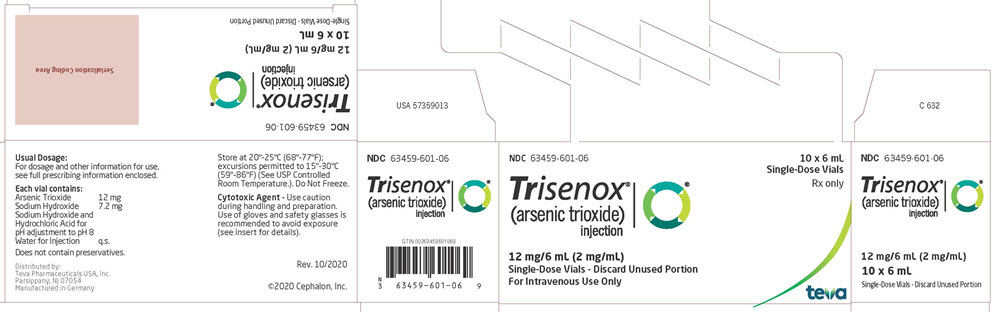
Package/Label Display Panel NDC 63459-601-06 Trisenox® (arsenic trioxide) injection 12 mg/6 mL (2 mg/mL) 10 x 6 mL Single-Dose Vial – Discard Unused Portion For Intravenous Use Only 10 x 6 mL Single-Dose Vial Rx only Teva Trisenox carton
Medicaid utilization & spend
About this NDC listing & data coverage
What data is (and isn’t) available for this NDC — tap to expand
| NDC identity (package / product / labeler codes) | ✓ Available |
| Labeler | ✓ Available |
| Product & package description | ✓ Available |
| Marketing category & status | ✓ Available |
| Active ingredient / dosage form / route | ✓ Available |
| FDA label (SPL via DailyMed) | ✓ Available |
| Package photos | ✓ Available |
| Inactive ingredients (structured) | — Not published for this NDC The labeler did not submit a structured excipient list, or no SPL is available. |
| NADAC pharmacy acquisition price (CMS) | — Not published for this NDC CMS publishes NADAC only for NDCs reported in its retail-pharmacy survey. |
| Orange Book / therapeutic-equivalence data | ✓ Available |
| HCPCS J-code billing crosswalk | ✓ Available |
| Medicaid utilization (CMS SDUD) | ✓ Available |