
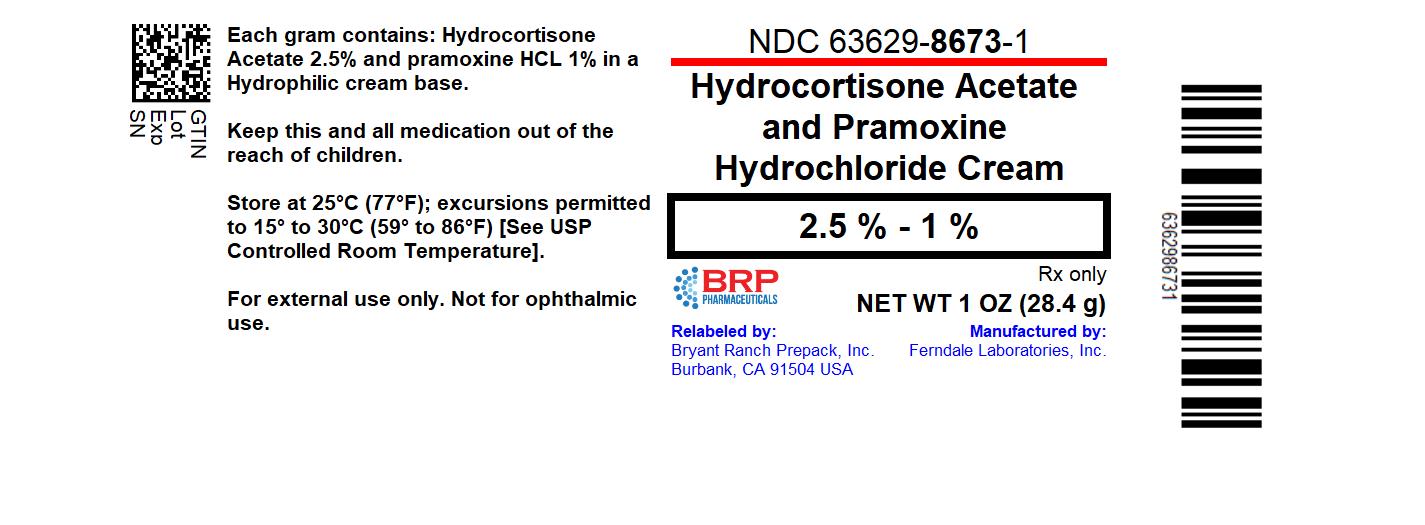
hydrocortisone acetate pramoxine HCl 2.5 g/100g; 1 g/100g Cream, 1 tube — NDC 63629-8673-1 (Billing 63629-8673-01)
This is a package of 1 tube of hydrocortisone acetate pramoxine HCl 2.5 g/100g; 1 g/100g Cream from Bryant Ranch Prepack, marketed since Mar 2011 and currently FDA-listed. It is this product's only package size.
NDC database record
One package, one record: these facts belong to NDC 63629-8673-1 alone.
- Record
- FDA NDC Directory package listing · Human prescription drug
- Code segments
- 63629 labeler · 8673 product · 1 package
- Package marketed since
- Jul 20, 2021
- Sample package
- No — commercial package
- Listing certified through
- Dec 31, 2026
- Barcode (UPC-A, from the NDC)
- 3 6362986731 8
- FDA record last changed
- Jul 24, 2026
Identity & classification
Regulatory identifiers FDA, NLM and CMS codes for this package
Drug-database identifiers Medi-Span GPI and First Databank GCN / HICL / AHFS classification
- GSN (GCN sequence number): 007413
- GCN: 84620
- HICL (First Databank): 015163
- AHFS class code: 84:06.08.00
- RxCUI (RxNorm): 1234506
Where does this data come from?
- FDA openFDA NDC Directory · synced Oct 1, 2026
- FDA label on DailyMed · label index refreshed Oct 6, 2026
- RxNorm (NLM RxNav) · catalog refreshed Oct 1, 2026
- Medi-Span GPI (licensed)
- First Databank (licensed) · refreshed Oct 1, 2026
RxNorm drug class
This medicine belongs to the Local anesthetics class.
Where does this data come from?
- RxClass (NLM) · catalog refreshed Oct 1, 2026
Clinical
Hydrocortisone topical is used to treat redness, swelling, itching, and discomfort of various skin conditions. Hydrocortisone is in a class of medications called corticosteroids. It works by activating natural substances in the skin to reduce swelling, redness, and itching.
Read the full MedlinePlus article ↗This is a topical cream containing hydrocortisone acetate and pramoxine hydrochloride. Hydrocortisone acetate is a corticosteroid typically used to reduce inflammation and itching in skin conditions. Pramoxine hydrochloride is a local anesthetic commonly used to provide temporary relief from pain and itching. The combination is intended for application to affected skin areas to address both inflammatory symptoms and discomfort.
Patient education
Supplement & herbal interactions
Where does this data come from?
- MedlinePlus (NLM) · refreshed Oct 1, 2026
- FDA label on DailyMed · label index refreshed Oct 6, 2026
Ask a licensed pharmacist directly — free, answered by our team.
Pricing
A drug doesn't have one price. Each row is a different public payment system, and none is what you'd pay at the counter — that depends on your insurance. The ⓘ on each row explains what it measures.
| Price system | Per g | Per package |
|---|---|---|
| Retail pharmacies payNADAC · weekly | Not in the retail survey — common for institutional, discontinued, or low-volume packs. | |
| Medicaid paysCMS SDUD · 12 mo | No recent Medicaid claims on file for this NDC — rare and low-volume NDCs are suppressed in the public data. | |
| Medicare drug plans payPart D · quarterly | No Part D plan price is available for this NDC in our data. | |
Where does this data come from?
- CMS NADAC weekly file
- CMS ASP pricing files · refreshed Sep 20, 2026
- CMS Medicaid State Drug Utilization Data · refreshed Oct 6, 2026
- CMS Part D plan pricing files · refreshed Sep 24, 2026
- VA National Acquisition Center price file
Packaging — all sizes for this product
| Package NDC | Description | Marketing start | Marketing end | Status |
|---|---|---|---|---|
| 63629-8673-01 You're viewing this Main listing | 1 TUBE in 1 CARTON / 28.4 g in 1 TUBE | 2021-07-20 | — | Active |
Therapeutic equivalents
| Product | Labeler | Pack | NADAC/unit | TE | Status | Price vs. this |
|---|---|---|---|---|---|---|
| hydrocortisone acetate pramoxine HCl 2.5 g/100g; 1 g/100g 52817-0817-01 | TRUPHARMA, | 1 tube | $1.588 | — | Availability likely | — |
| hydrocortisone acetate pramoxine HCl 2.5 g/100g; 1 g/100g 45802-0124-16 | Padagis | 1 tube | — | — | FDA listed | — |
| hydrocortisone acetate pramoxine HCl 2.5 g/100g; 1 g/100gthis 63629-8673-01 | Bryant | 1 tube | — | — | FDA listed | — |
| hydrocortisone acetate pramoxine HCl 2.5 g/100g; 1 g/100g 63629-8674-01 | Bryant | 1 tube | — | — | FDA listed | — |
| hydrocortisone acetate pramoxine HCl 2.5 g/100g; 1 g/100g 71335-2934-01 | Bryant | 1 tube | — | — | FDA listed | — |
| hydrocortisone acetate pramoxine HCl 2.5 g/100g; 1 g/100g 72162-1394-02 | Bryant | 1 tube | — | — | FDA listed | — |
Where does this data come from?
- FDA openFDA NDC Directory · synced Oct 1, 2026
- FDA Orange Book · refreshed Oct 3, 2026
- CMS NADAC weekly file
Availability & generic status
We did not find an FDA-approved generic match for this exact strength, form and route.
Where does this data come from?
- FDA Orange Book · refreshed Oct 3, 2026
Inactive Ingredients / Excipients
Inactive ingredients, also called excipients, are components of the drug product other than the active ingredient. They may include fillers, dyes, coatings, preservatives, flavors, or other formulation ingredients.
💡 Tap an ingredient (hover on desktop) to see what it is and why it’s used.
-
UNII 936JST6JCN
Cetyl alcohol is a waxy, fatty substance derived from plant or animal sources. It acts as an emulsifier and thickener in medicines, helping blend oil and water components and giving products a smooth, creamy texture.
-
UNII 8CRQ2TH63M
Isopropyl palmitate is an oily liquid derived from palm oil. It acts as an emollient and lubricant in medicines, helping soften the skin or improve how the product spreads and flows.
-
UNII 13A4J4NH9I
A synthetic emulsifier derived from stearic acid and polyethylene glycol. It helps mix oil and water-based ingredients together in liquid medicines and creams to create a smooth, uniform product.
-
UNII 1VPU26JZZ4
Potassium sorbate is a salt derived from sorbic acid, a naturally occurring preservative. It prevents growth of mold, yeast, and some bacteria, extending the medicine's shelf life.
-
UNII 6DC9Q167V3
Propylene glycol is a clear liquid derived from petroleum or vegetable sources. It acts as a solvent, humectant, and preservative in medicines, helping dissolve active ingredients and maintain product stability.
-
UNII X045WJ989B
Sorbic acid is a preservative derived from berries that prevents mold, yeast, and bacterial growth in medicines. It keeps the product stable and safe during storage.
-
UNII 4ELV7Z65AP
Stearic acid is a fatty acid derived from plant or animal sources. It acts as a binder and lubricant in tablets and capsules, helping them hold together and flow smoothly during manufacturing.
-
UNII E8458C1KAA
A synthetic detergent and cleansing agent derived from lauric acid. It helps break down oils and improve how active ingredients mix into the formula, and may also serve as a foaming or emulsifying agent in topical preparations.
-
UNII 059QF0KO0R
Water is a liquid solvent that dissolves and mixes ingredients together in liquid medicines, syrups, and injections. It helps distribute the active drug evenly throughout the product.
9 inactive ingredients listed in the exact product block matched to this NDC.
Where does this data come from?
ingredient classCode="IACT" elements from the exact product block matched by this NDC. Label-section narrative from DailyMed / the openFDA label index is shown separately when available.- FDA label on DailyMed · label index refreshed Oct 6, 2026
- FDA openFDA NDC Directory · synced Oct 1, 2026
Inactive ingredient FAQ
Are inactive ingredients the same for every manufacturer?
Why might an inactive ingredient be missing?
Can inactive ingredients matter?
Manufacturer & labeler
More NDCs from Bryant Ranch Prepack labeler code 63629
- Hydrocortisone 25 mg/g Cream NDC 63629-8667-1
- hydrocortisone 25 mg/mL Lotion NDC 63629-8668-1
- hydrocortisone acetate pramoxine hcl 1 g/100g; 1 g/100g Cream NDC 63629-8669-1
- Hydrocortisone Acetate Pramoxine Hcl 2.5 g/100g; 1 g/100g Cream NDC 63629-8670-1
- Hydrocortisone Acetate Pramoxine Hcl 2.5 g/100g; 1 g/100g Cream NDC 63629-8671-1
- Hydrocortisone Acetate Pramoxine Hcl 2.5 g/100g; 1 g/100g Cream NDC 63629-8672-1
- hydrocortisone acetate pramoxine HCl 2.5 g/100g; 1 g/100g Cream NDC 63629-8674-1
- Ketoconazole 20 mg/mL Shampoo, Suspension NDC 63629-8675-1
- ketoconazole 2 g/100g Aerosol, Foam NDC 63629-8676-1
- ketoconazole 2 g/100g Aerosol, Foam NDC 63629-8677-1
- Mesalamine Kit NDC 63629-8678-1
- Mesalamine Kit NDC 63629-8679-1
Where does this data come from?
- FDA openFDA NDC Directory · synced Oct 1, 2026
- Drugs@FDA
Full prescribing information FDA SPL
🎯 Indications and Usage ▾
INDICATIONS AND USAGE Topical corticosteroids are indicated for the relief of the inflammatory and pruritic manifestations of corticosteroid-responsive dermatoses.
⏱️ Dosage and Administration ▾
DOSAGE AND ADMINISTRATION Topical corticosteroids are generally applied to the affected area as a thin film three to four times daily depending on the severity of the condition. Occlusive dressings may be used for the management of psoriasis or recalcitrant conditions. If an infection develops, the use of occlusive dressings should be discontinued and appropriate antimicrobial therapy instituted.
⛔ Contraindications ▾
CONTRAINDICATIONS Topical corticosteroids are contraindicated in those patients with a history of hypersensitivity to any of the components of the preparation.
🤒 Adverse Reactions ▾
ADVERSE REACTIONS The following local adverse reactions are reported infrequently with topical corticosteroids, but may occur more frequently with the use of occlusive dressings. These reactions are listed in an approximate decreasing order of occurrence: Burning Hypertrichosis Maceration of the skin Itching Acneiform eruptions Secondary infection Irritation Hypopigmentation Skin atrophy Dryness Perioral dermatitis Striae Folliculitis Allergic contact dermatitis Miliaria
🤰 Pregnancy ▾
Pregnancy: Teratogenic Effects: Pregnancy Category C - Corticosteroids are generally teratogenic in laboratory animals when administered systemically at relatively low dosage levels. The more potent corticosteroids have been shown to be teratogenic after dermal application in laboratory animals. There are no adequate and well-controlled studies in pregnant women on teratogenic effects from topically applied corticosteroids.
Therefore, topical corticosteroids should be used during pregnancy only if the potential benefit justifies the potential risk to the fetus. Drugs of this class should not be used extensively on pregnant patients, in large amounts, or for prolonged periods of time.
🧒 Pediatric Use ▾
Pediatric Use - Pediatric patients may demonstrate greater susceptibility to topical corticosteroid induced HPA axis suppression and Cushing's syndrome than mature patients because of a larger skin surface area to body weight ratio. Hypothalamic-pituitary-adrenal (HPA) axis suppression, Cushing's syndrome, and intracranial hypertension have been reported in children receiving topical corticosteroids. Manifestations of adrenal suppression in children include linear growth retardation, delayed weight gain, low plasma cortisol levels, and absence of response to ACTH stimulation.
Manifestations of intracranial hypertension include bulging fontanelles, headaches, and bilateral papilledema. Administration of topical corticosteroids to children should be limited to the least amount compatible with an effective therapeutic regimen. Chronic corticosteroid therapy may interfere with the growth and development of children.
🆘 Overdosage ▾
OVERDOSAGE Topically applied corticosteroids can be absorbed in sufficient amounts to produce systemic effects. (See PRECAUTIONS .)
🧬 Clinical Pharmacology ▾
CLINICAL PHARMACOLOGY Topical corticosteroids share anti-inflammatory, anti-pruritic and vasoconstrictive actions. The mechanism of anti-inflammatory activity of topical corticosteroids is unclear. Various laboratory methods, including vasoconstrictor assays, are used to compare and predict potencies and/or clinical efficacies of the topical corticosteroids.
There is some evidence to suggest that a recognizable correlation exists between vasoconstrictor potency and therapeutic efficacy in man. Pramoxine hydrochloride is a topical anesthetic agent which provides temporary relief from itching and pain. It acts by stabilizing the neuronal membrane of nerve endings with which it comes into contact.
Pharmacokinetics – The extent of percutaneous absorption of topical corticosteroids is determined by many factors including the vehicle, the integrity of the epidermal barrier, and the use of occlusive dressings. Topical corticosteroids can be absorbed from normal intact skin. Inflammation and/or other disease processes in the skin increase percutaneous absorption.
Occlusive dressings substantially increase the percutaneous absorption of topical corticosteroids. Thus, occlusive dressings may be a valuable therapeutic adjunct for treatment of resistant dermatoses. (See DOSAGE AND ADMINISTRATION .) Once absorbed through the skin, topical corticosteroids are handled through pharmacokinetic pathways similar to systemically administered corticosteroids.
Corticosteroids are bound to plasma proteins in varying degrees. Corticosteroids are metabolized primarily in the liver and are then excreted by the kidneys. Some of the topical corticosteroids and their metabolites are also excreted into the bile.
📦 How Supplied / Storage and Handling ▾
HOW SUPPLIED Hydrocortisone Acetate 2.5% and Pramoxine HCl 1% Cream is available as follows: 1 oz tube (NDC 63629-8673-1) Store at 25ºC (77ºF); excursions permitted to 15-30ºC (59-86ºF) [see USP Controlled Room Temperature].
📋 Description ▾
DESCRIPTION Hydrocortisone Acetate 2.5% and Pramoxine HCl 1% Cream is a topical preparation containing hydrocortisone acetate 2.5% w/w and pramoxine hydrochloride 1% w/w in a hydrophilic cream base containing stearic acid, cetyl alcohol, Aquaphor ®, isopropyl palmitate, polyoxyl 40 stearate, propylene glycol, potassium sorbate, sorbic acid, triethanolamine lauryl sulfate, and purified water. Topical corticosteroids are anti-inflammatory and anti-pruritic agents. The structural formula, the chemical name, molecular formula and molecular weight for the active ingredients are presented below.
Image 1
💬 Information for Patients ▾
Information for The Patient - Patients using topical corticosteroids should receive the following information and instructions: 1. This medication is to be used as directed by the physician. It is for external use only.
Avoid contact with the eyes. 2. Patients should be advised not to use this medication for any disorder other than for which it was prescribed.
3. The treated skin area should not be bandaged or otherwise covered or wrapped as to be occlusive unless directed by the physician. 4.
Patients should report any signs of local adverse reactions especially under occlusive dressings. 5. Parents of pediatric patients should be advised not to use tight-fitting diapers or plastic pants on a child being treated in the diaper area, as these garments may constitute occlusive dressings.
⚠️ Precautions ▾
PRECAUTIONS General - Systemic absorption of topical corticosteroids has produced reversible hypothalamicpituitary- adrenal (HPA) axis suppression, manifestations of Cushing's syndrome, hyperglycemia, and glucosuria in some patients. Conditions which augment systemic absorption include the application of the more potent steroids, use over large surface areas, prolonged use, and the addition of occlusive dressings. Therefore, patients receiving a large dose of a potent topical steroid applied to a large surface area and under an occlusive dressing should be evaluated periodically for evidence of HPA axis suppression by using the urinary free cortisol and ACTH stimulation tests.
If HPA axis suppression is noted, an attempt should be made to withdraw the drug, to reduce the frequency of application, or to substitute a less potent steroid. Recovery of HPA axis function is generally prompt and complete upon discontinuation of the drug. Infrequently, signs and symptoms of steroid withdrawal may occur, requiring supplemental systemic corticosteroids.
Children may absorb proportionally larger amounts of topical corticosteroids and thus be more susceptible to systemic toxicity. (See PRECAUTIONS - Pediatric Use .) If irritation develops, topical corticosteroids should be discontinued and appropriate therapy instituted. In the presence of dermatological infections, the use of an appropriate antifungal or antibacterial agent should be instituted.
If a favorable response does not occur promptly, the corticosteroid should be discontinued until the infection has been adequately controlled. Information for The Patient - Patients using topical corticosteroids should receive the following information and instructions: 1. This medication is to be used as directed by the physician.
It is for external use only. Avoid contact with the eyes. 2.
Patients should be advised not to use this medication for any disorder other than for which it was prescribed. 3. The treated skin area should not be bandaged or otherwise covered or wrapped as to be occlusive unless directed by the physician.
4. Patients should report any signs of local adverse reactions especially under occlusive dressings. 5.
Parents of pediatric patients should be advised not to use tight-fitting diapers or plastic pants on a child being treated in the diaper area, as these garments may constitute occlusive dressings. Laboratory Tests - The following tests may be helpful in evaluating the HPA axis suppression: Urinary free cortisol test ACTH stimulation test Carcinogenesis, Mutagenesis, Impairment of Fertility - Long-term animal studies have not been performed to evaluate the carcinogenic potential or the effect on fertility of topical corticosteroids.
Studies to determine mutagenicity with prednisolone and hydrocortisone have revealed negative results. Pregnancy: Teratogenic Effects: Pregnancy Category C - Corticosteroids are generally teratogenic in laboratory animals when administered systemically at relatively low dosage levels. The more potent corticosteroids have been shown to be teratogenic after dermal application in laboratory animals.
There are no adequate and well-controlled studies in pregnant women on teratogenic effects from topically applied corticosteroids. Therefore, topical corticosteroids should be used during pregnancy only if the potential benefit justifies the potential risk to the fetus. Drugs of this class should not be used extensively on pregnant patients, in large amounts, or for prolonged periods of time.
Nursing Mothers - It is not known whether topical administration of corticosteroids could result in sufficient systemic absorption to produce detectable amounts in breast milk. Systemically administered corticosteroids are secreted into breast milk in quantities NOT likely to have a deleterious effect on the infant. Nevertheless, caution should be exercised when topical corticosteroids are administered to a nursing woman.
Pediatric Use - Pediatric patients may… [Excerpted — this section continues on DailyMed.]
🍼 Nursing Mothers ▾
Nursing Mothers - It is not known whether topical administration of corticosteroids could result in sufficient systemic absorption to produce detectable amounts in breast milk. Systemically administered corticosteroids are secreted into breast milk in quantities NOT likely to have a deleterious effect on the infant. Nevertheless, caution should be exercised when topical corticosteroids are administered to a nursing woman.
🧬 Pharmacodynamics ▾
Pharmacokinetics – The extent of percutaneous absorption of topical corticosteroids is determined by many factors including the vehicle, the integrity of the epidermal barrier, and the use of occlusive dressings. Topical corticosteroids can be absorbed from normal intact skin. Inflammation and/or other disease processes in the skin increase percutaneous absorption.
Occlusive dressings substantially increase the percutaneous absorption of topical corticosteroids. Thus, occlusive dressings may be a valuable therapeutic adjunct for treatment of resistant dermatoses. (See DOSAGE AND ADMINISTRATION .) Once absorbed through the skin, topical corticosteroids are handled through pharmacokinetic pathways similar to systemically administered corticosteroids.
Corticosteroids are bound to plasma proteins in varying degrees. Corticosteroids are metabolized primarily in the liver and are then excreted by the kidneys. Some of the topical corticosteroids and their metabolites are also excreted into the bile.
📄 Carcinogenesis, Mutagenesis, Impairment of Fertility ▾
Carcinogenesis, Mutagenesis, Impairment of Fertility - Long-term animal studies have not been performed to evaluate the carcinogenic potential or the effect on fertility of topical corticosteroids. Studies to determine mutagenicity with prednisolone and hydrocortisone have revealed negative results.
📄 Package Label / Principal Display Panel ▾
Hydrocortisone Acetate/Pramoxi Cream #28.4 Label
Reported adverse events (FAERS)
Top reported reactions
Reporter sex
Where does this data come from?
About this NDC listing & data coverage
Listed without an FDA application
This product's marketing category indicates it is marketed without an approved FDA application (no NDA, ANDA, or BLA on file). Having an NDC does not by itself establish FDA approval — the NDC Directory is a listing system, not an approval decision. Approval-linked data such as Orange Book therapeutic-equivalence ratings therefore does not apply.
What data is (and isn’t) available for this NDC — tap to expand
| NDC identity (package / product / labeler codes) | ✓ Available |
| Labeler | ✓ Available |
| Product & package description | ✓ Available |
| Marketing category & status | ✓ Available |
| Active ingredient / dosage form / route | ✓ Available |
| FDA label (SPL via DailyMed) | ✓ Available |
| Package photos | ✓ Available |
| Inactive ingredients (structured) | ✓ Available |
| NADAC pharmacy acquisition price (CMS) | — Not published for this NDC CMS publishes NADAC only for NDCs reported in its retail-pharmacy survey. |
| Orange Book / therapeutic-equivalence data | — Not published for this NDC Applies only to products approved under an NDA/ANDA; many listings are out of scope. |
| HCPCS J-code billing crosswalk | — Not published for this NDC Most self-administered / retail products have no J-code — that is normal. |
| Medicaid utilization (CMS SDUD) | — Not published for this NDC CMS reports utilization only for NDCs with Medicaid claims above its privacy threshold. |