
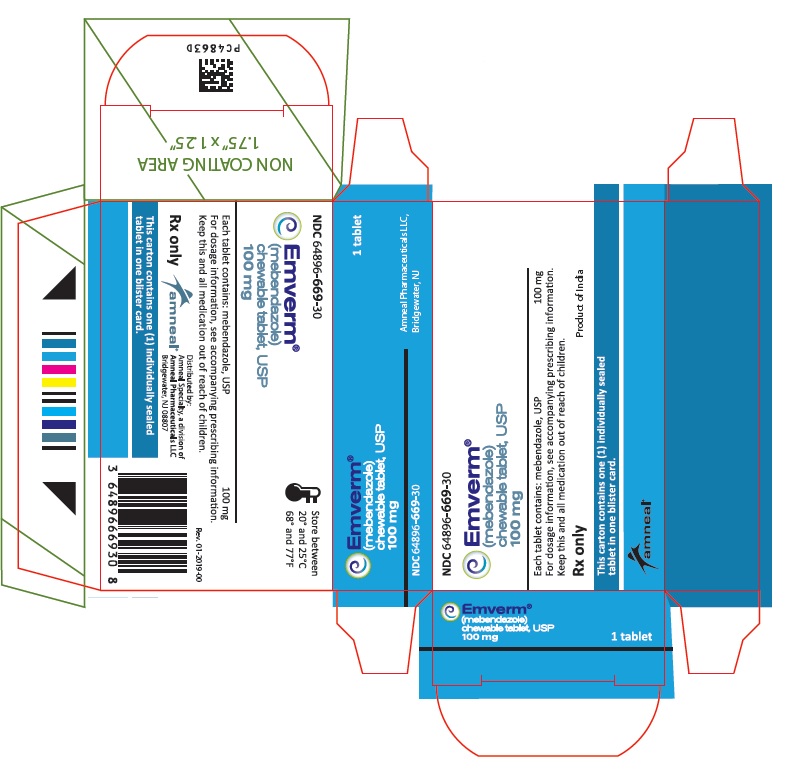
Emverm mebendazole 100 mg Tablet, Chewable, 1 tablet — NDC 64896-669-30 (Billing 64896-0669-30)
This is a package of 1 tablet of Emverm mebendazole 100 mg Tablet, Chewable from Amneal Pharmaceuticals LLC, no longer marketed, no longer in the FDA NDC Directory; retail pharmacies pay about $712.47 per tablet (NADAC). It is this product's only package size.
NDC database record
One package, one record: these facts belong to NDC 64896-669-30 alone.
- Record
- FDA NDC Directory package listing · Human prescription drug
- Code segments
- 64896 labeler · 669 product · 30 package
- Billing quantity
- 1 EA per package
- Barcode (UPC-A, from the NDC)
- 3 6489666930 8
- Medicaid fills, this package
- 13,051 prescriptions in the last four reported quarters
- FDA record last changed
- Jul 17, 2026
Identity & classification
Regulatory identifiers FDA, NLM and CMS codes for this package
Drug-database identifiers Medi-Span GPI and First Databank GCN / HICL / AHFS classification
- GSN (GCN sequence number): 009607
- GCN: 43181
- GPI-14 (Medi-Span): 15000010000505
- HICL (First Databank): 004167
- AHFS class code: 08:08.00.00
Where does this data come from?
- FDA openFDA NDC Directory · synced Oct 8, 2026
- FDA label on DailyMed · label index refreshed Oct 8, 2026
- RxNorm (NLM RxNav) · catalog refreshed Oct 1, 2026
- Medi-Span GPI (licensed)
- First Databank (licensed) · refreshed Oct 8, 2026
Clinical
Mebendazole is used to treat several types of worm infections. Mebendazole (Vermox) is used to treat roundworm and whipworm infections. Mebendazole (Emverm) is used to treat pinworm, whipworm, roundworm, and hookworm infections. Mebendazole is in a class of medications called anthelmintics. It works by killing the worms.
Read the full MedlinePlus article ↗- It treats worm infections in the gut. Emverm covers hookworm, roundworm, pinworm and whipworm in people 2 and older. Vermox Chewable covers roundworm and whipworm in people 1 and o...
- Take it by mouth exactly as prescribed. With Emverm, you can chew it, swallow it, or crush it into food. With Vermox Chewable, chew it completely and don't swallow it whole. No fas...
- Most people have little trouble. Possible effects include stomach pain, nausea, vomiting, diarrhea, gas, loss of appetite and rash. Call your doctor for severe skin reactions, swel...
- Avoid it. Serious skin reactions, including Stevens-Johnson syndrome, have been reported when the two are used together. Tell me or your doctor about every medicine you take.
Patient education
Supplement & herbal interactions
Some supplements/herbs that may interact with Mebendazole — tap one for details:
Where does this data come from?
- MedlinePlus (NLM) · refreshed Oct 8, 2026
- FDA label on DailyMed · label index refreshed Oct 8, 2026
Ask a licensed pharmacist directly — free, answered by our team.
Pricing
A drug doesn't have one price. Each row is a different public payment system, and none is what you'd pay at the counter — that depends on your insurance. The ⓘ on each row explains what it measures.
| Price system | Per ea | Per package |
|---|---|---|
| Retail pharmacies payNADAC · weekly | $712.469 | $712.47 / 1 tablet |
| Medicaid paysCMS SDUD · 12 mo | $706.23 | $706.23 / 1 tablet |
| Medicare drug plans payPart D · Q2 2026 | $707.75 | $707.75 / 1 tablet |
Where does this data come from?
- CMS NADAC weekly file · file of Oct 7, 2026
- CMS ASP pricing files · refreshed Sep 20, 2026
- CMS Medicaid State Drug Utilization Data · through Q4 2025
- CMS Part D plan pricing files · refreshed Sep 24, 2026
- VA National Acquisition Center price file
Packaging — all sizes for this product
| Package NDC | Description | Marketing start | Marketing end | Status |
|---|---|---|---|---|
| 64896-0669-30 You're viewing this Main listing | 1 BLISTER PACK in 1 CARTON / 1 TABLET, CHEWABLE in 1 BLISTER PACK | 2016-02-15 | — | Inactivated by FDA |
Therapeutic equivalents
| Product | Labeler | Pack | NADAC/unit | TE | Status | Price vs. this |
|---|---|---|---|---|---|---|
| Emverm 100 mgthis 64896-0669-30 | Amneal | 1 tablet | $712.469 | — | Discontinued | — |
Where does this data come from?
- FDA openFDA NDC Directory · synced Oct 8, 2026
- FDA Orange Book · refreshed Oct 3, 2026
- CMS NADAC weekly file · file of Oct 7, 2026
Availability & generic status
This product is an FDA-approved generic. Other versions of the same drug are listed under Therapeutic equivalents, least expensive first.
Where does this data come from?
- FDA Orange Book · refreshed Oct 3, 2026
What it looks like
Where does this data come from?
- FDA label on DailyMed · label index refreshed Oct 8, 2026
Inactive Ingredients / Excipients
Inactive ingredients, also called excipients, are components of the drug product other than the active ingredient. They may include fillers, dyes, coatings, preservatives, flavors, or other formulation ingredients.
🧪 Avoiding an ingredient? See Mebendazole inactive ingredients by manufacturer: every current product's list side by side, so you can ask your pharmacy for the version that does not list it.
💡 Tap an ingredient (hover on desktop) to see what it is and why it’s used.
-
UNII 3SY5LH9PMK
Anhydrous lactose is a milk sugar with no water content. It acts as a filler and binder in tablets and capsules, adding bulk and helping ingredients stick together.
-
UNII H77VEI93A8
A synthetic yellow dye used to color medications. It helps identify the drug and make it visually distinctive, with no effect on how the medicine works.
-
UNII 70097M6I30
Magnesium stearate is a salt made from magnesium and stearic acid, a fatty substance. It's used in tablets and capsules as a lubricant and glidant to help ingredients flow smoothly during manufacturing and prevent sticking.
-
UNII OP1R32D61U
Microcrystalline cellulose is a purified form of cellulose, a natural fiber from plant sources. It acts as a binder and filler in tablets and capsules, helping hold ingredients together and give the medicine its shape and size.
-
UNII SB8ZUX40TY
Saccharin sodium is an artificial sweetener made from saccharin salt. It's added to medicines to improve taste, especially in liquid formulations for children or bitter drugs.
-
UNII 368GB5141J
A detergent and foaming agent derived from coconut or palm oil. In medications, it helps break down and mix oil and water-based ingredients, aids in tablet disintegration, and improves how the drug dissolves and spreads in the mouth or digestive system.
-
UNII 5856J3G2A2
A starch-based powder made from potatoes and processed with sodium. It acts as a disintegrant, helping the tablet or capsule break apart quickly in the stomach so the medicine can be absorbed.
-
UNII O8232NY3SJ
A plant-based carbohydrate derived from corn kernels. It acts as a filler to add bulk, a binder to hold ingredients together, and a disintegrant to help the tablet break apart in your stomach for absorption.
-
UNII 4ELV7Z65AP
Stearic acid is a fatty acid derived from plant or animal sources. It acts as a binder and lubricant in tablets and capsules, helping them hold together and flow smoothly during manufacturing.
9 inactive ingredients listed in the exact product block matched to this NDC.
Where does this data come from?
ingredient classCode="IACT" elements from the exact product block matched by this NDC. Label-section narrative from DailyMed / the openFDA label index is shown separately when available.- FDA label on DailyMed · label index refreshed Oct 8, 2026
- FDA openFDA NDC Directory · synced Oct 8, 2026
Inactive ingredient FAQ
Are inactive ingredients the same for every manufacturer?
Why might an inactive ingredient be missing?
Can inactive ingredients matter?
Manufacturer & labeler
More NDCs from Amneal Pharmaceuticals LLC labeler code 64896
- Ongentys opicapone 50 mg Capsule NDC 64896-403-01
- BREKIYA Dihydroergotamine Mesylate 1 mg/mL Injection NDC 64896-509-02
- RYTARY Carbidopa and Levodopa 95 mg; 23.75 mg Capsule, Extended Release NDC 64896-661-01
- RYTARY Carbidopa and Levodopa 145 mg; 36.25 mg Capsule, Extended Release NDC 64896-662-01
- RYTARY Carbidopa and Levodopa 195 mg; 48.75 mg Capsule, Extended Release NDC 64896-663-01
- RYTARY Carbidopa and Levodopa 245 mg; 61.25 mg Capsule, Extended Release NDC 64896-664-01
- Dexedrine Spansule dextroamphetamine sulfate 5 mg Capsule, Extended Release NDC 64896-673-10
- Dexedrine Spansule dextroamphetamine sulfate 10 mg Capsule, Extended Release NDC 64896-674-10
- Dexedrine Spansule dextroamphetamine sulfate 15 mg Capsule, Extended Release NDC 64896-675-10
- Albenza albendazole 200 mg Tablet, Film Coated NDC 64896-693-49
- Oxymorphone hydrochloride 5 mg Tablet, Film Coated, Extended Release NDC 64896-695-01
- Oxymorphone hydrochloride 7.5 mg Tablet, Film Coated, Extended Release NDC 64896-696-01
Where does this data come from?
- FDA openFDA NDC Directory · synced Oct 8, 2026
- Drugs@FDA
Full prescribing information FDA SPL
🎯 Indications and Usage ▾
1 INDICATIONS AND USAGE EMVERM ® is indicated for the treatment of patients two years of age and older with gastrointestinal infections caused by Ancylostoma duodenale (hookworm), Ascaris lumbricoides (roundworm), Enterobius vermicularis (pinworm), Necator americanus (hookworm), and Trichuris trichiura (whipworm). EMVERM ® is an anthelmintic indicated for the treatment of patients two years of age and older with gastrointestinal infections caused by: Ancylostoma duodenale (hookworm), Ascaris lumbricoides (roundworm), Enterobius vermicularis (pinworm), Necator americanus (hookworm), and Trichuris trichiura (whipworm), ( 1 ).
⏱️ Dosage and Administration ▾
2 DOSAGE AND ADMINISTRATION The recommended dosage for EMVERM ® is described in Table 1 below. The same dosage schedule applies to adults and pediatric patients two years of age and older. The tablet may be chewed, swallowed, or crushed and mixed with food.
Table 1: Dosage of EMVERM in Adult and Pediatric Patients (two years of age and older) Pinworm (enterobiasis) Whipworm (trichuriasis) Roundworm (ascariasis) Hookworm Dose 1 tablet once 1 tablet morning and evening for 3 consecutive days 1 tablet morning and evening for 3 consecutive days 1 tablet morning and evening for 3 consecutive days If the patient is not cured three weeks after treatment, a second course of treatment is advised. No special procedures, such as fasting or purging, are required. Adults and Pediatrics : The tablet may be chewed, swallowed, or crushed and mixed with food ( 2 ).
Pinworm (enterobiasis) Whipworm (trichuriasis) Roundworm (ascariasis) Hookworm Dose 1 tablet once 1 tablet morning and evening for 3 consecutive days 1 tablet morning and evening for 3 consecutive days 1 tablet morning and evening for 3 consecutive days
💊 Dosage Forms and Strengths ▾
3 DOSAGE FORMS AND STRENGTHS EMVERM ® (mebendazole) Chewable Tablet, USP: 100 mg, round, light peach-colored, unscored, debossed “ap” above “107” on one side and plain on the other side. Chewable Tablet: 100 mg ( 3 )
⛔ Contraindications ▾
4 CONTRAINDICATIONS EMVERM ® is contraindicated in persons with a known hypersensitivity to the drug or its excipients. Patients with a known hypersensitivity to the drug or its excipients ( 4 )
⚠️ Warnings and Cautions ▾
5 WARNINGS AND PRECAUTIONS Risk of Convulsions: Convulsions in infants below the age of 1 year have been reported (5.1). Hematologic Effects: Neutropenia and agranulocytosis have been reported in patients receiving mebendazole at higher doses and for prolonged duration. Monitor blood counts in these patients (5.2).
Metronidazole and Serious Skin Reactions: Stevens-Johnson syndrome/toxic epidermal necrolysis (SJS/TEN) have been reported with the concomitant use of mebendazole and metronidazole. Avoid concomitant use of mebendazole and metronidazole (5.3).
5.1Risk of Convulsions Although EMVERM ® is approved for use in children two years of age and older, convulsions have been reported in infants below the age of 1 year during post-marketing experience with mebendazole, including EMVERM ® [see Adverse Reactions ( 6.2 ) and Use in Specific Populations ( 8.4 )] .
5.2Hematologic Effects Agranulocytosis and neutropenia have been reported with mebendazole use at higher doses and for more prolonged durations than is recommended for the treatment of soil-transmitted helminth infections. Monitor blood counts if EMVERM ® is used at higher doses or for prolonged duration.
5.3Metronidazole Drug Interaction and Serious Skin Reactions Stevens-Johnson syndrome/toxic epidermal necrolysis (SJS/TEN) have been reported with the concomitant use of mebendazole and metronidazole. Avoid concomitant use of mebendazole, including EMVERM ® and metronidazole.
🤒 Adverse Reactions ▾
6 ADVERSE REACTIONS Adverse reactions reported in clinical trials were anorexia, abdominal pain, diarrhea, flatulence, nausea, vomiting and rash ( 6.1 ). To report SUSPECTED ADVERSE REACTIONS, contact Amneal Pharmaceuticals at 1-877-835-5472 or FDA at 1-800-FDA-1088 or www.fda.gov/medwatch.
6.1Clinical Studies Because clinical trials are conducted under widely varying conditions, adverse reaction rates observed in the clinical trials of a drug cannot be directly compared to rates in the clinical trials of another drug and may not reflect the rates observed in practice. The safety of mebendazole was evaluated in 6276 subjects who participated in 39 clinical trials for treatment of single or mixed parasitic infections of the gastrointestinal tract. In these trials, the formulations, dosages and duration of mebendazole treatment varied.
Adverse reactions reported in mebendazole-treated subjects from the 39 clinical trials are shown in Table 2 below. Table 2: Adverse Reactions Reported in Mebendazole-treated Subjects from 39 Clinical Trials * Adverse Reaction(s) Gastrointestinal Disorders Anorexia Abdominal Pain Diarrhea Flatulence Nausea Vomiting Skin and Subcutaneous Tissue Disorders Rash *Includes mebendazole formulations, dosages and treatment duration other than EMVERM ® 100 mg tablet
6.2Postmarketing Experience The following adverse reactions have been identified in adult and pediatric patients postmarketing with mebendazole formulations and dosages other than the EMVERM ® 100 mg chewable tablet. Because these reactions are reported voluntarily from a population of uncertain size, it is not always possible to reliably estimate their frequency or establish a causal relationship to drug exposure. Table 3: Adverse Reactions Identified During Postmarketing Experience with Mebendazole * Adverse Reaction(s) Blood and Lymphatic System Disorders Agranulocytosis, Neutropenia Immune System Disorders Hypersensitivity including anaphylactic reactions Nervous System Disorders Convulsions, Dizziness Hepatobiliary Disorders Hepatitis, Abnormal liver tests Renal and Urinary Disorders Glomerulonephritis Skin and Subcutaneous Tissue Disorders Toxic epidermal necrolysis, Stevens-Johnson syndrome, Exanthema, Angioedema, Urticaria, Alopecia *Includes mebendazole formulations, dosages and treatment duration other than EMVERM ® 100 mg chewable tablets
🔄 Drug Interactions ▾
7 DRUG INTERACTIONS Concomitant use of mebendazole, including EMVERM ® , and metronidazole should be avoided [see Warnings and Precautions (5.3)] .
👥 Use in Specific Populations ▾
8 USE IN SPECIFIC POPULATIONS
8.1Pregnancy Risk Summary The available published literature on mebendazole use in pregnant women has not reported a clear association between mebendazole and a potential risk of major birth defects or miscarriages [see Data]. There are risks to the mother and fetus associated with untreated helminthic infection during pregnancy [see Clinical Considerations] . In animal reproduction studies, adverse developmental effects (i.e., skeletal malformations, soft tissue malformations, decreased pup weight, embryolethality) were observed when mebendazole was administered to pregnant rats during the period of organogenesis at single oral doses as low as 10 mg/kg (approximately 0.5-fold the total daily maximum recommended human dose [MRHD]).
Maternal toxicity was present at the highest of these doses [see Data]. The estimated background risk of major birth defects and miscarriage for the indicated populations is unknown. All pregnancies have a background risk of birth defect, loss, or other adverse outcomes.
In the U.S. general population, the estimated background risk of major birth defects and miscarriage in clinically recognized pregnancies is 2-4% and 15-20%, respectively. Clinical Considerations Disease-Associated Maternal and/or Embryo/Fetal Risks Untreated soil transmitted helminth infections in pregnancy are associated with adverse outcomes including maternal iron deficiency anemia, low birth weight, neonatal and maternal death. Data Human Data Several published studies, including prospective pregnancy registries, case-control, retrospective cohort, and randomized controlled studies, have reported no association between mebendazole use and a potential risk of major birth defects or miscarriage.
Overall, these studies did not identify a specific pattern or frequency of major birth defects with mebendazole use. However, these studies cannot definitely establish the absence of any mebendazole-associated risk because of methodological limitations, including recall bias, confounding factors and, in some cases, small sample size or exclusion of first trimester mebendazole exposures. Animal Data Embryo-fetal developmental toxicity studies in rats revealed no adverse effects on dams or their progeny at doses up to 2.5 mg/kg/day on gestation days 6–15 (the period of organogenesis).
Dosing at ≥10 mg/kg/day resulted in a lowered body weight gain and a decreased pregnancy rate. Maternal toxicity, including body weight loss in one animal and maternal death in 11 of 20 animals, was seen at 40 mg/kg/day. At 10 mg/kg/day, increased embryo-fetal resorption (100% were resorbed at 40 mg/kg/day), decreased pup weight and increased incidence of malformations (primarily skeletal) were observed.
Mebendazole was also embryotoxic and teratogenic in pregnant rats at single oral doses during organogenesis as low as 10 mg/kg (approximately 0.5-fold the total daily MRHD, based on mg/m 2 ). In embryo-fetal developmental toxicity studies in mice dosed on gestation days 6–15, doses of 10 mg/kg/day and higher resulted in decreased body weight gain at 10 and 40 mg/kg/day and a higher mortality rate at 40 mg/kg/day. At doses of 10 mg/kg/day (approximately 0.2-fold the total daily MRHD, based on mg/m 2 ) and higher, embryo-fetal resorption increased (100% at 40 mg/kg) and fetal malformations, including skeletal, cranial, and soft tissue anomalies, were present.
Dosing of hamsters and rabbits did not result in embryotoxicity or teratogenicity at doses up to 40 mg/kg/day (1.6 to 3.9-fold the total daily MRHD, based on mg/m 2 ). In a peri- and post-natal toxicity study in rats, mebendazole did not adversely affect dams or their progeny at 20 mg/kg/day. At 40 mg/kg (1.9-fold the total daily MRHD, based on mg/m 2 ), a reduction of the number of live pups was observed and there was no survival at weaning.
No abnormalities were found on gross and radiographic examination of pups at birth.
8.2Lactation Risk Summary Limited data from case re… [Excerpted — this section continues on DailyMed.]
🤰 Pregnancy ▾
8.1Pregnancy Risk Summary The available published literature on mebendazole use in pregnant women has not reported a clear association between mebendazole and a potential risk of major birth defects or miscarriages [see Data]. There are risks to the mother and fetus associated with untreated helminthic infection during pregnancy [see Clinical Considerations] . In animal reproduction studies, adverse developmental effects (i.e., skeletal malformations, soft tissue malformations, decreased pup weight, embryolethality) were observed when mebendazole was administered to pregnant rats during the period of organogenesis at single oral doses as low as 10 mg/kg (approximately 0.5-fold the total daily maximum recommended human dose [MRHD]).
Maternal toxicity was present at the highest of these doses [see Data]. The estimated background risk of major birth defects and miscarriage for the indicated populations is unknown. All pregnancies have a background risk of birth defect, loss, or other adverse outcomes.
In the U.S. general population, the estimated background risk of major birth defects and miscarriage in clinically recognized pregnancies is 2-4% and 15-20%, respectively. Clinical Considerations Disease-Associated Maternal and/or Embryo/Fetal Risks Untreated soil transmitted helminth infections in pregnancy are associated with adverse outcomes including maternal iron deficiency anemia, low birth weight, neonatal and maternal death. Data Human Data Several published studies, including prospective pregnancy registries, case-control, retrospective cohort, and randomized controlled studies, have reported no association between mebendazole use and a potential risk of major birth defects or miscarriage.
Overall, these studies did not identify a specific pattern or frequency of major birth defects with mebendazole use. However, these studies cannot definitely establish the absence of any mebendazole-associated risk because of methodological limitations, including recall bias, confounding factors and, in some cases, small sample size or exclusion of first trimester mebendazole exposures. Animal Data Embryo-fetal developmental toxicity studies in rats revealed no adverse effects on dams or their progeny at doses up to 2.5 mg/kg/day on gestation days 6–15 (the period of organogenesis).
Dosing at ≥10 mg/kg/day resulted in a lowered body weight gain and a decreased pregnancy rate. Maternal toxicity, including body weight loss in one animal and maternal death in 11 of 20 animals, was seen at 40 mg/kg/day. At 10 mg/kg/day, increased embryo-fetal resorption (100% were resorbed at 40 mg/kg/day), decreased pup weight and increased incidence of malformations (primarily skeletal) were observed.
Mebendazole was also embryotoxic and teratogenic in pregnant rats at single oral doses during organogenesis as low as 10 mg/kg (approximately 0.5-fold the total daily MRHD, based on mg/m 2 ). In embryo-fetal developmental toxicity studies in mice dosed on gestation days 6–15, doses of 10 mg/kg/day and higher resulted in decreased body weight gain at 10 and 40 mg/kg/day and a higher mortality rate at 40 mg/kg/day. At doses of 10 mg/kg/day (approximately 0.2-fold the total daily MRHD, based on mg/m 2 ) and higher, embryo-fetal resorption increased (100% at 40 mg/kg) and fetal malformations, including skeletal, cranial, and soft tissue anomalies, were present.
Dosing of hamsters and rabbits did not result in embryotoxicity or teratogenicity at doses up to 40 mg/kg/day (1.6 to 3.9-fold the total daily MRHD, based on mg/m 2 ). In a peri- and post-natal toxicity study in rats, mebendazole did not adversely affect dams or their progeny at 20 mg/kg/day. At 40 mg/kg (1.9-fold the total daily MRHD, based on mg/m 2 ), a reduction of the number of live pups was observed and there was no survival at weaning.
No abnormalities were found on gross and radiographic examination of pups at birth.
🧒 Pediatric Use ▾
8.4Pediatric Use The safety and effectiveness of EMVERM ® 100 mg chewable tablets has not been established in pediatric patients less than two years of age. Convulsions have been reported with mebendazole use in children less than one year of age [see Warnings and Precautions (5.1) and Adverse Reactions (6.2)].
🧓 Geriatric Use ▾
8.5Geriatric Use Clinical studies of mebendazole did not include sufficient numbers of subjects aged 65 and older to determine whether they respond differently from younger subjects.
🆘 Overdosage ▾
10 OVERDOSAGE In patients treated at dosages substantially higher than recommended or for prolonged periods of time, the following adverse reactions have been reported: alopecia, reversible transaminase elevations, hepatitis, agranulocytosis, neutropenia, and glomerulonephritis. Symptoms and signs In the event of accidental overdose, gastrointestinal signs/symptoms may occur. Treatment There is no specific antidote.
🧬 Clinical Pharmacology ▾
12 CLINICAL PHARMACOLOGY
12.1Mechanism of Action Mebendazole, a benzimidazole, is an anthelmintic drug [see Microbiology (12.4)] .
12.3Pharmacokinetics Absorption Following oral administration of mebendazole, the majority of the dose remains in the gastrointestinal tract where it exerts an anthelmintic effect locally. Following administration of 100 mg twice daily for three consecutive days, plasma concentrations of EMVERM ® (mebendazole) and its primary metabolite, the 2-amine hydrolyzed metabolite, do not exceed 0.03 mcg/mL and 0.09 mcg/mL, respectively. Dosing with a high fat meal increases the bioavailability of mebendazole, although the overall effect of food on the amount of drug remaining in the gastrointestinal tract is not expected to be substantial.
Distribution The plasma protein binding of mebendazole is 90 to 95%. The volume of distribution is 1 to 2 L/kg, indicating that absorbed mebendazole penetrates areas outside the vascular space. Metabolism Orally administered mebendazole is extensively metabolized primarily by the liver.
Plasma concentrations of its major metabolites (hydrolyzed and reduced forms of mebendazole) are higher than those of mebendazole. All metabolites are devoid of anthelmintic activity. Impaired hepatic function, impaired metabolism, or impaired biliary elimination may lead to higher plasma concentrations of mebendazole.
Excretion Mebendazole, the conjugated forms of mebendazole, and its metabolites likely undergo some degree of enterohepatic recirculation. The apparent elimination half-life after an oral dose ranges from 3 to 6 hours in most patients. Less than 2% of orally administered mebendazole is excreted in urine and the remainder in the feces as unchanged drug or its metabolites.
12.4Microbiology Mechanism of Action Mebendazole interferes with cellular tubulin formation in the helminth and causes ultrastructural degenerative changes in its intestine. As a result, its glucose uptake and the digestive and reproductive functions are disrupted, leading to immobilization, inhibition of egg production and death of the helminth. Antimicrobial Activity Mebendazole is active against: Ancylostoma duodenale Ascaris lumbricoides Enterobius vermicularis Necator americanus Trichuris trichiura Resistance There is a potential for development of resistance to mebendazole.
The mechanism of resistance to mebendazole is likely due to changes of beta-tubulin protein, which reduces binding of mebendazole to beta-tubulin; however, the clinical significance of this is not known.
🧬 Mechanism of Action ▾
12.1Mechanism of Action Mebendazole, a benzimidazole, is an anthelmintic drug [see Microbiology (12.4)] .
📦 How Supplied / Storage and Handling ▾
16 HOW SUPPLIED/STORAGE AND HANDLING EMVERM ® (mebendazole) Chewable Tablet, USP is available as a 100 mg, round, light peach-colored, unscored, debossed “ap” above “107” on one side and plain on the other side. They are supplied as follows: Blister package of 1 tablet NDC 64896-669-30 Store at 68° to 77°F (20° to 25°C) [See USP Controlled Room Temperature].
📋 Description ▾
11 DESCRIPTION EMVERM ® (mebendazole) is an orally administered, synthetic anthelmintic available as chewable tablets, each containing 100 mg of mebendazole, USP. Inactive ingredients are: microcrystalline cellulose, corn starch, anhydrous lactose NF, sodium starch glycolate, magnesium stearate, stearic acid, sodium lauryl sulfate, sodium saccharin, and FD&C Yellow #6. Chemically, mebendazole is methyl 5-benzoylbenzimidazole-2-carbamate with a molecular formula of C 16 H 13 N 3 O 3 and the following structural formula: Mebendazole, USP is a white to slightly yellow powder with a molecular weight of 295.29.
It is less than 0.05% soluble in water, dilute mineral acid solutions, alcohol, ether and chloroform, but is soluble in formic acid. 1
💬 Information for Patients ▾
17 PATIENT COUNSELING INFORMATION Advise the patient to read the FDA-approved patient labeling (Patient Information). Advise patients that: Taking EMVERM ® and metronidazole together may cause serious skin reactions and should be avoided [see Warning and Precautions ( 5.3 )]. EMVERM ® can be taken with or without food [see Dosage and Administration ( 2 )].
🧬 Pharmacokinetics ▾
12.3Pharmacokinetics Absorption Following oral administration of mebendazole, the majority of the dose remains in the gastrointestinal tract where it exerts an anthelmintic effect locally. Following administration of 100 mg twice daily for three consecutive days, plasma concentrations of EMVERM ® (mebendazole) and its primary metabolite, the 2-amine hydrolyzed metabolite, do not exceed 0.03 mcg/mL and 0.09 mcg/mL, respectively. Dosing with a high fat meal increases the bioavailability of mebendazole, although the overall effect of food on the amount of drug remaining in the gastrointestinal tract is not expected to be substantial.
Distribution The plasma protein binding of mebendazole is 90 to 95%. The volume of distribution is 1 to 2 L/kg, indicating that absorbed mebendazole penetrates areas outside the vascular space. Metabolism Orally administered mebendazole is extensively metabolized primarily by the liver.
Plasma concentrations of its major metabolites (hydrolyzed and reduced forms of mebendazole) are higher than those of mebendazole. All metabolites are devoid of anthelmintic activity. Impaired hepatic function, impaired metabolism, or impaired biliary elimination may lead to higher plasma concentrations of mebendazole.
Excretion Mebendazole, the conjugated forms of mebendazole, and its metabolites likely undergo some degree of enterohepatic recirculation. The apparent elimination half-life after an oral dose ranges from 3 to 6 hours in most patients. Less than 2% of orally administered mebendazole is excreted in urine and the remainder in the feces as unchanged drug or its metabolites.
🔬 Clinical Studies ▾
14 CLINICAL STUDIES Efficacy rates derived from various studies are shown in Table 4 below: Table 4: Mean Cure Rates and Egg Reductions from Clinical Studies Pinworm (enterobiasis) Whipworm (trichuriasis) Roundworm (ascariasis) Hookworm Cure rates mean 95% 68% 98% 96% Egg reduction mean - 93% 99% 99%
🧪 Nonclinical Toxicology ▾
13 NONCLINICAL TOXICOLOGY
13.1Carcinogenesis, Mutagenesis, Impairment of Fertility In carcinogenicity tests of mebendazole in mice and rats, no carcinogenic effects were seen at doses as high as 40 mg/kg (one to two times the human dose, based on mg/m 2 ) given daily over two years. No mutagenic activity was observed with mebendazole in a bacterial reverse gene mutation test. Mebendazole was mutagenic in the absence of S-9 when tested using a continuous (24 hour) treatment incubation period in the mouse lymphoma thymidine kinase assay.
Mebendazole was aneugenic in vitro in mammalian somatic cells. In the in vivo mouse micronucleus assay, orally administered mebendazole induced an increased frequency of micronucleated polychromatic erythrocytes with evidence suggestive of aneugenicity. Doses up to 40 mg/kg in rats (2 times the total daily human dose, based on mg/m 2 ), given to males for 60 days and to females for 14 days prior to gestation, had no effect upon fetuses and offspring.
📄 Carcinogenesis, Mutagenesis, Impairment of Fertility ▾
13.1Carcinogenesis, Mutagenesis, Impairment of Fertility In carcinogenicity tests of mebendazole in mice and rats, no carcinogenic effects were seen at doses as high as 40 mg/kg (one to two times the human dose, based on mg/m 2 ) given daily over two years. No mutagenic activity was observed with mebendazole in a bacterial reverse gene mutation test. Mebendazole was mutagenic in the absence of S-9 when tested using a continuous (24 hour) treatment incubation period in the mouse lymphoma thymidine kinase assay.
Mebendazole was aneugenic in vitro in mammalian somatic cells. In the in vivo mouse micronucleus assay, orally administered mebendazole induced an increased frequency of micronucleated polychromatic erythrocytes with evidence suggestive of aneugenicity. Doses up to 40 mg/kg in rats (2 times the total daily human dose, based on mg/m 2 ), given to males for 60 days and to females for 14 days prior to gestation, had no effect upon fetuses and offspring.
📄 Patient Package Insert ▾
PATIENT INFORMATION EMVERM ® (EM-verm) (mebendazole) Chewable Tablets USP, for oral use What is EMVERM? Emverm is a prescription medicine used to treat adults and children 2 years of age and older with intestinal worm infections caused by pinworm, whipworm, roundworm, or hookworm. Who should not take EMVERM?
Do not take Emverm if you are allergic to mebendazole or any of the ingredients in Emverm. See the end of this leaflet for a complete list of ingredients in Emverm. Before you take EMVERM, tell your healthcare provider about all of your medical conditions, including if you: are pregnant or plan to become pregnant.
It is not known if EMVERM will harm your unborn baby. are breastfeeding or plan to breastfeed. EMVERM can pass into your milk and may harm your baby. Talk to your healthcare provider about the best way to feed your baby if you take EMVERM.
Do not breastfeed while taking EMVERM. Tell your healthcare provider about all the medicines you take , including prescription and over-the-counter medicines, vitamins, and herbal supplements. Using EMVERM with certain other medicines can change the way these medicines act, causing serious side effects.
Know the medicines you take. Keep a list of them to show to your healthcare provider or pharmacist when you get a new medicine. How should I take EMVERM?
Take EMVERM exactly as your healthcare provider tells you to take it. Take EMVERM by mouth with or without food. EMVERM tablets may be chewed, swallowed, or crushed and mixed with food.
If you take too much EMVERM, you might have symptoms that include stomach cramps, nausea, vomiting or diarrhea. What should I avoid while taking EMVERM? Do not take Emverm with metronidazole (a medicine used to treat bacterial and protozoan infections) as serious skin reactions called Stevens-Johnson syndrome (SJS) and toxic epidermal necrolysis (TEN) can happen.
What are the possible side effects of EMVERM? EMVERM may cause serious side effects, including: Low white blood cell count (neutropenia). Neutropenia can cause you to get other infections.
Your healthcare provider will check your blood count regularly during your treatment with EMVERM. Tell your healthcare provider right away if you have a fever or any signs of an infection while taking EMVERM Severe skin reactions (Stevens-Johnson syndrome and toxic epidermal necrolysis). EMVERM may cause rare, but serious skin reactions when taken with metronidazole and other medicines that contain mebendazole.
These severe allergic reactions may be life-threatening and need to be treated in a hospital. Call your healthcare provider right away or get emergency medical help if you have any allergic reactions or the following symptoms: severe skin blisters sores around the mouth, nose, eyes, vagina or penis (genitals) peeling skin swollen face, lips, mouth, tongue or throat itchy rash (hives) The most common side effects of EMVERM include: loss of appetite (anorexia) stomach pain diarrhea passing gas nausea vomiting rash Tell your healthcare provider if you have any side effect that bothers you or does not go away.
These are not all the possible side effects of EMVERM. Call your doctor for medical advice about side effects. You may report side effects to FDA at 1-800-FDA-1088.
How should I store EMVERM? Store at room temperature between 68°F to 77°F (20°C to 25°C). Safely throw away medicine that is out of date or no longer needed.
Keep EMVERM and all medicines out of the reach of children. General information about the safe and effective use of EMVERM. Medicines are sometimes prescribed for purposes other than those listed in a Patient Information leaflet.
Do not use EMVERM for a condition for which it was not prescribed. Do not give EMVERM to other people, even if they have the same symptoms that you have. It may harm them.
You can ask your pharmacist or healthcare provider for information about EMVERM that is written for health professionals. What are the ingredients in EMVERM? Active ingredient: me… [Excerpted — this section continues on DailyMed.]
📄 Package Label / Principal Display Panel ▾
PRINCIPAL DISPLAY PANEL 1
Medicaid utilization & spend
Medicare Part D spend CMS · PART D · 2026 (Q1)
About this NDC listing & data coverage
What data is (and isn’t) available for this NDC — tap to expand
| NDC identity (package / product / labeler codes) | ✓ Available |
| Labeler | ✓ Available |
| Product & package description | ✓ Available |
| Marketing category & status | ✓ Available |
| Active ingredient / dosage form / route | ✓ Available |
| FDA label (SPL via DailyMed) | ✓ Available |
| Package photos | ✓ Available |
| Inactive ingredients (structured) | ✓ Available |
| NADAC pharmacy acquisition price (CMS) | ✓ Available |
| Orange Book / therapeutic-equivalence data | — Not published for this NDC Applies only to products approved under an NDA/ANDA; many listings are out of scope. |
| HCPCS J-code billing crosswalk | — Not published for this NDC Most self-administered / retail products have no J-code — that is normal. |
| Medicaid utilization (CMS SDUD) | ✓ Available |