
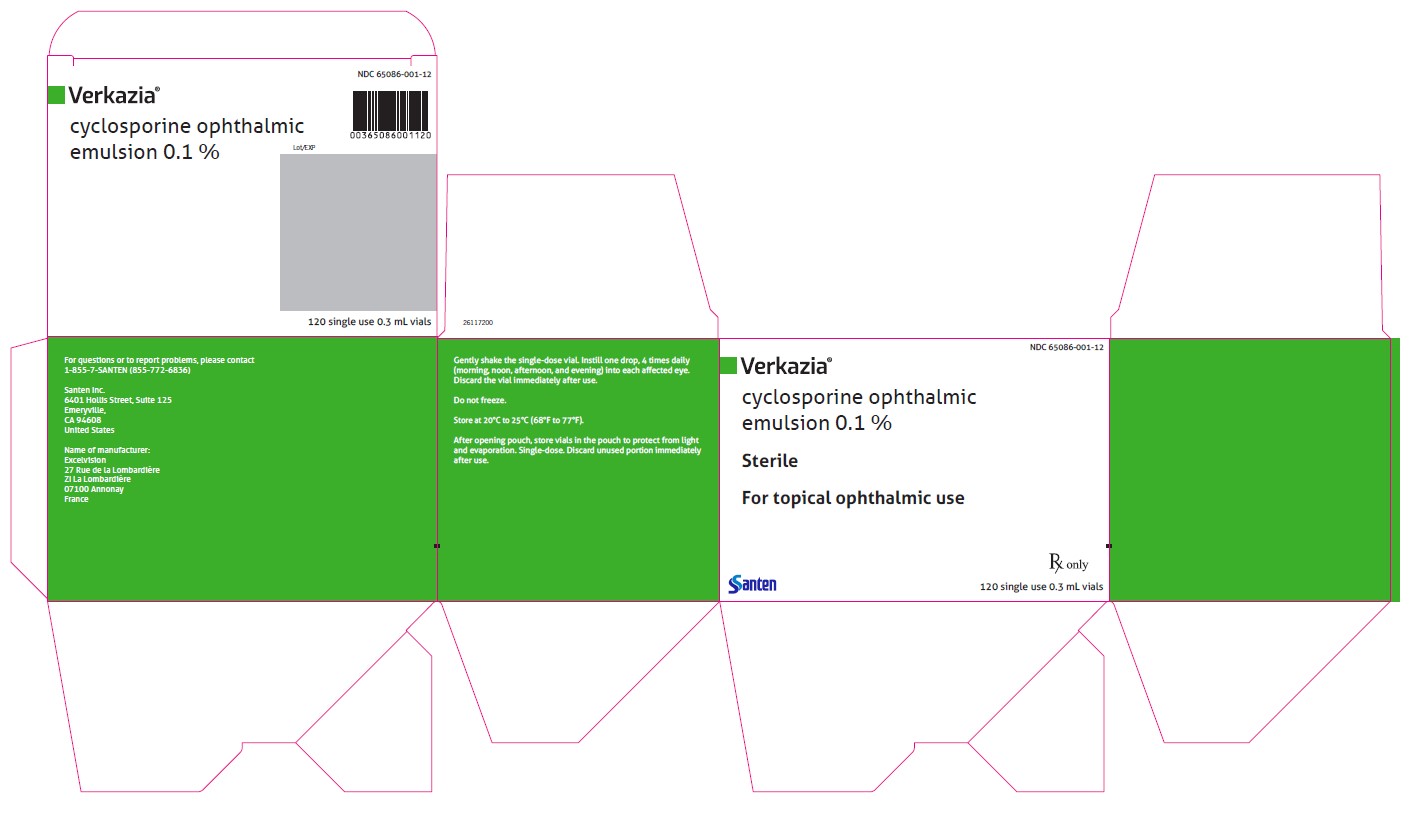
Verkazia cyclosporine 1 mg/mL Emulsion — NDC 65086-001-12 (Billing 65086-0001-12)
This is a package of Verkazia cyclosporine 1 mg/mL Emulsion from Santen Incorporated, marketed since Feb 2022 and currently FDA-listed. It is the main listing for this product, which comes in 2 package sizes.
NDC database record
One package, one record: these facts belong to NDC 65086-001-12 alone.
- Record
- FDA NDC Directory package listing · Human prescription drug
- Code segments
- 65086 labeler · 001 product · 12 package
- Package marketed since
- Feb 1, 2022
- Sample package
- No — commercial package
- Listing certified through
- Dec 31, 2026
- Barcode (UPC-A, from the NDC)
- 3 6508600112 0
- Medicaid fills, this package
- 526 prescriptions in the last four reported quarters
- FDA record last changed
- Jul 24, 2026
Identity & classification
Regulatory identifiers FDA, NLM and CMS codes for this package
Drug-database identifiers Medi-Span GPI and First Databank GCN / HICL / AHFS classification
- GSN (GCN sequence number): 080149
- GCN: 46848
- GPI-14 (Medi-Span): 86720020001630
- HICL (First Databank): 004524
- AHFS class code: 52:08.00.00
- RxCUI (RxNorm): 2590608
Where does this data come from?
- FDA openFDA NDC Directory · synced Oct 8, 2026
- FDA label on DailyMed · label index refreshed Oct 8, 2026
- RxNorm (NLM RxNav) · catalog refreshed Oct 1, 2026
- Medi-Span GPI (licensed)
- First Databank (licensed) · refreshed Oct 8, 2026
RxNorm drug class
This medicine belongs to the Calcineurin Inhibitor Immunosuppressant class.
Where does this data come from?
- RxClass (NLM) · catalog refreshed Oct 1, 2026
Clinical
- It depends on the product. Oral forms help prevent organ rejection after kidney, liver or heart transplants. Some oral products also treat severe rheumatoid arthritis and severe pl...
- Oral modified forms like Neoral and Gengraf are taken twice a day. Keep your timing and meal routine consistent from day to day. Follow your prescriber's directions and the label.
- No, avoid grapefruit and grapefruit juice. They raise cyclosporine levels in your blood, which can increase side effects.
- Not on your own. Modified products such as Neoral and Gengraf are not interchangeable with Sandimmune, and switching needs your doctor's supervision and extra blood level checks.
Patient education
Supplement & herbal interactions
Some supplements/herbs that may interact with Cyclosporine — tap one for details:
Cyclosporine may be associated with lower levels of 1 nutrient — worth a chat with your pharmacist, not a cause for alarm.
Where does this data come from?
- MedlinePlus (NLM) · refreshed Oct 8, 2026
- FDA label on DailyMed · label index refreshed Oct 8, 2026
Ask a licensed pharmacist directly — free, answered by our team.
Pricing
A drug doesn't have one price. Each row is a different public payment system, and none is what you'd pay at the counter — that depends on your insurance. The ⓘ on each row explains what it measures.
| Price system | Per mL | Per package |
|---|---|---|
| Retail pharmacies payNADAC · weekly | Not in the retail survey — common for institutional, discontinued, or low-volume packs. | |
| Medicaid paysCMS SDUD · 12 mo | $51.04 | $1,837.51 / 36 ml |
| Medicare drug plans payPart D · Q2 2026 | $15.84 | $570.06 / 36 ml |
Where does this data come from?
- CMS NADAC weekly file
- CMS ASP pricing files · refreshed Sep 20, 2026
- CMS Medicaid State Drug Utilization Data · through Q1 2026
- CMS Part D plan pricing files · refreshed Sep 24, 2026
- VA National Acquisition Center price file
Packaging — all sizes for this product
| Package NDC | Description | Marketing start | Marketing end | Status |
|---|---|---|---|---|
| 65086-0001-05 65086-001-05 | 1 POUCH in 1 CARTON / 5 VIAL, SINGLE-DOSE in 1 POUCH / .3 mL in 1 VIAL, SINGLE-DOSE Sample | 2022-02-01 | — | Active |
| 65086-0001-12 You're viewing this Main listing | 24 POUCH in 1 CARTON / 5 VIAL, SINGLE-DOSE in 1 POUCH / .3 mL in 1 VIAL, SINGLE-DOSE | 2022-02-01 | — | Active |
In Medicaid, this is the most-dispensed pack of this product — about 100% of fills over the last four reported quarters. See all packs ↓
Pack size FAQ
What quantity is in this package?
What NDC number is used to bill for this package of Verkazia cyclosporine 1 mg/mL Emulsion?
Therapeutic equivalents
| Product | Labeler | Pack | NADAC/unit | TE | Status | Price vs. this |
|---|---|---|---|---|---|---|
| Verkazia 1 mg/mLthis 65086-0001-12 | Santen | 24 pouches | — | — | FDA listed | — |
| Verkazia 1 mg/mL 82667-0014-00 | Harrow | 5 pouches | — | — | FDA listed | — |
Where does this data come from?
- FDA openFDA NDC Directory · synced Oct 8, 2026
- FDA Orange Book · refreshed Oct 3, 2026
- CMS NADAC weekly file
Availability & generic status
We did not find an FDA-approved generic match for this exact strength, form and route. Patent/protection dates below may affect future generic timing.
Why the date isn’t exact: Generic timing can change because patents may be challenged, settled, licensed, added, removed, or worked around with a narrower label — and FDA approval does not always mean a pharmacy can get the generic today.
🛈 What do these terms mean?
- Patent
- Legal protection listed in the Orange Book that may delay generic approval or launch. Issued by the U.S. Patent & Trademark Office.
- Substance patent
- Covers the active drug molecule itself — the hardest to design around. A generic generally can’t launch until it expires.
- Formulation (product) patent
- Covers a specific formulation or dosage form. A generic can sometimes work around it with a different formulation.
- Method-of-use patent
- A patent covering one specific approved use of the drug — not necessarily the whole molecule. A generic can sometimes launch with a “skinny label” that carves out the protected use and keeps the others.
- Skinny label
- A generic label that omits a still-patented use when the FDA allows it — letting a generic reach the market for the unprotected uses.
- Exclusivity
- FDA-granted marketing protection, separate from patents — e.g. 5-yr new chemical entity, 7-yr orphan drug, or a +6-month pediatric extension.
- Paragraph IV
- A generic applicant’s formal challenge to a listed patent. It can potentially lead to earlier generic entry, but often involves litigation or a settlement.
- RLD / RS
- Reference Listed Drug — the brand product the FDA uses as the reference for generic applications. Reference Standard — the product the FDA expects generics to compare against in bioequivalence testing.
- TE / AB rating
- FDA therapeutic-equivalence rating. An AB rating generally means the FDA considers a generic therapeutically equivalent to — and substitutable for — the brand.
- LOE (loss of exclusivity)
- The latest patent or exclusivity currently listed — the loss-of-exclusivity / latest-listed-protection date shown on this page. Paragraph-IV challenges and settlements can move the real date earlier; FDA approval and a manufacturer’s decision to market can move it later.
Built from the FDA Orange Book. The bars above are scaled to each protection’s expiry; the red LOE marker is the last one to lapse.
| Patent | Type | Use code | Expires |
|---|---|---|---|
| US 11612658 ↗ | Method of use | U-3560 | Jan 27, 2026 |
| US 8298568 ↗ | Drug product | — | Nov 3, 2027 |
| US 9132071 ↗ | Drug product | — | Jun 2, 2029 |
| US 9220694 ↗ | Drug product | — | Jan 27, 2026 |
| US 9956289 ↗ | Drug product | — | Jan 27, 2026 |
| US 7973081 ↗ | Drug product | — | Jan 27, 2026 |
| US 8524779 ↗ | Drug product | — | Jan 27, 2026 |
| Code | What it grants | Expires |
|---|---|---|
| ODE-358 | Orphan Drug Exclusivity (7-year) | Jun 23, 2028 |
Is there a generic version of VERKAZIA 0.1% EYE EMULSION?
The FDA approved a generic — why can’t I get it at my pharmacy yet?
Why do different websites show different generic release dates?
What does “FDA listed” mean?
What does a patent or protection date mean here?
What does “current Orange Book estimate” mean?
Can a generic come out before the last patent expires?
Can a generic come out after the listed dates?
What is the difference between patents and exclusivity?
Why are there multiple patent dates?
Where does this data come from?
- FDA Orange Book · refreshed Oct 3, 2026
What it looks like
Where does this data come from?
- FDA label on DailyMed · label index refreshed Oct 8, 2026
Inactive Ingredients / Excipients
Inactive ingredients, also called excipients, are components of the drug product other than the active ingredient. They may include fillers, dyes, coatings, preservatives, flavors, or other formulation ingredients.
🧪 Avoiding an ingredient? See Cyclosporine inactive ingredients by manufacturer: every current product's list side by side, so you can ask your pharmacy for the version that does not list it.
💡 Tap an ingredient (hover on desktop) to see what it is and why it’s used.
-
UNII 85474O1N9D
A synthetic antimicrobial compound used as a preservative in liquid medicines and solutions. It helps prevent bacterial and fungal growth, extending the product's shelf life.
-
UNII PDC6A3C0OX
Glycerin is a clear, thick liquid derived from plant oils or fats. It acts as a humectant to retain moisture, a sweetener, and a solvent in medications.
-
UNII C9H2L21V7U
A fat derived from coconut or palm oil containing shorter fatty acid chains. It serves as a solvent and carrier to help dissolve or suspend active ingredients, improving absorption and stability in liquid formulations.
-
UNII LQA7B6G8JG
A synthetic polymer made by combining water-soluble compounds. It acts as a surfactant and solubilizer to help mix oil and water-based ingredients, improving the medicine's texture and how active ingredients dissolve.
-
UNII 55X04QC32I
A strong alkaline chemical used to adjust and maintain the pH balance of liquid medicines. It helps keep the medicine stable and ensures it stays effective during storage.
-
UNII Y27PUL9H56
Tyloxapol is a synthetic detergent and surfactant used in medications as a solubilizer and emulsifier. It helps dissolve or blend ingredients that don't naturally mix well, improving how the medicine disperses in liquid formulations.
-
UNII 059QF0KO0R
Water is a liquid solvent that dissolves and mixes ingredients together in liquid medicines, syrups, and injections. It helps distribute the active drug evenly throughout the product.
7 inactive ingredients listed in the exact product block matched to this NDC.
Where does this data come from?
ingredient classCode="IACT" elements from the exact product block matched by this NDC. Label-section narrative from DailyMed / the openFDA label index is shown separately when available.- FDA label on DailyMed · label index refreshed Oct 8, 2026
- FDA openFDA NDC Directory · synced Oct 8, 2026
Inactive ingredient FAQ
Are inactive ingredients the same for every manufacturer?
Why might an inactive ingredient be missing?
Can inactive ingredients matter?
Manufacturer & labeler
Where does this data come from?
- FDA openFDA NDC Directory · synced Oct 8, 2026
- Drugs@FDA
Full prescribing information FDA SPL
🎯 Indications and Usage ▾
1 INDICATIONS AND USAGE Verkazia ophthalmic emulsion is indicated for the treatment of vernal keratoconjunctivitis (VKC) in children and adults. Verkazia ophthalmic emulsion is a calcineurin inhibitor immunosuppressant indicated for the treatment of vernal keratoconjunctivitis in children and adults ( 1 )
⏱️ Dosage and Administration ▾
2 DOSAGE AND ADMINISTRATION Instill one drop of Verkazia, 4 times daily (morning, noon, afternoon, and evening) in each affected eye ( 2 )
2.1General Dosing Information Gently shake the single-dose vial several times to obtain a uniform, white, opaque emulsion before use. Contact lenses should be removed before applying Verkazia and may be reinserted 15 minutes after administration. If a dose is missed, treatment should be continued as normal, at the next scheduled administration.
If more than one topical ophthalmic product is being used, administer the eye drops at least 10 minutes apart to avoid diluting products. Administer Verkazia 10 minutes prior to using any eye ointment, gel or other viscous eye drops. Discard the vial immediately after use.
2.2Recommended Dosage and Dose Administration Instill one drop of Verkazia, 4 times daily (morning, noon, afternoon, and evening) into each affected eye. Treatment can be discontinued after signs and symptoms are resolved and can be reinitiated if there is a recurrence.
2.1General Dosing Information Gently shake the single-dose vial several times to obtain a uniform, white, opaque emulsion before use. Contact lenses should be removed before applying Verkazia and may be reinserted 15 minutes after administration. If a dose is missed, treatment should be continued as normal, at the next scheduled administration.
If more than one topical ophthalmic product is being used, administer the eye drops at least 10 minutes apart to avoid diluting products. Administer Verkazia 10 minutes prior to using any eye ointment, gel or other viscous eye drops. Discard the vial immediately after use.
2.2Recommended Dosage and Dose Administration Instill one drop of Verkazia, 4 times daily (morning, noon, afternoon, and evening) into each affected eye. Treatment can be discontinued after signs and symptoms are resolved and can be reinitiated if there is a recurrence.
💊 Dosage Forms and Strengths ▾
3 DOSAGE FORM AND STRENGTH Ophthalmic emulsion: 0.1% (1 mg/mL) cyclosporine Ophthalmic emulsion: 0.1% (1 mg/mL) cyclosporine ( 3 )
⛔ Contraindications ▾
4 CONTRAINDICATIONS None None ( 4 )
⚠️ Warnings and Cautions ▾
5 WARNINGS AND PRECAUTIONS To avoid the potential for eye injury and contamination, advise patient not to touch the vial tip to the eye or other surfaces ( 5.1 )
5.1Potential for Eye Injury and Contamination To avoid the potential for eye injury or contamination, advise patients not to touch the vial tip to the eye or other surfaces.
5.1Potential for Eye Injury and Contamination To avoid the potential for eye injury or contamination, advise patients not to touch the vial tip to the eye or other surfaces.
🤒 Adverse Reactions ▾
6 ADVERSE REACTIONS The most common adverse reactions following the use of Verkazia were eye pain (12%) and eye pruritus (8%) ( 6.1 ) To report SUSPECTED ADVERSE REACTIONS, contact Santen at 1-855-7-SANTEN (855-772-6836) or FDA at 1-800-FDA-1088 or www.fda.gov/medwatch. See 17 for PATIENT COUNSELING INFORMATION and FDA‑approved patient labeling.
6.1Clinical Trials Experience Since clinical trials are conducted under widely varying conditions, adverse reaction rates observed in the clinical trials of a drug cannot be directly compared to rates in the clinical trials of another drug and may not reflect the rates observed in practice. In the VEKTIS study, a multicenter, randomized, double-masked, placebo‑controlled trial, a total of 57 patients received Verkazia dosed four times a day (QID) for 4 months. Forty-two (42) patients received Verkazia in an 8 month extension, safety follow-up of the VEKTIS study.
In the NOVATIVE study, a multicenter, randomized, double-masked, placebo‑controlled trial, 39 patients received Verkazia 1 mg/mL dosed QID for one month. A total of 53 patients received Verkazia 1 mg/mL QID during a 3-month safety follow‑up. The majority of the treated patients were male (79%).
The most common adverse reactions reported in greater than 5% of patients were eye pain (12%) and eye pruritus (8%) which were usually transitory and occurred during instillation (Table 1). Table 1: Adverse Reactions Reported in ≥ 1% of Patients Receiving Verkazia (N=135) Eye Disorders Eye pain a 12% Eye pruritus b 8% Ocular discomfort c 6% Visual acuity reduced 5% Ocular hyperemia 4% Systemic Cough 5% Headache 4% Upper respiratory tract infection 2% a Including eye pain and instillation site pain b Including eye pruritus and instillation site pruritus c Including foreign body sensation and ocular discomfort
6.1Clinical Trials Experience Since clinical trials are conducted under widely varying conditions, adverse reaction rates observed in the clinical trials of a drug cannot be directly compared to rates in the clinical trials of another drug and may not reflect the rates observed in practice. In the VEKTIS study, a multicenter, randomized, double-masked, placebo‑controlled trial, a total of 57 patients received Verkazia dosed four times a day (QID) for 4 months. Forty-two (42) patients received Verkazia in an 8 month extension, safety follow-up of the VEKTIS study.
In the NOVATIVE study, a multicenter, randomized, double-masked, placebo‑controlled trial, 39 patients received Verkazia 1 mg/mL dosed QID for one month. A total of 53 patients received Verkazia 1 mg/mL QID during a 3-month safety follow‑up. The majority of the treated patients were male (79%).
The most common adverse reactions reported in greater than 5% of patients were eye pain (12%) and eye pruritus (8%) which were usually transitory and occurred during instillation (Table 1). Table 1: Adverse Reactions Reported in ≥ 1% of Patients Receiving Verkazia (N=135) Eye Disorders Eye pain a 12% Eye pruritus b 8% Ocular discomfort c 6% Visual acuity reduced 5% Ocular hyperemia 4% Systemic Cough 5% Headache 4% Upper respiratory tract infection 2% a Including eye pain and instillation site pain b Including eye pruritus and instillation site pruritus c Including foreign body sensation and ocular discomfort
👥 Use in Specific Populations ▾
8 USE IN SPECIFIC POPULATIONS
8.1Pregnancy Risk Summary There are no adequate and well-controlled studies of Verkazia administration in pregnant women to inform a drug-associated risk. Oral administration of cyclosporine to pregnant rats or rabbits did not produce teratogenicity at clinically relevant doses [see Data ] . Data Animal Data Oral administration of cyclosporine oral solution (USP) to pregnant rats or rabbits was teratogenic at maternally toxic doses of 30 mg/kg/day in rats and 100 mg/kg/day in rabbits, as indicated by increased pre- and postnatal mortality, reduced fetal weight and skeletal retardations.
These doses (normalized to body weight) were approximately 320 and 2150 times higher than the daily maximum recommended human ophthalmic dose (MRHOD) of 0.015 mg/kg/day, respectively. No adverse embryofetal effects were observed in rats or rabbits receiving cyclosporine during organogenesis at oral doses up to 17 mg/kg/day or 30 mg/kg/day, respectively (approximately 185 and 650 times higher than the MRHOD, respectively). An oral dose of 45 mg/kg/day cyclosporine (approximately 485 times higher than MRHOD) administered to rats from Day 15 of pregnancy until Day 21 postpartum produced maternal toxicity and an increase in postnatal mortality in offspring.
No adverse effects in mothers or offspring were observed at oral doses of up to 15 mg/kg/day (160 times greater than MRHOD).
8.2Lactation Risk Summary There is no information regarding the presence of cyclosporine in human milk following topical administration or on the effect of Verkazia on the breastfed infants and milk production. Administration of oral cyclosporine to rats during lactation did not produce adverse effects in offspring at clinically relevant doses [see Pregnancy ( 8.1 )] . The development and health benefits of breastfeeding should be considered along with the mother’s clinical need for Verkazia and any potential adverse effects on the breast-fed child from cyclosporine.
8.3Females and Males of Reproductive Potential Infertility There are no data on the effects of Verkazia on human fertility. No impairment of fertility has been reported in animals receiving intravenous cyclosporine [ see Impairment of Fertility ( 13.1 ) ] .
8.4Pediatric Use Verkazia’s safety and effectiveness has been established in patients from 4 through 18 years of age.
8.5Geriatric Use The safety and effectiveness of Verkazia have not been studied in geriatric patients.
8.1Pregnancy Risk Summary There are no adequate and well-controlled studies of Verkazia administration in pregnant women to inform a drug-associated risk. Oral administration of cyclosporine to pregnant rats or rabbits did not produce teratogenicity at clinically relevant doses [see Data ] . Data Animal Data Oral administration of cyclosporine oral solution (USP) to pregnant rats or rabbits was teratogenic at maternally toxic doses of 30 mg/kg/day in rats and 100 mg/kg/day in rabbits, as indicated by increased pre- and postnatal mortality, reduced fetal weight and skeletal retardations.
These doses (normalized to body weight) were approximately 320 and 2150 times higher than the daily maximum recommended human ophthalmic dose (MRHOD) of 0.015 mg/kg/day, respectively. No adverse embryofetal effects were observed in rats or rabbits receiving cyclosporine during organogenesis at oral doses up to 17 mg/kg/day or 30 mg/kg/day, respectively (approximately 185 and 650 times higher than the MRHOD, respectively). An oral dose of 45 mg/kg/day cyclosporine (approximately 485 times higher than MRHOD) administered to rats from Day 15 of pregnancy until Day 21 postpartum produced maternal toxicity and an increase in postnatal mortality in offspring.
No adverse effects in mothers or offspring were observed at oral doses of up to 15 mg/kg/day (160 times greater than MRHOD).
8.2Lactation Risk Summary There is no information regarding the presence of cyclosporine in human milk following topical administration or on the… [Excerpted — this section continues on DailyMed.]
🧬 Clinical Pharmacology ▾
12 CLINICAL PHARMACOLOGY
12.1Mechanism of Action Cyclosporine is a calcineurin inhibitor immunosuppressant agent when administered systemically. Following ocular administration, cyclosporine is thought to act by blocking the release of pro-inflammatory cytokines such as IL-2. The exact mechanism of action in the treatment of VKC is not known.
12.3Pharmacokinetics Blood concentrations of cyclosporine were measured in 55 patients administered 1 drop of Verkazia 4 times daily in the VEKTIS Study. Blood samples were collected before administration and after 2, 4, and 12 months of administration of Verkazia. Among those patients that had quantifiable levels of cyclosporine during the study, the maximum blood level of cyclosporine was 0.67 ng/mL.
12.1Mechanism of Action Cyclosporine is a calcineurin inhibitor immunosuppressant agent when administered systemically. Following ocular administration, cyclosporine is thought to act by blocking the release of pro-inflammatory cytokines such as IL-2. The exact mechanism of action in the treatment of VKC is not known.
12.3Pharmacokinetics Blood concentrations of cyclosporine were measured in 55 patients administered 1 drop of Verkazia 4 times daily in the VEKTIS Study. Blood samples were collected before administration and after 2, 4, and 12 months of administration of Verkazia. Among those patients that had quantifiable levels of cyclosporine during the study, the maximum blood level of cyclosporine was 0.67 ng/mL.
📦 How Supplied / Storage and Handling ▾
16 HOW SUPPLIED/STORAGE AND HANDLING Verkazia (cyclosporine ophthalmic emulsion) 0.1% is packaged in low-density polyethylene single-dose vials. Each vial contains 0.3 mL fill; 5 vials are packaged in an aluminum pouch; 24 pouches are packaged in a box of 120 vials. The entire contents of each box of 120 vials must be dispensed intact.
120 Single-Dose Vials 0.3 mL each — NDC 65086-001-12 Storage: Do not freeze Verkazia. Store at 20°C to 25°C (68°F to 77°F). After opening the aluminum pouch, the single-dose vial should be kept in the pouch to protect from light and avoid evaporation.
Any opened individual single-dose vial with any remaining emulsion should be discarded immediately after use.
📋 Description ▾
11 DESCRIPTION Verkazia (cyclosporine ophthalmic emulsion) 0.1% contains a topical calcineurin inhibitor immunosuppressant. Cyclosporine is a white or almost white powder. Cyclosporine’s chemical name is Cyclo[[( E )-(2 S ,3 R ,4 R )-3-hydroxy-4-methyl-2-(methylamino)-6-octenoyl]-L-2-aminobutyryl- N -methylglycyl- N -methyl-L-leucyl-L-valyl- N -methyl-L-leucyl-L-alanyl-D-alanyl- N -methyl-L-leucyl- N -methyl-L-leucyl- N -methyl-L-valyl] and it has the following structure: Structural Formula Formula: C 62 H 111 N 11 O 12 Mol.
Wt.: 1202.61 Verkazia ophthalmic emulsion is a sterile, unpreserved topical emulsion. It appears as a milky-white homogeneous emulsion. It has an osmolality of approximately 265 mOsmol/kg and a pH of 5-7.
Each mL of Verkazia ophthalmic emulsion contains: Active: Cyclosporine 1 mg/mL. Inactives: Cetalkonium chloride, Glycerol, Medium-chain triglycerides, Poloxamer 188, Sodium Hydroxide to adjust pH, Tyloxapol and Water for Injection. Structural Formula
🔬 Clinical Studies ▾
14 CLINICAL STUDIES The safety and efficacy of Verkazia for the treatment of VKC was evaluated in two randomized, multi-center, double-masked, vehicle-controlled, clinical trials (VEKTIS Study NCT01751126 and NOVATIVE Study NCT00328653). In the VEKTIS study, patients with severe VKC were randomized to four times daily of Verkazia 1 mg/mL or two times daily (BID) of Verkazia 1 mg/mL and vehicle group for the first 4 months (Period 1). Similarly, in the NOVATIVE study, patients with moderate to severe VKC were randomized to QID of Verkazia 1 mg/mL or QID of cyclosporine ophthalmic emulsion 0.5 mg/mL and vehicle group for the first 1 month (Period 1).
In both studies, patients randomized to the vehicle group were switched to Verkazia (QID or BID) from Month 4 to Month 12 in VEKTIS Study and to cyclosporine ophthalmic emulsion 0.5 mg/mL QID or 1 mg/mL from Month 1 to Month 4 in NOVATIVE Study (Period 2). A total of 168 and 118 patients were enrolled in the VEKTIS and NOVATIVE studies for the efficacy analyses, respectively. Patients’ age ranged from 4 through 17 years (mean age 9 years) in VEKTIS and 4 through 21 years (mean age 9 years) in NOVATIVE, with most patients being between 4 and 11 years of age (76% in VEKTIS and 80% in NOVATIVE) and male (79% in VEKTIS and 81% in NOVATIVE).
Most of the patients had both limbal and tarsal forms of VKC (65% in VEKTIS and 74% in NOVATIVE). In both studies, patients had experienced VKC for a mean of 3 years prior to enrollment and all patients had a history of at least one recurrence of VKC in the year prior to study entry. In the VEKTIS study, key efficacy evaluation was based on the change in corneal fluorescein staining (CFS) score and in itching score over 4 months.
The results at each month are presented in Table 2 for the CFS score and in Table 3 for the Itching score. Table 2: Efficacy Results of the Mean Change in Keratitis Score from Baseline at Each Visit (Full Analysis Set) [1] Treatment differences (numbers in the middle of the horizontal lines) and 95% confidence intervals (horizontal lines) are based on ANCOVA model including baseline CFS score and the proportion of time potentially spent in taking study medication during the VKC season as covariate. For subjects that received rescue therapy during the study, all post-rescue data were imputed by the last available data observed prior to rescue initiation.
Note 1: CFS score was measured at each month using a 5-point scale (0 = no stain, and 5 = more stain). Note 2: The Full Analysis Set included all randomized subjects that received at least one drop of study medication. Table 3: Efficacy Results of the Mean Change in Itching Score from Baseline at Each Visit (Full Analysis Set) [1] Treatment differences (numbers in the middle of the horizontal lines) and 95% confidence intervals (horizontal lines) are based on ANCOVA model including baseline Itching score and the proportion of time potentially spent in taking study medication as covariate.
For subjects that received rescue therapy during the study, all post-rescue data were imputed by the last available data observed prior to rescue initiation. Note 1: Itching score at each visit was measured using a Visual Analogue Scale (0 = no itch to 100 = maximal itch). Analyses of the CFS score and Itching score at Month 1 of the efficacy evaluation period in the NOVATIVE Study also provided supporting evidence.
Table 2 Table 3
🧪 Nonclinical Toxicology ▾
13 NONCLINICAL TOXICOLOGY
13.1Carcinogenesis, Mutagenesis, Impairment of Fertility Carcinogenesis Systemic carcinogenicity studies were carried out in male and female mice and rats. In the 78-week oral (diet) mouse study, at doses of 1, 4, and 16 mg/kg/day, evidence of a statistically significant trend was found for lymphocytic lymphomas in females, and the incidence of hepatocellular carcinomas in mid-dose males significantly exceeded the control value. The low dose in mice is approximately 5 times greater than MRHOD.
In the 24-month oral (diet) rat study, conducted at 0.5, 2, and 8 mg/kg/day, pancreatic islet cell adenomas significantly exceeded the control rate in the low dose level. The hepatocellular carcinomas and pancreatic islet cell adenomas were not dose related. The low dose in rats is approximately 5 times greater than MRHOD.
Mutagenesis In genetic toxicity tests, cyclosporine has not been found to be mutagenic/genotoxic in the Ames Test, the V79-HGPRT Test, the micronucleus test in mice and Chinese hamsters, the chromosome-aberration tests in Chinese hamster bone-marrow, the mouse dominant lethal assay, and the DNA-repair test in sperm from treated mice. Cyclosporine was positive in an in vitro sister chromatid exchange (SCE) assay using human lymphocytes. Impairment of Fertility Oral administration of cyclosporine to rats for 12 weeks (male) and 2 weeks (female) prior to mating produced no adverse effects on fertility at doses up to 15 mg/kg/day (160 times higher than MRHOD).
13.1Carcinogenesis, Mutagenesis, Impairment of Fertility Carcinogenesis Systemic carcinogenicity studies were carried out in male and female mice and rats. In the 78-week oral (diet) mouse study, at doses of 1, 4, and 16 mg/kg/day, evidence of a statistically significant trend was found for lymphocytic lymphomas in females, and the incidence of hepatocellular carcinomas in mid-dose males significantly exceeded the control value. The low dose in mice is approximately 5 times greater than MRHOD.
In the 24-month oral (diet) rat study, conducted at 0.5, 2, and 8 mg/kg/day, pancreatic islet cell adenomas significantly exceeded the control rate in the low dose level. The hepatocellular carcinomas and pancreatic islet cell adenomas were not dose related. The low dose in rats is approximately 5 times greater than MRHOD.
Mutagenesis In genetic toxicity tests, cyclosporine has not been found to be mutagenic/genotoxic in the Ames Test, the V79-HGPRT Test, the micronucleus test in mice and Chinese hamsters, the chromosome-aberration tests in Chinese hamster bone-marrow, the mouse dominant lethal assay, and the DNA-repair test in sperm from treated mice. Cyclosporine was positive in an in vitro sister chromatid exchange (SCE) assay using human lymphocytes. Impairment of Fertility Oral administration of cyclosporine to rats for 12 weeks (male) and 2 weeks (female) prior to mating produced no adverse effects on fertility at doses up to 15 mg/kg/day (160 times higher than MRHOD).
📖 Instructions for Use ▾
INSTRUCTIONS FOR USE INSTRUCTIONS FOR USE Verkazia® [ver ka' zee ah] (cyclosporine ophthalmic emulsion, 0.1%) for topical ophthalmic use Read this Instructions for Use before you start using Verkazia and each time you get a refill. There may be new information. This leaflet does not take the place of talking to your healthcare provider about your medical condition or your treatment.
Important Information You Need to Know Before Using Verkazia Verkazia is for use in the eye. Verkazia is supplied as 5 single-dose vials packaged in a foil pouch. If you are using any other eye drops, use each eye drop at least 10 minutes apart from each other, including Verkazia.
If you are using any eye ointment, gel or other thicker in consistency (viscous) eye drops, use Verkazia 10 minutes before using them. Do not let the tip of the Verkazia vial touch your eye or any other surfaces to avoid contamination or injury to your eye. Adults should help children when starting treatment.
Adults should continue to help until the child is able to properly use Verkazia alone. Use 1 drop of Verkazia in the affected eye or eyes, 4 times a day (morning, noon, afternoon and evening). There is enough medicine in one vial to use in both eyes.
Throw away (discard) the vial immediately after use. If you forget to use Verkazia, skip that dose and continue with the next dose as planned. Contact lenses should be taken out before using Verkazia and wait at least 15 minutes after giving the dose before putting the contact lenses back into your eyes.
Do not use Verkazia after the expiration date (EXP) appearing on the outer carton, pouch and single-dose vial. The expiration date is the last day of that month. Using Verkazia Follow the instructions ( Step 1 to Step 12 ) each time you use Verkazia.
If there is anything that you do not understand, ask your healthcare provider. Step 1 . Wash your hands.
Step 2 . Open the aluminum pouch, which contains 5 single-dose vials. Step 3 .
Take 1 vial from the aluminum pouch. Leave the remaining vials in the pouch. Step 4 .
Gently shake the vial. Step 5 . Twist off the cap (see Figure A ).
Figure A Step 6 . Pull down your lower eyelid (see Figure B ). Figure B Step 7 .
Tilt your head back and look up. Step 8 . Gently squeeze 1 drop of the medicine onto your eye.
Make sure that the tip of the vial does not touch your eye. If a drop misses your eye, try again. Step 9 .
Blink a few times so that the medicine spreads across your eye. Step 10 . After using Verkazia, press the corner of your eye closest to your nose and gently close the eyelid for 2 minutes (see Figure C ).
Figure C Step 11 . If you need to use drops in both eyes, repeat Steps 6 to 10 for your other eye. There is enough medicine in one single-dose vial to use in both eyes.
Step 12 . Throw away the vial with any remaining medicine after use. Storing Verkazia Store Verkazia at room temperature between 68°F to 77°F (20°C to 25°C).
Do not freeze. After opening the pouch, keep vials in the pouch to protect from light and evaporation. Throwing away Verkazia Any open vial with any medicine left over should be thrown out right after use.
Talk with your healthcare provider if you want more information about Verkazia. Distributed by: Santen Incorporated 6401 Hollis St., Suite 125 Emeryville, CA 94608 This Instructions for Use has been approved by the U.S. Food and Drug Administration.
Approved: June 2021 Figure A Figure B Figure C
📄 Package Label / Principal Display Panel ▾
PRINCIPAL DISPLAY PANEL NDC 65086-001-12 Verkazia® cyclosporine ophthalmic emulsion 0.1% Sterile For topical ophthalmic use Rx only Santen 120 single use 0.3 mL vials PDP 120 carton
PRINCIPAL DISPLAY PANEL NDC 65086-001-05 Verkazia® cyclosporine ophthalmic emulsion 0.1% Sterile For topical ophthalmic use Professional courtesy package Not for sale Rx only Santen 5 single use 0.3 mL vials PDP sample carton
Medicaid utilization & spend
Medicaid utilization by pack size
Medicare Part D spend CMS · PART D · 2025 (Q1-Q4)
About this NDC listing & data coverage
What data is (and isn’t) available for this NDC — tap to expand
| NDC identity (package / product / labeler codes) | ✓ Available |
| Labeler | ✓ Available |
| Product & package description | ✓ Available |
| Marketing category & status | ✓ Available |
| Active ingredient / dosage form / route | ✓ Available |
| FDA label (SPL via DailyMed) | ✓ Available |
| Package photos | ✓ Available |
| Inactive ingredients (structured) | ✓ Available |
| NADAC pharmacy acquisition price (CMS) | — Not published for this NDC CMS publishes NADAC only for NDCs reported in its retail-pharmacy survey. |
| Orange Book / therapeutic-equivalence data | ✓ Available |
| HCPCS J-code billing crosswalk | — Not published for this NDC Most self-administered / retail products have no J-code — that is normal. |
| Medicaid utilization (CMS SDUD) | ✓ Available |