
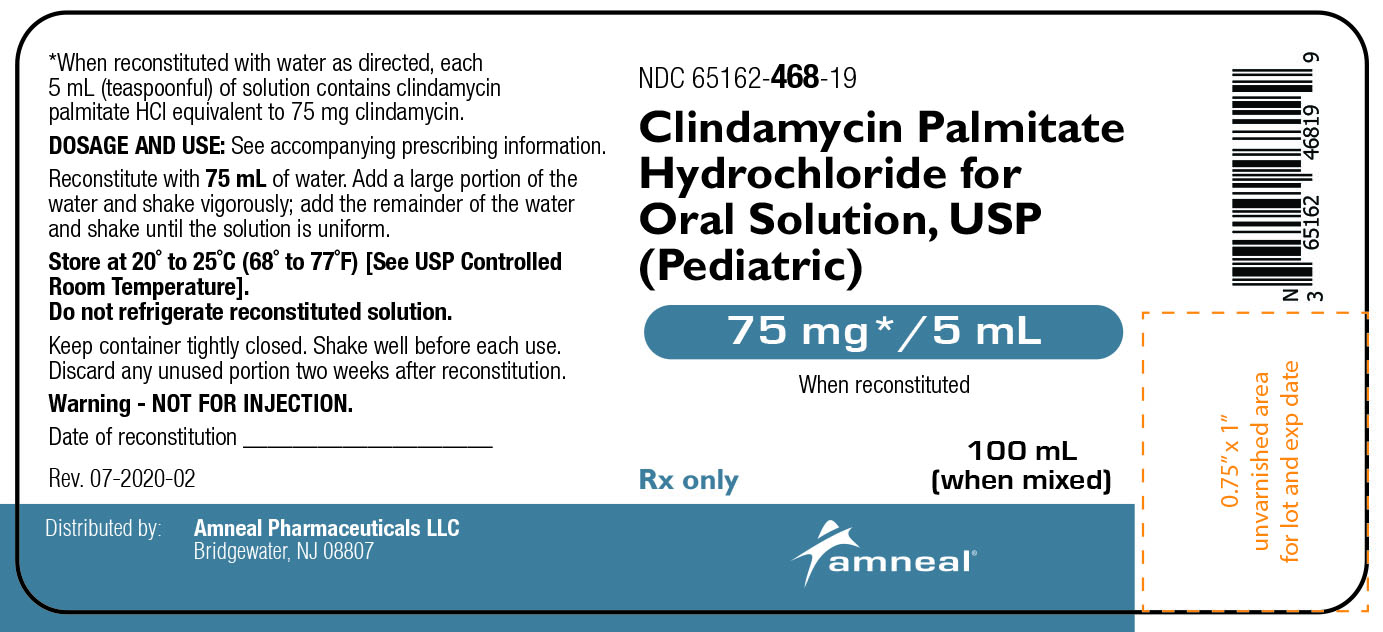
Clindamycin Palmitate Hydrochloride (Pediatric) 75 mg/5mL Powder, For Solution — NDC 65162-468-19 (Billing 65162-0468-19)
This is a package of Clindamycin Palmitate Hydrochloride (Pediatric) 75 mg/5mL Powder, For Solution from Amneal Pharmaceuticals LLC, no longer marketed (first marketed Sep 2013), no longer in the FDA NDC Directory; retail pharmacies pay about $0.1288 per mL (NADAC). It is this product's only package size.
NDC database record
One package, one record: these facts belong to NDC 65162-468-19 alone.
- Record
- FDA NDC Directory package listing · Human prescription drug
- Code segments
- 65162 labeler · 468 product · 19 package
- Package marketed since
- Sep 2, 2013
- Sample package
- No — commercial package
- Listing certified through
- Dec 31, 2027
- Barcode (UPC-A, from the NDC)
- 3 6516246819 9
- Medicaid fills, this package
- 448 prescriptions in the last four reported quarters
- FDA record last changed
- Jul 24, 2026
Other active recalls for Clindamycin Palmitate Hydrochloride (different manufacturers) — 1 · tap to view
Identity & classification
Regulatory identifiers FDA, NLM and CMS codes for this package
Drug-database identifiers Medi-Span GPI and First Databank GCN / HICL / AHFS classification
- GSN (GCN sequence number): 009346
- GCN: 40860
- GPI-14 (Medi-Span): 16220020222120
- HICL (First Databank): 019818
- AHFS class code: 08:12.28.20
- RxCUI (RxNorm): 562266
Where does this data come from?
- FDA openFDA NDC Directory · synced Oct 1, 2026
- FDA label on DailyMed · label index refreshed Oct 6, 2026
- RxNorm (NLM RxNav) · catalog refreshed Oct 1, 2026
- Medi-Span GPI (licensed)
- First Databank (licensed) · refreshed Oct 1, 2026
RxNorm drug class
This medicine belongs to the Lincosamide Antibacterial class.
Where does this data come from?
- RxClass (NLM) · catalog refreshed Oct 1, 2026
Clinical
- It treats serious bacterial infections, such as anaerobic infections, skin, lung, abdominal, gynecological, and bone and joint infections, depending on the product. It is often use...
- Swallow them with a full glass of water and stay upright for at least 30 minutes afterward. This helps prevent irritation of your throat. Take it as often as your prescriber says a...
- Rash, nausea, vomiting, stomach pain and itching are among the more commonly reported effects. Call your doctor right away if you get severe, watery or bloody diarrhea, even weeks...
- What side effects are normal, and when should I call you?
Patient education
Supplement & herbal interactions
Where does this data come from?
- MedlinePlus (NLM) · refreshed Oct 1, 2026
- FDA label on DailyMed · label index refreshed Oct 6, 2026
Ask a licensed pharmacist directly — free, answered by our team.
Pricing
A drug doesn't have one price. Each row is a different public payment system, and none is what you'd pay at the counter — that depends on your insurance. The ⓘ on each row explains what it measures.
| Price system | Per mL | Per package |
|---|---|---|
| Retail pharmacies payNADAC · weekly | $0.129 | $12.88 / 100 ml |
| Medicaid paysCMS SDUD · 12 mo | $0.1772 | $17.72 / 100 ml |
| Medicare drug plans payPart D · quarterly | No Part D plan price is available for this NDC in our data. | |
Where does this data come from?
- CMS NADAC weekly file · file of Sep 30, 2026
- CMS ASP pricing files · refreshed Sep 20, 2026
- CMS Medicaid State Drug Utilization Data · through Q1 2026
- CMS Part D plan pricing files · refreshed Sep 24, 2026
- VA National Acquisition Center price file
Packaging — all sizes for this product
| Package NDC | Description | Marketing start | Marketing end | Status |
|---|---|---|---|---|
| 65162-0468-19 You're viewing this Main listing | 1 BOTTLE in 1 CARTON / 100 mL in 1 BOTTLE | 2013-09-02 | — | Discontinued by firm |
Therapeutic equivalents
| Product | Labeler | Pack | NADAC/unit | TE | Status | Price vs. this |
|---|---|---|---|---|---|---|
| Clindamycin Palmitate Hydrochloride (Pediatric) 75 mg/5mL 16714-0483-01 | NorthStar | 1 bottle | $0.129 | AA | Availability likely | — |
| clindamycin palmitate hydrochloride 75 mg/5mL 23155-0603-51 | Heritage | 1 bottle | $0.129 | AA | Availability likely | — |
| Clindamycin Palmitate Hydrochloride (Pediatric) 75 mg/5mL 53746-0468-19 | Amneal | 1 bottle | $0.129 | — | Availability likely | — |
| CLINDAMYCIN PALMITATE HYDROCHLORIDE (Pediatric) 75 mg/5mL 64980-0511-10 | Rising | 100 ml | $0.129 | AA | Availability likely | — |
| Clindamycin Palmitate Hydrochloride (Pediatric) 75 mg/5mLthis 65162-0468-19 | Amneal | 1 bottle | $0.129 | — | Discontinued | — |
| Clindamycin Palmitate Hydrochloride (Pediatric) 75 mg/5mL 65862-0596-01 | Aurobindo | 1 bottle | $0.129 | AA | Availability likely | — |
| Cleocin Pediatric 75 mg/5mL 00009-0760-04 | Pharmacia | 1 bottle | — | AA | Discontinued | — |
| Clindamycin Palmitate Hydrochloride 75 mg/5mL 62135-0926-01 | Chartwell | 100 ml | — | AA | FDA listed | — |
| CLINDAMYCIN PALMITATE HYDROCHLORIDE (Pediatric) 75 mg/5mL 63629-2391-01 | Bryant | 100 ml | — | AA | FDA listed | — |
| CLINDAMYCIN PALMITATE HYDROCHLORIDE (Pediatric) 75 mg/5mL 72162-1809-01 | Bryant | 100 ml | — | AA | FDA listed | — |
Where does this data come from?
- FDA openFDA NDC Directory · synced Oct 1, 2026
- FDA Orange Book · refreshed Oct 3, 2026
- CMS NADAC weekly file · file of Sep 30, 2026
Availability & generic status
This product is an FDA-approved generic. Other versions of the same drug are listed under Therapeutic equivalents, least expensive first.
Where does this data come from?
- FDA Orange Book · refreshed Oct 3, 2026
Inactive Ingredients / Excipients
Inactive ingredients, also called excipients, are components of the drug product other than the active ingredient. They may include fillers, dyes, coatings, preservatives, flavors, or other formulation ingredients.
🧪 Avoiding an ingredient? See Clindamycin inactive ingredients by manufacturer: every current product's list side by side, so you can ask your pharmacy for the version that does not list it.
💡 Tap an ingredient (hover on desktop) to see what it is and why it’s used.
-
UNII BUC5I9595W
A natural flavoring derived from cherry fruit that gives the medicine its cherry taste. It helps mask bitter drug flavors and makes the medication more pleasant to take.
-
UNII 14255EXE39
Ethylparaben is a preservative, a chemical that stops bacteria and mold from growing in the medicine. It keeps the product safe and effective throughout its shelf life.
-
UNII 7CVR7L4A2D
A starch-derived carbohydrate produced by breaking down corn, potato, or tapioca starch. It functions as a filler and binder to give the medicine bulk and texture, and sometimes as a mild sweetener or texture enhancer in powders and tablets.
-
UNII LQA7B6G8JG
A synthetic polymer made by combining water-soluble compounds. It acts as a surfactant and solubilizer to help mix oil and water-based ingredients, improving the medicine's texture and how active ingredients dissolve.
-
UNII C151H8M554
A natural sugar derived from sugar cane or sugar beets. It's used as a sweetener, filler, and binder to improve taste, add bulk, and help hold tablet or capsule ingredients together.
5 inactive ingredients listed in the exact product block matched to this NDC.
Where does this data come from?
ingredient classCode="IACT" elements from the exact product block matched by this NDC. Label-section narrative from DailyMed / the openFDA label index is shown separately when available.- FDA label on DailyMed · label index refreshed Oct 6, 2026
- FDA openFDA NDC Directory · synced Oct 1, 2026
Inactive ingredient FAQ
Are inactive ingredients the same for every manufacturer?
Why might an inactive ingredient be missing?
Can inactive ingredients matter?
Manufacturer & labeler
More NDCs from Amneal Pharmaceuticals LLC labeler code 65162
- Meclizine Hydrochloride 50 mg Tablet NDC 65162-444-03
- Entecavir .5 mg Tablet, Film Coated NDC 65162-446-03
- Entecavir 1 mg Tablet, Film Coated NDC 65162-449-03
- Ibuprofen 400 mg Tablet NDC 65162-464-03
- Ibuprofen 600 mg Tablet NDC 65162-465-03
- Ibuprofen 800 mg Tablet NDC 65162-466-03
- EluRyng Etonogestrel and Ethinyl Estradiol .12 mg/d; .015 mg/d Ring NDC 65162-469-35
- Norethindrone Acetate 5 mg Tablet NDC 65162-475-03
- Nitrofurantoin (monohydrate/macrocrystals) 75 mg; 25 mg Capsule NDC 65162-478-10
- Indomethacin 75 mg Capsule, Extended Release NDC 65162-506-03
- Spironolactone 25 mg Tablet NDC 65162-511-03
- Salsalate 500 mg Tablet NDC 65162-512-10
Where does this data come from?
- FDA openFDA NDC Directory · synced Oct 1, 2026
- Drugs@FDA
Full prescribing information FDA SPL
🚨 Boxed Warning ▾
WARNING Clostridioides difficile- associated diarrhea (CDAD) has been reported with use of nearly all antibacterial agents, including clindamycin and may range in severity from mild diarrhea to fatal colitis. Treatment with antibacterial agents alters the normal flora of the colon leading to overgrowth of C. difficile. Because clindamycin therapy has been associated with severe colitis which may end fatally, it should be reserved for serious infections where less toxic antimicrobial agents are inappropriate, as described in the INDICATIONS AND USAGE section.
It should not be used in patients with nonbacterial infections such as most upper respiratory tract infections. C. difficile produces toxins A and B which contribute to the development of CDAD. Hypertoxin producing strains of C. difficile cause increased morbidity and mortality, as these infections can be refractory to antimicrobial therapy and may require colectomy.
CDAD must be considered in all patients who present with diarrhea following antibacterial drug use. Careful medical history is necessary since CDAD has been reported to occur over two months after the administration of antibacterial agents. If CDAD is suspected or confirmed, ongoing antibacterial drug use not directed against C. difficile may need to be discontinued.
Appropriate fluid and electrolyte management, protein supplementation, antibacterial drug treatment of C. difficile , and surgical evaluation should be instituted as clinically indicated.
🎯 Indications and Usage ▾
INDICATIONS AND USAGE Clindamycin palmitate hydrochloride for oral solution is indicated in the treatment of serious infections caused by susceptible anaerobic bacteria. Clindamycin is also indicated in the treatment of serious infections due to susceptible strains of streptococci, pneumococci and staphylococci. Its use should be reserved for penicillin-allergic patients or other patients for whom, in the judgment of the physician, a penicillin is inappropriate.
Because of the risk of colitis, as described in the BOXED WARNING , before selecting clindamycin the physician should consider the nature of the infection and the suitability of less toxic alternatives (e.g., erythromycin). Anaerobes: Serious respiratory tract infections such as empyema, anaerobic pneumonitis and lung abscess; serious skin and soft tissue infections; septicemia; intra-abdominal infections such as peritonitis and intra-abdominal abscess (typically resulting from anaerobic organisms resident in the normal gastrointestinal tract); infections of the female pelvis and genital tract such as endometritis, nongonococcal tubo-ovarian abscess, pelvic cellulitis and postsurgical vaginal cuff infection.
Streptococci: Serious respiratory tract infections; serious skin and soft tissue infections. Staphylococci: Serious respiratory tract infections; serious skin and soft tissue infections. Pneumococci: Serious respiratory tract infections.
Bacteriologic studies should be performed to determine the causative organisms and their susceptibility to clindamycin. To reduce the development of drug-resistant bacteria and maintain the effectiveness of clindamycin palmitate hydrochloride for oral solution and other antibacterial drugs, clindamycin palmitate hydrochloride for oral solution should be used only to treat or prevent infections that are proven or strongly suspected to be caused by susceptible bacteria. When culture and susceptibility information are available, they should be considered in selecting or modifying antibacterial therapy.
In the absence of such data, local epidemiology and susceptibility patterns may contribute to the empiric selection of therapy.
⏱️ Dosage and Administration ▾
DOSAGE AND ADMINISTRATION If significant diarrhea occurs during therapy, this antibacterial drug should be discontinued (see BOXED WARNING ). Concomitant administration of food does not adversely affect the absorption of clindamycin palmitate HCl contained in clindamycin palmitate hydrochloride Flavored Granules. Serious infections: 8 to 12 mg/kg/day (4 to 6 mg/lb/day) divided into 3 or 4 equal doses.
Severe infections: 13 to 16 mg/kg/day (6.5 to 8 mg/lb/day) divided into 3 or 4 equal doses. More severe infections: 17 to 25 mg/kg/day (8.5 to 12.5 mg/lb/day) divided into 3 or 4 equal doses. In pediatric patients weighing 10 kg or less, 1/2 teaspoon (37.5 mg) three times a day should be considered the minimum recommended dose.
Clindamycin should be dosed based on total body weight regardless of obesity. Serious infections due to anaerobic bacteria are usually treated with clindamycin injection. However, in clinically appropriate circumstances, the physician may elect to initiate treatment or continue treatment with clindamycin palmitate hydrochloride for oral solution.
NOTE: In cases of β-hemolytic streptococcal infections, treatment should be continued for at least 10 days. Reconstitution Instructions: When reconstituted with water as follows, each 5 mL (teaspoon) of solution contains clindamycin palmitate HCl equivalent to 75 mg clindamycin. Reconstitute bottles of 100 mL with 75 mL of water.
Add a large portion of the water and shake vigorously; add the remainder of the water and shake until the solution is uniform. Storage Conditions: Store at 20° to 25°C (68° to 77°F) [see USP Controlled Room Temperature].
⛔ Contraindications ▾
CONTRAINDICATIONS This drug is contraindicated in individuals with a history of hypersensitivity to preparations containing clindamycin or lincomycin.
⚠️ Warnings ▾
WARNINGS See BOXED WARNING . Clostridioides difficile -Associated Diarrhea Clostridioides difficile -associated diarrhea (CDAD) has been reported with use of nearly all antibacterial agents, including clindamycin palmitate hydrochloride, and may range in severity from mild diarrhea to fatal colitis. Treatment with antibacterial agents alters the normal flora of the colon leading to overgrowth of C. difficile .
C. difficile produces toxins A and B which contribute to the development of CDAD. Hypertoxin producing strains of C. difficile cause increased morbidity and mortality, as these infections can be refractory to antimicrobial therapy and may require colectomy. CDAD must be considered in all patients who present with diarrhea following antibacterial drug use.
Careful medical history is necessary since CDAD has been reported to occur over two months after the administration of antibacterial agents. If CDAD is suspected or confirmed, ongoing antibacterial drug use not directed against C. difficile may need to be discontinued. Appropriate fluid and electrolyte management, protein supplementation, antibacterial drug treatment of C. difficile , and surgical evaluation should be instituted as clinically indicated.
Anaphylactic and Severe Hypersensitivity Reactions Anaphylactic shock and anaphylactic reactions have been reported (see ADVERSE REACTIONS ). Severe hypersensitivity reactions, including acute myocardial ischemia with or without myocardial infarction, and severe skin reactions such as toxic epidermal necrolysis (TEN), drug reaction with eosinophilia and systemic symptoms (DRESS), Stevens-Johnson syndrome (SJS), some with fatal outcome, have been reported (see ADVERSE REACTIONS ). In case of such an anaphylactic or severe hypersensitivity reaction, discontinue treatment permanently and institute appropriate therapy.
A careful inquiry should be made concerning previous sensitivities to drugs and other allergens. Nephrotoxicity Clindamycin is potentially nephrotoxic and cases with acute kidney injury have been reported. Consider monitoring of renal function particularly in patients with pre-existing renal dysfunction or those taking concomitant nephrotoxic drugs.
In case of acute kidney injury, discontinue clindamycin palmitate hydrochloride for oral solution when no other etiology is identified. Usage in Meningitis: Since clindamycin does not diffuse adequately into the cerebrospinal fluid, the drug should not be used in the treatment of meningitis.
🤒 Adverse Reactions ▾
ADVERSE REACTIONS The following reactions have been reported with the use of clindamycin. Infections and infestations: Clostridioides difficile colitis Gastrointestinal: Abdominal pain, pseudomembranous colitis, esophagitis, nausea, vomiting and diarrhea (see BOXED WARNING ). The onset of pseudomembranous colitis symptoms may occur during or after antibacterial treatment (see WARNINGS ).
An unpleasant or metallic taste has been reported after oral administration. Hypersensitivity Reactions: Generalized mild to moderate morbilliform-like (maculopapular) skin rashes are the most frequently reported adverse reactions. Vesiculobullous rashes, as well as urticaria, have been observed during drug therapy.
Severe skin reactions such as toxic epidermal necrolysis, some with fatal outcome, have been reported (see WARNINGS ). Cases of scute generalized exanthematous pustulosis (AGEP), erythema multiforme, some resembling Stevens-Johnson syndrome, anaphylactic shock, anaphylactic reaction, acute myocardial ischemia with or without myocardial infarction occurring as part of an allergic reaction, cutaneous vasculitis, symmetrical drug-related intertriginous and flexural exanthema, and hypersensitivity have also been reported.
Skin and Mucous Membranes: Pruritus, vaginitis, angioedema, and rare instances of exfoliative dermatitis have been reported (see Hypersensitivity Reactions ). Liver: Jaundice and abnormalities in liver function tests have been observed during clindamycin therapy. Renal: Acute kidney injury (See WARNINGS ).
Hematopoietic: Transient neutropenia (leukopenia) and eosinophilia have been reported. Reports of agranulocytosis and thrombocytopenia have been made. No direct etiologic relationship to concurrent clindamycin therapy could be made in any of the foregoing.
Immune system: Drug reaction with eosinophilia and systemic symptoms (DRESS) cases have been reported. Musculoskeletal: Cases of polyarthritis have been reported.
🆘 Overdosage ▾
OVERDOSAGE Significant mortality was observed in mice at an intravenous dose of 855 mg/kg and in rats at an oral or subcutaneous dose of approximately 2,618 mg/kg. In the mice, convulsions and depression were observed. Hemodialysis and peritoneal dialysis are not effective in removing clindamycin from the serum.
🧬 Clinical Pharmacology ▾
CLINICAL PHARMACOLOGY Human Pharmacology Absorption Pharmacokinetic studies comparing clindamycin palmitate HCl with clindamycin hydrochloride show that both drugs reach their peak active serum concentrations at the same time, indicating a rapid hydrolysis of the palmitate to the clindamycin. Pharmacokinetic studies with clindamycin palmitate HCl in normal pediatric patients weighing 50 to 100 lbs given 2, 3 or 4 mg/kg every 6 hours (8, 12 or 16 mg/kg/day) demonstrated mean peak clindamycin serum concentrations of 1.24, 2.25 and 2.44 mcg/mL respectively, one hour after the first dose.
By the fifth dose, the 6-hour serum concentration had reached equilibrium. Peak serum concentrations after this time would be about 2.46, 2.98 and 3.79 mcg/mL with doses of 8, 12 and 16 mg/kg/day, respectively. Serum concentrations have been uniform and predictable from person to person and dose to dose.
Distribution Multiple-dose studies in neonates and infants up to 6 months of age show that the drug does not accumulate in the serum and is excreted rapidly. Serum concentrations exceed the MICs for most indicated organisms for at least six hours following administration of the usually recommended doses of clindamycin palmitate hydrochloride for oral solution in adults and pediatric patients. Clindamycin is widely distributed in body fluids and tissues (including bones).
No significant concentrations of clindamycin are attained in the cerebrospinal fluid, even in the presence of inflamed meninges. Metabolism In vitro studies in human liver and intestinal microsomes indicated that clindamycin is predominantly metabolized by Cytochrome P450 3A4 (CYP3A4), with minor contribution from CYP3A5, to form clindamycin sulfoxide and a minor metabolite, N-desmethylclindamycin. Excretion Approximately 10% of the bioactivity is excreted in the urine and 3.6% in the feces; the remainder is excreted as bioinactive metabolites.
The average serum half-life after doses of clindamycin palmitate hydrochloride for oral solution is approximately two hours in pediatric patients. Specific Populations Patients with Renal/Hepatic Impairment The elimination half-life of clindamycin is increased slightly in patients with markedly reduced renal or hepatic function. Hemodialysis and peritoneal dialysis are not effective in removing clindamycin from the serum.
Dosage schedules do not need to be modified in patients with renal or hepatic disease. Elderly Patients Pharmacokinetic studies in elderly volunteers (61 to 79 years) and younger adults (18 to 39 years) indicate that age alone does not alter clindamycin pharmacokinetics (clearance, the average elimination half-life, volume of distribution, and area under the serum concentration-time curve) after IV administration of clindamycin phosphate. After oral administration of clindamycin hydrochloride, elimination half-life is increased to approximately 4.0 hours (range 3.4 to 5.1 h) in the elderly compared to 3.2 hours (range 2.1 to 4.2 h) in younger adults; administration of clindamycin palmitate HCl resulted in a similar elimination half-life value of about 4.5 hours in elderly subjects.
However, the extent of absorption is not different between age groups and no dosage alteration is necessary for the elderly with normal hepatic function and normal (age-adjusted) renal function 1 . Obese Pediatric Patients Aged 2 to Less than 18 Years and Obese Adults Aged 18 to 20 Years An analysis of pharmacokinetic data in obese pediatric patients aged 2 to less than 18 years and obese adults aged 18 to 20 years demonstrated that clindamycin clearance and volume of distribution, normalized by total body weight, are comparable regardless of obesity.
Microbiology Mechanism of Action Clindamycin inhibits bacterial protein synthesis by binding to the 23S RNA of the 50S subunit of the ribosome. Clindamycin is bacteriostatic. Resistance Resistance to clindamycin is most often caused by modification of specific bases of the 23S ribosomal RNA.
Cross… [Excerpted — this section continues on DailyMed.]
📦 How Supplied / Storage and Handling ▾
HOW SUPPLIED Clindamycin palmitate HCl for oral solution, USP (pediatric) is a white to off-white powder forming a clear colorless cherry flavored solution upon constitution with water. When reconstituted as directed, each bottle yields 100 mL of solution containing 75 mg of clindamycin per 5 mL (NDC 65162-468-19). Rx only
📋 Description ▾
DESCRIPTION Clindamycin palmitate hydrochloride, USP is a water soluble hydrochloride salt of the ester of clindamycin and palmitic acid. Clindamycin is a semisynthetic antibacterial drug produced by a 7(S)-chloro-substitution of the 7(R)-hydroxyl group of the parent compound lincomycin. The structural formula is represented below: The chemical name for clindamycin palmitate hydrochloride is Methyl 7-chloro-6, 7, 8- trideoxy-6-(1-methyl- trans -4-propyl-L-2-pyrrolidinecarboxamido)-1-thio-L- threo -α-D- galacto -octopyranoside 2-palmitate monohydrochloride.
Clindamycin palmitate hydrochloride for oral solution Flavored Granules contain clindamycin palmitate hydrochloride for reconstitution. Each 5 mL contains the equivalent of 75 mg clindamycin. Inactive ingredients: artificial cherry flavor, dextrin, ethylparaben, poloxamer 188, sucrose.
Chemical Structure
⚠️ Precautions ▾
PRECAUTIONS General Review of experience to date suggests that a subgroup of older patients with associated severe illness may tolerate diarrhea less well. When clindamycin is indicated in these patients, they should be carefully monitored for change in bowel frequency. Clindamycin palmitate hydrochloride for oral solution should be prescribed with caution in individuals with a history of gastrointestinal disease, particularly colitis.
Clindamycin palmitate hydrochloride for oral solution should be prescribed with caution in atopic individuals. Indicated surgical procedures should be performed in conjunction with antibacterial drug therapy. The use of clindamycin palmitate hydrochloride for oral solution occasionally results in overgrowth of nonsusceptible organisms-particularly yeasts.
Should superinfections occur, appropriate measures should be taken as indicated by the clinical situation. Clindamycin dosage modification is not necessary in patients with renal disease. In patients with moderate to severe liver disease, prolongation of clindamycin half-life has been found.
However, it was postulated from studies that when given every eight hours, accumulation should rarely occur. Therefore, dosage modification in patients with liver disease may not be necessary. However, periodic liver enzyme determinations should be made when treating patients with severe liver disease.
Prescribing clindamycin palmitate hydrochloride for oral solution in the absence of a proven or strongly suspected bacterial infection or a prophylactic indication is unlikely to provide benefit to the patient and increases the risk of the development of drug-resistant bacteria. Information for Patients Patients should be counseled that antibacterial drugs including clindamycin palmitate hydrochloride for oral solution should only be used to treat bacterial infections. They do not treat viral infections (e.g., the common cold).
When clindamycin palmitate hydrochloride for oral solution is prescribed to treat a bacterial infection, patients should be told that although it is common to feel better early in the course of therapy, the medication should be taken exactly as directed. Skipping doses or not completing the full course of therapy may (1) decrease the effectiveness of the immediate treatment and (2) increase the likelihood that bacteria will develop resistance and will not be treatable by clindamycin palmitate hydrochloride for oral solution or other antibacterial drugs in the future.
Diarrhea is a common problem caused by antibacterial drugs which usually ends when the antibacterial drug is discontinued. Sometimes after starting treatment with antibacterial drugs, patients can develop watery and bloody stools (with or without stomach cramps and fever) even as late as two or more months after having taken the last dose of the antibacterial drug. If this occurs, patients should contact their physician as soon as possible.
Laboratory Tests During prolonged therapy, periodic liver and kidney function tests and blood counts should be performed. Drug Interactions Clindamycin has been shown to have neuromuscular blocking properties that may enhance the action of other neuromuscular blocking agents. Therefore, it should be used with caution in patients receiving such agents.
Clindamycin is metabolized predominantly by CYP3A4, and to a lesser extent by CYP3A5, to the major metabolite clindamycin sulfoxide and minor metabolite N-desmethylclindamycin. Therefore inhibitors of CYP3A4 and CYP3A5 may increase plasma concentrations of clindamycin and inducers of these isoenzymes may reduce plasma concentrations of clindamycin. In the presence of strong CYP3A4 inhibitors, monitor for adverse reactions.
In the presence of strong CYP3A4 inducers such as rifampicin, monitor for loss of effectiveness. In vitro studies indicate that clindamycin does not inhibit CYP1A2, CYP2C9, CYP2C19, CYP2E1 or CYP2D6 and only moderately inhibits CYP3A4. Carcinogenesis, Mutagenesis, Impair… [Excerpted — this section continues on DailyMed.]
📄 Package Label / Principal Display Panel ▾
PRINCIPAL DISPLAY PANEL NDC 65162-468-19 Clindamycin Palmitate Hydrochloride for Oral Solution, USP (Pediatric) 75 mg/5 mL Bottle Label Rx only Amneal Pharmaceuticals LLC NDC 65162-468-19 Clindamycin Palmitate Hydrochloride for Oral Solution, USP (Pediatric) 75 mg/5 mL Carton Rx only Amneal Pharmaceuticals LLC 1 2
Medicaid utilization & spend
About this NDC listing & data coverage
What data is (and isn’t) available for this NDC — tap to expand
| NDC identity (package / product / labeler codes) | ✓ Available |
| Labeler | ✓ Available |
| Product & package description | ✓ Available |
| Marketing category & status | ✓ Available |
| Active ingredient / dosage form / route | ✓ Available |
| FDA label (SPL via DailyMed) | ✓ Available |
| Package photos | ✓ Available |
| Inactive ingredients (structured) | ✓ Available |
| NADAC pharmacy acquisition price (CMS) | ✓ Available |
| Orange Book / therapeutic-equivalence data | — Not published for this NDC Applies only to products approved under an NDA/ANDA; many listings are out of scope. |
| HCPCS J-code billing crosswalk | — Not published for this NDC Most self-administered / retail products have no J-code — that is normal. |
| Medicaid utilization (CMS SDUD) | ✓ Available |