
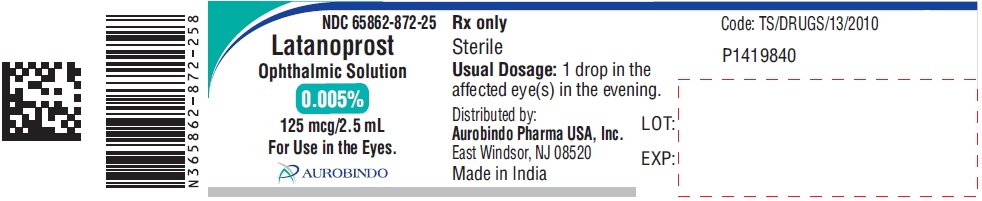
Latanoprost 50 ug/mL Solution/ Drops, 1 bottle — NDC 65862-872-25 (Billing 65862-0872-25)
This is a package of 1 bottle of Latanoprost 50 ug/mL Solution/ Drops from Aurobindo Pharma Limited, marketed since Sep 2019 and currently FDA-listed. It is this product's only package size.
NDC database record
One package, one record: these facts belong to NDC 65862-872-25 alone.
- Record
- FDA NDC Directory package listing · Human prescription drug
- Code segments
- 65862 labeler · 872 product · 25 package
- Package marketed since
- Sep 3, 2019
- Sample package
- No — commercial package
- Listing certified through
- Dec 31, 2026
- Barcode (UPC)
- 0365862872258
- FDA record last changed
- Jul 24, 2026
Other active recalls for Latanoprost (different manufacturers) — 1 · tap to view
Identity & classification
Regulatory identifiers FDA, NLM and CMS codes for this package
Drug-database identifiers Medi-Span GPI and First Databank GCN / HICL / AHFS classification
- GSN (GCN sequence number): 027370
- GCN: 32749
- GPI-14 (Medi-Span): 86330050002020
- HICL (First Databank): 011560
- AHFS class code: 52:40.28.00
- RxCUI (RxNorm): 314072
Where does this data come from?
- FDA openFDA NDC Directory · synced Oct 1, 2026
- FDA label on DailyMed · label index refreshed Oct 6, 2026
- RxNorm (NLM RxNav) · catalog refreshed Oct 1, 2026
- Medi-Span GPI (licensed)
- First Databank (licensed) · refreshed Oct 1, 2026
RxNorm drug class
This medicine belongs to the Prostaglandin Analog class.
Where does this data come from?
- RxClass (NLM) · catalog refreshed Oct 1, 2026
Clinical
- The evening timing is the recommended dosing schedule from clinical studies, and it's important to stick with it consistently. Using it at the same time every evening helps keep yo...
- Why do I have to use this at night? Can I use it in the morning instead?
- Yes, this is a real and well-documented effect of latanoprost. Over months to years, the iris (colored part of your eye) can gradually become more brown due to increased pigment. T...
- Will my eye color really change? Is that permanent?
Patient education
Supplement & herbal interactions
Where does this data come from?
- MedlinePlus (NLM) · refreshed Oct 1, 2026
- FDA label on DailyMed · label index refreshed Oct 6, 2026
Ask a licensed pharmacist directly — free, answered by our team.
Pricing
A drug doesn't have one price. Each row is a different public payment system, and none is what you'd pay at the counter — that depends on your insurance. The ⓘ on each row explains what it measures.
| Price system | Per mL | Per package |
|---|---|---|
| Retail pharmacies payNADAC · weekly | Not in the retail survey — common for institutional, discontinued, or low-volume packs. | |
| Medicaid paysCMS SDUD · 12 mo | No recent Medicaid claims on file for this NDC — rare and low-volume NDCs are suppressed in the public data. | |
| Medicare drug plans payPart D · Q2 2026 | $2.92 | $7.30 / 2.5 ml |
Where does this data come from?
- CMS NADAC weekly file
- CMS ASP pricing files · refreshed Sep 20, 2026
- CMS Medicaid State Drug Utilization Data · refreshed Oct 8, 2026
- CMS Part D plan pricing files · refreshed Sep 24, 2026
- VA National Acquisition Center price file
Packaging — all sizes for this product
| Package NDC | Description | Marketing start | Marketing end | Status |
|---|---|---|---|---|
| 65862-0872-25 You're viewing this Main listing | 1 BOTTLE in 1 CARTON / 2.5 mL in 1 BOTTLE | 2019-09-03 | — | Active |
Therapeutic equivalents
| Product | Labeler | Pack | NADAC/unit | TE | Status | Price vs. this |
|---|---|---|---|---|---|---|
| Latanoprost 50 ug/mL 24208-0463-25 | Bausch | 1 bottle | $1.575 | AT | Availability likely | — |
| Latanoprost 50 ug/mL 25021-0001-02 | Sagent | 1 bottle | $1.575 | AT | Availability likely | — |
| Latanoprost 50 ug/mL 42571-0499-06 | Micro | 1 bottle | $1.575 | AT | Availability likely | — |
| Latanoprost 50 ug/mL 59762-0333-02 | Mylan | 1 bottle | $1.575 | AT | Availability likely | — |
| Latanoprost 50 ug/mL 61314-0547-01 | Sandoz | 2.5 ml | $1.575 | AT | Availability likely | — |
| Latanoprost 50 ug/mL 64980-0516-25 | Rising | 1 bottle | $1.575 | AT | Availability likely | — |
| latanoprost 50 ug/mL 68462-0944-03 | GLENMARK | 1 bottle | $1.575 | AT | Availability likely | — |
| Latanoprost 50 ug/mL 70069-0421-01 | Somerset | 1 bottle | $1.575 | AT | Availability likely | — |
| Iyuzeh 50 ug/mL 82584-0003-30 | Thea | 30 pouches | $10.123 | — | Availability likely | — |
| Xalatan 50 ug/mL 58151-0419-35 | Viatris | 1 bottle | $108.342 | AT | Availability likely | — |
| Latanoprost 50 ug/mL 50090-1920-00 | A-S | 1 bottle | — | AT | FDA listed | — |
| Latanoprost 50 ug/mL 50090-7062-00 | A-S | 2.5 ml | — | AT | FDA listed | — |
| Latanoprost 50 ug/mLthis 65862-0872-25 | Aurobindo | 1 bottle | — | — | FDA listed | — |
| Latanoprost 50 ug/mL 68071-2376-02 | NuCare | 1 bottle | — | AT | FDA listed | — |
| Latanoprost 50 ug/mL 68071-3884-02 | NuCare | 1 bottle | — | AT | FDA listed | — |
| latanoprost 50 ug/mL 68083-0609-01 | Gland | 1 bottle | — | AT | FDA listed | — |
| Latanoprost Ophthalmic Solution 50 ug/mL 70756-0680-00 | Lifestar | 1 bottle | — | — | FDA listed | — |
| Latanoprost 50 ug/mL 71205-0154-25 | Proficient | 1 bottle | — | AT | FDA listed | — |
Where does this data come from?
- FDA openFDA NDC Directory · synced Oct 1, 2026
- FDA Orange Book · refreshed Oct 3, 2026
- CMS NADAC weekly file
Availability & generic status
This product is an FDA-approved generic. Other versions of the same drug are listed under Therapeutic equivalents, least expensive first.
Where does this data come from?
- FDA Orange Book · refreshed Oct 3, 2026
Inactive Ingredients / Excipients
Inactive ingredients, also called excipients, are components of the drug product other than the active ingredient. They may include fillers, dyes, coatings, preservatives, flavors, or other formulation ingredients.
🧪 Avoiding an ingredient? See Latanoprost Ophthalmic inactive ingredients by manufacturer: every current product's list side by side, so you can ask your pharmacy for the version that does not list it.
💡 Tap an ingredient (hover on desktop) to see what it is and why it’s used.
-
UNII F5UM2KM3W7
Benzalkonium chloride is a chemical compound that works as a preservative and antimicrobial agent in medications. It prevents bacterial and fungal growth in liquid formulations to keep the product safe during storage and use.
-
UNII 451W47IQ8X
Sodium chloride is common table salt. It's used in medicines as a buffer to maintain proper pH, as a filler to add bulk, or to adjust the osmotic balance in liquid formulations.
-
UNII 22ADO53M6F
A mineral salt derived from phosphoric acid, used as a buffer to maintain the pH balance of the medication and help stabilize the active ingredients.
-
UNII 593YOG76RN
A salt made from sodium and phosphate that helps regulate acidity and maintain proper pH balance in the medicine. It also acts as a buffer to keep the product stable.
-
UNII 059QF0KO0R
Water is a liquid solvent that dissolves and mixes ingredients together in liquid medicines, syrups, and injections. It helps distribute the active drug evenly throughout the product.
5 inactive ingredients listed in the exact product block matched to this NDC.
Where does this data come from?
ingredient classCode="IACT" elements from the exact product block matched by this NDC. Label-section narrative from DailyMed / the openFDA label index is shown separately when available.- FDA label on DailyMed · label index refreshed Oct 6, 2026
- FDA openFDA NDC Directory · synced Oct 1, 2026
Inactive ingredient FAQ
Are inactive ingredients the same for every manufacturer?
Why might an inactive ingredient be missing?
Can inactive ingredients matter?
Manufacturer & labeler
More NDCs from Aurobindo Pharma Limited labeler code 65862
- Iclevia Levonorgestrel and Ethinyl Estradiol Kit NDC 65862-865-83
- Lo Simpesse Levonorgestrel and Ethinyl Estradiol Kit NDC 65862-866-95
- Telmisartan 20 mg Tablet NDC 65862-867-03
- Telmisartan 40 mg Tablet NDC 65862-868-03
- Telmisartan 80 mg Tablet NDC 65862-869-03
- Risedronate Sodium 150 mg Tablet, Film Coated NDC 65862-870-03
- Quetiapine Fumarate 50 mg Tablet, Film Coated, Extended Release NDC 65862-873-01
- Quetiapine Fumarate 150 mg Tablet, Film Coated, Extended Release NDC 65862-874-01
- Quetiapine Fumarate 200 mg Tablet, Film Coated, Extended Release NDC 65862-875-01
- Quetiapine Fumarate 300 mg Tablet, Film Coated, Extended Release NDC 65862-876-01
- Quetiapine Fumarate 400 mg Tablet, Film Coated, Extended Release NDC 65862-877-01
- Solifenacin Succinate 5 mg Tablet, Film Coated NDC 65862-878-03
Where does this data come from?
- FDA openFDA NDC Directory · synced Oct 1, 2026
- Drugs@FDA
Full prescribing information FDA SPL
🎯 Indications and Usage ▾
1 INDICATIONS AND USAGE Latanoprost ophthalmic solution is indicated for the reduction of elevated intraocular pressure (IOP) in patients with open-angle glaucoma or ocular hypertension. Latanoprost ophthalmic solution is a prostaglandin F 2α analogue indicated for the reduction of elevated intraocular pressure in patients with open-angle glaucoma or ocular hypertension. ( 1 )
⏱️ Dosage and Administration ▾
2 DOSAGE AND ADMINISTRATION The recommended dosage is one drop in the affected eye(s) once daily in the evening. If one dose is missed, treatment should continue with the next dose as normal. The dosage of latanoprost ophthalmic solution should not exceed once daily; the combined use of two or more prostaglandins, or prostaglandin analogs including latanoprost ophthalmic solution is not recommended.
It has been shown that administration of these prostaglandin drug products more than once daily may decrease the IOP lowering effect or cause paradoxical elevations in IOP. Reduction of the IOP starts approximately 3 to 4 hours after administration and the maximum effect is reached after 8 to 12 hours. Latanoprost ophthalmic solution may be used concomitantly with other topical ophthalmic drug products to lower IOP.
In vitro studies have shown that precipitation occurs when eye drops containing thimerosal are mixed with latanoprost ophthalmic solution. If more than one topical ophthalmic drug is being used, the drugs should be administered at least five (5) minutes apart. Contact lenses should be removed prior to the administration of latanoprost ophthalmic solution, and may be reinserted 15 minutes after administration.
One drop in the affected eye(s) once daily in the evening. ( 2 )
💊 Dosage Forms and Strengths ▾
3 DOSAGE FORMS AND STRENGTHS Ophthalmic solution containing latanoprost USP, 50 mcg/mL (0.005%). Ophthalmic solution containing latanoprost, 50 mcg/mL (0.005%). ( 3 )
⛔ Contraindications ▾
4 CONTRAINDICATIONS Known hypersensitivity to latanoprost, benzalkonium chloride, or any other ingredients in this product. Known hypersensitivity to latanoprost, benzalkonium chloride, or any other ingredients in this product. ( 4 )
⚠️ Warnings and Cautions ▾
5 WARNINGS AND PRECAUTIONS Pigmentation : Pigmentation of the iris, periorbital tissue (eyelid) and eyelashes can occur. Iris pigmentation likely to be permanent. ( 5.1 ) Eyelash Changes : Gradual change to eyelashes including increased length, thickness and number of lashes. Usually reversible. ( 5.2 )
5.1Pigmentation Latanoprost has been reported to cause changes to pigmented tissues. The most frequently reported changes have been increased pigmentation of the iris, periorbital tissue (eyelid), and eyelashes. Pigmentation is expected to increase as long as latanoprost is administered.
The pigmentation change is due to increased melanin content in the melanocytes rather than to an increase in the number of melanocytes. After discontinuation of latanoprost, pigmentation of the iris is likely to be permanent, while pigmentation of the periorbital tissue and eyelash changes have been reported to be reversible in some patients. Patients who receive treatment should be informed of the possibility of increased pigmentation.
Beyond 5 years the effects of increased pigmentation are not known [see Clinical Studies (14.2) ] . Iris color change may not be noticeable for several months to years. Typically, the brown pigmentation around the pupil spreads concentrically towards the periphery of the iris and the entire iris or parts of the iris become more brownish.
Neither nevi nor freckles of the iris appear to be affected by treatment. While treatment with latanoprost can be continued in patients who develop noticeably increased iris pigmentation, these patients should be examined regularly.
5.2Eyelash Changes Latanoprost may gradually change eyelashes and vellus hair in the treated eye; these changes include increased length, thickness, pigmentation, the number of lashes or hairs, and misdirected growth of eyelashes. Eyelash changes are usually reversible upon discontinuation of treatment.
5.3Intraocular Inflammation Latanoprost should be used with caution in patients with a history of intraocular inflammation (iritis/uveitis) and should generally not be used in patients with active intraocular inflammation because inflammation may be exacerbated.
5.4Macular Edema Macular edema, including cystoid macular edema, has been reported during treatment with latanoprost. Latanoprost should be used with caution in aphakic patients, in pseudophakic patients with a torn posterior lens capsule, or in patients with known risk factors for macular edema.
5.5Herpetic Keratitis Reactivation of herpes simplex keratitis has been reported during treatment with latanoprost. Latanoprost should be used with caution in patients with a history of herpetic keratitis. Latanoprost should be avoided in cases of active herpes simplex keratitis because inflammation may be exacerbated.
5.6Bacterial Keratitis There have been reports of bacterial keratitis associated with the use of multiple-dose containers of topical ophthalmic products. These containers had been inadvertently contaminated by patients who, in most cases, had a concurrent corneal disease or a disruption of the ocular epithelial surface.
5.7Contact Lens Use Latanoprost contains benzalkonium chloride, which may be absorbed by contact lenses. Contact lenses should be removed prior to the administration of latanoprost, and may be reinserted 15 minutes after administration.
🤒 Adverse Reactions ▾
6 ADVERSE REACTIONS The following adverse reactions were reported in postmarketing experience and are discussed in greater detail in other sections of the label: Iris pigmentation changes [see Warnings and Precautions (5.1) ] Eyelid skin darkening [see Warnings and Precautions (5.1) ] Eyelash changes (increased length, thickness, pigmentation, and number of lashes) [see Warnings and Precautions (5.2) ] Intraocular inflammation (iritis/uveitis) [see Warnings and Precautions (5.3) ] Macular edema, including cystoid macular edema [see Warnings and Precautions (5.4) ] Most common adverse reactions (5 to 15%) from clinical trials are blurred vision, burning and stinging, conjunctival hyperemia, foreign body sensation, itching, increased pigmentation of the iris, and punctate keratitis.
( 6 ) To report SUSPECTED ADVERSE REACTIONS, contact Aurobindo Pharma USA, Inc. at 1-866-850-2876 or FDA at 1-800-FDA-1088 or www.fda.gov/medwatch .
6.1Clinical Trials Experience Because clinical trials are conducted under widely varying conditions, the adverse reaction rates observed in the clinical studies of a drug cannot be directly compared to rates in the clinical trials of another drug and may not reflect the rates observed in clinical practice. Latanoprost was studied in three multicenter, randomized, controlled clinical trials. Patients received 50 mcg/mL latanoprost once daily or 5 mg/mL active-comparator (timolol) twice daily.
The patient population studied had a mean age of 65±10 years. Seven percent of patients withdrew before the 6-month endpoint. Table 1: Ocular Adverse Reactions and Ocular Signs/Symptoms Reported by 5 to 15% of Patients Receiving Latanoprost Symptom/Finding Adverse Reactions (incidence (%)) Latanoprost (n=460) Timolol (n=369) Foreign body sensation 13 8 Punctate keratitis 10 9 Stinging 9 12 Conjunctival hyperemia 8 3 Blurred vision 8 8 Itching 8 8 Burning 7 8 Increased pigmentation of the Iris 7 0 Less than 1% of the patients treated with latanoprost required discontinuation of therapy because of intolerance to conjunctival hyperemia.
Table 2: Adverse Reactions That Were Reported in 1 to 5% of Patients Receiving Latanoprost Adverse Reactions (incidence (%)) Latanoprost (n=460) Timolol (n=369) Ocular Events/Signs and Symptoms Excessive tearing 4 6 Eyelid discomfort/pain 4 2 Dry eye 3 3 Eye pain 3 3 Eyelid margin crusting 3 3 Erythema of the eyelid 3 2 Photophobia 2 1 Eyelid edema 1 3 Blepharitis 1 3 Systemic Events Upper respiratory tract infection/nasopharyngitis/influenza 3 3 Myalgia/arthralgia/back pain 1
0.5Rash/allergic skin reaction 1 0.3
6.2Postmarketing Experience The following reactions have been identified during postmarketing use of latanoprost in clinical practice. Because they are reported voluntarily from a population of unknown size, it is not always possible to reliably estimate their frequency or establish a causal relationship to drug exposure. The reactions, which have been chosen for inclusion due to either their seriousness, frequency of reporting, possible causal connection to latanoprost, or a combination of these factors, include: Nervous System Disorders : Dizziness; headache; toxic epidermal necrolysis Eye Disorders : Eyelash and vellus hair changes of the eyelid (increased length, thickness, pigmentation, and number of eyelashes); keratitis; corneal edema and erosions; intraocular inflammation (iritis/uveitis); macular edema, including cystoid macular edema; trichiasis; periorbital and lid changes resulting in deepening of the eyelid sulcus; iris cyst; eyelid skin darkening; localized skin reaction on the eyelids; conjunctivitis; pseudopemphigoid of the ocular conjunctiva.
Respiratory, Thoracic and Mediastinal Disorders : Asthma and exacerbation of asthma; dyspnea Gastrointestinal Disorders : Nausea; vomiting Skin and Subcutaneous Tissue Disorders : Pruritis Infections and Infestations : Herpes keratitis Cardiac Disorders : Angina; palpitations; angina unstable General Disorders and Admini… [Excerpted — this section continues on DailyMed.]
👥 Use in Specific Populations ▾
8 USE IN SPECIFIC POPULATIONS
8.1Pregnancy Risk Summary There are no adequate and well-controlled studies of latanoprost administration in pregnant women to inform drug-associated risks. In animal reproduction studies, intravenous (IV) administration of latanoprost to pregnant rabbits and rats throughout the period of organogenesis produced malformations, embryofetal lethality and spontaneous abortion at clinically relevant doses [see Data] . The background risk of major birth defects and miscarriage for the indicated population is unknown.
However, the background risk in the U.S. general population of major birth defects is 2 to 4%, and of miscarriage is 15 to 20% of clinically recognized pregnancies. Data Animal Data Embryofetal studies were conducted in pregnant rabbits administered latanoprost daily by intravenous injection on gestation days 6 through 18, to target the period of organogenesis. A no observed adverse effect level (NOAEL) was not established for rabbit developmental toxicity.
Post-implantation loss due to late resorption was shown as doses ≥0.2 mcg/kg/day (equivalent to 1.3 times the maximum recommended human ophthalmic dose [RHOD], on a mg/m 2 basis, assuming 100% absorption). Spina bifida and abortion occurred at 5 mcg/kg/day (equivalent to 32 times the maximum RHOD). Total litter loss due to early resorption was observed at doses ≥50 mcg/kg/day (324 times the maximum RHOD).
Transient signs of maternal toxicity were observed after intravenous dosing (increased breathing, muscle tremors, slight motor incoordination) at 300 mcg/kg/day (1946 times the maximum RHOD). No maternal toxicity was observed at doses up to 50 mcg/kg/day. Embryofetal studies were conducted in pregnant rats administered latanoprost daily by intravenous injection on gestation days 6 through 15, to target the period of organogenesis.
A NOAEL for rat developmental toxicity was not established. Cleft palate was observed at 1 mcg/kg (equivalent to 3.2 times the maximum RHOD, on a mg/m 2 basis, assuming 100% absorption). Brain porencephalic cyst(s) were observed ≥50 mcg/kg (162 times the maximum RHOD).
Skeletal anomalies were observed at 250 mcg/kg (811 times the maximum RHOD). No maternal toxicity was detectable at 250 mcg/kg/day. Prenatal and postnatal development was assessed in rats.
Pregnant rats were administered latanoprost daily by intravenous injection from gestation day 15, through delivery, until weaning (lactation Day 21). No adverse effects on rat offspring were observed at doses up to 10 mcg/kg/day (32 times the maximum RHOD, on a mg/m 2 basis, assuming 100% absorption). At 100 mcg/kg/day (324 times the maximum RHOD), maternal deaths and pup mortality occurred.
8.2Lactation Risk Summary It is not known whether this drug or its metabolites are excreted in human milk. Because many drugs are excreted in human milk, caution should be exercised when latanoprost is administered to a nursing woman. The developmental and health benefits of breastfeeding should be considered along with the mother’s clinical need for latanoprost and any potential adverse effects on the breastfed child from latanoprost.
8.4Pediatric Use Safety and effectiveness in pediatric patients have not been established.
8.5Geriatric Use No overall differences in safety or effectiveness have been observed between elderly and younger patients.
🤰 Pregnancy ▾
8.1Pregnancy Risk Summary There are no adequate and well-controlled studies of latanoprost administration in pregnant women to inform drug-associated risks. In animal reproduction studies, intravenous (IV) administration of latanoprost to pregnant rabbits and rats throughout the period of organogenesis produced malformations, embryofetal lethality and spontaneous abortion at clinically relevant doses [see Data] . The background risk of major birth defects and miscarriage for the indicated population is unknown.
However, the background risk in the U.S. general population of major birth defects is 2 to 4%, and of miscarriage is 15 to 20% of clinically recognized pregnancies. Data Animal Data Embryofetal studies were conducted in pregnant rabbits administered latanoprost daily by intravenous injection on gestation days 6 through 18, to target the period of organogenesis. A no observed adverse effect level (NOAEL) was not established for rabbit developmental toxicity.
Post-implantation loss due to late resorption was shown as doses ≥0.2 mcg/kg/day (equivalent to 1.3 times the maximum recommended human ophthalmic dose [RHOD], on a mg/m 2 basis, assuming 100% absorption). Spina bifida and abortion occurred at 5 mcg/kg/day (equivalent to 32 times the maximum RHOD). Total litter loss due to early resorption was observed at doses ≥50 mcg/kg/day (324 times the maximum RHOD).
Transient signs of maternal toxicity were observed after intravenous dosing (increased breathing, muscle tremors, slight motor incoordination) at 300 mcg/kg/day (1946 times the maximum RHOD). No maternal toxicity was observed at doses up to 50 mcg/kg/day. Embryofetal studies were conducted in pregnant rats administered latanoprost daily by intravenous injection on gestation days 6 through 15, to target the period of organogenesis.
A NOAEL for rat developmental toxicity was not established. Cleft palate was observed at 1 mcg/kg (equivalent to 3.2 times the maximum RHOD, on a mg/m 2 basis, assuming 100% absorption). Brain porencephalic cyst(s) were observed ≥50 mcg/kg (162 times the maximum RHOD).
Skeletal anomalies were observed at 250 mcg/kg (811 times the maximum RHOD). No maternal toxicity was detectable at 250 mcg/kg/day. Prenatal and postnatal development was assessed in rats.
Pregnant rats were administered latanoprost daily by intravenous injection from gestation day 15, through delivery, until weaning (lactation Day 21). No adverse effects on rat offspring were observed at doses up to 10 mcg/kg/day (32 times the maximum RHOD, on a mg/m 2 basis, assuming 100% absorption). At 100 mcg/kg/day (324 times the maximum RHOD), maternal deaths and pup mortality occurred.
🧒 Pediatric Use ▾
8.4Pediatric Use Safety and effectiveness in pediatric patients have not been established.
🧓 Geriatric Use ▾
8.5Geriatric Use No overall differences in safety or effectiveness have been observed between elderly and younger patients.
🆘 Overdosage ▾
10 OVERDOSAGE Intravenous infusion of up to 3 mcg/kg of latanoprost in healthy volunteers produced mean plasma concentrations 200 times higher than during clinical treatment with latanoprost and no adverse reactions were observed. Intravenous dosages of 5.5 to 10 mcg/kg caused abdominal pain, dizziness, fatigue, hot flushes, nausea, and sweating. If overdosage with latanoprost occurs, treatment should be symptomatic.
🧬 Clinical Pharmacology ▾
12 CLINICAL PHARMACOLOGY
12.1Mechanism of Action Latanoprost is a prostaglandin F 2α analogue that is believed to reduce the IOP by increasing the outflow of aqueous humor. Studies in animals and man suggest that the main mechanism of action is increased uveoscleral outflow. Elevated IOP represents a major risk factor for glaucomatous field loss. The higher the level of IOP, the greater the likelihood of optic nerve damage and visual field loss.
12.2Pharmacodynamics Reduction of the IOP in man starts about 3 to 4 hours after administration and maximum effect is reached after 8 to 12 hours. IOP reduction is present for at least 24 hours.
12.3Pharmacokinetics Absorption Latanoprost is absorbed through the cornea where the isopropyl ester prodrug is hydrolyzed to the acid form to become biologically active. Distribution The distribution volume in humans is 0.16 ±
0.02L/kg. The acid of latanoprost can be measured in aqueous humor during the first 4 hours, and in plasma only during the first hour after local administration. Studies in man indicate that the peak concentration in the aqueous humor is reached about two hours after topical administration.
Elimination Metabolism Latanoprost, an isopropyl ester prodrug, is hydrolyzed by esterases in the cornea to the biologically active acid. The active acid of latanoprost reaching the systemic circulation is primarily metabolized by the liver to the 1,2-dinor and 1,2,3,4-tetranor metabolites via fatty acid β-oxidation. Excretion The elimination of the acid of latanoprost from human plasma is rapid (t 1/2 = 17 min) after both intravenous and topical administration.
Systemic clearance is approximately 7 mL/min/kg. Following hepatic β-oxidation, the metabolites are mainly eliminated via the kidneys. Approximately 88% and 98% of the administered dose are recovered in the urine after topical and intravenous dosing, respectively.
🧬 Mechanism of Action ▾
12.1Mechanism of Action Latanoprost is a prostaglandin F 2α analogue that is believed to reduce the IOP by increasing the outflow of aqueous humor. Studies in animals and man suggest that the main mechanism of action is increased uveoscleral outflow. Elevated IOP represents a major risk factor for glaucomatous field loss. The higher the level of IOP, the greater the likelihood of optic nerve damage and visual field loss.
📦 How Supplied / Storage and Handling ▾
16 HOW SUPPLIED/STORAGE AND HANDLING Latanoprost ophthalmic solution, 0.005% (50 mcg/mL) is a clear, isotonic, buffered, preserved colorless solution. It is supplied as a 2.5 mL solution in a 5 mL natural LDPE bottle with LDPE nozzle and turquoise color HDPE cap with a tamper-evident ring. 2.5 mL fill, 0.005% (50 mcg/mL) Package of 1 bottle NDC 65862-872-25 Storage: Protect from light.
Store unopened bottle(s) under refrigeration at 2°C to 8°C (36°F to 46°F). During shipment to the patient, the bottle may be maintained at temperatures up to 40°C (104°F) for a period not exceeding 8 days. Once a bottle is opened for use, it may be stored at room temperature up to 25°C (77°F) for 6 weeks.
📋 Description ▾
11 DESCRIPTION Latanoprost is a prostaglandin F 2α analogue. Its chemical name is isopropyl-(Z)-7[(1R,2R,3R,5S),3,5-dihydroxy-2-[(3R)-3-hydroxy-5-phenylpentyl]cyclopentyl]-5-heptenoate. Its molecular formula is C 26 H 40 O 5 and its chemical structure is: Latanoprost USP is clear to slightly opalescent yellow viscous liquid that is very soluble in acetonitrile and freely soluble in acetone, ethanol, ethyl acetate, isopropanol, methanol, and octanol.
It is practically insoluble in water. Latanoprost ophthalmic solution, 0.005% is supplied as a sterile, isotonic, buffered aqueous solution of latanoprost with a pH of approximately 6.7 and an osmolality of approximately 267 mOsmol/kg. Each mL of latanoprost ophthalmic solution contains 50 mcg of latanoprost USP.
Benzalkonium chloride, 0.02% is added as a preservative. The inactive ingredients are: sodium chloride, monobasic sodium phosphate monohydrate, dibasic sodium phosphate anhydrous, and water for injection. One drop contains approximately 1.5 mcg of latanoprost.
Latanoprost Chemical Structure
💬 Information for Patients ▾
17 PATIENT COUNSELING INFORMATION Potential for Pigmentation Advise patients about the potential for increased brown pigmentation of the iris, which may be permanent. Inform patients about the possibility of eyelid skin darkening, which may be reversible after discontinuation of latanoprost [see Warnings and Precautions (5.1) ] . Potential for Eyelash Changes Inform patients of the possibility of eyelash and vellus hair changes in the treated eye during treatment with latanoprost.
These changes may result in a disparity between eyes in length, thickness, pigmentation, number of eyelashes or vellus hairs, and/or direction of eyelash growth. Eyelash changes are usually reversible upon discontinuation of treatment. Handling the Container Instruct patients to avoid allowing the tip of the dispensing container to contact the eye or surrounding structures because this could cause the tip to become contaminated by common bacteria known to cause ocular infections.
Serious damage to the eye and subsequent loss of vision may result from using contaminated solutions [see Warnings and Precautions (5.6) ] . When to Seek Physician Advice Advise patients that if they develop an intercurrent ocular condition (e.g., trauma or infection) or have ocular surgery, or develop any ocular reactions, particularly conjunctivitis and eyelid reactions, they should immediately seek their physician’s advice concerning the continued use of the multiple-dose container. Contact Lens Use Advise patients that latanoprost contains benzalkonium chloride, which may be absorbed by contact lenses.
Contact lenses should be removed prior to administration of the solution. Lenses may be reinserted 15 minutes following administration of latanoprost. Use with Other Ophthalmic Drugs Advise patients that if more than one topical ophthalmic drug is being used, the drugs should be administered at least five (5) minutes apart.
If a Dose is Missed Advise patients that if one dose is missed, treatment should continue with the next dose as normal. This product’s labeling may have been updated. For the most recent prescribing information, please visit www.aurobindousa.com.
Distributed by: Aurobindo Pharma USA, Inc. 279 Princeton-Hightstown Road East Windsor, NJ 08520 Manufactured by: Eugia Pharma Specialities Limited Hyderabad - 500032 India
🧬 Pharmacokinetics ▾
12.3Pharmacokinetics Absorption Latanoprost is absorbed through the cornea where the isopropyl ester prodrug is hydrolyzed to the acid form to become biologically active. Distribution The distribution volume in humans is 0.16 ±
0.02L/kg. The acid of latanoprost can be measured in aqueous humor during the first 4 hours, and in plasma only during the first hour after local administration. Studies in man indicate that the peak concentration in the aqueous humor is reached about two hours after topical administration.
Elimination Metabolism Latanoprost, an isopropyl ester prodrug, is hydrolyzed by esterases in the cornea to the biologically active acid. The active acid of latanoprost reaching the systemic circulation is primarily metabolized by the liver to the 1,2-dinor and 1,2,3,4-tetranor metabolites via fatty acid β-oxidation. Excretion The elimination of the acid of latanoprost from human plasma is rapid (t 1/2 = 17 min) after both intravenous and topical administration.
Systemic clearance is approximately 7 mL/min/kg. Following hepatic β-oxidation, the metabolites are mainly eliminated via the kidneys. Approximately 88% and 98% of the administered dose are recovered in the urine after topical and intravenous dosing, respectively.
🧬 Pharmacodynamics ▾
12.2Pharmacodynamics Reduction of the IOP in man starts about 3 to 4 hours after administration and maximum effect is reached after 8 to 12 hours. IOP reduction is present for at least 24 hours.
🔬 Clinical Studies ▾
14 CLINICAL STUDIES
14.1Elevated Baseline IOP Patients with mean baseline IOP of 24 to 25 mmHg who were treated for 6 months in multi-center, randomized, controlled trials demonstrated 6 to 8 mmHg reductions in IOP. This IOP reduction with latanoprost ophthalmic solution, 0.005% dosed once daily was equivalent to the effect of timolol 0.5% dosed twice daily.
14.2Progression of Increased Iris Pigmentation A 3-year open-label, prospective safety study with a 2-year extension phase was conducted to evaluate the progression of increased iris pigmentation with continuous use of latanoprost once-daily as adjunctive therapy in 519 patients with open-angle glaucoma. The analysis was based on observed-cases population of the 380 patients who continued in the extension phase. Results showed that the onset of noticeable increased iris pigmentation occurred within the first year of treatment for the majority of the patients who developed noticeable increased iris pigmentation.
Patients continued to show signs of increasing iris pigmentation throughout the 5 years of the study. Observation of increased iris pigmentation did not affect the incidence, nature, or severity of adverse events (other than increased iris pigmentation) recorded in the study. IOP reduction was similar regardless of the development of increased iris pigmentation during the study.
🧪 Nonclinical Toxicology ▾
13 NONCLINICAL TOXICOLOGY
13.1Carcinogenesis, Mutagenesis, Impairment of Fertility Carcinogenesis Latanoprost was not carcinogenic in either mice or rats when administered by oral gavage at doses of up to 170 mcg/kg/day (approximately 2800 times the recommended maximum human dose) for up to 20 and 24 months, respectively. Mutagenesis Latanoprost was not mutagenic in bacteria, in mouse lymphoma, or in mouse micronucleus tests. Chromosome aberrations were observed in vitro with human lymphocytes.
Additional in vitro and in vivo studies on unscheduled DNA synthesis in rats were negative. Impairment of Fertility Latanoprost has not been found to have any effect on male or female fertility in rat studies at intravenous doses up to 250 mcg/kg/day (811 times the maximum RHOD, on a mg/m 2 basis, assuming 100% absorption).
📄 Carcinogenesis, Mutagenesis, Impairment of Fertility ▾
13.1Carcinogenesis, Mutagenesis, Impairment of Fertility Carcinogenesis Latanoprost was not carcinogenic in either mice or rats when administered by oral gavage at doses of up to 170 mcg/kg/day (approximately 2800 times the recommended maximum human dose) for up to 20 and 24 months, respectively. Mutagenesis Latanoprost was not mutagenic in bacteria, in mouse lymphoma, or in mouse micronucleus tests. Chromosome aberrations were observed in vitro with human lymphocytes.
Additional in vitro and in vivo studies on unscheduled DNA synthesis in rats were negative. Impairment of Fertility Latanoprost has not been found to have any effect on male or female fertility in rat studies at intravenous doses up to 250 mcg/kg/day (811 times the maximum RHOD, on a mg/m 2 basis, assuming 100% absorption).
📄 Package Label / Principal Display Panel ▾
PACKAGE LABEL-PRINCIPAL DISPLAY PANEL - 0.005% (125 mcg/2.5 mL) - Container Label NDC 65862-872-25 Latanoprost Ophthalmic Solution 0.005% 125 mcg/2.5 mL For Use in the Eyes. AUROBINDO PACKAGE LABEL-PRINCIPAL DISPLAY PANEL - 0.005% (125 mcg/2.5 mL) - Container Label
PACKAGE LABEL-PRINCIPAL DISPLAY PANEL - 0.005% (125 mcg/2.5 mL) - Container-Carton (1 Bottle) NDC 65862-872-25 Latanoprost Ophthalmic Solution 0.005% 125 mcg/2.5 mL* For Use in the Eyes. Sterile One 2.5 mL Bottle Rx only AUROBINDO PACKAGE LABEL-PRINCIPAL DISPLAY PANEL - 0.005% (125 mcg/2.5 mL) - Container-Carton (1 Bottle)
Medicare Part D spend CMS · PART D · 2026 (Q1)
About this NDC listing & data coverage
What data is (and isn’t) available for this NDC — tap to expand
| NDC identity (package / product / labeler codes) | ✓ Available |
| Labeler | ✓ Available |
| Product & package description | ✓ Available |
| Marketing category & status | ✓ Available |
| Active ingredient / dosage form / route | ✓ Available |
| FDA label (SPL via DailyMed) | ✓ Available |
| Package photos | ✓ Available |
| Inactive ingredients (structured) | ✓ Available |
| NADAC pharmacy acquisition price (CMS) | — Not published for this NDC CMS publishes NADAC only for NDCs reported in its retail-pharmacy survey. |
| Orange Book / therapeutic-equivalence data | — Not published for this NDC Applies only to products approved under an NDA/ANDA; many listings are out of scope. |
| HCPCS J-code billing crosswalk | — Not published for this NDC Most self-administered / retail products have no J-code — that is normal. |
| Medicaid utilization (CMS SDUD) | — Not published for this NDC CMS reports utilization only for NDCs with Medicaid claims above its privacy threshold. |