
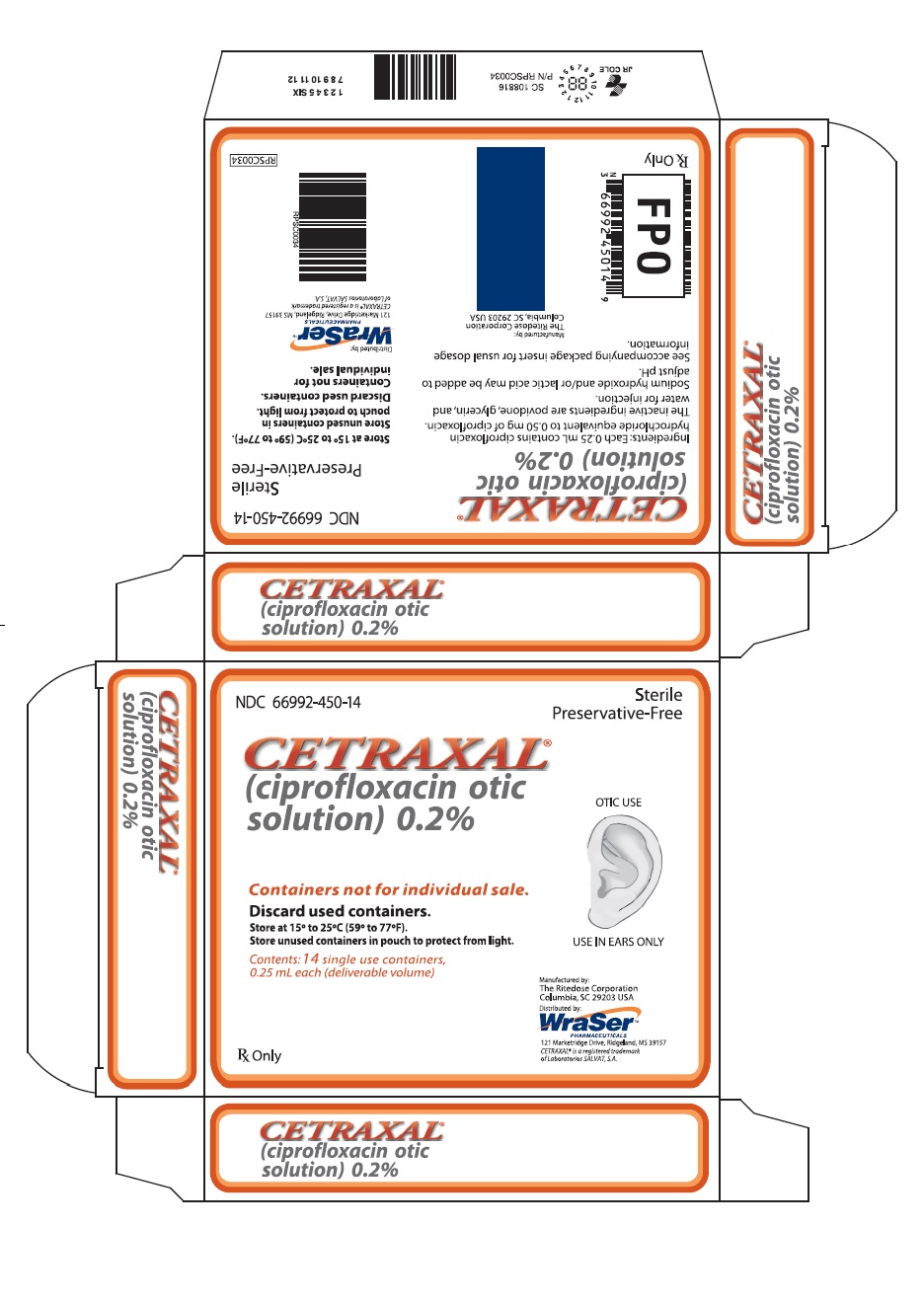
CETRAXAL Ciprofloxacin 0.5 mg/.25mL Solution/ Drops, 25 mL
Other active recalls for Ciprofloxacin (different manufacturers) — 3 · tap to view
🆔 Identity & classification
Where does this data come from?
🏭 Manufacturer & labeler
Where does this data come from?
🩺 Clinical
Ciprofloxacin otic solution (Cetraxal) and ciprofloxacin otic suspension (Otiprio) are used to treat outer ear infections in adults and children. Ciprofloxacin otic suspension (Otiprio) is also used in children during ear tube placement surgery to prevent infection or ear drainage. Ciprofloxacin otic is in a class of medications called quinolone antibiotics. It works by killing the bacteria that cause infection.
Read the full MedlinePlus article ↗- Ciprofloxacin treats a wide range of bacterial infections — things like urinary tract infections, skin infections, bone and joint infections, infectious diarrhea, typhoid fever, an...
- What kinds of infections does ciprofloxacin actually treat?
- You can take ciprofloxacin with or without food — that part's flexible. But avoid taking it at the same time as milk, yogurt, or calcium-fortified juices, because dairy and calcium...
- The most common side effects are nausea, diarrhea, and vomiting — uncomfortable, but usually manageable. The ones that mean stop-and-call-your-doctor-now are tendon pain (especiall...
Patient education
Supplement & herbal interactions
Some supplements/herbs that may interact with Ciprofloxacin — tap one for details:
Ciprofloxacin may be associated with lower levels of 11 nutrients — worth a chat with your pharmacist, not a cause for alarm.
Where does this data come from?
Ask a licensed pharmacist directly — free, answered by our team.
🧪 Inactive Ingredients / Excipients
Inactive ingredients, also called excipients, are components of the drug product other than the active ingredient. They may include fillers, dyes, coatings, preservatives, flavors, or other formulation ingredients.
💡 Tap an ingredient (hover on desktop) to see what it is and why it’s used.
-
UNII PDC6A3C0OX
Glycerin is a clear, thick liquid derived from plant oils or fats. It acts as a humectant to retain moisture, a sweetener, and a solvent in medications.
-
UNII 33X04XA5AT
Lactic acid is a naturally occurring organic acid derived from milk or plant sources. It lowers and maintains pH in formulations, helps preserve the product, and can enhance ingredient stability and absorption.
-
UNII FZ989GH94E
Povidone is a synthetic polymer made from a plastic-like material. It acts as a binder to hold tablet ingredients together and as a disintegrant to help the tablet break apart in your stomach so the medicine can be absorbed.
-
UNII 55X04QC32I
A strong alkaline chemical used to adjust and maintain the pH balance of liquid medicines. It helps keep the medicine stable and ensures it stays effective during storage.
-
UNII 059QF0KO0R
Water is a liquid solvent that dissolves and mixes ingredients together in liquid medicines, syrups, and injections. It helps distribute the active drug evenly throughout the product.
5 inactive ingredients listed in the exact product block matched to this NDC.
Where does this data come from?
ingredient classCode="IACT" elements from the exact product block matched by this NDC. Label-section narrative from DailyMed / the openFDA label index is shown separately when available.Inactive ingredient FAQ
Are inactive ingredients the same for every manufacturer?
Why might an inactive ingredient be missing?
Can inactive ingredients matter?
💲 Pricing
A drug doesn't have one price. Each row is a different public payment system, and none is what you'd pay at the counter — that depends on your insurance. The ⓘ on each row explains what it measures.
| Price system | Per mL | Per package |
|---|---|---|
| Retail pharmacies payNADAC · weekly | Not in the retail survey — common for institutional, discontinued, or low-volume packs. | |
| Medicaid paysCMS SDUD · 12 mo | No recent Medicaid claims on file for this NDC — rare and low-volume NDCs are suppressed in the public data. | |
| Medicare drug plans payPart D · quarterly | No Part D plan price is available for this NDC in our data. | |
Where does this data come from?
🔁 Therapeutic equivalents
| Product | Labeler | Pack | NADAC/unit | TE | Status | Price vs. this |
|---|---|---|---|---|---|---|
| Cetraxal 0.5 mg/.25mLthis 66992-0450-14 | Wraser | 25 ml | — | AB | Discontinued | — |
Where does this data come from?
⏳ Availability & generic status
FDA-approved generic versions are listed, and recent pricing/market data suggests they may be available — see Therapeutic equivalents.
Where does this data come from?
📊 Medicare Part D spend CMS · PART D · 2026 (Q1)
📦 Packaging — all sizes for this product
| Package NDC | Description | Marketing start | Status |
|---|---|---|---|
| 66992-0450-14 You're viewing this | 14 CONTAINER in 1 CARTON (66992-450-14) / .25 mL in 1 CONTAINER | 2009-05-14 | Inactivated by FDA |
🧭 About this NDC listing & data coverage
What data is (and isn’t) available for this NDC — tap to expand
| NDC identity (package / product / labeler codes) | ✓ Available |
| Labeler | ✓ Available |
| Product & package description | ✓ Available |
| Marketing category & status | ✓ Available |
| Active ingredient / dosage form / route | ✓ Available |
| FDA label (SPL via DailyMed) | ✓ Available |
| Package photos | ✓ Available |
| Inactive ingredients (structured) | ✓ Available |
| NADAC pharmacy acquisition price (CMS) | — Not published for this NDC CMS publishes NADAC only for NDCs reported in its retail-pharmacy survey. |
| Orange Book / therapeutic-equivalence data | ✓ Available |
| HCPCS J-code billing crosswalk | — Not published for this NDC Most self-administered / retail products have no J-code — that is normal. |
| Medicaid utilization (CMS SDUD) | — Not published for this NDC CMS reports utilization only for NDCs with Medicaid claims above its privacy threshold. |
Questions about this listing
Why is there no price listed?
What does the discontinued status mean for this NDC?
Is the NDC printed on the package the same as the 11-digit billing NDC?
What do the three segments of this NDC mean?
Who lists this product with the FDA?
Do I need a prescription for this product?
Where does this data come from?
📄 Full prescribing information FDA SPL
🎯 Indications and Usage ▾
1 INDICATIONS AND USAGE CETRAXAL is a quinolone antimicrobial indicated for the treatment of acute otitis externa due to susceptible isolates of Pseudomonas aeruginosa or Staphylococcus aureus. CETRAXAL is a quinolone antimicrobial indicated for the treatment of acute otitis externa due to susceptible isolates of Pseudomonas aeruginosa or Staphylococcus aureus .
⏱️ Dosage and Administration ▾
2 DOSAGE AND ADMINISTRATION The contents of one single use container (deliverable volume: 0.25 mL) should be instilled into the affected ear twice daily (approximately 12 hours apart) for 7 days. Wash hands before use. The solution should be warmed, by holding the container in the hands for at least 1 minute, to minimize the dizziness that may result from the instillation of a cold solution into the ear canal.
The patient should lie with the affected ear upward and then the solution should be instilled. This position should be maintained for at least 1 minute to facilitate penetration of the drops into the ear. Repeat, if necessary, for the opposite ear.
Contents of one single use container should be instilled into the affected ear twice daily (approximately 12 hours apart) for 7 days.
💊 Dosage Forms and Strengths ▾
3 DOSAGE FORMS AND STRENGTHS CETRAXAL is a sterile, preservative-free, otic solution of ciprofloxacin hydrochloride equivalent to 0.2 % ciprofloxacin (0.5 mg in 0.25 mL) in each single use container. CETRAXAL is a sterile, preservative-free otic solution of ciprofloxacin hydrochloride equivalent to 0.2 % ciprofloxacin (0.5 mg in 0.25 mL) in each single use container.
⛔ Contraindications ▾
4 CONTRAINDICATIONS CETRAXAL is contraindicated in persons with a history of hypersensitivity to ciprofloxacin. History of hypersensitivity to ciprofloxacin.
⚠️ Warnings and Cautions ▾
5 WARNINGS AND PRECAUTIONS CETRAXAL is for otic use only. (5.1) Hypersensitivity: discontinue at the first appearance of a skin rash or any other sign of hypersensitivity. (5.2) Use of CETRAXAL may result in overgrowth of nonsusceptible organisms. (5.3)
5.1Otic Use Only CETRAXAL is for otic use only. It should not be used for injection, for inhalation or for topical ophthalmic use.
5.2Hypersensitivity CETRAXAL should be discontinued at the first appearance of a skin rash or any other sign of hypersensitivity.
5.3Growth of Resistant Organisms with Prolonged Use As with other anti-infectives, use of CETRAXAL may result in overgrowth of nonsusceptible organisms, including yeast and fungi. If super-infection occurs, discontinue use and institute alternative therapy.
5.4Lack of Clinical Response If the infection is not improved after one week of therapy, cultures may help guide further treatment.
🤒 Adverse Reactions ▾
6 ADVERSE REACTIONS Because clinical studies are conducted under widely varying conditions, adverse drug reaction rates observed in the clinical studies of a drug cannot be directly compared to rates in the clinical studies of another drug and may not reflect the rates observed in clinical practice. In a randomized, active-controlled clinical trial, approximately 300 patients with clinical signs and symptoms of otitis externa were treated with CETRAXAL. The most frequently reported adverse reactions were application site pain, ear pruritus, fungal ear superinfection, and headache, each reported in approximately 2-3% of patients.
The most common adverse reactions reported in 2-3% of patients treated with CETRAXAL were application site pain, ear pruritus, fungal ear superinfection and headache. To report SUSPECTED ADVERSE REACTIONS, contact WraSer Pharmaceuticals at 1-888-252-3901 or FDA at 1-800-FDA-1088 or www.fda.go/medwatch.
👥 Use in Specific Populations ▾
8 USE IN SPECIFIC POPULATIONS
8.1Pregnancy Pregnancy Category C. Reproduction studies have been performed in rats and mice using oral doses of up to 100 mg/kg and intravenous (IV) doses up to 30 mg/kg and have revealed no evidence of harm to the fetus as a result of ciprofloxacin. In rabbits, ciprofloxacin (30 and 100 mg/kg orally) produced gastrointestinal disturbances resulting in maternal weight loss and an increased incidence of abortion, but no teratogenicity was observed at either dose.
After intravenous administration of doses up to 20 mg/kg, no maternal toxicity was produced in the rabbit, and no embryotoxicity or teratogenicity was observed. Animal reproduction studies have not been conducted with CETRAXAL. No adequate and well-controlled studies have been performed in pregnant women.
Caution should be exercised when CETRAXAL is used by a pregnant woman.
8.3Nursing Mothers Ciprofloxacin is excreted in human milk with systemic use. It is not known whether ciprofloxacin is excreted in human milk following otic use. Because of the potential for serious adverse reactions in nursing infants, a decision should be made whether to discontinue nursing or to discontinue the drug, taking into account the importance of the drug to the mother.
8.4Pediatric Use The safety and effectiveness of CETRAXAL in infants below one year of age have not been established. The efficacy of CETRAXAL in treating otitis externa in pediatric patients one year or older has been demonstrated in controlled clinical trials (see Section14 Clinical Studies). There is no evidence that the otic administration of quinolones has any effect on weight bearing joints, even though systemic administration of some quinolones has been shown to cause arthropathy in immature animals.
8.5Geriatric Use No overall differences in safety and effectiveness have been observed between elderly and younger patients.
🤰 Pregnancy ▾
8.1Pregnancy Pregnancy Category C. Reproduction studies have been performed in rats and mice using oral doses of up to 100 mg/kg and intravenous (IV) doses up to 30 mg/kg and have revealed no evidence of harm to the fetus as a result of ciprofloxacin. In rabbits, ciprofloxacin (30 and 100 mg/kg orally) produced gastrointestinal disturbances resulting in maternal weight loss and an increased incidence of abortion, but no teratogenicity was observed at either dose.
After intravenous administration of doses up to 20 mg/kg, no maternal toxicity was produced in the rabbit, and no embryotoxicity or teratogenicity was observed. Animal reproduction studies have not been conducted with CETRAXAL. No adequate and well-controlled studies have been performed in pregnant women.
Caution should be exercised when CETRAXAL is used by a pregnant woman.
🧒 Pediatric Use ▾
8.4Pediatric Use The safety and effectiveness of CETRAXAL in infants below one year of age have not been established. The efficacy of CETRAXAL in treating otitis externa in pediatric patients one year or older has been demonstrated in controlled clinical trials (see Section14 Clinical Studies). There is no evidence that the otic administration of quinolones has any effect on weight bearing joints, even though systemic administration of some quinolones has been shown to cause arthropathy in immature animals.
🧓 Geriatric Use ▾
8.5Geriatric Use No overall differences in safety and effectiveness have been observed between elderly and younger patients.
🧬 Clinical Pharmacology ▾
12 CLINICAL PHARMACOLOGY
12.1 Mechanism of Action Ciprofloxacin is a fluoroquinolone antimicrobial (see
12.4Clinical Pharmacology, Microbiology).
12.3Pharmacokinetics The plasma concentrations of ciprofloxacin were not measured following administration of 0.25 mL CETRAXAL (total dose: 0.5 mg ciprofloxacin). However, the maximum plasma concentration of ciprofloxacin is anticipated to be less than 5 ng/mL.
12.4Microbiology The bactericidal action of ciprofloxacin results from interference with the enzyme DNA gyrase, which is needed for the synthesis of bacterial DNA. Bacterial resistance to quinolones can develop through chromosomally- or plasmid-mediated mechanisms. The mechanism of action of fluoroquinolones, including ciprofloxacin, is different from that of macrolides.
Therefore, ciprofloxacin may be active against pathogens that are resistant to these antibiotics, and these antibiotics may be active against pathogens that are resistant to ciprofloxacin. In vitro studies demonstrated cross-resistance between ciprofloxacin and some fluoroquinolones. Ciprofloxacin has been shown to be active against most isolates of the following bacteria, both in vitro and in clinical infections of acute otitis externa as described in Section 1 Indications and Usage.
Staphylococcus aureus Pseudomonas aeruginosa.
🧬 Mechanism of Action ▾
12.1 Mechanism of Action Ciprofloxacin is a fluoroquinolone antimicrobial (see
12.4Clinical Pharmacology, Microbiology).
📦 How Supplied / Storage and Handling ▾
16 HOW SUPPLIED/STORAGE AND HANDLING CETRAXAL is a clear, colorless, sterile, preservative-free solution. CETRAXAL is supplied as a 0.2% otic solution in a low-density polyethylene (LDPE) single use container. Each single use container delivers 0.25 mL of solution equivalent to 0.5 mg of ciprofloxacin; 14 single use containers are packaged in a foil overwrap pouch in a carton (NDC 66992-450-14).
Store at 15ºC to 25ºC (59ºF to 77ºF). Discard used containers. Store unused containers in pouch to protect from light.
📦 Storage and Handling ▾
Store at 15ºC to 25ºC (59ºF to 77ºF). Discard used containers. Store unused containers in pouch to protect from light.
📋 Description ▾
11 DESCRIPTION CETRAXAL (ciprofloxacin otic solution) 0.2% contains the synthetic antimicrobial agent ciprofloxacin hydrochloride. CETRAXAL is a sterile, preservative-free solution for otic use. Each single use container of CETRAXAL delivers 0.25 mL of solution equivalent to 0.5 mg of ciprofloxacin.
The inactive ingredients are povidone, glycerin, and water for injection. Sodium hydroxide and/or lactic acid may be added to adjust pH. Ciprofloxacin, a fluroquinolone is available as the monohydrochloride, monohydrate salt of 1-cyclopropyl-6-fluoro-1,4-dihydro-4-oxo-7-(1-piperazinyl)-3-quinolinecarboxylic acid.
Its molecular formula is C 17 H 18 FN 3 O 3 •HCl•H 2 O, and molecular weight is 385.82. The chemical structure of ciprofloxacin hydrochloride is: image description
💬 Information for Patients ▾
17 PATIENT COUNSELING INFORMATION
17.1Directions for Use Patients should be advised that CETRAXAL is for otic use only. It is not for ophthalmic or inhalation use. It is not for injection.
CETRAXAL should be given 2 times each day (about 12 hours apart) in each infected ear. CETRAXAL should be used for as long as it is prescribed, even if the symptoms improve. The patient should be advised to follow these directions while on CETRAXAL: Wash their hands before use.
Warm the container in their hands for at least one minute prior to use to minimize dizziness that may result from the instillation of a cold solution into the ear canal. Twist off and discard top of container. Lie with the affected ear upward and then instill the contents of one container into the ear.
Maintain this position for at least one minute to facilitate penetration of the drops into the ear. Repeat, if necessary, for the opposite ear. Discard used container.
Store unused containers in pouch to protect from light. image description image description image description
17.2Hypersensitivity Patients should be advised to immediately discontinue CETRAXAL at the first appearance of a skin rash or any other sign of hypersensitivity [see Section
5.1Warnings and Precautions].