
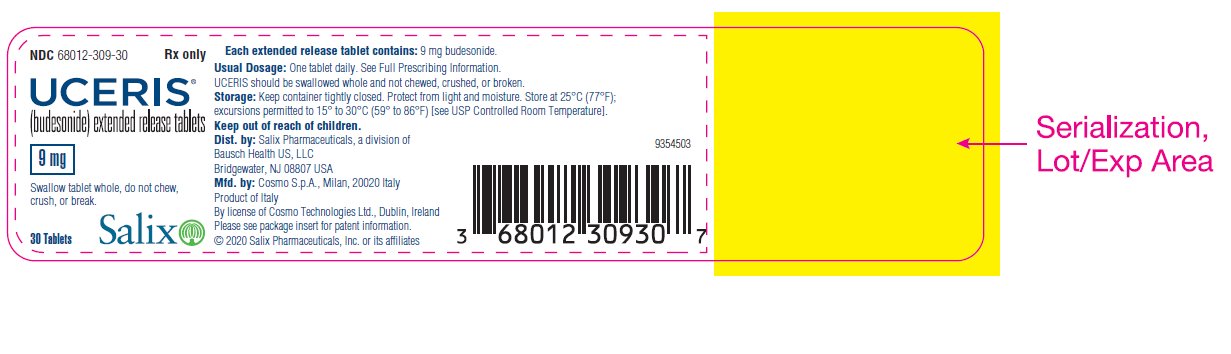
Uceris budesonide 9 mg Tablet, Extended Release, 30-count — NDC 68012-309-30 (Billing 68012-0309-30)
This is a package of 30 tablets of Uceris budesonide 9 mg Tablet, Extended Release from Santarus Inc., marketed since Jan 2013 and currently FDA-listed; retail pharmacies pay about $57.24 per tablet (NADAC). It is the main listing for this product, which comes in 3 package sizes.
NDC database record
One package, one record: these facts belong to NDC 68012-309-30 alone.
- Record
- FDA NDC Directory package listing · Human prescription drug
- Code segments
- 68012 labeler · 309 product · 30 package
- Package marketed since
- Jan 14, 2013
- Sample package
- No — commercial package
- Listing certified through
- Dec 31, 2026
- Billing quantity
- 30 EA per package
- Barcode (UPC-A, from the NDC)
- 3 6801230930 7
- Medicaid fills, this package
- 188 prescriptions in the last four reported quarters
- FDA record last changed
- Jul 24, 2026
Other active recalls for Budesonide (different manufacturers) — 3 · tap to view
Identity & classification
Regulatory identifiers FDA, NLM and CMS codes for this package
Drug-database identifiers Medi-Span GPI and First Databank GCN / HICL / AHFS classification
- GSN (GCN sequence number): 070506
- GCN: 34063
- GPI-14 (Medi-Span): 22100012007530
- HICL (First Databank): 006545
- AHFS class code: 68:04.00.00
- RxCUI (RxNorm): 1366550
Where does this data come from?
- FDA openFDA NDC Directory · synced Oct 1, 2026
- FDA label on DailyMed · label index refreshed Oct 3, 2026
- RxNorm (NLM RxNav) · catalog refreshed Oct 1, 2026
- Medi-Span GPI (licensed)
- First Databank (licensed) · refreshed Oct 1, 2026
RxNorm drug class
This medicine belongs to the Corticosteroid class.
Where does this data come from?
- RxClass (NLM) · catalog refreshed Oct 1, 2026
Clinical
- It calms inflammation. Depending on the product, that means asthma, Crohn’s disease, ulcerative colitis, eosinophilic esophagitis or IgA nephropathy. Your product was chosen for yo...
- No. It is for long-term control, not quick relief. If your asthma gets worse and your usual rescue medicine doesn’t help, contact your doctor right away.
- Can I use my budesonide inhaler or nebulizer for a sudden asthma attack?
- Rinse your mouth with water after each use and don’t swallow it. This lowers the chance of a yeast infection (thrush). Tell us if you notice white patches or soreness.
Patient education
Supplement & herbal interactions
Some supplements/herbs that may interact with Budesonide — tap one for details:
Budesonide may be associated with lower levels of 8 nutrients — worth a chat with your pharmacist, not a cause for alarm.
Where does this data come from?
- MedlinePlus (NLM) · refreshed Oct 1, 2026
- FDA label on DailyMed · label index refreshed Oct 3, 2026
Ask a licensed pharmacist directly — free, answered by our team.
Pricing
A drug doesn't have one price. Each row is a different public payment system, and none is what you'd pay at the counter — that depends on your insurance. The ⓘ on each row explains what it measures.
| Price system | Per ea | Per package |
|---|---|---|
| Retail pharmacies payNADAC · weekly | $57.239 | $1,717.18 / 30 tablets |
| Medicaid paysCMS SDUD · 12 mo | $57.09 | $1,712.84 / 30 tablets |
| Medicare drug plans payPart D · quarterly | No Part D plan price is available for this NDC in our data. | |
Where does this data come from?
- CMS NADAC weekly file · file of Feb 21, 2024
- CMS ASP pricing files · refreshed Sep 20, 2026
- CMS Medicaid State Drug Utilization Data · through Q1 2026
- CMS Part D plan pricing files · refreshed Sep 24, 2026
- VA National Acquisition Center price file
Packaging — all sizes for this product
| Package NDC | Description | Per unit | Per pack | Marketing start | Marketing end | Status |
|---|---|---|---|---|---|---|
| 68012-0309-01 68012-309-01 | 2 TABLET, EXTENDED RELEASE in 1 BLISTER PACK | — | — | 2013-01-14 | — | Active |
| 68012-0309-02 68012-309-02 | 2 TABLET, EXTENDED RELEASE in 1 BLISTER PACK | — | — | 2013-01-14 | — | Active |
| 68012-0309-30 You're viewing this Main listing | 30 TABLET, EXTENDED RELEASE in 1 BOTTLE | $57.24 / ea | $1,717.18 | 2013-01-14 | — | Active |
In Medicaid, this is the most-dispensed pack of this product — about 100% of fills over the last four reported quarters. See all packs ↓
Pack size FAQ
What quantity is in this package?
How does this package differ from NDC 68012-0309-01?
What NDC number is used to bill for this package of Uceris budesonide 9 mg Tablet, Extended Release?
Prices are the latest CMS NADAC pharmacy acquisition cost per NDC; per-pack figures are per-unit × pack quantity, shown only when the pack is denominated in the same measure NADAC prices.
Therapeutic equivalents
| Product | Labeler | Pack | NADAC/unit | TE | Status | Price vs. this |
|---|---|---|---|---|---|---|
| Budesonide 9 mg 00378-4500-93 | Mylan | 30 tablets | $15.549 | AB | Availability likely | save 73% |
| Budesonide 9 mg 00591-2510-30 | Actavis | 30 tablets | $15.549 | AB | Availability likely | save 73% |
| budesonide 9 mg 68682-0309-30 | Oceanside | 30 tablets | $26.009 | AB | FDA listed | save 55% |
| Uceris 9 mgthis 68012-0309-30 | Santarus | 30 tablets | $57.239 | AB | FDA listed | — |
Where does this data come from?
- FDA openFDA NDC Directory · synced Oct 1, 2026
- FDA Orange Book · refreshed Oct 3, 2026
- CMS NADAC weekly file · file of Feb 21, 2024
Availability & generic status
FDA-approved generic versions are listed, and recent pricing/market data suggests they may be available — see Therapeutic equivalents.
Why the date isn’t exact: Generic timing can change because patents may be challenged, settled, licensed, added, removed, or worked around with a narrower label — and FDA approval does not always mean a pharmacy can get the generic today.
🛈 What do these terms mean?
- Patent
- Legal protection listed in the Orange Book that may delay generic approval or launch. Issued by the U.S. Patent & Trademark Office.
- Substance patent
- Covers the active drug molecule itself — the hardest to design around. A generic generally can’t launch until it expires.
- Formulation (product) patent
- Covers a specific formulation or dosage form. A generic can sometimes work around it with a different formulation.
- Method-of-use patent
- A patent covering one specific approved use of the drug — not necessarily the whole molecule. A generic can sometimes launch with a “skinny label” that carves out the protected use and keeps the others.
- Skinny label
- A generic label that omits a still-patented use when the FDA allows it — letting a generic reach the market for the unprotected uses.
- Exclusivity
- FDA-granted marketing protection, separate from patents — e.g. 5-yr new chemical entity, 7-yr orphan drug, or a +6-month pediatric extension.
- Paragraph IV
- A generic applicant’s formal challenge to a listed patent. It can potentially lead to earlier generic entry, but often involves litigation or a settlement.
- RLD / RS
- Reference Listed Drug — the brand product the FDA uses as the reference for generic applications. Reference Standard — the product the FDA expects generics to compare against in bioequivalence testing.
- TE / AB rating
- FDA therapeutic-equivalence rating. An AB rating generally means the FDA considers a generic therapeutically equivalent to — and substitutable for — the brand.
- LOE (loss of exclusivity)
- The latest patent or exclusivity currently listed — the loss-of-exclusivity / latest-listed-protection date shown on this page. Paragraph-IV challenges and settlements can move the real date earlier; FDA approval and a manufacturer’s decision to market can move it later.
Built from the FDA Orange Book. The bars above are scaled to each protection’s expiry; the red LOE marker is the last one to lapse.
| Patent | Type | Use code | Expires |
|---|---|---|---|
| US 9192581 ↗ | Method of use | U-1325 | Sep 7, 2031 |
| US 8895064 ↗ | Drug product | — | Sep 7, 2031 |
| US 10660858 ↗ | Drug product | — | Sep 7, 2031 |
| US 10307375 ↗ | Drug product | — | Sep 7, 2031 |
| US 9132093 ↗ | Drug product | — | Sep 7, 2031 |
Is there a generic version of UCERIS 9 MG ER TABLET?
The FDA approved a generic — why can’t I get it at my pharmacy yet?
Why do different websites show different generic release dates?
What does “FDA listed” mean?
What does a patent or protection date mean here?
What does “current Orange Book estimate” mean?
Can a generic come out before the last patent expires?
Can a generic come out after the listed dates?
What is the difference between patents and exclusivity?
Why are there multiple patent dates?
Where does this data come from?
- FDA Orange Book · refreshed Oct 3, 2026
What it looks like
Where does this data come from?
- FDA label on DailyMed · label index refreshed Oct 3, 2026
Inactive Ingredients / Excipients
Inactive ingredients, also called excipients, are components of the drug product other than the active ingredient. They may include fillers, dyes, coatings, preservatives, flavors, or other formulation ingredients.
💡 Tap an ingredient (hover on desktop) to see what it is and why it’s used.
-
UNII 9XZ8H6N6OH
A plant-based cellulose derivative used as a binder to hold tablet ingredients together, a thickener in liquids, and a coating agent to control how fast the medicine dissolves.
-
UNII J2B2A4N98G
Lactose is a natural sugar derived from milk. In medications, it serves as a filler and binder to add bulk and help hold tablet or capsule ingredients together during manufacturing.
-
UNII 70097M6I30
Magnesium stearate is a salt made from magnesium and stearic acid, a fatty substance. It's used in tablets and capsules as a lubricant and glidant to help ingredients flow smoothly during manufacturing and prevent sticking.
-
UNII NX76LV5T8J
A synthetic plastic polymer made from methacrylic acid and ethyl acrylate. It's used as a coating or binder to control how and where the medicine dissolves in your digestive system.
-
UNII OP1R32D61U
Microcrystalline cellulose is a purified form of cellulose, a natural fiber from plant sources. It acts as a binder and filler in tablets and capsules, helping hold ingredients together and give the medicine its shape and size.
-
UNII ETJ7Z6XBU4
Silicon dioxide is a naturally occurring mineral used as a glidant and anti-caking agent. It helps powder ingredients flow smoothly and prevents clumping during manufacturing and storage.
-
UNII 1DI56QDM62
A natural fatty substance from soybeans that helps mix oil and water-based ingredients together. It acts as an emulsifier and lubricant in medicines to improve texture and help the product break down properly in your body.
-
UNII 4ELV7Z65AP
Stearic acid is a fatty acid derived from plant or animal sources. It acts as a binder and lubricant in tablets and capsules, helping them hold together and flow smoothly during manufacturing.
-
UNII 7SEV7J4R1U
A powder made from a naturally occurring mineral. In medicines, talc works as a glidant and anti-caking agent, helping tablets and capsules flow smoothly during manufacturing and preventing clumping.
-
UNII 15FIX9V2JP
Titanium dioxide is a bright white mineral powder commonly used as a colorant and opacifying agent. It makes pills and tablets white or lighter in color and helps make coatings non-transparent.
-
UNII 8Z96QXD6UM
Triethyl citrate is a clear liquid derived from citric acid. It acts as a plasticizer and solvent in tablet coatings and film formulations, helping the coating remain flexible and adhere properly to the medicine.
11 inactive ingredients listed in the exact product block matched to this NDC.
Where does this data come from?
ingredient classCode="IACT" elements from the exact product block matched by this NDC. Label-section narrative from DailyMed / the openFDA label index is shown separately when available.- FDA label on DailyMed · label index refreshed Oct 3, 2026
- FDA openFDA NDC Directory · synced Oct 1, 2026
Inactive ingredient FAQ
Are inactive ingredients the same for every manufacturer?
Why might an inactive ingredient be missing?
Can inactive ingredients matter?
Manufacturer & labeler
More NDCs from Santarus Inc. labeler code 68012
- Glumetza metformin hydrochloride 1000 mg Tablet, Film Coated, Extended Release NDC 68012-003-16
- Glumetza metformin hydrochloride 500 mg Tablet, Film Coated, Extended Release NDC 68012-004-50
- Zegerid omeprazole and sodium bicarbonate 20 mg; 1680 mg Powder, For Suspension NDC 68012-052-30
- Zegerid omeprazole and sodium bicarbonate 40 mg; 1680 mg Powder, For Suspension NDC 68012-054-03
- Zegerid omeprazole and sodium bicarbonate 20 mg; 1100 mg Capsule NDC 68012-102-30
- Zegerid omeprazole and sodium bicarbonate 40 mg; 1100 mg Capsule NDC 68012-104-05
Where does this data come from?
- FDA openFDA NDC Directory · synced Oct 1, 2026
- Drugs@FDA
Full prescribing information FDA SPL
🎯 Indications and Usage ▾
1 INDICATIONS AND USAGE UCERIS ® extended-release tablets are indicated for the induction of remission in patients with active, mild to moderate ulcerative colitis. UCERIS (budesonide) is a glucocorticosteroid indicated for the induction of remission in patients with active, mild to moderate ulcerative colitis. ( 1 )
⏱️ Dosage and Administration ▾
2 DOSAGE AND ADMINISTRATION The recommended dosage for the induction of remission in adult patients with active, mild to moderate ulcerative colitis is one 9 mg tablet to be taken once daily in the morning with or without food for up to 8 weeks. ( 2.1 )
2.1Mild to Moderate Ulcerative Colitis The recommended dosage for the induction of remission in adult patients with active, mild to moderate ulcerative colitis is 9 mg taken orally once daily in the morning with or without food for up to 8 weeks. UCERIS should be swallowed whole and not chewed or crushed.
2.2CYP3A4 Inhibitors If concomitant administration with ketoconazole, or any other CYP3A4 inhibitor, is indicated, patients should be closely monitored for increased signs and/or symptoms of hypercorticism. Avoid grapefruit juice, which is known to inhibit CYP3A4, when taking UCERIS. In these cases, discontinuation of UCERIS or the CYP3A4 inhibitor should be considered [see Drug Interactions ( 7 ) and Clinical Pharmacology ( 12.3 )].
2.1Mild to Moderate Ulcerative Colitis The recommended dosage for the induction of remission in adult patients with active, mild to moderate ulcerative colitis is 9 mg taken orally once daily in the morning with or without food for up to 8 weeks. UCERIS should be swallowed whole and not chewed or crushed.
2.2CYP3A4 Inhibitors If concomitant administration with ketoconazole, or any other CYP3A4 inhibitor, is indicated, patients should be closely monitored for increased signs and/or symptoms of hypercorticism. Avoid grapefruit juice, which is known to inhibit CYP3A4, when taking UCERIS. In these cases, discontinuation of UCERIS or the CYP3A4 inhibitor should be considered [see Drug Interactions ( 7 ) and Clinical Pharmacology ( 12.3 )].
💊 Dosage Forms and Strengths ▾
3 DOSAGE FORMS AND STRENGTHS White, round, biconvex extended-release tablets debossed with “MX9” . Each extended-release tablet contains 9 mg budesonide. Extended-release tablets: 9 mg ( 3 )
⛔ Contraindications ▾
4 CONTRAINDICATIONS UCERIS is contraindicated in patients with hypersensitivity to budesonide or any of the ingredients of UCERIS. Anaphylactic reactions have occurred with other budesonide formulations [see Adverse Reactions ( 6.2 )]. Known hypersensitivity to budesonide or any of the ingredients in UCERIS tablets ( 4 )
⚠️ Warnings and Cautions ▾
5 WARNINGS AND PRECAUTIONS Hypercorticism and adrenal suppression : May occur with treatment; monitor for signs and symptoms. ( 5.1 ) Transferring patients from systemic glucocorticoids: Risk of impaired adrenal function when transferring from glucocorticoid treatment with higher systemic effects to glucocorticoid treatment with lower systemic effects, such as UCERIS. Taper patients slowly from systemic corticosteroids if transferring to UCERIS.
( 5.2 ) Immunosuppression and Increased Risk of Infection: Increased risk of viral, bacterial, fungal, protozoal and helminthic infections, including potentially fatal varicella and measles infection. Monitor patients for new or worsening infection and consider drug discontinuation. Avoid use in patients with fungal infections, Strongyloides infestation, cerebral malaria and ocular herpes simplex.
Screen for hepatitis B infection. (5.3) Kaposi’s Sarcoma: Reported to occur in patients receiving corticosteroid therapy, most often for chronic conditions. (5.4)
5.1Hypercorticism and Adrenal Axis Suppression Systemic effects such as hypercorticism and adrenal suppression may occur with use corticosteroids, including UCERIS. Monitor patients for signs and symptoms of hypercorticism and adrenal axis suppression during treatment with UCERIS. Patients with moderate to severe liver disease should be monitored for increased signs and/or symptoms of hypercorticism.
Discontinuing the use of UCERIS tablets should be considered in these patients [see Use in Specific Populations (8.6)]. Glucocorticosteroids, including UCERIS, can reduce the response of the hypothalamus-pituitary-adrenal (HPA) axis to stress. In situations where patients are subject to surgery or other stress situations, supplementation with a systemic glucocorticosteroid is recommended.
5.2Transferring Patients from Systemic Glucocorticosteroid Therapy Care is needed in patients who are transferred from glucocorticosteroid treatment with higher systemic effects to glucocorticosteroids with lower systemic effects, such as UCERIS, since symptoms attributed to withdrawal of steroid therapy, including those of acute adrenal suppression or benign intracranial hypertension, may develop. Adrenocortical function monitoring may be required in these patients, and the dose of glucocorticosteroid treatment with high systemic effects should be reduced cautiously.
Replacement of systemic glucocorticosteroids with UCERIS tablets may unmask allergies (e.g., rhinitis and eczema), which were previously controlled by the systemic drug.
5.3Immunosuppression and Increased Risk of Infection Corticosteroids, including UCERIS, suppress the immune system and increase the risk of infection with any pathogen, including viral, bacterial, fungal, protozoan, or helminthic pathogens. Corticosteroids can: Reduce resistance to new infections Exacerbate existing infections Increase the risk of disseminated infections Increase the risk of reactivation or exacerbation of latent infections Mask some signs of infection Corticosteroid-associated infections can be mild but can be severe and at times fatal.
The rate of infectious complications increases with increasing corticosteroid dosages. Monitor patients for the development of infection and consider discontinuation of UCERIS if the patient develops an infection while on treatment. Tuberculosis If UCERIS is used in patients with latent tuberculosis or tuberculin reactivity, reactivation of tuberculosis may occur.
Closely monitor such patients for reactivation. During prolonged UCERIS therapy, patients with latent tuberculosis or tuberculin reactivity should receive chemoprophylaxis. Varicella Zoster and Measles Viral Infections Varicella and measles can have a serious or even fatal course in non-immune patients taking corticosteroids, including UCERIS.
In corticosteroid-treated patients who have not had these diseases or are non-immune, particular care should be taken to avoid exposure to varicella and measles: If a U… [Excerpted — this section continues on DailyMed.]
🤒 Adverse Reactions ▾
6 ADVERSE REACTIONS Systemic glucocorticosteroid use may result in the following: Hypercorticism and Adrenal Suppression [see Warnings and Precautions ( 5.1 )] Symptoms of steroid withdrawal in those patients transferring from Systemic Glucocorticosteroid Therapy [see Warnings and Precautions ( 5.2 )] Immunosuppression and Increased Risk of Infection [see Warnings and Precautions ( 5.3 )] Kaposi’s Sarcoma [see Warnings and Precautions ( 5.4 )] Increased Systemic Glucocorticoid Susceptibility [see Warnings and Precautions ( 5.5 )] Other Glucocorticosteroid Effects [see Warnings and Precautions ( 5.6 )] Most common adverse reactions (incidence ≥2%) are headache, nausea, decreased blood cortisol, upper abdominal pain, fatigue, flatulence, abdominal distension, acne, urinary tract infection, arthralgia, and constipation.
( 6.1 ) To report SUSPECTED ADVERSE REACTIONS, contact Salix Pharmaceuticals at 1-800-321-4576 or FDA at 1-800-FDA-1088 or www.fda.gov/medwatch.
6.1Clinical Trials Experience Because clinical trials are conducted under widely varying conditions, adverse reaction rates observed in the clinical trials of a drug cannot be directly compared to rates in the clinical trials of another drug and may not reflect the rates observed in practice. The safety of UCERIS has been evaluated in controlled and open-label clinical trials which enrolled a combined total of 1,105 patients with ulcerative colitis. In two 8-week, placebo-controlled studies in patients with active disease (Study 1 and Study 2), a total of 255 patients received UCERIS 9 mg, 254 patients received UCERIS 6 mg, and 258 patients received placebo.
They ranged in age from 18-77 years (mean=43), 56% were male, and 75% were Caucasian. The most common adverse reactions were headache, nausea, decreased blood cortisol, upper abdominal pain, fatigue, flatulence, abdominal distension, acne, urinary tract infection, arthralgia, and constipation. The adverse reactions occurring in 2% or more of patients on therapy with UCERIS 9 mg are summarized in Table 1.
Table 1: Summary of Adverse Reactions in Two Placebo-Controlled Trials Experienced by at Least 2% of the UCERIS 9 mg Group (Studies 1 and 2) UCERIS 9 mg (N=255) n (%) UCERIS 6 mg (N=254) n (%) Placebo (N=258) n (%) Headache 29 (11.4) 37 (14.6) 27 (10.5) Nausea 13 (5.1) 12 (4.7) 11 (4.3) Decreased blood cortisol 11 (4.3) 6 (2.4) 1 (0.4) Upper abdominal pain 10 (3.9) 8 (3.1) 5 (1.9) Fatigue 8 (3.1) 5 (2.0) 5 (1.9) Flatulence 6 (2.4) 8 (3.1) 5 (1.9) Abdominal distension 6 (2.4) 4 (1.6) 2 (0.8) Acne 6 (2.4) 2 (0.8) 5 (1.9) Urinary tract infection 5 (2.0) 1 (0.4) 1 (0.4) Arthralgia 5 (2.0) 5 (2.0) 4 (1.6) Constipation 5 (2.0) 1 (0.4) 2 (0.8) Of UCERIS 9 mg patients, a total of 15% discontinued treatment due to any adverse event (including adverse reactions) compared with 17% in the placebo group.
Table 2 summarizes the percentages of patients reporting glucocorticoid-related effects in the 2 placebo-controlled studies. Table 2: Summary of Glucocorticoid-Related Effects in Two Placebo-Controlled Trials (Studies 1 and 2) UCERIS 9 mg (N=255) n (%) UCERIS 6 mg (N=254) n (%) Placebo (N=258) n (%) Overall 26 (10.2) 19 (7.5) 27 (10.5) Mood changes 9 (3.5) 10 (3.9) 11 (4.3) Sleep changes 7 (2.7) 10 (3.9) 12 (4.7) Insomnia 6 (2.4) 6 (2.4) 8 (3.1) Acne 6 (2.4) 2 (0.8) 5 (1.9) Moon face 3 (1.2) 3 (1.2) 4 (1.6) Fluid retention 2 (0.8) 3 (1.2) 3 (1.2) Hirsutism 1 (0.4) 0 0 Striae rubrae 0 0 2 (0.8) Flushing 0 1 (0.4) 3 (1.2) No clinically significant differences were observed with respect to the overall percentages of patients with any glucocorticoid-related effects between UCERIS and placebo after 8 weeks of induction therapy.
Study 3 was an open-label study evaluating UCERIS 9 mg once daily for 8 weeks in 60 patients who had previously completed an 8-week induction study (Study 1) but had not achieved remission. Among patients who took UCERIS 9 mg up to 16 weeks cumulatively across Study 1 and Study 3 combined, similar rates of adve… [Excerpted — this section continues on DailyMed.]
🔄 Drug Interactions ▾
7 DRUG INTERACTIONS Avoid cytochrome P450 3A4 inhibitors (e.g., ketoconazole, grapefruit juice). May cause increased systemic corticosteroid effects. ( 2.2 , 7 , 12.3 )
7.1Interaction with CYP3A4 Inhibitors Concomitant oral administration of ketoconazole (a known inhibitor of CYP3A4 activity in the liver and in the intestinal mucosa) caused an eight-fold increase of the systemic exposure to oral budesonide. If treatment with inhibitors of CYP3A4 activity (such as ketoconazole, itraconazole, ritonavir, indinavir, saquinavir, erythromycin) is indicated, discontinuation of UCERIS should be considered. After extensive intake of grapefruit juice (which inhibits CYP3A4 activity predominantly in the intestinal mucosa), the systemic exposure for oral budesonide increased about two times.
Ingestion of grapefruit or grapefruit juice should be avoided in connection with UCERIS administration [see Dosage and Administration ( 2 ) and Clinical Pharmacology ( 12.3 )].
7.2Inhibitors of Gastric Acid Secretion Since the dissolution of the coating of UCERIS is pH dependent, the release properties and uptake of the compound may be altered when UCERIS is used after treatment with gastric acid reducing agents (e.g., proton pump inhibitors (PPIs), H 2 blockers and antacids).
7.1Interaction with CYP3A4 Inhibitors Concomitant oral administration of ketoconazole (a known inhibitor of CYP3A4 activity in the liver and in the intestinal mucosa) caused an eight-fold increase of the systemic exposure to oral budesonide. If treatment with inhibitors of CYP3A4 activity (such as ketoconazole, itraconazole, ritonavir, indinavir, saquinavir, erythromycin) is indicated, discontinuation of UCERIS should be considered. After extensive intake of grapefruit juice (which inhibits CYP3A4 activity predominantly in the intestinal mucosa), the systemic exposure for oral budesonide increased about two times.
Ingestion of grapefruit or grapefruit juice should be avoided in connection with UCERIS administration [see Dosage and Administration ( 2 ) and Clinical Pharmacology ( 12.3 )].
7.2Inhibitors of Gastric Acid Secretion Since the dissolution of the coating of UCERIS is pH dependent, the release properties and uptake of the compound may be altered when UCERIS is used after treatment with gastric acid reducing agents (e.g., proton pump inhibitors (PPIs), H 2 blockers and antacids).
👥 Use in Specific Populations ▾
8 USE IN SPECIFIC POPULATIONS Pregnancy: Based on animal data, may cause fetal harm. ( 8.1 ) Hepatic Impairment : Monitor patients for signs and/or symptoms of hypercorticism. ( 5.5 , 8.6 )
8.1Pregnancy Risk Summary Limited published studies report on the use of budesonide in pregnant women; however, the data are insufficient to inform a drug-associated risk for major birth defects and miscarriage. There are clinical considerations (see Clinical Considerations). In animal reproduction studies with pregnant rats and rabbits, subcutaneous administration of budesonide during organogenesis at doses 0.5 times and 0.05 times, respectively, the maximum recommended human dose, resulted in increased fetal loss, decreased pup weights, and skeletal abnormalities.
Maternal toxicity was observed in both rats and rabbits at these dose levels ( see Data ). Based on animal data, advise pregnant women of the potential risk to a fetus. The estimated background risk of major birth defects and miscarriage of the indicated population is unknown.
All pregnancies have a background risk of birth defect, loss, or other adverse outcomes. In the U.S. general population, the estimated background risk of major birth defects and miscarriage in clinically recognized pregnancies is 2% to 4%, and 15% to 20%, respectively. Clinical Considerations Disease-Associated Maternal and/or Embryofetal Risk Published data suggest that increased disease activity is associated with the risk of developing adverse pregnancy outcomes in women with ulcerative colitis.
Adverse pregnancy outcomes include preterm delivery (before 37 weeks of gestation), low birth weight (less than 2500 g) infants, and small for gestational age at birth. Fetal/Neonatal Adverse Reactions Hypoadrenalism may occur in infants born of mothers receiving corticosteroids during pregnancy. Infants should be carefully observed for signs of hypoadrenalism, such as poor feeding, irritability, weakness, and vomiting, and managed accordingly [see Warnings and Precautions (5.1)] .
Data Animal Data Budesonide was teratogenic and embryolethal in rabbits and rats. In an embryofetal development study in pregnant rats dosed subcutaneously with budesonide during the period of organogenesis from gestation days 6-15 there were effects on fetal development and survival at subcutaneous doses up to approximately 500 mcg/kg in rats (approximately 0.5 times the maximum recommended human dose on a body surface area basis). In an embryofetal development study in pregnant rabbits dosed during the period of organogenesis from gestation days 6-18, there was an increase in maternal abortion, and effects on fetal development and reduction in litter weights at subcutaneous doses up to approximately 25 mcg/kg in rabbits (approximately 0.05 times the maximum recommended human dose on a body surface area basis).
Maternal toxicity, including reduction in body weight gain, was observed at subcutaneous doses of 5 mcg/kg in rabbits (approximately 0.01 times the maximum recommended human dose on a body surface area basis) and 500 mcg/kg in rats (approximately 0.5 times the maximum recommended human dose on a body surface area basis). In a peri- and postnatal development study, rats dosed subcutaneously with budesonide during the period of Day 15 post coitum to Day 21 postpartum, budesonide had no effects on delivery but did have an effect on growth and development of offspring.
In addition, offspring survival was reduced, and surviving offspring had decreased mean body weights at birth and during lactation at exposures 0.02 times the MRHD (on a mg/m 2 basis at maternal subcutaneous doses of 20 mcg/kg/day and higher). These findings occurred in the presence of maternal toxicity.
8.2Lactation Risk Summary Lactation studies have not been conducted with UCERIS or other oral budesonide products and no information is available on the effects of budesonide on the breastfed infant or the effects of the drug on milk production. One published stud… [Excerpted — this section continues on DailyMed.]
🤰 Pregnancy ▾
8.1Pregnancy Risk Summary Limited published studies report on the use of budesonide in pregnant women; however, the data are insufficient to inform a drug-associated risk for major birth defects and miscarriage. There are clinical considerations (see Clinical Considerations). In animal reproduction studies with pregnant rats and rabbits, subcutaneous administration of budesonide during organogenesis at doses 0.5 times and 0.05 times, respectively, the maximum recommended human dose, resulted in increased fetal loss, decreased pup weights, and skeletal abnormalities.
Maternal toxicity was observed in both rats and rabbits at these dose levels ( see Data ). Based on animal data, advise pregnant women of the potential risk to a fetus. The estimated background risk of major birth defects and miscarriage of the indicated population is unknown.
All pregnancies have a background risk of birth defect, loss, or other adverse outcomes. In the U.S. general population, the estimated background risk of major birth defects and miscarriage in clinically recognized pregnancies is 2% to 4%, and 15% to 20%, respectively. Clinical Considerations Disease-Associated Maternal and/or Embryofetal Risk Published data suggest that increased disease activity is associated with the risk of developing adverse pregnancy outcomes in women with ulcerative colitis.
Adverse pregnancy outcomes include preterm delivery (before 37 weeks of gestation), low birth weight (less than 2500 g) infants, and small for gestational age at birth. Fetal/Neonatal Adverse Reactions Hypoadrenalism may occur in infants born of mothers receiving corticosteroids during pregnancy. Infants should be carefully observed for signs of hypoadrenalism, such as poor feeding, irritability, weakness, and vomiting, and managed accordingly [see Warnings and Precautions (5.1)] .
Data Animal Data Budesonide was teratogenic and embryolethal in rabbits and rats. In an embryofetal development study in pregnant rats dosed subcutaneously with budesonide during the period of organogenesis from gestation days 6-15 there were effects on fetal development and survival at subcutaneous doses up to approximately 500 mcg/kg in rats (approximately 0.5 times the maximum recommended human dose on a body surface area basis). In an embryofetal development study in pregnant rabbits dosed during the period of organogenesis from gestation days 6-18, there was an increase in maternal abortion, and effects on fetal development and reduction in litter weights at subcutaneous doses up to approximately 25 mcg/kg in rabbits (approximately 0.05 times the maximum recommended human dose on a body surface area basis).
Maternal toxicity, including reduction in body weight gain, was observed at subcutaneous doses of 5 mcg/kg in rabbits (approximately 0.01 times the maximum recommended human dose on a body surface area basis) and 500 mcg/kg in rats (approximately 0.5 times the maximum recommended human dose on a body surface area basis). In a peri- and postnatal development study, rats dosed subcutaneously with budesonide during the period of Day 15 post coitum to Day 21 postpartum, budesonide had no effects on delivery but did have an effect on growth and development of offspring.
In addition, offspring survival was reduced, and surviving offspring had decreased mean body weights at birth and during lactation at exposures 0.02 times the MRHD (on a mg/m 2 basis at maternal subcutaneous doses of 20 mcg/kg/day and higher). These findings occurred in the presence of maternal toxicity.
🧒 Pediatric Use ▾
8.4Pediatric Use Safety and effectiveness of UCERIS in pediatric patients have not been established. Glucocorticosteroids, such as UCERIS, may cause a reduction of growth velocity in pediatric patients.
🧓 Geriatric Use ▾
8.5Geriatric Use Clinical studies of UCERIS did not include sufficient numbers of subjects aged 65 and older to determine whether they respond differently from younger subjects. Other reported clinical experience has not identified differences in responses between the elderly and younger patients. In general, UCERIS should be used cautiously in elderly patients due to the potential for decreased hepatic, renal, or cardiac function, and of concomitant disease or other drug therapy.
🆘 Overdosage ▾
10 OVERDOSAGE Reports of acute toxicity and/or death following overdosage of glucocorticosteroids are rare. Treatment consists of immediate gastric lavage or emesis followed by supportive and symptomatic therapy. If glucocorticosteroids are used at excessive doses for prolonged periods, systemic glucocorticosteroid effects, such as hypercorticism and adrenal suppression may occur.
For chronic overdosage in the face of severe disease requiring continuous steroid therapy, the dosage may be reduced temporarily. Single oral budesonide doses of 200 and 400 mg/kg were lethal in female and male mice, respectively. The signs of acute toxicity were decreased motor activity, piloerection and generalized edema.
🧬 Clinical Pharmacology ▾
12 CLINICAL PHARMACOLOGY
12.1Mechanism of Action Budesonide has a high topical glucocorticosteroid (GCS) activity and substantial first-pass elimination. The formulation contains budesonide in an extended-release tablet core. The tablet core is enteric coated to protect dissolution in gastric juice which delays budesonide release until exposure to a pH ≥7 in the small intestine.
Upon disintegration of the coating, the core matrix provides extended release of budesonide in a time dependent manner.
12.2Pharmacodynamics Budesonide has a high glucocorticoid effect and a weak mineralocorticoid effect, and the affinity of budesonide to GCS receptors, which reflects the intrinsic potency of the drug, is about 200-fold that of cortisol and 15-fold that of prednisolone. Treatment with systemically active GCS, including UCERIS, is associated with a suppression of endogenous cortisol concentrations and an impairment of the hypothalamus-pituitary-adrenal (HPA) axis function. Markers, indirect and direct, of this are cortisol levels in plasma or urine and response to ACTH stimulation.
In a study assessing the response to ACTH stimulation test in patients treated with UCERIS 9 mg once daily, the proportion of patients with abnormal response was 47% at 4 weeks and 79% at 8 weeks.
12.3Pharmacokinetics Absorption Following single oral administration of UCERIS 9 mg in healthy subjects, peak plasma concentration (C max ) was 1.35 ± 0.96 ng/mL, the time to peak concentration (T max ) on average was 13.3 ± 5.9 hours, although it varied across different individual patients, and the area under the plasma concentration time curve (AUC) was approximately 16.43 ± 10.52 ng·hr/mL. The pharmacokinetic parameters of UCERIS 9 mg have a high degree of variability among subjects. There was no accumulation of budesonide with respect to both AUC and C max following 7 days of UCERIS 9 mg once daily dosing.
Food Effect A food-effect study involving administration of UCERIS to healthy volunteers under fasting conditions and with a high-fat meal indicated that the C max was decreased by 27% while there was no significant decrease in AUC. Additionally, a mean delay in absorption lag time of 2.4 hours was observed under fed conditions. Distribution The mean volume of distribution (V SS ) of budesonide varies between 2.2 and
3.9L/kg in healthy subjects and in patients. Plasma protein binding is estimated to be 85 to 90% in the concentration range 1 to 230 nmol/L, independent of gender. The erythrocyte/plasma partition ratio at clinically relevant concentrations is about 0.8.
Elimination Metabolism Following absorption, budesonide is subject to high first-pass metabolism (80-90%). In vitro experiments in human liver microsomes demonstrate that budesonide is rapidly and extensively biotransformed, mainly by CYP3A4, to its 2 major metabolites, 6β-hydroxy budesonide and 16α-hydroxy prednisolone. The glucocorticoid activity of these metabolites is negligible (<1/100) in relation to that of the parent compound.
In vivo investigations with intravenous doses in healthy subjects are in agreement with the in vitro findings and demonstrate that budesonide has a high plasma clearance, 0.9-1.8 L/min. These high plasma clearance values approach the estimated liver blood flow, and, accordingly, suggest that budesonide is a high hepatic clearance drug. The plasma elimination half-life, t 1/2 , after administration of intravenous doses ranges between 2 and 3.6 hours.
Excretion Budesonide is excreted in urine and feces in the form of metabolites. After oral as well as intravenous administration of micronized [ 3 H]-budesonide, approximately 60% of the recovered radioactivity is found in urine. The major metabolites, including 6β-hydroxy budesonide and 16α-hydroxy prednisolone, are mainly renally excreted, intact or in conjugated forms.
No unchanged budesonide is detected in urine. Specific Populations Patients with Renal Impairment The pharmacokinetics of budesonide in patients wit… [Excerpted — this section continues on DailyMed.]
🧬 Mechanism of Action ▾
12.1Mechanism of Action Budesonide has a high topical glucocorticosteroid (GCS) activity and substantial first-pass elimination. The formulation contains budesonide in an extended-release tablet core. The tablet core is enteric coated to protect dissolution in gastric juice which delays budesonide release until exposure to a pH ≥7 in the small intestine.
Upon disintegration of the coating, the core matrix provides extended release of budesonide in a time dependent manner.
📦 How Supplied / Storage and Handling ▾
16 HOW SUPPLIED/STORAGE AND HANDLING UCERIS ® (budesonide) extended-release tablets 9 mg are white, round, biconvex tablets and debossed with “MX9”. They are supplied as follows: NDC 68012-309-30 Bottles of 30 tablets Store at 25°C (77°F); excursions permitted to 15°C to 30°C (59°F to 86°F). [See USP Controlled Room Temperature]. Keep container tightly closed. Protect from light and moisture.
📋 Description ▾
11 DESCRIPTION UCERIS ® (budesonide) extended-release tablets, for oral administration, contain budesonide, a synthetic corticosteroid, as the active ingredient. Budesonide is designated chemically as (RS)-11β, 16α, 17,21 tetrahydroxypregna-1,4-diene-3,20-dione cyclic 16,17-acetal with butyraldehyde. Budesonide is provided as a mixture of two epimers (22R and 22S).
The empirical formula of budesonide is C 25 H 34 O 6 and its molecular weight is 430.5. Its structural formula is: Budesonide is a white to off-white, odorless, crystalline powder that is practically insoluble in water, sparingly soluble in alcohol, and freely soluble in chloroform. UCERIS, a delayed and extended-release tablet, is coated with a polymer film, which breaks down at or above pH 7.
The tablet core contains budesonide with polymers that provide for extended release of budesonide. Each tablet contains the following inactive ingredients: stearic acid, lecithin, microcrystalline cellulose, hydroxypropyl cellulose, lactose, silicon dioxide, magnesium stearate, methacrylic acid copolymer types A and B, talc, triethyl citrate, and titanium dioxide. uceris-1.jpg
💬 Information for Patients ▾
17 PATIENT COUNSELING INFORMATION Advise the patient to read the FDA-approved patient labeling (Patient Information). Patients treated with UCERIS extended-release tablets should receive the following information and instructions. This information is intended to aid the patient in the safe and effective use of UCERIS.
Hypercorticism and Adrenal Suppression Advise patients that UCERIS extended-release tablets may cause systemic glucocorticosteroid effects of hypercorticism and adrenal suppression. Taper slowly from systemic corticosteroids if transferring to UCERIS extended-release tablets [see Warnings and Precautions ( 5.1 ) and ( 5.2 )] . Immunosuppression and Increased Risk of Infection Advise patients to avoid exposure to people with varicella (chicken pox) or measles.
Advise patients to inform their healthcare provider if they are exposed to varicella or measles or develop a new or worsening infection [see Warnings and Precautions ( 5.3 )]. Kaposi’s Sarcoma Advise patients that Kaposi’s sarcoma has been reported in patients receiving corticosteroids for chronic conditions and to inform their healthcare provider if they experience signs or symptoms of Kaposi’s sarcoma [see Warnings and Precautions ( 5.4 )]. How to Take UCERIS Extended-Release Tablets Advise patients to swallow UCERIS extended-release tablets whole with water.
Do not chew or crush. Avoid the consumption of grapefruit juice for the duration of UCERIS therapy [see Dosage and Administration (2)] . Pregnancy Advise female patients that UCERIS may cause fetal harm and to inform their healthcare provider with a known or suspected pregnancy [see Use in Specific Populations ( 8.1 )] .
Distributed by: Salix Pharmaceuticals, a division of Bausch Health US, LLC Bridgewater, NJ 08807 USA Manufactured by: Cosmo S.p.A. Milan, 20045 Italy By license of Cosmo Technologies Ltd., Dublin, Ireland Patented. See https://patents.salix.com for US patent information.
UCERIS is a trademark of Salix Pharmaceuticals, Inc. or its affiliates. © 2024 Salix Pharmaceuticals, Inc. or its affiliates 9464204
🧬 Pharmacokinetics ▾
12.3Pharmacokinetics Absorption Following single oral administration of UCERIS 9 mg in healthy subjects, peak plasma concentration (C max ) was 1.35 ± 0.96 ng/mL, the time to peak concentration (T max ) on average was 13.3 ± 5.9 hours, although it varied across different individual patients, and the area under the plasma concentration time curve (AUC) was approximately 16.43 ± 10.52 ng·hr/mL. The pharmacokinetic parameters of UCERIS 9 mg have a high degree of variability among subjects. There was no accumulation of budesonide with respect to both AUC and C max following 7 days of UCERIS 9 mg once daily dosing.
Food Effect A food-effect study involving administration of UCERIS to healthy volunteers under fasting conditions and with a high-fat meal indicated that the C max was decreased by 27% while there was no significant decrease in AUC. Additionally, a mean delay in absorption lag time of 2.4 hours was observed under fed conditions. Distribution The mean volume of distribution (V SS ) of budesonide varies between 2.2 and
3.9L/kg in healthy subjects and in patients. Plasma protein binding is estimated to be 85 to 90% in the concentration range 1 to 230 nmol/L, independent of gender. The erythrocyte/plasma partition ratio at clinically relevant concentrations is about 0.8.
Elimination Metabolism Following absorption, budesonide is subject to high first-pass metabolism (80-90%). In vitro experiments in human liver microsomes demonstrate that budesonide is rapidly and extensively biotransformed, mainly by CYP3A4, to its 2 major metabolites, 6β-hydroxy budesonide and 16α-hydroxy prednisolone. The glucocorticoid activity of these metabolites is negligible (<1/100) in relation to that of the parent compound.
In vivo investigations with intravenous doses in healthy subjects are in agreement with the in vitro findings and demonstrate that budesonide has a high plasma clearance, 0.9-1.8 L/min. These high plasma clearance values approach the estimated liver blood flow, and, accordingly, suggest that budesonide is a high hepatic clearance drug. The plasma elimination half-life, t 1/2 , after administration of intravenous doses ranges between 2 and 3.6 hours.
Excretion Budesonide is excreted in urine and feces in the form of metabolites. After oral as well as intravenous administration of micronized [ 3 H]-budesonide, approximately 60% of the recovered radioactivity is found in urine. The major metabolites, including 6β-hydroxy budesonide and 16α-hydroxy prednisolone, are mainly renally excreted, intact or in conjugated forms.
No unchanged budesonide is detected in urine. Specific Populations Patients with Renal Impairment The pharmacokinetics of budesonide in patients with renal impairment have not been studied. Intact budesonide is not renally excreted, but metabolites are to a large extent, and might therefore reach higher levels in patients with impaired renal function.
However, these metabolites have negligible corticosteroid activity as compared with budesonide (<1/100). Patients with Hepatic Impairment In patients with liver cirrhosis, systemic availability of orally administered budesonide correlates with disease severity and is, on average, 2.5-fold higher compared with healthy controls. Patients with mild liver disease are minimally affected.
Patients with severe liver dysfunction were not studied. Absorption parameters were not altered, and for the intravenous dose, no significant differences in CL or V SS were observed. Drug Interaction Studies Budesonide is metabolized via CYP3A4.
Potent inhibitors of CYP3A4 can increase the plasma levels of budesonide several-fold. Co-administration of ketoconazole results in an eight-fold increase in AUC of budesonide, compared to budesonide alone. Grapefruit juice, an inhibitor of gut mucosal CYP3A, approximately doubles the systemic exposure of oral budesonide.
Conversely, induction of CYP3A4 can result in the lowering of budesonide plasma levels [see Dosage and Administration (2) and… [Excerpted — this section continues on DailyMed.]
🧬 Pharmacodynamics ▾
12.2Pharmacodynamics Budesonide has a high glucocorticoid effect and a weak mineralocorticoid effect, and the affinity of budesonide to GCS receptors, which reflects the intrinsic potency of the drug, is about 200-fold that of cortisol and 15-fold that of prednisolone. Treatment with systemically active GCS, including UCERIS, is associated with a suppression of endogenous cortisol concentrations and an impairment of the hypothalamus-pituitary-adrenal (HPA) axis function. Markers, indirect and direct, of this are cortisol levels in plasma or urine and response to ACTH stimulation.
In a study assessing the response to ACTH stimulation test in patients treated with UCERIS 9 mg once daily, the proportion of patients with abnormal response was 47% at 4 weeks and 79% at 8 weeks.
🔬 Clinical Studies ▾
14 CLINICAL STUDIES Induction of Remission in Active, Mild to Moderate Ulcerative Colitis Two similarly designed, randomized, double-blind, placebo-controlled studies were conducted in a total of 970 adult patients with active, mild to moderate ulcerative colitis (UC) which was defined as an Ulcerative Colitis Disease Activity Index (UCDAI of ≥4 and ≤10). Eight hundred ninety-nine of these patients had histology consistent with active UC; this was considered the primary analysis population. UCDAI is a four-component scale (total score of 0 to 12) that encompasses the clinical assessments of stool frequency, rectal bleeding, mucosal appearance and physician’s rating of disease activity (score of 0 to 3 for each of the components).
The baseline median UCDAI score in both studies was 7. In Study 1, 56% of patients were male, and the median age was 42 years. In Study 2, 57% of patients were male, and the median age was 44 years.
In Study 1, 50% of patients were Caucasian, 7% were African American, and 34% were Asian. In Study 2, more than 99% were Caucasian. Both studies compared UCERIS 9 mg and 6 mg with placebo and included an active reference arm (a mesalamine 2.4 g in Study 1 and a budesonide* 9 mg not approved for the treatment of UC in Study 2).
The primary endpoint was induction of remission after 8 weeks of treatment. Remission was defined as a UCDAI score of ≤1, with subscores of 0 for rectal bleeding, stool frequency, and mucosal appearance and with a ≥1 point reduction in an endoscopy-only score. In both studies, UCERIS 9 mg extended-release tablets demonstrated superiority to placebo in inducing remission (Table 4).
Table 4: Induction of Remission in Studies 1 and 2 Treatment Group Treatment Group Study 1 n/N (%) Study 2 n/N (%) UCERIS 9 mg 22/123 (17.9) 19/109 (17.4) UCERIS 6 mg 16/121 (13.2) 9/109 (8.3) Reference arm* 15/124 (12.1) 13/103 (12.6) Placebo 9/121 (7.4) 4/89 (4.5) Treatment difference between UCERIS 9 mg and placebo (95% CI) † 10.4% (2.2%, 18.7%) 12.9% (4.6%, 21.3%) The primary analysis population included only patients that had histology consistent with active UC. CI=Confidence Interval *The reference arm in Study 1 is a delayed release mesalamine 2.4 g; the reference arm in Study 2 is a budesonide 9 mg not approved for the treatment of UC. † p<0.025 for UCERIS 9 mg vs. placebo in both Studies 1 and 2 based on the Chi-square test (alpha=0.025)
🧪 Nonclinical Toxicology ▾
13 NONCLINICAL TOXICOLOGY
13.1Carcinogenesis, Mutagenesis, Impairment of Fertility Carcinogenicity Carcinogenicity studies with budesonide were conducted in rats and mice. In a two-year study in Sprague-Dawley rats, budesonide caused a statistically significant increase in the incidence of gliomas in male rats at an oral dose of 50 mcg/kg (approximately 0.05 times the maximum recommended human dose on a body surface area basis). In addition, there were increased incidences of primary hepatocellular tumors in male rats at 25 mcg/kg (approximately 0.023 times the maximum recommended human dose on a body surface area basis) and above.
No tumorigenicity was seen in female rats at oral doses up to 50 mcg/kg (approximately 0.05 times the maximum recommended human dose on a body surface area basis). In an additional two-year study in male Sprague-Dawley rats, budesonide caused no gliomas at an oral dose of 50 mcg/kg (approximately 0.05 times the maximum recommended human dose on a body surface area basis). However, it caused a statistically significant increase in the incidence of hepatocellular tumors at an oral dose of 50 mcg/kg (approximately 0.05 times the maximum recommended human dose on a body surface area basis).
The concurrent reference glucocorticosteroids (prednisolone and triamcinolone acetonide) showed similar findings. In a 91-week study in mice, budesonide caused no treatment-related carcinogenicity at oral doses up to 200 mcg/kg (approximately 0.1 times the maximum recommended human dose on a body surface area basis). Mutagenesis Budesonide was not genotoxic in the Ames test, the mouse lymphoma cell forward gene mutation (TK +/- ) test, the human lymphocyte chromosome aberration test, the Drosophila melanogaster sex-linked recessive lethality test, the rat hepatocycte unscheduled DNA synthesis (UDS) test and the mouse micronucleus test.
Impairment of Fertility In rats, budesonide had no effect on fertility at subcutaneous doses up to 80 mcg/kg (approximately 0.07 times the maximum recommended human dose on a body surface area basis). However, it caused a decrease in prenatal viability and viability in pups at birth and during lactation, along with a decrease in maternal body weight gain, at subcutaneous doses of 20 mcg/kg (approximately 0.02 times the maximum recommended human dose on a body surface area basis) and above. No such effects were noted at 5 mcg/kg (approximately 0.005 times the maximum recommended human dose on a body surface area basis).
📄 Carcinogenesis, Mutagenesis, Impairment of Fertility ▾
13.1Carcinogenesis, Mutagenesis, Impairment of Fertility Carcinogenicity Carcinogenicity studies with budesonide were conducted in rats and mice. In a two-year study in Sprague-Dawley rats, budesonide caused a statistically significant increase in the incidence of gliomas in male rats at an oral dose of 50 mcg/kg (approximately 0.05 times the maximum recommended human dose on a body surface area basis). In addition, there were increased incidences of primary hepatocellular tumors in male rats at 25 mcg/kg (approximately 0.023 times the maximum recommended human dose on a body surface area basis) and above.
No tumorigenicity was seen in female rats at oral doses up to 50 mcg/kg (approximately 0.05 times the maximum recommended human dose on a body surface area basis). In an additional two-year study in male Sprague-Dawley rats, budesonide caused no gliomas at an oral dose of 50 mcg/kg (approximately 0.05 times the maximum recommended human dose on a body surface area basis). However, it caused a statistically significant increase in the incidence of hepatocellular tumors at an oral dose of 50 mcg/kg (approximately 0.05 times the maximum recommended human dose on a body surface area basis).
The concurrent reference glucocorticosteroids (prednisolone and triamcinolone acetonide) showed similar findings. In a 91-week study in mice, budesonide caused no treatment-related carcinogenicity at oral doses up to 200 mcg/kg (approximately 0.1 times the maximum recommended human dose on a body surface area basis). Mutagenesis Budesonide was not genotoxic in the Ames test, the mouse lymphoma cell forward gene mutation (TK +/- ) test, the human lymphocyte chromosome aberration test, the Drosophila melanogaster sex-linked recessive lethality test, the rat hepatocycte unscheduled DNA synthesis (UDS) test and the mouse micronucleus test.
Impairment of Fertility In rats, budesonide had no effect on fertility at subcutaneous doses up to 80 mcg/kg (approximately 0.07 times the maximum recommended human dose on a body surface area basis). However, it caused a decrease in prenatal viability and viability in pups at birth and during lactation, along with a decrease in maternal body weight gain, at subcutaneous doses of 20 mcg/kg (approximately 0.02 times the maximum recommended human dose on a body surface area basis) and above. No such effects were noted at 5 mcg/kg (approximately 0.005 times the maximum recommended human dose on a body surface area basis).
📚 References ▾
15 REFERENCES 1. Rachmilewitz D. Coated mesalazine (5-aminosalicylic acid) versus sulphasalazine in the treatment of active ulcerative colitis: a randomised trial. BMJ . 1989;298:82-86.
📄 Patient Package Insert ▾
Patient Information PATIENT INFORMATION UCERIS ® (u SAIR us) (budesonide) Extended-Release tablets What are UCERIS extended-release tablets? UCERIS extended-release tablets are a prescription corticosteroid medicine used to help get active mild to moderate ulcerative colitis (UC) under control (induce remission). It is not known if UCERIS extended-release tablets are safe and effective in children.
Who should not take UCERIS extended-release tablets? Do not take UCERIS extended-release tablets if: you are allergic to budesonide or any of the ingredients in UCERIS extended-release tablets. See the end of this leaflet for a complete list of ingredients in UCERIS extended-release tablets.
What should I tell my healthcare provider before taking UCERIS extended-release tablets? Before you take UCERIS extended-release tablets tell your healthcare provider about all of your medical conditions, including if you: have liver problems. are planning to have surgery. have chickenpox or measles or have recently been near anyone with chickenpox or measles. have an infection, including fungal and threadworm ( Strongyloides ) infections. have or had a family history of diabetes, cataracts or glaucoma. have or had tuberculosis. have high blood pressure (hypertension). have decreased bone mineral density (osteoporosis). have stomach ulcers. have malaria of the brain (cerebral malaria). are pregnant or plan to become pregnant.
UCERIS extended-release tablets may harm your unborn baby. Tell your healthcare provider if you are pregnant or think you are pregnant. are breastfeeding or plan to breastfeed. UCERIS extended-release tablets can pass into your breast milk and may harm your baby.
You and your healthcare provider should decide if you will take UCERIS extended-release tablets or breastfeed. You should not do both. Tell your healthcare provider about all the medicines you take, including prescription and over-the-counter medicines, vitamins, and herbal supplements.
UCERIS extended-release tablets and other medicines may affect each other causing side effects. Especially tell your healthcare provider if you take another medicine that contains corticosteroids for other conditions, such as allergies or asthma. Know the medicines you take.
Keep a list of them to show your healthcare provider and pharmacist when you get a new medicine. How should I take UCERIS extended-release tablets? Take UCERIS extended-release tablets exactly as your healthcare provider tells you to take them.
Take UCERIS extended-release tablets 1 time each day in the morning with or without food. Take UCERIS extended-release tablets whole with water. Do not chew, crush, or break UCERIS extended-release tablets before swallowing.
If you take too much of UCERIS extended-release tablets, call your healthcare provider right away or go to the nearest hospital emergency room. What should I avoid while taking UCERIS extended-release tablets? Do not eat grapefruit or drink grapefruit juice while taking UCERIS extended-release tablets.
Eating grapefruit or drinking grapefruit juice can increase the level of UCERIS extended-release tablets in your blood. What are the possible side effects of UCERIS extended-release tablets? UCERIS extended-release tablets may cause serious side effects, including: Effects of having too much corticosteroid medicine in your blood (hypercorticism).
Long-time use of UCERIS extended-release tablets can cause you to have too much glucocorticosteroid medicine in your blood. Tell your healthcare provider if you have any of the following signs and symptoms of hypercorticism: acne bruise easily rounding of your face (moon face) ankle swelling thicker or more hair on your body and face a fatty pad or hump between your shoulders (buffalo hump) pink or purple stretch marks on the skin of your abdomen, thighs, breasts and arms Adrenal suppression. When UCERIS extended-release tablets are taken for a long period of time (chronic use), the adrenal glands do not make e… [Excerpted — this section continues on DailyMed.]
📄 Recent Major Changes ▾
Warnings and Precautions, Immunosuppression and Increased Risk of Infection ( 5.3 ) 06/2024 Kaposi’s Sarcoma ( 5.4 ) 06/2024
📄 Package Label / Principal Display Panel ▾
PRINCIPAL DISPLAY PANEL PACKAGE LABEL – PRINCIPAL DISPLAY PANEL 9 mg NDC 68012-309-30 Rx only UCERIS® (budesonide) extended-release tablets 9 mg Swallow tablet whole, do not chew or break. 30 Tablets Salix label