
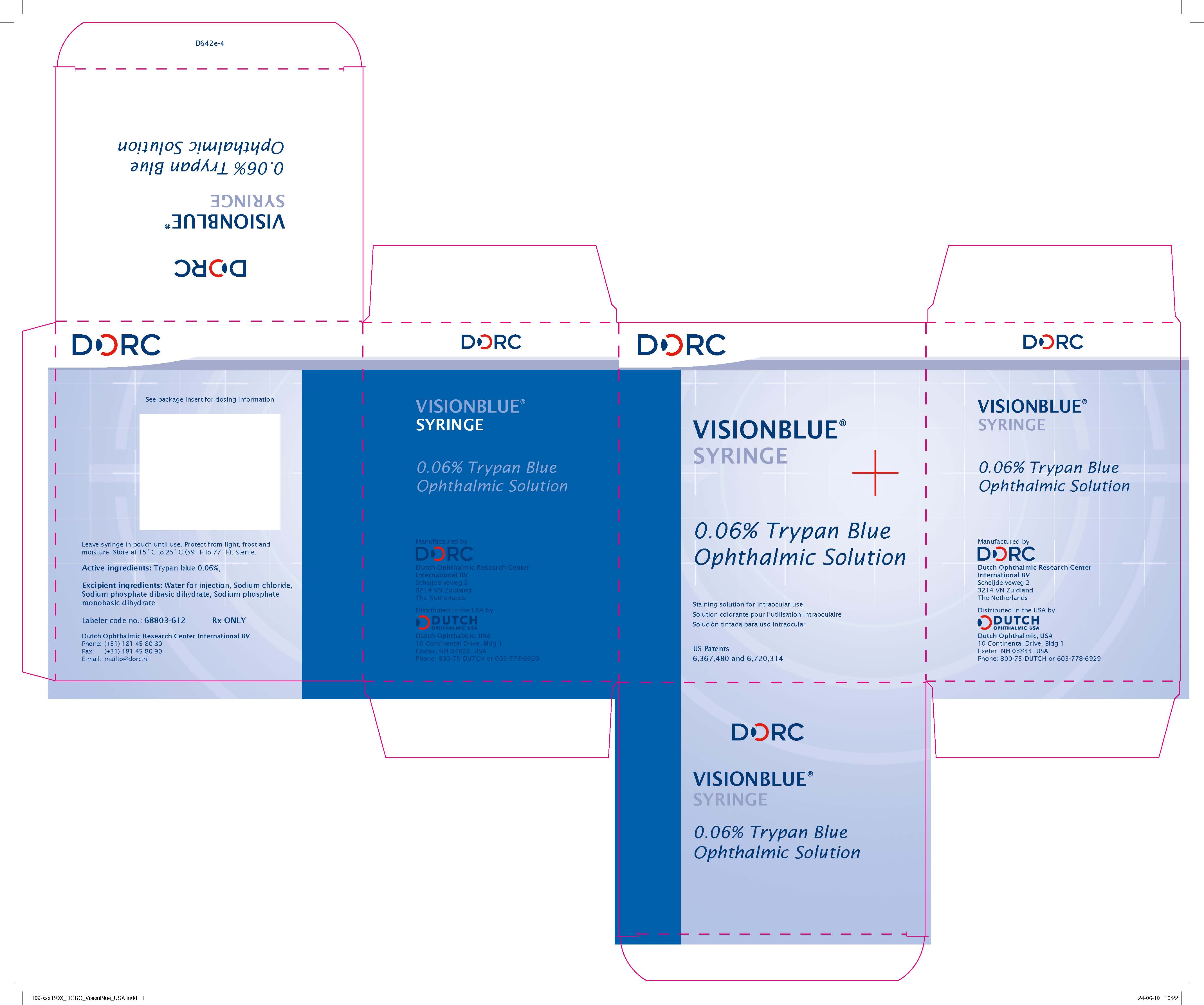
VISIONBLUE Trypan Blue .3 mg/.5mL Injection, Solution, 10 pouches
🆔 Identity & classification
Where does this data come from?
🏭 Manufacturer & labeler
Where does this data come from?
🩺 Clinical
Patient education
Supplement & herbal interactions
Some supplements/herbs that may interact with Trypan Blue — tap one for details:
Where does this data come from?
Ask a licensed pharmacist directly — free, answered by our team.
🧪 Inactive Ingredients / Excipients
Inactive ingredients, also called excipients, are components of the drug product other than the active ingredient. They may include fillers, dyes, coatings, preservatives, flavors, or other formulation ingredients.
💡 Tap an ingredient (hover on desktop) to see what it is and why it’s used.
-
4.1 mg / 0.5 mL
UNII 451W47IQ8X
Sodium chloride is common table salt. It's used in medicines as a buffer to maintain proper pH, as a filler to add bulk, or to adjust the osmotic balance in liquid formulations.
-
0.85 mg / 0.5 mL
UNII 94255I6E2T
Sodium phosphate dibasic dihydrate is a salt that helps control the acidity level of a medicine. It acts as a buffer and pH regulator to keep the medication stable and effective.
-
0.15 mg / 0.5 mL
UNII 5QWK665956
A salt derived from phosphoric acid and sodium, used primarily as a buffer to control the acidity or pH of a medication, helping keep it stable during storage and use.
-
0.5 mL / 0.5 mL
UNII 059QF0KO0R
Water is a liquid solvent that dissolves and mixes ingredients together in liquid medicines, syrups, and injections. It helps distribute the active drug evenly throughout the product.
4 inactive ingredients listed in the exact product block matched to this NDC.
Where does this data come from?
ingredient classCode="IACT" elements from the exact product block matched by this NDC. Label-section narrative from DailyMed / the openFDA label index is shown separately when available.Inactive ingredient FAQ
Are inactive ingredients the same for every manufacturer?
Why might an inactive ingredient be missing?
Can inactive ingredients matter?
💲 Pricing
A drug doesn't have one price. Each row is a different public payment system, and none is what you'd pay at the counter — that depends on your insurance. The ⓘ on each row explains what it measures.
| Price system | Per mL | Per package |
|---|---|---|
| Retail pharmacies payNADAC · weekly | Not in the retail survey — common for institutional, discontinued, or low-volume packs. | |
| Medicaid paysCMS SDUD · 12 mo | No recent Medicaid claims on file for this NDC — rare and low-volume NDCs are suppressed in the public data. | |
| Medicare drug plans payPart D · quarterly | No Part D plan price is available for this NDC in our data. | |
Where does this data come from?
🔁 Therapeutic equivalents
| Product | Labeler | Pack | NADAC/unit | TE | Status | Price vs. this |
|---|---|---|---|---|---|---|
| Visionblue .3 mg/.5mLthis 68803-0612-10 | D.O.R.C. | 10 pouches | — | — | FDA listed | — |
Where does this data come from?
⏳ Availability & generic status
We did not find an FDA-approved generic match for this exact strength, form and route.
Where does this data come from?
🔬 Reported adverse events (FAERS)
Top reported reactions
Age at onset
Reporter sex
Serious outcomes
Where does this data come from?
📦 Packaging — all sizes for this product
| Package NDC | Description | Marketing start | Status |
|---|---|---|---|
| 68803-0612-10 You're viewing this | 10 POUCH in 1 CARTON (68803-612-10) / 1 SYRINGE, GLASS in 1 POUCH / .5 mL in 1 SYRINGE, GLASS | 2004-12-16 | Active |
🧭 About this NDC listing & data coverage
What data is (and isn’t) available for this NDC — tap to expand
| NDC identity (package / product / labeler codes) | ✓ Available |
| Labeler | ✓ Available |
| Product & package description | ✓ Available |
| Marketing category & status | ✓ Available |
| Active ingredient / dosage form / route | ✓ Available |
| FDA label (SPL via DailyMed) | ✓ Available |
| Package photos | ✓ Available |
| Inactive ingredients (structured) | ✓ Available |
| NADAC pharmacy acquisition price (CMS) | — Not published for this NDC CMS publishes NADAC only for NDCs reported in its retail-pharmacy survey. |
| Orange Book / therapeutic-equivalence data | — Not published for this NDC Applies only to products approved under an NDA/ANDA; many listings are out of scope. |
| HCPCS J-code billing crosswalk | — Not published for this NDC Most self-administered / retail products have no J-code — that is normal. |
| Medicaid utilization (CMS SDUD) | — Not published for this NDC CMS reports utilization only for NDCs with Medicaid claims above its privacy threshold. |
Questions about this listing
Why is there no price listed?
Is the NDC printed on the package the same as the 11-digit billing NDC?
What do the three segments of this NDC mean?
Is this package still being marketed?
Who lists this product with the FDA?
Do I need a prescription for this product?
Where does this data come from?
📄 Full prescribing information FDA SPL
🎯 Indications and Usage ▾
Indications & Usage VisionBlue® 0.06% is indicated for use as an aid in ophthalmic surgery by staining the anterior capsule of the lens. VisionBlue® 0.06% is a diagnostic dye indicated for use as an aid in ophthalmic surgery by staining the anterior capsule of the lens.
⏱️ Dosage and Administration ▾
Dosage & Administration Cataract surgery. VisionBlue® 0.06% is packaged in a single-patient-use syringe filled to a volume of 0.5 mL syringe to which a blunt cannula has to be attached. After opening the eye, an air bubble is injected into the anterior chamber of the eye in order to minimize dilution of VisionBlue® 0.06% by the aqueous.
VisionBlue® 0.06% is carefully applied onto the anterior lens capsule using a blunt cannula. Sufficient staining is achieved as soon as the dye has contacted the capsule. The anterior chamber is then irrigated with balanced salt solution to remove all excess dye.
An anterior capsulotomy can then be performed. Inject an air bubble into the anterior chamber; Carefully apply VisionBlue® 0.06% onto the lens capsule; Remove all excess dye from the anterior chamber.
💊 Dosage Forms and Strengths ▾
Dosage forms & Strengths VisionBlue® (trypan blue ophtalmic solution) 0.06% is a clear, dark blue ophtalmic solution supplied in 2.25 mL single-patient-use syringe filled to a volume of 0.5 mL. VisionBlue® (trypan blue ophthalmic solution) 0.06% in a single-patient-use syringe.
⛔ Contraindications ▾
Contraindications VisionBlue® 0.06% is contraindicated when a non-hydrated (dry state), hydrophilic acrylic intraocular lens (IOL) is planned to be inserted into the eye. The dye may be absorbed by the IOL and stain it. Insertion of a non-hydrated (dry-state), hydrophilic acrylic intraocular lens (IOL).
⚠️ Warnings and Cautions ▾
Warnings and Precautions Excessive staining : It is recommended that after injection all excess VisionBlue® 0.06% is immediately removed from the eye by thorough irrigation of the anterior chamber. Excessive staining : Excess VisionBlue® 0.06% should be removed from the eye immediately after staining.
🤒 Adverse Reactions ▾
Adverse Reactions Adverse reactions reported following use of VisionBlue® 0.06% include discoloration of high water content hydrogen intraocular lenses ( see Contraindications ) and inadvertent staining of the posterior lens capsule and vitreous face. Staining of the posterior lens capsule or staining of the vitreous face is generally self limited, lasting up to one week. Inadvertent staining of the posterior lens capsule and vitreous face.
To report SUSPECTED ADVERSE REACTIONS contact, Dutch Ophtalmic, USA at 1-800-75-DUTCH or FDA at 1-800-FDA-1088 or www.fda.gov/medwatch
👥 Use in Specific Populations ▾
Use in specific populations Pregnancy Risk Summary There are no available data on the use of VisionBlue® 0.06% in pregnant women to inform a drug-associated risk of major birth defects, miscarriage, or adverse maternal or fetal outcomes. Systemic absorption of VisionBlue® 0.06% in humans is expected to be negligible following injection and subsequent removal of the drug at the completion of surgical procedures. Adequate animal reproduction studies were not conducted with VisionBlue® 0.06%, however, trypan blue has been shown to be teratogenic in various animal models at doses 800-fold and greater than the maximum recommended human dose, based on body surface area (BSA).
Due to the negligible human systemic exposure when used as recommended, it is not expected that maternal use of VisionBlue® 0.06% will result in fetal exposure to the drug and risk of teratogenic effects. Animal Data Trypan blue is teratogenic in rats, mice, rabbits, hamsters, dogs, guinea pigs, pigs, and chickens. The majority of teratogenicity studies performed involve intravenous, intraperitoneal, or subcutaneous administration in the rat.
The teratogenic dose is 50 mg/kg as a single dose or 25 mg/kg/day during embryogenesis in the rat. Normalized to BSA, these doses are approximately 1,600- and 800-fold the maximum recommended human dose of 0.3 mg per injection (based on a 60 kg person), assuming complete systemic absorption of trypan blue. Characteristic anomalies included neural tube, cardiovascular, vertebral, tail, and eye defects.
Trypan blue also caused an increase in post-implantation mortality and decreased fetal weight. In the monkey, trypan blue caused abortions with single or two daily doses of 50 mg/kg between 20th to 25th days of pregnancy, but no apparent increase in birth defects (approximately 3,200-fold the maximum recommended human dose based on BSA, assuming total absorption). Lactation Risk Summary The presence of trypan blue in human milk following intraocular administration of trypan blue has not been evaluated.
There are no data available regarding the effects of trypan blue on milk production. Breastfeeding is not expected to result in exposure of the child to trypan blue due to the negligible systemic exposure of trypan blue in humans following injection and subsequent removal of the drug at the completion of surgical procedures. Pediatric use The safety and effectiveness of trypan blue have been established in pediatric patients.
Use of trypan blue is supported by evidence from an adequate and well-controlled study in pediatric patients. Geriatric use No overall differences in safety and effectiveness have been observed between elderly and younger patients.
🤰 Pregnancy ▾
Pregnancy Risk Summary There are no available data on the use of VisionBlue® 0.06% in pregnant women to inform a drug-associated risk of major birth defects, miscarriage, or adverse maternal or fetal outcomes. Systemic absorption of VisionBlue® 0.06% in humans is expected to be negligible following injection and subsequent removal of the drug at the completion of surgical procedures. Adequate animal reproduction studies were not conducted with VisionBlue® 0.06%, however, trypan blue has been shown to be teratogenic in various animal models at doses 800-fold and greater than the maximum recommended human dose, based on body surface area (BSA).
Due to the negligible human systemic exposure when used as recommended, it is not expected that maternal use of VisionBlue® 0.06% will result in fetal exposure to the drug and risk of teratogenic effects. Animal Data Trypan blue is teratogenic in rats, mice, rabbits, hamsters, dogs, guinea pigs, pigs, and chickens. The majority of teratogenicity studies performed involve intravenous, intraperitoneal, or subcutaneous administration in the rat.
The teratogenic dose is 50 mg/kg as a single dose or 25 mg/kg/day during embryogenesis in the rat. Normalized to BSA, these doses are approximately 1,600- and 800-fold the maximum recommended human dose of 0.3 mg per injection (based on a 60 kg person), assuming complete systemic absorption of trypan blue. Characteristic anomalies included neural tube, cardiovascular, vertebral, tail, and eye defects.
Trypan blue also caused an increase in post-implantation mortality and decreased fetal weight. In the monkey, trypan blue caused abortions with single or two daily doses of 50 mg/kg between 20th to 25th days of pregnancy, but no apparent increase in birth defects (approximately 3,200-fold the maximum recommended human dose based on BSA, assuming total absorption).
🧒 Pediatric Use ▾
Pediatric use The safety and effectiveness of trypan blue have been established in pediatric patients. Use of trypan blue is supported by evidence from an adequate and well-controlled study in pediatric patients.
🧓 Geriatric Use ▾
Geriatric use No overall differences in safety and effectiveness have been observed between elderly and younger patients.
🧬 Clinical Pharmacology ▾
Clinical Pharmacology Mechanism of action VisionBlue® 0.06% selectively stains connective tissue structures in the human eye such as the anterior lens capsule of the human crystalline lens. VisionBlue® 0.06% is intended to be applied directly on the anterior lens capsule, staining any portion of the capsule which comes in contact with the dye. Excess dye is washed out of the anterior chamber.
The dye does not penetrate the capsule, permitting visualization of the anterior capsule in contrast to the non-stained lens cortex and inner lens material.
🧬 Mechanism of Action ▾
Mechanism of action VisionBlue® 0.06% selectively stains connective tissue structures in the human eye such as the anterior lens capsule of the human crystalline lens. VisionBlue® 0.06% is intended to be applied directly on the anterior lens capsule, staining any portion of the capsule which comes in contact with the dye. Excess dye is washed out of the anterior chamber.
The dye does not penetrate the capsule, permitting visualization of the anterior capsule in contrast to the non-stained lens cortex and inner lens material.
📦 How Supplied / Storage and Handling ▾
How Supplied/Storage and Handling VisionBlue® 0.06% is a clear, dark blue ophtalmic solution supplied as follows: 0.5 mL of VisionBlue® 0.06% in a sterile single-patient-use Luer Lok, 2.25 mL glass syringe, grey rubber plunger stopper and tip cap with polypropylene plunger rod in a peel pouch. Ten pouched products are packed in one distribution box. NDC 68803-612-05 (One 0,5 mL syringe) NDC 68803-612-10 (Carton of ten 0.5 mL syringes)
📦 Storage and Handling ▾
How Supplied/Storage and Handling Store between 15-25°C (59-77°F). Protect form direct sunlight.
📋 Description ▾
Description VisionBlue® (trypan blue ophthalmic solution) 0.06% is a sterile solution of trypan blue (an acid di-azo group dye) for intraocular ophtalmic use. VisionBlue® 0.06% is a selective tissue staining agent for use as a medical aid in ophthalmic surgery. Each mL of VisionBlue® 0.06% contains: 0.6 mg trypan blue; 1.9 mg sodium mono-hydrogen orthophosphate (Na 2 HPO 4 ·2H 2 O); 0.3 mg sodium di-hydrogen orthophosphate (NaH 2 PO 4 ·2H 2 O); 8.2 mg sodium chloride (NaCl); and water for injection.
Sodium hydroxide may be used to adjust pH. The pH is 7.3 – 7.6. The osmolality is 257-314 mOsm/kg.
The drug substance trypan blue has the chemical name 3,3’-[(3,3’-dimethyl-4,4’-biphenylylene) bis (azo)] bis (5-amino-4-hydroxy-2,7-naphthalenedisulfonic acid) tetra sodium salt, a molecular weight of 960.8, a molecular formula of C 34 H 24 N 6 Na 4 O 14 S 4 , and has the following chemical structure: Chemical structure VisionBlue