
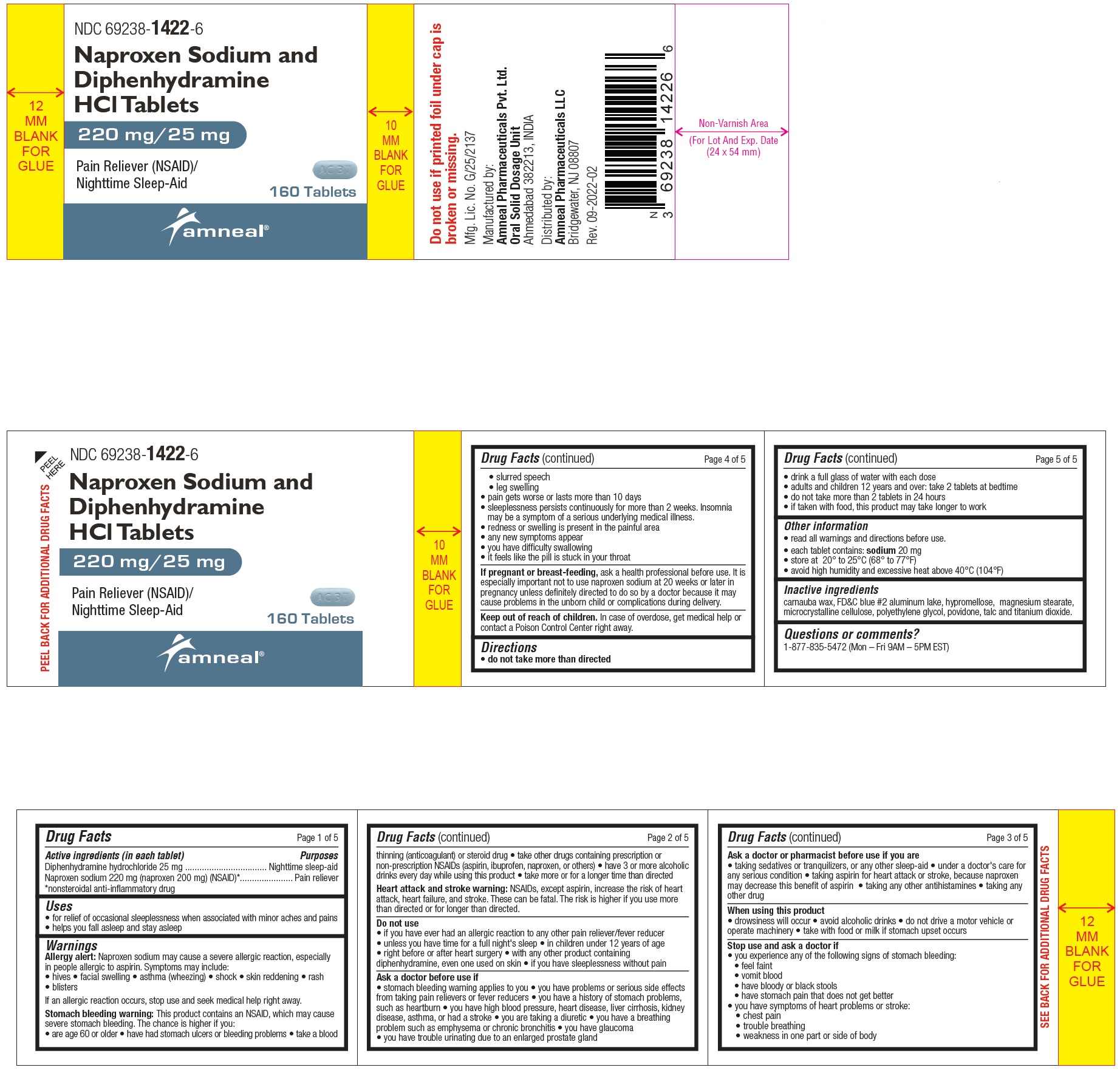
Naproxen Sodium and Diphenhydramine HCl 220 mg; 25 mg Tablet, Film Coated, 160-count — NDC 69238-1422-6 (Billing 69238-1422-06)
This is a package of 160 tablets of Naproxen Sodium and Diphenhydramine HCl 220 mg; 25 mg Tablet, Film Coated from Amneal Pharmaceuticals NY LLC, marketed since Oct 2018 and currently FDA-listed.
NDC database record
One package, one record: these facts belong to NDC 69238-1422-6 alone.
- Record
- FDA NDC Directory package listing · Human OTC drug
- Code segments
- 69238 labeler · 1422 product · 6 package
- Package marketed since
- Oct 23, 2018
- Sample package
- No — commercial package
- Listing certified through
- Dec 31, 2027
- Billing quantity
- 160 EA per package
- Barcode (UPC)
- 0369238142266
- FDA record last changed
- Oct 8, 2026
Identity & classification
Regulatory identifiers FDA, NLM and CMS codes for this package
- RxCUI (RxNorm): 1550957
Where does this data come from?
- FDA openFDA NDC Directory · synced Oct 8, 2026
- FDA label on DailyMed · label index refreshed Oct 8, 2026
- RxNorm (NLM RxNav) · catalog refreshed Oct 1, 2026
- Medi-Span GPI (licensed)
- First Databank (licensed) · refreshed Oct 8, 2026
RxNorm drug class
This medicine belongs to the Histamine-1 Receptor Antagonist class.
Where does this data come from?
- RxClass (NLM) · catalog refreshed Oct 1, 2026
Clinical
Patient education
Supplement & herbal interactions
Where does this data come from?
- MedlinePlus (NLM) · refreshed Oct 8, 2026
- FDA label on DailyMed · label index refreshed Oct 8, 2026
Ask a licensed pharmacist directly — free, answered by our team.
Pricing
A drug doesn't have one price. Each row is a different public payment system, and none is what you'd pay at the counter — that depends on your insurance. The ⓘ on each row explains what it measures.
| Price system | Per each | Per package |
|---|---|---|
| Retail pharmacies payNADAC · weekly | Not in the retail survey — common for institutional, discontinued, or low-volume packs. | |
| Medicaid paysCMS SDUD · 12 mo | No recent Medicaid claims on file for this NDC — rare and low-volume NDCs are suppressed in the public data. | |
| Medicare drug plans payPart D · quarterly | No Part D plan price is available for this NDC in our data. | |
Where does this data come from?
- CMS NADAC weekly file
- CMS ASP pricing files · refreshed Sep 20, 2026
- CMS Medicaid State Drug Utilization Data · refreshed Oct 8, 2026
- CMS Part D plan pricing files · refreshed Sep 24, 2026
- VA National Acquisition Center price file
Packaging — all sizes for this product
| Package NDC | Description | Marketing start | Marketing end | Status |
|---|---|---|---|---|
| 69238-1422-02 69238-1422-2 Main listing | 1 BOTTLE in 1 CARTON / 20 TABLET, FILM COATED in 1 BOTTLE | 2018-10-23 | — | Active |
| 69238-1422-04 69238-1422-4 | 1 BOTTLE in 1 CARTON / 40 TABLET, FILM COATED in 1 BOTTLE | 2018-10-23 | — | Active |
| 69238-1422-06 You're viewing this | 1 BOTTLE in 1 CARTON / 160 TABLET, FILM COATED in 1 BOTTLE | 2018-10-23 | — | Active |
| 69238-1422-08 69238-1422-8 | 1 BOTTLE in 1 CARTON / 80 TABLET, FILM COATED in 1 BOTTLE | 2018-10-23 | — | Active |
Pack size FAQ
What quantity is in this package?
How does this package differ from NDC 69238-1422-02?
What NDC number is used to bill for this package of Naproxen Sodium and Diphenhydramine HCl 220 mg; 25 mg Tablet, Film Coated?
Therapeutic equivalents
| Product | Labeler | Pack | NADAC/unit | TE | Status | Price vs. this |
|---|---|---|---|---|---|---|
| good sense naproxen sodium 25 mg/1; 220 mg 00113-8264-58 | L. | 40 tablets | — | — | Discontinued | — |
| Aleve PM 25 mg/1; 220 mg 00280-1200-01 | Bayer | 120 tablets | — | — | FDA listed | — |
| All Night Pain Relief Pm 25 mg/1; 220 mg 00363-2264-27 | Walgreen | 80 tablets | — | — | FDA listed | — |
| up and up naproxen sodium pm 25 mg/1; 220 mg 11673-0687-27 | Target | 80 tablets | — | — | FDA listed | — |
| Naproxen Sodium and Diphenhydramine HCL 25 mg/1; 220 mg 11673-0819-08 | TARGET | 80 tablets | — | — | FDA listed | — |
| Naproxen Sodium Pm 25 mg/1; 220 mg 21130-0639-71 | Safeway | 50 tablets | — | — | FDA listed | — |
| Naproxen Sodium Diphenhydramine Hydrochloride 220 mg/1; 25 mg 21130-0814-05 | SAFEWAY | 50 tablets | — | — | FDA listed | — |
| naproxen sodium pm 25 mg/1; 220 mg 30142-0383-60 | Kroger | 20 tablets | — | — | Discontinued | — |
| naproxen sodium pm 25 mg/1; 220 mg 30142-0753-27 | Kroger | 80 tablets | — | — | FDA listed | — |
| topcare all night pain relief pm 25 mg/1; 220 mg 36800-0264-27 | Topco | 80 tablets | — | — | FDA listed | — |
| naproxen sodium pm 25 mg/1; 220 mg 37808-0264-27 | H | 80 tablets | — | — | FDA listed | — |
| equaline naproxen sodium pm 25 mg/1; 220 mg 41163-0593-58 | United | 40 tablets | — | — | Discontinued | — |
| naproxen sodium pm 25 mg/1; 220 mg 41250-0526-27 | Meijer | 80 tablets | — | — | FDA listed | — |
| careone naproxen sodium pm 25 mg/1; 220 mg 41520-0264-27 | American | 80 tablets | — | — | FDA listed | — |
| dg health naproxen sodium pm 25 mg/1; 220 mg 55910-0858-27 | Dolgencorp | 80 tablets | — | — | FDA listed | — |
| Naproxen Sodium PM 220 mg/1; 25 mg 62011-0396-01 | Strategic | 20 tablets | — | — | Discontinued | — |
| Naproxen Sodium and Diphenhydramine HCl 220 mg/1; 25 mg 62207-0814-38 | Granules | 37500 tablets | — | — | FDA listed | — |
| Naproxen Sodium and Diphenhydramine HCl 220 mg/1; 25 mgthis 69238-1422-06 | Amneal | 160 tablets | — | — | FDA listed | — |
| Naproxen Sodium Diphenhydramine HCl 220 mg/1; 25 mg 69842-0328-02 | CVS | 20 tablets | — | — | FDA listed | — |
| Naproxen Sodium PM 220 mg/1; 25 mg 70677-0064-01 | Strategic | 20 tablets | — | — | FDA listed | — |
| basic care naproxen sodium pm 25 mg/1; 220 mg 72288-0310-06 | Amazon.com | 160 tablets | — | — | FDA listed | — |
| Naproxen Sodium Diphenhydramine HCL 25 mg/1; 220 mg 79903-0204-20 | Walmart | 20 tablets | — | — | FDA listed | — |
Where does this data come from?
- FDA openFDA NDC Directory · synced Oct 8, 2026
- FDA Orange Book · refreshed Oct 3, 2026
- CMS NADAC weekly file
Availability & generic status
This product is an FDA-approved generic. Other versions of the same drug are listed under Therapeutic equivalents, least expensive first.
Where does this data come from?
- FDA Orange Book · refreshed Oct 3, 2026
Inactive Ingredients / Excipients
Inactive ingredients, also called excipients, are components of the drug product other than the active ingredient. They may include fillers, dyes, coatings, preservatives, flavors, or other formulation ingredients.
💡 Tap an ingredient (hover on desktop) to see what it is and why it’s used.
-
UNII R12CBM0EIZ
A natural wax derived from a Brazilian palm tree, used as a coating and polish on tablets and capsules. It creates a smooth, shiny finish that protects the medicine and improves appearance.
-
UNII L06K8R7DQK
A synthetic blue dye approved by the FDA for use in medications and foods. It serves as a colorant to make pills and liquids visually distinct and easier to identify.
-
UNII 3NXW29V3WO
Hypromellose is a plant-based thickener made from cellulose. It's used in medicines as a binder to hold ingredients together, a coating for tablets, and a thickener for liquids.
-
UNII 70097M6I30
Magnesium stearate is a salt made from magnesium and stearic acid, a fatty substance. It's used in tablets and capsules as a lubricant and glidant to help ingredients flow smoothly during manufacturing and prevent sticking.
-
UNII OP1R32D61U
Microcrystalline cellulose is a purified form of cellulose, a natural fiber from plant sources. It acts as a binder and filler in tablets and capsules, helping hold ingredients together and give the medicine its shape and size.
-
UNII 3WJQ0SDW1A
Polyethylene glycol is a synthetic liquid or solid polymer used in medicines as a solvent, lubricant, and humectant. It helps dissolve active ingredients, reduces friction during manufacturing, and retains moisture in the final product.
-
UNII FZ989GH94E
Povidone is a synthetic polymer made from a plastic-like material. It acts as a binder to hold tablet ingredients together and as a disintegrant to help the tablet break apart in your stomach so the medicine can be absorbed.
-
UNII 7SEV7J4R1U
A powder made from a naturally occurring mineral. In medicines, talc works as a glidant and anti-caking agent, helping tablets and capsules flow smoothly during manufacturing and preventing clumping.
-
UNII 15FIX9V2JP
Titanium dioxide is a bright white mineral powder commonly used as a colorant and opacifying agent. It makes pills and tablets white or lighter in color and helps make coatings non-transparent.
9 inactive ingredients listed in the exact product block matched to this NDC.
Label-section wording can be broader than the structured product block and may mention additional formulation ingredients.
Where does this data come from?
ingredient classCode="IACT" elements from the exact product block matched by this NDC. Label-section narrative from DailyMed / the openFDA label index is shown separately when available.- FDA label on DailyMed · label index refreshed Oct 8, 2026
- FDA openFDA NDC Directory · synced Oct 8, 2026
Inactive ingredient FAQ
Are inactive ingredients the same for every manufacturer?
Why might an inactive ingredient be missing?
Can inactive ingredients matter?
Manufacturer & labeler
More NDCs from Amneal Pharmaceuticals NY LLC labeler code 69238
- Eltrombopag Olamine 75 mg Tablet, Film Coated NDC 69238-1414-3
- Eltrombopag Olamine 50 mg Tablet, Film Coated NDC 69238-1415-3
- Eltrombopag Olamine 25 mg Tablet, Film Coated NDC 69238-1416-3
- Eltrombopag Olamine 12.5 mg Tablet, Film Coated NDC 69238-1417-3
- Silodosin 8 mg Capsule NDC 69238-1420-3
- Silodosin 4 mg Capsule NDC 69238-1421-3
- Vigabatrin 500 mg Tablet NDC 69238-1424-1
- Vigabatrin 500 mg For Solution NDC 69238-1425-5
- Estradiol .025 mg/d Patch, Extended Release NDC 69238-1447-7
- Potassium Chloride 3 g/15mL Solution NDC 69238-1458-2
- Potassium Chloride 1.5 g/15mL Solution NDC 69238-1459-2
- Erythromycin 250 mg Tablet, Delayed Release NDC 69238-1471-1
Where does this data come from?
- FDA openFDA NDC Directory · synced Oct 8, 2026
- Drugs@FDA
FDA label — Drug Facts FDA SPL
🎯 Indications and Usage ▾
Uses for relief of occasional sleeplessness when associated with minor aches and pains helps you fall asleep and stay asleep
⏱️ Dosage and Administration ▾
Directions do not take more than directed drink a full glass of water with each dose adults and children 12 years and over: take 2 tablets at bedtime do not take more than 2 tablets in 24 hours if taken with food, this product may take longer to work
⚠️ Warnings ▾
Warnings Allergy alert: Naproxen sodium may cause a severe allergic reaction, especially in people allergic to aspirin. Symptoms may include: hives facial swelling asthma (wheezing) shock skin reddening rash blisters If an allergic reaction occurs, stop use and seek medical help right away. Stomach bleeding warning: This product contains an NSAID, which may cause severe stomach bleeding.
The chance is higher if you: are age 60 or older have had stomach ulcers or bleeding problems take a blood thinning (anticoagulant) or steroid drug take other drugs containing prescription or non-prescription NSAIDs (aspirin, ibuprofen, naproxen, or others) have 3 or more alcoholic drinks every day while using this product take more or for a longer time than directed Heart attack and stroke warning: NSAIDs, except aspirin, increase the risk of heart attack, heart failure, and stroke. These can be fatal. The risk is higher if you use more than directed or for longer than directed.
Do not use if you have ever had an allergic reaction to any other pain reliever/fever reducer unless you have time for a full night's sleep in children under 12 years of age right before or after heart surgery with any other product containing diphenhydramine, even one used on skin if you have sleeplessness without pain Ask a doctor before use if stomach bleeding warning applies to you you have problems or serious side effects from taking pain relievers or fever reducers you have a history of stomach problems, such as heartburn you have high blood pressure, heart disease, liver cirrhosis, kidney disease, asthma, or had a stroke you are taking a diuretic you have a breathing problem such as emphysema or chronic bronchitis you have glaucoma you have trouble urinating due to an enlarged prostate gland Ask a doctor or pharmacist before use if you are taking sedatives or tranquilizers, or any other sleep-aid under a doctor's care for any serious condition taking aspirin for heart attack or stroke, because naproxen may decrease this benefit of aspirin taking any other antihistamines taking any other drug When using this product drowsiness will occur avoid alcoholic drinks do not drive a motor vehicle or operate machinery take with food or milk if stomach upset occurs Stop use and ask a doctor if you experience any of the following signs of stomach bleeding: feel faint vomit blood have bloody or black stools have stomach pain that does not get better you have symptoms of heart problems or stroke: chest pain trouble breathing weakness in one part or side of body slurred speech leg swelling pain gets worse or lasts more than 10 days sleeplessness persists continuously for more than 2 weeks.
Insomnia may be a symptom of a serious underlying medical illness. redness or swelling is present in the painful area any new symptoms appear you have difficulty swallowing it feels like the pill is stuck in your throat If pregnant or breast-feeding, ask a health professional before use. It is especially important not to use naproxen sodium at 20 weeks or later in pregnancy unless definitely directed to do so by a doctor because it may cause problems in the unborn child or complications during delivery. Keep out of reach of children.
In case of overdose, get medical help or contact a Poison Control Center right away.
🧪 Active Ingredient ▾
Drug Facts Active ingredients (in each tablet) Diphenhydramine hydrochloride 25 mg Naproxen sodium 220 mg (naproxen 200 mg) (NSAID)* *nonsteroidal anti-inflammatory drug
🧪 Inactive Ingredients ▾
Inactive ingredients carnauba wax, FD&C blue #2 aluminum lake, hypromellose, magnesium stearate, microcrystalline cellulose, polyethylene glycol, povidone, talc and titanium dioxide.
🎯 Purpose ▾
Purposes Night time sleep-aid Pain reliever
📄 Do Not Use ▾
Do not use if you have ever had an allergic reaction to any other pain reliever/fever reducer unless you have time for a full night's sleep in children under 12 years of age right before or after heart surgery with any other product containing diphenhydramine, even one used on skin if you have sleeplessness without pain
📄 Ask a Doctor Before Use If ▾
Ask a doctor before use if stomach bleeding warning applies to you you have problems or serious side effects from taking pain relievers or fever reducers you have a history of stomach problems, such as heartburn you have high blood pressure, heart disease, liver cirrhosis, kidney disease, asthma, or had a stroke you are taking a diuretic you have a breathing problem such as emphysema or chronic bronchitis you have glaucoma you have trouble urinating due to an enlarged prostate gland
📄 Ask a Doctor or Pharmacist Before Use If ▾
Ask a doctor or pharmacist before use if you are taking sedatives or tranquilizers, or any other sleep-aid under a doctor's care for any serious condition taking aspirin for heart attack or stroke, because naproxen may decrease this benefit of aspirin taking any other antihistamines taking any other drug
📄 When Using This Product ▾
When using this product drowsiness will occur avoid alcoholic drinks do not drive a motor vehicle or operate machinery take with food or milk if stomach upset occurs
📄 Stop Use and Ask a Doctor If ▾
Stop use and ask a doctor if you experience any of the following signs of stomach bleeding: feel faint vomit blood have bloody or black stools have stomach pain that does not get better you have symptoms of heart problems or stroke: chest pain trouble breathing weakness in one part or side of body slurred speech leg swelling pain gets worse or lasts more than 10 days sleeplessness persists continuously for more than 2 weeks. Insomnia may be a symptom of a serious underlying medical illness. redness or swelling is present in the painful area any new symptoms appear you have difficulty swallowing it feels like the pill is stuck in your throat
🤰 If Pregnant or Breast-Feeding ▾
If pregnant or breast-feeding, ask a health professional before use. It is especially important not to use naproxen sodium at 20 weeks or later in pregnancy unless definitely directed to do so by a doctor because it may cause problems in the unborn child or complications during delivery.
📄 Keep Out of Reach of Children ▾
Keep out of reach of children. In case of overdose, get medical help or contact a Poison Control Center right away.
📄 Questions or Comments ▾
Questions or comments? 1-877-835-5472 (Mon – Fri 9AM – 5PM EST) Manufactured by: Amneal Pharmaceuticals Pvt. Ltd. Oral Solid Dosage Unit Ahmedabad 382213, INDIA Distributed by: Amneal Pharmaceuticals LLC Bridgewater, NJ 08807 Rev. 09-2022-02
📄 Package Label / Principal Display Panel ▾
Principal Display Panel NDC 69238-1422-6 Naproxen Sodium and Diphenhydramine HCl Tablets, 220 mg/25 mg Rx only 160 Tablets Amneal Pharmaceuticals LLC jh hj
About this NDC listing & data coverage
What data is (and isn’t) available for this NDC — tap to expand
| NDC identity (package / product / labeler codes) | ✓ Available |
| Labeler | ✓ Available |
| Product & package description | ✓ Available |
| Marketing category & status | ✓ Available |
| Active ingredient / dosage form / route | ✓ Available |
| FDA label (SPL via DailyMed) | ✓ Available |
| Package photos | ✓ Available |
| Inactive ingredients (structured) | ✓ Available |
| NADAC pharmacy acquisition price (CMS) | — Not published for this NDC CMS publishes NADAC only for NDCs reported in its retail-pharmacy survey. |
| Orange Book / therapeutic-equivalence data | — Not published for this NDC Applies only to products approved under an NDA/ANDA; many listings are out of scope. |
| HCPCS J-code billing crosswalk | — Not published for this NDC Most self-administered / retail products have no J-code — that is normal. |
| Medicaid utilization (CMS SDUD) | — Not published for this NDC CMS reports utilization only for NDCs with Medicaid claims above its privacy threshold. |