
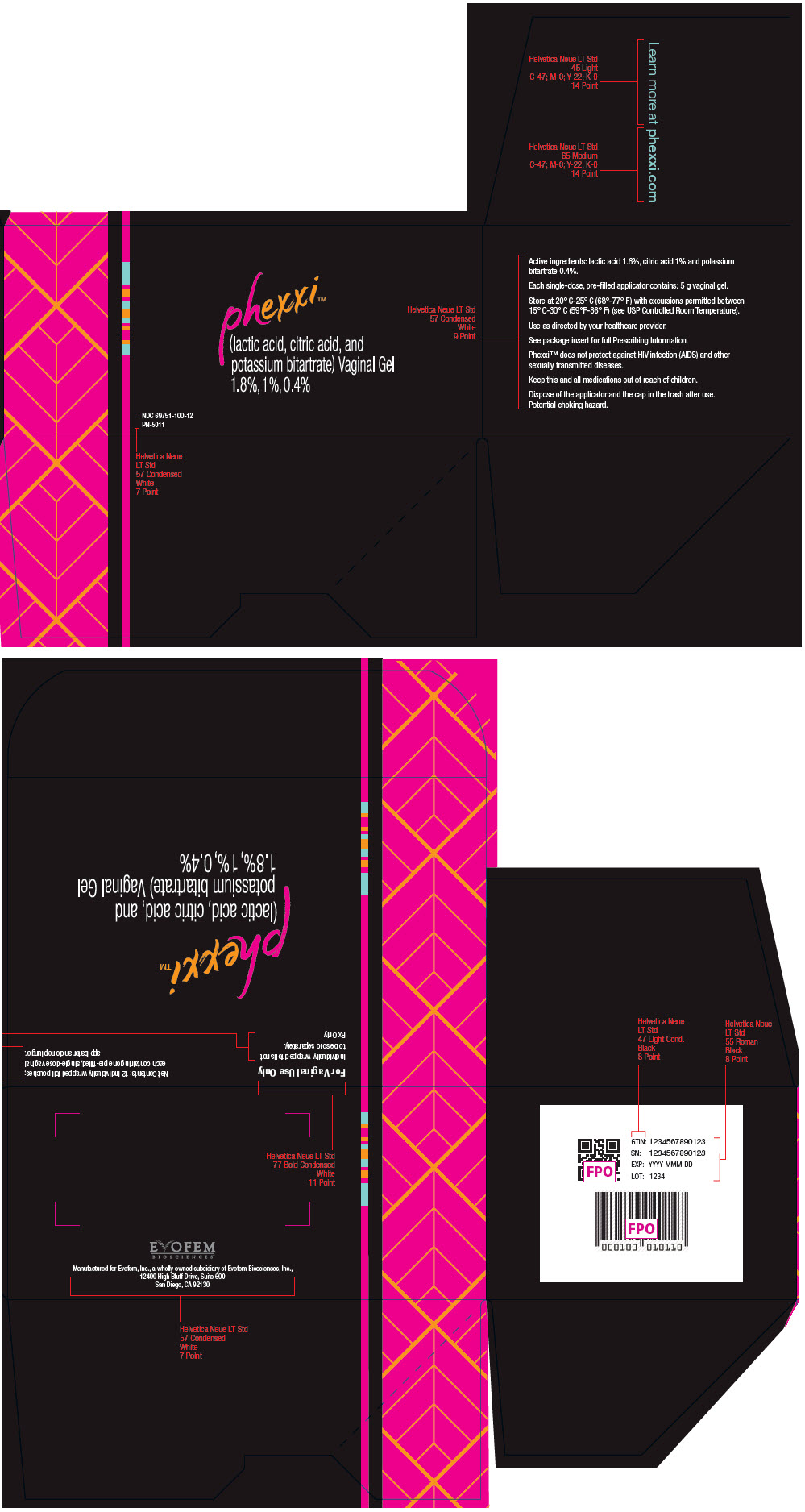
Phexxi lactic acid, L-, citric acid monohydrate, and potassium bitartrate 90 mg/5g; 50 mg/5g; 20 mg/5g Gel — NDC 69751-100-12 (Billing 69751-0100-12)
This is a package of Phexxi lactic acid, L-, citric acid monohydrate, and potassium bitartrate 90 mg/5g; 50 mg/5g; 20 mg/5g Gel from Evofem, Inc., marketed since Aug 2020 and currently FDA-listed; retail pharmacies pay about $6.05 per g (NADAC). It is the main listing for this product, which comes in 2 package sizes.
NDC database record
One package, one record: these facts belong to NDC 69751-100-12 alone.
- Record
- FDA NDC Directory package listing · Human prescription drug
- Code segments
- 69751 labeler · 100 product · 12 package
- Package marketed since
- Sep 1, 2020
- Sample package
- No — commercial package
- Listing certified through
- Dec 31, 2026
- Barcode (UPC-A, from the NDC)
- 3 6975110012 5
- Medicaid fills, this package
- 14,039 prescriptions in the last four reported quarters
- FDA record last changed
- Aug 27, 2026
Identity & classification
Regulatory identifiers FDA, NLM and CMS codes for this package
Drug-database identifiers Medi-Span GPI and First Databank GCN / HICL / AHFS classification
- GSN (GCN sequence number): 081105
- GCN: 48142
- GPI-14 (Medi-Span): 55329903404020
- HICL (First Databank): 046568
- AHFS class code: 32:00.00.00
- RxCUI (RxNorm): 2385348
Where does this data come from?
- FDA openFDA NDC Directory · synced Oct 8, 2026
- FDA label on DailyMed · label index refreshed Oct 8, 2026
- RxNorm (NLM RxNav) · catalog refreshed Oct 1, 2026
- Medi-Span GPI (licensed)
- First Databank (licensed) · refreshed Oct 8, 2026
RxNorm drug class
This medicine belongs to the Organic acids class.
Where does this data come from?
- RxClass (NLM) · catalog refreshed Oct 1, 2026
Clinical
The combination of lactic acid, citric acid, and potassium bitartrate is used to prevent pregnancy when used just before vaginal sex in women who can become pregnant. It does not prevent pregnancy when used after vaginal sex. The combination of lactic acid, citric acid, and potassium bitartrate is in a class of medications called non-hormonal contraceptives. It works by lowering the pH of the vagina and reducing sperm motility. Lactic acid, citric acid, and potassium bitartrate may prevent pregnancy, but this medication will not prevent the spread of human immunodeficiency virus (HIV, the viru...
Read the full MedlinePlus article ↗- No, it's not a pill. Both Phexxi and Phexx come as a pre-filled vaginal applicator, similar to how some yeast infection treatments work. You insert one applicator vaginally right b...
- How exactly do I use Phexxi or Phexx — do I take it like a pill?
- The FDA label for Phexxi and Phexx covers only pregnancy prevention — there is no indication that these products protect against sexually transmitted infections. If STI protection...
- Does it protect against STIs (sexually transmitted infections)?
Patient education
Supplement & herbal interactions
Where does this data come from?
- MedlinePlus (NLM) · refreshed Oct 8, 2026
- FDA label on DailyMed · label index refreshed Oct 8, 2026
Ask a licensed pharmacist directly — free, answered by our team.
Pricing
A drug doesn't have one price. Each row is a different public payment system, and none is what you'd pay at the counter — that depends on your insurance. The ⓘ on each row explains what it measures.
| Price system | Per g | Per package |
|---|---|---|
| Retail pharmacies payNADAC · weekly | $6.054 | $363.25 / 60 g |
| Medicaid paysCMS SDUD · 12 mo | $5.93 | $356.03 / 60 g |
| Medicare drug plans payPart D · Q2 2026 | $5.95 | $356.81 / 60 g |
Where does this data come from?
- CMS NADAC weekly file · file of Oct 7, 2026
- CMS ASP pricing files · refreshed Sep 20, 2026
- CMS Medicaid State Drug Utilization Data · through Q1 2026
- CMS Part D plan pricing files · refreshed Sep 24, 2026
- VA National Acquisition Center price file
Packaging — all sizes for this product
| Package NDC | Description | Per unit | Per pack | Marketing start | Marketing end | Status |
|---|---|---|---|---|---|---|
| 69751-0100-03 69751-100-03 | 3 APPLICATOR in 1 BOX / 5 g in 1 APPLICATOR Sample | — | — | 2021-05-24 | — | Active |
| 69751-0100-12 You're viewing this Main listing | 12 APPLICATOR in 1 BOX / 5 g in 1 APPLICATOR | $6.05 / g | $363.25 | 2020-09-01 | — | Active |
In Medicaid, this is the most-dispensed pack of this product — about 100% of fills over the last four reported quarters. See all packs ↓
Pack size FAQ
What quantity is in this package?
What NDC number is used to bill for this package of Phexxi lactic acid, L-, citric acid monohydrate, and potassium bitartrate 90 mg/5g; 50 mg/5g; 20 mg/5g Gel?
Prices are the latest CMS NADAC pharmacy acquisition cost per NDC; per-pack figures are per-unit × pack quantity, shown only when the pack is denominated in the same measure NADAC prices.
Therapeutic equivalents
| Product | Labeler | Pack | NADAC/unit | TE | Status | Price vs. this |
|---|---|---|---|---|---|---|
| Phexxi 90 mg/5g; 50 mg/5g; 20 mg/5gthis 69751-0100-12 | Evofem, | 12 applicators | $6.054 | — | Availability likely | — |
| Phexx 90 mg/5g; 50 mg/5g; 20 mg/5g 69751-0101-12 | Evofem, | 12 applicators | $6.054 | — | Availability likely | — |
Where does this data come from?
- FDA openFDA NDC Directory · synced Oct 8, 2026
- FDA Orange Book · refreshed Oct 3, 2026
- CMS NADAC weekly file · file of Oct 7, 2026
Availability & generic status
We did not find an FDA-approved generic match for this exact strength, form and route. Patent/protection dates below may affect future generic timing.
Why the date isn’t exact: Generic timing can change because patents may be challenged, settled, licensed, added, removed, or worked around with a narrower label — and FDA approval does not always mean a pharmacy can get the generic today.
🛈 What do these terms mean?
- Patent
- Legal protection listed in the Orange Book that may delay generic approval or launch. Issued by the U.S. Patent & Trademark Office.
- Substance patent
- Covers the active drug molecule itself — the hardest to design around. A generic generally can’t launch until it expires.
- Formulation (product) patent
- Covers a specific formulation or dosage form. A generic can sometimes work around it with a different formulation.
- Method-of-use patent
- A patent covering one specific approved use of the drug — not necessarily the whole molecule. A generic can sometimes launch with a “skinny label” that carves out the protected use and keeps the others.
- Skinny label
- A generic label that omits a still-patented use when the FDA allows it — letting a generic reach the market for the unprotected uses.
- Exclusivity
- FDA-granted marketing protection, separate from patents — e.g. 5-yr new chemical entity, 7-yr orphan drug, or a +6-month pediatric extension.
- Paragraph IV
- A generic applicant’s formal challenge to a listed patent. It can potentially lead to earlier generic entry, but often involves litigation or a settlement.
- RLD / RS
- Reference Listed Drug — the brand product the FDA uses as the reference for generic applications. Reference Standard — the product the FDA expects generics to compare against in bioequivalence testing.
- TE / AB rating
- FDA therapeutic-equivalence rating. An AB rating generally means the FDA considers a generic therapeutically equivalent to — and substitutable for — the brand.
- LOE (loss of exclusivity)
- The latest patent or exclusivity currently listed — the loss-of-exclusivity / latest-listed-protection date shown on this page. Paragraph-IV challenges and settlements can move the real date earlier; FDA approval and a manufacturer’s decision to market can move it later.
Built from the FDA Orange Book. The bars above are scaled to each protection’s expiry; the red LOE marker is the last one to lapse.
| Patent | Type | Use code | Expires |
|---|---|---|---|
| US 11337989 ↗ | Method of use | U-1 | Mar 15, 2033 |
| US 11992472 ↗ | Method of use | U-1 | Mar 15, 2033 |
| US 10568855 ↗ | Method of use | U-1 | Mar 15, 2033 |
| US 11439610 ↗ | Drug substance | — | Mar 15, 2033 |
Is there a generic version of PHEXXI 1.8-1-0.4% VAGINAL GEL?
The FDA approved a generic — why can’t I get it at my pharmacy yet?
Why do different websites show different generic release dates?
What does “FDA listed” mean?
What does a patent or protection date mean here?
What does “current Orange Book estimate” mean?
Can a generic come out before the last patent expires?
Can a generic come out after the listed dates?
What is the difference between patents and exclusivity?
Why are there multiple patent dates?
Where does this data come from?
- FDA Orange Book · refreshed Oct 3, 2026
What it looks like
Where does this data come from?
- FDA label on DailyMed · label index refreshed Oct 8, 2026
Inactive Ingredients / Excipients
Inactive ingredients, also called excipients, are components of the drug product other than the active ingredient. They may include fillers, dyes, coatings, preservatives, flavors, or other formulation ingredients.
🧪 Avoiding an ingredient? See Citric Acid / Lactic Acid / Potassium Bitartrate inactive ingredients by manufacturer: every current product's list side by side, so you can ask your pharmacy for the version that does not list it.
Where does this data come from?
IACT rows and label-wide narrative are kept separate; availability and product-level specificity depend on the submitted label.- FDA label on DailyMed · label index refreshed Oct 8, 2026
- FDA openFDA NDC Directory · synced Oct 8, 2026
Inactive ingredient FAQ
Are inactive ingredients the same for every manufacturer?
Why might an inactive ingredient be missing?
Can inactive ingredients matter?
Manufacturer & labeler
More NDCs from Evofem, Inc. labeler code 69751
Where does this data come from?
- FDA openFDA NDC Directory · synced Oct 8, 2026
- Drugs@FDA
Full prescribing information FDA SPL
🎯 Indications and Usage ▾
1 INDICATIONS AND USAGE PHEXXI is indicated for the prevention of pregnancy in females of reproductive potential for use as an on-demand method of contraception. PHEXXI is a combination of lactic acid, citric acid, and potassium bitartrate indicated for the prevention of pregnancy in females of reproductive potential for use as an on-demand method of contraception. ( 1 ) Limitations of Use: PHEXXI is not effective for the prevention of pregnancy when administered after intercourse.
Limitations of Use PHEXXI is not effective for the prevention of pregnancy when administered after intercourse [see Dosage and Administration (2.1) ].
⏱️ Dosage and Administration ▾
2 DOSAGE AND ADMINISTRATION Administer one (1) pre-filled single-dose applicator of PHEXXI (5 grams) vaginally immediately before (or up to one hour before) each episode of vaginal intercourse ( 2.1 ) May use during any part of the menstrual cycle ( 2.2 )
2.1Recommended Dosage Administer one pre-filled applicator of PHEXXI (5 grams) vaginally immediately before or up to one hour before each act of vaginal intercourse. If more than one act of vaginal intercourse occurs within one hour, an additional dose must be applied. Five grams of PHEXXI contains 90 mg of lactic acid, 50 mg of citric acid, and 20 mg of potassium bitartrate.
2.2Timing of PHEXXI Use May use PHEXXI during any part of the menstrual cycle. May use PHEXXI as soon as it is safe to resume vaginal intercourse after childbirth, abortion, or miscarriage.
2.3Use of PHEXXI with Other Contraceptive Methods PHEXXI may be used concomitantly with hormonal contraceptives; latex, polyurethane, and polyisoprene condoms; and vaginal diaphragms. Avoid PHEXXI use with vaginal rings.
2.4Use of PHEXXI with Other Vaginal Products PHEXXI may be used concomitantly with other products for vaginal infections including miconazole, metronidazole, and tioconazole.
💊 Dosage Forms and Strengths ▾
3 DOSAGE FORMS AND STRENGTHS Vaginal gel: 18 mg of lactic acid, 10 mg of citric acid, and 4 mg of potassium bitartrate in each gram (1.8%, 1%, and 0.4%, respectively) of off-white to tan color gel supplied in a pre-filled single-dose (5 grams) vaginal applicator Each pre-filled single-dose vaginal applicator delivers 5 grams of gel containing lactic acid (1.8%), citric acid (1%), and potassium bitartrate (0.4%). ( 3 )
⚠️ Warnings and Cautions ▾
5 WARNINGS AND PRECAUTIONS Cystitis and Pyelonephritis: Avoid use in women with a history of recurrent UTI or urinary tract abnormalities ( 5.1 )
5.1Cystitis and Pyelonephritis Among 2804 subjects who received PHEXXI in Studies 1 and 2, 0.36% (n=10) reported adverse reactions of cystitis, pyelonephritis, or other upper urinary tract infection (UTI). Of these, one case of pyelonephritis was considered serious and required hospitalization. Avoid use of PHEXXI in females of reproductive potential with a history of recurrent urinary tract infection or urinary tract abnormalities .
🤒 Adverse Reactions ▾
6 ADVERSE REACTIONS The following clinically significant adverse reactions are described elsewhere in the labeling: Cystitis and Pyelonephritis [see Warnings and Precautions (5.1) ] Most common adverse reactions (≥2%) were vulvovaginal burning sensation, vulvovaginal pruritus, vulvovaginal mycotic infection, urinary tract infection, vulvovaginal discomfort, bacterial vaginosis, vaginal discharge, genital discomfort, dysuria, and vulvovaginal pain. ( 6.1 ) To report SUSPECTED ADVERSE REACTIONS, contact Evofem at toll-free phone 1-833-EVFMBIO or FDA at 1-800-FDA-1088 or www.fda.gov/medwatch.
6.1Clinical Trials Experience Because clinical trials are conducted under widely varying conditions, adverse reaction rates observed in the clinical trials of a drug cannot be directly compared to rates in the clinical trials of another drug and may not reflect the rates observed in practice. The safety of PHEXXI (pre-filled applicator with 5-gram dose) has been evaluated in two clinical trials (Study 1 and Study 2) in 2804 subjects (over 19,000 cycles of exposure) . The racial/ethnic distribution was 66% White, 27% Black or African American, 2% Asian, 1% American Indian or Alaska Native, 0.3% Native Hawaiian or Pacific Islander, and 5% other; 32% of the study population was Hispanic.
Study 1 included a one-year extension phase where 342 U.S. subjects were exposed to PHEXXI for 13 cycles. Hypersensitivity Reaction Of the 2804 PHEXXI-treated subjects in Studies 1 and 2, one subject reported a suspected drug hypersensitivity. Avoid PHEXXI use in females of reproductive potential with suspected hypersensitivity to the ingredients in PHEXXI.
The most common adverse reactions (≥10%) in the U.S. population in Studies 1 and 2 (n = 2480) were: vulvovaginal burning sensation (18.0%) and vulvovaginal pruritus (14.5%). The majority of these adverse reactions were mild and few led to discontinuation. Table 1 summarizes the most common adverse reactions (≥2%) reported by subjects using PHEXXI in the U.S.
Table 1. Adverse Reactions that Occurred in ≥ 2% of Subjects Who Used PHEXXI to Prevent Pregnancy (Studies 1 and 2 – U.S. population only) Adverse Reaction PHEXXI (N=2480) (%) Vulvovaginal Burning Sensation
18.0 Vulvovaginal Pruritus
14.5Vulvovaginal Mycotic Infection Includes preferred terms (PT) vulvovaginal mycotic infection and vulvovaginal candidiasis.
9.1Urinary Tract Infection Includes PTs urinary tract infection, streptococcal urinary tract infection, Escherichia urinary tract infection, and urinary tract infection bacterial. Does not include PTs cystitis, kidney infection, and pyelonephritis [see Warnings and Precautions (5.1)].
9.0 Vulvovaginal Discomfort
9.0 Bacterial Vaginosis
8.4 Vaginal Discharge
5.5 Genital Discomfort
4.1 Dysuria
3.1 Vulvovaginal pain
2.1Among subjects who used PHEXXI in Studies 1 and 2, 1.6% discontinued from the clinical trials due to an adverse reaction. The most common adverse reactions leading to study discontinuation were vulvovaginal burning sensation (0.7%); and vulvovaginal pruritus and vulvovaginal discomfort (0.1% each). Adverse Reactions in Male Partners Among male partners of subjects who used PHEXXI for contraception in Study 2, 9.8% (131 of 1330) reported symptoms of local discomfort (burning, itching, pain, and "other").
Of these local discomfort symptoms, 74.7% were mild, 21.4% were moderate, and 3.9% were severe. Two subjects discontinued participation in the study due to male partner symptoms.
👥 Use in Specific Populations ▾
8 USE IN SPECIFIC POPULATIONS
8.1Pregnancy Risk Summary There is no use for PHEXXI in pregnancy; therefore, discontinue PHEXXI during pregnancy. There are no data with the use of PHEXXI in pregnant women or animals. In the U.S. general population, the estimated background risk of major birth defects and miscarriage in clinically recognized pregnancies is 2 to 4 percent and 15 to 20 percent, respectively.
8.2Lactation Risk Summary There are no data on the presence of lactic acid, citric acid, and potassium bitartrate or their metabolites in human milk, the effects on the breastfed infant, or the effects on milk production.
8.4Pediatric Use The safety and effectiveness of PHEXXI have been established in females of reproductive potential. Efficacy is expected to be the same for post-menarchal females under the age of 17 as for users 17 years and older. The use of PHEXXI before menarche is not indicated.
🤰 Pregnancy ▾
8.1Pregnancy Risk Summary There is no use for PHEXXI in pregnancy; therefore, discontinue PHEXXI during pregnancy. There are no data with the use of PHEXXI in pregnant women or animals. In the U.S. general population, the estimated background risk of major birth defects and miscarriage in clinically recognized pregnancies is 2 to 4 percent and 15 to 20 percent, respectively.
🧒 Pediatric Use ▾
8.4Pediatric Use The safety and effectiveness of PHEXXI have been established in females of reproductive potential. Efficacy is expected to be the same for post-menarchal females under the age of 17 as for users 17 years and older. The use of PHEXXI before menarche is not indicated.
🧬 Clinical Pharmacology ▾
12 CLINICAL PHARMACOLOGY
12.1Mechanism of Action In in vitro studies, Phexxi produced a normal vaginal pH range (pH 3.5 – 4.5) in the presence of semen. In clinical studies, post-coital testing demonstrated pH < 5 in the majority of subjects, and sperm motility reduction.
12.2Pharmacodynamics Pharmacodynamic studies in humans have not been performed.
12.3Pharmacokinetics Pharmacokinetic studies in humans have not been performed. Systemic exposures of lactic acid, citric acid, and potassium bitartrate following vaginal administration of PHEXXI are not expected to lead to safety concerns. In vitro studies with commonly used vaginal preparations (miconazole, metronidazole, tioconazole, and a product for maintaining normal vaginal pH) showed no significant effect on the pH or buffering capacity of PHEXXI.
🧬 Mechanism of Action ▾
12.1Mechanism of Action In in vitro studies, Phexxi produced a normal vaginal pH range (pH 3.5 – 4.5) in the presence of semen. In clinical studies, post-coital testing demonstrated pH < 5 in the majority of subjects, and sperm motility reduction.
📦 How Supplied / Storage and Handling ▾
16 HOW SUPPLIED/STORAGE AND HANDLING PHEXXI (lactic acid, citric acid, and potassium bitartrate) vaginal gel is an off-white to tan color gel of uniform consistency containing lactic acid (1.8%), citric acid (1%), and potassium bitartrate (0.4%), supplied as individually wrapped 5 gram pre-filled single-dose vaginal applicators in sealed foil pouches along with a plunger, and are available as follows: NDC 69751-100-12 Box of 12 units NDC 69751-100-03 Sample box of 3 units Store in the original foil pack at room temperature 20°C to 25°C (68°F to 77°F); excursion permitted between 15°C to 30°C (59°F to 86°F) [ see USP Controlled Room Temperature ].
📦 Storage and Handling ▾
Store in the original foil pack at room temperature 20°C to 25°C (68°F to 77°F); excursion permitted between 15°C to 30°C (59°F to 86°F) [ see USP Controlled Room Temperature ].
📋 Description ▾
11 DESCRIPTION PHEXXI (lactic acid, citric acid, and potassium bitartrate) is a vaginal gel. PHEXXI is an off-white to tan in color gel of uniform consistency, containing three active ingredients: lactic acid, citric acid, and potassium bitartrate. The structural formula for lactic acid is: Lactic acid is designated chemically as 2-hydroxypropanoic acid with an empirical formula of C 3 H 6 O 3 and a molecular weight of 90.08 g/mol.
The structural formula for citric acid is: Citric acid is designated chemically as 2-hydroxypropane-1,2,3-tricarboxylic acid with an empirical formula of C 6 H 8 O 7 and a molecular weight of 192.124 g/mol. The structural formula for potassium bitartrate is: Potassium bitartrate is designated chemically as potassium; (2 R , 3 R )-2,3,4-trihydroxy-4-oxobutanoate with an empirical formula of KC 4 H 5 O 6 and a molecular weight of 188.177 g/mol. Each 5 gram dose is provided in a pre-filled single-dose applicator containing lactic acid USP (1.8% w/w), citric acid USP (1% w/w), and potassium bitartrate USP (0.4% w/w).
Inactive ingredients present in the gel are: glycerin, alginic acid, xanthan gum, sodium hydroxide, benzoic acid, and purified water. Chemical Structure Chemical Structure Chemical Structure
💬 Information for Patients ▾
17 PATIENT COUNSELING INFORMATION Advise the patient to read the Patient Information and FDA-approved patient labeling (Instructions for Use). Advise the patient: To intravaginally administer the contents of one pre-filled single-dose applicator of PHEXXI before each episode of vaginal intercourse and to administer an additional dose if intercourse does not occur within one hour of administration [ see Dosage and Administration (2.1) ]. To consult their healthcare provider for severe or prolonged genital irritation [ see Adverse Reactions (6.1) ] .
To discontinue PHEXXI if they develop a local hypersensitivity reaction [ see Adverse Reactions (6.1) ]. To contact their healthcare provider if experiencing urinary tract symptoms [ see Warnings and Precautions (5.1) ]. That PHEXXI does not protect against HIV infection and other sexually transmitted infections.
🧬 Pharmacokinetics ▾
12.3Pharmacokinetics Pharmacokinetic studies in humans have not been performed. Systemic exposures of lactic acid, citric acid, and potassium bitartrate following vaginal administration of PHEXXI are not expected to lead to safety concerns. In vitro studies with commonly used vaginal preparations (miconazole, metronidazole, tioconazole, and a product for maintaining normal vaginal pH) showed no significant effect on the pH or buffering capacity of PHEXXI.
🧬 Pharmacodynamics ▾
12.2Pharmacodynamics Pharmacodynamic studies in humans have not been performed.
🔬 Clinical Studies ▾
14 CLINICAL STUDIES The efficacy of PHEXXI for the prevention of pregnancy was evaluated in a multi-center, open-label, single-arm clinical trial in the United States (AMP002; NCT03243305). The study enrolled females of reproductive potential 18 to 35 years of age with regular menstrual cycles (21 to 35 days). The median age was 27.8 years.
The racial distribution was 70.6% White, 23.7% Black or African American, 2.5% Asian, 0.4% American Indian or Alaska Native, 0.2% Native Hawaiian or Pacific Islander, and 2.7% other. Subjects agreed to engage in at least 3 acts of heterosexual, vaginal intercourse per cycle. Subjects self-administered a 5 gram dose of PHEXXI intravaginally up to one hour before each episode of intercourse for up to 7 cycles.
The primary efficacy endpoint was the 7-cycle typical use cumulative pregnancy rate as derived by Kaplan-Meier life-table analysis. A total of 101 on-treatment pregnancies occurred in 1183 subjects contributing 4769 evaluable natural cycles. The 7-cycle cumulative pregnancy rate was 13.7% (95% CI: 10.0%, 17.5%), excluding cycles with back-up contraception, cycles <21 days or >35 days in length and cycles in which no intercourse was reported.
The estimated Pearl Index, calculated based on data from the 7-cycle study, was 27.5 (95% CI: 22.4%, 33.5%).
🧪 Nonclinical Toxicology ▾
13 NONCLINICAL TOXICOLOGY
13.1Carcinogenesis, Mutagenesis, Impairment of Fertility Carcinogenesis Long-term carcinogenicity studies have not been performed with PHEXXI. Mutagenesis Mutagenic studies have not been performed with PHEXXI. Impairment of Fertility Reproductive studies have not been performed with PHEXXI. Upon discontinuation of PHEXXI, pregnancy may occur.
📄 Carcinogenesis, Mutagenesis, Impairment of Fertility ▾
13.1Carcinogenesis, Mutagenesis, Impairment of Fertility Carcinogenesis Long-term carcinogenicity studies have not been performed with PHEXXI. Mutagenesis Mutagenic studies have not been performed with PHEXXI. Impairment of Fertility Reproductive studies have not been performed with PHEXXI. Upon discontinuation of PHEXXI, pregnancy may occur.
📄 Patient Package Insert ▾
PATIENT INFORMATION PHEXXI ® (FEX ee) (lactic acid, citric acid, and potassium bitartrate) vaginal gel For Vaginal Use Only This Patient Information has been approved by the U.S. Food and Drug Administration Issued: June 2023 What is PHEXXI? PHEXXI is a prescription medicine used to prevent pregnancy in females who can become pregnant and choose to use an on-demand method of birth control.
PHEXXI is not effective at preventing pregnancy when used after vaginal sex. How well does PHEXXI work? Your chance of getting pregnant depends on how well you follow the directions for using PHEXXI.
The better you follow the directions, the less chance you have of getting pregnant. It is very important that you follow the directions carefully each time you have vaginal sex. PHEXXI does not protect against HIV infection or other sexually transmitted infections (STIs).
Before using PHEXXI, tell your healthcare provider about all of your medical conditions, including if you: are pregnant or think you are pregnant. PHEXXI is not for use in pregnant women. are breastfeeding or plan to breastfeed. It is not known if PHEXXI passes into your breast milk.
Tell your healthcare provider about all the medicines you take, including prescription and over-the-counter medicines, vitamins, and herbal supplements. Know the medicines you take. Keep a list of them to show your healthcare provider and pharmacist when you get a new medicine.
How should I use PHEXXI? See the Instructions for Use that come with PHEXXI for detailed instructions on the right way to use PHEXXI. Use PHEXXI exactly as your healthcare provider tells you to use it.
PHEXXI must be used before vaginal sex. PHEXXI comes as a pre-filled single-dose vaginal applicator. Insert 1 PHEXXI pre-filled applicator into your vagina and use PHEXXI within 1 hour before each time you have vaginal sex.
If you do not have vaginal sex within 1 hour of using PHEXXI, you must insert a new PHEXXI pre-filled applicator. If you have vaginal sex more than 1 time within 1 hour, you must use a new PHEXXI pre-filled applicator. PHEXXI may be used at any time during the menstrual cycle.
PHEXXI may be used as soon as your healthcare provider tells you it is safe for you to have vaginal sex after childbirth, abortion, or miscarriage. PHEXXI may be used with hormonal contraceptives; and latex, polyurethane and polyisoprene condoms. PHEXXI may be used with a vaginal diaphragm.
Avoid using PHEXXI with contraceptive vaginal rings. PHEXXI may be used with other medicines used in the vagina to treat infections including miconazole, metronidazole and tioconazole. What are the possible side effects of PHEXXI?
PHEXXI may cause serious side effects, including: Bladder infection (cystitis) and acute kidney infection (pyelonephritis). Urinary tract infections are common but can also be serious. You should not use PHEXXI if you have a history of urinary tract infections that keep coming back or other problems with your urinary tract.
Call your healthcare provider if you have burning with urination or other signs and symptoms of a urinary tract infection such as: burning feeling when passing urine, urine that looks cloudy, pain in the pelvis, or back pain. Allergic reactions . Avoid using PHEXXI if you are a female who can become pregnant and are allergic to lactic acid, citric acid, potassium bitartrate or any of the ingredients in PHEXXI; or your sexual partners are allergic to any of the ingredients in PHEXXI".
Stop using PHEXXI if you have a local vulvovaginal reaction. The most common side effects of PHEXXI include: vaginal burning vaginal itching vaginal yeast infection discomfort around the vaginal area bacterial vaginosis vaginal discharge discomfort in the genital area pain while passing urine These are not all the possible side effects of PHEXXI. Call your healthcare provider for medical advice about side effects.
You may report side effects to FDA at 1-800-FDA-1088. How should I store PHEXXI? Store PHEXXI at room temperat… [Excerpted — this section continues on DailyMed.]
📖 Instructions for Use ▾
INSTRUCTIONS FOR USE PHEXXI ® (FEX ee) (lactic acid, citric acid, and potassium bitartrate) vaginal gel For Vaginal Use Only These Instructions for Use contain information on how to use PHEXXI vaginal gel. Make sure that you read, understand, and follow the Instructions for Use before using PHEXXI and each time you get a refill. There may be new information.
Contents: Each box contains either 3 or 12 foil pouches. Each foil pouch contains a pre-filled applicator and plunger rod (see Figure A ). Each pre-filled applicator contains 1 dose of PHEXXI for 1-time use (single use).
Figure A Important Information You Need to Know Before Using PHEXXI Use 1 dose of PHEXXI within 1 hour before you have vaginal sex. A new PHEXXI pre-filled applicator must be used each time you have vaginal sex. If you have vaginal sex more than 1 time within 1 hour, a new PHEXXI pre-filled applicator must be used .
Prepare to Use PHEXXI Keep the pre-filled applicator and plunger rod in the foil pouch until you are ready to use PHEXXI. Step 1: Wash Your Hands Wash your hands with soap and water before opening the foil pouch. Step 2: Remove the Pre-filled Applicator and Plunger Rod from the Foil Pouch Remove the pre-filled applicator and plunger rod from the foil pouch (see Figure B ).
Figure B Important : Do not remove the pink cap until instructed in Step 4. Insert PHEXXI Gel Step 3: Insert the Plunger Rod Gently and slowly insert the plunger rod into the pre-filled applicator. Push until you feel the tip of the plunger rod connect to the inside of the pre-filled applicator (see Figure C ).
Do not push hard or continue to push after the tip of the plunger rod connects to the inside of the pre-filled applicator. This could cause the gel to go into the pink cap. Use a new pre-filled applicator if the gel goes into the pink cap.
Figure C Step 4: Remove the Pink Cap After the plunger rod is connected to the pre-filled applicator, remove the pink cap from the pre-filled applicator (see Figure D ). The extra space between the gel and the end of the pre-filled applicator is normal. The pre-filled applicator is now ready for use.
Figure D Step 5: Insert the PHEXXI Pre-filled Applicator into the Vagina Hold the pre-filled applicator at the grooved area closest to the plunger rod (see Figure E ). Gently insert the pre-filled applicator into the vagina as far as it will comfortably go while you continue to hold it by the grooved area firmly. This can be done sitting with your knees apart, lying on your back with your knees bent (see Figure F ), or while standing with your feet apart or knees bent.
Figure E Figure F Step 6: Insert PHEXXI Gel While the pre-filled applicator is inserted in your vagina, use your index finger to push the plunger rod down until it stops. This is to make sure you receive the entire dose of PHEXXI (see Figure G ). It is normal for a small amount of gel to be left in the applicator.
You will still get the right dose. Figure G Step 7: Remove the Used PHEXXI Pre-filled Applicator Gently remove the plunger rod and pre-filled applicator from the vagina (see Figure H ) and throw away (dispose of) the used pre-filled applicator. PHEXXI should be used within 1 hour before each time you have vaginal sex .
Use a new pre-filled applicator if you do not have vaginal sex within 1 hour of inserting PHEXXI gel and you still plan to have vaginal sex. Figure H Disposing of PHEXXI Step 8: Throw Away (Dispose of) the Used PHEXXI Pre-filled Applicator Used PHEXXI pre-filled applicators and caps should be disposed of in the trash. The cap may be a potential choking hazard.
Storing PHEXXI Store PHEXXI at room temperature between 68°F to 77°F (20°C to 25°C). Store PHEXXI in the original foil pouch. Keep PHEXXI and all medicines out of the reach of children.
These Instructions for Use have been approved by the U.S. Food and Drug Administration. For more information, including full prescribing information and information on patient safety, go to www.phexxi.com or c… [Excerpted — this section continues on DailyMed.]
📄 Package Label / Principal Display Panel ▾
PRINCIPAL DISPLAY PANEL - 12 Applicator Box phexxi ™ (lactic acid, citric acid, and potassium bitartrate) Vaginal Gel 1.8%, 1%, 0.4% NDC 69751-100-12 PN-5011 PRINCIPAL DISPLAY PANEL - 12 Applicator Box