
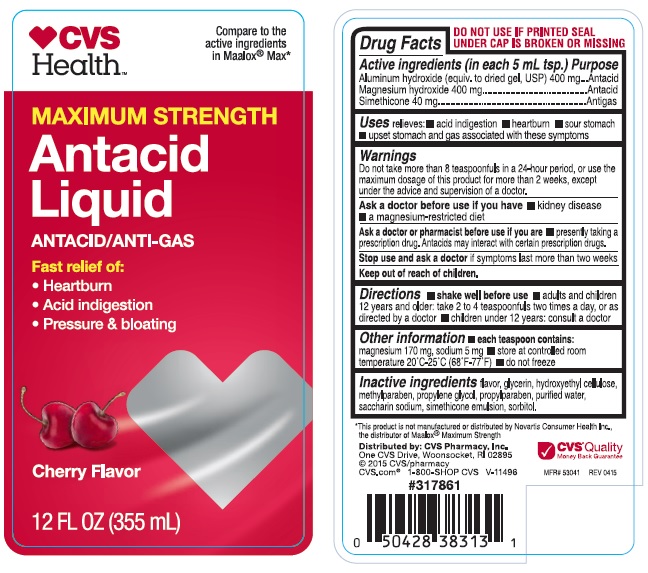
Antacid Aluminum Hydroxide, Magnesium Hydroxide and Simethicone 400 mg/5mL; 400 mg/5mL; 40 mg/5mL Suspension, 355 mL — NDC 69842-508-05 (Billing 69842-0508-05)
This is a package of 355 mL of Antacid Aluminum Hydroxide, Magnesium Hydroxide and Simethicone 400 mg/5mL; 400 mg/5mL; 40 mg/5mL Suspension from CVS, marketed since Mar 2011 and currently FDA-listed. It is this product's only package size.
Identity & classification
Regulatory identifiers FDA, NLM and CMS codes for this package
- RxCUI (RxNorm): 237870
Where does this data come from?
- FDA openFDA NDC Directory · synced Oct 1, 2026
- FDA label on DailyMed · label index refreshed Oct 1, 2026
- RxNorm (NLM RxNav) · catalog refreshed Oct 1, 2026
- Medi-Span GPI (licensed)
- First Databank (licensed) · refreshed Oct 1, 2026
RxNorm drug class
This medicine belongs to the Aluminium compounds class.
Where does this data come from?
- RxClass (NLM) · catalog refreshed Oct 1, 2026
Clinical
Aluminum Hydroxide, Magnesium Hydroxide are antacids used together to relieve heartburn, acid indigestion, and upset stomach. They may be used to treat these symptoms in patients with peptic ulcer, gastritis, esophagitis, hiatal hernia, or too much acid in the stomach (gastric hyperacidity). They combine with stomach acid and neutralize it. Aluminum Hydroxide, Magnesium Hydroxide are available without a prescription. This medication is sometimes prescribed for other uses; ask your doctor or pharmacist for more information.
Read the full MedlinePlus article ↗This is an oral suspension antacid product sold over the counter under FDA's OTC monograph rules. It contains aluminum hydroxide and magnesium hydroxide, which are bases that typically work to neutralize stomach acid and provide temporary relief of heartburn and indigestion. Simethicone (dimethicone) is an anti-gas ingredient commonly included to help reduce bloating and gas discomfort that may accompany acid reflux.
Patient education
Supplement & herbal interactions
Where does this data come from?
- MedlinePlus (NLM) · refreshed Oct 1, 2026
- FDA label on DailyMed · label index refreshed Oct 1, 2026
Ask a licensed pharmacist directly — free, answered by our team.
Pricing
A drug doesn't have one price. Each row is a different public payment system, and none is what you'd pay at the counter — that depends on your insurance. The ⓘ on each row explains what it measures.
| Price system | Per mL | Per package |
|---|---|---|
| Retail pharmacies payNADAC · weekly | Not in the retail survey — common for institutional, discontinued, or low-volume packs. | |
| Medicaid paysCMS SDUD · 12 mo | No recent Medicaid claims on file for this NDC — rare and low-volume NDCs are suppressed in the public data. | |
| Medicare drug plans payPart D · quarterly | No Part D plan price is available for this NDC in our data. | |
Where does this data come from?
- CMS NADAC weekly file
- CMS ASP pricing files · refreshed Sep 20, 2026
- CMS Medicaid State Drug Utilization Data · refreshed Oct 3, 2026
- CMS Part D plan pricing files · refreshed Sep 24, 2026
- VA National Acquisition Center price file
Packaging — all sizes for this product
| Package NDC | Description | Marketing start | Marketing end | Status |
|---|---|---|---|---|
| 69842-0508-05 You're viewing this Main listing | 355 mL in 1 BOTTLE | 2011-03-09 | — | Active |
Therapeutic equivalents
Where does this data come from?
- FDA openFDA NDC Directory · synced Oct 1, 2026
- FDA Orange Book · refreshed Sep 3, 2026
- CMS NADAC weekly file
Availability & generic status
We did not find an FDA-approved generic match for this exact strength, form and route.
Where does this data come from?
- FDA Orange Book · refreshed Sep 3, 2026
What it looks like
Where does this data come from?
- FDA label on DailyMed · label index refreshed Oct 1, 2026
Inactive Ingredients / Excipients
Inactive ingredients, also called excipients, are components of the drug product other than the active ingredient. They may include fillers, dyes, coatings, preservatives, flavors, or other formulation ingredients.
💡 Tap an ingredient (hover on desktop) to see what it is and why it’s used.
-
UNII PDC6A3C0OX
Glycerin is a clear, thick liquid derived from plant oils or fats. It acts as a humectant to retain moisture, a sweetener, and a solvent in medications.
-
UNII R33S7TK2EP
Hydroxyethyl cellulose is a thickening agent made from processed plant cellulose. It's used in medicines to increase viscosity, improve texture, and help distribute active ingredients evenly throughout liquid or semi-solid formulations.
-
UNII A2I8C7HI9T
Methylparaben is a preservative derived from benzoic acid that prevents growth of bacteria, fungi, and mold in medicines. It extends the product's shelf life and maintains safety during storage.
-
UNII Z8IX2SC1OH
Propylparaben is a chemical preservative used to prevent bacterial and fungal growth in medicines and personal care products. It helps extend shelf life and maintain product safety during storage.
-
UNII SB8ZUX40TY
Saccharin sodium is an artificial sweetener made from saccharin salt. It's added to medicines to improve taste, especially in liquid formulations for children or bitter drugs.
-
UNII 506T60A25R
Sorbitol is a natural sugar alcohol derived from glucose. It serves as a sweetener, humectant, and bulking agent in medications to improve taste and help maintain moisture in the product.
-
UNII 059QF0KO0R
Water is a liquid solvent that dissolves and mixes ingredients together in liquid medicines, syrups, and injections. It helps distribute the active drug evenly throughout the product.
7 inactive ingredients listed in the exact product block matched to this NDC.
Label-section wording can be broader than the structured product block and may mention additional formulation ingredients.
Where does this data come from?
ingredient classCode="IACT" elements from the exact product block matched by this NDC. Label-section narrative from DailyMed / the openFDA label index is shown separately when available.- FDA label on DailyMed · label index refreshed Oct 1, 2026
- FDA openFDA NDC Directory · synced Oct 1, 2026
Inactive ingredient FAQ
Are inactive ingredients the same for every manufacturer?
Why might an inactive ingredient be missing?
Can inactive ingredients matter?
Manufacturer & labeler
Where does this data come from?
- FDA openFDA NDC Directory · synced Oct 1, 2026
- Drugs@FDA
FDA label — Drug Facts FDA SPL
🎯 Indications and Usage ▾
Uses relieves: acid indigestion heartburn sour stomach upset stomach and gas associated with these symptoms
⏱️ Dosage and Administration ▾
Directions shake well before use. adults and children 12 years and older: take 2 to 4 teaspoonfuls two times a day, or as directed by a doctor children under 12 years: consult a doctor
⚠️ Warnings ▾
Warnings Do not take more than 8 teaspoonfuls in a 24-hour period, or use the maximum dosage of this product for more than 2 weeks, except under the advice and supervision of a doctor. Ask a doctor before use if you have kidney disease a magnesium-restricted diet Ask a doctor or pharmacist before use if you are presently taking a prescription drug. Antacids may interact with certain prescription drugs.
Stop use and ask a doctor if symptoms last more than two weeks Keep out of reach of children.
📦 Storage and Handling ▾
Other information each teaspoon contains: magnesium 170 mg, sodium 5 mg store at controlled room temperature 20 o C-25 o C (68 o F-77 o F) do not freeze
🧪 Active Ingredient ▾
Active ingredient (in each 5mL tsp.) Aluminum hydroxide (equvi. to dried gel, USP) 400 mg Magnesium hydroxide 400 mg Simethicone 40 mg
🧪 Inactive Ingredients ▾
Inactive ingredients flavor, glycerin, hydroxyethylcellulose, methylparaben, propylene glycol, purified water, saccharin sodium, simethicone emulsion, sorbitol
🎯 Purpose ▾
Purpose Antacid Antacid Antigas
📄 Ask a Doctor Before Use If ▾
Ask a doctor before use if you have kidney disease a magnesium-restricted diet Ask a doctor or pharmacist before use if you are presently taking a prescription drug. Antacids may interact with certain prescription drugs. Stop use and ask a doctor if symptoms last more than two weeks Keep out of reach of children.
📄 Ask a Doctor or Pharmacist Before Use If ▾
Ask a doctor or pharmacist before use if you are presently taking a prescription drug. Antacids may interact with certain prescription drugs. Stop use and ask a doctor if symptoms last more than two weeks Keep out of reach of children.
📄 Stop Use and Ask a Doctor If ▾
Stop use and ask a doctor if symptoms last more than two weeks Keep out of reach of children.
📄 Keep Out of Reach of Children ▾
Keep out of reach of children.
📄 Package Label / Principal Display Panel ▾
PDP Compare to the active ingredients in Maalox max Maximum strength Antacid Liquid Antacid / Anti-gas Fast relief of: Heartburn Acid indigestion Pressure & Bloating Cherry Flavor 12 FL OZ (355 mL) LABEL
About this NDC listing & data coverage
What data is (and isn’t) available for this NDC — tap to expand
| NDC identity (package / product / labeler codes) | ✓ Available |
| Labeler | ✓ Available |
| Product & package description | ✓ Available |
| Marketing category & status | ✓ Available |
| Active ingredient / dosage form / route | ✓ Available |
| FDA label (SPL via DailyMed) | ✓ Available |
| Package photos | ✓ Available |
| Inactive ingredients (structured) | ✓ Available |
| NADAC pharmacy acquisition price (CMS) | — Not published for this NDC CMS publishes NADAC only for NDCs reported in its retail-pharmacy survey. |
| Orange Book / therapeutic-equivalence data | — Not published for this NDC Applies only to products approved under an NDA/ANDA; many listings are out of scope. |
| HCPCS J-code billing crosswalk | — Not published for this NDC Most self-administered / retail products have no J-code — that is normal. |
| Medicaid utilization (CMS SDUD) | — Not published for this NDC CMS reports utilization only for NDCs with Medicaid claims above its privacy threshold. |