
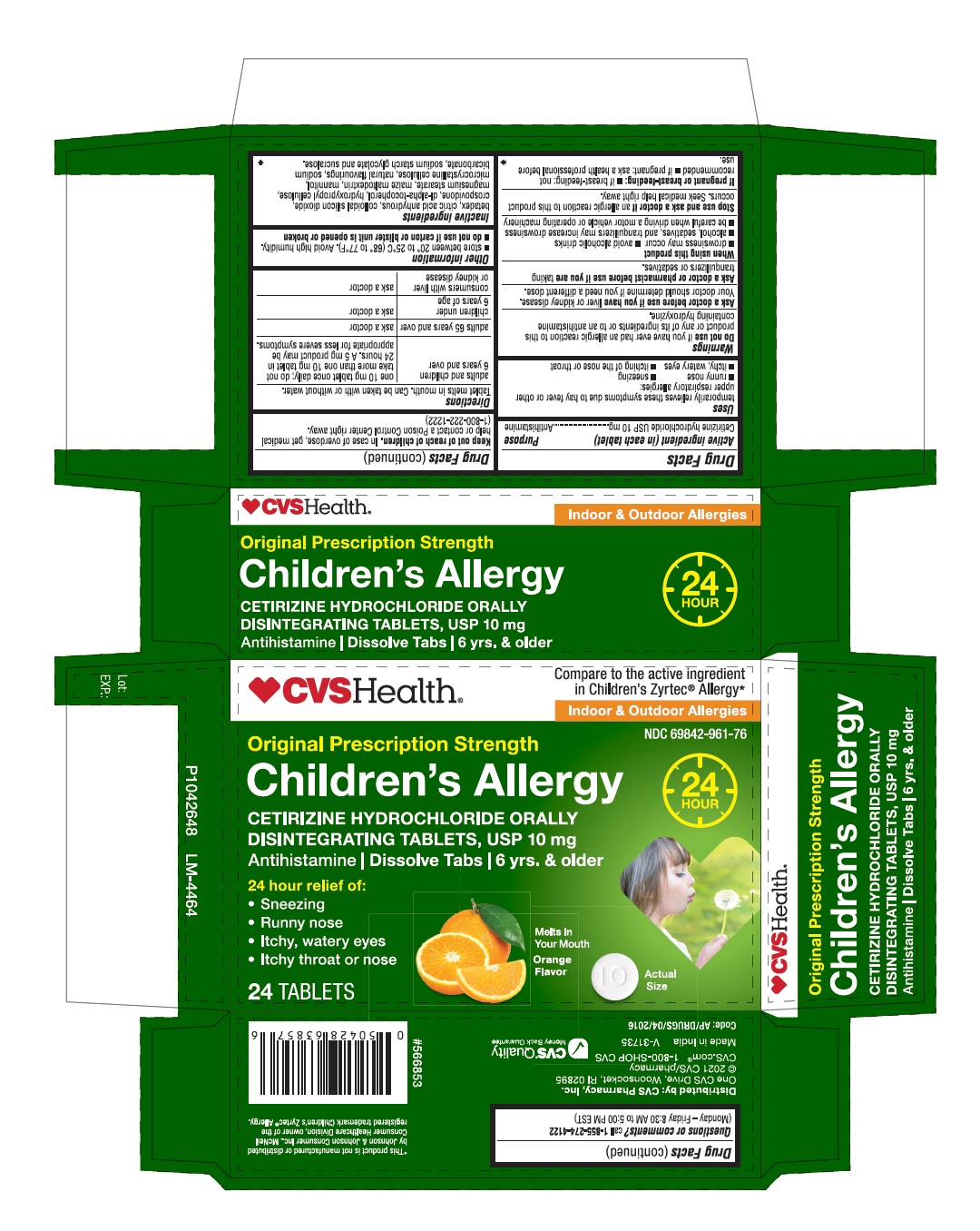
Childrens Cetirizine Hydrochloride 10 mg Tablet, Orally Disintegrating
Other active recalls for Cetirizine Hydrochloride (different manufacturers) — 3 · tap to view
🆔 Identity & classification
Where does this data come from?
🏷️ RxNorm drug class
This medicine belongs to the Histamine-1 Receptor Antagonist class.
Where does this data come from?
🏭 Manufacturer & labeler
Where does this data come from?
🩺 Clinical
Cetirizine is used to treat allergy symptoms: sneezing runny nose itching of the nose or throat red, itchy, or watery eyes Cetirizine is also used to treat urticaria (hives; itchy raised red bumps on skin). Cetirizine is in a class of medications called antihistamines. It works by blocking the action of histamine, a substance in the body that causes allergic symptoms. Cetirizine is also available in combination with pseudoephedrine. This monograph only includes information about the use of cetirizine alone. If you are taking the cetirizine and pseudoephedrine combination product, read th...
Read the full MedlinePlus article ↗- Cetirizine is an antihistamine that helps with allergies and hives. Most oral products — tablets, capsules, solutions — treat classic allergy symptoms like runny nose, sneezing, it...
- It can, yes — drowsiness is the most commonly reported side effect. Cetirizine is considered less sedating than older antihistamines because it doesn't penetrate the brain as readi...
- You can take oral cetirizine with or without food — it doesn't matter much. Food doesn't reduce the total amount absorbed, though it can delay the peak effect by an hour or two. So...
- Can I take cetirizine with food, or does it need to be on an empty stomach?
Patient education
Supplement & herbal interactions
Some supplements/herbs that may interact with Cetirizine Hydrochloride — tap one for details:
Where does this data come from?
Ask a licensed pharmacist directly — free, answered by our team.
💊 What it looks like
Where does this data come from?
🧪 Inactive Ingredients / Excipients
Inactive ingredients, also called excipients, are components of the drug product other than the active ingredient. They may include fillers, dyes, coatings, preservatives, flavors, or other formulation ingredients.
💡 Tap an ingredient (hover on desktop) to see what it is and why it’s used.
-
UNII 7QWA1RIO01
A synthetic form of vitamin E used as an antioxidant in medicines. It prevents oils and fats in the formulation from breaking down, helping the drug remain stable and effective during storage.
-
UNII XF417D3PSL
Anhydrous citric acid is a sour, crystalline powder derived from citric acid with water removed. In medicines, it acts as a buffer to control pH, adds tartness to improve taste, and helps tablets disintegrate.
-
UNII JV039JZZ3A
Betadex is a modified sugar molecule derived from starch. It acts as a solubilizer and stabilizer in medicines, helping dissolve poorly soluble drugs and keep them stable during storage.
-
UNII 40UAA97IT9
Crospovidone is a synthetic polymer derived from povidone. It absorbs liquid quickly and swells, helping tablets and capsules break apart and dissolve faster in your stomach.
-
UNII 5Y0974F5PW
Hydroxypropyl cellulose is a plant-derived thickener and binder made by chemically treating cellulose. In medicines, it helps hold tablets together, thickens liquids, and can form a protective coating on capsules.
-
UNII 70097M6I30
Magnesium stearate is a salt made from magnesium and stearic acid, a fatty substance. It's used in tablets and capsules as a lubricant and glidant to help ingredients flow smoothly during manufacturing and prevent sticking.
-
UNII 7CVR7L4A2D
A starch-derived carbohydrate produced by breaking down corn, potato, or tapioca starch. It functions as a filler and binder to give the medicine bulk and texture, and sometimes as a mild sweetener or texture enhancer in powders and tablets.
-
UNII 3OWL53L36A
A natural sugar alcohol derived from seaweed or synthesized in the lab. It's used as a filler to add bulk, a sweetener in sugar-free formulas, and a disintegrant to help tablets break apart in the stomach.
-
UNII 7T9FYH5QMK
A plant-derived powder that serves as a binder and filler in tablets and capsules. It helps hold ingredients together, adds bulk, and aids in smooth tablet disintegration when swallowed.
-
UNII PNR0YF693Y
A plant-based powder made from purified wood cellulose. It acts as a filler to add bulk, a binder to hold ingredients together, and a disintegrant to help the tablet break apart in the stomach.
-
UNII ETJ7Z6XBU4
Silicon dioxide is a naturally occurring mineral used as a glidant and anti-caking agent. It helps powder ingredients flow smoothly and prevents clumping during manufacturing and storage.
-
UNII 8MDF5V39QO
A white powder form of baking soda that acts as a buffer and pH regulator in medicines. It helps maintain the right acid-base balance and may aid tablet disintegration.
-
UNII 5856J3G2A2
A starch-based powder made from potatoes and processed with sodium. It acts as a disintegrant, helping the tablet or capsule break apart quickly in the stomach so the medicine can be absorbed.
-
UNII 96K6UQ3ZD4
Sucralose is a synthetic sweetener made from sugar. It's added to medicines to improve taste without adding calories, helping make bitter or unpleasant-tasting drugs easier to take.
14 inactive ingredients listed in the exact product block matched to this NDC.
Label-section wording can be broader than the structured product block and may mention additional formulation ingredients.
Where does this data come from?
ingredient classCode="IACT" elements from the exact product block matched by this NDC. Label-section narrative from DailyMed / the openFDA label index is shown separately when available.Inactive ingredient FAQ
Are inactive ingredients the same for every manufacturer?
Why might an inactive ingredient be missing?
Can inactive ingredients matter?
💲 Pricing
A drug doesn't have one price. Each row is a different public payment system, and none is what you'd pay at the counter — that depends on your insurance. The ⓘ on each row explains what it measures.
| Price system | Per each | Per package |
|---|---|---|
| Retail pharmacies payNADAC · weekly | Not in the retail survey — common for institutional, discontinued, or low-volume packs. | |
| Medicaid paysCMS SDUD · 12 mo | No recent Medicaid claims on file for this NDC — rare and low-volume NDCs are suppressed in the public data. | |
| Medicare drug plans payPart D · quarterly | No Part D plan price is available for this NDC in our data. | |
Where does this data come from?
🔁 Therapeutic equivalents
| Product | Labeler | Pack | NADAC/unit | TE | Status | Price vs. this |
|---|---|---|---|---|---|---|
| Cetirizine Hydrochloride 10 mg 00363-0471-76 | WALGREEN | 6 tablets | — | — | FDA listed | — |
| Childrens Cetirizine Hydrochloride 10 mg 00363-4025-76 | WALGREEN | 6 tablets | — | — | FDA listed | — |
| Cetirizine Hydrochloride 10 mg 30142-0058-76 | KROGER | 6 tablets | — | — | FDA listed | — |
| Zyrtec Allergy 10 mg 50580-0778-24 | Kenvue | 6 tablets | — | — | FDA listed | — |
| Childrens Zyrtec Allergy 10 mg 50580-0782-01 | Kenvue | 6 tablets | — | — | FDA listed | — |
| Cetirizine Hydrochloride 10 mg 58602-0838-14 | Aurohealth | 6 tablets | — | — | FDA listed | — |
| Childrens Cetirizine Hydrochloride 10 mg 58602-0856-14 | Aurohealth | 6 tablets | — | — | FDA listed | — |
| Cetirizine Hydrochloride 10 mg 58602-0860-76 | Aurohealth | 6 tablets | — | — | FDA listed | — |
| Cetirizine Hydrochloride 10 mg 58602-0862-76 | Aurohealth | 6 tablets | — | — | FDA listed | — |
| Cetirizine Hydrochloride 10 mg 69842-0234-76 | CVS | 6 tablets | — | — | FDA listed | — |
| Childrens Cetirizine Hydrochloride 10 mgthis 69842-0961-76 | CVS | 6 tablets | — | — | FDA listed | — |
| Cetirizine Hydrochloride 10 mg 76162-0009-76 | TOPCO | 6 tablets | — | — | FDA listed | — |
| Childrens Cetirizine Hydrochloride 10 mg 79903-0406-10 | WALMART | 6 tablets | — | — | FDA listed | — |
Where does this data come from?
⏳ Availability & generic status
This product is an FDA-approved generic. Other versions of the same drug are listed under Therapeutic equivalents, least expensive first.
Where does this data come from?
🔬 Reported adverse events (FAERS)
Top reported reactions
Age at onset
Reporter sex
Serious outcomes
Where does this data come from?
📦 Packaging — all sizes for this product
| Package NDC | Description | Marketing start | Status |
|---|---|---|---|
| 69842-0961-76 You're viewing this | 4 BLISTER PACK in 1 CARTON (69842-961-76) / 6 TABLET, ORALLY DISINTEGRATING in 1 BLISTER PACK | 2021-02-01 | Active |
🧭 About this NDC listing & data coverage
What data is (and isn’t) available for this NDC — tap to expand
| NDC identity (package / product / labeler codes) | ✓ Available |
| Labeler | ✓ Available |
| Product & package description | ✓ Available |
| Marketing category & status | ✓ Available |
| Active ingredient / dosage form / route | ✓ Available |
| FDA label (SPL via DailyMed) | ✓ Available |
| Package photos | ✓ Available |
| Inactive ingredients (structured) | ✓ Available |
| NADAC pharmacy acquisition price (CMS) | — Not published for this NDC CMS publishes NADAC only for NDCs reported in its retail-pharmacy survey. |
| Orange Book / therapeutic-equivalence data | — Not published for this NDC Applies only to products approved under an NDA/ANDA; many listings are out of scope. |
| HCPCS J-code billing crosswalk | — Not published for this NDC Most self-administered / retail products have no J-code — that is normal. |
| Medicaid utilization (CMS SDUD) | — Not published for this NDC CMS reports utilization only for NDCs with Medicaid claims above its privacy threshold. |
Questions about this listing
Why is there no price listed?
Is the NDC printed on the package the same as the 11-digit billing NDC?
What do the three segments of this NDC mean?
Is this package still being marketed?
Who lists this product with the FDA?
Do I need a prescription for this product?
Where does this data come from?
📄 FDA label — Drug Facts FDA SPL
🎯 Indications and Usage ▾
Uses temporarily relieves these symptoms due to hay fever or other upper respiratory allergies: runny nose sneezing itchy, watery eyes itching of the nose or throat
⏱️ Dosage and Administration ▾
Directions Tablet melts in mouth. Can be taken with or without water. adults and children 6 years and over one 10 mg tablet once daily; do not take more than one 10 mg tablet in 24 hours. A 5 mg product may be appropriate for less severe symptoms. adults 65 years and over ask a doctor children under 6 years of age ask a doctor consumers with liver or kidney disease ask a doctor
⚠️ Warnings ▾
Warnings
📦 Storage and Handling ▾
Other information store between 20° to 25°C (68° to 77°F). Avoid high humidity. do not use if blister unit is torn or broken
🧪 Active Ingredient ▾
Drug Facts Active ingredient (in each tablet) Cetirizine hydrochloride USP 10 mg
🧪 Inactive Ingredients ▾
Inactive ingredients betadex, citric acid anhydrous, colloidal silicon dioxide, crospovidone, dl-alpha-tocopherol, hydroxypropyl cellulose, magnesium stearate, maize maltodextrin, mannitol, microcrystalline cellulose, natural flavourings, sodium bicarbonate, sodium starch glycolate and sucralose. Questions or comments? call 1-855-274-4122 (Monday - Friday 8:30 AM to 5:00 PM EST) Distributed by: CVS Pharmacy, Inc. One CVS Drive, Woonsocket, RI 02895 © 2026 CVS/pharmacy CVS.com ® 1-800-SHOP CVS Made in India
🎯 Purpose ▾
Purpose Antihistamine